


66,99 €
Mehr erfahren.
- Herausgeber: John Wiley & Sons
- Kategorie: Wissenschaft und neue Technologien
- Sprache: Englisch
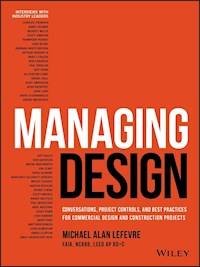
Offers state-of-the-art principles and strategies gleaned from high-profile projects to help readers manage design This guide to managing design process within the commercial design and construction industry addresses a growing pain point in an industry where collaborative approaches to project delivery are outpacing the way professionals work. It synthesizes issues by investigating the "why," "how," and "who" of the discipline of managing design, and gives the "what" and "when" to apply the solutions given various project delivery and contracting methods. The book features candid interviews with over 40 industry leaders--architects, engineers, contractors, owners, educators, technology evangelists, and authors--which present a broad look at current issues and offer paths to future collaboration and change. Managing Design: Conversations, Project Controls and Best Practices for Commercial Design and Construction Projects is a self-help book for design and construction that provides aninsider's look at the mysteries of managing design for yourself, team, firm and future. It tackles client empathy; firm culture; owner leadership; design and budgets; dealing with engineers, consultants, and contractors; contracts; team assembly; and much more. * Features eye-opening interviews with 40 industry luminaries * Exposes issues and poses solutions to longstanding industry ills * Offers a project design controls framework and toolset for immediate application and action * Includes best practice tips, process diagrams, and comparative analytical tables to support the text Written in a relatable style, Managing Design: Conversations, Project Controls and Best Practices for Commercial Design and Construction Projects is a welcome resource for owners, contractors, and designers in search of better ways to work together. "Managing Design blends practical advice from the author's five decades in architecture and construction with wisdom from more than three dozen luminaries in the design, delivery, ownership and operation of the built environment. The result is an extraordinary guide to integrating practice across disciplines." --Bob Fisher, Editor-In-Chief, Design Intelligence "Managing Design peers into the soul of a contentious industry as it grapples with change--a deep dive into the design and construction process in the words of those doing the work. I enjoyed the engineers and contractors' pleas to be made parties to design process early on. The questions--as interesting as the answers--are both here in this book." --Richard Korman, Deputy Editor, Engineering News Record "Managing Design hits many of the design and construction industry's ills head-on with insightful interviews by new and established leaders and real-world tactics on creating better teams, better communications between players, and--most vitally--better project results." --Rebecca W. E. Edmunds, AIA, Editor, Author and President, r4 llc
Sie lesen das E-Book in den Legimi-Apps auf:
Seitenzahl: 842
Veröffentlichungsjahr: 2019
Ähnliche




















Table of Contents
Cover
Preface
It's Time
Foreword
The Question
Managing Design Is Different from Managing Construction
So How Do You Manage Design?
Design Isn't What It Used to Be
Why a Book of Conversations?
Why Now?
One Well-Connected Author
The Never Futile and Always Sisyphean Task of Managing Design
Will Reading These Conversations and Ideas Help Us Work Together?
Introduction
Premise
Mission
Methods
Issues
Context
Themes
Movement
Notes
PART 1: PERSPECTIVES
CHAPTER 1: The Interviews
Thought Leaders: Current Realities and Future States
Topics
Chapter 2 Client Empathy: Listening, Collaboration, and Expertise
Chapter 3 Owner Leadership: Programs, Users, and Talking
Chapter 4 Building Learning Organizations: Knowledge, and Research
Chapter 5 Firm Culture: Management and Attitudes
Chapter 6 Strategy: Early Questions, Planning Horizons, and Socialization
Chapter 7 Process: Lean Scheduling – Agile and Efficient
Chapter 8 Collaborators: Performative Design (Better Together)
Chapter 9 Design and Budgets: Architect/Contractor Collaboration and Trust
Chapter 10 Strategy: Early Questions, Planning Horizons, and Socialization
Chapter 11 Engineers and the Consultant's Mindset: Leading From Behind
Chapter 12 Contractors: Risk and Design Assist Expertise
Chapter 13 Technology: Leveraging Data
Chapter 14 Entrepreneurship: Vertical Integration and Value Propositions
Chapter 15 Change Agents: Advocacy, Equity, and Sustainability
CHAPTER 2: Client Empathy: Listening, Collaboration, and Expertise
Client Intimacy and the Creative Continuum or “Snow Cards, Squatter Sessions, and Goody-Goody Talk”
Specialization and Generalization or “Orchestrating the Post and Beam Crowd”
Note
CHAPTER 3: Owner Leadership: Programs, Users, and Talking
Collaboration and Communication or “Teaching Masochists”
Programs versus Projects or “Savvy Owners”
Paying Utility Bills, Fixing Leaks, and Dictating Design, or “How to Get Less”
CHAPTER 4: Building Learning Organizations: Knowledge and Research
Building Design Futures: Courage For The Future Or “Moving The Laggards”
Knowledge Management, Design Culture, Research and Credibility, or “Going It on Your Own”
Integrated Education and the Role of the Academy or “Wearing Three Hats”
Note
CHAPTER 5: Firm Culture: Management and Attitudes
An Integrated Approach: Avoiding Voluntary Misfortune or “Doomed to Be Successful”
The Regional Model or “Sittin' Around the Table”
AIA Reflections or “Breaking Boundaries”
The Known Unknown: Keys to Change Readiness or “Weeding and Nurturing”
CHAPTER 6: Strategy: Early Questions, Planning Horizons, and Socialization
Post-Pasture Value Propositions or “Three Horizons?”
Strategic Business Planning or “Asking the Right Questions”
Team Building and Project Planning or “Last Exit”
Note
CHAPTER 7: Process: Lean Scheduling – Agile and Efficient
Standardized Methods or “Leaning in, Softly”
Self-Determined Lean Work Planning
and Career Paths
or “Playing Cards”
Notes
CHAPTER 8: Collaborators: Performative Design (Better Together)
On Collaboration or “We're Better Together”
Sharing Expertise, Trust, and Owner Engagement or “Assume This”
Performative Design or “Welcome to the Machine Age”
Note
CHAPTER 9: Design and Budgets: Architect/Contractor Collaboration and Trust
Pressing Schedules or “Are We Done Yet?”
Meeting Budgets
or “How to Work with Contractors”
CHAPTER 10: Art and Architecture: Design Leadership and Conviction
Cultural Understanding, Design Tools and Ideas or “We're Still in Charge”
Art and Beauty, Architecture and Building, or “Instinct, Innovation, and Respect: Managing Ourselves”
CHAPTER 11: Engineers and The Consultant's Mindset: Leading From Behind
Aligning Objectives and Optimizing Systems or “Catalog Engineering”
Managing at the Point of Attack: Anticipating Outcomes
or “The Waiter and the Old Man and the Sea”
CHAPTER 12: Contractors: Risk and Design Assist Expertise
Trade Contractor Expertise or, “My Friend the Architect”
Planning and Trade Contractor
Design-Assist Mindsets or “We Need You Onsite Tomorrow”
“Eyes-Wide-Open” Leadership and Design Ownership
or “Stretching the Market
: The Chain”
Contracts, Collaboration, Construction, and “Chasing Design”
' or “Fear the Unknown”
Notes
CHAPTER 13: Technology: Leveraging Data
Mining the Data, Counting Your Blessings, and Seeing Clearly or “Life Is Just a Game”
Manufacturers, Knowledge and Building Relationships or “Can the Internet Buy You Lunch?”
Reusing Data or “The Technology Problem”
CHAPTER 14: Entrepreneurship: Vertical Integration and Value Propositions
Rethinking Relationships, Delivering Value or “Giving Them the Business”
Integrating Vertically
, Changing the Market
or “We Do Different Things”
Notes
CHAPTER 15: Change Agents: Advocacy, Equity, and Sustainability
Sustainable Practice: Tools and Data, Proof
& Persuasion or “Doing Right, Good and Well”
The Advocate
or “To Be Continued”
PART 2: PROJECT DESIGN CONTROLS: A FRAMEWORK FOR BALANCE, CHANGE, AND ACTION
CHAPTER 16: Project Design Controls: A Framework for Balance, Change, and Action
Origins: Looking, Seeing, Borrowing, and Common Sense
Navigation and Adoption: Internalization and Sharing
Toolmaking: What Gets Measured Gets Done
Boundaries, Limits, and Constraints: Enemies or Friends?
The Litmus Test: Project Design Controls
Notes
CHAPTER 17: Level 0: Subsurface (Contractual/Forming)
Project Design Controls
Supporting Collaboration
Other Resources
Note
CHAPTER 18: Level 1: Foundation (Planning/Organizing)
Goals and Objectives
Roles and Responsibilities
Communication Protocols
BIM/VDC/Digital Infrastructure
Programming and Research
Project Analysis Kickoff Meeting
Project Definition Package (PDP)
Notes
CHAPTER 19: Level 2: Structure (Measuring/Baseline)
Tangible, Measurable Project Design Controls: The “Structural” Baseline
Notes
CHAPTER 20: Level 3: Systems (Relating/Collaboration)
Owner, Architect, Contractor: The Team
Notes
CHAPTER 21: Level 4: Enclosure (Leading/Strategic)
Change
Options and Value Analysis
Decision Support: Issue Tracking and Completion
Consultant Coordination
CHAPTER 22: Context: Supply Network, Market Forces, Emerging Technology
Supply Network
Market Forces
Emerging Technologies
Other Considerations
Note
CHAPTER 23: Understanding and Using the Framework
Order and Logic: “Visual Onomatopoeia”
Processes: Repeatable, Shared, One Off?
Causes and Effects, Actions and Reactions
When Does Design Management Happen?
Problems (and Solutions)
How to Know
How to Coach
Self-Evaluation Quiz: Managing Design Litmus Test
Note
CHAPTER 24: Case Studies
CHAPTER 25: Actions
What Works
In Search of [Design] Excellence: [Designed and] Built to Last
Forty Questions
My Take
Where to Focus: Drivers
It's Up to You
The Ideal Project
Take Action
The Team
A Final Request
Notes
Epilogue
Future Vision
Prognostications and Advice
Organizational Systems Thinking: The 7-S+1 Model
Reach and Closure: Design Futures Council Summit on the Future of Architecture, 2018
Continuing
Constants and Encouragement
Answers
Notes
Acknowledgments
About the Author
Bibliography
Photo Credits
Interview Photos
Illustrations
Figures
Tables
Index
End User License Agreement
List of Tables
Introduction
TABLE 1 Design Conditions and Contexts
TABLE 2 Team (OAC Relationship)
TABLE 3 Design Drivers and Influences
TABLE 4 Design Disciplines and Consultants
Chapter 17
TABLE 17.1 Relative Facility Life Cycle Cost
TABLE 17.2 Project Delivery Methods: Design Management Advantages
Chapter 18
TABLE 18.1 Responsibility Matrix
Chapter 19
TABLE 19.1 Building Program Requirements Evolution
TABLE 19.2 Design Schedule Evolution
TABLE 19.3 Normalized Data
TABLE 19.4 Documents Planning and Creation
TABLE 19.5 Documents Management and Production
TABLE 19.6 Documents Review
List of Illustrations
Preface
FIGURE 0.1 This Is My Dad Going to Work, drawing courtesy Danielle LeFevre.
Foreword
FIGURE 0.2 Design versus Construction Process, Chuck Thomsen.
Chapter 12
FIGURE 12.1 7-S +1 diagram, M. LeFevre after Peters, Waterman,...
Chapter 16
FIGURE 16.1 Using target value limits.
FIGURE 16.2 Project Design Controls framework, including Level 0.
Chapter 17
FIGURE 17.1 Level 0: “Subsurface” (Contractual/Forming).
FIGURE 17.2 Project Delivery Timelines and Project Design Control Timing.
Chapter 18
FIGURE 18.1 Level 1: “Foundation” (Planning/Organizing).
FIGURE 18.2 Project analysis.
Chapter 19
FIGURE 19.1 Level 2: “Structure” (Measuring/Baseline).
FIGURE 19.2 Collect | Analyze | Synthesize.
FIGURE 19.3 Individual | Group.
FIGURE 19.4 Diverge | Converge.
Chapter 20
FIGURE 20.1 Level 3: “Systems” (Relating/Collaborating).
FIGURE 20.2 Alignment.
Chapter 21
FIGURE 21.1 Level 4: “Enclosure” (Leading/Strategic).
Chapter 22
FIGURE 22.1 Project Design Controls framework, with “context”
Chapter 23
FIGURE 23.1 “The Science of Muddling Through,” after T. Sargent and C. Lindblom.
Chapter 24
FIGURE CS1.1 Georgia Tech Manufacturing Research Center:
Progressive
...
FIGURE CS1.2 Georgia Tech MARC: brick detail; author sketch.
FIGURE CS1.3 Georgia Tech MARC: physical model.
FIGURE CS1.4 Georgia Tech MARC: atrium; photo: Jonathan Hillyer.
FIGURE CS1.5 Georgia Tech MARC: drawing, “Things That Move.”
FIGURE CS1.6 Georgia Tech MARC: entry detail.
FIGURE CS1.7 Georgia Tech MARC: entry bridge.
FIGURE CS1.8 Georgia Tech MARC: entry bridge; photo: Jonathan Hillyer.
FIGURE CS1.9 Georgia Tech MARC: digital model; Courtesy Lord, Aeck...
FIGURE CS1.10 Georgia Tech MARC: reflected ceiling; Courtesy Lord,...
FIGURE CS1.11 Georgia Tech MARC: gear ceiling; photo: Jonathan Hillyer.
FIGURE CS1.12 Georgia Tech MARC: Progressive Architecture Citation.
FIGURE CS2.1 Zoo Arc, Lord, Aeck & Sargent, Architects; photo: Jo...
FIGURE CS3.1 Flint RiverQuarium, Albany, Georgia, Antoine Predock Arc...
FIGURE CS3.2 Flint RiverQuarium: value analysis concept sketch.
FIGURE CS4.1 ASU Hayden Library; image courtesy Eric Zobrist, Ayers Saint Gross.
FIGURE CS5.1 Emory CLC, image courtesy Duda|Paine Architects, rendering by...
Guide
Cover
Table of Contents
Begin Reading
Pages
i
v
vi
xiii
xv
xvii
xviii
xix
xx
xxi
xxiii
xxiv
xxv
xxvi
xxvii
xxviii
xxix
xxx
xxxi
xxxii
xxxiii
xxxiv
xxxv
xxxvi
xxxvii
xxxviii
xxxix
xl
xli
xlii
xliii
xliv
xlv
xlvi
xlvii
xlviii
1
3
4
5
6
7
9
10
11
12
13
14
15
16
17
19
20
21
22
23
24
25
26
27
28
29
30
31
32
33
34
35
36
37
38
39
40
41
42
43
44
45
46
47
48
49
50
51
52
53
54
55
56
57
58
59
60
61
62
63
64
65
66
67
68
69
71
72
73
74
75
76
77
78
79
80
81
82
83
84
85
86
87
88
89
91
92
93
94
95
96
97
98
99
101
102
103
104
105
106
107
108
109
110
111
112
113
114
115
117
118
119
120
121
122
123
124
125
126
127
129
130
131
132
133
134
135
136
137
138
139
140
141
142
143
144
145
146
147
148
149
150
151
152
153
154
155
156
157
158
159
160
161
162
163
164
165
166
167
168
169
170
171
172
173
174
175
176
177
178
179
180
181
182
183
184
185
186
187
188
189
191
192
193
194
195
196
197
198
199
200
201
202
203
204
205
206
207
208
209
211
213
214
215
216
217
218
219
220
221
222
223
224
225
226
227
229
230
231
232
233
234
235
236
237
238
239
241
242
243
244
245
246
247
248
249
250
251
252
253
254
255
256
257
258
259
260
261
262
263
264
265
266
267
268
269
271
272
273
274
275
276
277
279
280
281
282
283
284
285
286
287
288
289
290
291
292
293
294
295
296
297
299
300
301
302
303
304
305
306
307
308
309
310
311
312
313
314
315
316
317
319
320
321
322
323
324
325
326
327
328
329
330
331
333
334
335
336
337
338
339
340
341
342
343
344
345
347
348
349
350
351
352
353
355
356
357
358
359
360
361
362
363
“From the beginning the designer's task has been to go from Infinity-to-One; artfully sifting alternatives to define an optimum solution. This book explores how this idealized process fits into today's complex, digitally-powered practices. Relatable to anyone who touches design process, its guidance is both profound and confounding.”
– Stephen Jones, Senior Director, Industry Insights Research, Dodge Data & Analytics
“A timely, terrific collection. LeFevre's project management tips are compelling; his interviews are a delight, chock full of industry wisdom.”
– Jeffrey Donnell, Frank Webb Chair of Professional Communications, George W. Woodruff School of Mechanical Engineering, Georgia institute of Technology
“LeFevre's methodical dissection of the art of design belies his deep, intuitive comprehension of the subject. Having spent his career immersed in the field he surfaces to share his boundary-crossing perspective and love of the process with members of his tribe – and others.”
– Thomas J. Powers, Author
Managing Design
Conversations, Project Controls and Best Practices for Commercial Design and Construction Projects
Michael Alan LeFevre
This edition first published 2019© 2019 John Wiley & Sons
All rights reserved. No part of this publication may be reproduced, stored in a retrieval system, or transmitted, in any form or by any means, electronic, mechanical, photocopying, recording or otherwise, except as permitted by law. Advice on how to obtain permission to reuse material from this title is available at http://www.wiley.com/go/permissions.
The right of Michael LeFevre to be identified as the author of this work has been asserted in accordance with law.
Registered OfficeJohn Wiley & Sons, Inc., 111 River Street, Hoboken, NJ 07030, USA
Editorial Office111 River Street, Hoboken, NJ 07030, USA
For details of our global editorial offices, customer services, and more information about Wiley products visit us at www.wiley.com.
Wiley also publishes its books in a variety of electronic formats and by print-on-demand. Some content that appears in standard print versions of this book may not be available in other formats.
Limit of Liability/Disclaimer of WarrantyWhile the publisher and authors have used their best efforts in preparing this work, they make no representations or warranties with respect to the accuracy or completeness of the contents of this work and specifically disclaim all warranties, including without limitation any implied warranties of merchantability or fitness for a particular purpose. No warranty may be created or extended by sales representatives, written sales materials or promotional statements for this work. The fact that an organization, website, or product is referred to in this work as a citation and/or potential source of further information does not mean that the publisher and authors endorse the information or services the organization, website, or product may provide or recommendations it may make. This work is sold with the understanding that the publisher is not engaged in rendering professional services. The advice and strategies contained herein may not be suitable for your situation. You should consult with a specialist where appropriate. Further, readers should be aware that websites listed in this work may have changed or disappeared between when this work was written and when it is read. Neither the publisher nor authors shall be liable for any loss of profit or any other commercial damages, including but not limited to special, incidental, consequential, or other damages.
Library of Congress Cataloging-in-Publication Data is Available:
ISBN 9781119561767 (Hardback)ISBN 9781119562009 (ePDF)ISBN 9781119561972 (ePub)
Cover design: Wiley
Preface
It's Time
Managing design is an oxymoron but can be done – by those who want to and know how. This is a book for readers who seek to fulfill those conditions – one that explores the hearts and souls, minds and processes of design and construction collaborators. What core issues create this conundrum? Why is it so hard for designers to grapple with the constructs of budget and schedule control? How can team members understand one another better to mutually intensify the value of their teamwork? These decades-old questions have resurfaced with the convergence of pressures such as more participants, growing complexity, and hyper-track schedules.
In the thirty years since Chuck Thomsen's Managing Brainpower books were published, we've seen significant change in the design and construction industry. In the span of these decades, technological change such as the advent of CADD and BIM, and new contracting approaches like Integrated Project Delivery (IPD), have had dramatic impacts on design practice and the ways projects are delivered. Who could have imagined virtual meetings, Web-based access, remote computing, and the schedule compression and new collaboration forms we've witnessed? In the last few years, Randy Deutsch has addressed this change and looked to the future of practice. In the foreword I've asked both to link past to present to frame current industry challenges.
What challenges are inherent in managing design? To begin with, centuries-old cultural norms – the very belief systems of the design and construction professions – cling to individual prowess and ego as primary values. A predominant white, male culture lingers. The number of players on project teams is ever increasing, as is the complexity of designing and building, and doing it sustainably. Uncertainty in global sociopolitical and economic arenas compounds tight schedules and budgets. For the past few decades, an industry typically slow to change has been forced to evolve and assimilate automation at record speeds with dizzying results. Finally, economic downturns and recessions have impacted the profession's talent pool. If change is in the wind, a new understanding of these forces, those who use them, and their minds and processes is needed.
This book is an “exposé.” It exposes issues and poses solutions to longstanding industry ills. The design-construction landscape is shifting in response to “chaos theory” intervening events – forces that threaten our stability. As we redesign ourselves to adapt, talk and action are needed. In this book, I give you something you can't get anywhere else: an insider's look at the mysteries of managing design for yourself, team, firm, and future, a self-help book for design and construction.
Managing Design is written to help you find your place in today's design management continuum. What you do when you find that place, and how you advance it for future projects and generations, is up to you.
Michael Alan LeFevre
This book is for all who have faced the challenge of trying to take a circular, messy, seemingly random, creative process and force it into a neat, linear, objective process with deadlines.
FIGURE 0.1 This Is My Dad Going to Work, drawing courtesy Danielle LeFevre.
Foreword
Charles Thomsen
FAIA, FCMAA, PASTCHAIRMAN 3D/I, AUTHOR, MANAGING BRAINPOWER, 1989
The Question
The question Michael poses so eloquently is: Can design be managed? If so, how?
I know of no more important issue in the construction industry. Design shapes our environment, the quality of our buildings, and the productivity of construction – the nation's second largest industry, and the world's largest. In the 20th century, the number of subcontractors on projects went from very few to a great many. Less work was done in the field. Since project teams were populated with companies that hadn't worked together, complexity escalated. Management became as important as craftsmanship and knowing how to put a building together. In response, colleges and universities added construction management curricula. “Construction management” became a profession, a delivery strategy, and a contract form.
Similar changes happened in design. Subconsultants increased. Global organizations replaced local sources. Industrialization offered an infinite number of new products and technologies and buildings became more sophisticated. By the 21st century, most of the knowledge of construction technology and cost resided with subcontractors and manufacturers, not architects and engineers. Designers changed from being experts in construction to understanding complicated user needs, evaluating technology developed by others, and integrating it all. CM, Bridging, Design Assist, and IPD emerged to bring more collaboration to extended project teams that included contractors and subcontractors.
The changes in design and construction are similar in both design and construction organizations. But while the construction industry has developed management tools, little attention has been given to developing tools for managing design – no new curricula in colleges and universities, no new profession. The unwritten assumption is that construction managers will manage project delivery of design and construction. Not a bad idea, but design – so different from construction – requires different management concepts.
Managing Design Is Different from Managing Construction
Construction involves a series of definable tasks in predictable sequences using calculable resources. A construction manager can plan a fixed number of masons, a finite number of days, and a specified number of bricks to build a wall of a given size. It is subject to analysis and modification: if the number of masons is increased, the days can be decreased.
But the ideas and decisions that led to the design of that wall, its material choices, their relation to other building systems, and the cost and the functional and aesthetic requirements weren't governed by a finite plan. While construction of a brick wall is complete when the last brick is in place, there's no objective measure of when a design is “done.” Builders want decisions. Designers want time. An effort to improve has no definable end. Design deadlines, while necessary, become arbitrary. As projects progress, designers understand them better, have epiphanies, discard work, double back, and redesign. Builders, if they want to stay in business, don't do that. In construction, excellence in craftsmanship, schedule, and logistics is clear. In design, functional and aesthetic excellence lack objective yardsticks. Construction demands sequential discipline: place rebar before pouring concrete; build foundations before walls. Not true with design. An architect can think about cabinet details and the site plan on the same day.
FIGURE 0.2 Design versus Construction Process, Chuck Thomsen.
Construction teams focus on a clear goal: build what is specified, efficiently, profitably. Design teams are divided. Some may be production and profit oriented, others interested in aesthetics or functional optimization. Some will be inclined to ask for more time to study the problem in search of a better solution. But “better” may be defined in personal terms and invite disagreement on what that means. A generation of construction managers appeared at the end of the 20th century, educated to train contractors and use tools appropriate for construction. When those same tools don't work with design, CMs feel designers are “flakey” and “unbusinesslike.” Designers mutter about crass contractors who only care about cost and schedule. Stereotyping raises its ugly head. Collaboration suffers.
Construction is resource and production intensive. It deals with materials and defined results. The sequence of work can be mapped and managed. Design is information and decision intensive. One must conceive the processes to acquire information, organize ideas, prioritize issues, and formulate decisions. It's a lot fuzzier than pouring concrete and laying brick. Design deals with ideas and inexplicit issues among diverse people with varied legal relationships. The path and result are difficult to map.
So How Do You Manage Design?
Design shapes our world. Managing it is crucial, yet little guidance exists for how to do it. But do it we must. Projects can't be run like artist colonies. Clients want to know what their projects will look like, what they will cost, and when they'll be done. Design controls the answers to those questions. It must be managed. Michael LeFevre has attacked these questions by interviewing thought leaders. The conversations offer a variety of opinions. Michael's discussions include how to connect with clients, education, and the designer's mentality. These interchanges offer fuel for thought for design and construction teammates in the future. Most important, he discusses the growing expectation that construction managers and trade contractors must help shape designs with constructability, cost, and schedule input. Like the design process he describes, readers—present or future design managers—are presented with an opportunity to digest the data, grasp the ideas, and plot a course. Good luck!
Chuck Thomsen
Randy Deutsch, AIA, LEED AP
AUTHOR, SUPERUSERS: DESIGNTECHNOLOGYSPECIALISTS AND THEFUTURE OFPRACTICE, 2019
Design Isn't What It Used to Be
What we call design continues to evolve at an ever-increasing clip. With data-driven design we design by manipulating data, not form. With generative design we design leveraging algorithms and parametric modeling with predetermined constraints. Design is changing due to the introduction of new computational tools, including algorithms. Soon, AI-enabled design will be informed and improved in pre-design by post-occupancy evaluations that take place before the project is even designed. Design professionals today use visual programming tools to automate and complete work in hours that might otherwise take days. The cloud enables data visualizations to be a real-time product of the design act, something that designers working with their managers used to undertake as a separate activity. No more. Many activities designers do today can be transformed into data, and many design process tasks have been automated.
Indeed, much of design management has been outsourced – not to countries or people, but to software – and will increasingly be in the years ahead. Will design management still be needed as we further redesign design? The answer depends on whom you ask.
Why a Book of Conversations?
In the spirit of MIT professor and author Sherry Turkle, Michael LeFevre does his part in this book to reclaim conversation at a time witnessing the rise of technology and all its negative effects. In this time of technology and machine solutions, people – with their attendant conversation, connecting and collaborating – become more important. We are finally learning that quicker and more convenient communication is not necessarily better communication; where reading interviews – reliving conversations that have already taken place – slows down time, providing the reader with the opportunity to digest and question.
The heart of the book is not a collection of isolated interviews but a series of connected conversations. What kind? Conversations that argue for a larger role for the architect, a larger outlook and understanding of their role in the construction process and industry; conversations on the ambiguities and uncertainties of managing design in an industry ripe for transformation; conversations that, as Michael asserts, take the pulse of the profession, conducted live, in one sitting, recorded and transcribed nearly verbatim. Having participated, I can attest they were indeed intimate, candid, and substantial. Reading this book is like eavesdropping on a stimulating conversation among industry stalwarts at a dinner party.
Why Now?
Today, as we more and more design with the end in mind, design and construction are becoming increasingly indistinguishable. Written at a time of interdisciplinary collaboration when project phases are merging, disciplines blurring, roles blending, and tools converging; when architects are increasingly moving into means and methods, and builders are increasingly providing design services. It's a time when more firms and emerging professionals are exploring vertical integration and entering the entire project pipeline. One can imagine in the not-too-distant-future “design'” no longer as a stand-alone phase, a world where design technologists become just technologists. Does it still make sense to address the management of design as a separate subject? As Philip Bernstein FAIA, whose conversation appears in these pages, has suggested elsewhere, in the near future "there will be a stronger connection between what's designed, built, and how it operates.” And with that stronger connection comes a transformation of design management. But to what, exactly?
One Well-Connected Author
What makes this book unique and worth reading? In two words: Michael LeFevre. Michael is particularly well-qualified to write a cross-industry book on managing design as he has been living it for five decades. His unique perspective, stemming from having practiced as both architect and construction manager – and their connector – offers much.
What also makes this book unique and worth reading is Michael's incomparable network of industry luminaries. I don't know of anyone else in the industry with such a wide network of industry experts, or who else could have written this, a book of conversations that form a foundation for industry change. Only Michael. While this book has but one author, as a collaborative effort it comprises the collective intelligence of many voices. Take Chuck Thomsen. Chuck is an architect, construction manager, corporate executive, and educator. So too is Michael. And now, with this book – like Chuck – he is now also an author. Just as I reached for Chuck Thomsen's Managing Brainpower in 1989 (the original small box set of three books is still here next to me as I write this), if I were starting off in the industry today, I would undoubtedly reach for Michael LeFevre's Managing Design.
The book may be called Managing Design, but the theme is unmistakably that of change. A fount of institutional knowledge himself, Michael conducted interviews with more than 40 industry leaders, each, as Michael says, with a passionate agenda for change. So much has changed in the years that separate the publication of these books. But one thing hasn't: conversation.
These conversations represent multiple voices and points of view from all core project parties – owners, architects, engineers, contractors – as well as the many industry advancers critical to a thorough understanding of managing design. Listening in to these varied perspectives will help you think like others on project teams, making you a more effective communicator and, importantly, an empathetic team member.
By understanding what's important to others, we can more effectively shape our message. Together, what they share offers a valuable look at the state of design and construction management in the U.S. Just as a rising tide lifts all boats, LeFevre talks to industry leaders to elevate the rest of us. Like an architectural Robin Hood, he takes from the experience-rich to reward those hungry for knowledge and hard-won wisdom.
The Never Futile and Always Sisyphean Task of Managing Design
What Michael LeFevre has attempted to accomplish in this book is to capture the current knowledge, thinking, and insights of an industry in a moment of transition, before it is lost. Michael's observations from leading industry change agents and thought leaders led him to, as he puts it, “a series of deeper conversations – to help us understand why our siloed professions persist – and what we can do about it.” The book does not merely bemoan the many familiar inefficiencies, obstacles, and challenges to project success; it poses solutions: insights, strategies, and propositions that readers can “test the wheels of” and apply to their own organizations and practices.
Architects may be comfortable with ambiguity. Many others aren't. Owners want certainty – in a project there's too much risk, too much unknown at stake. Managing the design process takes a design from a state of uncertainty and ambiguity to one of certainty and clarity – something every owner wants and can appreciate. Similarly, through a litany of new tech tools and collaborative workflows, we can move from a complex, time-intensive design to one that is instantaneous and simple.
Recent research shows that managers are overconfident about their skills. And, per the Dunning-Kruger effect, the worse they are, the better they think they are. This book is a necessary antidote to this illusory bias and will stop readers from confusing confidence with competence. Good design management is about creating good experiences. You may not be able to pinpoint what design management is, but you always recognize an enjoyable project experience when its design is managed well. Good design management is about creating good project experiences.
Will Reading These Conversations and Ideas Help Us Work Together?
I believe so. But reading isn't enough. It is up to the reader to take the advice presented here and apply it. At this watershed technological moment, change is no longer on the horizon. We're in the midst of it. War soldiers famously carried with them to the front commonplace books containing snippets of wisdom serving to keep their spirits up, lift their morale in troubled times, and keep them focused on what's important. You can think of this book of conversations and principles as a commonplace book for our profession and industry in this time.
Dip in, find a useful nugget of first-hand industry experience, meditate on it, then apply it, and move on to another. Arm yourself with all the current knowledge you can find, none of which incidentally can be found on the Internet: book knowledge combined with the most expert, useful, and actionable insights available. That's why a book like this is a great resource, helping you navigate the best of both worlds. Herein, you'll find decisive direction that will help you and your organization not only manage, but lead, change. As Michael says of these conversations in the introduction, “via shared history and future visioning, they posit a professional GIS system using the wisdom of many.” Consider this book your professional GIS system.
What could possibly be of more use in this time of uncertainty?
Randy Deutsch
Introduction
Premise
Managing design is difficult. To tackle the task, this book speaks across traditional industry silos. For designers: “Why are contractors so impatient? Why don't they understand design?” For contractors: “What motivates architects and engineers?” For owners: “Why can't they get along? Why is this so difficult?” For students and teachers: “What do we need for future practice? We've proven we need each other, but can we understand one another better to collaborate at higher levels?” For all of us: “What does the future hold and can we shape it?”
“Opportunity dances with those on the dance floor.”
– Anonymous
The following interviews with industry leaders—owners, architects, contractors, and academics—help us answer these questions and presents a passionate agenda for change. Dialogues with diverse, experienced leaders have the power to expand our understanding. What makes these conversations on the ambiguities of managing design valuable? Honesty, awareness, and empathy. The interviewees' openness on the issues and solutions around managing design shows that at the heart of our industry and its future is humanism.
“Yes, risk-taking is inherently failure-prone. Otherwise, it would be called ‘sure-thing-taking.'”
– Jim McMahon
How better to understand our teammates than to hear them speak? Discussions on the “dark side” of architect, contractor, and owner relationships are uncomfortable. They are also a prerequisite to navigating between creativity and discipline. The inherent conflicts between these groups make our work challenging, rewarding and infinitely human. Maybe by making ourselves aware of our team members' issues, we will learn to appreciate their point of view. In project debriefings and discussions with design partners and clients, the answer ultimately comes down to one thing: people. Team trust and communication is part of that dialogue. In a profession fraught with methodological obstacles, egos, complex programs, and evolving toolsets, the issue always comes back to people. I talked to dozens of them, experts all. They offer a valuable look inside the state of design and construction. And a way forward. As a management model, the Project Design Controls framework in Part 2 does too. As you contemplate your next project or career move, ask yourself, do you care—about others? Do you really have a team? In a team you have a chance to be a multiplier—part of something larger than yourself. Do you have the fundamentals to manage design?
“Necessity is the mother of taking chances.”
– Mark Twain
Mission
In 1997, after a thirty-year career as a practicing architect, I felt the need for industry change. Witnessing the emerging digital revolution and complexities, and recurring overbudget, late designs, I was compelled to create an opportunity for contractors and designers to work better together. I had lived it myself. After too many budget-busting nightmares I had the opportunity to work with Atlanta-based Holder Construction Company on two projects: Zoo Atlanta's Action Research Conservation Center and WXIA-TV's Newsroom Studio. In both instances we collaborated to resolve the challenges and build successful projects. We created a new position—a role focused on connecting designers and contractors. Holder's Planning & Design Support Services group was born. I changed my life for this purpose: I switched careers to build this bridge. While architectural colleagues accused me of moving to the “dark side,” my newfound construction associates believed I had “seen the light.” Whatever the illumination, I have spent the past twenty years working with more than eighty design firms throughout the country, in the penumbra between design and construction, enabling and managing design on projects.
In that time, my colleagues and I have continued to respond to on-project challenges in managing design. In each case, we applied tools developed in response to project needs to enable teamwork. We called the process “design management.” Like the slogan from chemical company BASF, design managers “don't make the designs or the buildings, they make the collaboration better.” With company support, I compiled these practices to share with a wider audience. This book is the result. Use it to get better projects and more collaborative teams.
Perspective
My years under a hard hat deepened my appreciation of design leadership. Leading a design team while conquering fee, schedule, and budget bogeymen is not easy. Teams need design managers, but not to apply rote management practices. Teams need leaders who “get” design. Designers do too. Working in one of the country's best construction management companies, I have found ways to bridge design and management differences. That cross-industry perspective drove me to share my insights.
“Literary style is nothing less than an ethical strategy—it's always an attempt to get the reader to care about people who are not the same as he or she is.”
– Zadie Smith
Surveying my personal career asymptote made me abandon the status quo. It was time to buck inertia – and my comfort zone – to take on a larger cause. This is the book I had to write. In it you'll find issues and opinions, problems and solutions. One thing you won't find: apathy. People care deeply about designing and building. It's profound. When you talk to people who make buildings for a living, you will not find nonchalance, you will find passion. That was a joy to affirm and gives me hope. Look at the interviews. None of them say things are fine, or that they don't care. If you're reading this, you feel the same way.
Owners, designers and builders share another trait. They have a common desire to create new realities. Facing obstacles like conflicting information and limited resources, the best of us stay positive. What we need now is a new reality for how we work together – positive thinking about “managing design.”
While many recognize and discuss these problems, few are moved to action. In the decision to redirect my career, I decided to do something about them. That choice changed my life and broadened my reach. I am trying to cultivate others to do the same.
“Watch out – he's a dual agent!”
– Antoine Predock, FAIA, AIA Gold Medalist
“Dual Agent”
In 2002, my employer, Atlanta-based Holder Construction, was working on the Flint RiverQuarium in Albany, Georgia. Holder served as construction manager and worked on the project with Antoine Predock Architects. Their project architect was Sam Sterling. As Sam and I got to know each other in the early days, I proudly described my role: “As someone who has practiced on both sides, I can speak two languages! I can translate design intent into constructible form.” Sam looked at me and said, “You know Mike, I mentioned that to Antoine. He said, ‘You know what that means. It means: watch out, he's a dual agent!'”
It gave us a good laugh, even though the sentiment is emblematic of the mistrust that lurks in the weeds of our professions. We've got some weeding and fertilizing to do.
“Without you guys pulling us out of the budget inferno, we wouldn't have had a project.”
– Sam Sterling, AIA
A few years later, I ran into Antoine at the American Institute of Architects' national convention in Los Angeles, moments after he had been awarded the AIA's Gold Medal before thousands in the plenary session. After I congratulated him, he was quick to remember “how great it was to work with Holder.” We'd succeeded in getting our project back in budget and realizing its vision. (See Case Study 3 in Chapter 24.) His. Ours. A nice closure. His colleague Sam Sterling would later say, “Without you guys pulling us out of the budget inferno we wouldn't have had a project.”
Creating more of those kinds of memories is what this book is about.
Methods
I interviewed more than forty people for this book. Many I know from working together and sharing a passion for the subject. Others represent an important position on one or more issues. The group's initial composition held some of the familiar, closed-culture thinking I sought to expel. At the suggestion of Rebecca W. E. Edmunds, the demographic expanded to include broader perspectives, more women and ethnicities, millennials and younger contributors – voices I hadn't yet sought. The collection and conversations got richer. Questions were tailored to each respondent's background and sent in advance. Interviews were conducted live, recorded, and transcribed with modest editing for brevity. The expanded reach needed a convergence: principles to bring it together to apply on projects. You will find that in Part 2, “Project Design Controls.”
Evocation, Provocation, and Paths
Can talking with people through interviews evoke enough emotion to change the order of things? Can it invoke thought or provoke action? I hope so. It would be rewarding if it could cause even a small positive movement in one person, project, or firm. Designing and building can be filled with the joys of serving, collaborating, and making, but need a little attention, redirection, and inspiration. Like those of other technical professions becoming more complex, design and construction graduates are being forced to choose a specialized path or create a niche. For architects, the traditional vectors are still available: design, technical prowess, communication and people skills, marketing, and more. But now, add energy, environmental skills, design management, facility management, and digital wizardry.
Odyssey: Me to We
Like most design projects, this book began with an idea and a step. Then another. It gained focus and took shape. It began as an introspective look at the nature of design – a bridging, psychological inquiry into the minds of diverse team members to draw conclusions on the amorphous, immensely challenging nature of managing design. But I quickly learned that before drawing conclusions, the analysis had to move beyond “me” to “we.” It grew to have an extroverted focus, polling experts from a broad landscape to recognize problems and to find possible solutions.
Terms
In this book, the terms “architect” and “designer” are used as generic shortcuts for architects, engineers, interior designers, landscape architects, graphic designers, and the cornucopia of design professionals and consultants who contribute to projects. Gender terms (e.g. he, she, we, and they) are used interchangeably.
The term “owner” is used for owners, users, owner's representatives, program managers, developers, and others whose job it is to manage and shape design, and direct teams.
“Contractor” refers broadly to construction managers, general contractors, trade contractors, manufacturers, suppliers, and vendors who implement, build, and install designers' visions.
“Team” refers to the breadth of participants needed to design and build.
The “industry” spoken of refers broadly to planning, design, construction, ownership, and operation of commercial and institutional building projects.
Countless others who offer support are consciously excluded, including the legions of code officials, regulators, financiers, and others who react to and support the work of designers, owners, and contractors rather than manage it.
Focus
If you seek a comprehensive design methods overview, you have chosen the wrong book. J. Chris Jones wrote that book in 1970. Its title is Design Methods. His pioneering book surveys more than thirty-five design methods in an academic research context. Readers seeking instruction on how to run a design firm should look to Chuck Thomsen's Managing Brainpower and Art Gensler's Art's Principles. Those wondering whether to become an architect should consider Roger K. Lewis's approachable classic Architect? A Candid Guide to the Profession. If you're looking for the one-size-fits-all answer on how to manage design, you won't find it here. What you will find in Part 2 is a conceptual model of fundamental principles useable to manage a team during design and construction of a project. They are called Project Design Controls.
“The positive thinker sees the invisible, feels the intangible, and achieves the impossible.”
– Winston Churchill
Precedents: Anecdotal Dearth
Shockingly, despite centuries of practice, the art and science of managing design are still new subjects. Scant literature exists to inform us. Little research or applied sciences exist to bridge the disparate cultures of designers, contractors, and owners. A few good books have been written on managing design. Most approach the subject from a pure management point of view, as if design were an objective, measurable set of tasks. In my experience, that is far from the truth. Working beside notable professionals has given me the sense of how architects think. As designer, manager and principal, I did what they did.
Managing Uncertainty
At the 2018 AIA National Conference in New York, I reconnected with a study called Managing Uncertainty and Expectations in Design and Construction. This McGraw-Hill Smart Market Report by Clark Davis, Steve Jones, and Carol Wedge, with the AIA's Large Firm Roundtable, studied issues we will discuss. Presenter Steve Jones's observations included:
“In designing and building we're trying to build one-of-a-kind assets out in the weather. In this study, we're trying to find out what drives them into the ditch. This data has never existed in our industry. With it, we can have adult conversations about these issues, not act like a bunch of mercenaries out to protect ourselves.”
Industry best practice calls for planning and teaming first. But many projects do not start that way.
“What's the root cause of these dysfunctions? It's that the pace of change is exceeding the pace of construction.”
– Carol Wedge, 23rd June 2018
Why don't owners correct this? Because their corporate incentives and jobs can discourage it. For one-time, nonserial builders, projects do not follow patterns. They are risky. As business people busy with their jobs, these owners may push design and construction onto the backs of their hired professionals.
“Owners don't want to own the fact that – with their project team – they've created a startup.”
– Stephen Jones, 23rd June 2018.
Consistent with this book's findings and framework, this research by Dodge Data & Analytics offers hard data and useful tools. Among them is a free project contingency calculator, useful in managing design risk. To download this report, see www.construction.com/toolkit/reports/project-planning-guide-owners-project-teams.
Outreach: Provoking Change
Standing on the shoulders of Tom Peters and Bob Waterman's 1982 In Search of Excellence: Lessons from America's Best-Run Companies, and Jim Collins and Jerry Porras' Built to Last: Successful Habits of Visionary Companies, I reached out to leaders from the country's best firms. This semi-scientific approach would be more credible than my own experience. How were things working for them? What were they experiencing? What could we change to be better partners? Unlike Peters and Collins, I did not study firms. Instead, I asked questions to get perspectives on issues facing the profession to understand the nature of the design-management continuum, and ways forward.
At the same time, I gave presentations to some of their leadership groups, speaking the truth, planting seeds to shift perspectives and provoke change. I modeled these talks after a campaign I led from 2005 to 2012 called BIM Education Awareness Momentum and Use by Partners (BEAMUP). That effort contributed to changing behavior within the industry.
Audience
What kind of readers can benefit from Managing Design? Everyone! Owners, architects, contractors, and emerging professionals. Whether you are an engineer, interior designer, trade contractor, student, teacher, experienced pro, or early career aspirant, the issues and opportunities in the introduction, conversations in Part 1, and Project Design Controls and actions in Part 2 can open your eyes. This book is for:
Architects wrestling with the age-old demons of designing to budget, fending off contractor advances, or musing their future
Owner searching for ways to lead design and construction teams in a complex world – with unfamiliar tools and processes
Contractors and trade contractors faced with incomplete, uncoordinated drawings and untenable schedules, and mystified about design thinking and process
Teachers, students, engineers, software gurus and technologists
The notion that architects, contractors, and owners are the only ones suffering from these issues is limiting. The design–management continuum applies to any creative endeavor – software, cooking, advertising, graphic design, software coders – you name it. The discussion looks at alternate thinking to bring these thought modes together for a common cause.
In reading this book, experienced professionals may find it tells them what they already know for their own discipline, but not for the disciplines of others. Blending disparate cultures is challenging. Designers, contractors, and owners have different educations and motivations. They think and speak in different languages. By understanding one another better, we can better align to serve our clients and one another.
Project-First Attitude
What is design management? Activities that achieve projects whose program, design, and scope stay within their budget, delivered on time, with good collaboration, design, and documents. Achieving this takes many forms. Tools and techniques help. Focus, responsibility, and assigning team member responsibilities do too. On good teams it is not about contracts or who's in charge. No one says it better than Holder Construction's Michael Kenig: “It doesn't matter who's doing what, as long as what needs to be getting done is getting done.” His advice advocates a project-first attitude – the hallmark of a successful collaborator.
How to Use This Book
Managing Design is organized to accommodate a variety of reader types. Those who prefer a linear approach can absorb it front to back, building conclusions. Others may prefer a selective route. If you are interested in one voice type or theme (e.g. owner leadership) or are familiar with one or more interviewee, skip around. Digest it as you like. Solution-oriented readers can move ahead to Part 2 to find a skeleton whose experiential bones offer design control best practices. Learn something new or affirm something you believe. Design your own path.
In the book's margins, in addition to interviewee quotes, you'll find empowering nudges from famous artists, musicians, improvisors, and rulebreakers, including unexpected people like John Prine, Jimmy Carter, Miles Davis, T.S. Eliot, and B.B. King. Why? Because design involves having the freedom to venture without fear of failure. Risk taking. Managing design does too. It's an art and a science; one that demands that its practitioners go freeform and play off their bandmates.
Play on.
Applied, Not Basic
This book is about understanding design process to keep it in some semblance of organized, rational behavior, time, space, and financial parameters that support construction. These are foreign constructs to many architects—things foisted upon them. Maybe they had one management class in school. This study avoids management basics: how to set objectives, fee budgets, proposals, and workplans.
The book does not offer legal advice. Readers must apply its findings in their own way at their own risk. The focus is on what's different from conventional management – design anomalies: how to apply thinking, resources and tools to manage design directly – and with constructors and owners.
The book's tone and interviews cast doubt on whether design can be managed at all. Certainly, there's no one way to try. The process seems more a question of how to ameliorate differences. What you'll find is a trove of perspectives from industry leaders and a conceptual grid for design control thinking you can apply in a way that suits you best.
Questions
Three questions can be drawn from the book's title: Are you managing design? Can design be managed? And what does the future hold? This book will answer all three, through dialogue. Do we need to manage design and change processes? Keeping quiet, or simply talking and not doing anything differently has not worked.
“Qui tacet consentire videtur.” (He who is silent is taken to agree.)”
This expression reflects the “silence procedure” or “tacit acceptance” in law. As you will discover, neither the people interviewed in book, nor its author, are being silent. There is no tacit acceptance. Designers who work in isolation, disengaged owners, and builders who shun design process ownership perpetuate the problems.
The active verb/gerund title form “managing design” is used more than the passive/noun form (i.e. “management”) because managing design is an ongoing pursuit. Starting with intention and desire, attempts to manage design are often followed by quick reaction and adjustment. Experienced practitioners do it more slowly, with wisdom, self-leveling feedback mechanisms, and teamwork.
Goals, Data, People
The goal of this book is to expose issues and help like-minded people change them. Being iconoclastic was never a goal. Attacking cherished beliefs and long-held traditions offers no understanding or solutions. There's a lack of clear thinking and new directions. It's time for a new S-curve in architecture and building.
There is ample momentum – even hype – for using computers to cure our ills. Some interviewed in this book are that movement's staunchest advocates. But data driven design doesn't foretell the solution. Acts of design – and management – start with the numbers. Data are the basis that inform your thought process, but they don't tell you what to do. You can ignore, question, or refine them, or project them into the future, but without them what do you have? Nothing. How can you practice that way? You can't. That's why architects are “losing”: they're losing at data.1 Contractors and owners wield cost data like clubs. In this book, data is one point of beginning for a new way to collaborate, not the be all and end all. People offer that.
Lost Horizon
In researching this book, I looked for precedents and visions to guide the writing. I didn't find many, and then it struck me. In the 1970s, during a quiet, graduate school summer in Ann Arbor, I learned of James Hilton's classic 1933 book, Lost Horizon. I devoured it – carefully, judiciously, appreciatively. The Zen of the experience was a marked contrast to my college-student excess. I sat quietly on my balcony absorbing this new thinking rather than washing it down with a cold one.
What did I discover in my reading? The valley of Shangri-La, a mythical place where peace and brotherhood are the norm, and no one ever gets old. Peace, serenity, and utopia in a hidden valley in the Himalayas. A place where monks and citizens live in harmony under one rule: Be kind. Wouldn't that be a fine precedent for how to design and build projects instead of fighting and burning out? A utopian fantasy? Maybe. But what if there's something to learn from Shangri-La about managing design? A little moderation? Perhaps one of you will be the next Robert Conway, the chosen one who ascends to be the new leader – to show us the way. Conway was a fighter, diplomat, and leader. Skeptical at first, he ultimately recognized his calling. Will you?
In Frank Capra's 1937 film adaptation of the book, one of Conway's traveling companions articulates our traditional approach: “If you can't get it with smooth talk, you send your army.” The default to conflict serves no one. Another says, “It's not knowing where you're going that's the problem, it's wondering what's going to be there when you get there.” Fear of the unknown is something we all face in our work. Conway looks to the future without fear. He believes in a new horizon. In design and construction, when it comes to collaboration, it seems we've lost sight of our horizon. Maybe you can help us find it again.
Time to Act
Is now the right time for this book? The “change or perish”' mantra has become a cause célèbre in the building industry. Is this book merely one more jalopy in a decades-long, slow-moving traffic jam? Like most design efforts the book was an exploration. Start and see where it goes. Now complete, its synthesis has multiple forms: a unity of minds with change as bond – a divergence of possible directions to foster that change, and a framework for design control. I accept them all. Traveling this path, I found interesting people, each with a unique perspective. Each with a passion for change. There were no passive observers, only experts willing to share their convictions and act on them.
How will it end? Will some deus ex machina resolve the situation? Thomas Friedman2 talks about America becoming a dictatorship for one day, to demand that utility companies work cooperatively to share and fix America's energy grid. Maybe an omniscient benevolent government overlord can figure out how to fix the building industry's malaise. Until then, we're all we've got: enlightened owners, change-ready contractors, and fed-up architects, students, and teachers determined to go about things in a smarter way, together, starting with figuring out how to manage ourselves.
Issues
Managing Design is a book about the people and problems that drive our industry. Its perspectives expose core issues we face as teams: What contractual, educational, and economic roadblocks constrain us? How do our motivations differ? What themes reappear? Expert viewpoints bring currency to these issues and provoke investigation into solutions. Their questions are familiar:




