


122,99 €
Mehr erfahren.
- Herausgeber: John Wiley & Sons
- Kategorie: Wissenschaft und neue Technologien
- Sprache: Englisch
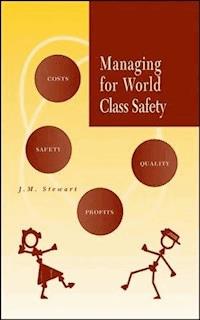
Despite the extensive literature on safety, few tools have been available to help managers quantitatively assess the level of safety management and the quality of the safety practices in organizations. In his consulting practice, Dr. Jim Stewart, a former executive at DuPont, developed such a method, crafting a safety survey centering on a comprehensive questionnaire for employees at all levels, that reveals the true level of corporate commitment to safety. Managing for World Class Safety first describes the model of safety management that underpins the questionnaire and then demonstrates how this innovative procedure illuminates critical intangibles like management commitment, the enforcement of rules, worker involvement, and injury investigation. The central part of this book is the description of research at the University of Toronto that applies the questionnaire in comprehensive research at five of the world's safest companies and five with very poor safety. The questionnaire polled 700 people in the ten companies, "measuring" the level of more than twenty key elements such as: * The workers' perception of the priority given to safety * The belief that all injuries can be prevented * The extent to which line management takes responsibility/accountability for safety * How well safety rules are followed and enforced * The frequency and quality of safety meetings * The level of recognition to reinforce safety excellence * In every element, the contrast between the responses from the very safe companies and those from the companies with poor safety was dramatic, clearly depicting where the former succeed and the latter fail By developing quantitative benchmark data, Stewart reasons that it will be easier to convince reluctant management to undertake the fundamental change necessary for a "step change" in their company performance. Managing for World Class Safety promises a revolutionary new approach to workplace safety improvement for corporate leaders, safety professionals, and regulators.
Sie lesen das E-Book in den Legimi-Apps auf:
Seitenzahl: 341
Veröffentlichungsjahr: 2012
Ähnliche



















Contents
Cover
Half Title page
Title page
Copyright page
Foreword
Preface
Acknowledgments
Chapter 1: Introduction
Chapter 2: The Model of Safety Management
2.1 The Framework of the Model
2.2 Designing the Model for Measurement
2.3 The Beliefs and Practices for Excellence in Safety
2.4 The Cost-Benefit Trade-Off
2.5 Limitations of the Model
Chapter 3: The Safety Questionnaire
3.1 Background to the Development of the Questionnaire
3.2 Scope of the Questionnaire
Chapter 4: Selection of Companies for Research
4.1 Size of Company
4.2 Difficulties in Identifying Companies with Excellent Safety
4.3 Canadian Companies
4.4 US Companies
4.5 Offshore Companies
4.6 Companies with Very Poor Safety
4.7 Company Environment—Culture
Chapter 5: Research Methodology
5.1 Outline of Research
5.2 Collection of Company Data—Very Safe Companies
5.3 Questionnaire Survey Procedures
5.4 Interviews and Focus Groups
5.5 Summary of Companies and Research Undertaken
Chapter 6: Analysis of the Questionnaire Results
Questions 1 & 2: The Priority Given to Safety
Question 3: The Belief That All Injuries Can Be Prevented
Questions 4 AND 5: The Interaction Between Business and Safety
Question 6: The Extent to Which Safety is Built In
Question 7: The Presence and Influence of Safety Values
Question 8: Line Management Responsibility—Accountability for Safety
Questions 9 and 10: Involvement in Safety Activities and Empowerment
Question 11: Safety Training
Question 12: The Frequency and Quality of Safety Meetings
Question 13: Safety Rules
Question 14: Enforcement of Safety Rules
Question 15: Injury and Incident Investigation
Question 16: Workplace Audits/Inspections
Question 17: Modified Duty and Return-to-Work Systems
Question 18: Off-the-Job Safety
Question 19: Recognition for Safety Performance
Question 20: Employing the Best Safety Technology
Question 21: Measuring and Benchmarking Safety Performance
Question 22: The Safety Organization
Question 23: The Safety Department-Safety Specialists
Question 24: Satisfaction with the Safety Performance of the Organization
Beliefs and Practices for Which no Questions were Developed
Chapter 7: The Safety Management Approaches of Five Very Safe Companies
7.1 Abitibi-Consolidated, Fort Frances Mill: Safety Excellence in Pulp and Paper Production
7.2 Dupont Canada: One of the World’s Safest Companies
7.3 Milliken and Company: World Class Safety in the Textile Industry
7.4 S&C Electric Canada: A Turnaround to Safety Excellence in the Electrical Equipment Industry
7.5 Shell Canada: World Class Safety in the Oil Industry
Chapter 8: Conclusions-How Companies Achieve Excellence in Safety
The Commitment of Management to Excellence in Safety
Line Management Ownership of the Safety Agenda
Involvement in Safety Activities, Training, and Empowerment
Comprehensive Safety Practices
Safety Organization and Safety Specialists
Satisfaction with Safety Performance
Validity of the Model and the Questionnaire
Chapter 9: Applying the Results of the Research
Application of the Safety Survey
Combining the Safety Survey with Future State Visioning-The Future State Visioning Workshop
Action From the Survey and Workshop Results
Where the Safety Improvement Process has been Used
Future Use of the Safety Improvement Process
Appendix A: References and End-Notes
Appendix B: Nomenclature
Appendix C: Questions for Interviews of Company Leaders
Appendix D: Statistical Analysis of Data
Appendix E: The Safety Questionnaire
Appendix F: Tables of Detailed Results
Appendix G: About the Author
Index
MANAGING FOR WORLD CLASS SAFETY
Copyright © 2002 by J. M. Stewart Enterprises & E. I. Du Pont. All right reserved.
Published simultaneously in Canada.
No part of this publication may be reproduced, stored in a retrieval system or transmitted in any form or by any means, electronic, mechanical, photocopying, recording, scanning or otherwise, except as permitted under Sections 107 or 108 of the 1976 United States Copyright Act, without either the prior written permission of the Publisher, or authorization through payment of the appropriate per-copy fee to the Copyright Clearance Center, 222 Rosewood Drive, Danvers, MA 01923, (978) 750-8400, fax (978) 750-4744. Requests to the Publisher for permission should be addressed to the Permissions Department, John Wiley & Sons, Inc., 605 Third Avenue, New York, NY 10158-0012, (212) 850-6011, fax (212) 850-6008, E-Mail:[email protected].
For ordering and customer service, call 1-800-CALL-WILEY.
Library of Congress Cataloging-in-Publication Data:Stewart, J. M.Managing for world class safety / J. M. Stewart.p. cm.“A Wiley-Interscience publication”.Includes bibliographical references.ISBN 0-471-44386-7 (cloth: alk. paper)1. Industrial satety—Management. 2. Psychology, Industrial. I. TitleHD7262 .S813 2002658.3’82—dc212001037875
FOREWORD
The safety of its people has always been the most important value at DuPont. It shows in the enduring world-class safety record of the company. Those of us who have worked for such companies and have become steeped in the philosophy of safety management, often tend to forget how difficult it is to manage safety to high levels of excellence. It requires a strong commitment to fundamental values and thorough application of the key practices. For example, the central belief that all injuries can be prevented must become more than a slogan. It must be the driver that requires all leaders to work persistently to prevent any injury—and to take full responsibility if one does occur.
While there have been many articles and books that describe how the safest companies achieve excellence, in most cases the evidence is qualitative and anecdotal. It could be said that safety management has not advanced to as sophisticated a level as other areas of management. There has been an evident need for more systematic and quantitative research on safety management, done in such a way that companies seeking to improve could find more specific guidance. Part of the problem has been that the foundations of safety management lie in a system of beliefs—a culture of safety—and measurement in these “soft” areas is difficult.
It is thus very gratifying to see the results of Jim Stewart’s research. He has thoroughly documented the basic beliefs and practices of safety management and then developed methods to “measure” the extent they are present in an organization. The benchmark data obtained through careful research at some of the safest companies and some with very poor safety represents an important step in improving the understanding of safety management. Jim’s techniques were originally developed for use in safety consulting and have been widely proven in practice with Canadian companies. The combination of research and consulting ensured that the research was soundly based on best practice and useable and credible with corporate leaders.
Jim Stewart worked closely with me for many years in senior positions when I was CEO of DuPont Canada. He was always an innovator, interested in finding out how to make management systems work better and to develop and introduce new ones. And then to find ways to conceptualize them so that they could be applied elsewhere. He was one of the leaders in building self-management and world class manufacturing into the company, a legacy that endures today. He could envisage a better way, test it methodically and drive it to practice across the company. In the 1980s, Jim was in charge of the company’s manufacturing and engineering as the company moved to self-management systems and adapted to global competition. Through this period of great change the company maintained and improved its safety performance. Jim was the first recipient of the company’s highest award—the Daedalus Award—given for his outstanding contribution to building self-management, increasing productivity and reducing costs.
Thus it did not surprise me that when Jim moved into the field of research and consulting on the management of safety, he was able to develop new, leading-edge systems. His background in research, in management and his involvement in safety were ideal qualifications for this.
The research described in this book was built on the solid principles of safety management practiced by the safest companies. It breaks new ground in developing techniques to measure the state of safety management quantitatively. It advances the knowledge of safety management through the investigations carefully done at very safe companies and at companies with very poor safety. Thus it lays the base for a much more specific methods for companies to assess where they stand in comparison to best practice, and to focus directly where they should seek to improve.
It is a very substantial and very important undertaking. For those organizations that wish to make major changes in their safety performance it will be very valuable. It should be compulsory reading for every member of every leadership team.
Ted NewallChairman, Nova Chemical CorporationFormer Chairman, President & CEO, DuPont Canada Inc.
PREFACE
In the world’s safest companies, safety has unquestioned priority and meticulous attention is given to using the best safety practices. As a long-term executive at DuPont, one of the very safest companies, I had known that such attention to safety was the exception, not the rule. But it was only when I became involved in consulting on safety management that I realized just how formidable the obstacles are for leaders intent on making a step change in their company’s safety performance. The main barriers are:
As a result of these interrelated factors, improvement efforts often do not focus on the “right things.” The right things are usually not the physical or system deficiencies that are the easiest to see. Rather, they are the intangibles that cannot be easily measured and thus are often neglected—like lack of management commitment or a low level of involvement of workers in safety activities.
In my consulting practice, before undertaking this research, I had developed a Safety Survey process to deal more thoroughly and quantitatively with the first of these factors—the measurement of the state of safety management. The process was built on a model of safety management supported by a set of beliefs and practices derived from the methods of very safe companies. The central innovation of the Safety Survey was a comprehensive safety questionnaire, completed by a cross section of the organization, from leaders to workers. The questionnaire “measures” the extent to which the factors of the model and the beliefs and practices are present and effective in the workplace.
The research described in this book addresses the second of the above three issues—the lack of comprehensive information, particularly quantitative benchmark data, on how the safest companies achieve excellence. The research was undertaken from 1995 through 1998 while I was an Executive-in-Residence at the Rotman School of Management at the University of Toronto. The Safety Survey techniques were used to investigate in depth five North American companies that have achieved enduring world class safety performance and to determine, in a more quantitative way than had previously been done, how they achieve excellence. Similar measurements were completed at five companies with very poor safety, providing a striking contrast to the safe company data and helping to validate the measurement techniques.
The lost work injury frequency of the five very safe companies averaged 0.08 per 200,000 hours over a 5-year period. The 24-question, multiple-choice questionnaire was completed by 400 people at the five companies. They ranged from workers to presidents. Extensive on-site research was conducted with the five very safe companies to supplement the questionnaire results.
At the other end of the safety performance scale, 250 employees of five companies with very poor safety records completed the same questionnaire. The lost work injury frequency of these companies averaged 20 per 200,000 hours, 250 times worse than that of the very safe companies. The surveys of the companies with very poor safety were conducted with the help of provincial safety agencies. On-site investigations beyond the completion of the questionnaires were not possible.
For almost every question, the quantitative results of the research correlated well with safety performance. In most cases there were dramatic differences between the results from the very safe companies and those from the companies with very poor safety. For example, 75% of the 400 respondents in the safe companies reported that their management was held responsible for injuries, compared with only 16% of the 250 respondents from the companies with poor safety. The contrast between the “best” results from the safe companies and the “worst” results from the companies with poor safety was even more striking. For example, in one of the safe companies, 68% of workers said that they were deeply or quite involved in safety activities and a further 20% said that they were moderately involved. In the worst result from an unsafe company, only 12% of workers said they were deeply or quite involved; 88% said they were not much involved or not involved at all.
Through the research, new insights were gained into the fundamentals of safety management. The model of safety management and the questionnaire were improved and extended. To augment the survey data and to illustrate how they achieve outstanding safety, a case write-up was prepared on each of the five very safe companies.
The results of the research confirm the validity of the model of safety management. The most important factors driving excellence in safety prove to be management commitment, line ownership of safety, and worker involvement. If these “soft” factors are present, they in turn lead to excellence in the important safety practices.
The research further confirmed the power of the questionnaire technique for measuring the state of safety management. It affords a way to quantitatively assess the important intangibles such as management commitment and to identify the quality and effectiveness of a company’s safety practices. By determining in specific terms where the problems lie, the survey helps indicate the pathway to improvement. The quantitative results developed in this research represent unique benchmark data, invaluable in helping assess the state of safety management in a company.
A research report on the work was published in 1999, and this book closely follows that report. The copyrighted elements of the Safety Survey process, including the questionnaire and associated implementation techniques, initially developed by the author’s consulting company, were licensed to E. I. DuPont de Nemours in 2000 and are being integrated into its safety consulting business.
J. M. Stewart
ACKNOWLEDGMENTS
The research described in this book was carried out at the Rotman School of Management at the University of Toronto while the author was located there as an Executive-in-Residence and Adjunct Professor of Strategic Studies. The author thanks the School and the University for providing the facilities and for assistance in the research. Very capable help was provided by Kazuo Noguchi, a research assistant at the School, and later by Peter Steer.
The research was funded by donations to the University from Canadian governments and Canadian corporations. All of the provincial and territorial safety or workers’ compensation agencies and the federal Departments of Health and Human Resources participated. The government funding was coordinated by Human Resources Development Canada (HRDC) through the Occupational Safety and Health Committee of the Canadian Association of Administrators of Labour Legislation (CAALL-OSH Committee). The author is grateful to HRDC, to the members of the CAALL-OSH Committee, and to their respective governments for their advice as well as for their financial support. The late Jim McLellan, formerly of HRDC, was instrumental in initiating the research and was a strong supporter of the work.
The companies participating in the funding were Dow Chemical Canada, Nacan Products, National Rubber Co., Nova Chemicals, Ontario Hydro, Shell Canada, and TransCanada Pipelines. The author thanks these companies sincerely for their generous contributions.
A central part of the project was the detailed research done at five companies with excellent safety records—Abitibi-Consolidated, DuPont Canada, Milliken and Company (US), S&C Electric Canada, and Shell Canada. These companies went the second mile in many ways, opening their facilities for the author, making the time of their people freely available, and providing the information needed for the research. The author thanks these companies and their people for their outstanding cooperation.
The collection of questionnaire data at companies with very poor safety was conducted by the provincial agencies of British Columbia (WCB of B.C.), Manitoba (Department of Labour), and Ontario (Industrial Accident Prevention Association—IAPA). This work could only be done through such public bodies, and their generous help provided invaluable data for the project.
The draft of the research report on which this book was based was reviewed by James Hansen of the IAPA, John Shepherd, formerly of Nacan, Allan Luck of the B.C. WCB, and Linton Kulak and Ron Czura of Shell Canada. The author thanks them sincerely for their very helpful comments.
Throughout the research, particular help was provided by Maureen Shaw and others at the IAPA (Ontario), by Geoff Bawden and Barry Warrack of the Manitoba Department of Labour, and by Allan Luck and Ralph McGinn at the British Columbia WCB.
CHAPTER 1
INTRODUCTION
Every year, over 700 Canadians are killed in workplace accidents and 400,000 are injured seriously enough to require time off the job (1). In addition to the toll in human suffering, occupational injuries and illnesses cost the Canadian economy tens of billions of dollars per year. If all the indirect costs are added up, the tally probably comes to more than $25 billion per year (2). Although the injury frequency has been declining, costs have increased substantially. This situation exists in the face of a surprising observation: the safest companies achieve results up to 1000 times better than the worst and 10 to 100 times better than the average! How can such differences be justified? The know-how to achieve much better safety performance apparently exists. Why is it not being applied?
The costs of injuries are sometimes compared with the costs of safety initiatives in the context of what is called the cost-benefit trade-off. The assumption is that beyond achieving fair safety, further efforts to improve safety would be counterproductive. A major reason for poor safety performance is that many leaders work from this premise.
Lesen Sie weiter in der vollständigen Ausgabe!
Lesen Sie weiter in der vollständigen Ausgabe!
Lesen Sie weiter in der vollständigen Ausgabe!
Lesen Sie weiter in der vollständigen Ausgabe!
Lesen Sie weiter in der vollständigen Ausgabe!
Lesen Sie weiter in der vollständigen Ausgabe!
Lesen Sie weiter in der vollständigen Ausgabe!
Lesen Sie weiter in der vollständigen Ausgabe!
Lesen Sie weiter in der vollständigen Ausgabe!
Lesen Sie weiter in der vollständigen Ausgabe!
Lesen Sie weiter in der vollständigen Ausgabe!
Lesen Sie weiter in der vollständigen Ausgabe!
Lesen Sie weiter in der vollständigen Ausgabe!
Lesen Sie weiter in der vollständigen Ausgabe!
Lesen Sie weiter in der vollständigen Ausgabe!
Lesen Sie weiter in der vollständigen Ausgabe!




