


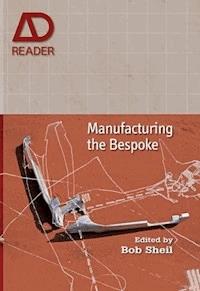
Manufacturing the Bespoke E-Book
33,99 €
Mehr erfahren.
- Herausgeber: John Wiley & Sons
- Kategorie: Geisteswissenschaft
- Serie: AD Reader
- Sprache: Englisch
The essential reader on fabrication in architecture for practitioners and producers alike An original and informative reader on the subject of translating architectural ideas from conceptual propositions to physical manifestations, Manufacturing the Bespoke is an essential resource for students and practitioners of architecture, as well as producers and suppliers of architectural products. At a time where roles, methods and capabilities within the disciplines of building production are in unprecedented flux, this book: * Provides a unique and highly current treatment on the subject of fabrication in architecture with its emphasis on contemporary technology, cultural history and theory * A key source book for students and professionals engaged in manufacturing/fabrication projects * Includes extended articles by internationally renowned critics, theorists, educators and designers, such as Mathias Kohler, Nevi Oxman, and Michael Stacey * Articles will examine and refer to key portfolios of the 20th and 21st Century including works by Pierre Charreau, Peter Salter and Rural Studio Featuring essays from pioneering architects, engineers, academics and designers from around the world on both existing and yet-to-be-built projects, the book covers architecture across the ages.
Sie lesen das E-Book in den Legimi-Apps auf:
Seitenzahl: 435
Veröffentlichungsjahr: 2012
Ähnliche




















The editor and the publisher gratefully acknowledge the people who gave their permission to reproduce material in this book. While every effort has been made to contact copyright holders for their permission to reprint material, the publishers would be grateful to hear from any copyright holder who is not acknowledged here and will undertake to rectify any errors or omissions in future editions.
This edition first published 2012
© 2012 John Wiley & Sons Ltd
Registered office
John Wiley & Sons Ltd, The Atrium, Southern Gate, Chichester, West Sussex, PO19 8SQ, United Kingdom
For details of our global editorial offices, for customer services and for information about how to apply for permission to reuse the copyright material in this book please see our website at www.wiley.com.
This is a collective work. The copyright ownership of individual extracts is indicated in a copyright notice at the end of each extract.
All rights reserved. No part of this publication may be reproduced, stored in a retrieval system, or transmitted, in any form or by any means, electronic, mechanical, photocopying, recording or otherwise, except as permitted by the UK Copyright, Designs and Patents Act 1988, without the prior permission of the publisher.
Wiley publishes in a variety of print and electronic formats and by print-on-demand. Some material included with standard print versions of this book may not be included in e-books or in print-on-demand. If this book refers to media such as a CD or DVD that is not included in the version you purchased, you may download this material at http://booksupport.wiley.com. For more information about Wiley products, visit www.wiley.com.
Designations used by companies to distinguish their products are often claimed as trademarks. All brand names and product names used in this book are trade names, service marks, trademarks or registered trademarks of their respective owners. The publisher is not associated with any product or vendor mentioned in this book. This publication is designed to provide accurate and authoritative information in regard to the subject matter covered.
It is sold on the understanding that the publisher is not engaged in rendering professional services. If professional advice or other expert assistance is required, the services of a competent professional should be sought.
Executive Commissioning Editor: Helen Castle
Project Editor: Miriam Swift
Assistant Editor: Calver Lezama
ISBN 978-0-470-66583-1 (hb)
ISBN 978-0-470-66582-4 (pb)
ISBN 978-1-119-96911-2 (ebk)
ISBN 978-1-119-96912-9 (ebk)
ISBN 978-1-119-96913-6 (ebk)
Cover image © Kate Davies and Emmanuel Vercruysse/Liquidfactory
Design by Artmedia, London
Please note that cross references throughout refer to pages in the printed version of this book.
Table of Contents
Title Page
Dedication
Copyright
Introduction
From Making the Bespoke to Manufacturing the Bespoke
The Bespoke is a Way of Working, Not a Style
Models, Prototypes and Archetypes
Digital Craft in the Making of Architecture
R-O-B
The Matter of Pochoir and the Imaging of the Maison de Verre
Soil and Protoplasm: Designing the Hylozoic Ground Component System
Walmer Road
The Fore Cast
Drawing Out an Indeterminate Duration
Incisions in the Haze
An Interview with Frank Fantauzzi from Iceberg Project
Grymsdyke Farm
The Rural Studio
Fractal, Bad Hair, Swoosh and Driftwood
Microstructure, Macrostructure and the Steering of Material Proclivities
Print to Protocell
Large-Scale Additive Fabrication
Material Computation
Models of Risk
Key Search Terms
Introduction
Bob Sheil
At the disposal of today's architect is an evolving array of interoperable tools and processes that allow the fabrication of design propositions to be increasingly complex, nonstandard and adaptive. As wet chemistry and nano-engineering laboratories generate an entirely new palette to explore, the scope of the designer has also entered the domain of specifying and manipulating the growth, structure and behaviour of materials. How are designers equipped to deal with such a growing breadth of new potential, and how are the underlying philosophies that underpin this potential being defined? Manufacturing the Bespoke attempts to address what is something of a contemporary dilemma in architectural production, as the constraints of industrial standardisation are relaxed. Have the roles of designers and makers changed in a way that we've not experienced before, and what else is conveyed in the work as a new approach to making architecture is emerging? As this collection of new essays conveys, the hybridisation of digital technologies in design representation and manufacture has shifted the scope and influence of design from a largely pre-emptive act into a creative and experimental process that occupies the full extent of architectural production, where particular, unique and tailored solutions are increasingly viable.
Conventional protocols of exchange on the key relationship between design and making have been thoroughly redefined by digital fabrication technology.1 For centuries, the construction of prototypes, artefacts, buildings and structures has operated on a rolling tradition of visual and verbal communication between designers, consultants, makers, clients, users, regulatory bodies and contractors. In making buildings, roles were defined by where individuals and disciplines were located on a chain from concept to execution. All were reliant on its links being successfully forged, not only to achieve results, but also to underpin their status within their respective professions and trades. Guiding the entire process was the design, an assemblage of cross-referenced visualisations, specifications and quantities forming the templates and instructions to make. Given the numeracy of complex transfers from one step to the next, constructs in architecture have evolved as negotiated translations, and the most engaging are those that have recognised this in a creative and informed way from the very outset.
The redefinition of these historic protocols was initially led by the gradual adoption of computer-aided drawing in the early 1990s by practice and academia. As three-dimensional modelling and rendering became more available and sophisticated, a frenzy of liberated experimentation ensued. Speculative design looked to the weightless and scaleless domain of digital space as the new terrain for innovation and speculative discourse and as a means to compositionally define spatial and formal complexity.2 The gap between the designer's vision and operations of the construction industry widened as fabrication processes remained largely analogue in how they were driven and delivered. A defining example of this challenge was Future Systems' Media Centre at Lord's cricket ground (competition winner 1995, opened 1999), in which the primary enclosure was entirely prefabricated by the Pendennis shipyard in Falmouth, Cornwall, as theirs was the only industry both familiar and experienced in extrapolating design information for the fabrication of such forms.
Concurrently though, new tools of computation, means to capture and analyse the performance of buildings, built environments and the behaviour of users, brought a fresh understanding of the complexity and density of dynamic contexts in architecture. Geometry was reignited as a great organiser, only now it was adaptable and smart, as developments in design software far outstripped those in the world of how such forms could easily be made, and more significantly the means to communicate from one realm to the other was restricted. In the first decade of the new millennium this restriction started to lift as CAD/CAM (computer-aided design and computer-aided manufacture) entered the mainstream. Subsequently, a vast expansion on the remit, scope and potential of the designer was released, allowing for his/her direct engagement and control of fabrication processes. Likewise, the capability of manufacturing and construction to fulfil design intent was expanded, and a creative dialogue between design and fabrication was converging once more.
Size Matters
The term bespoke is said to have originated over a thousand years ago from the old English ‘bespeak’, meaning ‘to request’, ‘to order in advance’ or ‘to give order for it to be made’.3 Tailors of London's Savile Row claim that the term was in common use on their street from the 17th century, when tailors kept their cloth on the premises and customers would ‘bespeak’ a particular length of fabric to be fitted as a suit or uniform. The first recorded use is thought to have been in 1755 in A Narrative of the Life of Mrs Charlotte Charke4 on the life and experiences of an actress, cross-dresser and daughter of a famous playwright in 18th-century London.
Almost 275 years after suits and uniforms were first made there, the Savile Row Bespoke Association was founded in 2004, and within three years they trademarked the term ‘Savile Row Bespoke’ which defined a two-piece bespoke suit as ‘crafted from a choice of at least 2,000 fabrics … made almost completely by hand, and requiring at least 50 hours of hand-stitching’. To qualify, Savile Row Bespoke suits must also be ‘derived from a paper pattern, individually cut and produced by a master cutter, and subsequently undergo personal supervision by the master cutter in the course of production’. In June 2008,5 the association lodged a complaint under the truthfulness rule at the UK's Advertising Standards Authority against international firm Sartoriani who had recently opened a nearby shop where machine-cut suits were promoted as bespoke. The ASA noted the complainant's argument that, ‘the advertised suits were machine-cut abroad6 to a standard pattern after initial measurements were taken and adjusted at the end of the process’ and that the suits ‘at best’ should be described as ‘made to measure’. Sartoriani claimed that the initial machine-cut fabric pattern was a ‘working frame’ that could be individually adjusted if the customer's measurements did not match a standard pattern size, and that this occurred in some cases.
The ASA concluded that following recent changes to the industry, the use of the word bespoke to describe the advertised suits was ‘unlikely to mislead’. They went on to say, ‘both bespoke and made-to-measure suits were “made to order”, in that they were made to the customer's precise measurements and specifications, unlike off-the-peg suits’. The ASA did not rule on a fuzzy distinction between handmade or machine-made, nor the particular differences of approach either method adopts in making or fitting, nor even where the suit was made; they ruled on the rather neater and universal principle of measurement.7 Whether the artefact is made to order, made on the premises, made to measure, made by hand, or manufactured by machine, our recent understanding of the centuries-old term bespoke has undoubtedly been altered.8
Designer as Maker
Today, the bespoke is referred to in the context of personalised stationery, customised software, pharmaceuticals, wines, cars, financial investments, even biscuits, suggesting it is increasingly common for everyday and mass-produced artefacts to be made to order. The bespoke is also a term associated with architecture, and in the first instance through the idea that most buildings are in some sense unique to their location, the time they were designed and built, who they were designed and built by, how they were built, and the circumstances that surround their occupation and use. More specifically, the architecturally bespoke has associations with craft, ornamentation, materiality, fit, uniqueness and the unrepeated. However, as with the core productions of Savile Row, and for many of the same reasons, the meaning of bespoke in architecture in recent years has shifted on methodological grounds. Key to this are two primary issues: first, radical changes in how architecture is designed and made; and second, a vast expansion in what might be regarded as materials for architectural specification – from the deployment of nanotechnologies to choreographing four-dimensional behaviour.
Unlike tailors, most architects do not make the things they design. They make design information; the equivalent of making the pattern, not the suit. Moreover, unlike tailors, architects make an immaterial substance, space, with this pattern, the equivalent of forming the host upon which the pattern is draped. A bespoke architectural design is therefore associated not only with the ability to establish rules for the artefact that is ‘made to order’, but also with generating a design that understands and anticipates the challenge and consequences of making that particular order. Thus, what is subsequently made reveals the manner in which design information prompted a skilled craftsman or specialist to respond, and how the overarching construct fits together. At its best, this collaborative dialogue has the capacity to transcend the drawing as a literal template and goad the maker and the material into new territories. Since the introduction of digital fabrication technologies, profound changes have been brought to bear on this relationship and the habitual protocols between design and making. Through the progressive elimination of craftsmen and skilled machine operatives, the expertise that designers relied upon to translate their work has diminished and in many respects transgressed into their own domain.
A further ingredient of the bespoke is how an intimate knowledge of materials and their performance in use informs design, and relates to its method. Cutting fabric on the bias and incorporating ease within a garment, each has its equivalent at architectural scales, such as the imprint of shuttering on cast concrete, or the deflection of steel under load. In tailoring a bespoke suit, drawing and making are synthesised from the outset where graphic and illustrative representation dissolves as the final artefact appears. Processes of measurement, pattern making, cutting, forming and joining components progress through three stages of fitting and fabrication known as the ‘skeleton baste’, the ‘forward’ and the ‘finish bar finish’. Such intimacy between drawing and making is rare in the practice of architecture and the architectural drawing must therefore anticipate and understand the difference between the simulated and the actual and adapt accordingly. Clearly, the breadth of materials specified in architecture is substantially broader and more complex than that of tailoring, not least as it also incorporates strategies for immaterial qualities such as context, light, reflection, temperature, sound, culture, meaning, memory and emotion. In this regard, both the tools and the palette of the 21st-century architectural designer are rapidly expanding as they provide the ability to approach design as a strategic act with novel outcomes.
A Work in Progress
This book explores ideas on making architecture in this new paradigm. It contains new articles by makers, academics, practitioners, theorists and various interdisciplinary hybrids from an assembly of disciplines within architectural production. Contributors were invited to speculate, report and reflect on ways that architecture is being designed and made today. Each of the articles draws from the direct experience of the author, and in most cases is based on new works in progress. The articles expand on aspects of design and making that commonly evade formal documentation, aspects that are more accustomed to a part in the spoken dialogue of making things. By definition a reader is not a singular manifesto but a collation of many platforms and arguments. Among those presented here is an avenue into reading the digital as a stimulus for craft that is delivered with an unambiguous caveat on what has yet to be gained by this opportunity. Michael Stacey (pages 58–77) pays homage to architects of the pre-digital age for whom, he argues, the drawing and the building were more intellectually integrated. This tone of caution is echoed by two other contributors of distinction, first by Stephen Gage (pages 28–41), who asks if there are limits to the appropriateness or effectiveness of the bespoke, and how it is contextualised within the broader history of architectural practice and tradition. And second, by Mark Burry (pages 42–57), who suggests that digital fabrication has blurred definitions of the model and the prototype, and with it, a lack of clarity in the role of the archetype has been initiated. These balanced and thoughtful critiques are essential parentheses, not only in leashing besotted enthusiasm that is often associated with new techniques and technologies, but also by acting as a grounded and informed check on attempts to prematurely formulate or construct an associated universal theory.
In their chapter entitled ‘R-O-B: Towards a Bespoke Building Process’ (pages 78–87), Tobias Bonwetsch, Fabio Gramazio and Matthias Kohler of the Institute for Technology in Architecture at the Faculty of Architecture at ETH Zurich, leapfrog the construction industry's hereditary lag in the use of programmable automation by approaching the technology as a tool awaiting a design instruction as a composed digital score. Through their choreographic guidance, the actions of commonly available robotic industrial arms are animated to perform experimental routines of sublime dexterity and meticulous craft. In establishing a lexicon of ornate and complex built structures and surfaces, their work offers an insight into experimental design as a time-based and malleable building process. They generously share their work in publications, lectures and online, as speculative demonstrators on the implicit potential of operating as a designer with programmable tools. As the engineer Hanif Kara has said elsewhere, it is this core generosity that singles Gramazio and Kohler out as a key influence in this field.9
Based at the University of Waterloo Toronto, Philip Beesley takes the idea of manipulating and exploring behaviour in another direction to challenge the status of building material itself (pages 102–19). In Hylozoic Ground, the latest in a sequence of projects he leads, what he calls naked hyperbolic meshworks are organised as a ‘geotextile terrain’, a fundament to the act of creating the earth itself. They are dressed with a primitive intelligence, layers of structure, muscle, wet chemistry, neurons, memory and an active circulation system. The resultant assembly offers the template for a responsive architectural system, a practical system that lives and breathes, that knows where it is and who is in proximity. Beesley asks if this could form the basis of a system that cares, architecture of hope and optimism? Beesley's chapter is embellished by a collaborator on the Hylozoic Ground project, Rachel Armstrong (pages 238–47). In ‘Print to Protocell’, qualified medical doctor, science fiction author, arts collaborator and architectural researcher Armstrong explores the possibility of growing building materials, and imagines buildings that will transfer from inert to living matter and become part of the biosphere.10 Allied to the investigation of materials at a behavioural level is the work of Neri Oxman (pages 256–65), director of the Mediated Matter research group at MIT Media Lab. Oxman's essay presents the idea that examined and computationally manipulated at a structural and environmental level, material performance can lead to an entirely new way of approaching and developing form. These essays represent a collection that speculates on the processes of how future architecture may be built and what it may be built with, by exploiting automated, responsive and living systems.
Weaving through the book is another collection of essays dealing with a very different and more familiar palette, one that continues to extract the extraordinary from the ordinary. The collections are not posed against each other as counterarguments, as the book is a deliberately open and diverse collection of valid positions from esteemed contributors each of whom operates in socially, economically and culturally different circumstances, contexts and environments. In this set, we find the work of distinguished individuals such as Peter Salter (pages 120–31) and Mark West (pages 132–45), the unique organisation Rural Studio (pages 194–207), and the rising talent of Guan Lee (pages 182–93). Known for his deeply evocative drawings that seep with an intimate knowledge of materials and structure, Peter Salter reflects on his time as an assistant for the Smithsons. As he embarks on building three mews houses on Walmer Road, West London, he advocates a timeless approach for a design methodology that synthesises all scales of design, from overarching strategies of spatial organisation to those of detailed fabrication.
From the workbenches of his unique base, CAST (the Centre for Architectural Structures and Technology) at the University of Manitoba, Mark West is known internationally, more for how he has transformed the potential and understanding of concrete as a liquid material, than for his parallel explorations in drawing. In his essay entitled ‘The Fore Cast’, he retraces the evolution of his work from its earliest steps, and reviews as much as recounts how the site and practice of drawing is an integral act in the excavation and search for ideas. It is a typically generous invitation into his world, and one that provides further enlightenment on the strategies behind his world-class research. From over 2500 kilometres (1553 miles) south of CAST, regular visitor to the Rural Studio in Newbern, Alabama, architect Anderson Inge, reports on the outpost of Auburn University led by Andrew Freear, which has attained an almost mythical status in international architectural education. Here notions of the bespoke are at experienced first hand in the design and production of protoarchitectural constructs that challenge the very basic conventions of building materials and their collage. Going deeper, Inge presents the school as a chosen path requiring absolute commitment and an unambiguous attitude towards an ideology that relates to its immediate social, economic and legislative context.
This book is also populated with a number of case studies on a diverse set of new works in progress by innovative researchers in academia and practice. They represent authorship from individuals and collaborations, some at the beginning of their careers and from others who have an established body of work spanning recent decades of substantial change in practice. Among them, Xavier De Kestelier of Foster + Partners and Richard Buswell of Loughborough University (pages 248–55) illustrate an all too rare collaboration between cutting-edge research and practice. They share valuable insight into the evolution of deposition technologies upon design methods and strategies over the past two decades, and finish on the primary role that toolpaths play in shaping and forming large concrete elements without formwork. Their investigations remind us of the similarity and difference that continue to exist between architectural information and physical manufacture, and the essay is an urgent provocation for fruitful collaboration of this kind to become an everyday occurrence.
Echoing this cry, in his chapter entitled ‘Microstructure, Macrostructure and the Steering of Material Proclivities’ Phil Ayres (pages 220–37), from the Centre for Information Technology and Architecture at the Royal Danish Academy of Fine Arts Copenhagen, presents novel design strategies that exploit the potential of digital technologies applied to design, fabrication and use as a circular relationship through which intent is translated into artefact. In a detailed analysis of recent experiments in hydroforming, he provides vital insight into the development of new theories of design and representation. Within a similar vein, Nat Chard's chapter, ‘Drawing Out an Indeterminate Duration’ (pages 146– 61) extends the discussion on fluid relationships between the drawn and the made, and the transition that exists between them. His fascinating and exquisitely crafted drawing instruments are both the construct of representation, and the means of constructing representation. These issues are further explored by architect, educator and researcher-in-residence Mary Vaughan Johnson in her scholarly diagnosis of Chareau's masterpiece of the bespoke, the Maison de Verre (pages 88–101).
Manufacturing the Bespoke is also populated with detailed accounts on the making of speculative and highly particular prototypes including the sequence of pavilions designed and built by AA Intermediate Unit 2 led by Charles Walker and Martin Self between 2006 and 2009 (pages 208–19), and for a more extreme context, Constance Adams documents her work for NASA on environments to house and sustain space travellers (pages 266–75). She illustrates how designing for the most extreme and uncertain of scenarios is considerably more than a technical task; by necessity it is a forecast on core human relationships with issues of survival, ability, skill and adaptation. In a very different manner, the idea of survival within an uncertain earthly future is speculated upon in a polemic chapter by the young experimental practice Liquidfactory, led by Kate Davies and Emmanuel Vercruysse (pages 162–73). As with all other included texts theirs is written exclusively for this publication, but Davies and Vercruysse go a step further and present an entirely new phase of an ongoing project as a response to the invitation. ‘Incisions in the Haze’ presents the power of the speculative project in constructing an apparently extreme speculative scenario through drawings, constructs and narratives. Their work exemplifies Stephen Gage's earlier message that ‘The Bespoke is a Way of Working not a Style’.
In conclusion, I wish to thank each and every one of my contributors for their counsel and generosity in providing such stimulating and original material. Their diverse and varied insight has thoroughly enriched understanding and knowledge in this field, and their continued pursuit defining new frontiers in architecture is an inspiration. I owe a special thanks to Helen Castle, Calver Lezama and Miriam Swift of Wiley whose unrelenting support I have relied upon with considerable dependency. I also wish to thank my colleagues at The Bartlett UCL and in sixteen*(makers) for their support and fervent encouragement, in particular, Ruairi Glynn and Marilena Skavara with whom I was involved in organising an international conference at UCL while this book was in development. Finally, I wish to express my deepest gratitude to Caroline Rabourdin who endured the consequences of my imperfect project management. To her much is owed, and in recognition of my sincere appreciation for her graceful patience and persistent kindness, I dedicate this work.
Notes
1 B Sheil, ‘Transgression from Drawing to Making’, arq (Architectural Research Quarterly), 9.1, 2005, pp 20–32, 26.
2 Seminal publications of this period that explore these themes include a number of guest-edited issues of Architectural Design including Greg Lynn (ed), Folding in Architecture, AD Profile 102, Academy Group (London), 1993, and Neil Spiller (ed), ADArchitects in Cyberspace, vol 68, John Wiley & Sons (London), 1998.
3www.dictionary.com
4 C Charke, A Narrative of the Life of Mrs Charlotte Charke, Youngest Daughter of Colley Cibber, Esq, London, 1755.
5http://www.asa.org.uk/ASA-action/Adjudications/2008/6/Sartoriani-London/TF_ADJ_44555.aspx
6 Germany at the time.
7 Recent developments in three-dimensional body scanning offer a route to broader and more perplexing questions on specific measurement (Treleaven 2004). Here, not only is the individual accurately measured in 3D, but the data may also be of assistance in monitoring their state of health, contributing to national welfare statistics and understanding their physical attractiveness to others (Swami, Tovée et al 2002, 2005).
8 Shortly afterwards Sartoriani went on to open a shop on Savile Row. However, at the time of writing the firm had ceased trading and existing orders had been taken over by online trader asuitthatfits.com
9 Hanif Kara interviews Matthias Kohler; R Glynn, B Sheil (eds), FABRICATE, Riverside Architectural Press, University of Waterloo School of Architecture (Cambridge, Ontario), 2011, pp 116–21.
10 See Neil Spiller and Rachel Armstrong (eds), ADProtocell Architecture, vol 81, no 2, John Wiley & Sons (London), 2011.
© 2012 John Wiley & Sons Ltd.
From Making the Bespoke to Manufacturing the Bespoke
Bob Sheil
Two co-authored design and make projects are examined here: a chair from 1995 and a small building from 2009. Both projects fit within the author's definition of protoarchitecture,1 a genre of experimental design that challenges the methods and role of the designer particularly in relation to how and why the work is made. Secondly, and central to the arguments presented here, both projects identify a key transition in the definition of the bespoke that spans a period of significant change in design and fabrication methodologies and tooling. In analysing these projects together for the first time, it will be argued that many of the strategies in designing and making a bespoke piece of furniture that went beyond the realm of the conventional drawing, and were exclusively developed by hand, are now adoptable through digital design and fabrication technologies. It will also be suggested that these new facilities must be seen as essentially hybrid disciplines that are practised adjacent to the point of production. What is also being explored here is an underlying idea that integrated digital design and fabrication technologies have instigated a renewed relationship between the bespoke and the prototype, and that a pursuit to explore either presents opportunities for the other. What is new in this relationship is that these pursuits can be exercised mutually and synthetically, and for those who wish to take advantage of this potential, there are significant implications for the way they might practise and learn.
Lesen Sie weiter in der vollständigen Ausgabe!
Lesen Sie weiter in der vollständigen Ausgabe!
Lesen Sie weiter in der vollständigen Ausgabe!
Lesen Sie weiter in der vollständigen Ausgabe!
Lesen Sie weiter in der vollständigen Ausgabe!
Lesen Sie weiter in der vollständigen Ausgabe!
Lesen Sie weiter in der vollständigen Ausgabe!
Lesen Sie weiter in der vollständigen Ausgabe!
Lesen Sie weiter in der vollständigen Ausgabe!
Lesen Sie weiter in der vollständigen Ausgabe!
Lesen Sie weiter in der vollständigen Ausgabe!
Lesen Sie weiter in der vollständigen Ausgabe!
Lesen Sie weiter in der vollständigen Ausgabe!
Lesen Sie weiter in der vollständigen Ausgabe!
Lesen Sie weiter in der vollständigen Ausgabe!
Lesen Sie weiter in der vollständigen Ausgabe!
Lesen Sie weiter in der vollständigen Ausgabe!
Lesen Sie weiter in der vollständigen Ausgabe!
Lesen Sie weiter in der vollständigen Ausgabe!
Lesen Sie weiter in der vollständigen Ausgabe!




