


Maritime Poetics E-Book
0,00 €
Mehr erfahren.
- Herausgeber: transcript Verlag
- Kategorie: Geisteswissenschaft
- Serie: Edition Kulturwissenschaft
- Sprache: Englisch
In the past fifty years, port cities around the world have experienced considerable changes to their morphologies and their identities. The increasing intensification of global networks and logistics, and the resulting pressure on human societies and earthly environments have been characteristic of the rise of a »planetary age«. This volume engages with contemporary artistic practices and critical poeticsthat trace an alternate construction of the imaginaries and aspirations of our present societies at the crossroads of sea and land – taking into account complex pasts and interconnected histories, transnational flux, as well as material and immaterial borders.
Das E-Book können Sie in Legimi-Apps oder einer beliebigen App lesen, die das folgende Format unterstützen:
Veröffentlichungsjahr: 2021
Ähnliche




















Gabriel N. Gee holds a PhD in contemporary art history from the Université Paris X Nanterre. He teaches contemporary art history and theory at Franklin University. His current research interests include twentieth century British and Irish art, the changing representations and imaginaries of port cities, as well as interconnected global histories. He is co-founder of the TETI group, for Textures and Experiences of Trans-Industriality (www.tetigroup.org).
Caroline Wiedmer holds a PhD in comparative literature from Princeton University. She teaches comparative literature, film studies, and cultural studies at Franklin University. Her research interests include memory studies, refugee studies, documentary film, environmental humanities, law and culture, spatiality, and the workings of narrative in multiple domains of cultural, legal, and intellectual life.
Gabriel N. Gee, Caroline Wiedmer (eds.)
Maritime Poetics
From Coast to Hinterland
Published with the support of the Swiss National Science Foundation and Franklin University Switzerland
Bibliographic information published by the Deutsche Nationalbibliothek
The Deutsche Nationalbibliothek lists this publication in the Deutsche Nationalbibliografie; detailed bibliographic data are available in the Internet at http://dnb.d-nb.de
This work is licensed under the Creative Commons Attribution-NonCommercial-NoDerivatives 4.0 (BY-NC-ND) which means that the text may be used for non-commercial purposes, provided credit is given to the author. For details go to http://creativecommons.org/licenses/by-nc-nd/4.0/ To create an adaptation, translation, or derivative of the original work and for commercial use, further permission is required and can be obtained by contacting [email protected]
Creative Commons license terms for re-use do not apply to any content (such as graphs, figures, photos, excerpts, etc.) not original to the Open Access publication and further permission may be required from the rights holder. The obligation to research and clear permission lies solely with the party re-using the material.
© 2021 transcript Verlag, Bielefeld
Cover layout: Maria Arndt, Bielefeld
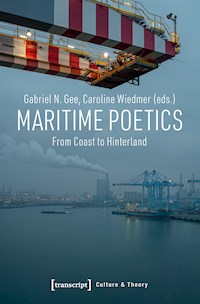
Cover illustration: Gregory Collavini, 13.01.2018, View of Rotterdam Port, 2018
Proofread by The Angle (www.theangle.ch)
Print-ISBN 978-3-8376-5023-5
PDF-ISBN 978-3-8394-5023-9
EPUB-ISBN 978-3-7328-5023-5
https://doi.org/10.14361/9783839450239
Contents
Foreword
Introduction: maritime introspections
Gabriel N. Gee and Caroline Wiedmer
Part 1: Work and leisure in the port city
Altona: Between land and sea
Vanessa Hirsch
The future of work: scaffolds and agencies
Johanna Bruckner
Genoa: the story of a port city and its hinterland
Cora Piantoni
European seaport narratives: mirroring history in contemporary media
Giuliano Sergio
Part 2: Commerce
Market stall: maritime commerce in the collections of European maritime museums
Gabriel N. Gee
From lighthouses to barcodes
Cliona Harmey
The European tour
Gregory Collavini
Bottleneck pressure: Port Said
Jürgen Baumann
Part 3: Metabolic pressure
Tarnished gold: border regimes from the Mediterranean to Switzerland
Caroline Wiedmer
Liquid territory
Monica Ursina Jäger
They cleaned the beach before we arrived
Anne-Laure Franchette
Between the city and the deep sea: on the plastic nature of the Helsinki shoreline
Tuula Närhinen
No trophy
Michael Günzburger
Part 4: Dreamscapes
Haul away: Liverpool’s irregular currents
Bryan Biggs
North Canada – English Electric, 2010
David Jacques
A short journey (from Derry to Inishowen)
Conor McFeely
A letter to Henrietta
Dorota Lukianska
Acoustic ocean: annotated video script
Ursula Biemann
Foreword
This volume Maritime Poetics: From Coast to Hinterland began with a workshop organised by the TETI Group – Textures and Experiences of Trans-Industriality – in May 2018 at the independent art space Corner College, Zurich. The workshop accompanied an exhibition in two parts entitled Hinterland: the eyes of the lighthouse; blood as a rover, curated by Gabriel Gee and Anne-Laure Franchette. Many of the authors and artists contributing to the present collection of essays took part in the workshop, which opened grounds for further dialogues and collaborations on maritime representations and narrations, as they come to inform our present interconnected societies. The maritime in this volume is seen from the vantage points of the present, albeit a present constantly nurtured by past and historical ramifications; of Europe, although a European continent perpetually tied to global routes and faraway seas and lands; of aesthetics, yet an aesthetics that unfolds through different artistic voices and practices in a radiant interplay with the many ways of life that make our contemporary worlds: architecture, engineering, mathematics, politics, literature, botany, trade, military, environmental sciences, history, psychology...and poetry. And it looks at these maritime waves from the hinterland, far from the shore where nevertheless the whiff of the sea, once one starts looking for it, becomes a flagrant bouquet engulfing fields, mountains and streets alike.
The editors would like to thank all the contributors to the volume for their enthusiasm and commitment to this textual maritime project. We are also indebted to Dimitrina Sevova and Alain Roth, for the initial invitation to organise an exhibition at Corner College, Zurich and we thank Temperatio Stiftung for its support of the exhibitions in 2018. The research workshop which accompanied the exhibitions and this publication were made possible by the support of the Swiss National Science Foundation which promotes scholarly research. We also thank Franklin University Switzerland for the platform they offered us to try out our ideas in the classroom and for their support of our research. We finally, and always, thank our families for reading and commenting on our work and for accompanying us on our many visits to port cities.
Introduction: maritime introspections
Gabriel N. Gee and Caroline Wiedmer
Janus, the two-headed God, looks out and looks in. Down the Palatine hill in Rome, next to the church of San Giorgio in Velabro, not far from where Romulus and Remus were said to have been found by the she-wolf, stands the Arch of Janus Quadrifrons. It was erected in the early fourth century under the reign of Constantine, at the northeastern tip of the Forum Boarium, the cattle market of ancient Rome. Sixteen metres high and twelve metres wide, with an archway on each of its four sides, this arch of Janus served as a monument and a gateway to the commercial centre of the Roman capital. The Forum Boarium dates back to the time of the Republic and is strategically located between the Palatine, Capitoline and Aventine hills, and the Tiber River. Janus, the God of passageways, of going in and out, was venerated in Rome from time immemorial. In the Forum Romanum, the temple of Janus geminus had been consecrated by Numa Pompilius, the second king of Rome, in the seventh century BCE. Its door remained open in times of war, and closed, if only very rarely, in times of peace. The God with two faces, one looking outwards, the other looking inwards, presided over the fortunes of a growing territorial and commercial empire. As it was required to channel increasing amounts of goods to feed the capital, the Portus Tiberinus, built under Servius Tullius in the sixth century next to the Forum Boarium, became congested. The seven hills are situated some twenty miles inland from the sea. In the first century BCE, the fortress at Ostia on the coast was further developed into a city. The need for a deep harbour port remained, and under the reign of Claudius digging eventually commenced.1 The Portus, Rome’s harbour, was developed just north of Ostia. Two gigantic moles were built into the sea to protect the inner basin. Trajan, in the second century CE, added an artificial hexagonal basin that could accommodate another two hundred vessels. A canal connected the port to the Tiber and to the inner city. In the Vatican, a sixteenth-century fresco depicts the imperial harbour from above, with its geometric complex of palaces and warehouses surrounding the hexagonal core and the spherical outreach onto the sea. The Portus was a strategic infrastructural feat, as well as a symbol of Roman might for all visitors. On an artificial island between the two moles, a lighthouse signalled the entrance to the harbour. Out, into the imperial routes and networks; in, to the hinterland and the million-strong inhabitants of its capital.
With the fall of Rome in the fifth-century the Portus was progressively abandoned. The figure of Janus, however, has remained a looming presence on European coastlines. The voyages launched in the fifteenth century to circumvent the African continent and cross the Atlantic Ocean in search of Indian markets metaphorically revived the divinity’s double gaze. European port cities grew as privileged gateways to foreign wealth and inner splendour. No longer confined to coastal navigation, Spanish caravels and Dutch fluyt roamed the oceans in search of spices, gold and slaves. With the development of lens technology, the lighthouses that were built at the thresholds of port cities – from the seventy-six-metre lanterna di Genoa to the Gothic brick tower of Bremerhaven, from the Brandaris lighthouse perched on Tersehlling island in Friesland to the Bellem lighthouse at the mouth of the Tagus – have endorsed the role of Janus beaming in and out to safely bring sailors to and fro. Industrialisation in the nineteenth century furthered the European hold on global markets, as the lighthouse shone stronger than ever before, thanks to the adoption of the Fresnel lens.2
In the past fifty years, however, European port cities have experienced considerable changes to their morphologies and identities. The introduction of the standardised container in the 1960s contributed to the acceleration of global interconnectedness, while simultaneously introducing a caesura within port cities as container terminals were developed out of the urban core to accommodate new transportation vessels.3 In Europe, the shift took place in parallel with the global decentralisation of major maritime industrial assets, bringing economic downturn and social hardship to many harbour cities. Nevertheless, these metamorphoses can also be seen as having opened a path to emancipation from a formerly narcissistic relation to the sea and the world beyond: European port cities could gain a capacity to see the Other within themselves, thereby potentially undermining the self-centred perspective that had nurtured colonial expansionism.4 Artistic practices engaging with maritime heritage have been noteworthy for articulating such an alternate set of aspirations, and for creating a multipolar identity for the European port city of the twenty-first century. If the seventeenth and eighteenth-century seascapes could capture and represent so strikingly the changing networks of European trade and political outreach, the late twentieth century witnessed a diversification of aesthetic perspectives on ports and the sea, exploring a range of critical and poetic interventions through various media. The present collection of essays explores facets of this introspective turn.
Continental epiphanies: the inward gaze of Narcissus
European port cities developed long-distance networks in the ill-named ‘Age of Discoveries’. From Lisbon and Cadiz, Amsterdam, London and Stockholm, vessels sailed to the Americas and the South China Sea. In parallel, the Renaissance saw the adoption of a new pictorial construction based on a mathematical system throughout Europe. The window onto the world, however, tended to serve as the projection of an inner vision, which commanded a powerful normative framing of the world. The encounter with the Other beyond the seas was thus largely undermined by a self-belief that could work against an understanding and appreciation of difference and dissimilar viewpoints. This infatuation was broken in the 1960s, in the opening of a ‘Beyond Narcissus’.5 The normative gaze of modernity came into question, as did the binary separation of nature and culture it had promoted.6 In Ovid’s tale of Narcissus, the boy who fell in love with his own reflection, there comes a moment, right before he drowns, when Narcissus realises his mistake. He sees suddenly that it is himself he has been looking at with adoring eyes. The cosmological crisis that engulfed Europe in the aftermath of World War II prompted an inward turn, a questioning of identity that implied a critical enquiry into national self-beliefs. The introspective gaze that emerged in European politics, philosophy and aesthetics at the turn of the 1960s was accompanied by a psychological retreat from the seas. For one thing, decolonialising movements shifted Europeans’ gaze from overseas to their own shores, where generations of migration and exchange had been shaping increasingly hybrid societies. Secondly, if the standardisation of shipping containers begun in the 1960s obeyed the logic of maritime efficiency, it also shifted the attention of port cities away from the seas to the hinterlands. The gaze of Narcissus turned from the water below, and his own reflection, to the earth beneath his feet.7
Three sites command the iconological regime of this introspective Narcissus: the coast, the port city and the hinterland. Coasts have long been inhabited by humans; coastal communities were among the first human settlements, benefiting from a combination of fishing and shell picking in the sea, and silvan and agrarian cultivation on land.8 In the twentieth century, human populations throughout the world have converged on coastal areas in unprecedented numbers.9 The pleasures of a leisured life spent on the seaside had emerged already in the nineteenth century, alongside intensifying industrialisation. The beach, a desert unfavoured by our coastal ancestors, was discovered by increasingly urban societies looking for a connection to ‘nature’. Gustave Courbet tipping his hat to the sea in Le bord de mer à Palavas (1854) emblematically captured this new sentiment. In the late twentieth century, access to the seaside was democratised. Where Courbet’s painting portrays a solitary figure facing the mighty elements, the photographs in Martin Parr’s book of photographs, Life is a beach, depict congested shorelines with bodies crammed next to one another in ‘Vina del mar’ and ‘Cartagena, Chile’ (2007), large-scale ice cream cones and tourist trucks on the sand in ‘Mablethorpe’ (2008), and everywhere the microcosms of home adapted to the outdoors: chairs, magazines, coolers, blinds, barbecues, musicians, even a television, all installed on the new frontier. The densification of coastal areas has also led to the erection of housing walls on many shores. Christine Nicolas’ watercolour panorama trait de côte (2013), displays on film, in a 24.57-minute travelling sequence, the built-up façade of the French Mediterranean coast near Marseille. Such walls, seen from the sea, depict a layered inhabited depth on land. The series of photographs entitled Bord de mer, taken by Gabriele Basilico on the Northwestern French coast as part of a DATAR commission in 1984-85, show the strata of coastal occupation, from the waves breaking on the sand and the huts on the seaside to the roads following the coastal relief, the car parks and the residential districts stretching far into the land, as well as the cranes and industrial infrastructures that are as much part of the coastal landscape. The coast is a border, which is more than a mere line drawn into the sea but is also a layered assemblage of structures, functions and people oscillating on the shoreline.
Standing at the junction of the sea and the hinterland, the port city also serves as a gateway between the outside and the inside, between the world beyond and the world within. A city, particularly a port city, may be inclined to revel in its own scintillation. Hubert Damisch in Skyline. La ville Narcisse queried the possibility of an urban Narcissus: ‘What of a Narcissus of the city? What would be his difference with a Narcissus of the meadows or the woods and sources? To which forms, to which modalities of narcissism, which are bound to influence his visions of the city, is the urban dweller reduced?’10 The city, with and through the mediation of its inhabitants, can become engulfed in its own image. The port city, rooted in the sea rather than in the land, historically faced an expanse from which its identity and its desires were channelled and in which they were mirrored. With the estrangement of port terminals from core living areas in the 1960s and 70s, European harbour cities have re-centred on de-maritimised urban nuclei, connected to the sea through marinas and regenerated docklands. There, cultural institutions have come to occupy former warehouses and quays, from the Tate Liverpool (1988) to the Guggenheim in Bilbao (1997), while the erection of new cultural landmarks, such as the Elbphilarmonie in the HafenCity in Hamburg (2018) or the Mucem in Marseille (2013), attest to the growing importance of the cultural economy in the European harbour city. Simultaneously, the break with the imperial past brought on by the reorganisation of global maritime economics in this period opened a path towards self-enlightenment, as port cities were able to gain a better understanding of their own hybrid textures, manifest in the historical transnational circulation of people, habitus and networks. This opening paved the way for a critical reappraisal of the past, particularly regarding colonial legacies, as exemplified by such works as Fiona Tanʼs re-reading of the travels of Venetian merchant Marco Polo in the video installation Disorient (2009), which engages with the tensions inherent in global trading, or in the series of exhibits and events co-organised in Liverpool, Bristol and Hull by Keith Piper in 1992 entitled Trophies of Empire, which addresses the dark heritage of Colombus’ first transatlantic voyage, whose quincentennial was celebrated that year.11 Such critical aesthetic enquiries into the port city’s maritime past and present could, through an inner turn, paradoxically liberate a maritime gaze blinded by its own desires. This revelation has been a characteristic of the development of European consciousness in the late twentieth century – albeit a contested one.
Narcissus, emancipated, looks inside himself; in true Janus fashion, he can see beyond and within, where corridors lead to the European hinterland. In economic geography, the hinterland designates a space within which a transportation terminal sells its services.12 The natural hinterland is the area that is technically serviceable by the transportation terminal. The ‘fundamental’ hinterland describes the area within which access and proximity guarantee a monopolistic relation to the terminal, while the ‘competitive’ hinterland points to the areas where various terminal outreaches overlap. In Europe, different spheres of service structure commercial transportation networks, with major sea-land terminals in Hamburg, Antwerp, Rotterdam and le Havre commanding continental routes, and Athens, Algeciras, Lisbon, Varna, Dublin, Hull and Copenhagen-Malmo servicing interconnected regional hubs. In the opening sequence of Allan Sekula and Noel Burch’s 2010 documentary The Forgotten Space, the camera floats in the mouth of the Meuse while the narrator evokes the land behind us, ‘a greedy continent’. Global trade is a key force in the strategic organisation of current territorial infrastructure. Simultaneously, however, the logics of capitalistic production and consumption, as they have reached out further to the East with the fall of the Berlin wall, have been punctuated by an anxious reflection on their ‘collateral’ consequences in the planetary age. From the photographs of earthrise taken by the crew of the 1968 NASA Apollo 8 mission, to the emergence of the term ‘anthropocene’ in the first decade of the twentieth century to describe the impact of human activities on the planet, a question mark has grown over the world’s insatiable search for surplus-value.13 The metabolic processes whereby nature and materials are extracted, transformed and redistributed are handled on tectonic scales. The representation of these processes, their anticipation as well as their negation, constantly feeds back into the fabric of territories, altering their course and destination.14 The internal gaze of Narcissus, overlooking the European arteries that connect the Atlantic to the Alps, the Mediterranean to the German woodlands, the North Sea to Central Europe, implies a localisation critique: the overlapping of boundaries and the fragmentation of scalar anchorage generates pressure on self-identities, urban, rural, regional, national, transnational. Poetic investigation combines a critical perspective necessary to identify the pressure points of the present, as they are rooted in historical determinations, with a lyrical imagination that can formulate novel collective forms of anchorage for the future. The iconology of this European hinterland, in correlation with expanding planetary navigations, will have to focus on the new hybrids of an anxious but enlightened self; the urbanised mountain,15 the botanic building sites,16 the rural industries;17 a maritime poetics will consider, in particular, the juxtaposition of the continental land and the sea, or the land as sea with its currents, its winds, its routes, its islands, its regal companies and its pirates. This internal charting can guide the new mappings of the critical European soul.
Stories of metabolic pressure
Stories are crucial to these new mappings. From the ancient world and its enthralling myths to the age of discoveries and colonial quests; from the industrial awakening to the shockwaves of the murderous twentieth century, and into our own bourgeoning century of vast progress, unmoored elements, mass movements, viral threats, tumultuous political shifts and deep ensuing uncertainties, stories have served as conduits for the multiple changes that increased globalised connections and competition have brought to our societies. Port cities, which tend to function as a continent’s canaries, have often sensed those transformations first. We can thus read the fundamental implications of their direct physical and symbolic involvement in world trade, their extraordinary geographic exposure to the elements, and their crucial function as a relay station of pressures that pulsate both out to sea and into the hinterlands, as changes in metabolic pressure, which often manifest as changes in narrative tensions.
At no time in history has narrative not been fundamental to culture; there has never been a culture in which competitive stories were not both anchors of stasis and drivers of transformation, constituting norms and imagining the new. As Anthony Amsterdam and Jerome Bruner put it, stories ‘are deeply concerned with legitimacy, they are about threats to normatively valued states of affairs, and what it takes to overcome these threats’.18 By exploring threats to the everyday, by imagining what might happen if norms were broken, stories also help us understand not only what is, but what could be; not only where we have been, but where we wish to go.19 They help us imagine foreign continents on the scent of a spice, a silken touch, the glitter of gold, and the titillating notion of the savage; they re-structure societies around clattering trains and smoke-belching factories; they issue warnings of impending war, even as they send soldiers to the battlefield with glorious tales of what it means to be a hero; they project environmental dystopias that find their way into policy papers and international accords; they track deadly pandemics while tracing the social fracture lines left in their wake. There is no getting away from stories. To speak with Roland Barthes, ‘narrative is international, transhistorical, transcultural: it is simply there, like life itself’.20 But while the act of story-telling is universal and transhistorical, each individual story is embedded in its own time and place, and equipped with extraordinary sensors for drama, and change. Stories, like port cities, are so good at portraying and grappling with impending upheaval because one of their most elemental functions is to make and break norms, and to establish new equilibria. This is also why many cultural changes first show up in the urban tissue of port cities and then proceed to act as bulwarks to change in other realms.
Narrative is at once pre-generic and pan-generic; it animates all forms of expression: architecture, logistics, art, maps, images – both moving and still – objects, sounds and, yes, literature. And the stuff of narrative is broad. It stacks the elements of plot, time, reversal, crisis, place and human suffering in a myriad of forms: in fiction, fact, or myth; in photography and film; in song, urban design and other forms of expression. Stories can, for instance, animate the gossip we share with a neighbour, the graphs that show us the fate of humankind, buildings that soar into the skies, and government pronouncements on war and peace. Narratives also cling to objects: in this volume, we encounter plastic pellets and sand kernels, lenses and lighthouses, ships and a dead polar bear, all of which are saturated with their own stories, even as they forge new ones within this collection. In the port city, stories help pick apart the strands of the social, the economic, the spatial, the biological and the ecological to reveal their interconnectedness in the urban texture, and their function in the metabolic pressures that are continuously at work.21
Many of the stories we hear, and believe, and tell without thinking twice, are pre-structured by stock narratives – narratives that have been handed down through the ages and that pattern our thinking – and many of those narratives, in turn, are iterations of myths from ancient times. These stock stories hold archetypal characters and cultural truths, such as the idea of ‘the soldier’ that we associate with ideas of ‘heroism’, ‘bravery’ and ‘sacrifice’. These notions are continuously tested and help determine our actions and shape our cultures. Janus, the two-headed god, and Narcissus, the love-besotted boy, looking inwards and outwards, and deep into a pool of water, are each part of a roster of such archetypal figures that get tailored, through the centuries, to what matters to a given culture, to a given time, and to a given place. In Maritime Poetics, Janus and Narcissus help to forge a corridor into the images, objects and stories offered up by the artists, curators and academics assembled here. Their work, and the stories about their work, coalesce around the sea, the shore, the coastal city and the hinterland, and give individual interpretations on how these sites are connected and why they matter to us today. The collection places particular emphasis on the European continent and its histories, as seen from the maritime front. The European conquering narrative that stretched its muscles out into faraway lands and seas from the time of the ill-named ‘discoveries’ of the fifteenth and sixteenth centuries was superseded in the twentieth century by a shift in perspective under postcolonialism. On the one hand, this has led to an ontological uncertainty as its hitherto centred perception gave way to mobile shifting grounds, and the margins moved inwards. On the other, it has opened new philosophical and political possibilities in Europe to rethink the world’s narratives – and indeed those of the twenty-first century, and the planet’s – at a time when globalised exchange is perceived as all-encompassing, enlightening in the cultural reorientation it fosters, and destructive in its adherence to the problematic logic of economic accumulation coupled with toxic, essentialist and introverted narratives.
The pertinence of critical approaches stemming from European lands and intellectual traditions has itself been the object of competing diagnoses. Walter Mignolo, in a series of de-colonialising reflections focussing on ‘the dark side of Western modernity’, calls for ‘breaking the Western code’ that has nurtured, since the Renaissance, a colonial matrix of power with tragic and sombre consequences for humans, nature and planet alike.22 Assessment of the role of economic narratives is here crucial, akin to Marshall Berman’s twentieth-century revisiting of Karl Marx’s famous phrase, ‘all that is solid melts into air’,23 pointing to the capitalist economic system’s cycles of creative destruction, which Neil Brenner queried in the early twenty-first century through a series of collective investigations into current forms of ‘implosions-explosions’.24 The capacity of Western modernity to develop critical discourses parallel with the implementation of forms of blind materialism has been powerfully queried by Dipesh Chakrabarthy in a study significantly entitled ‘Provincializing Europe’.25 Here, the author aims to balance the usefulness of critical tools inherited from the European traditions dating back to the Enlightenment, with their bruising historicising perspective, which systematically brushes aside narratives and points of view that do not abide by its conventions; tellingly, Western thought is described by Chakrabarthy as both ‘indispensable and inadequate’. Much here resides in the identification of the narratives at play in history, and their value and agency in the present. In his 2019 study L’héritage des lumières. Ambivalences de la modernité, Antoine Lilti suggests that, while postcolonial critique in the second half of the twentieth century has been instrumental in unveiling the troubled legacies of European thought, attention to the inception of eighteenth-century philosophical, economic and political discourses reveals a much more nuanced picture than that of a complicit and generative matrix.26 In particular, scrutiny of debates and discourses of the Enlightenment reveals an array of interrogations, uncertainties and critical investigations rather than a uniform doctrine, and as such can inform a decentralised interactionist cultural construction of the present.
Switzerland itself, home to many of the contributors to this volume, possessed no colonies; its past and present economic entanglements, developmental strategies, politics of neutrality and national narratives have therefore often flown below the radar of postcolonial scrutiny. With their postcolonial approach, Patricia Purtschert, Barbara Lüthi and Francesca Falk, editors of a 2012 volume entitled Postkoloniale Schweiz: Formen und Folgen eines Kolonialismus ohne Kolonien, offer an important scholarly corrective to the complex imbrications of cultural, economic and political practices that have shaped Swiss society and identities for over a century.27 They have also shifted the perspective on colonialism and its legacies to the margins of empire, to Switzerland as one of the mediators and accomplices of colonialism, to use Shalini Randeria’s terms in the introduction to the volume: to one of the nations that was centrally involved in connecting the actors of the colonial project, while the traces and consequences of this intermediary position remained largely shrouded or misunderstood for much of the last century.28 By applying concepts from postcolonial theory, such as transnational entanglement, everyday racism and the spectacle of the exotic, to Swiss cultural practices, the volume lays bare these traces and provides the background to many of the contributions in our own volume.
The panorama two decades into the twenty-first century appears complex. This volume aims to explore the complexity of globally interwoven narratives as they coalesce on European shores, as well as their maritime heritage, through the lenses of aesthetics and artistic practices. The particular nature of aesthetic thought, what the art historian Pierre Francastel has termed ‘la pensée plastique’,29 offers, if used appropriately, a privileged channel through which to revisit, reposition, displace, translate, and rephrase the world. Therefore, each of the texts in this volume, placing particular emphasis on artists’ voices, proposes representational strategies that link up politically and aesthetically with these planetary issues as perceived through their maritime corridors. In particular, by giving space to visual artists’ voices and narratives, the collection explores the manner through which poetics, here more specifically anchored in the tradition of the visual arts, can contribute to the unpacking, but also, crucially, to the re-visualisation, and to the re-orchestration, of our interconnected stories.
From coast to hinterland
Maritime Poetics is structured in four parts, each featuring a critical analytical chapter followed by a series of artistic reflections stemming from individual practices, and offering up a distinct story about the work of each artist. The volume’s narrative arc is spatial, beginning with the sea and how it interweaves with the port city in terms of urban transformation, commerce and ecosystems; then proceeding inwards into the hinterlands via intricate tributaries of commerce, mobilities, and dreams; before ending, submerged, in a return to the sound universe of the deep blue sea.
Part I of Maritime Poetics, entitled ‘Work and leisure in the port city’, focusses on the balance of work and leisure in relation to maritime economies and exchange. It assembles contributions that consider the cultural and political shifts in port cities that have occurred in the second half of the last century and continue to inform our present age. These writings unfold against the historical backdrop of urban, social and geographic dislocations of port terminals – Hamburg and Altona in the North, Naples and Genoa in the South – which have come under pressure from the massive re-organisation of global maritime economies. Along with these shifts, many traditional professions associated with the seaport, such as sailing and navigation, the loading and unloading of cargoes, their storage and distribution, came to an end or were deeply transformed. In terms of the urban fabric, this ‘retreat of the sea’ left numerous vacant spaces, both physically and mentally, that prompted regeneration strategies based on cultural economics related to trans-industrial changes in the late twentieth century. These, in turn, also affected the identities of waterfronts and city-centres, with the transformation of former commercial docks and buildings into condos and shopping malls. The contributions in this section explore the ambiguous nature of these transformations.
The opening chapter in this section, by Vanessa Hirsch, curator at the Altonaer Museum, traces the history of Altona, once an independent city, now a district of Hamburg, and its relationship to the Elbe river, which connects the city to the North Sea. As Europe’s first free port, Altona holds the distinction of releasing its manufacturers from the yoke of a guild, thus enabling mass production of goods; moreover and perhaps most importantly, the status of free port guaranteed freedom of faith, a feature which always set it apart from Hamburg, its larger competitor only a few miles down the Elbe. Hirsch describes three distinct aspects of Altona through the lens of recent exhibitions at the Altonaer Museum that emblematise the institution’s distinctive remit for the area between the North Sea and the hinterland, in particular that of northern Germany and the federal state of Schleswig-Holstein. She evokes the importance of the Elbe for the founding and development of Altona as a port city, before looking at a photographic history of stereotypic images of Northern Germany that derive from the artistic visions in nineteenth-century painting. Finally, Hirsch introduces the museum’s interdisciplinary tour through 130 years of urban development and citizen movements.
Johanna Bruckner’s piece, ‘The future of work: scaffolds and agencies’, takes us to the present day, to a brand-new multi-use redevelopment project in HafenCity in Hamburg, just a few miles down the road from Altona, to reflect on the effects of the redevelopment on workers and inhabitants alike within the framework of late capitalism. Her narrative focus is on the various forms the replacement of labour economy through automation might take, and on her artistic activism, which carves out politically organised scenarios of action. In films, performance scripts and writing, she investigates the possibilities of the so-called robot tax – a tax to lessen the social costs of the replacement – or the impact of the Universal Basic Dividend, that would distribute to all citizens dividends sourced in a public trust from shares in companies. Her work not only serves as a support system to the workers of HafenCity, but also produces narratives in which she adapts the archetype of ‘the worker’ and the modernist space of the docks into story elements fit for the twenty-first century.
Genoa, with its intricate layers of history, stories, images and perspective, is the focus of Cora Piantoni’s film, which she discusses in her piece entitled ‘Genoa: the story of a port city and its hinterlands’. Interested primarily in radical movements of the 60s and 70s, Piantoni creates a palimpsest of stories she gathered about various social groupings that gave the city its special flavour: memories of the anti-fascist Radio GAP group that would hijack the airwaves in Genoa during commercials in the 70s to broadcast their own messages of protest, intersect with stories about the Campagnia Unica, an association that fought for worker’s rights and essentially ran the port until it was privatised in the early 1990s; an encounter with the Trallalero




