


9,99 €
Mehr erfahren.
- Herausgeber: Glagoslav Publications B.V. (N)
- Kategorie: Poesie und Drama
- Sprache: Englisch
Valentina Hine and Robert Leach’s new translation of Masquerade brings out all the searing tensions and dangerous actions of the society which Lermontov depicts, and conveys the performative perils which threaten the innocent when life is seen as a masquerade.
Das E-Book können Sie in Legimi-Apps oder einer beliebigen App lesen, die das folgende Format unterstützen:
Seitenzahl: 116
Veröffentlichungsjahr: 2026
Ähnliche










Masquerade
Mikhail Lermontov
Glagoslav Publications
Masquerade
by Mikhail Lermontov
Translated from the Russian by Valentina Hine and Robert Leach
First published in Russian as Маскарад in 1873
Proofreading by Richard Coombes
English translation © Valentina Hine and Robert Leach 2025
© Glagoslav Publications 2025
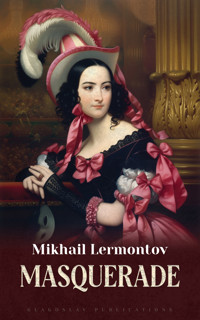
Cover image: Joseph-Désiré Court, ‘Au bal masque
(Vénitienne au bal masqué)’ (1837)
www.glagoslav.com
ISBN: 978-1-80484-245-4 (Ebook)
Published in English by Glagoslav Publications in September 2025
A catalogue record for this book is available from the British Library.
This book is in copyright. No part of this publication may be reproduced, stored in a retrieval system or transmitted in any form or by any means without the prior permission in writing of the publisher, nor be otherwise circulated in any form of binding or cover other than that in which it is published without a similar condition, including this condition, being imposed on the subsequent purchaser.
Contents
Introduction
Masquerade
ACT ONE
Scene One
Scene Two
Scene Three
ACT TWO
Scene One
Scene Two
Scene Three
Scene Four
ACT THREE
Scene One
Scene Two
ACT FOUR
Scene One
About the Translators
Introduction
‘If one were to seek the [Russian] author who best fits the stereotype of “the romantic poet,” Mikhail Lermontov would win without question.’ So wrote John Mersereau Jr in The Cambridge History of Russian Literature, and it is a judgment with which it is hard to disagree, and one which has been shared by most readers and critics since Lermontov’s death.
Mikhail Yuryevich Lermontov was born in Moscow in 1814. His mother came from a wealthy family, while his father was in the military. But their marriage seems to have been an unhappy one, and in any case his mother died in 1817. He was raised by his maternal grandmother, but she and Lermontov’s father constantly disagreed about his upbringing. His youth was therefore turbulent and difficult, and in his teens his troubles were multiplied by his poor health. He was lonely, melancholy, haughty and even unapproachable. But he did not lack charisma.
He began to write poems, and by the age of fourteen he had already displayed a remarkable precocious talent. For the rest of his short life, he was prolific, creating not only poems, but also plays and novels. In 1830 he enrolled at Moscow University; two years later he joined the Life Guard Hussars; but at all times he continued energetically with his writing. Like so many of the Romantic writers throughout Europe, Lermontov came to admire especially Lord Byron, and in 1840 his novel, A Hero of our Time, gave perhaps the most telling expression of any to the Byronic figure. However, it should also be noted that Arbenin, the hero of the play, Masquerade, was a significant earlier portrayal of that same Romantic Byronic hero.
But Lermontov’s was a tangled and ill-fated life. He fought more than one duel, and in July 1841 in Pyatigorsk, he was shot in a duel, and died 48 hours later. He was just twenty-six years old.
He never saw his play, Masquerade, performed – the first performance did not take place until the 1860s. It was rejected by the censor on account of the sharpness of its satire, which culminates in the final act when the Lady remarks bluntly that the cause of her cousin’s death was ‘the stupidity of our society.’ Moreover, much of the action of the play takes place in a very real setting – the house of Engelhardt, well-known in the early 1830s for hosting balls and masquerades attended by the upper echelons of society, even including members of the family of the tsar himself. Lermontov certainly attended a few such events there in 1834 and 1835.
The play tells of a gambler and rake, Arbenin, who has been reformed by the love of his innocent young wife, Nina. He thinks that he has discovered that she is unfaithful to him with Prince Zvezdich. He decides to kill the Prince, and when this fails, he tries to humiliate him by throwing a pack of cards in his face in a gambling den. In fact, Nina has not been unfaithful to him: she unknowingly dropped a bracelet at a masquerade. This was picked up by Baroness Shtrall, who gave it to an admirer of hers – Prince Zvezdich. But Arbenin refuses to believe in Nina’s innocence, especially when he sees her speaking to the Prince at a society ball. He poisons her ice cream there, and when they return home, he tells her what he has done. She dies. But it is then that a stranger remorselessly reveals the truth to him, thereby driving him to insanity. It is a deliberately Othello-like story of unfounded jealousy, with the bracelet taking the place of Othello’s handkerchief, though the characters are romantic, not Shakespearean.
It may also be noticed that gambling, such as that shown in Masquerade, was a perennially fascinating subject for the Russian intelligentsia of the time. Other treatments of it may be found in Alexander Pushkin’s 1835 play, The Queen of Spades, which Tchaikovsky later made into the well-known opera; The Gamblers, Nikolay Gogol’s play of 1840; and The Gambler (1866) by Fyodor Dostoyevsky, written very rapidly with the aim, ironically enough, of making enough money to pay off his gambling debts.
The present translation of Lermontov’s drama is entitled Masquerade, not The Masquerade, which is a possible alternative. The reason for this is because the action is not so much realistic as performative. To include ‘the’ in the title limits the subject; without ‘the’, the idea of masquerading becomes central. The masquerade is a place where participants are required to perform: the mask removes their usual quotidian person, and compels them to playact. Near the end of the play, Kazarin says to Arbenin, ‘Enough of this, brother – take off the mask,’ and admits, ‘we’re both actors.’ If, therefore, a masquerade is inherently performative, the actors of Kazarin, Arbenin and the rest must decide how this performativity can be accessed. It asks questions, for example, of how the many ‘asides’ which the characters speak may be presented. The lack of the article in the title also focuses the question of Arbenin’s behaviour – is it the result of demonic possession, as nineteenth century interpreters tended to suggest, or social pressure, as was often adduced in the twentieth century? And who then is the Stranger? The embodiment of some unseen force, or a hired assassin (as the great theatre director, Vsevolod Meyerhold, opined)?
Indeed it was Meyerhold’s production in 1917 in St Petersburg which demonstrated this play’s extraordinary dramatic power. At least five years in the making, and probably the most expensive production ever mounted in a theatre at that time, the production lasted in the repertoire of the Alexandrinsky Theatre till the 1940s, by which time the director himself had been done to death in one of Stalin’s prisons. It was rehearsed and first presented, however, as the revolution was gathering pace, so that even reaching the theatre for the early audiences was extremely hazardous. The leading actor was turned away by soldiers at one early performance, though an officer who had seen him act managed to intervene, and thus enabled him to get through; Meyerhold himself and his designer, Alexander Golovin, had to run through flying bullets on one occasion; and on another, an audience member was actually shot dead at the entrance to the theatre.
But the production survived, and it was able to demonstrate the power of Lermontov’s quintessential Romanticism.
Robert Leach
Masquerade
Characters
Yevgeny Alexandrovich Arbenin
Nastasya Pavlovna, ‘Nina’, his wife
Prince Zvezdich
Baroness Shtrall
Afanasy Pavlovich Kazarin
Adam Petrovich Shprikh
The Stranger
Host at the gambling house
A clerk
Sasha, Nina’s maid
The Aunt
The Niece
Doctor
Old Man
Gamblers
Servants
Maskers
Guests
The action takes place in St Petersburg in 1835.
ACT ONE
Scene One
A gambling house. Card players: Zvezdich, Kazarin, Shprikh and others at the table, playing; more men standing around.
1 GAMBLER : Ivan Ilich, allow me, please.
BANKER : You’re welcome.
1 GAMBLER : One hundred roubles.
BANKER : Certainly.
2 GAMBLER : Very well, begin, please.
3 GAMBLER : The luck’s got to change – it’s these cards, they’re bewitched.
4 GAMBLER : I shall have to double the stakes.
3 GAMBLER : Play.
2 GAMBLER : On that? … No, I’ll get burned.
4 GAMBLER : My dear sir, you know that nowadays, unless you are extremely cunning, you can achieve nothing.
3 GAMBLER (whispering to 1 Gambler) : Be careful. Keep your eyes on him.
PRINCE : I’m going for broke!
2 GAMBLER : My dear Prince, emotions only poison the blood. Be so good as to remain calm while playing.
PRINCE : Be so good as to keep your advice to yourself.
(They play.)
BANKER : The card is dead.
PRINCE : Hell!
BANKER : Pass all the stakes, please.
2 GAMBLER (mockingly) : I see that in the heat of the moment you’re ready to lose everything. What price your epaulettes?
PRINCE : Honour was the price – a currency you couldn’t pay in.
2 GAMBLER : If I were you, I’d be less chicken-bold – considering your age and your lack of luck!
(Prince, having drunk a glass of lemonade, sits at the side and falls into contemplation.)
SHPRIKH (approaches him sympathetically) : Is it cash you need, Prince? I would be honoured to help you – my interest is low, and my patience inexhaustible.
(Prince nods coldly to him and turns away. Shprikh retreats, looking displeased. Arbenin enters, bows to everybody, comes to the table. He signals to Kazarin, and steps aside with
him.)
ARBENIN : Why are you not taking part? Well, Kazarin?
KAZARIN : I’m merely observing. And yes, my dear sir, you are married now, rich – you have become a sybarite, you have even forgotten your friends.
ARBENIN : Well – I haven’t been here with you for some time.
KAZARIN : Are you busy?
ARBENIN : Busy making love, not money.
KAZARIN : Escorting your wife to all the balls?
ARBENIN : No.
KAZARIN : Do you still play cards?
ARBENIN : No, that’s finished for me. But there are new faces here. Who is that … (ironically) … fashion plate?
KAZARIN : Shprikh! Adam Petrovich! I can easily acquaint you with him. (Shprikh approaches them, and greets them with a bow.) This is my friend. Let me introduce you.
Arbenin.
SHPRIKH : I know you –
ARBENIN : I do not remember our having met –
SHPRIKH : By reputation. Yes, I’ve heard such a great deal about you that for a long time I’ve wished to make your acquaintance.
ARBENIN : Unfortunately I never heard anything about you. But I’m sure you yourself will let me hear plenty. (They bow to each other. Shprikh, making a sour face, retreats.) I don’t like him. I’ve seen all sorts of faces, but it would take a considerable effort to invent one like that. Look at his smile. He has a vicious smile. Eyes as if they were made of glass. When you look at him, you can’t tell whether he’s a human being or a devil.
KAZARIN : Well, my dear friend, a person’s appearance is not important. Even if he were the devil incarnate, we’d still need him. If one needs money, he instantly obliges. I really have no idea what his nationality is – he speaks all languages. He’s probably a Yid. He knows everybody, he’s involved in everybody’s business. He remembers everything, he knows everything, he’s always up to something. He’s been thrashed more than once. If he meets an atheist, he behaves like an atheist; if he associates with a saint, he is a Jesuit; when he’s with us, he’s a gambler; and when he mixes with honest people, he is the most honest person in the world. In other words – I’m sure you’ll like him.
ARBENIN : The portrait may be impressive, but the original is odious! Well, what about that tall gentleman with the moustaches and the make-up? A haunter of fashionable shops, certainly, and a retired womanizer? He’s blatantly westernized – I’m sure he’s a hero of trivialities, yes? He can hit any target of no significance.
KAZARIN : It’s almost like that. He was expelled from his first regiment for fighting a duel – or rather, for not fighting it. He was afraid to kill – his mama told him not to. Then, after a few years, he was challenged to another duel, and this time he did fight.
ARBENIN : What about the scruffy little man there, the one with the broad grin and the cross and the little snuff
box?
KAZARIN : Trushov. He is a man not fully appreciated: he served in Georgia for seven years, or was despatched there with some general. There he killed somebody – but slyly, not in a duel. He spent five years with this general, and got the cross round his neck as a reward.
ARBENIN : You’re obviously very fussy when choosing your friends.
GAMBLERS : Kazarin! Afanasy Pavlovich, come over here!
KAZARIN : I’m coming. (With affected attention and interest) What an extraordinary example of treachery. Ha ha ha ha!
1 GAMBLER : Hurry up!
KAZARIN : What happened?
(The players talk animatedly, then calm down. Arbenin notices Prince Zvezdich and approaches him.)
ARBENIN : Prince, what are you doing here? Perhaps it isn’t your first visit?
PRINCE (moodily) : I could ask the same of you.
ARBENIN : I can forestall your question. Many of the people here have been my acquaintance for a long time. I often used to come here and watched anxiously how the wheel of fortune spun. I saw how it uplifted one person to the heights, and dashed another into an abyss. I never envied them, but neither did I feel any sympathy. I just watched them – young people, full of hope and ardour, others happy in their ignorance of life … passionate souls whose lives had been devoted to love – they soon shrivelled here in front of my eyes. Today destiny drew me back to see this again.
PRINCE (taking him by the arm, emotionally) : I have lost –
ARBENIN : I know. So what now? Are you going to drown yourself?
PRINCE : Oh, I’m in desperate straits.




