


0,99 €
Mehr erfahren.
- Herausgeber: Reading Essentials
- Kategorie: Fantasy und Science-Fiction
- Sprache: Englisch
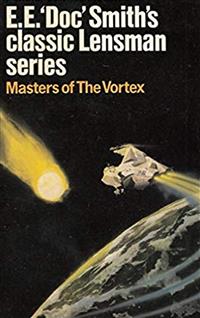
A churning nuclear fireball, appearing out of nowhere, bringing utter destruction - and countless numbers of them were menacing planets throughout the Galaxy! "Storm" Cloud, nucleonic genius, set out in his spaceship Vortex Blaster to track and destroy the mysterious vortices - and embarked on a saga of adventure, discovery and conflict among the far stars that could have been told only by the incomparable "Doc" Smith.
Das E-Book können Sie in Legimi-Apps oder einer beliebigen App lesen, die das folgende Format unterstützen:
Veröffentlichungsjahr: 2018
Ähnliche













Masters of the Vortex
THE VORTEX BLASTER
—“Storm” Cloud, the only man who could destroy the ravening nuclear vortices that struck and killed at random.
THE VORTEX BLASTER
was also the name of Cloud’s space-ship, an incredibly advanced arsenal of modern science, in which Cloud and his crew of colorful space castaways hunted the source of the lethal vortices, battled a criminal mastermind, developed unheard-of sciences, and made an ultimate discovery of shattering importance to the destiny of the Universe!
THE VORTEX BLASTERS
team up in a saga of crisis and adventure in the worlds of the Lensmen—“Doc” Smith’s most enduring creation.
Novels of science fiction
by
“DOC” SMITH
The Skylark series
THE SKYLARK OF SPACE
SKYLARK OF VALERON
SKYLARK THREE
SKYLARK DUQUESNE
The Lensman series
TRIPLANETARY
FIRST LENSMAN
GALACTIC PATROL
GRAY LENSMAN
SECOND STAGE LENSMEN
CHILDREN OF THE LENS
MASTERS OF THE VORTEX
(
original title
: The Vortex Blaster)
MASTERS
OF THE
VORTEX
(original title: THE VORTEX BLASTER)
E. E. Smith
To
Bob Heinlein
CONTENTS
Chapter
Page
1
Catastrophe
7
2
Cloud Blasts a Vortex
15
3
Cloud Loses an Arm
24
4
“Storm” Cloud on Deka
34
5
The Boneheads
48
6
Driving Jets are Weapons
54
7
The Blaster Acquires a Crew
70
8
Vesta the Vegian
77
9
Trouble on Tominga
89
10
Janowick
99
11
Joan the Telepath
106
12
Vesta Practices Spaceal
115
13
Games Within Games
123
14
Vesta the Gambler
138
15
Joan and Her Brains
147
16
Vegian Justice
158
17
The Call
171
18
Cahuita
183
Chapter 1 ▂▂▂▂▂▂CATASTROPHE
SAFETY DEVICES that do not protect.
“Unsinkable” ships that, before the days of Bergenholm and of atomic and cosmic energy, sank into the waters of Earth.
More particularly, safety devices which, while protecting against one agent of destruction, attract magnet-like another and worse. Such as the armored cable within the walls of a wooden house. It protects the electrical conductors within it against accidental external shorts; but, inadequately grounded, it may attract and upon occasion has attracted the stupendous force of lightning. Then, steel armor exploding into incandescence inside walls and ceilings, that house’s existence thereafter is to be measured in minutes.
Specifically, four lightning rods. The lightning rods protecting the chromium, glass, and plastic home of Neal Cloud. Those rods were adequately grounded, with copper-silver cables the size of a big man’s forefinger; for Neal Cloud, Doctor of Nucleonics, knew his lightning and was taking no chances whatever with the safety of his wife and children.
He did not know, did not even suspect, that under certain conditions of atmospheric potential and of ground-magnetic stress his perfectly-designed and perfectly-installed system would become a super-powerful attractor for flying vortices of atomic disintegration.
So now Neal Cloud, nucleonicist, sat at his desk in a strained, dull apathy. His face was a yellowish-gray white, his tendoned hands gripped rigidly the arms of his chair. His eyes, hard and lifeless, stared unseeingly past the small, three-dimensional block portrait of all that had made life worth living.
For his guardian against lightning had been a vortex-magnet at the moment when some luckless wight had tried to abate the nuisance of a “loose” atomic vortex. That wight dies, of course—they almost always did—and the vortex, instead of being destroyed, was simply broken up into a number of widely-scattered new vortices. And one of those bits of furious, uncontrolled energy, resembling a handful of substance torn from the depths of a sun, darted toward and shot downward to earth through Neal Cloud’s new house.
That house did not burn; it exploded. Nothing of it, in it, or near it stood a chance, for in a few seconds the place where it had been was a crater of seething, boiling lava—a crater which filled the atmosphere with poisonous vapors; which flooded all nearby space with lethal radiations.
Cosmically, the whole thing was infinitesimal. Ever since man learned how to use atomic power the vortices of disintegration had been breaking out of control. Such accidents had been happening, and would continue to happen. More than one world, perhaps, had been or would be consumed to the last gram by such loose atomic vortices. What of that? Of what real importance are a few grains of sand to a pile five thousand miles long, a hundred miles wide, and ten miles deep?
Even to that individual grain of sand called “Earth”—or, in modern parlance, “Sol Three,” or “Tellus of Sol,” or simply “Tellus”—the affair was negligible. One man had died; but, in dying, he had added one more page to the thick bulk of negative results already on file. That Mrs. Cloud and her children had perished was merely unfortunate. The vortex itself was not yet a real threat to Tellus. It was a “new” one, and thus it would be a long time before it would become other than a local menace.
Nor, to any except a tiny fraction of Earth’s inhabitants, was the question of loose atomic vortices a matter of concern. It was unthinkable that Tellus, the point of origin and the very center of Galactic Civilization, could cease to exist. Long before such vortices could eat away much of her mass, or poison much of her atmosphere, Earth’s scientists would have solved the problem.
But to Neal Cloud the accident was ultimate catastrophe. His personal universe had crashed in ruins; what was left was not worth picking up. He and Jo had been married for more than fifteen years and the bonds between them had grown stronger, deeper, truer with every passing day. And the kids . . . it couldn’t have happened . . . fate COULDN’T do this to him . . . but it had . . . it could. Gone . . . gone . . . GONE!
And to Neal Cloud, sitting there at his desk in black abstraction, with maggots of thought gnawing holes in his mind, the catastrophe was doubly galling because of its cruel irony. For he was second from the top in the Vortex Control Laboratory; his life’s work had been a search for a means or method of extinguishing loose atomic vortices.
His eyes focused vaguely upon the portrait. Wavy brown hair . . . clear, honest gray eyes . . . lines of character, of strength and of humor . . . sweetly curved lips, ready to smile or to kiss. . . .
He wrenched his attention away and scribbled briefly upon a sheet of paper. Then, getting up stiffly, he took the portrait and moved woodenly across the room to a furnace. After the flaming arc had done its work he turned and handed the paper to a tall man, with a Lens glowing upon his wrist, who had been watching him with quiet, understanding eyes. Significant enough, to the initiate, of the importance of the laboratory is the fact that it was headed by a Lensman.
“As of now, Phil, if it’s QX with you.”
The Lensman took the document, glanced at it, and slowly, meticulously, tore it into sixteen equal pieces.
“Uh-uh, Storm,” he denied, gently. “Not a resignation. Leave of absence, perhaps, but not severance.”
“Why not?” It was scarcely a question; Cloud’s voice was level, uninflected. “I wouldn’t be worth the paper I’d waste.”
“Now, no; but the future’s another matter. I haven’t said anything so far, because I knew you and Jo. Nothing could be said.” Two hands gripped and held. “For the future, though, four words that were spoken long ago have never been improved upon. ‘This, too, shall pass’.”
“You think so?”
“I know so, Storm. I’ve been round a long time. You’re too good a man to go down out of control. You’ve got a place in the world and a job to do. You’ll be back—” a thought struck the Lensman and he went on, in a strangely altered tone: “But you wouldn’t—of course you wouldn’t—you couldn’t.”
“I don’t think so. No.” Suicide, tempting although it might be, was not the answer. “Good-bye, Phil.”
“Not good-bye, Storm. Au revoir.”
“Maybe.” Cloud left the laboratory and took an elevator down to the garage. Into his big blue DeKhotinsky Special and away.
Through traffic so heavy that front-, rear-, and side-bumpers almost touched he drove with his wonted cool skill; even though he did not know, consciously, that the other cars were there. He slowed, turned, stopped, “shoveled on the coal,” all correctly—and all purely automatically.
He did not know where he was going, nor care. His numbed brain was simply trying to run away from its own bitter imaginings—which, if he had thought at all, he would have known hopeless of accomplishment. But he did not think. He simply acted; dumbly, miserably.
Into a one-way skyway he rocketed; along it over the suburbs and into the trans-continental super-highway. Edging inward, lane after lane, he reached the “unlimited” way—unlimited, that is, except for being limited to cars of not less than seven hundred horsepower, in perfect mechanical condition, driven by registered, tested drivers at not less than one hundred twenty five miles per hour—flashed his number at the control station, and shoved his right foot down to the floor.
Everyone knows that an ordinary DeKhotinsky Sporter will do a hundred and forty honestly-measured miles in one honestly-timed hour; but very few drivers have ever found out how fast one of those brutal big souped-up Specials can wheel. Most people simply haven’t got what it takes to open one up.
“Storm” Cloud found out that day. He held that six-thousand-pound Juggernaut onto the road, wide open, for mile after mile after mile. But it didn’t help. Drive as he would, he could not out-run that which rode with him. Beside him and within him and behind him; for Jo was there.
Jo and the kids, but mostly Jo. It was Jo’s car as much as it was his. “Babe, the big blue ox,” was her pet name for it; because, like Paul Bunyan’s fabulous beast, it was pretty nearly six feet between the eyes.
Jo was in the seat beside him. Every dear, every sweet, every luscious, lovely memory of her was there . . . and behind him, just beyond eye-corner visibility, were the three kids. And a whole lifetime of this loomed ahead—a vista of emptiness more vacuous by far than the emptiest reaches of inter-galactic space. Damnation! he couldn’t stand much more of. . . .
High over the roadway, far ahead, a brilliant octagon flared red. That meant “STOP!” in any language. Cloud eased up on the accelerator; eased down on the brake-pedal; took his place in the line of almost-stalled traffic. There was a barrier and a trimly-uniformed policeman.
“Sorry, sir,” the officer said, with a sweeping, turning gesture, “but you’ll have to detour over to Twenty. There’s a loose atomic vortex beside the road up ahead. . . . Oh, it’s you, Doctor Cloud! You can go ahead, of course. Couple of miles yet before you’ll need your armor. They didn’t tell us they were sending for you. It’s just a little new one, and the dope we got was that they were going to shove it over into the badlands with pressors.”
“They didn’t send for me.” Cloud tried to smile. “I’m just driving around. No armor, even, so I might as well go back.”
He turned the Special around. A loose vortex—new. There might be three or four of them, scattered over that many counties. Sisters of the one that had murdered his family—spawn of that damned Number Eleven that that bungling nitwit had tried to blow out. . . . Into his mind there leaped a picture, wire-sharp, of Number Eleven as he had last seen it, and simultaneously an idea hit him like the blow of a fist.
He thought. Really thought, now; intensely and clearly. If he could do it—could actually blow out the atomic flame of an atomic vortex . . . not exactly revenge, but . . . it would work . . . it would have to work—he’d make it work! And grimly, quietly, but alive now in every fiber, he drove back to the city almost as fast as he had come away.
If Philip Strong was surprised at Cloud’s sudden reappearance in the laboratory he did not show it. Nor did he offer any comment as his erstwhile assistant went to various lockers and cupboards, assembling coils, tubes, armor, and other paraphernalia.
“Guess that’s all I’ll need, chief,” Cloud remarked, finally. “Here’s a blank check. If some of this stuff shouldn’t happen to be in usable condition when I get done with it, fill it out to suit, will you?”
“No.” The Lensman tore up the check just as he had torn up the resignation. “If you want the stuff for legitimate purposes, you’re on Patrol business and it’s the Patrol’s risk. But if you’re thinking of trying to snuff a vortex, the stuff stays here. That’s out, Storm.
“But I’m going to really snuff ’em, starting with Number One and taking ’em in order. No suicide.”
“Huh?” Skepticism incarnate. “It can’t be done, except by an almost impossibly fortuitous accident, which is why you yourself have always been as opposed to such attempts as the rest of us. The charge of explosive must match, within very narrow limits, the activity of the vortex itself at the instant of detonation; and that activity varies so greatly and so unpredictably that all attempts at accurate extrapolation have failed. Even the Conference of Scientists couldn’t develop a usable formula, any more than they could work out a tractor that could be used as a tow-line on one.”
“Wait a minute!” Cloud protested. “They found that it could be forecast, for a length of time proportional to the length of the cycle in question, by an extension of the calculus of warped surfaces.”
“Humph! I said a usable formula!” the Lensman snorted. “What good is a ten-second forecast when it takes a GOMEAC twice that long to solve. . . . Oh!” he broke off, staring.
“Oh,” he repeated, slowly. “I forgot for a minute that you were born with a super-GOMEAC in your head. But there are other things.”
“There were. Now there are none.”
“No?”
“NO. I couldn’t take such chances before, and I’d’ve tied myself up into knots if I did. Now nothing can throw me. I can compute all the elements of a sigma curve in nothing flat. A ten-second prediction gives me ten seconds of action. That’s plenty.”
“I see.” Strong pondered, his fingers drumming softly upon his desk. Lensmen did not ordinarily use their Lenses on their Lensless friends, but this was no ordinary occasion. “You aren’t afraid of death any more. But you won’t invite it? And do you mind if I Lens you on that?”
“Come in. I’ll not invite it, but that’s as far as I’ll go in promising. I won’t make any superhuman effort to avoid it. I’ll take all due precautions, for the sake of the job, but if one gets me, what the hell?”
“QX.” The Lensman withdrew from Cloud’s mind. “Not too good, but good enough. What’s your plan? You won’t have time for the usual method of attack.”
“Like this.” Cloud found a sheet of drafting paper and sketched rapidly. “There’s the crater, with the vortex at the bottom—there. From the sigma curve I estimate the most probable value of the activity I’ll have to shoot at. Then I select three duodec bombs from the hundred or so I’ll have made up in advance—one on the mark, one each five percent over and under the mark. The bombs, of course, will be cased in neocarballoy thick enough for penetration. Then I take off in a shielded armored flying suit, say about here. . . .”
“If you take off at all, you and your suit will be inside a flitter,” the Lensman interrupted. “Too many instruments for a suit, to say nothing of bombs, and you’ll need heavier screen than a suit can put out. We can adapt a flitter for bomb-throwing easily enough.”
“That’d be better, of course. QX, I set my flitter into a projectile trajectory toward the center of disturbance. Twelve seconds away, at about this point here, I take my instantaneous readings, solve the equations of that particular warped surface for some definite zero time. . . .”
“But s’pose the cycle won’t give you a ten-second solution?”
“Then I’ll swing around and try again until a long-enough cycle does show up.”
“QX. It will, sometime.”
“Sure. Then, having everything set for zero time, and assuming that the activity is somewhere near my assumed value. . . .”
“Assume it isn’t—it probably won’t be.”
“I accelerate or decelerate. . . .”
“Solving new equations—differential equations at that—all the while?”
“Certainly. Don’t interrupt so. I stick around until the sigma curve, extrapolated to zero time, matches one of my bombs. I build up the right velocity, cut that bomb loose, shoot myself off in a sharp curve, and Z-W-E-E-T—POWIE! She’s out.” With an expressive, sweeping gesture.
“You hope.” Strong was frankly dubious. “And there you are, right in the middle of the damndest explosion you ever saw.”
“Oh, no. I’ve gone free in the meantime, so nothing can touch me.”
“I hope! But do you realize just how busy you are going to be during those ten or twelve seconds?”
“Yes.” Cloud’s face grew somber. “But I’ll be in full control. I won’t be afraid of anything that can happen—of anything that can happen. From my standpoint, that’s the hell of it.”
“QX,” the Lensman decided, “You can go. We’ll iron out the kinks as we go.”
“We?”
“I’ll be in the lookout shack with the boys, at least on the first ones. When do you want to start?”
“How long will it take to fix up the flitter?”
“Two days. Say we meet you there Saturday morning?”
“I’ll be there,” and again Neal Cloud and Babe, the big blue ox, hit the road; and as he rolled along the physicist mulled over in his mind the assignment to which he had set himself.
Like fire, only worse, atomic energy was a good servant, but a very bad master. Man had liberated it before he could really control it. In fact, control was not yet, and probably never would be, perfect. True, all except a minute fraction of one percent of the multitudes of small, tame, self-limiting vortices were perfect servants. But at long intervals, for some unknown reason—science knew so little, fundamentally, of nuclear reactions—one of them flared, nova-like, into a huge, wild, self-sustaining monster. It ceased being a servant, then, and became a master.
Such flare-ups occurred very infrequently; the trouble was that the loose vortices were so utterly, so damnably permanent. They never went out; and no data were ever obtained. Every living thing in the vicinity of a flare-up died; every instrument and every other solid thing within a radius of hundreds of feet melted down into the reeking, boiling slag of its crater.
Fortunately, the rate of growth was slow—as slow, almost, as it was persistent. But even so, unless something could be done about loose vortices before too many years, the situation would become extremely serious. That was why the Laboratory had been established in the first place.
Nothing much had been accomplished so far. Tractor beams would not hold. Nothing material was of any use. Pressors worked after a fashion—vortices could be moved from one place to another. One or two, through sheer luck, had been blown out by heavy charges of duodecaplylatomate. But duodec had taken many lives; and since it scattered a vortex as often as it fed it, duodec had caused vastly more damage than it had cured.
No end of fantastic schemes had been proposed, of course; of varying degrees of fantasy. Some of them sounded almost practical. Some of them had been tried; some were still being tried. Some, such as the perennially-appearing one of installing a free drive and flinging the whole neighborhood off into space, were perhaps feasible from an engineering standpoint. They were potentially so capable of making things worse, however, that they could not be used except as last-ditch measures. In short, the control of loose atomic vortices was very much an unsolved problem.
Chapter 2 ▂▂▂▂▂▂CLOUD BLASTS A VORTEX
NUMBER ONE, the oldest and worst vortex on Tellus, had been pushed out into the badlands, and there, at eight o’clock of the indicated morning, Cloud started to work on it.
The “lookout shack” was in fact a fully-equipped nucleonics laboratory. Its staff was not large—eight men worked in three staggered eight-hour shifts—but the development of its instrumentation had required hundreds of man-years of intensive research. Every factor of the vortex’s activity was measured and recorded continuously, throughout every minute of every day of every year; and all of these measurements were summed up, integrated, into the “sigma” curve. This curve, which to the layman’s eye was only a senselessly zig-zagging line, told the expert everything he wanted to know.
Cloud glanced at the chart and scowled, for one jagged peak, less than half an hour old, almost touched the top line of the paper.
“Bad, huh, Frank?”
“Bad, Storm, and getting worse. I wouldn’t wonder if ‘Calamity’ were right—it certainly looks like she’s getting ready to blow her top.”
“No equation, I suppose,” Strong said. The Lensman ignored as completely as did the observer, if not as flippantly, the distinct possibility that at any moment the observatory and all that it contained might be resolved into their sub-atomic components.
“None,” Cloud stated. He did not need to spend hours at a calculating machine; at one glance he knew, without knowing how he knew, that no equation could fit that wildly-shifting sigma curve. “But most of these recent cycles cut ordinate seven fifty, so I’ll take that for my value. That means nine point nine six zero kilograms of duodec for my basic, and nine four six two and ten point three five eight as alternates. On the wire?”
“It went out as you said it,” the observer replied. “They’ll be here in five minutes.”
“QX. I’ll get dressed, then.”
The Lensman and one of the observers helped him into his cumbersome, heavily-padded armor; then all three men went out to the flitter. A tiny speedster, really; a slim torpedo with the stubby wings and the ludicrous tail-surfaces, the multifarious driving-, braking-, side-, top-, and under-jets so characteristic of the tricky, cranky, but ultra-maneuverable breed. Cloud checked the newly installed triplex launcher, made sure that he knew which bomb was in each tube, and climbed into the tiny operating compartment. The massive door—flitters are too small to have airlocks—rammed shut upon its teflon gaskets, the heavy toggles drove home. A heavily-padded form closed in upon the pilot, leaving only his left arm and his right leg free to move.
“Everybody in the clear?”
“All clear.”
Cloud shot the flitter into the air and toward the seething inferno which was Loose Atomic Vortex Number One. The crater was a ragged, jagged hole perhaps two miles from lip to lip and a quarter of a mile in depth. The floor, being largely molten, was almost level except for a depression at the center, where the actual vortex lay. The walls of the pit were steeply, unstably irregular, varying in pitch and shape with the refractoriness of the strata composing them. Now a section would glare into an unbearably blinding white, puffing away in sparkling vapor. Again, cooled by an inrushing blast of air, it would subside into an angry scarlet, its surface crawling in a sluggish flow of lava. Occasionally a part of the wall might even go black, into pockmarked scoriae or brilliant planes of obsidian.
For always, at some point or other, there was a torrent of air rushing into that crater. It rushed in as ordinary air. It came out, however, in a ragingly uprushing pillar, as—as something else. No one knows exactly what a vortex does to air. Or, rather, the composition of the effluent gases varies as frequently and as unpredictably as does the activity of the vortex. Thus, the atmosphere emitted from a vortex-crater may be corrosive, it may be poisonous, it may be merely different; but it is no longer the air which we human beings are used to breathing. This conversion and corruption of Earth’s atmosphere, if it could not be stopped, would end the possibility of life upon the planet’s surface long before the world itself could be consumed.
As to the vortex itself . . . it is difficult indeed to describe such a phenomenon. Practically all of its frightful radiation lies in those octaves of the spectrum which are invisible to the human eye. Suffice it to say, then, that it was a continuously active atomic reactor, with an effective surface temperature of approximately twenty five thousand degrees Kelvin, and let it go at that.
Neal Cloud, driving his flitter through that murky, radiation-riddled atmosphere, extrapolating his sigma curve by the sheer power of his mathematical-prodigy’s mind, sat appalled. For the activity level was, and even in its lowest dips remained, well above the figure he had chosen. Distant though he was from the rim of that hellish pit, his skin began to prickle and to burn. His eyes began to smart and to ache. He knew what those symptoms meant: even the flitter’s powerful screens were leaking; even his suit-screens and his special goggles were not stopping the stuff. But he wouldn’t quit yet: the activity might—probably would—take a nose-dive any second now. If it did, he’d have to be ready. On the other hand, it might blow up any second, too.
There were two schools of mathematical thought upon that point. One held that a vortex, without any essential change in its nature or behavior, would keep on growing bigger until, uniting with the other vortices of the planet, it had converted all the mass of the world into energy.
The second school, of which the forementioned “Calamity” Carlowitz was the loudest voice, taught that at a certain stage of development the internal energy of the vortex would become so great that generation-radiation equilibrium could not be maintained. This would of course result in an explosion, the nature and consequences of which this Carlowitz was wont to dwell upon in ghoulishly mathematical glee. Neither school could prove its point, however—or, rather, each school proved its point with eminently plausible mathematics—and each hated and derided the other, with heat and at length.
Neal Cloud, as he studied through his almost opaque defenses that indescribably ravening fireball, that rapacious monstrosity which might very well have come from the very center of the hottest hell of mythology, felt strangely inclined to agree with Carlowitz. It didn’t seem possible that it could get any worse without exploding.
The activity stayed high; ’way too high. The tiny control room grew hotter and hotter. His skin burned more and his eyes ached worse. He touched a stud and spoke.
“Phil? Better get me three more bombs. Like these, except up around. . . .”
“I don’t check you. If you do that, it’s apt to drop to a minimum and stay there. I’d suggest a wider interval.”
“QX—that’d be better. Two, then, instead of three. Four point nine eight zero and thirteen point nine four zero. You might break out a jar of burn-dressing, too; some fairly warm stuff is leaking through.”
“Will do. Come down, fast!”
Cloud landed. He stripped to the skin and his friends smeared him with the thick, gooey stuff that was not only added protection against radiation, but also a sovereign remedy for new burns. He exchanged his goggles for a heavier, darker pair. The two bombs arrived and were substituted for two of the original load.
“I thought of something while I was up there,” Cloud said then. “Fourteen kilograms of duodec is nobody’s firecracker, but it may be the least of what’s going to go off. Have you got any idea of what’s going to become of the intrinsic energy of the vortex when I snuff it?”
“Can’t say I have.” The Lensman frowned in thought. “No data.”
“Neither have I. But I’d say you’d better go back to the new station—the one you were going to move to if it kept on getting worse. The clocks are ticking there, aren’t they?”
“Yes. It might be the smart thing to do—just in case.”
Again in air, Cloud found that the activity, while still very high, was not too high for his heaviest bomb, but that it was fluctuating too rapidly. He could not get even five seconds of trustworthy prediction, to say nothing of ten. So he waited, as close to the horrible center of disintegration as he dared.
The flitter hung poised in air, motionless, upon softly hissing under-jets. Cloud knew to a fraction his height above the ground. He knew to a fraction his distance from the vortex. He knew the density of the atmosphere and the velocity and direction of the wind. Hence, since he could also read, closely enough, the momentary variations in the cyclonic storms within the crater, he could compute very easily the course and velocity necessary to land the bomb in the exact center of the vortex at any given instant of time. The hard part—the thing that no one had as yet succeeded in doing—was to predict, for a time far enough ahead to be of any use, a usably close approximation to the vortex’s quantitative activity.
Therefore Cloud concentrated upon the dials and gauges in front of him; concentrated with every fiber of his being and with every cell of his brain.
Suddenly, almost imperceptably, the sigma curve gave signs of flattening out. Cloud’s mind pounced. Simultaneous differential equations; nine of them. A quadruple integration in four dimensions. No matter—Cloud did not solve problems laboriously, one operation at a time. Without knowing how he had arrived at it, he knew the answer; just as the Posenian or the Rigellian can perceive every separate component particle of an opaque, three-dimensional solid, but without being able to explain to any Tellurian how his sense of perception works. It just is, that’s all.
By virtue of whatever sense or ability it is which makes a mathematical prodigy what he is, Cloud knew that in exactly seven and three-tenths seconds from that observed instant the activity of the vortex would match precisely the rating of his heaviest bomb. Another flick of his mental switch and he knew exactly the velocity he would require. His hand swept over the studs, his right foot tramped down hard upon the firing pedal; and, even as the quivering flitter rammed forward under five Tellurian gravities of acceleration, he knew to the thousandth of a second how long he would have to hold that acceleration to attain that velocity. While not really long—in seconds—it was much too long for comfort. It would take him much closer to the vortex than he wanted to be; in fact, it would take him almost to the crater’s rim.
But he stuck to the calculated course, and at the precisely correct instant he released his largest bomb and cut his dive. Then, in a continuation of the same motion, his hand slashed down through the beam of light whose cutting would activate the Bergenholm and make the vessel inertialess—safe from any form whatever of physical violence. For an instant nothing happened, and for that instant Cloud sat appalled. Neutralization of inertia took time! Not that he had ever been told that it was instantaneous—he had just assumed so. He had never noticed any time-lapse before, but now it seemed to be taking forever!
After that one instant of shocked inaction he went into ultra-speed action; kicking in the little vessel’s all-out eight-G drive and whirling her around as only a flitter or a speedster can whirl; only to see in his plate the vortex opening up like a bell-flower, or like a sun going nova.
Cloud’s forebodings were more than materialized then, for it was not only the bomb that was going off. The staggeringly immense energy of the vortex was merging with that of the detonating duodec to form an utterly indescribable explosion.




