


0,99 €
Mehr erfahren.
- Herausgeber: Wildside Press
- Kategorie: Fantasy und Science-Fiction
- Sprache: Englisch
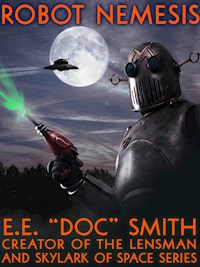
The War of the Planets ended in stalemate. Both fleets were so horribly shattered that the survivors despaired of continuing hostilities. Instead, the few and crippled remaining vessels of each force limped into some sort of formation and returned to their various planetary bases. And, so far, there has not been another battle. Neither side dares attack the other; each is waiting for the development of some super-weapon which will give it the overwhelming advantage...
Das E-Book können Sie in Legimi-Apps oder einer beliebigen App lesen, die das folgende Format unterstützen:
Seitenzahl: 36
Veröffentlichungsjahr: 2022
Ähnliche













Table of Contents
ROBOT NEMESIS, by E. E. “Doc” Smith, Ph.D.
COPYRIGHT INFORMATION
INTRODUCTION
CHAPTER 1
CHAPTER 2
CHAPTER 3
CHAPTER 4
ROBOT NEMESIS,by E. E. “Doc” Smith, Ph.D.
COPYRIGHT INFORMATION
Copyright © 2022 by Wildside Press LLC.
Originally published in Thrilling Wonder Stories, June 1939.
Published by Wildside Press LLC.
wildsidepress.com | bcmystery.com
INTRODUCTION
Edward Elmer Smith (1890–1965)—who first published science fiction as “E.E. Smith, Ph.D.” and later as “E. E. ‘Doc’ Smith”—was an American food engineer (specializing in doughnut and pastry mixes) who also wrote science fiction. His two degrees in chemical engineering gave his work an veneer of scientific respectability in the early days of the field, even though his galaxy-ranging adventure tales had little to do with actual science. He virtually invented the sub-genre of “space opera” in the pulp magazine Amazing Stories, and today he is often referred to as “the father of space opera.”
It was not a smooth road to success for Smith. Although he complete his first book in 1920, there were no science fiction magazines in those days, so he tried general fiction pulps (which sometimes dabbled in science fiction and fantasy). The editor of Argosy rejected it with an encouraging note, saying he thought it was too far out for his readers. Clearly the other pulps agreed. The Skylark of Space would not be sold until 1927 (when Smith noticed a copy of Amazing Stories on the newsstand) and then published as a 3-part serial in Amazing in 1928.
Skylark was embraced enthusiastically by Amazing’s largely juvenile readership. Editor T. O’Connor Sloane wrote to Smith before publication of the second installment and requested a sequel. His career was launched.
“Robot Nemesis,” published in Thrilling Wonder Stories in June 1939, is a tale of interplanetary war in typical Smith fashion, with much at stake for whoever breaks a military stalemate with a new invention of supreme power.
—John Betancourt
Cabin John, Maryland
CHAPTER 1
The Ten Thinkers
The War of the Planets is considered to have ended on 18 Sol, 3012, with that epic struggle, the Battle of Sector Ten. In that engagement, as is of course well known, the Grand Fleet of the Inner Planets—the combined space-power of Mercury, Venus, Earth, and Mars—met that of the Outer Planets in what was on both sides a desperate bid for the supremacy of interplanetary space.
But, as is also well known, there ensued not supremacy, but stalemate. Both fleets were so horribly shattered that the survivors despaired of continuing hostilities. Instead, the few and crippled remaining vessels of each force limped into some sort of formation and returned to their various planetary bases.
And, so far, there has not been another battle. Neither side dares attack the other; each is waiting for the development of some super-weapon which will give it the overwhelming advantage necessary to insure victory upon a field of action so far from home. But as yet no such weapon has been developed; and indeed, so efficient are the various Secret Services involved, the chance of either side perfecting such a weapon unknown to the other is extremely slim.
Thus, although each planet is adding constantly to its already powerful navy of the void, and although four-planet, full-scale war maneuvers are of almost monthly occurrence, we have had and still have peace—such as it is.
In the foregoing matters the public is well enough informed, both as to the actual facts and to the true state of affairs. Concerning the conflict between humanity and the robots, however, scarcely anyone has even an inkling, either as to what actually happened or as to who it was who really did abate the Menace of the Machine; and it is to relieve that condition that this bit of history is being written.
* * * *
The greatest man of our age, the man to whom humanity owes most, is entirely unknown to fame. Indeed, not one in a hundred million of humanity’s teeming billions has so much as heard his name. Now that he is dead, however, I am released from my promise of silence and can tell the whole, true, unvarnished story of Ferdinand Stone, physicist extraordinary and robot-hater plenipotentiary.




