


48,99 €
Mehr erfahren.
- Herausgeber: John Wiley & Sons
- Kategorie: Wissenschaft und neue Technologien
- Serie: The Manchester Physics Series
- Sprache: Englisch
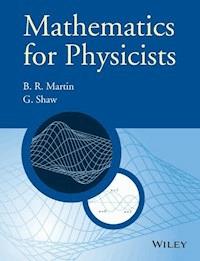
Mathematics for Physicists is a relatively short volume covering all the essential mathematics needed for a typical first degree in physics, from a starting point that is compatible with modern school mathematics syllabuses. Early chapters deliberately overlap with senior school mathematics, to a degree that will depend on the background of the individual reader, who may quickly skip over those topics with which he or she is already familiar. The rest of the book covers the mathematics that is usually compulsory for all students in their first two years of a typical university physics degree, plus a little more. There are worked examples throughout the text, and chapter-end problem sets.
Mathematics for Physicists features:
- Interfaces with modern school mathematics syllabuses
- All topics usually taught in the first two years of a physics degree
- Worked examples throughout
- Problems in every chapter, with answers to selected questions at the end of the book and full solutions on a website
This text will be an excellent resource for undergraduate students in physics and a quick reference guide for more advanced students, as well as being appropriate for students in other physical sciences, such as astronomy, chemistry and earth sciences.
Sie lesen das E-Book in den Legimi-Apps auf:
Seitenzahl: 710
Veröffentlichungsjahr: 2015
Ähnliche

















The Manchester Physics Series
General Editors
J.R. FORSHAW, H.F. GLEESON, F.K. LOEBINGER
School of Physics and Astronomy, University of Manchester
Properties of Matter
B.H. Flowers and E. Mendoza
Statistical Physics
Second Edition
F. Mandl
Electromagnetism
Second Edition
l.S. Grant and W.R. Phillips
Statistics
R.J. Barlow
Solid State Physics
Second Edition
J.R. Hook and H.E. Hall
Quantum Mechanics
F. Mandl
Computing for Scientists
R.J. Barlow and A.R. Barnett
The Physics of Stars
Second Edition
A.C. Phillips
Nuclear Physics
J.S. Lilley
Introduction to Quantum Mechanics
A.C. Phillips
Particle Physics
Third Edition
B.R. Martin and G. Shaw
Dynamics and Relativity
J.R. Forshaw and A.G. Smith
Vibrations and Waves
G.C. King
Mathematics for Physicists
B.R. Martin and G. Shaw
Mathematics for Physicists
B.R. MARTIN
Department of Physics and Astronomy University College London
G. SHAW
Department of Physics and Astronomy Manchester University
This edition first published 2015 © 2015 John Wiley & Sons, Ltd
Registered officeJohn Wiley & Sons Ltd, The Atrium, Southern Gate, Chichester, West Sussex, PO19 8SQ, United Kingdom
For details of our global editorial offices, for customer services and for information about how to apply for permission to reuse the copyright material in this book please see our website at www.wiley.com.
The right of the author to be identified as the author of this work has been asserted in accordance with the Copyright, Designs and Patents Act 1988.
All rights reserved. No part of this publication may be reproduced, stored in a retrieval system, or transmitted, in any form or by any means, electronic, mechanical, photocopying, recording or otherwise, except as permitted by the UK Copyright, Designs and Patents Act 1988, without the prior permission of the publisher.
Wiley also publishes its books in a variety of electronic formats. Some content that appears in print may not be available in electronic books.
Designations used by companies to distinguish their products are often claimed as trademarks. All brand names and product names used in this book are trade names, service marks, trademarks or registered trademarks of their respective owners. The publisher is not associated with any product or vendor mentioned in this book.
Limit of Liability/Disclaimer of Warranty: While the publisher and author have used their best efforts in preparing this book, they make no representations or warranties with respect to the accuracy or completeness of the contents of this book and specifically disclaim any implied warranties of merchantability or fitness for a particular purpose. It is sold on the understanding that the publisher is not engaged in rendering professional services and neither the publisher nor the author shall be liable for damages arising herefrom. If professional advice or other expert assistance is required, the services of a competent professional should be sought.
The advice and strategies contained herein may not be suitable for every situation. In view of ongoing research, equipment modifications, changes in governmental regulations, and the constant flow of information relating to the use of experimental reagents, equipment, and devices, the reader is urged to review and evaluate the information provided in the package insert or instructions for each chemical, piece of equipment, reagent, or device for, among other things, any changes in the instructions or indication of usage and for added warnings and precautions. The fact that an organization or Website is referred to in this work as a citation and/or a potential source of further information does not mean that the author or the publisher endorses the information the organization or Website may provide or recommendations it may make. Further, readers should be aware that Internet Websites listed in this work may have changed or disappeared between when this work was written and when it is read. No warranty may be created or extended by any promotional statements for this work. Neither the publisher nor the author shall be liable for any damages arising herefrom.
Library of Congress Cataloging-in-Publication Data.
Martin, B. R. (Brian Robert), author. Mathematics for physicists / B.R. Martin, G. Shaw. pages cm Includes bibliographical references and index. ISBN 978-0-470-66023-2 (cloth) – ISBN 978-0-470-66022-5 (pbk.) 1. Mathematics. 2. Mathematical physics. I. Shaw, G. (Graham), 1942– author. II. Title. QC20.M35 2015 510–dc23
2015008518
CONTENTS
Editors' preface to the Manchester Physics Series
Authors' preface
Notes and website information
‘Starred’ material
Website
Examples, problems and solutions
1 Real numbers, variables and functions
1.1 Real numbers
1.2 Real variables
1.3 Functions, graphs and co-ordinates
Problems 1
Notes
2 Some basic functions and equations
2.1 Algebraic functions
2.2 Trigonometric functions
2.3 Logarithms and exponentials
2.4 Conic sections
Problems 2
Notes
3 Differential calculus
3.1 Limits and continuity
3.2 Differentiation
3.3 General methods
3.4 Higher derivatives and stationary points
3.5 Curve sketching
Problems 3
Notes
4 Integral calculus
4.1 Indefinite integrals
4.2 Definite integrals
4.3 Change of variables and substitutions
4.4 Integration by parts
4.5 Numerical integration
4.6 Improper integrals
4.7 Applications of integration
Problems 4
Notes
5 Series and expansions
5.1 Series
5.2 Convergence of infinite series
5.3 Taylor's theorem and its applications
5.4 Series expansions
*5.5 Proof of d'Alembert's ratio test
*5.6 Alternating and other series
Problems 5
Notes
6 Complex numbers and variables
6.1 Complex numbers
6.2 Complex plane: Argand diagrams
6.3 Complex variables and series
6.4 Euler's formula
Problems 6
Notes
7 Partial differentiation
7.1 Partial derivatives
7.2 Differentials
7.3 Change of variables
7.4 Taylor series
7.5 Stationary points
*7.6 Lagrange multipliers
*7.7 Differentiation of integrals
Problems 7
Notes
8 Vectors
8.1 Scalars and vectors
8.2 Products of vectors
8.3 Applications to geometry
8.4 Differentiation and integration
Problems 8
Notes
9 Determinants, Vectors and Matrices
9.1 Determinants
9.2 Vectors in
n
Dimensions
9.3 Matrices and linear transformations
9.4 Square Matrices
Problems 9
Notes
10 Eigenvalues and eigenvectors
10.1 The eigenvalue equation
*10.2 Diagonalisation of matrices
Problems 10
Notes
11 Line and multiple integrals
11.1 Line integrals
11.2 Double integrals
11.3 Curvilinear co-ordinates in three dimensions
11.4 Triple or volume integrals
Problems 11
12 Vector calculus
12.1 Scalar and vector fields
12.2 Line, surface, and volume integrals
12.3 The divergence theorem
12.4 Stokes' theorem
Problems 12
Notes
13 Fourier analysis
13.1 Fourier series
13.2 Complex Fourier series
13.3 Fourier transforms
Problems 13
Notes
14 Ordinary differential equations
14.1 First-order equations
14.2 Linear ODEs with constant coefficients
*14.3 Euler's equation
Problems 14
Notes
15 Series solutions of ordinary differential equations
15.1 Series solutions
15.2 Eigenvalue equations
15.3 Legendre's equation
15.4 Bessel's equation
Problems 15
Notes
16 Partial differential equations
16.1 Some important PDEs in physics
16.2 Separation of variables: Cartesian co-ordinates
16.3 Separation of variables: polar co-ordinates
*16.4 The wave equation: d'Alembert's solution
*16.5 Euler Equations
*16.6 Boundary conditions and uniqueness
Problems 16
Notes
Answers to selected problems
Problems 1
Problems 2
Problems 3
Problems 4
Problems 5
Problems 6
Problems 7
Problems 8
Problems 9
Problems 10
Problems 11
Problems 12
Problems 13
Problems 14
Problems 15
Problems 16
Index
EULA
List of Tables
Chapter 3
Table 3.1
Chapter 4
Table 4.1
Table 4.2
Chapter 5
Table 5.1
Chapter 12
Table 12.1
Table 12.2
Chapter 14
Table 14.1
Chapter 15
Table 15.1
Guide
Cover
Table of Contents
Preface
Pages
xi
xiii
xv
1
2
3
4
5
6
7
8
9
10
11
12
13
14
15
16
17
18
19
20
21
22
23
24
25
26
27
28
29
30
31
32
33
34
35
36
37
38
39
40
41
42
43
44
45
46
47
48
49
50
51
52
53
54
55
56
57
58
59
60
61
62
63
64
65
66
67
68
69
71
72
73
74
75
76
77
78
79
80
81
82
83
84
85
86
87
88
89
90
91
92
93
94
95
96
97
98
99
100
101
102
103
104
105
106
107
108
109
110
111
112
113
114
115
116
117
118
119
120
121
122
123
124
125
126
127
128
129
130
131
132
133
134
135
136
137
138
139
140
141
143
144
145
146
147
148
149
150
151
152
153
154
155
156
157
158
159
160
161
162
163
164
165
166
167
169
170
171
172
173
174
175
176
177
178
179
180
181
182
183
184
185
186
187
188
189
190
191
192
193
194
195
196
197
198
199
200
201
202
203
204
205
206
207
208
209
210
211
212
213
214
215
216
217
219
220
221
222
223
224
225
226
227
228
229
230
231
232
233
234
235
236
237
238
239
240
241
242
243
244
245
246
247
248
249
250
251
252
253
254
255
256
257
258
259
260
261
262
263
264
265
266
267
268
269
270
271
272
273
274
275
276
277
278
279
280
281
282
283
284
285
286
287
288
289
291
292
293
294
295
296
297
298
299
300
301
302
303
304
305
306
307
308
309
310
311
312
313
314
315
316
317
318
319
320
321
322
323
324
325
326
327
328
329
330
331
332
333
334
335
336
337
338
339
340
341
342
343
344
345
346
347
348
349
350
351
352
353
354
355
356
357
358
359
360
361
362
363
364
365
366
367
368
369
370
371
372
373
374
375
376
377
378
379
380
381
382
383
384
385
386
387
389
390
391
392
393
394
395
396
397
398
399
400
401
402
403
404
405
406
407
408
409
410
411
412
413
414
415
416
417
418
419
420
421
422
423
424
425
426
427
428
429
431
432
433
434
435
436
437
438
439
440
441
442
443
444
445
446
447
448
449
450
451
452
453
454
455
456
457
458
459
460
461
462
463
464
465
466
467
468
469
470
471
472
473
474
475
476
477
478
479
480
481
482
483
484
485
486
487
488
489
490
491
492
493
494
495
496
497
498
499
500
501
502
503
504
505
507
508
509
510
511
512
513
514
515
516
517
518
519
520
521
522
523
524
525
526
527
528
529
530
531
532
533
534
535
536
537
538
539
540
541
542
543
544
545
546
547
548
549
550
551
552
553
554
555
556
557
558
559
560
561
562
563
564
565
Editors' preface to the Manchester Physics Series
The Manchester Physics Series is a set of textbooks at first degree level. It grew out of the experience at the University of Manchester, widely shared elsewhere, that many textbooks contain much more material than can be accommodated in a typical undergraduate course; and that this material is only rarely so arranged as to allow the definition of a short self-contained course. The plan for this series was to produce short books so that lecturers would find them attractive for undergraduate courses, and so that students would not be frightened off by their encyclopaedic size or price. To achieve this, we have been very selective in the choice of topics, with the emphasis on the basic physics together with some instructive, stimulating and useful applications.
Although these books were conceived as a series, each of them is self-contained and can be used independently of the others. Several of them are suitable for wider use in other sciences. Each Author's Preface gives details about the level, prerequisites, etc., of that volume.
The Manchester Physics Series has been very successful since its inception over 40 years ago, with total sales of more than a quarter of a million copies. We are extremely grateful to the many students and colleagues, at Manchester and elsewhere, for helpful criticisms and stimulating comments. Our particular thanks go to the authors for all the work they have done, for the many new ideas they have contributed, and for discussing patiently, and often accepting, the suggestions of the editors.
Finally, we would like to thank our publisher, John Wiley & Sons, Ltd., for their enthusiastic and continued commitment to the Manchester Physics Series.
J. R. Forshaw
H. F. Gleeson
F. K. Loebinger
August 2014
Authors' preface
Our aim in writing this book is to produce a relatively short volume that covers all the essential mathematics needed for a typical first degree in physics, from a starting point that is compatible with modern school mathematics syllabuses. Thus, it differs from most books, which include many advanced topics, such as tensor analysis, group theory, etc., that are not required in a typical physics degree course, except as specialised options. These books are frequently well over a thousand pages long and contain much more material than most undergraduate students need. In addition, they are often not well interfaced with school mathematics and start at a level that is no longer appropriate. Mathematics teaching at schools has changed over the years and students now enter university with a wide variety of mathematical backgrounds.
The early chapters of the book deliberately overlap with senior school mathematics, to a degree that will depend on the background of the individual reader, who may quickly skip over those topics with which he or she is already familiar. The rest of the book covers the mathematics that is usually compulsory for all students in their first two years of a typical university physics degree, plus a little more. Although written primarily for the needs of physics students, it would also be appropriate for students in other physical sciences, such as astronomy, chemistry, earth science, etc.
We do not try to cover all the more advanced, optional courses taken by some physics students, since these are already well treated in more advanced texts, which, with some degree of overlap, take up where our book leaves off. The exception is statistics. Although this is required by undergraduate physics students, we have not included it because it is usually taught as a separate topic, using one of the excellent specialised texts already available.
The book has been read in its entirety by one of the editors of the Manchester Physics Series, Jeff Forshaw of Manchester University, and we are grateful to him for many helpful suggestions that have improved the presentation.
B.R. Martin
G. Shaw
April 2015
Notes and website information
‘Starred’ material
Some sections of the book are marked with a star. These contain more specialised or advanced material that is not required elsewhere in the book and may be omitted at a first reading.
Website
Any misprints or other necessary corrections brought to our attention will be listed on www.wiley.com/go/martin/mathsforphysicists. We would also be grateful for any other comments about the book.
Examples, problems and solutions
Worked examples are given in all chapters. They are an integral part of the text and are designed to illustrate applications of material discussed in the preceding section. There is also a set of problems at the end of each chapter. Some equations which are particularly useful in problem solving are highlighted in the text for ease of access and brief ‘one-line’ answers to most problems are given at the end of the book, so that readers may quickly check whether their own answer is correct. Readers may access the full solutions to all the odd-numbered problems at www.wiley.com/go/martin/mathsforphysicists. Full solutions to all problems are available to instructors at the same website, which also contains electronic versions of the figures.




