


51,99 €
Mehr erfahren.
- Herausgeber: John Wiley & Sons
- Kategorie: Wissenschaft und neue Technologien
- Serie: The Manchester Physics Series
- Sprache: Englisch
An accessible and carefully structured introduction to Particle Physics, including important coverage of the Higgs Boson and recent progress in neutrino physics.
- Fourth edition of this successful title in the Manchester Physics series
- Includes information on recent key discoveries including: An account of the discovery of exotic hadrons, byond the simple quark model; Expanded treatments of neutrino physics and CP violation in B-decays; An updated account of ‘physics beyond the standard model’, including the interaction of particle physics with cosmology
- Additional problems in all chapters, with solutions to selected problems available on the book’s website
- Advanced material appears in optional starred sections
Sie lesen das E-Book in den Legimi-Apps auf:
Seitenzahl: 839
Veröffentlichungsjahr: 2016
Ähnliche

















The Manchester Physics Series
General Editors
J.R. FORSHAW, H.F. GLEESON, F.K. LOEBINGER
School of Physics and Astronomy
,
University of Manchester
Properties of Matter
B.H. Flowers and E. Mendoza
Statistical Physics
Second Edition
F. Mandl
Electromagnetism
Second Edition
l.S. Grant and W.R. Phillips
Statistics
R.J. Barlow
Solid State Physics
Second Edition
J.R. Hook and H.E. Hall
Quantum Mechanics
F. Mandl
Computing for Scientists
R.J. Barlow and A.R. Barnett
The Physics of Stars
Second Edition
A.C. Phillips
Nuclear Physics
J.S. Lilley
Introduction to Quantum Mechanics
A.C. Phillips
Dynamics and Relativity
J.R. Forshaw and A.G. Smith
Vibrations and Waves
G.C. King
Mathematics for Physicists
B.R. Martin and G. Shaw
Particle Physics
Fourth Edition
B.R. Martin and G. Shaw
Particle Physics
Fourth Edition
B.R. MARTIN
Department of Physics and Astronomy University College London
G. SHAW
School of Physics and Astronomy Manchester University
This edition first published 2017 © 2017 John Wiley & Sons, Ltd
Registered officeJohn Wiley & Sons, Ltd, The Atrium, Southern Gate, Chichester, West Sussex, PO19 8SQ, United Kingdom
For details of our global editorial offices, for customer services and for information about how to apply for permission to reuse the copyright material in this book please see our website at www.wiley.com.
The right of the authors to be identified as the authors of this work has been asserted in accordance with the Copyright, Designs and Patents Act 1988.
All rights reserved. No part of this publication may be reproduced, stored in a retrieval system, or transmitted, in any form or by any means, electronic, mechanical, photocopying, recording or otherwise, except as permitted by the UK Copyright, Designs and Patents Act 1988, without the prior permission of the publisher.
Wiley also publishes its books in a variety of electronic formats. Some content that appears in print may not be available in electronic books.
Designations used by companies to distinguish their products are often claimed as trademarks. All brand names and product names used in this book are trade names, service marks, trademarks or registered trademarks of their respective owners. The publisher is not associated with any product or vendor mentioned in this book. This publication is designed to provide accurate and authoritative information in regard to the subject matter covered. It is sold on the understanding that the publisher is not engaged in rendering professional services. If professional advice or other expert assistance is required, the services of a competent professional should be sought.
Library of Congress Cataloging-in-Publication Data applied for.
A catalogue record for this book is available from the British Library.
ISBN: 9781118911907 (hardback), 9781118912164 (paperback)
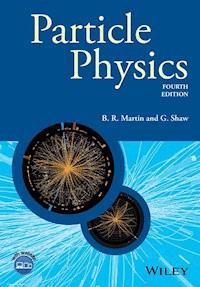
The pictures on the front cover show two Higgs boson production events obtained at the LHC accelerator at CERN. The larger circle shows the decay of the Higgs to four electrons (indicated by the blue and red lines) obtained by the ATLAS collaboration and the smaller circle shows the decay of the Higgs to two gamma rays (indicated by the green lines) obtained by the CMS collaboration.
‘But why are such terrific efforts made just to find new particles?’ asked Mr Tompkins.
‘Well, this is science,’ replied the professor, ‘the attempt of the human mind to understand everything around us, be it giant stellar galaxies, microscopic bacteria, or these elementary particles. It is interesting and exciting, and that is why we are doing it.’
From Mr Tompkins Tastes a Japanese Meal, by George Gamow (Mr Tompkins in Paperback, Cambridge University Press (1965), p.186).
List of Tables
Appendix D
Table D.1
Chapter 1
Table 1.1
Chapter 2
Table 2.1
Chapter 3
Table 3.1
Table 3.2
Table 3.3
Table 3.4
Table 3.5
Chapter 4
Table 4.1
Table 4.2
Table 4.3
Table 4.4
Chapter 5
Table 5.1
Chapter 6
Table 6.1
Table 6.2
Table 6.3
Table 6.4
Table 6.5
Table 6.6
Table 6.7
Table 6.8
Table 6.9
Table 6.10
Table 6.11
Table 6.12
Table 6.13
Table 6.14
Chapter 9
Table 9.1
Chapter 10
Table 10.1
Table 10.2
Chapter 12
Table 12.1
Guide
Cover
Table of Contents
1
Pages
xiii
xv
xvii
xix
1
2
3
4
5
6
7
8
9
10
11
12
13
14
15
16
17
18
19
20
21
22
23
24
25
26
27
28
29
30
31
32
33
34
35
36
37
38
39
40
41
42
43
44
45
46
47
48
49
50
51
52
53
54
55
56
57
58
59
60
61
62
63
64
65
66
67
68
69
70
71
72
73
74
75
76
77
78
79
80
81
82
83
84
85
86
87
88
89
90
91
92
93
94
95
96
97
98
99
100
101
102
103
104
105
106
107
108
109
110
111
112
113
114
115
116
117
118
119
120
121
122
123
124
125
126
127
128
129
130
131
132
133
134
135
136
137
138
139
140
141
142
143
144
145
146
147
148
149
150
151
152
153
154
155
156
157
158
159
160
161
162
163
164
165
166
167
168
169
170
171
172
173
174
175
176
177
178
179
180
181
182
183
184
185
186
187
189
190
191
192
193
194
195
196
197
198
199
200
201
202
203
204
205
206
207
208
209
210
211
212
213
214
215
216
217
218
219
220
221
222
223
224
225
226
227
228
229
230
231
232
233
234
235
236
237
238
239
240
241
242
243
244
245
246
247
248
249
250
251
253
254
255
256
257
258
259
260
261
262
263
264
265
266
267
268
269
270
271
272
273
274
275
276
277
278
279
280
281
282
283
284
285
286
287
288
289
290
291
292
293
294
295
296
297
298
299
300
301
302
303
304
305
306
307
308
309
310
311
312
313
314
315
316
317
318
319
320
321
322
323
324
325
326
327
328
329
330
331
332
333
334
335
336
337
338
339
340
341
342
343
344
345
346
347
348
349
350
351
352
353
354
355
356
357
358
359
360
361
362
363
364
365
366
367
368
369
370
371
372
373
374
375
376
377
378
379
380
381
382
383
384
385
386
387
388
389
390
391
392
393
394
395
396
397
398
399
399
400
401
402
403
404
405
406
407
408
409
410
411
412
413
414
415
416
417
418
419
420
421
422
423
424
425
426
427
428
429
430
431
432
433
434
435
436
437
438
439
440
441
442
443
444
445
446
447
448
449
450
451
452
453
454
455
456
Editors' preface to the Manchester Physics Series
The Manchester Physics Series is a set of textbooks at first degree level. It grew out of the experience at the University of Manchester, widely shared elsewhere, that many textbooks contain much more material than can be accommodated in a typical undergraduate course; and that this material is only rarely so arranged as to allow the definition of a short self-contained course. The plan for this series was to produce short books so that lecturers would find them attractive for undergraduate courses, and so that students would not be frightened off by their encyclopaedic size or price. To achieve this, we have been very selective in the choice of topics, with the emphasis on the basic physics together with some instructive, stimulating and useful applications.




