


114,99 €
Mehr erfahren.
- Herausgeber: John Wiley & Sons
- Kategorie: Wissenschaft und neue Technologien
- Sprache: Englisch
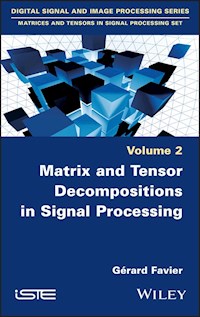
The second volume will deal with a presentation of the main matrix and tensor decompositions and their properties of uniqueness, as well as very useful tensor networks for the analysis of massive data. Parametric estimation algorithms will be presented for the identification of the main tensor decompositions. After a brief historical review of the compressed sampling methods, an overview of the main methods of retrieving matrices and tensors with missing data will be performed under the low rank hypothesis. Illustrative examples will be provided.
Sie lesen das E-Book in den Legimi-Apps auf:
Seitenzahl: 521
Veröffentlichungsjahr: 2021
Ähnliche



















Table of Contents
Cover
Title Page
Copyright
Introduction
I.1. What are the advantages of tensor approaches?
I.2. For what uses?
I.3. In what fields of application?
I.4. With what tensor decompositions?
I.5. With what cost functions and optimization algorithms?
I.6. Brief description of content
1 Matrix Decompositions
1.1. Introduction
1.2. Overview of the most common matrix decompositions
1.3. Eigenvalue decomposition
1.4. URV
H
decomposition
1.5. Singular value decomposition
1.6. CUR decomposition
2 Hadamard, Kronecker and Khatri–Rao Products
2.1. Introduction
2.2. Notation
2.3. Hadamard product
2.4. Kronecker product
2.5. Kronecker sum
2.6. Index convention
2.7. Commutation matrices
2.8. Relations between the
diag
operator and the Kronecker product
2.9. Khatri–Rao product
2.10. Relations between vectorization and Kronecker and Khatri–Rao products
2.11. Relations between the Kronecker, Khatri–Rao and Hadamard products
2.12. Applications
3 Tensor Operations
3.1. Introduction
3.2. Notation and particular sets of tensors
3.3. Notion of slice
3.4. Mode combination
3.5. Partitioned tensors or block tensors
3.6. Diagonal tensors
3.7. Matricization
3.8. Subspaces associated with a tensor and multilinear rank
3.9. Vectorization
3.10. Transposition
3.11. Symmetric/partially symmetric tensors
3.12. Triangular tensors
3.13. Multiplication operations
3.14. Inverse and pseudo-inverse tensors
3.15. Tensor decompositions in the form of factorizations
3.16. Inner product, Frobenius norm and trace of a tensor
3.17. Tensor systems and homogeneous polynomials
3.18. Hadamard and Kronecker products of tensors
3.19. Tensor extension
3.20. Tensorization
3.21. Hankelization
4 Eigenvalues and Singular Values of a Tensor
4.1. Introduction
4.2. Eigenvalues of a tensor of order greater than two
4.3. Best rank-one approximation
4.4. Orthogonal decompositions
4.5. Singular values of a tensor
5 Tensor Decompositions
5.1. Introduction
5.2. Tensor models
5.3. Examples of tensor models
Appendix Random Variables and Stochastic Processes
A1.1. Introduction
A1.2. Random variables
A1.3. Discrete-time random signals
A1.4. Application to system identification
References
Index
End User License Agreement
List of Illustrations
Introduction
Figure I.1.
Third-order PARAFAC model
Figure I.2.
Third-order Tucker model
Figure I.3.
Fourth-order TT model
Chapter 3
Figure 3.1.
Fibers of a third-order tensor
Figure 3.2.
Matrix slices of a third-order tensor
Figure 3.3.
Unfolding
B
J
1×
J
2
I
3
.
Appendix Random Variables and Stochastic Processes
Figure A1.1.
Symmetry regions of the third-order cumulant
List of Tables
Introduction
Table I.1.
Signal and image tensors
Table I.2.
Other fields of application
Table I.3.
Parametric complexity of the CPD, TD, and TT decompositions
Table I.4.
Cost functions for model estimation and recovery of missing data
Chapter 1
Table 1.1.
The most common matrix decompositions
Table 1.2.
Eigenvalues of a real square matrix
Table 1.3.
Eigenvalues and extrema of the Rayleigh quotient
Table 1.4.
Eigenvalue properties of certain matrix classes
Table 1.5.
Eigenvalues of positive/negative (semi-)definite matrices
Table 1.6.
Equivalent and similar matrices
Table 1.7.
Fundamental subspaces of
A ∈
I
×
J
Table 1.8.
Relations between the fundamental subspaces
Table 1.9.
Relations between left and right singular vectors
Table 1.10.
Definition and properties of the SVD
Table 1.11.
Relations between the left and right singular vectors
Table 1.12.
SVD and fundamental subspaces
Table 1.13.
Computation of an SVD and of the Moore-Penrose pseudo-inverse
Table 1.14.
Matrix norms
Table 1.15.
Rank-
k
approximation and approximation errors
Table 1.16.
Least squares estimator
Chapter 2
Table 2.1.
Hadamard, Kronecker, and Khatri-Rao products and Kronecker sum
Table 2.2.
Hadamard product of Hermitian positive (semi-)definite matrices
Table 2.3.
Basic relations satisfied by the Hadamard product
Table 2.4.
The
diag
operator and the Hadamard product
Table 2.5.
Basic relations satisfied by the Kronecker product of vectors
Table 2.6.
Rank-one matrices and Kronecker products of vectors
Table 2.7.
Other decompositions of
(u ⊗ v)(x ⊗ y)
H
Table 2.8.
Relations involving Kronecker products of vectors
Table 2.9.
Properties of the multiple Kronecker product
Table 2.10.
Identities involving matrix-vector Kronecker products
Table 2.11.
Rank, trace, determinant, and spectrum of a Kronecker product
Table 2.12.
Kronecker product of positive/negative definite matrices
Table 2.13.
Structural properties of the Kronecker product
Table 2.14.
Kronecker products of vectors and index convention
Table 2.15.
Kronecker products of matrices and index convention
Table 2.16.
Commutation matrices, vectorization, and Kronecker product
Table 2.17.
Khatri-Rao product and index convention
Table 2.18.
Relations between the Hadamard, Khatri-Rao, and Kronecker products
Table 2.19. Relations between the Kronecker, Khatri-Rao, and Hadamard products o...
Table 2.20. Other relations between the Kronecker, Khatri-Rao, and Hadamard prod...
Table 2.21.
Basic relations
Table 2.22.
Vectorization formulae
Table 2.23.
Partial derivatives of various functions
Table 2.24.
Derivatives of a scalar function and a vector function
Table 2.25.
Derivatives of a matrix function with respect to a matrix variable
Table 2.26.
Definitions of
in partitioned form
Table 2.27.
Other derivatives
Table 2.28.
Derivatives of matrix traces
Chapter 3
Table 3.1.
Notation for sets of indices and dimensions
Table 3.2.
Various sets of tensors
Table 3.3.
Multilinear forms and associated tensors
Table 3.4.
Multilinear forms and associated homogeneous polynomials
Table 3.5.
Notation for tensors
Table 3.6.
Matricization by index blocks for different sets of tensors
Table 3.7.
Block-wise transposition
Table 3.8.
Hermitian/symmetric tensors by blocks of order
P
Table 3.9.
Block symmetrized tensor
χ
of a third-order tensor
Table 3.10.
Outer products of matrices and tensors
Table 3.11.
Scalar elements of outer products
Table 3.12.
Matricized and vectorized forms of a rank-one third-order tensor
Table 3.13.
Mode-
p
products of a third-order tensor with a matrix
Table 3.14.
Matrix products and mode-
p
product
Table 3.15.
Different types of multiplication with tensors
Table 3.16.
Orthogonality and idempotence properties
Table 3.17.
Inverses of orthogonal/unitary tensors
Table 3.18.
Generalized inverses
Table 3.19.
Operations with the Einstein product
Table 3.20.
Properties of the Moore-Penrose pseudo-inverse
Table 3.21.
LS solutions of tensor linear systems
Table 3.22.
Matrix operations
Table 3.23.
Tensor operations
Chapter 4
Table 4.1.
Eigenpairs and generalized eigenpairs for tensors
Table 4.2.
Properties of hypercubic symmetric tensors
Chapter 5
Table 5.1.
Third-order Tucker model
Table 5.2.
Tucker-(2,3) and Tucker-(1,3) models
Table 5.3.
Third-order PARAFAC model
Table 5.4.
Fourth-order PARAFAC model
Table 5.5.
Variants of the third-order PARAFAC model
Table 5.6.
k
-rank of certain matrices and essential uniqueness of a third-order ...
Appendix Random Variables and Stochastic Processes
Table A1.1.
Some definitions for jointly distributed r.v.s
x
and
y
Table A1.2.
Definitions of uncorrelated and orthogonal r.v.s
x
and
y
Table A1.3.
Properties of r.v.s
Table A1.4. Definitions and properties of the second-order statistics of real ra...
Table A1.5.
Definitions and properties for real random signals
x
(
k
)
and
y
(
k
)
Table A1.6. Definitions and properties of second-order statistics for stationary...
Table A1.7.
Second-order statistics of the output of a linear system
Table A1.8.
Factors of the polyspectra
Table A1.9.
Bispectra and trispectra of the output of a linear system
Guide
Cover
Table of Contents
Title Page
Copyright
Introduction
Begin Reading
Appendix Random Variables and Stochastic Processes
References
Index
Other titles from iSTE in Digital Signal and Image Processing
End User License Agreement
Pages
v
iii
iv
xi
xii
xiii
xiv
xv
xvi
xvii
xviii
xix
xx
xxi
xxii
xxiii
xxiv
xxv
xxvi
xxvii
xxviii
1
2
3
4
5
6
7
8
9
10
11
12
13
14
15
16
17
18
19
20
21
22
23
24
25
26
27
28
29
30
31
32
33
34
35
36
37
38
39
40
41
42
43
44
45
47
48
49
50
51
52
53
54
55
56
57
58
59
60
61
62
63
64
65
66
67
68
69
70
71
72
73
74
75
76
77
78
79
80
81
82
83
84
85
86
87
88
89
90
91
92
93
94
95
96
97
98
99
100
101
102
103
104
105
106
107
108
109
110
111
112
113
114
115
116
117
118
119
120
121
122
123
124
125
126
127
128
129
130
131
132
133
134
135
136
137
138
139
140
141
142
143
144
145
146
147
148
149
150
151
152
153
154
155
156
157
158
159
160
161
162
163
164
165
166
167
168
169
170
171
172
173
174
175
176
177
178
179
180
181
182
183
184
185
186
187
188
189
190
191
192
193
194
195
196
197
198
199
200
201
202
203
204
205
206
207
208
209
210
211
212
213
214
215
216
217
218
219
221
222
223
224
225
226
227
228
229
230
231
232
233
234
235
236
237
238
239
240
241
242
243
244
245
246
247
248
249
250
251
252
253
254
255
256
257
258
259
260
261
262
263
264
265
266
267
268
269
270
271
272
273
274
275
276
277
278
279
280
281
282
283
284
285
286
287
288
289
290
291
292
293
294
295
296
297
298
299
300
301
302
303
304
305
306
307
308
309
310
311
312
313
314
315
316
317
318
319
320
321
322
323
324
325
326
327
329
330
331
332
333
334
335
336
337
338
339
340
341
342
343
344
345
347
348
349
350
351
352
353
354
355
356
357
Matrices and Tensors with Signal Processing Set
coordinated byGérard Favier
Volume 2
Matrix and Tensor Decompositions in Signal Processing
Gérard Favier
First published 2021 in Great Britain and the United States by ISTE Ltd and John Wiley & Sons, Inc.
Apart from any fair dealing for the purposes of research or private study, or criticism or review, as permitted under the Copyright, Designs and Patents Act 1988, this publication may only be reproduced, stored or transmitted, in any form or by any means, with the prior permission in writing of the publishers, or in the case of reprographic reproduction in accordance with the terms and licenses issued by the CLA. Enquiries concerning reproduction outside these terms should be sent to the publishers at the undermentioned address:
ISTE Ltd27-37 St George’s RoadLondon SW19 4EUUK
www.iste.co.uk
John Wiley & Sons, Inc.111 River StreetHoboken, NJ 07030USA
www.wiley.com
© ISTE Ltd 2021The rights of Gérard Favier to be identified as the author of this work have been asserted by him in accordance with the Copyright, Designs and Patents Act 1988.
Library of Congress Control Number: 2021938218
British Library Cataloguing-in-Publication DataA CIP record for this book is available from the British LibraryISBN 978-1-78630-155-0




