


Erhalten Sie Zugang zu diesem und mehr als 300000 Büchern ab EUR 5,99 monatlich.
- Herausgeber: THP Ireland
- Kategorie: Fantasy und Science-Fiction
- Sprache: Englisch
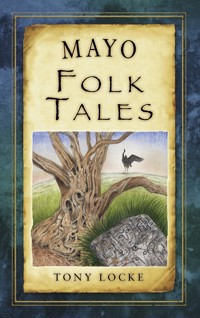
Those magic words 'Once upon a time' have been spoken around the flickering flame of the turf fire by storytellers for thousands of years. In this book, author Tony Locke has gathered together the rich tapestry of stories that make up the folklore, myth and legend of County Mayo. This book will take you on a journey through the rugged landscape of the west coast of Ireland, to its holy mountain, Croagh Patrick, and across the foaming waters of Clew Bay. Here you will read of Gráinne Ní Mháille, the Pirate Queen, the spectre known as the Fír Gorta who roamed the famine villages of west Mayo, the monsters that inhabit the deep waters of Lough Mask and the Matchstick Man of Straide. You will also read of the Love Flower and two young lovers, the land of eternal youth that is Tír na nÓg and the night of the Big Wind. So why not pull up a chair and sit awhile? You know you're never too old for a story.
Sie lesen das E-Book in den Legimi-Apps auf:
Seitenzahl: 286
Veröffentlichungsjahr: 2014
Das E-Book (TTS) können Sie hören im Abo „Legimi Premium” in Legimi-Apps auf:
Ähnliche















This book is dedicated to my wife and soulmate, Gaynor, with love and appreciation for all her support over the years.
ACKNOWLEDGEMENTS
This book would not have been possible without the support and encouragement of my wife, Gaynor. Words cannot express my gratitude for her advice and guidance and the amount of time she spent proofreading. Her superb illustrations are a joy to the eye.
My thanks to our daughter Siobhán for her patience, understanding and endless cups of tea.
I would also like to thank Tony Cranston, a fellow storyteller, for his advice, experience and comments, as well as Turtle Bunberry (‘The Night of the Big Wind’), Gerard Delaney and the South Mayo Family Research Journal (‘The Night of the Big Wind’), Ivor Hamrock, Mayo County Library, Jack O’Reilly and his daughter Gertrude O’Reilly McHale.
Finally, I’d like to acknowledge all those storytellers past and present, for a story does not become a story until it is shared and in the sharing it makes the journey a lot shorter.
CONTENTS
Title
Dedication
Acknowledgements
Introduction
1 The Legends of Barnalyra Wood
2 An Gorta Mór / The Great Famine 1845–1850
3 The Legends of Inishkea and Inishglora
4 Tadhg Dall O’Huiginn: The Matchstick Man of Straide
5 The Love Flower
6 Soul Gatherers
7 The Night of the Big Wind
8 The Dobhar Chú
9 Tír na nÓg: The Land of Eternal Youth
10 Sea Monsters of the Fairy Realm
11 The Remarkable Story of a Seal
12 Gráinne Ní Mháille
13 Folk Tales of Cong
14 The Prophet of Erris and the Achill Tragedies
15 The Cóiste Bodhar
16 Sacred Wells
17 The Love Fairies
18 Patrick and Croagh Patrick
19 Guleesh of County Mayo
20 Cillíní
21 Irish Wakes
22 The Yew
23 Who was the Hangman of Robert Emmet?
24 Festivals
Bibliography
Copyright
INTRODUCTION
Those magic words ‘once upon a time’ have been spoken around the flickering flame of the turf fire by storytellers for thousands of years. In these pages you will find gathered together tales of County Mayo to ignite your imagination: tales of highwaymen and ghostly figures that roam the woods, monsters that inhabit the deep waters of Lough Mask and creatures of the night that suck the life from those they visit.
The stories are part of the rich tapestry that makes up the folklore, myth and legend of Count Mayo and they will take you on a journey through the rugged landscape of the west coast of Ireland, to its holy mountain Croagh Patrick, known locally as ‘the Reek’, and across the waters of Clew Bay. You will read of Gráinne Ní Mháille, the Pirate Queen, the spectre known as the Fear Gorta that roamed the famine villages of west Mayo, and the matchstick man of Straide.
Within the covers of this book, you will also find the story of ‘The Love Flower’ with its two young lovers, the land of eternal youth known as Tír na nÓg, ‘The Night of the Big Wind’ and many more. So why not pull up a chair and sit awhile? You know you’re never too old for a story.
1
THE LEGENDSOF BARNALYRA WOOD
Barnalyra was mentioned in O’Donovan’s Ordnance Survey (1838), where it was recorded as being the property of Lord Dillon. It covered 796 acres of hilly ground and the soil was described as gravelly, suitable for growing oats and potatoes. There was a deep, wooded ravine on the land, which runs parallel to the road, although most of the trees have since been felled. This was known as Barnalyra Wood and it was located just next to where Knock International Airport is today. The wood is long gone and the few remaining stumps and trees resemble tombstones in a deserted graveyard. This quiet and desolate spot seems to invite you to imagine all sorts of ghostly apparitions and what follows is a tale of one such ghost.
THE GHOSTOF BARNALYRA WOOD
The Irish Tourist Association Survey of 1944 records the fact that, in the parish of Kilbeagh in County Mayo, not far from Charlestown, there is a local legend that speaks of greed, heartbreak and a curse that was to lead to the haunting of Barnalyra Wood.
Once there was a poor woodcutter and his wife who lived in a small simple cottage on the edge of the wood. They had one child, a son; however for economic reasons he had gone to England to make his fortune. The cottage was next to the road that led from Sligo to Galway, so a number of travellers would pass by their door each day. One summer’s morning there was a knock on the door, which came as a surprise as no coach had stopped. The woodcutter opened the door to find a passing traveller who informed him and his wife that he had word from their son, saying that he was returning from England. In great excitement, the woodcutter and his wife began to make preparations for their son’s return.
The son arrived in due course with a travelling companion. They were very tired as they had walked from the town of Drogheda but great joy was felt in their little cottage that night. The son and his friend were given a hearty meal and afterwards they all sat around the blazing fire, smoking their pipes and talking about times gone by and all the strange things they had seen in England. However, the conversation soon turned to the subject of money and how much they had made while working across the water. Of course, the woodcutter found all this boasting a little hard to believe as he didn’t think anyone could make that amount of money, so the son’s companion took out a large purse filled with gold coins as proof of his earnings. Unfortunately for him, from that moment on his fate was sealed.
As the evening wore on, the son and his friend began to suffer the effects of their long day and decided that they would retire for the night. However, as it was such a small cottage, there were only two bedrooms: one for the woodcutter and his wife and the other for the son. The son and his friend had no option but to share the bed, the son on the inside and his friend on the outside. The woodcutter wished them a good night, closed the door and went back to his wife by the kitchen fire. The son went straight to sleep but his friend found sleep hard to come by and lay awake listening to the sound of voices coming from the kitchen. The woodcutter and his wife were arguing and although he didn’t like to listen he found himself drawn to the sound. Imagine his horror when he discovered the reason why they were arguing.
The woodcutter was planning to kill him and take his purse of gold. The wife insisted that this was wrong and that no good would come of it but the woodcutter was adamant and would not be dissuaded. The stranger heard the soft sound of footsteps approaching as the woodcutter, armed with a hatchet, crept stealthily towards the room. The stranger crawled over his friend and lay down on the inside of the bed, hoping that the woodcutter would not be able to attack him without waking his son. Unfortunately, it was a dark night lit only by a faint moonbeam coming through the window, so the woodcutter mistook his son for the stranger and brought the hatchet down on his neck, killing his only son. In the confusion that followed, the stranger escaped, never to be seen again.
About a week passed and the woodsman began to hear a rumour about a headless ghost haunting the road leading from the wood. At first people laughed at the rumour, putting it down to superstition and imagination. However, it wasn’t long before more and more people began to report sightings and it was said that even though it was headless they could hear an unearthly screaming coming from the ghost. The rumour soon spread and travellers began to stay clear of the area. It is said that the ghost of their son may still be seen in Barnalyra Wood. Sometimes the ghostly apparition is seen without its head, crying in a sad, unearthly way as he ‘curses his father but blesses his mother’.
We don’t really know what happened to his parents. Were they convicted of the crime of murder? Did they bury the body and get away with it? I guess we’ll never know; however, some people claim they were driven mad by grief and suffered their own death a thousand times before eventually shuffling off this mortal coil. As for the ghost, well, if you’re walking near Barnalyra Wood in the dark of night and you hear a faint scream, walk a little faster.
THE IRISH HIGHWAYMEN
The Irish highwaymen were at the height of their powers around the seventeenth and into the late eighteenth century and were particularly active on the main roads leading to and from cities in Kerry, Cork, Dublin and Galway. They had a romantic air about them, a little bit like the Irish version of those famous English outlaws, Robin Hood and Dick Turpin. It was said that, like their English counterparts, they only robbed the rich (usually English or Anglo-Irish landlords) and left the poor peasants alone. For this reason they were generally aided by the peasants who offered them aid and shelter or a place to stable their horse.
However, this in itself carried a severe risk for if you were caught harbouring a highwayman the penalty was death by hanging. It was even said that you would be denied a decent burial in consecrated ground; instead you would be buried at the crossroads or in the local cillín.
The term ‘rapparee’ comes from an Old Irish word meaning a pike-wielding person. The pike was a long thrusting spear used in close combat. Rapparees were usually footpads (common robbers). The footpads had no scruples; they formed small gangs and would just as soon rob the priest of his collection money as thrust a pike into an English gentleman for the gold in his purse.
The highwaymen, however, were a higher class of criminal. It was said they were Irish gentlemen who had been robbed of their land by the English invaders during Cromwell’s infamous time in Ireland. These dispossessed Irish gentlemen usually had some military training, could afford a horse, a gun and sometimes a short sword rather than a pike, and they usually didn’t murder their victims.
There are many stories told concerning the exploits of the highwaymen, some in song, including ‘The Wild Rover’, ‘Brennan on the Moor’ and, one of my favourites, ‘Whiskey in the Jar’, a song of betrayal which is said to refer to Patrick Fleming who was hanged in 1650.
In County Mayo we had our own notorious highwaymen, two of whom were known to use Barnalyra Wood as a hideout, although at different points in history. Their names were Dudley Costello and Captain Gallagher.
Dudley Costello
Every county in Ireland had their own ‘gentlemen of the road’, also known as highwaymen or thieving blackguards, depending on which end of the weapon you were on. County Mayo was no exception. Dudley Costello was known as ‘the scourge of Mayo’ and Barnalyra Wood was his favourite hideout. The Costellos were descended from an early Anglo-Norman family that had settled in County Mayo. As with many of the Normans who arrived here, they went on to intermarry with indigenous Irish families and soon adopted native ways, becoming ‘more Irish than the Irish themselves’. However, it was for this reason that they incurred the wrath of the English authorities in Ireland and after the unsuccessful Irish rebellion of 1641 their lands were seized and given to what the English saw as loyal Crown subjects.
The Costello lands were given to the Dillons. In 1660 Dudley Costello, who had witnessed the distribution of his estates, decided enough was enough. His answer came in open revolt against the English and all they stood for. He gathered a couple of dozen followers who were veterans of various conflicts, including the 1641 rebellion. As veterans, they were trained in the use of sidearms. They took to the woods and hills of County Mayo and they were soon attacking the new planters. Costello became so successful that the State papers of the time described him as the ‘Scourge of Mayo’. They began to go further afield, from Lough Mask in County Mayo to Lough Erne in County Fermanagh, burning mansions belonging to those Costello described as ‘his enemies’ and driving their cattle into the bogs, hills and woodland.
In 1667, during one of these cattle raids in Killasser, Costello and his men were driving the cattle towards Barnalyra Wood when they were ambushed at a crossing on the River Moy. Costello was killed by an English officer with what was described at the time as ‘a lucky shot’. However, the rest of his men managed to escape, including his second in command, Captain Nangle. Costello’s head was sent to Dublin and displayed on a spike for a year and a day outside St James’s Prison, now the Guinness Brewery. The inscription on a plaque above his head read ‘The Scourge of Mayo’.
Captain Gallagher
Captain Gallagher was born in Bonniconlon but reared in Derryronane near Swinford by his aunt. In many ways he was Ireland’s answer to Dick Turpin, a folk hero and a champion of the peasant classes who suffered injustice and oppression at the hands of the rich and ruling classes.
He led a small band of men armed with blunderbusses and they operated over quite a wide area, stretching from Bonniconlon to Swinford, including Attymass, Lough Talt and Foxford. Eventually they began raiding mail coaches as well as wealthy landowners and travellers throughout eastern Mayo and parts of southern County Sligo and western County Roscommon. His attacks on landowners were especially widely known and, in one reported incident, he and his men raided the home of an extremely unpopular landlord in Killasser. He forced the landlord to eat half a dozen eviction notices he had recently drawn up his tenant farmers. Gallagher then escaped with silver and other valuables.
They were known to be utterly fearless and had no problem carrying out robberies in broad daylight. They also had no qualms about robbing the houses of the rich almost on a nightly basis. It was said that nowhere was beyond Gallagher’s reach.
Captain Gallagher has become part of the folklore of County Mayo. His generosity to the poor, his ability to escape the clutches of the redcoats and his retreat to the Ox Mountains are legendary. The people of Swinford will recall that one of Gallagher’s hiding places was Barnalyra Wood, and it has been suggested that he even had a house on Glass Island near Pontoon.
Amongst the stories told about Gallagher’s exploits, there is one concerning a shop in Foxford. Apparently the shop was robbed on a regular basis, despite the owner hiring a night-watchman; the culprit always seemed to just fade away. Captain Gallagher offered his services and hid in a large chest in a dark corner of the shop. The nightwatchman arrived shortly afterwards and, instead of standing guard, he proceeded to rob the place. Gallagher jumped out of the box and held him captive until the shopkeeper had him tied up. It turned out it was the nightwatchman who was the thief all along.
Another story tells us of a woman who was coming home from the fair in Tubbercurry. She had been there to sell her house cow so she could pay her rent to her landlord. We all know how important that cow must have been to her family as it would have supplied milk, butter, cheese and buttermilk. The poor woman must have been in a desperate situation if she found herself forced to sell it.
Nightfall was fast approaching and she was passing through a windy gap when all of a sudden she saw a dark shadow coming towards her. A person spoke, asking her where she was going at this time of day and why did she seem to be in such a hurry.
‘I’m trying to get home before dark, sir. It’s on account of Captain Gallagher; I’m afraid he might rob me of what little I have, sir.’
Captain Gallagher questioned her and upon finding out her reason for going to the fair he gave her the full price of the cow so she could buy a new one and he also gave her the money to pay her rent to the landlord. He told her to go safely home and tell whoever she knew that Captain Gallagher was not as bad as he was painted out to be.
Captain Gallagher’s reign was finally ended when his band of men were captured near Westport. Gallagher escaped but was finally captured near Foxford. According to one story, he was staying in a house where he was recovering from an illness. He was given a meal that had been laced with poteen and upon falling into a deep sleep the people of the house tied him up and sent word to the redcoats in Foxford. Another version blames a jealous neighbour and, in order to save his host, Gallagher surrendered. Whichever version you believe, the final outcome remains the same. The redcoats alerted Ballina, Swinford and Castlebar, a huge force turned up and Gallagher, already bound, was taken to Castlebar to be hanged after a hasty sham trial.
His execution in 1818 is said to have been the last public hanging to take place on the hanging tree opposite Daly’s Hotel on the Mall in Castlebar.
Charles Gavan Duffy, the Young Irelander, wrote a ballad called ‘The Rapparees’:
Now Sassenach and Cromweller, take heed of what I say,
Keep down your black and angry looks that scorn us night and day;
For there’s a just and wrathful Judge that every action sees,
And he’ll make strong, to right our wrong, the faithful Rapparees.
2
AN GORTA MÓR / THE GREAT FAMINE 1845–1850
Ireland has suffered the devastating effects of famine many times during her history. The Great Famine, or An Gorta Mór, is the most important event in modern Irish history and the actions of the government of the day compounded its effects. The failure of the potato crop was unprecedented and led to the deaths of more than 1.5 million people and mass emigration on a scale never seen before or since. It was a time that most Irish people rarely talk about. Some remember it as a famine; however, others still refer to it as ‘The Great Starvation’ for when there is food enough to export there should be no famine.
God sent a curse upon the land because her sons were slaves.
The rich earth brought forth rottenness, and gardens became graves,
The green crops withered in the fields, all blackened by the curse,
And wedding gay and dance gave way to coffin and to hearse.
(Anon., 1849)
FÉAR GORTACH
‘Féar gortach’ means ‘hungry grass’. This is a patch of dead grass that pops up where someone has died violently, according to some, while others say it happens where someone has died of hunger specifically. There are those who suggest that it’s a spot where a corpse has lain on the way to its final resting place, or even where they still lie, covered by grass, a reminder of the famine. There are even those who say that it may be a fairy curse. Whatever the reason, the grass becomes a predator.
Have you ever been walking down a green grassy bóithrín (the Irish term for a small road with room for one cow) on a bright sunny day when you were suddenly overtaken by a hunger so strong you almost passed out? Believe me, it’s happened and a good Irishman would immediately know why and what to do. Anyone who walks or passes over the féar gortach in Irish, will suddenly become hungry beyond reason, even if they have just been well fed. Those who live near patches of such grass have been known to keep extra food on hand in the case of afflicted travellers knocking on their door. No other side effects are known.
Sometimes you might even hear some of the older folk say, ‘The féar gortach is on me’, meaning they are feeling very hungry. When we were young children we were told to always have a biscuit or a piece of bread in our pockets when going out for a walk just in case the féar gortach came on us. However, if you didn’t have a biscuit you could always suck on a shoelace.
As an adult when I visit somewhere like the famine village over in Achill, I place a piece of bread and pour a little of what I have to drink onto the ground as an offering to the spirits of the place.
THEFEAR GORTA
When we were children we were told the story of the Fear Gorta or the ‘Man of Hunger’. He was a tall thin man dressed in black, raggedy clothes. He travelled around County Mayo, going from place to place, village to village and town to town during times of famine. It was said that when he knocked on your door you had to welcome him as you would a stranger and offer him a little food and drink even though food was extremely hard to come by during the famine. For this reason many would hide behind closed doors, some would deny him any food or drink and some would even chase him from the door. For these people there would be no hope; they had sealed their fate – death by starvation.
Those who spared a small piece of potato or a drop of milk, even if that was all the family had, or those who genuinely had nothing except the offer of a welcome hand would be thanked by the Fear Gorta for their generosity. He would then politely refuse their offer and take his leave of them. However, before he left he would say, ‘Because of your generosity and your honest welcome today you will be truly blessed. Neither you nor your family will ever die of the hunger. Tell no others of what has passed here but from this day forth your pot will never be empty, your jug will never run dry.’ In the morning the woman of the house would go to the pot, where she would find a great big potato, more than enough to feed the whole family, and a jug that was brimming over with fresh, creamy milk. It would be the same each morning and the family would survive the famine.
Ireland has traditionally been known as the ‘land of a thousand welcomes’; however, I wonder how many of us would welcome a stranger to our door today with an offer of a hot meal and a warm drink?
3
THE LEGENDSOF INISHKEAAND INISHGLORA
INISHKEA
The Inishkea Islands are situated off the north Mayo coast and consist of Inishkea North and Inishkea South. They are also known as the Goose Islands in Irish (Inis Gé).
The islands were named after a woman called Kea who founded a small community of nuns there. However, the inhabitant I wish to tell you about is a magical crane. It is said that he has been on the island since the beginning of time, perched high up on a rock looking out over the Atlantic Ocean. He keeps a lonely vigil; never visited by any of his own kind, he ignores all other birds. Life passes him by like a fog drifting in from the sea and folklore tells us that he will continue his vigil until the end of time.
INISHGLORA
It is said that bodies buried on the Island of Inishglora, situated off the coast of North Mayo, do not decompose because the air and soil have magical powers that prevent decay. In times past, bodies were taken to the island and left lying above ground in the open air. It was said that they remained unchanged and that even their nails and hair grew quite naturally so that years later a person could return to the Island and still recognise not only their father and grandfather but even their ancestors. It is claimed that this was true until the monks left the island (R. Nolan, 1997).
Gerald of Wales, a member of the aristocratic Norman family of the Fitzgeralds, was a visitor to Ireland in the twelfth century. He wrote:
In this island human corpses are not buried and do not putrefy, but are placed in the open and remain without corruption. Here men see with some wonder and recognise their grandfathers, great grandfathers, and great, great grandfathers and a long line of ancestors.
(Wright, T. (ed.), The historical works of Giraldus Cambrensis)
It was also claimed that the sand and clay from the island would banish rats and mice and that this would work even if soil was taken to use on the mainland. Gerald of Wales went on to write:
There is another remarkable thing about this island. While the whole of Ireland is infested with mice, there is not a single mouse here. For no mouse is bred here, nor does one live if it be brought in. If by any chance it is brought in, it makes straight for the nearest point of the sea and throws itself in; if it be prevented, it dies on the spot.
(Wright, T. (ed.), The historical works of Giraldus Cambrensis)
Another legend tells us that there was a tradition that infertile couples who did a station on the island would be blessed with a family. Having done the station, they retired to a special bed on the island. Maybe we can think of it as an early fertility clinic. There is also a story told about a curious blackbird that visits Inishglora and apparently the only other place it’s seen is Sceilig Mhicil.
The island is uninhabited today; if you visit you will find the ruins of old buildings, including the two churches (one for men, the other for women). There are some beehive huts that were used by the monks, and perhaps even predate the arrival of Christianity, and there is a well known as St Brendan’s Well, which has steps leading down to it. The well has its own superstition associated with it, which states that if a woman takes water from it, the water will turn to blood and this blood will be full of worms. This has been put to the test and has been found to be untrue.
Could this superstition have been created for practical reasons? Lonely monks going down the steps into a dark place might have meet lonely nuns fetching water and of course we all know what can happen then, don’t we? ‘It was the waters’ fault’ was the cry. So there you have it: the women had to be kept away from the well.
You will still find garden herbs, introduced by the monks and nuns hundreds of years ago, growing wild all over the island and locals say that the herbs will grow until the end of time. Who can say? Maybe they will.
THE CHILDRENOF LIR
Once upon a time long, long ago there lived a king who ruled the sea and his name was Lir. He had a beautiful wife called Eva, with whom he was to have four children. The eldest son was called Aodh, they had a daughter called Fionnuala and twin boys, Fiachra and Conn. Unfortunately their mother died whilst giving birth to the twins, leaving Lir and his children heartbroken. Lir needed to re-marry so his children could have a mother and he could have some company, so he married Eva’s sister, Aoife. Unknown to Lir, Aoife was an evil witch.
At first all seemed to go well. Aoife appeared to love the children and she was a good wife to Lir. However, it was not to last. Soon Aoife began to resent the children and she became jealous of the time that the king spent with them. One day she decided that she had had enough; the only way she was going to get the attention she deserved from Lir was to rid herself of these troublesome children. Aoife suggested that the children pay a visit to their grandfather. On the way, they stopped by a lake where she encouraged them to go for a swim. Due to the fact that their father was the king of the sea, the children had been born with gills and webbing between their fingers and toes, so they loved the water and were having a great time happily splashing each other. They didn’t notice that their stepmother was now standing at the water’s edge wearing their father’s magic cloak.
‘For too long you have stood between me and your father, but no more for now I will be rid of you,’ Aoife screamed.
‘We can’t be killed by the likes of you,’ Aodh replied, ‘we are the children of Lir and if you harm us then our ghosts will haunt you until the end of time.’
‘Ohhh, I’m not going to kill you,’ she cried. ‘I have something far worse planned for you.’
Aoife bowed her head and began to cast a spell. The children looked at each other in fear as they saw a dark circle begin to envelop them on the water. Aoife opened her cloak and from within a great fireball emerged and hurtled towards them, destroying everything in its wake. When the fireball hit the water, steam began to rise up around the children. As the steam rose, they began to lose all feeling in their legs and arms and their sight faded. They were soon to regain their sight, only to see Aoife standing at the water’s edge, laughing at them. Aodh tried to raise his arm in order to attack her but for some reason he just started to furiously splash the water. He turned to his brothers and sister and it was then he realised that they had all been turned into the most beautiful swans ever seen.
Aoife screamed at them and told them that she had cursed them with a spell. They were to spend nine hundred years as swans: three hundred on Lough Derravaragh, three hundred on the straits of Moyle and three hundred on the isle of Inishglora. To end the spell they would have to hear the bell of the new God.
‘I leave you with your voices, however, and they will be the most beautiful singing voices ever heard,’ she said.
When Aoife arrived back home, Lir was frantic. He had not known about the trip and had been searching for his children all day. Aoife told him that they had been attacked and killed by wild boars. Aoife in her triumph had not noticed that the children had followed her back and Fionnuala, now in swan form, approached her father and told him what Aoife had done. Lir was furious and banished Aoife into exile, turning her into a crane, the bird symbolising of death in Celtic lore.
The children spent the first three hundred years on the lake and their father made sure that their time was spent as happily as it could be. The next three hundred years began and the swans left for the straits of Moyle, never to see their father again. Unfortunately, without the power of their father’s love, their time on the northern straits of Moyle was less joyous. There were frequent storms and it was very cold but at least they survived and were still together.
After another three hundred years they left the cold straits and flew over the land, looking down at where their father’s fort had been but by now it was in ruins. The time of the Tuatha Dé Danann had ended and they began to weep. Travelling west, they arrived at Inishglora and found refuge on a saltwater lake. Here time passed slowly.
One day an old man visited the lake and the children asked him if he was a follower of the new God. The man was startled; he had heard the legend of the children of Lir but always believed it to be just a story. He asked them if they were the children of Lir and they told him that they were.
‘Are you a holy man?’ asked Fiachra.
‘I am,’ replied the old man.
The children realised that the time of their entrapment was coming to an end. The holy man began to tell them of his new God and of a man called Patrick. The children became excited as they knew that this was the new God that their stepmother had told them about. They stayed with the holy man for many years and were given sanctuary in a small church he had built. The holy man had spent years melting down old bits of metal that he found, with which he intended to make a bell to put onto the top of the church. The time came and the bell was completed and ready to be rung when disaster struck.
A warrior dressed in armour arrived on the island. He entered the church and demanded the swans he had heard about. He was Liargen, the King of Connacht, and his wife had been told of the beautiful singing voices of the swans.
‘My wife desires those swans and I will have them,’ he said. ‘Hand them over or I will tear this church to the ground.’




