


51,99 €
Mehr erfahren.
- Herausgeber: John Wiley & Sons
- Kategorie: Wissenschaft und neue Technologien
- Sprache: Englisch
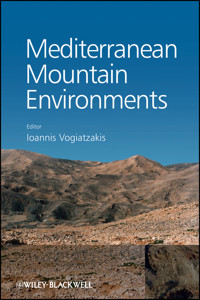
Mediterranean mountains exhibit many similarities in their biotic ecological, physical and environmental characteristics. There are also many differences in terms of their human colonization pattern, historic land uses and current anthopogenic pressures.
This book provides an introduction to these environments of mountainous areas in the Mediterranean and their changes in time and space in relation to both natural and cultural factors.
Mediterranean Mountain Environments places its emphasis on physical geography while adopting an integrated approach to the whole subject area. The book draws examples from a wide range of environments, demonstrating the interaction between human and physical processes responsible for shaping mountain areas. Risks and conflicts, as well as methods and tools for the conservation and management of both the natural and cultural environment are covered in the light of future challenges for the sustainable development of the Mediterranean mountains.
- Emphasis on both mainland and island mountain ranges
- Combines natural and cultural approach in the topic
- Integrated approach: facing future challenges based on the study and understanding of the historical processes that have shaped the Mediterranean mountains
- Key references at the end of each chapter
Sie lesen das E-Book in den Legimi-Apps auf:
Seitenzahl: 390
Veröffentlichungsjahr: 2012
Ähnliche



















Contents
Cover
Title Page
Copyright
Dedication
List of contributors
Preface
Acknowledgements
Chapter 1: Introduction to the Mediterranean mountain environments
1.1 Introduction
1.2 Setting the scene
1.3 The character of the Mediterranean mountains
Chapter 2: Quaternary environmental history
2.1 Introduction
2.2 The pre-Quaternary period
2.3 The Quaternary period
2.4 The Holocene
2.5 Conclusion
Chapter 3: Glacial history
3.1 Introduction
3.2 Pleistocene glaciations in the Mediterranean mountains
3.3 Modern and recent glaciers in the Mediterranean mountains
3.4 Conclusion
Chapter 4: Landforms and soils
4.1 Introduction
4.2 Geomorphological processes in the Mediterranean mountain region
4.3 Geological setting
4.4 Soil characteristics of Mediterranean landscape units
4.5 Northern Mediterranean mountain landscapes: from the Pyrenees to the Hellenids
4.6 Eastern Mediterranean mountains: the Lebanon Mountains
4.7 Southern Mediterranean mountains: Atlas Mountains and Iberian Baetic Cordillera
4.8 Characteristic mountain landscapes of the Mediterranean islands
4.9 Conclusion
Chapter 5: Climate and hydrology
5.1 Introduction
5.2 Climate and physical characteristics
5.3 Vulnerability of water resources to climate change
5.4 Adaptation strategies
5.5 Conclusion
Chapter 6: Biogeography
6.1 Introduction to mountain biogeography
6.2 Vegetation
6.3 Flora
6.4 Fauna
6.5 Conservation in Mediterranean mountains
6.6 Conclusion
Chapter 7: Cultural geographies
7.1 Introduction
7.2 Mythical mountains
7.3 Theophanic mountains
7.4 ‘Traditional’ mountains
7.5 Commodified mountains
7.6 Conclusion
Chapter 8: Land use changes
8.1 Introduction
8.2 Drivers of land use changes
8.3 Major land uses and their historical evolution
8.4 Recent land use changes
8.5 Discussion
8.6 Conclusion
8.7 Acknowledgements
Chapter 9: Climate change and its impact
9.1 Introduction
9.2 Climate change in Mediterranean mountains
9.3 Cryosphere changes in the Mediterranean mountains
9.4 Hydrosphere changes in the Mediterranean mountains
9.5 Biosphere changes in the Mediterranean mountains
9.6 Conclusion
Chapter 10: Conclusions
10.1 Introduction
10.2 Environmental challenges in Mediterranean mountains
10.3 Adaptation and protection
10.4 Conclusion
Index
This edition first published 2012 © 2012 by John Wiley & Sons, Ltd
Wiley-Blackwell is an imprint of John Wiley & Sons, formed by the merger of Wiley's global Scientific, Technical and Medical business with Blackwell Publishing.
Registered Office: John Wiley & Sons, Ltd, The Atrium, Southern Gate, Chichester, West Sussex, PO19 8SQ, UK
Editorial offices: 9600 Garsington Road, Oxford, OX4 2DQ, UK The Atrium, Southern Gate, Chichester, West Sussex, PO19 8SQ, UK 111 River Street, Hoboken, NJ 07030-5774, USA
For details of our global editorial offices, for customer services and for information about how to apply for permission to reuse the copyright material in this book please see our website at www.wiley.com/wiley-blackwell.
The right of the author to be identified as the author of this work has been asserted in accordance with the UK Copyright, Designs and Patents Act 1988.
All rights reserved. No part of this publication may be reproduced, stored in a retrieval system, or transmitted, in any form or by any means, electronic, mechanical, photocopying, recording or otherwise, except as permitted by the UK Copyright, Designs and Patents Act 1988, without the prior permission of the publisher.
Designations used by companies to distinguish their products are often claimed as trademarks. All brand names and product names used in this book are trade names, service marks, trademarks or registered trademarks of their respective owners. The publisher is not associated with any product or vendor mentioned in this book. This publication is designed to provide accurate and authoritative information in regard to the subject matter covered. It is sold on the understanding that the publisher is not engaged in rendering professional services. If professional advice or other expert assistance is required, the services of a competent professional should be sought.
Library of Congress Cataloging-in-Publication Data
CIP data has been applied for.
A catalogue record for this book is available from the British Library.
Wiley also publishes its books in a variety of electronic formats. Some content that appears in print may not be available in electronic books.
To Isabella,
who will soon start enjoying the Mediterranean and its mountains.
List of contributors
Veronica della Dora School of Geographical Sciences, University of Bristol, University Road, Clifton, Bristol, BS8 1SS, UK
brahim Gürer Gazi University, Mühendislik Fakültesi Eti Mah. Yükseliş Sok No:5 Maltepe Ankara, Turkey
Philip D. Hughes Geography, School of Environment and Development, Arthur Lewis Building, University of Manchester, Manchester, M13 9PL, UK
Carmen de Jong The Mountain Centre, University of Savoy, F 77376 Le Bourget-du-Lac, France
Stefano Loddo AGRIS (Sardinian Agency for Agricultural Research), Viale Trieste 111, 09123 Cagliari
J.I. López-Moreno Pyrenean Institute of Ecology, CSIC, Spain
A.M. Mannion Department of Geography and Environmental Science, School of Human and Environmental Sciences, The University of Reading, Whiteknights, PO Box 227, Reading, RG6 6AB, UK
Maria Teresa Melis Laboratory of Photogeology and Remote Sensing, Department of Earth Sciences, University of Cagliari, Via Università 40, 09124 Cagliari, Italy
David Nogués-Bravo Center for Macroecology, Evolution and Climate, University of Copenhagen, Denmark
Vasilios P. Papanastasis Laboratory of Rangeland Ecology, Aristotle University Campus (286), School of Forestry and Natural Environment, 54124, Thessaloniki, Greece
Alon Rimmer Israel Oceanographic & Limnological Research Ltd, The Kinneret Limnological Laboratory, PO Box 447, Migdal 14950 Israel
Amin Shaban National Council for Scientific Research, CNRS, 59, Zahia Salmane street, Jnah, P.O. Box 11-8281, Beirut, Lebanon
Theano S. Terkenli Department of Geography, University of the Aegean, University Hill, 81100 Mytilene, Greece
S.M. Vicente-Serrano Instituto Pirenaico de Ecología, CSIC, Zaragoza, Spain
Ioannis N. Vogiatzakis School of Pure and Applied Sciences, Open University of Cyprus, PO Box 12794, 2252 Latsia, Nicosia, Cyprus
Mark Williams Department of Geography and Institute of Arctic and Alpine Research (INSTAAR), 450 CB, Boulder Colorado 80309-0450 USA
Preface
After the publication in 1992 of J.R. McNeil's The Mountains of the Mediterranean World and despite the general textbooks on the physical geography of the Mediterranean, there has not been a book dedicated to the mountains of the region. There is currently increasing interest for teaching and research on the topic due to rapid changes induced by anthropogenic forces, including changes in primary economic sectors operating in those areas (such as agriculture, forestry, etc.) and potential impacts of climate change. Current shifts in people's perception about the countryside have increased tourism and recreation pressures on both the natural and cultural environment, posing new threats but also providing new opportunities for the sustainable development of the Mediterranean mountains. The importance of interdisciplinary approaches to the study of mountain environments has recently been highlighted by both academics and practitioners; however, there is still a lack of integrated reading material on Mediterranean mountains that encapsulates both natural and cultural elements of the mountain environments in the region.
Mediterranean mountains unsurprisingly share many common biotic ecological, physical and environmental elements with mountains worldwide. At the same time they also display specificities as a result of a long and complex human presence in the area. However, they do not receive the same attention as their American, Asian and European counterparts.
Compared to the environmental historical account by McNeil, this volume is more of a textbook with chapters on physical and human geography of the mountains that correspond to topics taught in undergraduate courses at various universities worldwide. It is therefore much hoped that it will be received and adopted as such. This is hopefully just the start that will trigger a greater response to Mediterranean mountains, their landscapes and people.
Ioannis N. Vogiatzakis
Acknowledgements
The following colleagues, in alphabetical order, have kindly provided reviews for the chapters of this book: Dr Elias Dimitriou, Dr Rosario Gavilán, Dr Geoffrey Griffiths, Dr Steve Gurney, Prof. Jala Makhzoumi, Dr Jeroen Schoerl, Prof Jean-Pierre Suc, Dr Maria Zomeni. Dr Zomeni also assisted with proof reading while Māra Zēna and Vassilis Trigkas assisted with map production.
Chapter 5 is based on the MountSnowMed project proposal coordinated by the Prof. Carmen De Jong with a consortium of 29 partners from 13 countries around the Mediterranean in preparation for a 7th framework call of the EU in 2007. Our particular thanks go to Pier Carlo Zingari, Richard Escadafal, Gilles Neveau, Sergio Vicente-Serrano, Javier Sanchez Gutierrez, Rut Aspizua Canton, Vincente Carabias-Huetter, Louis Gimeno, Marco Borga, Spassimir Tonkov, Khier Bouguerra, Iggy Litaor, Mario Gomarasca, Alberto Bellin, Reinhard Böhm, Mehmet Oezel, Hulya Yildirim, Catherine Freissinet, Daniel Viviroli, Nektarios Chrysoulakis, Anna Spiteri, Hilmi Salem, Dan Blumberg, Dan Malkinson, Ivanka Dimitrova, Bruno Maiolini, Jacques Ganoulis for contributing to the rich reflections in the projects proposal. We are very grateful to the French Ministry of National Education, Higher Education and Research, Direction of Research and Innovation for financing the preparation of the proposal with their subvention Nr. 07A 706 in 2007. This enabled the organisation of an international partner meeting in Chambery, France, an extensive literature review, collection of basic data and creation of maps. We would also like to thank the input from Mark Williams and Pierre Paccard in preparing the project proposal.
Chapter 9 has been supported by funding from the Danish National Research Foundation, the research projects CGL2011-27574-CO2-02 and CGL2011-27536 financed by the Spanish Commission of Science and Technology and FEDER, ACQWA (FP7-ENV-2007-1- 212250) financed by the 7th Framework Programme of the European Commission, “Efecto de los escenarios de cambio climático sobre la hidrología superficial y la gestión de embalses del Pirineo Aragonés” financed by “Obra Social La Caixa” and the Aragón Government and Influencia del cambio climático en el turismo de nieve CTTP01/10, Financed by the Comisión de Trabajo de los Pirineos.
Permission to use a number of figures in this book were kindly granted by the Israel Sciences Journals – L.P.P. Ltd, Wiley, Elsevier, Springer, Oxford University Press, the British Library and the Gennadius Library at the American School of Classical Studies in Athens. At Wiley-Blackwell I would like to thank Fiona Seymour for her support throughout this endeavor, the production team and the copy editor Robert Hine for his professionalism.
Last but by no means least, I would like to express my gratitude to Laura [grazie di cuore] who has shown yet more patience with my new venture.
1
Introduction to the Mediterranean mountain environments
Ioannis N. Vogiatzakis
1.1 Introduction
Mountains are present in all continents, latitude zones and principal biome types, accounting for more than 20% of the Earth's terrestrial surface (Beniston, 2000). They come in all shapes and forms and are even present on islands, oceanic and continental. The northern hemisphere hosts most of the world's mountain areas, whereas the highest concentration of high mountains is in Central and southern Asia. The harsh conditions of mountain environments, including high altitude steep slopes, and extreme weather, result in them being regarded as hostile regions and therefore less inhabited and productive areas. However, they are still home to 20% (1.2 billion) of the world's human population and have special spiritual, cultural and sacred significance for over one billion people worldwide (Price, 2004). Isolation in geological and historic times has resulted in mountains acting as biological and cultural laboratories.
Worldwide mountains encompass a great diversity of topographic, climatic, biotic and cultural elements and therefore provide a range of ecosystem services (MEA, 2005).
Mountains are an important source of water, energy and biological diversity. Furthermore, they are a source of such key resources as minerals, forest products and agricultural products and of recreation. As a major ecosystem representing the complex and interrelated ecology of our planet, mountain environments are essential to the survival of the global ecosystem.
Agenda 21, Chapter 13, ‘Managing Fragile Ecosystems: Sustainable Mountain Development’
Table 1.1 Research goals for mountains according to the Glochamore initiative (Björnsen Gurung, 2005)
TopicResearch goalClimateTo develop consistent and comparable regional climate scenarios for mountain regions, with a focus on Mountain Biosphere ReservesLand use changeTo monitor land use change in mountain regions using methods that are consistent and comparableCryosphereTo predict the areal extent of glaciers under different climate scenariosWater systemsTo determine and predict water balance and its components, particularly run-off and water yield of mountain catchments (including wetlands and glaciers) under different global change scenariosLesen Sie weiter in der vollständigen Ausgabe!
Lesen Sie weiter in der vollständigen Ausgabe!
Lesen Sie weiter in der vollständigen Ausgabe!
Lesen Sie weiter in der vollständigen Ausgabe!
Lesen Sie weiter in der vollständigen Ausgabe!
Lesen Sie weiter in der vollständigen Ausgabe!
Lesen Sie weiter in der vollständigen Ausgabe!
Lesen Sie weiter in der vollständigen Ausgabe!
Lesen Sie weiter in der vollständigen Ausgabe!
Lesen Sie weiter in der vollständigen Ausgabe!




