


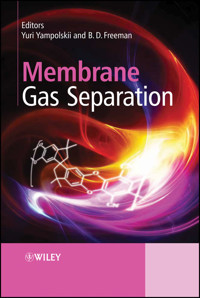
Membrane Gas Separation E-Book
158,99 €
Mehr erfahren.
- Herausgeber: John Wiley & Sons
- Kategorie: Fachliteratur
- Sprache: Englisch
Gas separation membranes offer a number of benefits over other separation technologies, and they play an increasingly important role in reducing the environmental impacts and costs of many industrial processes.
This book describes recent and emerging results in membrane gas separation, including highlights of nanoscience and technology, novel polymeric and inorganic membrane materials, new membrane approaches to solve environmental problems e.g. greenhouse gases, aspects of membrane engineering, and recent achievements in industrial gas separation. It includes:
- Hyperbranched polyimides, amorphous glassy polymers and perfluorinated copolymers
- Nanocomposite (mixed matrix) membranes
- Polymeric magnetic membranes
- Sequestration of CO2 to reduce global warming
- Industrial applications of gas separation
Developed from sessions of the most recent International Congress on Membranes and Membrane Processes, Membrane Gas Separation gives a snapshot of the current situation, and presents both fundamental results and applied achievements.
Sie lesen das E-Book in den Legimi-Apps auf:
Seitenzahl: 616
Veröffentlichungsjahr: 2011
Ähnliche




















Contents
Preface
Contributors
Part I Novel Membrane Materials and Transport in Them
1 Synthesis and Gas Permeability of Hyperbranched and Cross-linked Polyimide Membranes
1.1 Introduction
1.2 Molecular Designs for Membranes
1.3 Synthesis of Hyperbranched Polyimides
1.4 Gas Permeation Properties
1.5 Concluding Remarks
References
2 Gas Permeation Parameters and Other Physicochemical Properties of a Polymer of Intrinsic Microporosity (PIM-1)
2.1 Introduction
2.2 The PIM Concept
2.3 Gas Adsorption
2.4 Gas Permeation
2.5 Inverse Gas Chromatography
2.6 Positron Annihilation Lifetime Spectroscopy
2.7 Conclusions
Acknowledgements
References
3 Addition-type Polynorbornene with Si(CH3)3 Side Groups: Detailed Study of Gas Permeation, Free Volume and Thermodynamic Properties
3.1 Introduction
3.2 Experimental
3.3 Results and Discussion
3.4 Conclusions
References
4 Amorphous Glassy Perfluoropolymer Membranes of Hyflon AD ®: Free Volume Distribution by Photochromic Probing and Vapour Transport Properties
4.1 Introduction and Scope
4.2 Membrane Preparation
4.3 Free Volume Analysis
4.4 Molecular Dynamics Simulations
4.5 Transport Properties
4.6 Correlation of Transport and Free Volume
4.7 Conclusions
References
5 Modelling Gas Separation in Porous Membranes
5.1 Introduction
5.2 Background
5.3 Surface Diffusion
5.4 Knudsen Diffusion
5.5 Membranes: Porous Structures?
5.6 Transition State Theory (TST)
5.7 Transport Models for Ordered Pore Networks
5.8 Pore Size, Shape and Composition
5.9 The New Model
5.10 Conclusion
References
Part II Nanocomposite (Mixed Matrix) Membranes
6 Glassy Perfluorolymer–Zeolite Hybrid Membranes for Gas Separations
6.1 Introduction
6.2 Materials and Methods
6.3 Results and Discussion
6.4 Conclusions
Acknowledgements
References
7 Vapor Sorption and Diffusion in Mixed Matrices Based on Teflon ® AF 2400
7.1 Introduction
7.2 Theoretical Background
7.3 Experimental
7.4 Results and Discussion
7.5 Conclusions
Acknowledgements
References
8 Physical and Gas Transport Properties of Hyperbranched Polyimide–Silica Hybrid Membranes
8.1 Introduction
8.2 Experimental
8.3 Results and Discussion
8.4 Conclusions
References
9 Air Enrichment by Polymeric Magnetic Membranes
9.1 Introduction
9.2 Formulation of the Problem
9.3 Experimental
9.4 Results and Discussion
9.5 Conclusions
Acknowledgements
List of Symbols
References
Part III Membrane Separation of CO2 from Gas Streams
10 Ionic Liquid Membranes for Carbon Dioxide Separation
10.1 Introduction
10.2 Experimental
10.3 Results
10.4 Discussion
10.5 Conclusions
References
11 The Effects of Minor Components on the Gas Separation Performance of Polymeric Membranes for Carbon Capture
11.1 Introduction
11.2 Sorption Theory for Multiple Gas Components
11.3 Minor Components
11.4 Conclusions
References
12 Tailoring Polymeric Membrane Based on Segmented Block Copolymers for CO2 Separation
12.1 Introduction
12.2 Tailoring Block Copolymers with Superior Performance
12.3 Block Copolymers and their Blends with Polyethylene Glycol
12.4 Composite Membranes
12.5 Conclusions and Future Aspects
References
13 CO2 Permeation with Pebax®-based Membranes for Global Warming Reduction
13.1 Introduction
13.2 Experimental
13.3 Results and Discussions
13.4 Conclusions
References
Part IV Applied Aspects of Membrane Gas Separation
14 Membrane Engineering: Progress and Potentialities in Gas Separations
14.1 Introduction
References
15 Evolution of Natural Gas Treatment with Membrane Systems
15.1 Introduction
15.3 Amine Treaters
15.4 Contaminants and Membrane Performance
15.5 Cellulose Acetate versus Polyimide
15.6 Compaction in Gas Separations
15.7 Experimental
15.8 Laboratory Tests of Cellulose Acetate Membranes
15.9 Field Trials of Cellulose Acetate Membranes
15.10 Strategies for Reduced Size of Large-scale Membrane Systems
15.11 Research Directions
15.12 Summary
Acknowledgements
References
16 The Effect of Sweep Uniformity on Gas Dehydration
16.1 Introduction
16.2 Theory
16.3 Results and Discussion
16.4 Conclusion
References
Index
This edition first published 2010
© (2010) John Wiley & Sons Ltd
Registered office
John Wiley & Sons Ltd, The Atrium, Southern Gate, Chichester, West Sussex, PO19 8SQ, United Kingdom
For details of our global editorial offices, for customer services and for information about how to apply for permission to reuse the copyright material in this book please see our website at www.wiley.com.
The right of the author to be identified as the author of this work has been asserted in accordance with the Copyright, Designs and Patents Act 1988.
All rights reserved. No part of this publication may be reproduced, stored in a retrieval system, or transmitted, in any form or by any means, electronic, mechanical, photocopying, recording or otherwise, except as permitted by the UK Copyright, Designs and Patents Act 1988, without the prior permission of the publisher.
Wiley also publishes its books in a variety of electronic formats. Some content that appears in print may not be available in electronic books.
Designations used by companies to distinguish their products are often claimed as trademarks. All brand names and product names used in this book are trade names, service marks, trademarks or registered trademarks of their respective owners. The publisher is not associated with any product or vendor mentioned in this book. This publication is designed to provide accurate and authoritative information in regard to the subject matter covered. It is sold on the understanding that the publisher is not engaged in rendering professional services. If professional advice or other expert assistance is required, the services of a competent professional should be sought.
The publisher and the author make no representations or warranties with mrespect to the accuracy or completeness of the contents of this work and specifically disclaim all warranties, including without limitation any implied warranties of fitness for a particular purpose. This work is sold with the understanding that the publisher is not engaged in rendering professional services. The advice and strategies contained herein may not be suitable for every situation. In view of ongoing research, equipment modifications, changes in governmental regulations, and the constant flow of information relating to the use of experimental reagents, equipment, and devices, the reader is urged to review and evaluate the information provided in the package insert or instructions for each chemical, piece of equipment, reagent, or device for, among other things, any changes in the instructions or indication of usage and for added warnings and precautions. The fact that an organization or Website is referred to in this work as a citation and/or a potential source of further information does not mean that the author or the publisher endorses the information the organization or Website may provide or recommendations it may make. Further, readers should be aware that Internet Websites listed in this work may have changed or disappeared between when this work was written and when it is read. No warranty may be created or extended by any promotional statements for this work. Neither the publisher nor the author shall be liable for any damages arising herefrom.
Library of Congress Cataloging-in-Publication Data
Yampolskii, Yuri
Membrane gas separation/Yuri Yampolskii and Benny Freeman.
p. cm.
Includes bibliographical references and index.
ISBN 978-0-470-74621-9 (cloth)
1. Gas separation membranes. 2. Polyamide membranes. 3. Gases-Separation. I. Yampolskii, Y. P. (Yuri Pavlovich) II. Title.
TP248.25.M46F74 2010
660′.043-dc22
2010013153
Preface
The International Congress on Membranes and Membrane Processes (ICOM) meetings are the most important events for the community of membrane science and technology. They are organized once every three years in the succession: Europe, Asia, America. The most recent ICOM2008 took place in Honolulu, Hawaii (USA). According to the opinion of the editors of this volume it was one the most interesting meetings ever attended. Probably the greatest interest was the subject of membrane gas separation. There were five sessions devoted to this sub-field of membrane science and technology, more than to any other area discussed at ICOM2008. After strong competition, 30 submitted papers were selected by the program committee as oral presentations. The material of these presentations was so interesting and relevant for the field that it occurred to us while in Honolulu that it would be worthwhile to publish a volume based on the oral presentations of the gas separation sessions. This book is conceived to give a snapshot of the current situation in membrane gas separation and related fields as described by the speakers at ICOM2008. In this regard it differs from the volume published several years ago, also by John Wiley & Sons, Ltd [1], which summarized the state of the art in this field achieved during the last decade.
The results presented in this book were obtained owing to the activity of really international group of teams from Australia, Czech Republic, France, Germany, Italy, Japan, Poland, Russia, Slovenia, United Kingdom and USA. The chapters submitted by the authors were partitioned among four Sections. Before considering the contents of these sections it should be emphasized that many chapters focus on the most relevant problems; without a solution to these problems further progress of membrane gas separation looks doubtful.
Chapters 1, 4, 6 and 8 discuss the possible ways to prevent plasticization effects that result in significant reduction in selectivity of separation of mixtures containing active (strongly sorbed) vapours. Recently it became clear that high permeability of certain polymer materials can be rationalized on the basis of the concept of inner porosity. In this regard, such polymers are similar to common porous inorganic media. In such polymers, mixed gas permeation is characterized by high selectivity, so the problem of plasticization is excluded. Transport behaviour of membranes with inner porosity is the subject of Chapters 2, 3 and 5. Another approach that permits overcoming the plasticization problem is an application of perfluorinated polymers that reveal a reduced solubilityof hydrocarbon vapours. Different aspects of the use of such membrane materials are considered in Chapters 4, 6 and 7. Some of the contributions include interesting reviews of different problems of membrane gas separation (Chapters 1, 10, 14 and 15).
Section I (Novel Membrane Materials and Transport in Them) focuses on the most recent advances in development of new membrane materials and considers the transport parameters and free volume of polymeric and even inorganic membranes. Kanehashi et al. (Chapter 1) present a detailed review of hyperbranched polyimides, which are compared with more common cross-linked polyimides. These polymers with unusual architecture were studied in the hope that they would show weaker tendency to plasticization than conventional linear polymers. However, many representatives of this new class of polymers reveal relatively poor film forming properties due to absence of chain entanglement. Nonetheless, some promising results obtained can show directions of further studies.
The next two chapters deal with novel amorphous glassy polymers that are characterized by large free volume, high gas permeability and good combination of permeability and permselectivity. The polymer of intrinsic microporosity (PIM-1, Chapter 2) has attracted a great attention in membrane community, and at present several polymers structurally similar to PIM-1 have been prepared and characterized. This polymer has ‘inner’ surface area of about 700 m2/g, higher than that of some sorts of carbon, and its gas and vapour solubility coefficients are the highest among all the polymers studied so far (even polytrimethylsilylpropyne). The subject of Chapter 3 is Si-containing additiontype polynorbornene, also having relatively high gas permeability. The polymers of this class have been the subject of investigation during the last decade; however, only the introduction of Si (CH3)3 groups into the monomer resulted in rather attractive properties of the polymer obtained. If somebody asked us 10 years ago which polymer structure would provide extra high permeability of the membrane materials, the answer would be: ‘Polyacetylenes and, maybe, some perfluorinated polymers’. Now we see that much wider variation of polymer design can lead to large free volume and high permeability and diffusivity. This result seems to be very optimistic for further activity of synthetic polymericchemists aimed to create new membrane materials.
The objects of the investigation by Jansen et al. (Chapter 4) were perfluorinated copolymers of Hyflon AD. The authors reported novel data on free volume, presented the results of computer modelling and the gas permeation parameters. It should be stressed that such comprehensive study of a polymer becomes more and more popular today if one wants to understand transport and sorption parameters of a membrane material. This chapter will give much ‘food’ for future comparisons with other perfluorinated polymers as well as conventional glassy polymers.
The aim of Chapter 5 by Thornton et al. was to give systematic consideration to different types of transport in porous membranes. They developed a new model that allows one to predict the separation outcome for a variety of membranes in which the pore shape, size and composition are known, and conversely to predict pore characteristics with known permeation rates.
An important event of recent years in membrane science was the discovery of a new phenomena observed when nano-particles are added into (mainly high permeability) polymer matrix: references to these pioneer works can be found in chapters of Section II: Nanocomposite (Mixed Matrix) Membranes. So it is not surprising that several presentations at ICOM2008 dealt with such systems. Golemme et al. (Chapter 6) investigatedthe system that contained perfluorinated polymers and surface-fluorinated zeolites as nano -additives. Perfluorinated polymer AF2400 with nano-additives was also the object of Chapter 7, where detailed investigation of sorption and diffusion are presented. The authors showed a good agreement between a theoretical approach based on the NELF model and the experimental data for mixed matrix membranes. While the authors of these chapters introduced nano-particles into high permeability polymer matrices, Chapter 8 by Suzuki et al. presents a mixed matrix system based on hyperbranched polyimides. Maybe there is more reason to introduce nano-particles in such systems, because in polyimides, it is permeability and not permselectivity that usually requires to be increased. Indeed, it was shown that permeability coefficients of the hybrid membranes increased with increasing silica content because of additional formation of free volume elements. Especially large enhancements of CO2 permeability was combined with improved CO2/ CH4 separation factor.
Chapter 9 takes a special place in Section II. For some time the problem of acceleration of membrane permeation of paramagnetic molecules of oxygen mixed with diamagnetic nitrogen has been discussed in membrane community, but only the team headed by Grzywna has demonstrated that it is really possible. For this purpose they introduced neodymium powder into films of ethylcellulose and polyphenyleneoxide and exposed such films to external magnetic fields. Quantitatively, the observed effects are rather modest, but the demonstration of the effect itself seems to be the main gain of this really pioneering study.
The problem of sequestration of carbon dioxide in order to tackle global warming is of utmost importance for the future of humanity. So, no wonder that several presentations at ICOM2008 tackled this subject. This is the theme of Section III (Membrane Separation of CO2 from Gas Streams); however, to some extent the same problem is discussed in other chapters of this volume (2, 8, 14, 15). It is well known that Pebax copolymers show excellent transport parameters in separating gas mixtures containing carbon dioxide. So, Chapters 12 and 13 deal with certain modifications of this material. The polymers considered in Chapter 11 are rubbery polydimethylsiloxane and glassy polysulfone and polyimide Matrimid, but the main emphasis made in this chapter is on the effects of various minor impurities that can be presented in gaseous feedstock. Chapter 10 considers the application of ionic liquids for the separation of the mixture containing carbon dioxide. It seems to us that an attentive reader will be able to compare the data of these four chapters and make some conclusions about advances and drawbacks of various membranes for separation of CO2.
The last section ‘Applied Aspects of Membrane Gas Separation’ contains three chapters. Brunetti et al. start their contribution with a brief review of membrane materials and membranes used in gas separation and survey the main directions of industrial applications of gas separation (hydrogen recovery, air separation, etc.). In the second part of their chapter they present a new concept for comparison of membrane and other, more traditional, methods for gas separation. Their approach includes a consideration of engineering, economical, environmental and social indicators. Something similar had been written 15 years ago [2] but this analysis is now rather outdated. White (Chapter 15) focuses on a specific but very important problem in industrial gas separation: membrane separation of natural gas. The main emphasis is on cellulose acetate based membranes that have the longest history of practical applications. This chapter also contains the results of field tests of these membranes and considers approaches how to reduce the size and cost of industrial membrane systems. The final chapter is an example of detailed engineering analysis of another membrane problem – the improvement of performance of a module for gas dehydration.
Finally, the editors wish to express their gratitude to all the contributors of this book. We also greatly appreciate the help and understanding of the publishers of this book, John Wiley and Sons, Ltd., Chichester, UK.
(1) Materials Science of Membranes for Gas and Vapor Separation, Yu. Yampolskii, I. Pinnau, B. D. Freeman. John Wiley & Sons, Ltd., Chichester, 2006.
(2) R. Prasad, R. L. Shaner, K. J. Doshi, Comparison of membranes and other gas separation technologies, in: Polymeric Gas Separation Membranes, Ed. by D. R. Paul, Yu. P. Yampolskii, CRC Press, Boca Raton, 1994, p. 531.
Benny Freeman
Yuri Yampolskii
Contributors
Giuseppe Barbieri, National Research Council – Institute for Membrane Technology (ITM–CNR), Via Pietro BUCCI, c/o The University of Calabria, Cubo 17C, 87030 Rende CS, Italy
Nikolai Belov, A. V. Topchiev Institute of Petrochemical Synthesis, Russian Academy of Sciences, 29 Leninsky Pr., 119991, Moscow, Russia
Paola Bernardo, National Research Council – Institute for Membrane Technology (ITM–CNR), Via Pietro BUCCI, c/o The University of Calabria, Cubo 17C, 87030 Rende CS, Italy
Adele Brunetti, National Research Council – Institute for Membrane Technology (ITM CNR), Via Pietro BUCCI, c/o The University of Calabria, Cubo 17C, 87030 Rende CS, Italy
Andrea Bruno, Universit à della Calabria, Dipartimento di Ingegneria Chimica e dei Materiali, and INSTM Consortium; Via Pietro Bucci 45/A, I- 87030 Rende, Italy
Peter M. Budd, Organic Materials Innovation Centre, School of Chemistry, University of Manchester, Manchester, M13 9PL, UK
Maria Giovanna Buonomenna, Università della Calabria, Dipartimento di IngegneriaChimica e dei Materiali, and INSTM Consortium; Via Pietro Bucci 45/A, I – 87030 Rende, Italy
Anja Car, Institute of Material Research, GKSS- Research Centre Geesthacht GmbH, Max-Planck-Str.1, 21502 Geesthacht, Germany
Corinne Chappey, Laboratoire ‘Polymères, Biopolymères, Surfaces’, FRE 3103, Université de Rouen- CNRS, 76821 Mon-Saint-Aignan Cedex, France
Jungkyu Choi, University of Minnesota, Department of Chemical Engineering and Materials Science; 421 Washington Ave. SE, Minneapolis, MN 55455, USA
Maria Grazia De Angelis, Dipartimento di Ingegneria Chimica, Mineraria e delle Tecnologie Ambientali (DICMA), Alma Mater Studiorum-Università di Bologna, via Terracini 28, 40131 Bologna, Italy
Luana De Lorenzo, Institute on Membrane Technology, ITM- CNR, c/o University of Calabria, Via P. Bucci, 17/C, Rende (CS), Italy
Enrico Drioli, Institute on Membrane Technology, ITM–CNR, c/o University of Calabria,Via P. Bucci, 17/C, Rende (CS), Italy
Maria Chiara Ferrari, Dipartimento di Ingegneria Chimica, Mineraria e delle Tecnologie Ambientali (DICMA), Alma Mater Studiorum – Universit à di Bologna, via Terracini 28, 40131 Bologna, Italy
Eugene Finkelshtein, A. V. Topchiev Institute of Petrochemical Synthesis, Russian Academy of Sciences, 29 Leninsky Pr., 119991, Moscow, Russia
Karel Friess, Department of Physical Chemistry, Institute of Chemical Technology, Technick á 5, 166 28 Prague 6, Czech Republic
Detlev Fritsch, Institute of Polymer Research, GKSS Research Centre Geesthacht GmbH, Max-Planck-Strasse 1, D-21502 Geesthacht, Germany
Michele Galizia, Dipartimento di Ingegneria Chimica, Mineraria e delle Tecnologie Ambientali (DICMA), Alma Mater Studiorum- Universit à di Bologna, via Terracini 28, 40131 Bologna, Italy
Giovanni Golemme, Università della Calabria, Dipartimento di Ingegneria Chimica e dei Materiali, and INSTM Consortium; Via Pietro Bucci 45/A, I- 87030 Rende, Italy
Maria Gringolts, A. V. Topchiev Institute of Petrochemical Synthesis, Russian Academy of Sciences, 29 Leninsky Pr., 119991, Moscow, Russia
Zbigniew J. Grzywna, Faculty of Chemistry, Silesian University of Technology, 44–100 Gliwice, Poland
Pingjiao Hao, Chemical and Environmental Engineering Department, University of Toledo, Toledo, OH 43606–3390, USA
Matthias Heuchel, GKSS Research Center, Institute of Chemistry, Kantstrasse 55, D-14513, Teltow, Germany
Anita J. Hill, CSIRO Materials Science and Engineering, Locked Bag 33, Clayton Sth MDC, Victoria 3169, Australia
James M. Hill, Nanomechanics Group, School of Mathematics and Applied Statistics, University of Wollongong, New South Wales 2522, Australia
Jeffery B. Ilconich, Parsons, P.O. Box 618, South Park, PA 15129, USA
Kumi Itahashi, Department of Biomolecular Engineering, Kyoto Institute of Technology, Matsugasaki, Sakyo-ku, Kyoto 606–8585, Japan
Johannes Carolus Jansen, Institute on Membrane Technology, ITM-CNR, c/o University of Calabria, Via P. Bucci, 17/C, Rende (CS), Italy
Shinji Kanehashi, Department of Applied Chemistry, Meiji University, 1-1-1 Higashimita, Tama-ku, Kawasaki 214–8571, Japan
Sandra E. Kentish, Cooperative Research Centre for Greenhouse Gas Technologies (CO2CRC), University of Melbourne, Parkville, Victoria 3010, Australia
Dominique Langevin, Laboratoire “Polym ères, Biopolymères, Surfaces’, FRE 3103, Universit é de Rouen-CNRS, 76821 Mon-Saint-Aignan Cedex, France
G. Glenn Lippscomb, Chemical and Environmental Engineering Department, University of Toledo, Toledo, OH 43606–3390, USA
David R. Luebke, P.O. Box 10940, Pittsburgh, PA 15236–0940, USA
Marialuigia Macchione, University of Calabria, Via P. Bucci 14/D, 87030 Rende (CS), Italy
Raffaella Manes, Università della Calabria, Dipartimento di Ingegneria Chimica e dei Materiali, and INSTM Consortium; Via Pietro Bucci 45/A, I- 87030 Rende, Italy
Stéphane Marais, Laboratoire ‘Polymères, Biopolymères, Surfaces’, FRE 3103, Universit é de Rouen-CNRS, 76821 Mon-Saint-Aignan Cedex, France
Neil B. McKeown, School of Chemistry, Cardiff University, Cardiff, CF10 3AT, UK
Daniela Muoio, Università della Calabria, Dipartimento di Ingegneria Chimica e dei Materiali, and INSTM Consortium; Via Pietro Bucci 45/A, I- 87030 Rende, Italy
Christina R. Myers, P.O. Box 10940, Pittsburgh, PA 15236–0940, USA
Kazukiyo Nagai, Department of Applied Chemistry, Meiji University, 1-1-1 Higashimita, Tama-ku, Kawasaki 214–8571, Japan
Quang Trong Nguyen, Laboratoire ‘Polymères, Biopolymères, Surfaces’, FRE 3103, Universit é de Rouen-CNRS, 76821 Mon-Saint-Aignan Cedex, France
Klaus-Viktor Peinemann, Institute of Material Research, GKSS-Research Centre Geesthacht GmbH, Max- Planck- Str.1, 21502 Geesthacht, Germany
Henry W. Pennline, P.O. Box 10940, Pittsburgh, PA 15236–0940, USA
Fabienne Poncin-Epaillard, Laboratoire Polymères, Colloï des, Interfaces, UMR 6120, CNRS-Université du Maine, 72085 Le Mans Cedex, France
Aleksandra Rybak, Faculty of Chemistry, Silesian University of Technology, 44–100 Gliwice, Poland
Jun Sakai, Department of Biomolecular Engineering, Kyoto Institute of Technology, Matsugasaki, Sakyo-ku, Kyoto 606–8585, Japan
Giulio Cesare Sarti, Dipartimento di Ingegneria Chimica, Mineraria e delle Tecnologie Ambientali (DICMA), Alma Mater Studiorum- Universit à di Bologna, via Terracini 28, 40131 Bologna, Italy
Shuichi Sato, Department of Applied Chemistry, Meiji University, 1-1-1 Higashi-mita, Tama-ku, Kawasaki 214–8571, Japan
Colin A. Scholes, Cooperative Research Centre for Greenhouse Gas Technologies (CO2CRC), University of Melbourne, Parkville, Victoria 3010, Australia
Victor Shantarovich, N. N. Semenov Institute of Chemical Physics, Russian Academy of Sciences, 4 Kosygin Street, 119991 Moscow, Russia
Ludmila Starannikova, A. V. Topchiev Institute of Petrochemical Synthesis, Russian Academy of Sciences, 29 Leninsky Pr., 119991, Moscow, Russia
Geoff W. Stevens, Cooperative Research Centre for Greenhouse Gas Technologies (CO2CRC), University of Melbourne, Parkville, Victoria 3010, Australia
Chrtomir Stropnik, University of Maribor, Faculty of Chemistry and Chemical Engineering, Smetanova 17, Slovenia
Anna Strzelewicz, Faculty of Chemistry, Silesian University of Technology, 44–100 Gliwice, Poland
Julie Sublet, Institut de recherches sur la catalyse et l’ environnement de Lyon, UMR 5256, CNRS-Université de Lyon 1, 69626 Villeurbanne Cedex, France
Tomoyuki Suzuki, Department of Biomolecular Engineering, Kyoto Institute of Technology, Matsugasaki, Sakyo- ku, Kyoto 606–8585, Japan
Aaron W. Thornton, CSIRO Materials Science and Engineering, Locked Bag 33, Clayton Sth MDC, Victoria 3169, Australia
Elena Tocci, Institute on Membrane Technology, ITM- CNR, c/o University of Calabria, Via P. Bucci, 17/C, Rende (CS), Italy
Michael Tsapatsis, University of Minnesota, Department of Chemical Engineering and Materials Science; 421 Washington Ave. SE, Minneapolis, MN 55455, USA
Jean-Marc Valleton, Laboratoire ‘Polymères, Biopolymères, Surfaces’, FRE 3103, Universit é de Rouen-CNRS, 76821 Mon-Saint-Aignan Cedex, France
Lloyd S. White, UOP LLC, Des Plaines, Illinois, USA
Shan Wickramanayake, Parsons, P.O. Box 618, South Park, PA 15129, USA
Yasuharu Yamada, Department of Biomolecular Engineering, Kyoto Institute of Technology, Matsugasaki, Sakyo- ku, Kyoto 606–8585, Japan
Yuri Yampolskii, A. V. Topchiev Institute of Petrochemical Synthesis, Russian Academy of Sciences, 29 Leninsky Pr., 119991, Moscow, Russia
Wilfredo Yave, Institute of Material Research, GKSS- Research Centre Geesthacht GmbH, Max-Planck-Str.1, 21502 Geesthacht, Germany
Part I
Novel Membrane Materials and Transport in Them
1
Synthesis and Gas Permeability of Hyperbranched and Cross-linked Polyimide Membranes
Shinji Kanehashi, Shuichi Sato and Kazukiyo Nagai
Department of Applied Chemistry, Meiji University, Tama-ku, Kawasaki, Japan
1.1 Introduction
Recently, the polymer science field has focused on the role of polymers as membrane materials with precise, well-ordered structures through the development of defined synthesis and analysis of polymers. Among these well-ordered polymers are the hyperbranched polymers (e.g. hyperbranched polyimides). Part of the interest in such polymers is due to the expectation that they could have different properties as compared to common linear polymers. Also, cross-linked polyimides have attracted much attention from researchers, as can be judged by a high number of publications.
In general, hyperbranched polymers have many orderly branching units whose structures are different compared to linear and randomly cross-linked polymers [1–3]. According to the Commission on Macromolecular Nomenclature of the International Union of Pure and Applied Chemistry (IUPAC), a crosslink polymer is defined as a polymer having a small region in a macromolecule from which at least four chains emanate [4]. It is formed by reactions involving sites or groups on existing macromolecules or by interactions between existing macromolecules. The word ‘network’ is also defined as a highly ramified macromolecule in which essentially each constitutional unit is connected to each other constitutional unit and to the macroscopic phase boundary by many permanent paths through the macromolecule, the number of such paths increasing with the average number of intervening bonds; the paths must on the average be coextensive with the macromolecule [4]. In this chapter, we use the term crosslink polymer to describe a random cross-linked network between polymer segments.
Scheme 1.1
Precisely branched polymers include hyperbranched polymers, dendrimers and dendrons. Dendrimers and dendrons are characterized by perfectly controlled structures in three dimensions such as tree branch architecture, and they have attractive features such as a well-ordered chemical structure, molecular mass, size and configuration of polymers [5]. Although the precise order of shape of hyperbranched polymers is less than that of dendrimers and dendrons, hyperbranched polymers have unique properties such as low viscosity attributed to the lack of entanglement of polymer segments, and the possibility of chemical modification in terminal functional groups such as in dendrimers [1–3].
Synthesis of hyperbranched polymers is typically performed through the selfpolycondensation reaction of AB2-type monomers (Scheme 1.1) [6,7]. The theoretical study of the random ABx polycondensation has already been reported by Flory in 1952 [8]. He pointed out that the synthesis of hyperbranched polymers from ABx monomers should resemble linear polymers in their elusion of infinite network (i.e. gelation) formation, which cannot occur except through the intervention of other interlinking reactions. Since then, there have only been a few experimental data made available on hyperbranched polymers; some have even been overlooked due to the fact that the use of the term hyperbranched polymers began only in the late 1980s. However, in early 1990s, hyperbranched polyphenylene was synthesized from AB-type monomers [9]. This marked the beginning of the reawakened hyperbranched polymer concept. A variety of hyperbranched polymers such as polyphenylene [9], polyimide [10–12], polyamide [13–15], polyester [16], polyetherketone [17] and polycarbonate [18] have been reported in recent years. It is important that hyperbranched polymers with feathers of closed dendrons can be synthesized through the self-polycondensation one-step reaction because dendrimers and dendrons are synthesized by multistep procedures (e.g. protection, coupling and deprotection cycles). Producing dendrimers and dendrons is also costly and requires complicated manufacturing processes for industrial applications.
Lesen Sie weiter in der vollständigen Ausgabe!
Lesen Sie weiter in der vollständigen Ausgabe!
Lesen Sie weiter in der vollständigen Ausgabe!
Lesen Sie weiter in der vollständigen Ausgabe!
Lesen Sie weiter in der vollständigen Ausgabe!
Lesen Sie weiter in der vollständigen Ausgabe!
Lesen Sie weiter in der vollständigen Ausgabe!
Lesen Sie weiter in der vollständigen Ausgabe!
Lesen Sie weiter in der vollständigen Ausgabe!
Lesen Sie weiter in der vollständigen Ausgabe!
Lesen Sie weiter in der vollständigen Ausgabe!
Lesen Sie weiter in der vollständigen Ausgabe!
Lesen Sie weiter in der vollständigen Ausgabe!
Lesen Sie weiter in der vollständigen Ausgabe!
Lesen Sie weiter in der vollständigen Ausgabe!
Lesen Sie weiter in der vollständigen Ausgabe!
Lesen Sie weiter in der vollständigen Ausgabe!
Lesen Sie weiter in der vollständigen Ausgabe!
Lesen Sie weiter in der vollständigen Ausgabe!




