


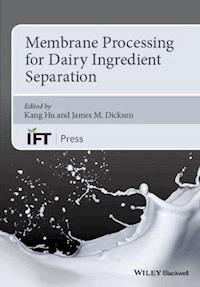
Membrane Processing for Dairy Ingredient Separation E-Book
158,99 €
Mehr erfahren.
- Herausgeber: John Wiley & Sons
- Kategorie: Fachliteratur
- Serie: Institute of Food Technologists Series
- Sprache: Englisch
Membrane processing is a filtration technique in which particles are separated from liquids by being forced through a porous material, or membrane. Applied to dairy products, the separation techniques allow valuable compounds, found in milk, to be isolated for use as ingredients in food processing. A comprehensive overview of membrane separation processes, this book explores various applications such as pressure driven processes, electrical field driven processes, and concentration driven processes, for the recovery of various dairy streams and ingredients. The topics covered place emphasis on new applications, including microfiltration, ultrafiltration, reverse osmosis, electrodialysis, and pervaporation. The text also presents in-depth knowledge of the mechanisms of each membrane separation process, as well as membrane types and the equipment used in these processes. Combining their educational backgrounds and substantial industrial experience in dairy ingredients processes, the authors address cutting-edge technologies that have been thoroughly researched and have great potential to be commercialized in the near future. The book will therefore be of interest to dairy industry professionals and will serve as a source of reference material for professors and students in food science and engineering.
Sie lesen das E-Book in den Legimi-Apps auf:
Seitenzahl: 520
Veröffentlichungsjahr: 2015
Ähnliche




















CONTENTS
Cover
Title page
Dedication
Acknowledgment
Preface
List of contributors
1 Microfiltration for casein and serum protein separation
1.1 INTRODUCTION OF MICROFILTRATION
1.2 CASEIN MICELLES AND SERUM PROTEINS IN SKIM MILK
1.3 EFFECTS OF PERMEATE FLUX AND SHEAR STRESS ON SEPARATION PERFORMANCE
1.4 SEPARATION OF CASEIN AND SERUM PROTEINS USING CERAMIC MEMBRANE MF
1.5 SEPARATION OF CASEIN AND SERUM PROTEINS USING POLYMERIC MEMBRANE MF
1.6 COMPARISON OF CERAMIC MEMBRANE SYSTEM AND POLYMERIC MEMBRANE SYSTEM
Nomenclature
References
2 Dairy stream lactose fractionation/concentration using polymeric ultrafiltration membrane
2.1 INTRODUCTION
2.2 ULTRAFILTRATION MEMBRANE
2.3 ULTRAFILTRATION ON LACTOSE FRACTIONATION/CONCENTRATION
2.4 INTEGRATED MEMBRANE BIOREACTOR
2.5 FUTURE AND CHALLENGES IN SEPARATING MILK SUGAR FOR A PRODUCTION OF LOW LACTOSE MILK
Nomenclature
References
3 Membrane fouling: a challenge during dairy ultrafiltration
3.1 DAIRY ULTRAFILTRATION
3.2 FLUX–PRESSURE RELATIONSHIP
3.3 CONCENTRATION POLARIZATION
3.4 MEMBRANE FOULING
3.5 FACTORS AFFECTING MEMBRANE FOULING
3.6 ENGINEERING MODELS FOR MEMBRANE FOULING
3.7 CONTROL STRATEGIES
3.8 MEMBRANE CLEANING AND SANITIZATION
References
4 Dairy protein fractionation and concentration using charged ultrafiltration membranes
4.1 INTRODUCTION
4.2 THEORY
4.3 CHARGED ULTRAFILTRATION MEMBRANES FOR PROTEIN FRACTIONATION
4.4 NEGATIVELY CHARGED ULTRAFILTRATION MEMBRANES FOR PROTEIN CONCENTRATION
Nomenclature
References
5 Demineralization of dairy streams and dairy mineral recovery using nanofiltration
5.1 INTRODUCTION
5.2 MEMBRANE OPERATIONS
5.3 THEORY OF SEPARATION
5.4 DAIRY SALTS AND SALT EQUILIBRIUM
5.5 MEMBRANE FOULING
5.6 CONCLUSIONS
Nomenclature
References
6 Development and application of reverse osmosis for separation
6.1 INTRODUCTION
6.2 REVERSE OSMOSIS AND ITS WORKING MECHANISM
6.3 REVERSE OSMOSIS MEMBRANES
6.4 MEMBRANE MODULES AND CONFIGURATIONS
6.5 TRANSPORT MECHANISMS AND MODELS IN REVERSE OSMOSIS MEMBRANES
6.6 REVERSE OSMOSIS PROCESS
6.7 TECHNICAL AND ECONOMIC CHALLENGES
6.8 REVERSE OSMOSIS PROCESS IN THE DAIRY INDUSTRY
6.9 CURRENT DEVELOPMENT IN REVERSE OSMOSIS MEMBRANES
6.10 CONCLUSIONS AND OUTLOOK
Nomenclature
References
7 Pervaporative extraction of dairy aroma compounds
7.1 INTRODUCTION
7.2 PERVAPORATION – FUNDAMENTALS
7.3 PERVAPORATION FOR RECOVERY OF AROMA COMPOUNDS USING ORGANOPHILIC MEMBRANES
7.4 CONCLUDING REMARKS
Nomenclature
References
8 Membrane chromatography: current applications, future opportunities, and challenges
8.1 INTRODUCTION
8.2 CURRENT APPLICATIONS
8.3 FUTURE OPPORTUNITIES
8.4 CHALLENGES
8.5 CONCLUSION
References
9 Electrodialysis applications on dairy ingredients separation
9.1 INTRODUCTION
9.2 ELECTRODIALYSIS
9.3 APPLICATIONS TO DAIRY INGREDIENTS
9.4 CONCLUSION AND PERSPECTIVES
Nomenclature
References
Index
End User License Agreement
List of Tables
Chapter 1
Table 1.1 The composition and molecular weight of the major milk proteins (Fox and McSweeney, 2003).
Table 1.2 Estimation of membrane area required to recover 90% serum protein from a feed stream 20 m
3
/h, using a multistage MF system including concentration and diafiltration stages.
Table 1.3 Capital investment and operation cost for the ceramic membrane system compared to the polymeric membrane system for the recovery of casein from skim milk using microfiltration systems.
Chapter 2
Table 2.1 Applications of membrane processes in the dairy industry (modified from Cheryan and Alvarez, 1995; Rosenberg, 1995; Brans et al., 2004; Pouliot, 2008).
Table 2.2 Current available lactose-free products on the market worldwide.
Table 2.3 Advantages and disadvantages of the integrated membrane bioreactor (modified from Garcia et al., 1999; Rios et al., 2004).
Table 2.4 Examples of integrated membrane bioreactors for the hydrolysis of lactose and GOS production.
Chapter 4
Table 4.1 Sieving coefficients of ALA and BLG and selectivity during the ultrafiltration of MSP at pH 4.3 using the charged and uncharged membranes. The reader is referred to Arunkumar and Etzel (2013) for more details.
Table 4.2 Purities of ALA and BLG in the permeates and retentates for different staging situations. The feed (MSP) contains 1.2 g/L ALA and 2.2 g/L BLG (35% ALA and 65% BLG).
S
o
ALA = 0.52,
S
o
BLG = 0.13, volume reduction of 5 times for each stage.
Table 4.3 Performance characteristics of unmodified and negatively charged ultrafiltration membranes during the ultrafiltration of MSP. Experiments were performed at 2 bar.
Table 4.4 Permeate flux of different membranes during the ultrafiltration of Swiss cheese whey. Experiments for the unmodified membranes were performed at 2 bar and those for the charged membrane were performed at 1.4 bar.
Chapter 5
Table 5.1 Current NF membranes sold for whey demineralisation and lactose Concentration. (Data taken from Manufacturer Specification Sheets.)
Table 5.2 Hydrated ionic radii for some ions commonly present in dairy solutions.
Table 5.3 Typical values of the parameters
a
,
b
,
c
, and
e
for use in Equation (5.16) for relevant membrane modules (Prudich et al., 2008).
Table 5.4 Distribution of milk salts between soluble and insoluble colloidal fractions in cow's milk (Fox and McSweeney, 1998).
Table 5.5 Calculated concentration (mM) of ions and complexes in the aqueous phase of milk (Holt, Dalgleish, and Jenness, 1981).
Table 5.6 Intrinsic solubility products for some dairy salts (Marshall and Daufin, 1995; Walstra and Jenness, 1984).
Chapter 6
Table 6.1 Commercially available ROMs and modules (Chian et al., 2007). Reproduced with permission of Humana Press.
Chapter 7
Table 7.1 Dairy aroma compounds studied for pervaporative extraction.
Table 7.2 Pervaporative extraction of dairy aromas by PDMS-based membranes.
Table 7.3 Pervaporative extraction of dairy aromas by POMS-based membranes.
Table 7.4 Pervaporative extraction of dairy aromas by PEBA-based membranes
Table 7.5 Pervaporative extraction of dairy aromas by EPDM-based membranes.
Table 7.6 Pervaporative extraction of dairy aromas by EVA-based membranes
Table 7.7 A comparison of membrane performance for diary aroma extraction by pervaporation
Table 7.8 Pervaporative extraction of dairy aromas by other membranes
List of Illustrations
Chapter 1
Figure 1.1 Microfiltration membrane surface images. (a) Polymeric membranes fabricated by melt-stretch (from Barbe, Hogan, and Johnson, 2000. Reproduced with permission of Elsevier). (b) Polymeric membranes fabricated by track-etching (Millipore Product Catalogue, 2013). (c): Polymeric membranes fabricated by phase inversion (Ying, Kang, and Neoh, 2002. Reproduced with permission of Elsevier). (d) Ceramic membranes fabricated by sintering (Zhang, Zhong, and Xing, 2013. Reproduced with permission of Elsevier).
Figure 1.2 (a) Dead-end flow and (b) cross-flow MF.
Figure 1.3 Concentration polarization effects of a microfiltration membrane with particle concentration profiles.
Figure 1.4 (a) Cross-flow microfiltration permeate flux decreases with time due to membrane fouling. Membrane fouling caused by pore plugging and cake layer formation: (b) initial deposition of particles and concentration polarization followed by (c) cake layer formation.
Figure 1.5 Critical flux regimes: flux dependency on transmembrane pressure (from Brans et al., 2004. Reproduced with permission of Elsevier).
Figure 1.6 Casein and serum protein separation from skim milk using MF.
Figure 1.7 Illustration of the TMP along a cross-flow membrane.
Figure 1.8 Commercial ceramic membrane elements (a) and module (b). Adapted from Pall Corporation product data sheet (Pall Corporation Catalogue, 2007).
Figure 1.9 Process illustration and the changes of TMP (solid line) and
J
V
(dotted line) with
L
for (a) conventional, (b) UTP, and (c) GP processes.
Figure 1.10 Permeate flux and absorbance (indicating protein concentration) of the permeate during microfiltration of skim milk at 50 °C, cross-flow velocity of 6.9 m/s and 190 kPa average TMP.
▪
flux; ♦ absorbance (from Pouliot, Pouliot, and Britten, 1996. Reproduced with permission of Elsevier).
Figure 1.11 Evaluation of the critical operating ratio
J
/
τ
during MF of skimmed milk: permeation flux,
J
, versus wall shear stress,
τ
(from Gesan-Guiziou, Boyaval, and Daufin, 1999. Reproduced with permission of Elsevier).
Figure 1.12 A commercial GP system with three modules installed in a parallel manner. The image is provided by Pall Corporation.
Figure 1.13 The structure of a polymeric spiral wound membrane element. (Adapted from Lin et al., 2013. Reproduced with permission of Elsevier).
Figure 1.14 A spiral wound system used for dairy processing. © GEA Process Engineering Inc.
Chapter 2
Figure 2.1 Schematic flow diagram of the process for a lactose-free milk product patented by Lange (modified from Lange, 2005).
Figure 2.2 Schematic flow diagram of the process for a lactose-free milk product patented by Wang (Wang, 2005).
Figure 2.3 Schematic flow diagram of the process for a lactose-free milk product patented by Tossavainen and Sahlstein (modified from Tossavainen and Sahlstein, 2013).
Figure 2.4 Configuration types of (a) a membrane bioreactor reactor coupled with a membrane separation unit and (b) an integrated membrane bioreactor in which the membrane serves as a catalytic and separation unit.
Chapter 3
Figure 3.1 Typical correlation between UF flux and transmembrane pressure, indicating a pressure and mass transfer controlled area (Cheryan, 1998).
Figure 3.2 Loss of productivity due to membrane fouling in (a) constant pressure UF and (b) constant flux UF.
Figure 3.3 Mechanisms of membrane fouling: (a) external fouling and (b) internal fouling.
Chapter 4
Figure 4.1 Schematic of the stagnant film model for concentration polarization.
Figure 4.2 Different three-stage flow configurations: (a) three-stage system with two rectification stages and one stripping stage and (b) three-stage system with three rectification stages.
Figure 4.3 Schematic diagram of the process used to concentrate Swiss cheese whey by 40 times to manufacture WPC 80.
Figure 4.4 Protein recovery (%) and for the WPC 80 process in terms of other whey proteins (OWP), glycomacropeptide (GMP), and total whey protein (TWP).
Figure 4.5 Total permeate dry solids and total nonprotein permeate dry solids measured from the composite permeate and diafiltrate streams.
Chapter 5
Figure 5.1 A process flowsheet showing how dairy minerals can be recovered from an ultrafiltration whey permeate stream following nanofiltration (based on Vembu and Rathinam, 1997).
Figure 5.2 Effect of calcium on the measured zeta potential of a GE Osmonics Desal 5 membrane. All experiments were performed with a background electrolyte of 1 mM KCl. Error bars signify ±1 mV (Rice et al., 2011a). Reproduced with permission from Elsevier.
Figure 5.3 Operational modes of a typical dairy membrane operation.
Figure 5.4 The concept of osmotic pressure (a) causes water to flow into a salt solution until it reaches a certain height to even out the concentration difference – this is osmosis. (b) An applied pressure in excess of this osmotic pressure is required to drive flow in the opposite direction – this is reverse osmosis.
Figure 5.5 Rejection of ions during nanofiltration of a solution containing 10 mM KCl and 2 mM CaCl
2
, measured at 15 bar TMP, 0.45 m/s cross-flow velocity and 25 °C. Error bars represent ±2 standard deviations (Rice et al., 2011b). Reproduced with permission from Elsevier.
Figure 5.6 The impact of concentration polarisation on membrane performance once solute precipitation occurs. The concentration at the membrane surface is constrained by the solid/liquid equilibria of the solute at
C
G
. The flux (
J
v
) is then limited by the rate of back diffusion (
D
d
C
/d
y
).
Figure 5.7 Predicted distribution of phosphate species in an aqueous phase of a 10 mM KCl +2 mM CaCl
2
+2 mM KH
2
PO
4
system as a function of pH. The ionic strength was 0.020 ± 0.003 M (Rice et al., 2010). Reproduced with permission from Elsevier.
Figure 5.8 Predicted distribution of citrate species in a 10 mM KCl + 2 mM CaCl
2
+ 2 mM KH
2
Cit system as a function of pH. The ionic strength was 0.018 ± 0.0004 M (Rice et al., 2010). Reproduced with permission from Elsevier.
Figure 5.9 Predicted distribution of calcium in an aqueous phase of a 10 mM KCl + 2 mM CaCl
2
+ 2 mM KH
2
Cit + 2 mM KH
2
PO
4
system as a function of pH. The ionic strength is 0.021 ± 0.003 M (Rice et al., 2010). Reproduced with permission from Elsevier.
Figure 5.10 Solubility diagram for a salt such as calcium phosphate, showing the metastable region.
Figure 5.11 Variation in flux decline during nanofiltration of different batches of UF permeate at 30 °C and 15 bar transmembrane pressure (Rice et al., 2009). Reproduced with permission from Elsevier.
Figure 5.12 Flux decline during NF of UF permeate at various operating temperatures and modified feed pH values, 15 bar TMP, 0.45 m/s cross-flow velocity (Rice et al., 2009). Reproduced with permission from Elsevier.
Chapter 6
Figure 6.1 Schematic view of normal osmosis and reverse osmosis processes.
Figure 6.2 Classification of polymeric membranes (Ren and Wang, 2011). Reproduced with permission of Springer.
Figure 6.3 Schematic of the TFC-ROM and the chemical structure of the aromatic polyamide.
Figure 6.4 Schematic diagram of a spiral wound RO module (Ettouney and Wilf, 2009). Reproduced with permission of Springer.
Figure 6.5 Schematic diagram of hollow fiber membrane (Chen et al., 2011). Reproduced with permission of Springer.
Figure 6.6 Schematic diagram of membranes for the solution diffusion mechanism.
Figure 6.7 Schematic view of the membrane pore for pore flow models.
Figure 6.8 Schematic view of the ROM process.
Figure 6.9 Schematic view of the concentration polarization profile in a cross-flow membrane system.
Figure 6.10 Conceptual illustrations of antifouling mechanisms: (a) steric repulsion, (b) formation of a water layer, (c) electrostatic repulsion (Kang and Cao, 2012). Reproduced with permission of Elsevier.
Chapter 7
Figure 7.1 Schematic diagram of a typical laboratory pervaporation set-up (Overington et al., 2008). Reproduced with permission of Elsevier.
Figure 7.2 Number of publications each year indexed within the “Web of Science Core Collection” (as of June 2014).
Figure 7.3 Illustration of solution-diffusion model for mass transport in pervaporation.
Figure 7.4 Dairy aromas most widely used as model compounds in pervaporation extraction.
Figure 7.5 Range of membrane selectivities for pervaporative extraction of dairy aroma compounds.
Figure 7.6 Illustration of typical cross-sections of composite membranes.
Figure 7.7 Organophilic membranes used for pervaporative extraction of dairy aroma compounds.
Figure 7.8 Structure of PDMS, POMS, PEBA, EPDM, and EVAC polymers.
Figure 7.9 Possible mechanism of cross-linking reaction between PDMS and PMHS (Tanaka et al., 2010).
Figure 7.10 Schematic of boundary layer effect in pervaporation transport.
Chapter 8
Figure 8.1 Comparison of mass transport in particle-based packed bed and membrane adsorbers (A: convection of solute from inlet to particle, B: pore diffusion of solute to binding site, C: pore diffusion of solute away from binding site, D: convection of solute from particle to outlet, a: convection of solute from inlet to binding site, b: convection of solute from binding site to outlet).
Figure 8.2 A stacked-disc type membrane chromatography device.
Figure 8.3 Arrangement of membrane roll within a spiral-wound radial flow membrane device.
Figure 8.4 ESEM images of high-binding capacity hydrogel-based Natrix HD-S Membrane (A: 400X magnification, B: 1000X magnification) (Image courtesy of Natrix Separations Inc.)
Chapter 9
Figure 9.1 Schematic representation of a conventional electrodialysis cell. AEM: anion-exchange membrane, CEM: cation-exchange membrane.
Figure 9.2 Principle of an anion-exchange membrane.
Figure 9.3 Electrodialysis with bipolar membrane cell configuration. BM: bipolar membrane, AEM: anion-exchange membrane, CEM: cation-exchange membrane.
Figure 9.4 Electrodialysis with filtration membrane cell configuration. FM: filtration membrane, AEM: anion-exchange membrane, CEM: cation-exchange membrane.
Figure 9.5 Ionic concentration profiles in boundary layers close to a cation-exchange membrane under an electric field and the different mass transfer mechanisms involved in cation migration (adapted from Bazinet, 2011).
Figure 9.6 Schematic diagram of a bipolar membrane electrodialysis unit using a three-compartment configuration for lactate migration. BM: bipolar membrane, AEM: anion-exchange membrane, CEM: cation-exchange membrane.
Figure 9.7 Simultaneous hydrolysis and peptide separation by electrodialysis with filtration membrane. UFM: ultrafiltration membrane, AEM: anion-exchange membrane, CEM: cation-exchange membrane.
Guide
Cover
Table of Contents
Begin Reading
Pages
iii
iv
ii
v
vi
ix
xi
xii
xiii
xiv
xv
xvi
1
2
3
4
5
6
7
8
9
10
11
12
13
14
15
16
17
18
19
20
21
22
23
24
25
26
27
28
29
30
31
32
33
34
35
36
37
38
39
40
41
42
43
44
45
46
47
48
49
50
51
52
53
54
55
56
57
58
59
60
61
62
63
64
65
66
67
68
69
70
71
72
73
74
75
76
77
78
79
80
81
82
83
84
85
86
87
88
89
90
91
92
93
94
95
96
97
98
99
100
101
102
103
104
105
106
107
108
109
110
111
112
113
114
115
116
117
118
119
120
121
122
123
124
125
126
127
128
129
130
131
132
133
134
135
136
137
138
139
140
141
142
143
144
145
146
147
148
149
150
151
152
153
154
155
156
157
158
159
160
161
162
163
164
165
166
167
168
169
170
171
172
173
174
175
176
177
178
179
180
181
182
183
184
185
186
187
188
189
190
191
192
193
194
195
196
197
198
199
200
201
202
203
204
205
206
207
208
209
210
211
212
213
214
215
216
217
218
219
220
221
222
223
224
225
226
227
228
229
230
231
232
233
234
235
236
237
238
239
240
241
242
243
244
245
246
247
248
249
250
251
252
253
254
255
256
257
258
259
260
261
262
263
264
265
267
The IFT Press series reflects the mission of the Institute of Food Technologists – to advance the science of food contributing to healthier people everywhere. Developed in partnership with Wiley, IFT Press books serve as leading-edge handbooks for industrial application and reference and as essential texts for academic programs. Crafted through rigorous peer review and meticulous research, IFT Press publications represent the latest, most significant resources available to food scientists and related agriculture professionals worldwide. Founded in 1939, the Institute of Food Technologists is a nonprofit scientific society with 18,000 individual members working in food science, food technology, and related professions in industry, academia, and government. IFT serves as a conduit for multidisciplinary science thought leadership, championing the use of sound science across the food value chain through knowledge sharing, education, and advocacy.
IFT Press Advisory Group
Nicolas Bordenave
YiFang Chu
J. Peter Clark
Christopher J. Doona
Jung Hoon Han
Florence Feeherry
Chris Findlay
Thomas J. Montville
Karen Nachay
Martin Okos
David S. Reid
Sam Saguy
Fereidoon Shahidi
Cindy Stewart
Herbert Stone
Hilary Thesmar
Yael Vodovotz
Ron Wrolstad
Bob Swientek (IFT)
Melanie Bartelme (IFT)
David McDade (Wiley)
Membrane Processing for Dairy Ingredient Separation
Edited by
Kang Hu
Global Dairy Ingredients, Land O’Lakes Inc., Arden Hills, Minnesota, USA
James M. Dickson
Department of Chemical Engineering, McMaster University, Hamilton, Ontario, Canada L8S 4L7
This edition first published 2015 © 2015 by John Wiley & Sons, Ltd
Registered office: John Wiley & Sons, Ltd, The Atrium, Southern Gate, Chichester, West Sussex, PO19 8SQ, UK
Editorial offices: 9600 Garsington Road, Oxford, OX4 2DQ, UKThe Atrium, Southern Gate, Chichester, West Sussex, PO19 8SQ, UK111 River Street, Hoboken, NJ 07030-5774, USA
For details of our global editorial offices, for customer services and for information about how to apply for permission to reuse the copyright material in this book please see our website at www.wiley.com/wiley-blackwell.
The right of the author to be identified as the author of this work has been asserted in accordance with the UK Copyright, Designs and Patents Act 1988.
All rights reserved. No part of this publication may be reproduced, stored in a retrieval system, or transmitted, in any form or by any means, electronic, mechanical, photocopying, recording or otherwise, except as permitted by the UK Copyright, Designs and Patents Act 1988, without the prior permission of the publisher.
Designations used by companies to distinguish their products are often claimed as trademarks. All brand names and product names used in this book are trade names, service marks, trademarks or registered trademarks of their respective owners. The publisher is not associated with any product or vendor mentioned in this book.
Limit of Liability/Disclaimer of Warranty. While the publisher and author(s) have used their best efforts in preparing this book, they make no representations or warranties with respect to the accuracy or completeness of the contents of this book and specifically disclaim any implied warranties of merchantability or fitness for a particular purpose. It is sold on the understanding that the publisher is not engaged in rendering professional services and neither the publisher nor the author shall be liable for damages arising herefrom. If professional advice or other expert assistance is required, the services of a competent professional should be sought.
Library of Congress Cataloging-in-Publication Data applied for.
ISBN: 9781118590171
A catalogue record for this book is available from the British Library.
Wiley also publishes its books in a variety of electronic formats. Some content that appears in print may not be available in electronic books.
Cover image: White paint splash © portishead1/istockphoto.
Titles in the IFT Press series
Accelerating New Food Product Design and Development
(Jacqueline H. Beckley, Elizabeth J. Topp, M. Michele Foley, J.C. Huang, and Witoon Prinyawiwatkul)
Advances in Dairy Ingredients
(Geoffrey W. Smithers and Mary Ann Augustin)
Anti-Ageing Nutrients: Evidence-based Prevention of Age-Related Diseases
(Deliminda Neves)
Bioactive Compounds from Marine Foods: Plant and Animal Sources
(Blanca Hernandez-Ledesma and Miguel Herrero)
Bioactive Proteins and Peptides as Functional Foods and Nutraceuticals
(Yoshinori Mine, Eunice Li-Chan, and Bo Jiang)
Biofilms in the Food Environment
(Hans P. Blaschek, Hua H. Wang, and Meredith E. Agle)
Calorimetry in Food Processing: Analysis and Design of Food Systems
(Gönül Kaletunç)
Coffee: Emerging Health Effects and Disease Prevention
(YiFang Chu)
Food Carbohydrate Chemistry
(Ronald E. Wrolstad)
Food Industry Design, Technology and Innovation
(Helmut Traitler, Birgit Coleman, and Karen Hofmann)
Food Ingredients for the Global Market
(Yao-Wen Huang and Claire L. Kruger)
Food Irradiation Research and Technology, second edition
(Christoper H. Sommers and Xuetong Fan)
Foodborne Pathogens in the Food Processing Environment: Sources, Detection and Control
(Sadhana Ravishankar, Vijay K. Juneja, and Divya Jaroni)
Food Oligosaccharides: Production, Analysis and Bioactivity
(F. Javier Moreno and Maria Luz Sanz
Food Texture Design and Optimization
(Yadunandan Lal Dar and Joseph M. Light)
High Pressure Processing of Foods
(Christopher J. Doona and Florence E. Feeherry)
Hydrocolloids in Food Processing
(Thomas R. Laaman)
Improving Import Food Safety
(Wayne C. Ellefson, Lorna Zach, and Darryl Sullivan)
Innovative Food Processing Technologies: Advances in Multiphysics Simulation
(Kai Knoerzer, Pablo Juliano, Peter Roupas, and Cornelis Versteeg)
Mathematical and Statistical Methods in Food Science and Technology
(Daniel Granato and Gastón Ares)
Membrane Processes for Dairy Ingredient Separation
(Kang Hu and James M. Dickson)
Microbial Safety of Fresh Produce
(Xuetong Fan, Brendan A. Niemira, Christopher J. Doona, Florence E. Feeherry, and Robert B. Gravani)
Microbiology and Technology of Fermented Foods
(Robert W. Hutkins)
Multiphysics Simulation of Emerging Food Processing Technologies
(Kai Knoerzer, Pablo Juliano, Peter Roupas and Cornelis Versteeg)
Multivariate and Probabilistic Analyses of Sensory Science Problems
(Jean-François Meullenet, Rui Xiong, and Christopher J. Findlay)
Nanoscience and Nanotechnology in Food Systems
(Hongda Chen)
Nanotechnology and Functional Foods: Effective Delivery of Bioactive Ingredients
(Cristina Sabliov, Hongda Chen, and Rickey Yada)
Natural Food Flavors and Colorants
(Mathew Attokaran)
Nondestructive Testing of Food Quality
(Joseph Irudayaraj and Christoph Reh)
Nondigestible Carbohydrates and Digestive Health
(Teresa M. Paeschke and William R. Aimutis)
Nonthermal Processing Technologies for Food
(Howard Q. Zhang, Gustavo V. Barbosa-Cánovas, V.M. Balasubramaniam, C. Patrick Dunne, Daniel F. Farkas, and James T.C. Yuan)
Nutraceuticals, Glycemic Health and Type 2 Diabetes
(Vijai K. Pasupuleti and James W. Anderson)
Organic Meat Production and Processing
(Steven C. Ricke, Ellen J. Van Loo, Michael G. Johnson, and Corliss A. O’Bryan)
Packaging for Nonthermal Processing of Food
(Jung H. Han)
Practical Ethics for the Food Professional: Ethics in Research, Education and the Workplace
(J. Peter Clark and Christopher Ritson)
Preharvest and Postharvest Food Safety: Contemporary Issues and Future Directions
(Ross C. Beier, Suresh D. Pillai, and Timothy D. Phillips, Editors; Richard L. Ziprin, Associate Editor)
Processing and Nutrition of Fats and Oils
(Ernesto M. Hernandez and Afaf Kamal-Eldin)
Processing Organic Foods for the Global Market
(Gwendolyn V. Wyard, Anne Plotto, Jessica Walden, and Kathryn Schuett)
Regulation of Functional Foods and Nutraceuticals: A Global Perspective
(Clare M. Hasler)
Resistant Starch: Sources, Applications and Health Benefits
(Yong-Cheng Shi and Clodualdo Maningat)
Sensory and Consumer Research in Food Product Design and Development
(Howard R. Moskowitz, Jacqueline H. Beckley, and Anna V.A. Resurreccion)
Sustainability in the Food Industry
(Cheryl J. Baldwin)
Thermal Processing of Foods: Control and Automation
(K.P. Sandeep)
Trait-Modified Oils in Foods
(Frank T. Orthoefer and Gary R. List)
Water Activity in Foods: Fundamentals and Applications
(Gustavo V. Barbosa-Cánovas, Anthony J. Fontana Jr., Shelly J. Schmidt, and Theodore P. Labuza)
Whey Processing, Functionality and Health Benefits
(Charles I. Onwulata and Peter J. Huth)
Kang Hu would like to dedicate this book to his family: Kate, Sarah, and Haiyan for the happiness and joy they bring to his life.
James Dickson would like to dedicate this book to his loving, supportive, patient and caring wife, Debi.
Acknowledgment
This book would not have been possible without the work from all the contributors. It is their unique background and experience on membrane technology that bring the depth and color to this book. We express our appreciation to the publisher, John Wiley & Sons, particularly to David McDade, Fiona Seymour, Audrie Tan, and Lea Abot, for their patience and assistance during the past three years.
As well the book editors, Kang Hu and Jim Dickson would like to thank the continued support of McMaster University. Kang Hu acknowledges the support of Land O’Lakes. Jim Dickson wishes to thank the hard work of all the students that have worked with him over the years many of whom continue to work in membrane science and engineering.
Kang Hu and James M. Dickson
Preface
According to the Food and Agriculture Organization of the United Nations, 2011, about 730 million tonnes of milk were produced annually from around 260 million dairy cows.1 The vast majority of this production goes to feeding humans in various forms including raw milk, various processed milk products, and cheese. However, many valuable components exist within milk that are or can be produced industrially, such as lipids, proteins, minerals, and vitamins, by using various separation processes on milk and/or milk by-products. Membrane-based separation processes have proven to be effective in recovering these products and this book is concerned with such processes.
Lesen Sie weiter in der vollständigen Ausgabe!
Lesen Sie weiter in der vollständigen Ausgabe!
Lesen Sie weiter in der vollständigen Ausgabe!
Lesen Sie weiter in der vollständigen Ausgabe!
Lesen Sie weiter in der vollständigen Ausgabe!
Lesen Sie weiter in der vollständigen Ausgabe!
Lesen Sie weiter in der vollständigen Ausgabe!
Lesen Sie weiter in der vollständigen Ausgabe!
Lesen Sie weiter in der vollständigen Ausgabe!
Lesen Sie weiter in der vollständigen Ausgabe!
Lesen Sie weiter in der vollständigen Ausgabe!
Lesen Sie weiter in der vollständigen Ausgabe!




