


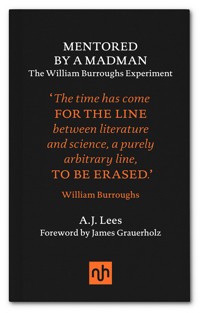
Erhalten Sie Zugang zu diesem und mehr als 300000 Büchern ab EUR 5,99 monatlich.
- Herausgeber: Notting Hill Editions
- Kategorie: Wissenschaft und neue Technologien
- Sprache: Englisch
A fascinating personal account by one of the world's leading neurologists of the profound influence of William Burroughs on his medical career. Lees journeys to the Amazonian rainforest in search of cures, and through self-experimentation seeks to find the answers his patients crave. 'The inevitable comparison with the late, great Oliver Sacks is entirely just.' - Professor Raymond Tallis
Sie lesen das E-Book in den Legimi-Apps auf:
Seitenzahl: 255
Veröffentlichungsjahr: 2016
Das E-Book (TTS) können Sie hören im Abo „Legimi Premium” in Legimi-Apps auf:
Ähnliche

















‘Lees takes the reader on an extraordinary journey inside and outside the brain. His deep humanity and honesty shines throughout. The inevitable comparison with the late, great Oliver Sacks is entirely just.’ – Raymond Tallis
‘Andrew Lees enters a powerful protest against the narrow, bureaucratic and often commercially-tainted nature of what is nowadays counted as evidence. He tells a fascinating story … and he pleads for much greater freedom for researchers to make leaps of the imagination in place of endless form-filling. If only the government would listen!’ – Theodore Dalrymple, prison doctor and author of Junk Medicine: Doctors, Lies and the Addiction Bureaucracy.
‘As medical research and practice gets squeezed by the iron hand of evidence based conformity, Andrew Lees celebrates the honourable tradition of the hunch in medical diagnosis and treatment.’ – Professor John Hardy, winner of the 2015 Discovery Prize
‘A fascinating and engrossing memoir that pays homage to the creative genius of the Beat Generation’s most challenging writer, William S. Burroughs. This book redefines the relationship between doctors, drugs, and patients. A pleasure to read.’ – Bill Morgan, Author of I Celebrate Myself: The Somewhat Private Life of Allen Ginsberg
‘As Lees shows with great insight and humour, Burroughs’ radical commitment to the power of experiment and chance could open up new worlds of possibility … Less a medical memoir than a medicinal tonic, this book would have made the old doctor nod and smile.’ – Oliver Harris, author of William Burroughs and the Secret of Fascination
‘Andrew Lees explores the life, times and peregrinations of a great American writer who, like some benign creative virus, became part of everyone’s world-view … Burroughs had seen it all – and it’s all here.’ – Geoff Ward, Burroughs devotee
Andrew Lees is a Professor of Neurology at the National Hospital, Queen Square London. He is the recipient of numerous awards including the American Academy of Neurology Life Time Achievement Award, the Association of British Neurologists’ Medal, the Dingebauer Prize for Outstanding Research and the Gowers Medal. He is one of the three most highly cited Parkinson’s disease researchers in the world. He is the author of several books, including Ray of Hope, runner-up in the William Hill Sports Book of the Year, Hurricane Port and The Silent Plague.
William Burroughs, London, 1960
A. J. Lees
–
MENTORED BY A MADMAN
–
The William Burroughs Experiment
Altamirage is that special personal quality by which good luck is prompted as a result of personally distinctive actions. In contrast, serendipity involves finding valuable things as a result of happy accidents, general exploratory behaviour, or sagacity. The most novel scientific discoveries occur when several varieties of chance coincide.
Contents
James Grauerholz
– Foreword –
‘Doctorhood is being made with me’ – Dr Konstantins Raudive, Breakthrough:An Amazing Experiment in Electronic Communication with the Dead (1971)
The book in your hands was entirely written in the three years since I first met Dr Andrew Lees via email and we became pen pals. It is a compelling, unpredictable and quirky life-review, which everyone should read. And I would still make that statement even if this book were not as riddled as a raisin cake with the words and ideas of William S. Burroughs … which it certainly is! Thus, it is my sincere pleasure to commend it humbly to your attention.
Andrew and I first made contact when he asked his good friend, the late Dr Oliver Sacks, to put out word to Sacks’ network that Lees was researching an article-in-progress, ‘Hanging Out with the Molecules’. (That brief article, published in 2014 in the Dublin Review of Books, was in many ways Dr Lees’ outline for this present work). At least two recipients of Sacks’ emailing were old friends of mine and the late William S. Burroughs, whose companion I was and whose literary executor I am, so Andrew and I were soon in touch.
Captivated by Andrew’s keen interest in all things Burroughs, I threw out lead after biographical lead, paths of research down the long years and documents of William’s life – St Louis; Vienna; New York; Chicago; Paris – not counting the worlds of Burroughs’ imagination, Interzones, that he rendered into his dozens of books and writings. (There are also many ‘Doctor’ figures to be seen among the prolific visual artworks that Burroughs made in his last decade).
Sometimes I can imagine Lees as the consummate Watson to Burroughs’ Holmes; and, I rather think, so can Andrew – I know he is well-versed in the ways of Baker Street. Of course, Dr Watson always gave Sherlock Holmes all the credit for their successful cases, and my only reservation about Mentored by a Madman is that Andrew attributes so very much of his own medical insight to the effects on him of Burroughs’ ideas.
Of course, even the most casual reader of Burroughs will know that, in his books, central roles are often played by medical and psychiatric doctors, neurosurgeons and nurses. Doctor Benway of Naked Lunch, in particular, has reached iconic status by now; but doctors and psychiatrists are everywhere in Burroughs’ writings … like the familiar host of tiny, surreal, demon-figures who always gambol in the margins of the eschatological landscapes of Hieronymus Bosch.
The key to this ‘mentorship’ is that Lees and Burroughs never met in person: it was etheric, and intergenerational. Already, in Lees’ career as a young doctor, the Burroughsian Word Virus was helping to light the way toward his own discoveries and innovations.
So was Burroughs really a madman? It has always been easy enough to see the mature author and his auto-protagonist that way, from a distance. Many of his literary doctors are ‘mad doctors’, a character type that he did not originate but to which he memorably added. His biography and his mythos did not dispel his own mad-doctor impression.
William’s friends will agree that it is undoubtedly very much for the best that he dropped out of his medical classes at the Universitaet Wien. Burroughs loved to imagine himself a doctor, but surely, many future patients’ lives were spared by that lucky turn of events in Austria in the winter of 1936–7.
And yet those horrific months in the notorious Dr Eduard Pernkopf’s anatomy class, and young Burroughs’ other medical studies, have given us such immortal characters as:
Dr Tetrazzini – who does not so much operate as perform:
I say perform advisedly because his operations were performances. He would start by throwing a scalpel across the room into the patient and then make his entrance like a ballet dancer. His speed was incredible: ‘I don’t give them time to die,’ he would say. Tumors put him in a frenzy of rage. ‘Fucking undisciplined cells!’ he would snarl, advancing on the tumor like a knife-fighter.’
Doctor Benway, who says to his students,
‘Now, boys, you won’t see this operation performed very often and there’s a reason for that … You see it has absolutely no medical value … I think it was a pure artistic creation from the beginning.’
And the German Practitioner of Technical Medicine:
‘The human body is filled up vit unnecessary parts. They should not be so close in together crowded. You can get by vit von kidney. Vy have two?’ [And he adds, sotto voce, peering ominously into the abdominal cavity:] ‘Yes dot is a kidney …’
And then with a straight face, there is William himself, solemnly pontificating to me that, since he never got a cold when he had a junk habit, therefore the junk must be delivering a protective antiviral coating to his cells. I told him: ‘Maybe it’s because on junk you never leave your house, so how could you even catch a virus.’ Oh, we had fun.
The heart of this book is that Andrew Lees has, all his career, taken on board the peculiar potpourri of visionary ideas and crackpot theories that come from ‘the mad Burroughs’. Unlike most of his contemporaries in neurology, Dr Lees gave Burroughs the benefit of the doubt, and asked himself the scientist’s indispensable questions: Why not? And what if?
Science – ‘pure science’ – relies for the solidity of its intellectual edifice on proofs, excluded middles, logical certainty and the like. But without experiment, there is no theory … and when Burroughs in 1953 was in a brujo’s shack in the rotting jungle under a full moon, drinking a cup of black, oily, fresh-brewed yage-vine liquor with no assurance of his safety or even survival, that was experimental.
The truth is out there. You want to believe. And if you are so lucky, perhaps you broaden the healing arts. I speak of the art of science, of art as science – not of misguided ‘scientism’, nor all the Faustian terrors of our modern age. These 20th-century dysfunctions were diagnosed early by the West’s bohemian post-War generation, weren’t they … for what is Beat Mind in the first place, but forms of that same ‘madness’ by which Allen Ginsberg in Howl, 1956, saw ‘the great minds of [his] generation … destroyed’? And then the sacralization of that madness, all madness, recuperated from the doctor-authorities and claimed by the mad, for the mad, détourné, Occupied, contested.
As Andrew Lees’ life story shows, he enjoys an endearing immunity to whatever it is that makes doctors overbearing and under-bearable. He does see himself seriously as a committed healer, upholding his oaths Hippocratic and Aesculapeian …
‘Of course, he has his ethical standards …’ – as William might sardonically quip.
But hold the irony, because I do believe it has been neurology’s good fortune that Andrew Lees can also see some of himself in old Doctor Benway, making that first appearance in Cambridge, Massachusetts, 1938, with William and his best friend from St Louis, Kells Elvins, co-writing ‘Twilight’s Last Gleamings’:
‘S. S. America, off Jersey coast’ … Explosion splits the boat …
By the dawn’s early light, Dr. Benway, Ship’s Doctor, pushed through a crowd at the rail and boarded the first lifeboat.
‘Are you all alright?’ he said, seating himself among the women …
‘I’m the Doctor.’
Kansas, 5 February 2016
– Preface –
In a medical field where there are so many brutal and incurable diseases, research designed to find remedies should be an integral part of the duty of care. Thirty years ago this was accepted and encouraged in neurology. Barriers have now been erected between the universities and the National Health Service that have created serious deterrents to clinical research. Academics, who sometimes prefer to call themselves clinical neuroscientists rather than neurologists, spend more and more time in their offices writing large grant applications, calculating their own impact based on their publications, and dreaming of the chimera of bench to bedside.
Neurologists have a calling and live a great part of their lives in the cloisters of the hospital. Like the police, we prefer our own company. The centenary of William Burroughs’ birth in 2014 was the spur I needed to let the cat out of the bag. It was not censure by the authorities or damage to my reputation that delayed the writing of this book but a fear of ostracism by my colleagues. To be cast out by the brotherhood would have been a punishment far greater than imprisonment.
I had realised during casual conversations over the years that few neurologists had even heard of William Burroughs let alone read him. Naked Lunch, his best-known work, was not on the recommended reading list for aspiring medical students. The few who had read Burroughs told me that they found most of it unintelligible and his diatribes against doctors and scientists deluded.
William Burroughs would have made a dreadful neurologist but he helped me to find some of the answers my patients craved, and sustained my curiosity for self-experimentation. He understood the secret of fascination. He was a virus in the dogma, the extra-terrestrial in the ointment, the third that walked beside me and influenced some of my most lasting achievements. He taught me a method of inquiry that depended on divine secret and unnoticed features. Eventually I came to see his crazy pronouncements as a Hippocratic Oath for Medical Science.
Too much is omitted and forgotten and too much imagined for this to be a memoir. I prefer to call it a fantasia. The story is a far cry from the glorious blood and thunderous craft of brain surgery and the hardcore molecular science of the wet laboratory. It is an idiosyncratic botany trip along the backwaters of observational research. It is a plea for open-mindedness and freedom.
The Hargreaves Building, Liverpool, 2016
1
– Synchronicity –
On October 5 1982, whilst I was preparing for an interview for the most senior position of my career, William Seward Burroughs entered a Liverpool that was still tense after the Toxteth riots. A small promotion tucked away in the Echo was the only public announcement:
A MAN OF INFLUENCE
Waiting for the man? William Burroughs, divine mentor, legend etc., whose books have influenced people like Lou Reed, Patti Smith, David Bowie and many others comes to Liverpool tonight for a rare reading of his works. Time 7-30pm. Be there early or the cult following will get all the seats.
Geoff Ward, a young university lecturer in English Literature, was there to welcome his hero at Lime Street Station with a gift of a bottle of vodka. Burroughs was polite but there was no small talk. Ensconced in the Adelphi Hotel, Burroughs idly turned the television on and sat immersed in a documentary on lemurs. His penumbral presence sucked the oxygen from the room and created an echo chamber. He had fallen out of the world into himself and was almost invisible, dematerialised but for the cold-blooded glow of his eyes. As the afternoon dragged on, an aromatic whiff of weed floated down the long, empty second-floor corridor. His large entourage including one man making kerpow noises with an imitation gun, ignored the insistent knocking on the door by a chambermaid dressed in full burlesque attire.
That evening Burroughs did a signing at the Atticus bookshop on Hardman Street. He was courteous and eager to socialise. A scally handed him a Tarzan comic, which he autographed without blinking an eye. He complimented the management on a terrific display that included issue 4/5 of Re/Search magazine in which he featured on the front cover. Inside was an article in which he talked about his advanced ideas about the social control process. He then walked over to the Conference Hotel accompanied by James Grauerholz, John Giorno of Dial-a-Poem fame, ex-Warhol disciple Victor Bockris and Roger Ely, one of the organisers with Genesis P-Orridge of the Final Academy, a series of events featuring Burroughs that had taken place at the Ritzy Cinema in Brixton and the Hacienda Club in Manchester.
The deliberately chosen cheap and neutral venue situated on Mount Pleasant had recently hosted the Liverpool finals of the Miss Caribbean contest. About a hundred and fifty arty punks sat in silent anticipation. Ward, who had described the events of the day to me, plucked up courage to ask Burroughs what he felt about dying, to which the tortured response had come: ‘Well it’s a step in the right direction’.
The ‘happening’ began with poetry readings by Adrian Henri of the Liverpool Scene, Geoff Ward and Jeff Nuttall, one of the first Englishmen to champion Burroughs in My Own Mag in the sixties. These understated, low-key British performances were followed by a full-on bellowing rendition of ‘Just Say No to Family Values’ by the American performance poet John Giorno.
Then Burroughs got up. ‘Can you all hear me?’ he drawled in his funereal voice. He began by reading extracts from his new book, The Place of Dead Roads. He explained that a ‘Johnson’ was a harmless person who kept his word and honoured his obligations, minded his own business and would not stand by to watch innocent people die. He was the polar opposite of a ‘Shit’ – a sanctimonious hypocrite who craved power and tried to enforce his harmful viewpoint on others. Shits comprised about one fifth of the American population and were responsible for all that was wrong in the world. He next introduced his protagonist, the gunslinging gay junky Kim Carsons whose mission was to organise the Johnson family into a worldwide space programme. Carsons was a morbid, slimy youth of unwholesome proclivities with an insatiable appetite for the extreme and the sensational who adored ectoplasm and crystal balls. He stank like a polecat and wallowed in abomination.
Burroughs next launched into a folkloric text related to his experiences in the Lexington Narcotics Hospital. The ‘do rights’ were sycophantic inmates who had acquired good bedside manners and who pretended they had made their peace with Jesus and the star-spangled banner in a cynical attempt to squeeze more dope from their gullible doctors.
He concluded the reading with an extract from ‘Twilights Last Gleamings’, a story he had written together with his childhood friend Kells Elvins, in which the first mention of Doctor Benway appears:
Dr. Benway, ships doctor, drunkenly added two inches to a four-inch incision with one stroke of his scalpel.
‘Perhaps the appendix is already out doctor?’ The nurse said. Appearing dubiously over his shoulder, ‘I saw a little scar.’
‘The appendix already out!’
‘I’m taking the appendix out!’
‘What do you think I’m doing here?!’
‘Perhaps the appendix is on the left side doctor that happens sometimes you know!’
‘Stop breathing down my neck I’m coming to that.’
‘Don’t you think I know where an appendix is?’
‘I studied appendectomy in 1904 at Harvard.’
Burroughs’ performance was animated, polished and wickedly humorous despite the fact he had been smoking dope all day and drinking red wine and vodka since late afternoon. He had travelled sideways into myth and backwards into history to reveal contemporary phantoms. He released an atom-deep sensation of otherworldliness on a Liverpool scene.
On the same day Burroughs arrived in Liverpool for the first and only time, I was successfully appointed to the post of Consultant Neurologist to the National Hospital for Nervous Diseases, Queen Square and University College Hospital in London. I had toed the line, avoided making powerful enemies and had endeavoured to develop a dignified uniformity with my fellow man. Despite my retiring and solitary nature, a flair for clinical research had carried me home. I also had a wife and two small children that helped to falsely reassure the interview panel that I was unlikely to be a deviant or subversive. I was relieved not to have lost out to opponents that I considered less deserving, yet the burden of responsibility that came with this new office filled me with fear. I had now joined the Establishment and would find it much harder to challenge authority.
William Burroughs had been my dark angel and cultural guru since our intersection at medical school and Liverpool was the eternal city of my childhood that I could never leave behind. The events of October 5, 1982, were a concatenation and became an expression of a deeper intuitive order.
As I had gone through my training I had learned to treat the person not the disease. William Osler’s words ‘Ask not what disease the person has but rather what person the disease has’ had become my modus operandi. I had come to understand the importance of the nuanced explanation, the calm gesture and the reassuring smile. I had observed my patients’ varied responses to their treatment and grasped the mystery of the therapeutic process.
I tried as best I could to enter into my patients’ mode of thought. I avoided at all costs saying to them, ‘I understand how you feel’. Many of my decisions were now based on informed guesses, hunches and imaginings; exploratory acts motivated by a passion to do good and quite independent of scientific knowledge. Unconscious wisdom, know-how and rules of thumb all played a part in my doctoring. I looked at the wider picture and when I felt it appropriate I self-experimented to obtain answers. I did my best to relieve suffering and preserve health but most of all I wanted to find new cures.
From now on, William Burroughs would be my guiding lamp. He was Dr Henry Jekyll warning me about hubris, the power of imagery and the dangers of regulation. I needed to verify, refute and establish the validity of everything I did in relation to the sour smell of nervous disease. Every effect had its cause and there was no such thing as a coincidence. There was no turning back. I was hooked on unreality.
2
– Doctor Benway –
An encyclopaedic knowledge of redundant ports and a passion for grasses and trees contrived to launch me on a career in medicine. My schoolboy geography did not revolve around mountain ranges or capitals but focused on entrepôts like Manaus where rare flowers waited in boxes to be dispatched to Liverpool. I liked to focus on those spaces on maps marked terraincognita and small mysterious islands like Terceira in the Azores. My history reading glossed over battles, treaties, and the lives of England’s monarchs but focused on the lives of the great naval explorers like Álvaro Cabral and Amerigo Vespucci. These adventurers who had made journeys into the unknown became my honorary ancestors.
A year after I had passed my GCE O-level examinations I was asked to attend for interview at the London Hospital Medical College in Whitechapel. The train journey from Leeds took me past arable land alive with fluttering peewits, cooling towers and northern ings littered with the feathers of mutilated swans. At the Kings Cross depôt I entered the zigzag of underground corridors and stairs that led me to the Tube.
I was now in an after world of perpetual solitude, another level down, above the tombs with nothing to worry about. The Underground train doors closed shut and we careered through endless echoing darkness, drawing in air before finally breaking cover in the Whitechapel cutting. I felt like a diminutive package in a canister being sucked through an airless system of pipes.
I alighted on Platform 4, climbed the wide flight of stairs and walked across the overhead bridge that linked the station’s islands to the booking office. Rows of market stalls with the bluster of Jewish costermongers greeted me on the Whitechapel Road. ‘Blame it on the Bossa Nova’ (the dance of love) by Eydie Gormé, was blasting out from Paul’s for Music. Across the road emblazoned on a large yellow brick building below a huge clock with its round stone bezel and ashen face were the words ‘The London Hospital’. In the anaemic sunlight I stared up at the attic where Joseph Merrick, ‘The Elephant Man’, had first found peace.
I climbed the stairs to the hospital, walked through its imposing colonnade and past the forecourt full of parked Daimlers and ambulances. At the lodge in the front wing, the dapper head porter pointed me in the direction of a short flight of stairs that led to the Board Room. A middle-aged woman dressed in a prim blouse told me to take a seat outside the door. I rehearsed again the extracts I had memorised from the College prospectus. The London Infirmary, later to become The London Hospital, had been founded by six businessmen in the Feathers Tavern in 1740, primarily for the relief of all sick merchant seamen. It had later become the first voluntary hospital to offer a teaching course of lectures as well as an apprenticeship. According to my mother, who had thoroughly researched the hospital’s credentials, diseases of the poor and exotic maladies common in lascars were its particular forte.
After a short delay I was ushered in by the secretary and asked to sit on a hard backed chair without arms. I explained to my ten genial inquisitors that for the last three years I had kept diaries of garden birds and had learned the importance of accurate observation and precise recording through contact with learned men in the Leeds Naturalist’s Club. As the interview was drawing to an end, I raised one or two chuckles from the committee when I told them that ‘The London’ was my first choice because of its proximity to the docks. The chairman, Dr John Ellis, then stood up and thanked me for attending. As I left the room I could see two of the committee members smiling conspiratorially.
In less than a minute I was back out on the Whitechapel Road under a clay white sky. I slipped down the stairs of the Underground as if it was a ship’s ladder. On the way back to Kings Cross, I started to enjoy the contingencies between the train stopping and the doors opening. The noise of a passing car on the other line recalled Atlantic breakers. The slamming of the doors sounded like a giant wave of surf rolling down the platform. I was in deep and a long way from shore.
Two weeks later my parents received a short note informing them I had been offered a place on the proviso that I didn’t flunk my A-levels. None of the doctors and surgeons on the panel had asked me if there were doctors in the family, whether I played rugby for the school first team, or if I could recall whether stethoscopes and nurses had featured in my childhood play routines. My destiny had been sealed in less than half an hour but for now I could keep my distance and return to the neutrality and beauty of nature. I kept returning to the Liverpool Landing Stage to look out at that exotic grey horizon. The Manaus riverboats haunted my dreams.
I arrived back in Whitechapel eighteen months later on October 4, 1965 to begin my apprenticeship. My year was composed of a mix of public school and grammar school entrants from all over the United Kingdom but only seven out of the eighty were women and there were no black students. In his welcome address, the Dean informed us that we were here to study medicine and that from now on our lives would be dedicated to the prevention, cure or alleviation of human disease. Medicine was a calling, not a business. He hoped that we would all live up to the high traditions of our chosen profession and represent ‘The London’ with honour and trustworthiness. Homo sum,humani nihil a me alienum puto – ‘I am a human being, I consider nothing that is human foreign to me’ was the hospital’s motto.
On my third day, I lined up in embarrassment with Lampard, Lashman, Lawford, Lewin and Lupini by the side of the last dead body on the row of cadavers. A smell of rancid sickliness tinged with the pungency of fixative turned our stomachs. Our corpse was a man called Wolynski, portly, with a gargantuan head and sparse body hair. His name tag stated that he had died of natural causes nine months earlier. I imagined he must have been a Polish seaman who had collapsed in a boarding house down by the river. He was a stunning figurine waiting to be vandalised. My first cut into his swollen arm revealed a morass of deathly beigeness devoid of the glistening red, white and blue of living flesh. Soon Wolynski became little more than a giant rat.
I had been forced to accept that a career collecting rare flowers in an imaginary homeland was now no more than an adolescent dream and my focus transferred to the anatomy of the human body. I applied ribald mnemonics to the tributaries of the carotid artery and reduced the brachial plexus to roots, trunks and branches. Our surgical demonstrator Andrew Paris took us to the museum where we pored over pots of pickled organs under the watchful eye of Merrick’s skeleton. Paris told us we were embarking on an adventure that may take us to places beyond our mind’s eye.
I shut myself away in my room to memorise Henry Gray’s descriptions and recite the name of each ridge and groove of my second-hand bone collection. I wrote home to reassure my anxious parents that I was adjusting to leaving home and enjoying medical school. Fortunately, my mother had not got wind of the fact that a doctor’s son from Wales had shot himself in the first week of term, reducing our number to seventy-nine. But my letters did not really tell the truth. London was a different country and a faceless monster that both excited and frightened me. I desperately missed those kindly flat vowels and people who talked to me at bus stops. I missed the passion and romance of little Northern towns like St Helens, Widnes, Wigan and Oldham and the intergalactic highway of Liverpool. I had closed down and curled inwards. Study had become a pathetic solace and a remedy for homesickness.
When our picking was finally complete, Wolynski’s frozen remains were removed from the dissection room and buried. His ‘cutting open’ had been our rite of passage. A rumour that passed from one generation of students to the next was that at the end of each term the mauled cadavers were transported on a dead body train from the hospital to Whitechapel Station and then to a place of rest near the necropolis of Brick Lane. I was not invited to Wolynski’s funeral but I was grateful for his sacrifice and have never forgotten him. He had helped me to acquire the carapace of insensitivity required to become a doctor.
Once I had negotiated the 2nd MB examinations




