


Metabolic Ecology E-Book
71,99 €
Mehr erfahren.
- Herausgeber: John Wiley & Sons
- Kategorie: Wissenschaft und neue Technologien
- Sprache: Englisch
Metabolic Ecology
Most of ecology is about metabolism, the ways that organisms use energy and materials. The energy requirements of individuals (their metabolic rates) vary predictably with their body size and temperature. Ecological interactions are exchanges of energy and materials between organisms and their environments. Therefore, metabolic rate affects ecological processes at all levels: individuals, populations, communities and ecosystems. Each chapter focuses on a different process, level of organization, or kind of organism. It lays a conceptual foundation and presents empirical examples. Together, the chapters provide an integrated framework that holds the promise for a unified theory of ecology.
The book is intended to be accessible to upper-level undergraduates and graduate students, but also of interest to senior scientists. Its easy-to-read chapters and clear illustrations can be used in lecture and seminar courses. This is an authoritative treatment that will inspire future generations to study metabolic ecology.
Sie lesen das E-Book in den Legimi-Apps auf:
Seitenzahl: 1039
Veröffentlichungsjahr: 2012
Ähnliche




















Table of Contents
Cover
COMPANION WEBSITE
Title page
Copyright page
Notes on contributors
Preface
Introduction: Metabolism as the basis for A theoretical unification of ecology
I METABOLISM IS TO ECOLOGY AS GENETICS IS TO EVOLUTION?
II METABOLIC ECOLOGY IS MORE THAN SCALING AND MTE
III ORGANIZATION OF THE BOOK
IV A FINAL COMMENT
Part I: Foundations
Chapter 1: Methodological Tools
1.1 INTRODUCTION
1.2 VISUALIZING MTE RELATIONSHIPS
1.3 FITTING MTE MODELS TO DATA
1.4 ARE THE FITTED PARAMETERS CONSISTENT WITH THEORETICAL PREDICTIONS?
1.5 IS THE SHAPE OF THE RELATIONSHIP CONSISTENT WITH THEORETICAL PREDICTIONS?
1.6 THOUGHTS ON TESTING ECOLOGICAL THEORIES
ACKNOWLEDGMENTS
Chapter 2: The Metabolic Theory of Ecology and its Central Equation
2.1 INTRODUCTION
2.2 THE CENTRAL EQUATION OF METABOLIC ECOLOGY
2.3 ANALYZING, PLOTTING, AND EVALUATING DATA
2.4 THE EFFECT OF BODY SIZE AND THE RIDDLE OF QUARTER-POWER SCALING
2.5 THE MODELS OF WEST, BROWN, AND ENQUIST
2.6 THE EFFECT OF TEMPERATURE
2.7 INCORPORATING STOICHIOMETRY
2.8 CONCLUSION
Chapter 3: Stoichiometry
3.1 INTRODUCTION
3.2 BUILDING ORGANISMS USING ENERGY AND STUFF
3.3 WHAT DO ALL THESE ELEMENTS DO?
3.4 HOW ARE CHEMICAL ELEMENTS DISTRIBUTED?
3.5 MODELS AND APPLICATIONS OF STOICHIOMETRY TO METABOLISM
3.6 A FEW APPLICATIONS OF LIEBIG LOGIC
3.7 BEYOND LIEBIG: WHEN METABOLISM IS LIMITED BY MULTIPLE ELEMENTS
3.8 LINKING ES AND MTE MODELS OF METABOLIC ECOLOGY
3.9 OPPORTUNITIES
Chapter 4: Modeling Metazoan Growth and Ontogeny
4.1 INTRODUCTION TO ONTOGENETIC SCALING
4.2 ALLOMETRIC MODELS OF ONTOGENETIC GROWTH
4.3 INFLUENCES OF TEMPERATURE AND STOICHIOMETRY
4.4 CAVEATS AND CONCLUSIONS
Chapter 5: Life History
5.1 INTRODUCTION
5.2 WHAT IS A LIFE HISTORY?
5.3 PREDICTING HOW LIFE HISTORIES CHANGE WITH BODY SIZE
5.4 DATA
5.5 EVOLUTIONARY CONSIDERATIONS
5.6 CONCLUSIONS
Chapter 6: Behavior
6.1 INTRODUCTION
6.2 THE ROLE OF METABOLISM
6.3 FORAGING AND RESOURCE ACQUISITION
6.4 COMMUNICATION
6.5 REPRODUCTION
6.6 COOPERATION AND GROUP LIVING
6.7 CONCLUSIONS
Chapter 7: Population and Community Ecology
7.1 INTRODUCTION
7.2 PARAMETERIZING POPULATION DYNAMIC MODELS
7.3 ENERGY AND COMMUNITY STRUCTURE
7.4 CAN ECOLOGY EXPLAIN THE SCATTER IN METABOLIC SCALING?
7.5 PROSPECTS
ACKNOWLEDGMENTS
Chapter 8: Predator–Prey Relations and Food Webs
8.1 INTRODUCTION
8.2 TROPHIC RELATIONS
8.3 FOOD WEB STRUCTURE
8.4 FOOD WEB DYNAMICS AND STABILITY
8.5 WAYS FORWARD
ACKNOWLEDGMENTS
Chapter 9: Ecosystems
9.1 INTRODUCTION
9.2 BODY SIZE
9.3 TEMPERATURE
9.4 WATER
9.5 NUTRIENTS
9.6 CONCLUSION
Chapter 10: Rates of Metabolism and Evolution
10.1 INTRODUCTION
10.2 METHODS FOR MEASURING EVOLUTIONARY RATES
10.3 PROBLEMS AND HYPOTHESES
10.4 CONCLUDING COMMENTS
Chapter 11: Biodiversity and Its Energetic and Thermal Controls
11.1 INTRODUCTION
11.2 THE MORE-INDIVIDUALS HYPOTHESIS AND ITS LIMITATIONS
11.3 METABOLIC THEORY OF BIODIVERSITY
11.4 CONCEPTUAL PROBLEMS OF THE CURRENT FORMULATION OF THE METABOLIC THEORY OF BIODIVERSITY
11.5 EMPIRICAL PATTERNS: EVIDENCE AND COUNTEREVIDENCE
11.6 MERITS OF THE METABOLIC THEORY OF BIODIVERSITY
11.7 TEMPERATURE AGAIN: WHICH EFFECTS AND WHEN?
11.8 CONCLUSIONS
ACKNOWLEDGMENTS
Part II: Selected Organisms and Topics
Chapter 12: Microorganisms
12.1 INTRODUCTION
12.2 BRIEF HISTORY OF METABOLIC ECOLOGY OF MICROBES
12.3 PHYSIOLOGICAL FOUNDATIONS
12.4 QUANTITATIVE OUTLINE OF THE DIMENSIONS OF METABOLISM
12.5 DIMENSION 1: THERMODYNAMICS
12.6 DIMENSION 2: CHEMICAL KINETICS
12.7 DIMENSION 3: PHYSIOLOGICAL HARSHNESS AND ENVIRONMENTAL STRESS
12.8 DIMENSION 4: CELL SIZE
12.9 DIMENSION 5: LEVELS OF BIOLOGICAL ORGANIZATION
12.10 COMMUNITY METABOLISM AND THE INTERPLAY OF DIMENSIONS
12.11 CONCLUDING REMARKS
Chapter 13: Phytoplankton
13.1 INTRODUCTION
13.2 SCALING OF PHYTOPLANKTON PHYSIOLOGY AND ECOLOGY
13.3 SCALING OF PHYTOPLANKTON COMMUNITIES
13.4 EFFECTS OF GLOBAL CHANGE
13.5 FUTURE DIRECTIONS
Chapter 14: Land Plants: New Theoretical Directions and Empirical Prospects
14.1 INTRODUCTION
14.2 PLANT SCALING: HISTORICAL OVERVIEW
14.3 EXAMPLES OF BOTANICAL SCALING: FROM ANATOMY AND PHYSIOLOGY TO ECOSYSTEMS
14.4 ORIGIN OF BOTANICAL SCALING EXPONENTS: WEST, BROWN, AND ENQUIST MODEL
14.5 ORIGIN OF BOTANICAL SCALING NORMALIZATIONS: MERGING OF WBE2 WITH TRAIT-BASED PLANT ECOLOGY
14.6 WHAT HAVE WE LEARNED SINCE 1997 AND 1999?
14.7 SCALING UP TO POPULATIONS, COMMUNITIES, AND ECOSYSTEMS
14.8 CONCLUSIONS
ACKNOWLEDGMENTS
Chapter 15: Marine Invertebrates
15.1 INTRODUCTION
15.2 OVERVIEW OF METABOLIC THEMES IN MARINE INVERTEBRATE ECOLOGY AND EVOLUTION
15.3 PATTERNS IN METABOLIC RATE WITH DEPTH, AND SELECTION FOR HIGH RATES IN SURFACE WATERS
15.4 TEMPERATURE DEPENDENCE OF DEVELOPMENT, AND RELATED PHENOTYPIC COMPENSATION
15.5 MOVING FORWARD: A NEW GENERATION OF MARINE METABOLIC ECOLOGY IN A TIME OF GLOBAL CHANGE
Chapter 16: Insect Metabolic Rates
16.1 INTRODUCTION
16.2 ENVIRONMENTAL AND BEHAVIORAL EFFECTS ON INSECT METABOLIC RATES
16.3 CORRELATIONS BETWEEN BODY SIZE AND METABOLIC RATE
16.4 BROADER IMPLICATIONS
Chapter 17: Terrestrial Vertebrates
17.1 METABOLISM OF TERRESTRIAL VERTEBRATES VARIES PREDICTABLY WITH DIFFERENCES IN BODY SIZE AND TEMPERATURE
17.2 MECHANISTIC CORRELATES OF METABOLISM VS. SIZE IN TERRESTRIAL VERTEBRATES
17.3 MECHANISTIC CORRELATES OF RESOURCE ACQUISITION AND ALLOCATION VS. SIZE IN TERRESTRIAL VERTEBRATES
17.4 IMPLICATIONS OF METABOLIC SCALING FOR VERTEBRATE POPULATION ECOLOGY
17.5 OTHER IMPLICATIONS AND APPLICATIONS OF METABOLIC SCALING IN VERTEBRATE BIOLOGY
17.6 CONCLUDING REMARKS
Chapter 18: Seabirds and Marine Mammals
18.1 INTRODUCTION
18.2 GENERAL PATTERNS OF ENERGY INTAKE AND EXPENDITURE, FORAGING, AND REPRODUCTION
18.3 COMPARISONS AMONG SEABIRDS
18.4 CONCLUDING REMARKS
ACKNOWLEDGMENTS
Chapter 19: Parasites
19.1 INTRODUCTION
19.2 WHY CONSIDER PARASITES AND INFECTIOUS DISEASE?
19.3 PARASITE INDIVIDUALS
19.4 PARASITES IN HOSTS
19.5 PARASITES AND FREE-LIVING SPECIES IN ECOSYSTEMS
19.6 CONCLUSIONS AND FUTURE DIRECTIONS
Chapter 20: Human Ecology
20.1 INTRODUCTION
20.2 COMPARATIVE HUMAN LIFE HISTORY
20.3 COMPARATIVE HUMAN POPULATION ECOLOGY
20.4 HUMAN ECOLOGICAL AND EVOLUTIONARY ENERGETICS
20.5 CONCLUSIONS
Part III: Practical Applications
Chapter 21: Marine Ecology and Fisheries
21.1 INTRODUCTION
21.2 LIFE HISTORIES
21.3 FOOD WEBS
21.4 FOOD WEB COMPLEXITY
21.5 FISHING IMPACTS
21.6 FISHERY ASSESSMENT AND MANAGEMENT
21.7 CONCLUSIONS
Chapter 22: Conservation Biology
22.1 INTRODUCTION
22.2 METABOLIC LINKAGES TO EXTINCTION RISK
22.3 BROAD-SCALE CONSERVATION APPLICATIONS OF MTE
22.4 CONCLUSIONS
Chapter 23: Climate Change
23.1 INTRODUCTION
23.2 INDIVIDUALS
23.3 COMMUNITIES
23.4 ECOSYSTEMS
23.5 CONCLUSIONS
Chapter 24: Beyond Biology
24.1 INTRODUCTION
24.2 CITIES
24.3 COMPUTERS
24.4 BACK TO BIOLOGY
Chapter 25: Synthesis and Prospect
SYNTHESIS
PROSPECT
Glossary
References
Index
Cover image
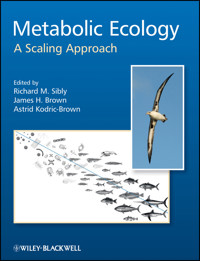
Photograph of a Laysan Albatross (Phoebastria immutabilis) by D. Costa. Drawings and photographs of organisms courtesy of R. Beckett, S. R. Jennings and J. H. Nichols.
COMPANION WEBSITE
This book is accompanied by a companion website:
www.wiley.com/go/sibly/metabolicecology
With figures and tables from the book for downloading, together with updates and additional resources
This edition first published 2012 © 2012 by John Wiley & Sons, Ltd.
Wiley-Blackwell is an imprint of John Wiley & Sons, formed by the merger of Wiley’s global Scientific, Technical and Medical business with Blackwell Publishing.
Registered office: John Wiley & Sons, Ltd, The Atrium, Southern Gate, Chichester, West Sussex, PO19 8SQ, UK
Editorial offices: 9600 Garsington Road, Oxford, OX4 2DQ, UK
The Atrium, Southern Gate, Chichester, West Sussex, PO19 8SQ, UK
111 River Street, Hoboken, NJ 07030-5774, USA
For details of our global editorial offices, for customer services and for information about how to apply for permission to reuse the copyright material in this book please see our website at www.wiley.com/wiley-blackwell.
The right of the author to be identified as the author of this work has been asserted in accordance with the UK Copyright, Designs and Patents Act 1988.
All rights reserved. No part of this publication may be reproduced, stored in a retrieval system, or transmitted, in any form or by any means, electronic, mechanical, photocopying, recording or otherwise, except as permitted by the UK Copyright, Designs and Patents Act 1988, without the prior permission of the publisher.
Designations used by companies to distinguish their products are often claimed as trademarks. All brand names and product names used in this book are trade names, service marks, trademarks or registered trademarks of their respective owners. The publisher is not associated with any product or vendor mentioned in this book. This publication is designed to provide accurate and authoritative information in regard to the subject matter covered. It is sold on the understanding that the publisher is not engaged in rendering professional services. If professional advice or other expert assistance is required, the services of a competent professional should be sought.
Library of Congress Cataloging-in-Publication Data applied for.
Hardback: 9780470671535; paperback: 9780470671528.
ISBN: 9781119968504 (epdf); ISBN: 9781119968511 (epub); ISBN: 9781119968528 (mobi)
A catalogue record for this book is available from the British Library.
Wiley also publishes its books in a variety of electronic formats. Some content that appears in print may not be available in electronic books.
Notes on contributors
Ken H. Andersen is a professor in theoretical marine ecology at the National Institute of Aquatic Resources at the Technical University of Denmark. He studies how the marine ecosystem responds to perturbations, in particular fishing, using size-spectrum models and metabolic arguments. ttp://ken.haste.dk
Kristina J. Anderson-Teixeira received her PhD in Biology under James H. Brown and also studied under Marcy E. Litvak at the University of New Mexico. She is currently working as a postdoctoral research associate with Evan H. DeLucia at the University of Illinois. Her research focuses on understanding how climate shapes terrestrial ecosystems, quantifying the climate regulation services of terrestrial ecosystems, and applying knowledge of ecosystem–climate interactions to inform land-use decisions in an era of climate change.
Lisa Patrick Bentley is currently an NSF postdoctoral fellow at the University of Arizona. She works on extending metabolic scaling theory to account for additional aspects of plant hydraulics, xylem function, and carbon flux. Her aim is to integrate key plant physiological processes that affect ecosystem-level dynamics. Her approach addresses an increasing need for predictive models that scale from the leaf to globe in order to inform future research and government policy decisions.
Julia Blanchard is a Lecturer in the Department of Animal and Plant Sciences at the University of Sheffield and an Honorary Research Fellow of Imperial College London. Julia teaches and researches both the fundamental and applied ecology of marine populations, communities, and ecosystems. Her current research involves linking macroecology, food webs and fisheries ecology to inform marine ecosystem management. www.sheffield.ac.uk/aps/staff-and-students/acadstaff/blanchard-julia
Alison Boyer is a Research Assistant Professor in the Department of Ecology asd Evolutionary Biology at the University of Tennessee. She uses ecological informatics and the fossil record to examine community ecology and extinction risk in island birds. She is also engaged in research at broader scales to examine processes governing biological diversity. http://eeb.bio.utk.edu/boyer/index.html
James H. Brown is Distinguished Professor of Biology at the University of New Mexico, Albuquerque. He led the development of the Metabolic Theory of Ecology on which this book is largely based. He has a long history of research in biogeography and macroecology, taking a large-scale statistical approach to questions about abundance, distribution, and diversity. http://biology.unm.edu/jhbrown/index.shtml
John Bruno is a marine ecologist in the Department of Biology at the University of North Carolina at Chapel Hill. His research is focused on marine biodiversity, coral reef ecology and conservation and the impacts of climate change on marine ecosystems. John earned his PhD in Ecology and Evolutionary Biology from Brown University and was a postdoctoral fellow in disease ecology at Cornell University. www.brunolab.net
Oskar Burger is a Postdoctoral Fellow at the Max Planck Institute for Demographic Research. He has many interests in both the social and natural sciences centered around understanding large-scale evolutionary constraints on human/primate life history. His latest projects include the evolution of the post-reproductive lifespan, cross-species primate mortality patterns, life-history invariants across the tree of life, and the effects of variation in energy consumption on human demographics.
Chris Carbone works at the Institute of Zoology, Zoological Society of London, Regent’s Park, and is interested in understanding drivers of species distributions and abundance. His work focuses particularly on the role of body size and consumer–resource relationships in shaping organism ecology and population processes, and he is developing a fondness for dinosaurs.
Daniel Costa is a Distinguished Professor of Ecology and Evolutionary Biology at the University of California at Santa Cruz. He research focuses on the ecology and physiology of marine mammals and seabirds. He has worked in almost every habitat from the Galapagos to the Antarctic with a broad range of animals including penguins, albatross, seals, sea lions, whales, and dolphins. http://bio.research.ucsc.edu/people/costa/
Jennifer Dunne is a Professor at the Santa Fe Institute (www.santafe.edu) and Co-Director of the Pacific Ecoinformatics and Computational Ecology Lab (www.foodwebs. org). Her research seeks to identify fundamental patterns and principles of ecological network structure, robustness, and dynamics at multiple spatial and temporal scales.
Brian Enquist is a Professor in the Department of Ecology and Evolutionary Biology at the University of Arizona (www. salvias.net/∼brian). He uses physiological, theoretical, computational, and informatics approaches in order to discover general principles that shape the: (i) origin of biological scaling laws; (ii) scaling of plant functional traits to ecology and evolution; and (iii) origin and maintenance of functional and phylogenetic diversity. He addresses these questions in tropical forests and alpine ecosystems.
S. K. Morgan Ernest is an Associate Professor in the Department of Biology at Utah State University. She teaches courses on Animal Community Ecology, Macroecology, and non-majors courses in Biology. While she has been involved in research spanning from life-history theory to paleoecology, she is particularly interested in how energetic constraints impact the structure and dynamics of communities. http://ernestlab.weecology.org
Stephanie Forrest is Professor of Computer Science, University of New Mexico, and External Professor of the Santa Fe institute. Her research studies adaptive systems, including immunology, evolutionary computation, biological modeling, and computer security. http://www.cs.unm.edu/∼forrest/
Jamie Gillooly is an Assistant Professor of Biology at the University of Florida. Jamie played a primary role in developing the Metabolic Theory of Ecology, and is currently working to extend these energy-based models in new directions. Current projects include the study of animal communication, animal migration, and aging and disease. In addition, Jamie has been working to foster collaboration between artists and scientists as a “scholar-in-residence” in the School of Fine Arts and Art History at the University of Florida.
John Gittleman is Dean and Professor of Ecology in the Odum School of Ecology at the University of Georgia where he teaches Macroecology and Conservation Ecology. His research interests are large-scale ecological and evolutionary problems, specifically related to speciation, extinction, and global biodiversity. http://blackbear.ecology.uga.edu/gittleman/
Marcus Hamilton is a Postdoctoral Fellow at the Santa Fe Institute and an Adjunct Professor of Anthropology at the University of New Mexico. His research focuses on general principles that drive the structure, dynamics, and diversity of human societies in the past, present, and future, integrating perspectives from across the social, biological, and physical sciences. http://www.unm.edu/∼marcusj/home.htm
Jon F. Harrison is a Professor in the School of Life Sciences at Arizona State University where he teaches a variety of courses in biology and physiology. His research focuses on environmental and ecological physiology of insects. http://jharrison.faculty.asu.edu
April Hayward is a Postdoctoral Associate at the University of Florida whose research ultimately focuses on understanding how complex biological systems emerged from a prebiotic soup. Current efforts toward this end center on understanding the flow and retention of matter and energy through different levels of biological organization.
Ryan Hechinger is a research scientist at the University of California, Santa Barbara. He has three overarching and related research goals. One is to evaluate the importance of parasites in ecosystems. Another is to use parasites to test and refine general ecological and evolutionary theory. The third is to “keep it real.”http://www.lifesci.ucsb.edu/∼hechinge/
Nick Isaac works at the Natural Environment Research Council’s Centre for Ecology and Hydrology in Wallingford, Oxfordshire, on questions about species’ distribution and abundance over large scales, using data on mammals, insects, and birds. Of particular interest is the relative contribution of intrinsic biological traits and extrinsic environmental drivers in shaping biodiversity, and how these patterns change at different spatial, temporal, and taxonomic scales.
Simon Jennings is a Principal Scientist at the Centre for Environment, Fisheries and Aquaculture Science, Lowestoft, and Professor of Environmental Science at the University of East Anglia. His research focuses on assessing the sustainability of human and environmental impacts on marine populations, communities, and ecosystems as well as developing and applying tools to support marine environmental management.
Walter Jetz is Associate Professor in the Ecology and Evolutionary Biology Department at Yale University. Using mostly terrestrial vertebrates and plants as study systems, his interdisciplinary research draws on elements of biogeography, community ecology, landscape ecology, macroecology, global change ecology, evolution, comparative biology, biodiversity informatics, and conservation, aiming to integrate across scales of geography and ecological organization – from local to global assemblages. http://www.yale.edu/jetz/
William Karasov is Professor in the Department of Forest and Wildlife Ecology at University of Wisconsin-Madison, where he teaches Animal Physiological Ecology. He researches digestive physiology, nutritional ecology, animal energetics, and ecotoxicology of vertebrates. http://forestandwildlifeecology. wisc.edu/facstaff/karasov.html
Michael Kaspari is a Presidential Professor and Director of the EEB graduate program at the University of Oklahoma where he teaches Community Ecology and Introduction to Biology. He uses metabolic approaches to understand the structure of brown, or detrital, food webs and how their structure and function varies geographically. He is particularly fond of tropical forests and ants. http://faculty-staff.ou.edu/K/Michael.E.Kaspari-1/AntLab_Home.htm
Drew Kerkhoff is Associate Professor in the Departments of Biology and Mathematics at Kenyon College. He teaches Ecology, Statistics, Biogeography, and Mathematical Biology, as well as introductory and non-majors courses. His research includes experimental, field, and macroecological studies of biological scaling and biodiversity, mostly focused on plants and, more recently, insects. http://biology.kenyon.edu/kerkhoff
Astrid Kodric-Brown is a Professor of Biology at the University of New Mexico, Albuquerque. Her research interests include the behavioral ecology of freshwater fishes, especially the evolution of mate recognition systems and their role in speciation in pupfishes (Cyprinodon); the allometry of sexually selected traits; and community structure and conservation of desert fishes. http://biology.unm.edu/biology/kodric/
Armand Kuris is Professor of Zoology at the University of California Santa Barbara where he teaches Parasitology, Invertebrate Zoology, Higher Invertebrates and Evolutionary Medicine. With Kevin Lafferty and Ryan Hechinger, he researches the role of infectious processes in ecosystems. They focus on the flow of energy through trophic levels and the evolution of parasitism, investigating biological control of schistosomiasis and exotic marine pests. http://www.lifesci.ucsb.edu/eemb/labs/kuris/index.html
Kevin Lafferty is an ecologist with the US Geological Survey and adjunct faculty at University of California Santa Barbara. He studies the ecology of infectious disease and conservation biology, primarily in marine systems. http://www.werc.usgs.gov/person.aspx?personID=166.
Elena Litchman is an associate professor at Michigan State University. Her research interests are ecology and evolution of freshwater and marine phytoplankton and aquatic ecosystem responses to global environmental change. She uses experiments, field studies, and mathematical models to investigate how abiotic factors and biotic interactions jointly determine phytoplankton community structure. http://www.kbs.msu.edu/people/faculty/litchman
Brian McGill works at the School of Biology and Ecology & Sustainability Solutions Initiative, University of Maine, where he studies biodiversity and organism–environment interactions at large scales (large areas, long time periods). A primary question is understanding how geographic ranges will shift in response to climate change. He also uses a heavily informatic approach involving large datasets and advanced statistics to analyze them.
Melanie Moses is an Assistant Professor in the Computer Science Department, with a joint appointment in Biology, at the University of New Mexico. She uses mathematical models and computational concepts to understand complex biological systems. Her research focuses on networks, including scaling in cardiovascular networks and networks of information exchange in ant colonies and immune systems. http://cs.unm.edu/∼melaniem
Mary O’Connor is an Assistant Professor in the Department of Zoology and Biodiversity Research Centre at the University of British Columbia in Vancouver, BC, Canada, where she teaches Advanced Ecology and Marine Ecology. She researches the ecosystem-level consequences of environmental temperature change, and explores the contribution of ecological theory to a stronger understanding of climate change impacts. http://www.zoology.ubc.ca/∼oconnor
Jordan G. Okie is a NASA Astrobiology Institute and Arizona State University School of Earth and Space Exploration postdoctoral fellow. He is interested in biological scaling, macroecology, macroevolution, microbial ecology and biogeography, astrobiology, and the role of metabolism in ecology and evolution.
Owen Petchey is Professor of Integrative Ecology at the Institute of Evolutionary Biology and Environmental Studies, University of Zurich. His group’s research about biodiversity and ecological networks aims to improve our understanding of the causes and consequences of extinctions.
Scott Shaffer is an Assistant Professor in the Department of Biological Sciences at San Jose State University. He teaches Physiological Ecology and Introductory Biology and his research focuses on the ecological energetics, functional morphology, and behavioral ecology of seabirds and marine mammals. http://www.biology.sjsu.edu/facultystaff/sshaffer/sshaffer.aspx
Richard Sibly is Professor in the School of Biological Sciences at the University of Reading where he teaches Behavioural Ecology and Population Biology. He researches metabolic ecology questions with members of Jim Brown’s laboratory at the University of New Mexico and also works to promote the use of Agent-Based Models (ABMs) more widely in ecology. http://www.reading.ac.uk/biologicalsciences/about/staff/r-m-sibly.aspx
Felisa Smith is an Associate Professor of Biology at the University of New Mexico. She studies factors influencing mammalian body size across time, space, and hierarchical scales. Current projects include field investigations of the physiological and morphological trade-offs to life in an extreme environment, paleomiddens investigations of microevolutionary response to late Quaternary climate change, and macroecological studies of mammalian body size across evolutionary time and geographic space. http://biology.unm.edu/fasmith/
Patrick R. Stephens is an Assistant Research Scientist in the Odum School of Ecology at the University of Georgia. He uses phylogenetic methods to explore questions that lie at the intersection of ecology and evolutionary biology, and is particularly interested in the origins of large-scale patterns of community structure and diversity. http://www. ecology.uga.edu/facultyMember.php?Stephens- 348/
David Storch is based at the Charles University in Prague, Czech Republic. His interests embrace macroecology, biogeography, and evolutionary ecology, namely patterns in species richness, null models of species abundances and distributions, and geometrical issues concerning biological diversity. He has edited the book Scaling Biodiversity (Cambridge University Press, 2007), and has coauthored several other books on ecology and evolution. http://www.cts.cuni.cz/∼storch/
Peter Vitousek is Clifford G. Morrison Professor of Population and Resources in the Department of Biology at Stanford University, where he teaches ecology and biogeochemistry. His research focuses on the biogeochemistry of nitrogen, the ecosystems of the Hawaiian Islands, and the dynamics of Polynesian agriculture prior to European contact. http//www.stanford.edu/group/Vitousek/
Robert Walker is Assistant Professor of Anthropology at the University of Missouri. He researches the evolution of human bio-cultural variation with a focus on phylogenetic methods, kin co-residence patterns, marriage practices, and life-history variation across human populations. http://anthropology. missouri.edu/people/walker.html
James S. Waters is a Biology PhD candidate in the School of Life Sciences at Arizona State University working under the guidance and mentorship of Jon F. Harrison. His dissertation research focuses on how the functional integration of social insect colonies scales with colony size. He is also involved with research on the biomechanics and respiratory physiology of insect tracheal systems.
Ethan White is an Assistant Professor with joint appointments in the Department of Biology and the Ecology Center at Utah State University. His research addresses a broad range of questions in macroecology and quantitative ecology, and he is actively involved in the development of tools to facilitate environmental informatics. http://whitelab.weecology.org
Xiao Xiao is a graduate student in the Department of Biology and the Ecology Center at Utah State University. Her research focuses on the application of mathematics, statistics, and informatics in the study of macroecological patterns.
Part I Foundations
Chapter 1
Methodological Tools
Ethan P. White, Xiao Xiao, Nick J. B. Isaac, and Richard M. Sibly
SUMMARY
1 In this chapter we discuss the best methodological tools for visually and statistically comparing predictions of the metabolic theory of ecology to data.
Lesen Sie weiter in der vollständigen Ausgabe!
Lesen Sie weiter in der vollständigen Ausgabe!
Lesen Sie weiter in der vollständigen Ausgabe!
Lesen Sie weiter in der vollständigen Ausgabe!
Lesen Sie weiter in der vollständigen Ausgabe!
Lesen Sie weiter in der vollständigen Ausgabe!
Lesen Sie weiter in der vollständigen Ausgabe!
Lesen Sie weiter in der vollständigen Ausgabe!
Lesen Sie weiter in der vollständigen Ausgabe!
Lesen Sie weiter in der vollständigen Ausgabe!
Lesen Sie weiter in der vollständigen Ausgabe!
Lesen Sie weiter in der vollständigen Ausgabe!
Lesen Sie weiter in der vollständigen Ausgabe!
Lesen Sie weiter in der vollständigen Ausgabe!
Lesen Sie weiter in der vollständigen Ausgabe!
Lesen Sie weiter in der vollständigen Ausgabe!
Lesen Sie weiter in der vollständigen Ausgabe!
Lesen Sie weiter in der vollständigen Ausgabe!
Lesen Sie weiter in der vollständigen Ausgabe!
Lesen Sie weiter in der vollständigen Ausgabe!
Lesen Sie weiter in der vollständigen Ausgabe!
Lesen Sie weiter in der vollständigen Ausgabe!
Lesen Sie weiter in der vollständigen Ausgabe!
Lesen Sie weiter in der vollständigen Ausgabe!
Lesen Sie weiter in der vollständigen Ausgabe!
Lesen Sie weiter in der vollständigen Ausgabe!
Lesen Sie weiter in der vollständigen Ausgabe!




