


9,99 €
Mehr erfahren.
- Herausgeber: Daniel Zaborowski
- Sprache: Englisch
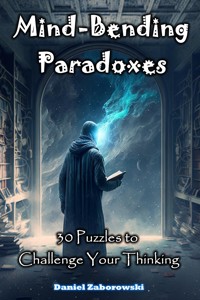
The e-book "Mind-Bending Paradoxes: 50 Puzzles to Challenge Your Thinking" is a comprehensive exploration of paradoxes from different fields of study. The e-book delves into logical paradoxes such as the Liar Paradox, Russell's Paradox, and the Barber Paradox, physical paradoxes like the Heat Death Paradox, and philosophical paradoxes like the Euthyphro Dilemma and the Paradox of the Knower. Additionally, the e-book covers famous paradoxes like the Ship of Theseus, the Trolley Problem, and the Monty Hall Paradox.
Throughout the e-book, the reader is presented with a variety of solutions and perspectives for each Paradox which helps to deepen the understanding of these complex problems. The e-book also provides discussion questions and exercises for each paradox to encourage critical thinking and analysis.
The e-book aims to provide valuable insights into the limits of human understanding and knowledge and to question the reader's beliefs and challenge their understanding of the world around them. The book concludes with a thank you note to the reader for their engagement and support and encourages them to continue exploring the world of paradoxes and other philosophical, logical, and physical concepts in the future.
Das E-Book können Sie in Legimi-Apps oder einer beliebigen App lesen, die das folgende Format unterstützen:
Veröffentlichungsjahr: 2023
Ähnliche

















Table of Contents
Introduction
Chapter 1: Logical Paradoxes
Chapter 2: Physical Paradoxes
Chapter 3: Philosophical Paradoxes
Conclusion
Introduction
Welcome to "Mind-Bending Paradoxes: 30 Puzzles to Challenge Your Thinking"! This e-book is designed to introduce you to the world of paradoxes and to help you develop your critical thinking skills.
A paradox is a statement or situation that contradicts itself or appears to be untrue. Paradoxes have been studied for centuries by philosophers, mathematicians, and scientists, and they continue to fascinate and perplex us to this day. Paradoxes can be found in many areas of human knowledge, including logic, physics, and philosophy. They can be simple or complex, and they can challenge our understanding of the world in ways that are both profound and unexpected.
The purpose of this e-book is to introduce you to a variety of paradoxes from different areas of knowledge and to help you develop your critical thinking skills through analysis and discussion. The e-book is divided into three sections: logical paradoxes, physical paradoxes, and philosophical paradoxes. Each section includes a brief explanation of each paradox, along with discussion questions and exercises to encourage critical thinking and analysis.
In the section on logical paradoxes, you will learn about a variety of paradoxes that challenge our understanding of logic and reasoning. Some of the paradoxes in this section include the liar paradox, Russell's paradox, and the Barber paradox. These paradoxes will challenge your understanding of the foundations of logic and help you to see how seemingly simple statements can lead to contradictions and confusion.
In the section on physical paradoxes, you will learn about paradoxes that challenge our understanding of the physical world. Some of the paradoxes in this section include Zeno's paradoxes, the twin paradox, and the arrow paradox. These paradoxes will challenge your understanding of time, space, and motion and help you to see how the laws of physics can lead to unexpected and seemingly contradictory results.
In the section on philosophical paradoxes, you will learn about paradoxes that challenge our understanding of the nature of reality, morality, and knowledge. Some of the paradoxes in this section include the trolley problem, the ship of Theseus, and the Euthyphro dilemma. These paradoxes will challenge your understanding of morality, personal identity, and the nature of knowledge and help you to see how seemingly simple questions can lead to deep and profound philosophical questions.
As you read through this e-book, you will be challenged to think critically and to question your assumptions about the world. Paradoxes are not simply puzzles to be solved; they are tools for expanding your mind and helping you to see the world in new ways. By the end of this e-book, you will have a deeper understanding of the nature of paradoxes and a sharper mind to tackle any future challenge.
This e-book is not only for people who are interested in philosophy, mathematics, or science, but also for anyone who is interested in expanding their mind and challenging their thinking. Paradoxes are a powerful tool for understanding the world around us and the way we think about it, and this e-book is an excellent introduction to the fascinating world of paradoxes.
The e-book's structure is designed to be easy to follow and understand, and the language used is simple and straightforward. However, some of the concepts and paradoxes discussed in this e-book can be complex and challenging, but that is what makes it so exciting and mind-bending.
So, get ready to dive into the world of paradoxes and to challenge your thinking in ways you never thought possible. Let's begin!
Chapter 1: Logical Paradoxes
The Liar Paradox
––––––––
The Liar Paradox is a well-known logical paradox that has been studied and debated by philosophers and logicians for centuries. At its core, the Liar Paradox is a self-referential statement that contradicts itself, leading to a seemingly unsolvable problem. The statement can be in the form of a sentence or a question, and it raises important questions about the nature of truth, language, and logic.
The most common form of the Liar Paradox is the sentence "This sentence is false." If the sentence is true, then it must be false, but if it is false, then it must be true. This creates a logical contradiction, and it is not clear how to evaluate the truth of the statement.
The Liar Paradox can also take the form of a question, such as "Is this statement true or false?" If the question is true, then the statement must be false, but if the question is false, then the statement must be true. The question, like the sentence, creates a logical contradiction.
The Liar Paradox has been studied by many philosophers and logicians, and several different solutions have been proposed. One solution is to reject the law of the excluded middle, which states that every statement must be either true or false. By rejecting this law, the Liar Paradox can be seen as a statement that is neither true nor false, but simply undefined.




