


117,99 €
Mehr erfahren.
- Herausgeber: John Wiley & Sons
- Kategorie: Wissenschaft und neue Technologien
- Sprache: Englisch
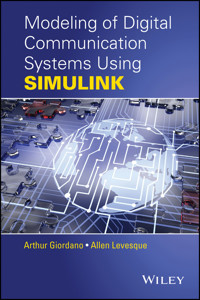
A comprehensive and detailed treatment of the program SIMULINK® that focuses on SIMULINK® for simulations in Digital and Wireless Communications Modeling of Digital Communication Systems Using SIMULINK® introduces the reader to SIMULINK®, an extension of the widely-used MATLAB modeling tool, and the use of SIMULINK® in modeling and simulating digital communication systems, including wireless communication systems. Readers will learn to model a wide selection of digital communications techniques and evaluate their performance for many important channel conditions. Modeling of Digital Communication Systems Using SIMULINK® is organized in two parts. The first addresses Simulink® models of digital communications systems using various modulation, coding, channel conditions and receiver processing techniques. The second part provides a collection of examples, including speech coding, interference cancellation, spread spectrum, adaptive signal processing, Kalman filtering and modulation and coding techniques currently implemented in mobile wireless systems. * Covers case examples, progressing from basic to complex * Provides applications for mobile communications, satellite communications, and fixed wireless systems that reveal the power of SIMULINK modeling * Includes access to useable SIMULINK® simulations online * All models in the text have been updated to R2018a; only problem sets require updating to the latest release by the user Covering both the use of SIMULINK® in digital communications and the complex aspects of wireless communication systems, Modeling of Digital Communication Systems UsingSIMULINK® is a great resource for both practicing engineers and students with MATLAB experience.
Sie lesen das E-Book in den Legimi-Apps auf:
Seitenzahl: 272
Veröffentlichungsjahr: 2015
Ähnliche



















Table of Contents
Cover
Title Page
Copyright
Dedication
Preface
Scope
Organization of the Book
Chapter 1
Chapter 2
Chapter 3
Chapter 4
Chapter 5
Chapter 6
Chapter 7
Chapter 8
Chapter 9
Chapter 10
Chapter 11
Chapter 12
Chapter 13
About the Software
Acknowledgments
About the Companion Website
Abbreviations and Acronyms
Chapter 1: Getting Started With Simulink
1.1 Introduction
1.2 Starting a MATLAB Session
1.3 Simulink Block Libraries
1.4 Building a New Simulink Model
1.5 Executing the Simulink Model
1.6 Reconfiguring the Signal Block
1.7 Sample-Based Signals
1.8 Sending Data to Workspace
1.9 Using Model Explorer
1.10 Adding Labels to Figures
1.11 Selecting Model Configuration Parameters
1.12 Summary Discussion
Problems
Chapter 2: Sinusoidal Simulink Model
2.1 A First Simulink Model
2.2 Simulink Model of Sine Wave
2.3 Spectrum of a Sine Wave
2.4 Summary Discussion
Problems
Chapter 3: Digital Communications BER Performance in AWGN (BPSK and QPSK)
3.1 BPSK and QPSK Error Rate Performance in AWGN
3.2 Construction of a Simulink Model in Simple Steps
3.3 Comparison of Simulated and Theoretical BER
3.4 Alternate Simulink Model for BPSK
3.5 Frame-Based Simulink Model
3.6 QPSK Symbol Error Rate Performance
3.7 BPSK Fixed Point Performance
3.8 Summary Discussion
Appendix 3.A: Theoretical BER Performance of BPSK in AWGN
Problems
Chapter 4: Digital Communications BER Performance in AWGN (MPSK & QAM)
4.1 MPSK and QAM Error Rate Performance in AWGN
4.2 MPSK Simulink Model
4.3 BER for Other Alphabet Sizes
4.4 Fixed Point BER for MPSK
4.5 QAM Simulink Model
4.6 QAM BER for Other Alphabet Sizes Using Average Power
4.7 QAM BER Using Peak Power
4.8 Power Amplifier Constraint Using Peak Power Selection with QAM
4.9 Summary Discussion
Problems
Chapter 5: Digital Communications BER Performance in AWGN (FSK and MSK)
5.1 FSK and MSK Error Rate Performance in AWGN
5.2 BFSK Simulink Model
5.3 MFSK Simulink Model
5.4 MSK Simulink Model
5.5 MSK Power Spectrum
5.6 Summary Discussion
Problems
Chapter 6: Digital Communications BER Performance in AWGN (BPSK in Fading)
6.1 BPSK in Rayleigh and Rician Fading
6.2 BPSK BER Performance in Rayleigh Fading
6.3 BPSK BER Performance in Rician Fading
6.4 BPSK BER Performance in Rician Fading with Multipath
6.5 Summary Discussion
Appendix 6.A: Theoretical BER Performance of BPSK in Rayleigh Fading
Appendix 6.B: Theoretical BER Performance of BPSK in Rician Fading
Problems
Chapter 7: Digital Communications BER Performance in AWGN (FSK in Fading)
7.1 FSK in Rayleigh and Rician Fading
7.2 BFSK BER Performance in Rayleigh Fading
7.3 MFSK BER Performance in Rayleigh Fading
7.4 BFSK BER Performance in Rician Fading
7.5 BFSK BER Performance in Rician Fading with Multipath
7.6 Summary Discussion
Appendix 7A: Theoretical BER Performance of FSK in Rayleigh and Rician Fading
Problems
Chapter 8: Digital Communications BER Performance (STBC)
8.1 Digital Modulations in Rayleigh Fading With STBC
8.2 BPSK BER in Rayleigh Fading with STBC
8.3 QAM BER in Rayleigh Fading with STBC
8.4 Summary Discussion
Appendix 8A: Space–Time Block Coding for BPSK
Appendix 8B: Space–Time Block Coding for 16-QAM
Problems
Chapter 9: Digital Communications BER Performance in AWGN (Block Coding)
9.1 Digital Communications with Block Coding in AWGN
9.2 BER Performance of BPSK in AWGN with a Binary BCH Block Code
9.3 BER Performance of BPSK in AWGN with a Hamming Code
9.4 BER Performance of BPSK in AWGN with a Golay(24,12) Block Code
9.5 BER Performance of FSK in AWGN with Reed-Solomon Code
9.6 BER Performance of QAM in AWGN with Reed-Solomon Coding
9.7 Summary Discussion
Problems
Chapter 10: Digital Communications BER Performance in AWGN (Block Coding and Fading)
10.1 Digital Communications with Block Coding in Fading
10.2 BER Performance of BPSK in Rayleigh Fading with Interleaving and a BCH Block Code
10.3 BER Performance of BFSK in Rayleigh Fading with Interleaving and a Golay(24,12) Block Code
10.4 BER Performance of 32-FSK in Rayleigh Fading with Interleaving and a Reed-Solomon(31,15) Block Code
10.5 BER Performance of 16-QAM in Rayleigh Fading with Interleaving and a Reed-Solomon(15,7) Block Code
10.6 BER Performance of 16-QAM in Rayleigh and Rician Fading with Interleaving and a Reed-Solomon(15,7) Block Code
10.7 BER Performance of BPSK in Rayleigh Fading with Interleaving and a BCH Block Code and Alamouti STBC
10.8 BER Performance of BFSK in Rayleigh Fading with Interleaving and a Golay(24,12) Block Code and Alamouti STBC
10.9 BER Performance of 32-FSK in Rayleigh Fading with Interleaving and a Reed-Solomon(31,15) Block Code and Alamoutix STBC
10.10 BER Performance of 16-QAM in Rayleigh Fading with Interleaving and a Reed-Solomon (15,7) Block Code and Alamouti STBC
10.11 Summary Discussion
Problems
Chapter 11: Digital Communications BER Performance in AWGN and Fading (Convolutional Coding)
11.1 Digital Communications with Convolutional Coding in AWGN and Fading
11.2 BER Performance of Convolutional Coding and BPSK in AWGN
11.3 BER Performance of Convolutional Coding and BPSK in AWGN and Rayleigh Fading with Interleaving (Soft- and Hard-Decision Decoding)
11.4 BER Performance of Convolutional Coding and BPSK and Alamouti STBC in Rayleigh Fading with Interleaving
11.5 Summary Discussion
Problems
Chapter 12: Adaptive Equalization in Digital Communications
12.1 Adaptive Equalization
12.2 BER Performance of BPSK in Dispersive Multipath Channel Using an LMS Linear Equalizer
12.3 BER Performance of BPSK in Dispersive Multipath Channel Using an LMS Linear Equalizer From the Simulink Library
12.4 BER Performance of QPSK in a channel with ISI Using an LMS Linear Equalizer
12.5 BER Performance of BPSK in Dispersive Multipath Channel Using a Decision Feedback Equalizer
12.6 BER Performance of BPSK in Rayleigh Fading Multipath Channel Using an RLS Equalizer
12.7 Summary Discussion
Problems
Chapter 13: Simulink Examples
13.1 Linear Predictive Coding (LPC) for Speech Compression
13.2 RLS Interference Cancellation
13.3 Spread Spectrum
13.4 Antenna Nulling
13.5 Kalman Filtering
13.6 Orthogonal Frequency Division Multiplexing
13.7 Turbo Coding with BPSK
Appendix A: Principal Simulink Blocks used in Chapters 1–13
A.A.1 Sources (Figure A.1)
A.A.2 Sinks (Figure A.2)
A.A.3 Modulations (Figure A.3)
A.A.4 Channels (Figure A.4)
A.A.5 Error Control Coding (Figure A.5)
A.A.6 Signal Processing (Figure A.6)
A.A.7 Statistics (Figure A.7)
A.A.8 Special Blocks (Figure A.8)
Appendix B: Further Reading
Index
End User License Agreement
Pages
xiii
xiv
xv
xvi
xvii
xviii
xix
xxi
xxiii
xxiv
1
2
3
4
5
6
7
8
9
10
11
12
13
14
15
16
17
18
19
20
21
22
23
24
25
26
27
28
29
31
32
33
34
35
36
37
38
39
40
41
42
43
44
45
46
47
48
49
50
51
52
53
54
55
56
57
58
59
60
61
62
63
64
65
66
67
68
69
70
71
72
73
74
75
76
77
79
80
81
82
83
84
85
86
87
88
89
90
91
92
93
94
95
96
97
98
99
100
101
102
103
104
105
106
107
108
109
110
111
112
113
114
115
116
117
119
120
121
122
123
124
125
126
127
128
129
130
131
132
133
134
135
136
137
138
139
140
141
142
143
144
145
146
147
148
149
150
151
152
153
154
155
156
157
158
159
160
161
162
163
164
165
166
167
168
169
171
172
173
174
175
176
177
178
179
180
181
182
183
184
185
186
187
188
189
190
191
192
193
194
195
196
197
198
199
200
201
202
203
204
205
206
207
208
209
210
211
212
213
214
215
216
217
218
219
220
221
222
223
224
225
226
227
228
229
230
231
232
233
234
235
236
237
238
239
240
241
242
243
244
245
247
248
249
250
251
252
253
254
255
256
257
258
259
260
261
262
263
264
265
266
267
268
269
270
271
272
273
274
275
276
277
278
279
280
281
282
283
284
285
286
287
288
289
290
291
292
293
294
295
296
297
298
299
300
301
302
303
304
305
306
307
308
309
310
311
312
313
314
315
316
317
318
319
320
321
322
323
324
325
326
327
328
329
330
331
332
333
334
335
336
337
338
339
340
341
342
343
344
345
346
347
348
349
350
351
352
353
354
355
356
357
358
359
360
361
362
363
364
365
366
367
368
371
372
373
374
375
376
377
Guide
Cover
Table of Contents
Preface
Begin Reading
List of Illustrations
Figure 1.1
Figure 1.2
Figure 1.3
Figure 1.4
Figure 1.5
Figure 1.6
Figure 1.7
Figure 1.8
Figure 1.9
Figure 1.10
Figure 1.11
Figure 1.12
Figure 1.13
Figure 1.14
Figure 1.15
Figure 1.16
Figure 1.17
Figure 1.18
Figure 1.19
Figure 1.20
Figure 1.21
Figure 1.22
Figure 1.23
Figure 1.24
Figure 1.25
Figure 1.26
Figure 1.27
Figure 1.28
Figure 1.29
Figure 1.30
Figure 1.31
Figure 2.1
Figure 2.2
Figure 2.3
Figure 2.4
Figure 2.5
Figure 2.6
Figure 2.7
Figure 2.8
Figure 2.9
Figure 2.10
Figure 2.11
Figure 2.12
Figure 2.13
Figure 2.14
Figure 3.1
Figure 3.2
Figure 3.3
Figure 3.4
Figure 3.5
Figure 3.6
Figure 3.7
Figure 3.8
Figure 3.9
Figure 3.10
Figure 3.11
Figure 3.12
Figure 3.13
Figure 3.14
Figure 3.15
Figure 3.16
Figure 3.17
Figure 3.18
Figure 3.19
Figure 3.20
Figure 3.21
Figure 3.22
Figure 3.23
Figure 3.24
Figure 3.25
Figure 3.26
Figure 3.27
Figure 3.28
Figure 3.29
Figure 3.30
Figure 3.31
Figure 3.32
Figure 3.33
Figure 3.34
Figure 3.35
Figure 3.36
Figure 3.37
Figure P.3.1
Figure P.3.2
Figure P.3.3
Figure 4.1
Figure 4.2
Figure 4.3
Figure 4.4
Figure 4.5
Figure 4.6
Figure 4.7
Figure 4.8
Figure 4.9
Figure 4.10
Figure 4.11
Figure 4.12
Figure 4.13
Figure 4.14
Figure 4.15
Figure 4.16
Figure 4.17
Figure 4.18
Figure 4.19
Figure 5.1
Figure 5.2
Figure 5.3
Figure 5.4
Figure 5.5
Figure 5.6
Figure 5.7
Figure 5.8
Figure 5.9
Figure 5.10
Figure 5.11
Figure 5.12
Figure 5.13
Figure 5.14
Figure 5.15
Figure 5.16
Figure 5.17
Figure 5.18
Figure 5.19
Figure 6.1
Figure 6.2
Figure 6.3
Figure 6.4
Figure 6.5
Figure 6.6
Figure 6.7
Figure 6.8
Figure 6.9
Figure 6.10
Figure 6.11
Figure 6.12
Figure 6.13
Figure 6.14
Figure 6.15
Figure 6.16
Figure 6.17
Figure P.6.1
Figure 7.1
Figure 7.2
Figure 7.3
Figure 7.4
Figure 7.5
Figure 7.6
Figure 7.7
Figure 7.8
Figure 7.9
Figure 7.10
Figure P.7.1
Figure 8.1
Figure 8.2
Figure 8.3
Figure 8.4
Figure 8.5
Figure 8.6
Figure 8.7
Figure 8.8
Figure 8.A.1
Figure 9.1
Figure 9.2
Figure 9.3
Figure 9.4
Figure 9.5
Figure 9.6
Figure 9.7
Figure 9.8
Figure 9.9
Figure 9.10
Figure 9.11
Figure 9.12
Figure 9.13
Figure 9.14
Figure 9.15
Figure 9.16
Figure 10.1
Figure 10.2
Figure 10.3
Figure 10.4
Figure 10.5
Figure 10.6
Figure 10.7
Figure 10.8
Figure 10.9
Figure 10.10
Figure 10.11
Figure 10.12
Figure 10.13
Figure 10.14
Figure 10.15
Figure 10.16
Figure 10.17
Figure 10.18
Figure 10.19
Figure 10.20
Figure 10.21
Figure 10.22
Figure 11.1
Figure 11.2
Figure 11.3
Figure 11.4
Figure 11.5
Figure 11.6
Figure 11.7
Figure 11.8
Figure 11.9
Figure 11.10
Figure 11.11
Figure 11.12
Figure 11.13
Figure 11.14
Figure P.11.1
Figure 12.1
Figure 12.2
Figure 12.3
Figure 12.4
Figure 12.5
Figure 12.6
Figure 12.7
Figure 12.8
Figure 12.9
Figure 12.10
Figure 12.11
Figure 12.12
Figure 12.13
Figure 12.14
Figure 12.15
Figure 12.16
Figure 12.17
Figure 12.18
Figure 12.19
Figure 12.20
Figure 12.21
Figure 12.22
Figure 12.23
Figure 12.24
Figure 12.25
Figure 12.26
Figure 12.27
Figure 12.28
Figure 12.29
Figure 12.30
Figure 12.31
Figure 12.32
Figure 13.1
Figure 13.2
Figure 13.3
Figure 13.4
Figure 13.5
Figure 13.6
Figure 13.7
Figure 13.8
Figure 13.9
Figure 13.10
Figure 13.11
Figure 13.12
Figure 13.13
Figure 13.14
Figure 13.15
Figure 13.16
Figure 13.17
Figure 13.18
Figure 13.19
Figure 13.20
Figure 13.21
Figure 13.22
Figure 13.23
Figure 13.24
Figure 13.25
Figure 13.26
Figure 13.27
Figure 13.28
Figure 13.29
Figure 13.30
Figure 13.31
Figure 13.32
Figure 13.33
Figure 13.34
Figure 13.35
Figure 13.36
Figure 13.37
Figure 13.38
Figure 13.39
Figure 13.40
Figure 13.41
Figure 13.42
Figure 13.43
Figure 13.44
Figure 13.45
Figure 13.46
Figure 13.47
Figure 13.48
Figure 13.49
Figure 13.50
Figure 13.51
Figure 13.52
Figure 13.53
Figure 13.54
Figure 13.55
Figure 13.56
Figure 13.57
Figure 13.58
Figure 13.59
Figure 13.60
Figure 13.61
Figure 13.62
Figure 13.63
Figure 13.64
Figure 13.65
Figure 13.66
Figure 13.67
Figure 13.68
Figure 13.69
Figure 13.70
Figure 13.71
Figure 13.72
Figure 13.73
Figure 13.74
Figure 13.75
Figure 13.76
Figure 13.77
Figure 13.78
Figure 13.79
Figure 13.80
Figure 13.81
Figure A.1
Figure A.2
Figure A.3
Figure A.4
Figure A.5
Figure A.6
Figure A.7
Figure A.8
List of Tables
Table 2.1
Table 3.1
Table 3.2
Table 9.1
Table 12.1
Table 12.2
Table 13.1
Table 13.2
Table 13.3
Table 13.4
Table 13.5
Table 13.6
MODELING OF DIGITAL COMMUNICATION SYSTEMS USING SIMULINK®
ARTHUR A. GIORDANO & ALLEN H. LEVESQUE
Copyright © 2015 by John Wiley & Sons, Inc. All rights reserved
Published by John Wiley & Sons, Inc., Hoboken, New Jersey
Published simultaneously in Canada
MATLAB and Simulink are registered trademarks of The MathWorks, Inc. See www.mathworks.com trademarks for a list of additional trademarks. The MathWorks Publisher Logo identifies books that contain MATLAB® content. Used with permission. The MathWorks does not warrant the accuracy of the text or exercises in this book or in the software downloadable fromhttp://www.wiley.com/WileyCDA/WileyTitle/ productCd-047064477X.html andhttp://www.mathworks.com/matlabcentral/fileexchange/?term=authorid% 3A80973. The book's or downloadable software's use or discussion of MATLAB® software or related products does not constitute endorsement or sponsorship by The MathWorks of a particular use of the MATLAB® software or related products.
For MATLAB® and Simulink® product information, or information on other related products, please contact:
The MathWorks, Inc.
3 Apple Hill Drive
Natick, MA 01760-2098 USA
Tel 508-647-7000
Fax: 508-647-7001
E-mail: [email protected]
Web: www.mathworks.com
How to buy: www.mathworks.com/store
No part of this publication may be reproduced, stored in a retrieval system, or transmitted in any form or by any means, electronic, mechanical, photocopying, recording, scanning, or otherwise, except as permitted under Section 107 or 108 of the 1976 United States Copyright Act, without either the prior written permission of the Publisher, or authorization through payment of the appropriate per-copy fee to the Copyright Clearance Center, Inc., 222 Rosewood Drive, Danvers, MA 01923, (978) 750-8400, fax (978) 750-4470, or on the web at www.copyright.com. Requests to the Publisher for permission should be addressed to the Permissions Department, John Wiley & Sons, Inc., 111 River Street, Hoboken, NJ 07030, (201) 748-6011, fax (201) 748-6008, or online at http://www.wiley.com/go/permission.
Limit of Liability/Disclaimer of Warranty: While the publisher and authors have used their best efforts in preparing this book, they make no representations or warranties with respect to the accuracy or completeness of the contents of this book and specifically disclaim any implied warranties of merchantability or fitness for a particular purpose. No warranty may be created or extended by sales representatives or written sales materials. The advice and strategies contained herein may not be suitable for your situation. You should consult with a professional where appropriate. Neither the publisher nor authors shall be liable for any loss of profit or any other commercial damages, including but not limited to special, incidental, consequential, or other damages.
For general information on our other products and services or for technical support, please contact our Customer Care Department within the United States at (800) 762-2974, outside the United States at (317) 572-3993 or fax (317) 572-4002.
Wiley also publishes its books in a variety of electronic formats. Some content that appears in print may not be available in electronic formats. For more information about Wiley products, visit our web site at www.wiley.com.
MATLAB® is a trademark of The MathWorks, Inc. and is used with permission. The MathWorks does not warrant the accuracy of the text or exercises in this book. This book's use or discussion of MATLAB® software or related products does not constitute endorsement or sponsorship by The MathWorks of a particular pedagogical approach or particular use of the MATLAB® software.
Library of Congress Cataloging-in-Publication Data:
Giordano, Arthur A. (Arthur Anthony), 1941-
Modeling of digital communications systems using Simulink / Arthur A. Giordano & Allen H. Levesque.
pages cm
Includes bibliographical references and index.
ISBN 978-1-118-40005-0 (cloth)
1. Digital communications–Computer simulation. 2. SIMULINK. I. Levesque, Allen H. II. Title.
TK5102.83.G56 2015
621.3820285′53--dc23
2014042283
Cover Image courtesy of iStockphoto © Greyfebruary
To our families, especially Diane and Barbara
Preface
This book is designed to introduce the communications systems engineer to the use of The MathWorks® Simulink®1 for modeling and evaluating the performance of digital communications systems. Simulink is a block-oriented modeling tool that utilizes well-tested MATLAB® code to enable rapid development of simulations for communication systems modeling. This block-oriented approach obviates the need for writing new software routines. The Simulink library provides an extensive array of MathWorks-verified blocks available for assembling any specific model. Upon gaining facility with the use of Simulink, the user will have a robust engineering tool for estimating communication systems performance in instances where analytic results are unavailable, such as nonlinear systems or time-varying channels.
Scope
This book introduces the reader to Simulink, an extension of the widely-used MATLAB2 modeling tool, and the use of Simulink in modeling and simulating digital communication systems, including wireless communications systems. In contrast with other books that treat MATLAB in depth but treat Simulink only at an introductory level, this book enables the communication systems engineer to learn and use the extensive capabilities of Simulink to model a wide selection of digital communications systems and evaluate their performance for many important channel conditions.
The reader is expected to have an understanding of MATLAB and its environment. It is also expected that the reader has a basic knowledge of digital communications including modulation, coding, and channel models, digital signal processing (DSP) such as digital filtering and Fourier transforms and statistical communications. The book is not intended to be a substitute for a course in digital communications but can be a valuable accompaniment to such a course. The presentation in this text is designed to allow the user to gain familiarity with basic Simulink tools, enabling rapid construction of useful communications systems models rather than providing comprehensive Simulink training currently available from The MathWorks.
Another feature of Simulink, not treated in this book, is Simulink's capability to develop a model, produce C/C++ code and migrate the model for incorporation in an field-programmable gate array (FPGA) or DSP devices. The MathWorks Corporation provides training for this capability.
Organization of the Book
The book is organized in two parts. The first 12 chapters address Simulink models of digital communication systems using various modulation, coding, channel type, and receiver processing techniques. These chapters include theoretical results for known conditions, when available, and simulated results in other cases. Problem sets at the end of each chapter accompany topics to be emphasized. Chapter 13 provides an extensive collection of examples designed to acquaint the reader with applications that reveal the power of Simulink modeling. Appendix A summarizes principal Simulink blocks used in chapters 1–13. Appendix B provides a list of references for further reading on MATLAB and Simulink.
Chapter 1
In this chapter, the fundamentals of developing a Simulink model and its relationship to MATLAB are described. Screens encountered in a typical MATLAB session are presented.3 The Simulink library blocks are identified with a focus on the Communications System Toolbox and the DSP System Toolbox.
Chapter 2
This chapter is intended to introduce the user to the first and simplest Simulink model associated with a sinusoidal waveform. Block parameters are identified, the simulation is performed and outputs are sent to the Workspace. Blocks that display data and scopes showing waveforms are employed. A Fast Fourier Transform (FFT) block is used to compute the spectrum and compare with a sinusoid's known spectrum. Two blocks are used to determine the spectrum including a spectrum analyzer that has multiple spectrum settings. Commonly used math blocks are also incorporated into the Simulink model.
Chapter 3
This chapter introduces several topics in Simulink based on binary phase shift keying (BPSK) and quadrature phase shift keying (QPSK) modulations. Communications blocks for BPSK and QPSK are utilized along with communications channel blocks identified as additive white Gaussian noise (AWGN) and Gaussian noise. BPSK and QPSK bit error rate (BER) performance is simulated and compared with the corresponding theoretical BER results. Use of the bertool is shown to be a convenient technique to obtain BER performance over a range of bit energy to noise spectral density values. Sample-based and frame-based computations are presented where it is seen that frame-based computations are vector based and provide faster computation. The chapter concludes with Simulink computations employing fixed-point arithmetic.
Chapter 4
This chapter continues the development of Simulink models for coherent modulations including multi-phase PSK (MPSK) and quadrature amplitude modulation (QAM). Simulink modeling of BER performance for MPSK using floating- and fixed-point arithmetic is obtained for various alphabet sizes. Simulink modeling of QAM BER is performed for both average and peak power conditions, again with various alphabet sizes. Using an example of QAM signaling in conjunction with a nonlinear power amplifier highlights the power of Simulink to model a communication system and determine its performance in a case where theoretical results are not available.
Chapter 5
This chapter continues the development of Simulink models to determine simulated BER results focusing on binary frequency shift keying (BFSK), M-ary frequency shift keying (MFSK), minimum shift keying (MSK), and Gaussian minimum shift keying (GMSK). Comparison of simulated and theoretical performance confirms the facility to reliably estimate performance. The ability of the spectrum analyzer to exhibit a wide selection of spectral estimation techniques and parameters is demonstrated. Spectral efficiencies of BFSK, 4-FSK, MSK, and GMSK are obtained.
Chapter 6
Prior chapters have introduced Simulink models to acquaint the reader and obtain confidence in the results from Simulink model development. This chapter presents several topics in Simulink based on BPSK modulation in fading channels. Specifically both Rayleigh and Rician fading channels are incorporated in the Simulink models and used to simulate BPSK BER performance under a variety of channel conditions. Comparisons of theoretical with simulated results are performed. Simulink models that introduce multipath allow BPSK BER performance to be readily estimated and are examples where BER performance is not easily obtained analytically.
Chapter 7
Chapter 7 continues the investigation of BER performance using Simulink models incorporating Rayleigh and Rician fading channels with FSK modulation and noncoherent detection. BER performance for Simulink models implementing MFSK in Rayleigh fading is determined for a selection of alphabet sizes. This chapter concludes with a Simulink model that investigates the BER performance of coherently detected FSK in a multipath channel with Rician fading.
Chapter 8
Use of diversity is a well-known technique for mitigating the loss in performance due to fading. Space time block coding (STBC) using multiple transmit and/or receive antennas can substantially improve BER performance in these instances. The Simulink models presented here incorporate STBC for compensating for BER degradation due to channel fading. Using STBC, BER performance for BPSK and QAM modulations in Rayleigh fading is determined where it is seen that Simulink obviates the need for theoretical results.
Chapter 9
Block error control coding is an important technique to enhance communication system performance. Simulink models for BPSK in AWGN are used to develop BER performance for operation with common block codes including Hamming, Golay, and Bose–Chadhuri–Hocquenghem (BCH). Simulink models are also developed for FSK and QAM with Reed-Solomon codes. A Simulink example is provided to demonstrate the degradation due to multipath with and without coding.
Chapter 10
This chapter presents topics in Simulink based on block error control coding in a fading channel. Simulink models employing Rayleigh fading are shown for BCH coding with BPSK, Golay coding with BFSK, Reed-Solomon coding with 32-FSK, and Reed-Solomon coding with 16-QAM. In each of these cases, an interleaver is introduced. A Simulink model is also developed for Rician fading and interleaving using Reed-Solomon coding with 16-QAM. A concluding section presents Simulink models for selected block codes and modulations with STBC and interleaving in Rayleigh fading.
Chapter 11
Convolutional coding is another technique utilized to enhance communications system performance. This chapter presents topics in Simulink incorporating convolutional error control coding in an AWGN and a fading channel. Simulink models are developed for computing BER performance of convolutional coding and BPSK in AWGN and Rayleigh fading using both hard- and soft-decision decoding. This chapter concludes with a Simulink model for determining BER performance of convolutional coding and BPSK with STBC and interleaving in Rayleigh fading.
Chapter 12
Adaptive equalization has been used extensively to compensate for the degradations from time- dispersive multipath channels. Simulink models, incorporating adaptive equalization for multipath mitigation, are developed for linear least mean square (LMS) equalizers with BPSK and QPSK, decision feedback equalizers (DEFs) with BPSK and recursive least squares (RLS) equalizers with BPSK. A final Simulink model in this chapter was developed using RLS equalization with BPSK in Rayleigh fading. Simulation is required in each of these cases and Simulink is the tool that achieves the desired results.
Chapter 13
This chapter provides several Simulink examples for a variety of individual applications. In particular Simulink models are developed for the following situations: Linear Predictive Coding (LPC) for speech compression, RLS interference cancellation, spread spectrum, antenna nulling of a single interferer, Kalman filtering, Orthogonal Frequency Division Multiplexing (OFDM), and Turbo Coding with BPSK. The choice of topics is meant to illustrate the multiplicity of applications that can be investigated using Simulink modeling.
About the Software
Simulink models for all of the cases presented in this book are available on a companion website, www.wiley.com/go/simulink. All of the models have been successfully executed in MATLAB 2014a. The website also provides Simulink models for the problem sets, and for instructors, answers to the problems can be obtained through the website.
1
The MathWorks™ is the leading developer of mathematical computing software for engineers and scientists. Founded in 1984, with headquarters in Natick, Massachusetts, USA. Simulink
®
is a block diagram environment for multidomain simulation and Model-Based Design. It supports simulation, automatic code generation, and continuous test and verification of embedded systems.
2
MATLAB is a high-level language and interactive environment for numerical computation, visualization, and programming. Computations are most generally performed using vector and/or matrix representations.
3
Matlab screens are Reprinted with permission from The MathWorks, Inc.
Acknowledgments
This book was made possible by the generous support from The MathWorks™, who provided multiple MATLAB®/Simulink® releases during the book's preparation. The MathWorks technical staff provided valuable help in identifying and correcting Simulink model issues and for this we are extremely grateful. MATLAB Central is also a significant source of user-developed Simulink models that often enable the developer to obtain a satisfactory resolution of a complex problem. We want to thank Dr. Michael Mulligan at The MathWorks™ for agreeing to support this undertaking. We want to especially thank The MathWorks™ for offering to include our work in The MathWorks Book Program and for granting permissions to reprint a number of copyrighted figures throughout the book.
About the Companion Website
This book is accompanied by a companion website:
http://www.wiley.com/go/simulink
The website includes:
Solutions Manual available to Instructors.
Abbreviations and Acronyms
ACF
autocorrelation function
AGC
automatic gain control
AM
amplitude modulation
ASIC
application-specific integrated circuit
AWGN
additive white Gaussian noise
BCH
Bose–Chaudhuri–Hocquenghem
BER
bit error rate
BFSK




