


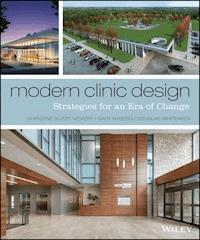
Modern Clinic Design E-Book
78,99 €
Mehr erfahren.
- Herausgeber: John Wiley & Sons
- Kategorie: Geisteswissenschaft
- Sprache: Englisch
Shift Clinic design to keep pace with the evolving healthcare industry Modern Clinic Design: Strategies for an Era of Change is a comprehensive guide to optimizing patient experience through the design of the built environment. Written by a team of veteran healthcare interior designers, architects, and engineers, this book addresses the impacts of evolving legislation, changing technologies, and emerging nontraditional clinic models on clinic design, and illustrates effective design strategies for any type of clinic. Readers will find innovative ideas about lean design, design for flexibility, and the use of mock-ups to prototype space plans within a clinic setting, and diagrammed examples including waiting rooms, registration desks, and exam rooms that demonstrate how these ideas are applied to real-world projects. Spurred on by recent healthcare legislation and new technological developments, clinics can now offer a greater variety of services in a greater variety of locations. Designers not only need to know the different requirements for each of these spaces, but also understand how certain design strategies affect the patient's experience in the space. This book explores all aspects of clinic design, and describes how aesthetics and functionality can merge to provide a positive experience for patients, staff, and healthcare providers. * Understand how recent industry developments impact facility design * Learn how design strategies can help create a positive patient experience * Examine emerging clinic models that are becoming increasingly prevalent * Analyze the impact of technology on clinic design A well-designed clinic is essential for the well-being of the patients and health care providers that occupy the space every day. The healthcare industry is shifting, and the healthcare design industry must shift with it to continue producing spaces that are relevant to ever-evolving patient and worker needs. For complete guidance toward the role of design, Modern Clinic Design is a thorough, practical reference.
Sie lesen das E-Book in den Legimi-Apps auf:
Seitenzahl: 633
Veröffentlichungsjahr: 2015
Ähnliche




















CONTENTS
Titlepage
Copyright
Foreword
Preface
Chapter 1: Understanding the Patient Experience
Overview
Five Stages of the Patient’s Journey
Methods of Discovery and Evaluation
Trends
Design Considerations and Strategies
Chapter 2: Lean Design and Efficiency
Overview
Lean Roots
Lean and Healthcare Design
Key Concepts
The Lean Design Process (3Ps)
Key Considerations
Project Team Composition
Technology
Summary
Chapter 3: Visualization Tools and Mock-ups
Overview
Lessons Learned: Tips for Successful Mock-ups
Computer-Based Models and Simulations
Project Examples
Summary
Chapter 4: Designing for Flexibility
Overview
Trends
Design Considerations
Design Challenges and Strategies
Acuity-Adaptable Exam Rooms
Summary
Chapter 5: Clinic Planning Concepts
Overview
Trends
Design Considerations, Challenges, and Strategies
Clinic Module Prototypes
Summary
Chapter 6: The Exam Room Today
Overview
Trends
Design Considerations
Design Challenges and Strategies
Types of Exam Rooms
Project Examples
Summary
Chapter 7: Politics and Healthcare
Chapter 8: The Retailing of Healthcare
Overview
Trends
Design Considerations and Challenges
Project Examples: Convenient Care
Project Examples: Clinics in Retail Settings
Project Examples: Emerging Models
Summary
Chapter 9: The Medical Home Model
Overview
Key Characteristics
Trends
Technology Considerations
Design Features and Challenges
Project Examples
Summary
Chapter 10: Healthcare Outside the Clinic
Overview
Trends and Driving Forces
Project Examples
Summary
Afterword Planning for a Flexible Future
The Clinic Visit in the Future
Minimizing Future Shock
Select Bibliography
Contributors
Editors
Contributing Author
Content Contributors
End-User License Agreement
List of Tables
List of Illustrations
Figure 1-1
Figure 1-2
Figure 1-3
Figure 1-4
Figure 1-5
Figure 1-6
Figure 1-7
Figure 1-8
Figure 1-9
Figure 1-10
Figure 1-11
Figure 1-12
Figure 1-13
Figure 1-14
Figure 1-15
Figure 1-18
Figure 1-19
Figure 1-20
Figure 1-21
Figure 1-22
Figure 2-1
Figure 2-2
Figure 2-5
Figure 2-6
Figure 2-7
Figure 3-1
Figure 3-2
Figure 3-3
Figure 3-4
Figure 3-5
Figure 3-6
Figure 3-7
Figure 3-8
Figure 3-9
Figure 3-10
Figure 3-11
Figure 3-12
Figure 3-13
Figure 3-14
Figure 3-15
Figure 3-16
Figure 4-3
Figure 4-4
Figure 4-5
Figure 4-6
Figure 4-7
Figure 4-8
Figure 4-9
Figure 4-10
Figure 4-11
Figure 4-14
Figure 4-15
Figure 4-16
Figure 4-17
Figure 4-18
Figure 4-21
Figure 4-22
Figure 4-23
Figure 4-24
Figure 5-1
Figure 5-2
Figure 5-3
Figure 5-4
Figure 5-5
Figure 5-6
Figure 5-7
Figure 5-8
Figure 5-9
Figure 5-10
Figure 5-11
Figure 5-12
Figure 5-13
Figure 5-14
Figure 5-15
Figure 5-16
Figure 5-17
Figure 5-18
Figure 5-19
Figure 5-20
Figure 5-21
Figure 5-22
Figure 5-23
Figure 5-24
Figure 5-25
Figure 6-1
Figure 6-2
Figure 6-3
Figure 6-4
Figure 6-5
Figure 6-6
Figure 6-7
Figure 6-8
Figure 6-9
Figure 6-10
Figure 6-11
Figure 6-12
Figure 6-13
Figure 6-14
Figure 6-15
Figure 6-16
Figure 6-17
Figure 6-18
Figure 6-19
Figure 6-20
Figure 6-21
Figure 6-22
Figure 6-23
Figure 8-7
Figure 8-8
Figure 8-9
Figure 8-10
Figure 9-1
Figure 9-2
Figure 9-3
Figure 9-4
Figure 9-5
Figure 9-6
Figure 9-7
Figure 9-8
Figure 9-9
Figure 9-10
Figure 9-11
Figure 10-3
Figure 10-4
Figure 10-5
Guide
Cover
Title Page
Front Matter
Foreword
Preface
Chapter 1: Understanding the Patient Experience
Start Reading
Chapter 2: Lean Design and Efficiency
Chapter 3: Visualization Tools and Mock-ups
Chapter 4: Designing for Flexibility
Chapter 5: Clinic Planning Concepts
Chapter 6: The Exam Room Today
Chapter 7: Politics and Healthcare
Chapter 8: The Retailing of Healthcare
Chapter 9: The Medical Home Model
Chapter 10: Healthcare Outside the Clinic
End-User License Agreement
Pages
i
ii
v
vi
vii
1
3
4
5
6
7
8
10
11
12
13
14
15
16
17
18
19
20
21
22
23
24
25
26
27
28
29
30
31
32
33
34
35
36
37
38
39
40
41
42
43
45
46
47
49
50
51
52
53
54
55
56
57
58
59
60
61
62
63
64
65
66
67
68
69
70
71
73
75
76
77
78
79
80
81
82
83
84
85
86
87
88
89
90
91
93
94
95
96
97
98
99
100
101
102
103
104
105
106
107
108
109
110
111
112
113
114
115
116
117
118
119
120
121
122
123
124
126
127
129
130
131
132
133
134
135
136
137
138
139
140
141
142
143
144
145
146
147
148
149
150
151
152
153
154
155
156
157
158
159
160
161
162
165
167
168
169
170
171
172
173
174
175
176
177
178
179
180
181
182
183
184
185
186
187
188
189
190
191
192
193
194
195
196
197
198
199
201
203
204
205
206
207
208
209
210
211
212
213
214
215
216
217
218
219
220
221
222
223
224
227
229
230
231
232
233
234
235
236
237
238
239
240
241
242
243
244
245
246
247
248
249
250
252
253
255
256
257
258
259
260
261
262
263
264
265
266
267
268
269
270
271
272
273
274
275
276
277
278
279
282
283
285
286
287
288
289
290
291
292
293
294
295
296
297
298
299
300
301
302
303
304
305
306
307
309
311
312
313
314
315
316
modern clinic design
Strategies for an Era of Change
Edited by Christine Guzzo Vickery, Gary Nyberg, and Douglas Whiteaker
Copyright
Cover images: Top images © Hammel, Green and Abrahamson, Inc.; bottom image © 2013 Darris Lee Harris
Cover design: Wiley
This book is printed on acid-free paper.
Copyright © 2015 by John Wiley & Sons, Inc. All rights reserved
Published by John Wiley & Sons, Inc., Hoboken, New Jersey
Published simultaneously in Canada
No part of this publication may be reproduced, stored in a retrieval system, or transmitted in any form or by any means, electronic, mechanical, photocopying, recording, scanning, or otherwise, except as permitted under Section 107 or 108 of the 1976 United States Copyright Act, without either the prior written permission of the Publisher, or authorization through payment of the appropriate per-copy fee to the Copyright Clearance Center, 222 Rosewood Drive, Danvers, MA 01923, (978) 750-8400, fax (978) 646-8600, or on the web at www.copyright.com. Requests to the Publisher for permission should be addressed to the Permissions Department, John Wiley & Sons, Inc., 111 River Street, Hoboken, NJ 07030, (201) 748-6011, fax (201) 748-6008, or online at www.wiley.com/go/permissions.
Limit of Liability/Disclaimer of Warranty: While the publisher and authors have used their best efforts in preparing this book, they make no representations or warranties with the respect to the accuracy or completeness of the contents of this book and specifically disclaim any implied warranties of merchantability or fitness for a particular purpose. No warranty may be created or extended by sales representatives or written sales materials. The advice and strategies contained herein may not be suitable for your situation. You should consult with a professional where appropriate. Neither the publisher nor the author shall be liable for damages arising herefrom.
For general information about our other products and services, please contact our Customer Care Department within the United States at (800) 762-2974, outside the United States at (317) 572-3993, or fax (317) 572-4002.
Wiley publishes in a variety of print and electronic formats and by print-on-demand. Some material included with standard print versions of this book may not be included in e-books or in print-on-demand. If this book refers to media such as a CD or DVD that is not included in the version you purchased, you may download this material at http://booksupport.wiley.com. For more information about Wiley products, visit www.wiley.com.
Unless otherwise indicated, all architectural projects discussed or illustrated are by HGA (Hammel, Green and Abrahamson, Inc.).
ISBN 978-1-118-76506-7 (hardback); 978-1-118-76508-1 (pdf); 978-1-118-76507-4 (epub)
Printed in the United States of America
10 9 8 7 6 5 4 3 2 1
Foreword
This book is about the present, and more important, the future. Well over one billion outpatient visits occur annually in the United States, with the trend continuing to grow. These visits will occur in a variety of settings, from private physician offices to emergency departments. Although the current rate of growth has jumped, the shift from inpatient to outpatient care has been an ongoing worldwide phenomenon. A variety of factors have contributed to this shift:
Medical advances in diagnostics, treatments, and medications that allow safe care outside the hospital environment.
Political pressure to reduce healthcare expenditures for expensive inpatient care.
Consumer expectations—the desire to get quick and convenient medical diagnosis and treatment.
Driven by the high costs, complexity, and safety issues, much of the research into healthcare architecture has focused on the hospital environment.. This book, in contrast, recognizes that a significant element of future healthcare will be ambulatory care. It is reasonable to assume that this building segment will become a major growth area over the next decade.
Healthcare architecture has historically combined innovation and adaptation. From the early Western medical use of temple and monastery models to the contemporary “patient-focused” care models, design philosophies have reflected the technical, functional, and cultural values of their times.
Modern Clinic Design: Strategies for an Era of Change provides an overview of current care concepts and their translation into design based on the use of analytical tools, case studies, and in-depth analysis of key planning concepts.
Clearly, the heart of ambulatory care is the exam room environment. This book provides a valuable discussion of the issues related to the design of this space, including the interplay between universality and unique care needs. Equally important is the emerging recognition that the environment can play an important role in supporting effective communications among care providers, patients, and their families. As is noted in the book, support for care of the elderly is becoming a significant issue in all areas of healthcare, presenting special patient considerations and, frequently, the need to include family in the examination experience. The integration of information technologies and mobile diagnostics will also shape the exam room environment, possibly creating divergent needs for comfort and functionality in the exam room of the future.
Over the past 50 years, since time-management techniques were first introduced to production processes, there has been the continuing desire to apply management tools to the overall healthcare delivery process and to design. The current interest in the “Lean” Toyota approach illustrates the melding of operations research tools and the participation of care providers in seeking the elimination of waste and process improvement. It is important to recognize that healthcare is not a product production process—we are not “manufacturing” healthcare in a context similar to the way in which automobiles are moved along an assembly line. Patients frequently present unique problems, both medically and culturally. The goal of standardization and reduction of variation must be seen in the context of providing effective, safe care. We can learn much from the current interest in Lean techniques, but our unique needs call for further evolution of management tools.
As an illustration, if we were focusing on the optimization of exam room resources, there would be an obvious desire to minimize scheduling, room time, and procedure variation. However, if we were focusing on a “patient-centered” experience, we might try to minimize patient travel and waiting, moving, additional diagnostics, counseling, and support tasks to the patient in the exam room, thereby introducing additional variation and lower overall room utilization.
Equally as important as inpatient care is the role that ambulatory care will play in the education of the next generation of providers. The historical use of the teaching hospital is changing. The design of “teaching clinics” will blend patient care with direct learning opportunities, group teaching, and research.
Modern Clinic Design: Strategies for an Era of Change illustrates several significant shifts in ambulatory care from traditional office environments to retail and home care models. It is reasonable to assume that advances in medical “bedside” analytics and high-speed Internet connectivity will allow components of outpatient care to be provided virtually. Current examples of these tools hold promise for a future in which patients will not have to spend time driving, parking, and waiting to get consultation and care for selected problems. This will include the impending wave of aging “boomers,” who are much more computer savvy than earlier generations. We may see a new office component providing space to allow doctors and nurses to interview virtually, analyze home-transmitted data, and diagnose action. Can we adapt research from the business office experience into these settings to assure an effective work environment?
We must recognize that the design process is reflective—we gain knowledge as we proceed from planning to design, to construction. The ability to effectively manage the process requires sensitivity to the need to move quickly as well as the need to adjust and to provide time to absorb the new information emerging from the design process. Proper preparation is an important piece in supporting an effective process and minimizing restarts. Modern Clinic Design provides a valuable source of knowledge to planners, designers, providers, and administrators. It also serves as a valuable resource to students seeking to understand this important area of design.
The challenge for the next generation will be to use existing models as a springboard for future innovation, where needed, to respond to a healthcare world that will emphasize larger medical practice models, increased use of outpatient diagnostics and treatment, and a patient population diverse in demographics, culture, and levels of understanding
Frank Zilm, D.Arch, FAIA, FACHA
Chester Dean Lecturer on Healthcare Design
The University of Kansas School of Architecture, Planning, and Design
Preface
Opening the Dialogue on Clinic Design
The need for a clinic book has never been more relevant than now. The healthcare industry is undergoing major changes that are placing greater emphasis on cost-effective preventive care, wellness, and outpatient services. Healthcare organizations are reimagining their delivery methods with the constant evolution of new technology, changing reimbursements, and shifting demographics. Now more than ever, healthcare owners and designers need to collaborate to create flexible healthcare environments that support health and wellness—not just treat illness. The outpatient clinic will be a vital part of this changing healthcare landscape.
Modern Clinic Design: Strategies for an Era of Change leads healthcare owners, designers, and students through the clinic design process. Our goal is to share knowledge and expertise in the planning and design of successful clinics.
Knowledge sharing, in fact, is essential to our design approach. We have gained more than 50 years of healthcare planning and design experience since HGA Architects and Engineers was founded in 1953. During that time, our relationships with healthcare clients, design colleagues, students, and patients have evolved as we continue to learn from each other to create better and more efficient healthcare environments. Modern Clinic Design consolidates that collective industry-wide knowledge and reflects our commitment to both the healthcare industry and the design industry. The featured clinic plans and case studies are drawn from our research and experience, representing best approaches to different clinic modules—always with an eye on flexibility.
As with the design process, this book was a collaborative process in which we shared our individual expertise to write an informed clinic book. We pulled from our resources within HGA, but also reached out to healthcare owners, design colleagues, students, and patient user groups to research and write the book. We see Modern Clinic Design as an ongoing dialogue with you as we work toward a common goal to design exceptional clinics that improve the patient experience.
We are grateful to the many people who contributed to this book, from those who provided quantitative and qualitative research to those who offered insight through casual conversation. Thanks specifically to Frank Zilm, Brent Peterson, Amy Douma, Jennifer Romer, Len Kaiser, and Jennifer Klund for their contributions. We are particularly grateful to contributing author Heather Beal, whose enthusiasm and dedication as a writer and editor proved invaluable throughout the book’s development.
We hope you find Modern Clinic Design: Strategies for an Era of Change helpful in planning a clinic. Modern Clinic Design simply opens the dialogue in what promises to be an exciting period in the healthcare industry.
Christine Guzzo Vickery, CID, EDAC
Gary Nyberg, RA
Douglas Whiteaker, AIA
Froedtert Hospital & Medical College of Wisconsin–Moorland Reserve Health Center, New Berlin, Wisconsin; Hammel, Green and Abrahamson, Inc. Photography © 2013 by Darris Lee Harris.
Chapter 1Understanding the Patient Experience
Overview
Healthcare design has been changing rapidly in recent years. In the past this movement generally focused on supporting the workflows of physicians, with patients viewed as the individuals who were receiving care rather than as active participants in their own health and wellness. The design of clinics reinforced this formal relationship in an institutional, monochromatic manner. As recently as the 1990s, white walls, rows of seating, and buzzing fluorescent light fixtures were the norm.
Since 1984, when Robert Ulrich published the landmark “View through a Window” study in Science magazine, interest in the relationship between design decisions and patient health outcomes has steadily grown.1 More than a thousand studies have now been completed in the field of evidence-based design, which the Center for Health Design defines as the “process of basing decisions about the built environment on credible research to achieve the best possible outcomes.”2
Five Stages of the Patient’s Journey
A key strategy for approaching clinic design from the standpoint of patients is to envision what occurs at each step along the care continuum to determine how their experience can be enhanced by various aspects of the built environment. For years, design professionals have divided the patient’s journey to, through, and away from a clinic into five stages: awareness, entry, assessment, treatment, and transition. These stages still provide a good basic structure for completing the research, planning, and design portions of a clinic project.
Awareness
The patient’s journey begins with an awareness that he or she needs to seek care because of illness, injury, or need for routine appointments (e.g., an annual physical). Patients now have a variety of tools and resources to help them evaluate when they can address a condition through self-care and when they need to be examined by a healthcare professional in person.
Today, most clinics use the telephone, e-mail, printed postcards, letters, or text messages to remind patients that they should schedule a clinic visit to obtain preventative care services. When patients are not sure of what level and type of care they need or where this should be provided, they can use resources provided by insurance companies and healthcare organization, such as:
As part of the master plan for updating Altru’s existing health centers, design professionals developed a series of graphic icons to create visual interest, aid with wayfinding, and convey Altru’s emphasis on health, wellness, service, respect, and dignity. Designers drew their inspiration from the natural surroundings of Grand Forks, North Dakota, where the Altru Health System is headquartered, and selected images that are familiar and comforting for patients and their families. The final set of icons includes:
Lesen Sie weiter in der vollständigen Ausgabe!
Lesen Sie weiter in der vollständigen Ausgabe!
Lesen Sie weiter in der vollständigen Ausgabe!
Lesen Sie weiter in der vollständigen Ausgabe!
Lesen Sie weiter in der vollständigen Ausgabe!
Lesen Sie weiter in der vollständigen Ausgabe!
Lesen Sie weiter in der vollständigen Ausgabe!
Lesen Sie weiter in der vollständigen Ausgabe!
Lesen Sie weiter in der vollständigen Ausgabe!
Lesen Sie weiter in der vollständigen Ausgabe!
Lesen Sie weiter in der vollständigen Ausgabe!
Lesen Sie weiter in der vollständigen Ausgabe!
Lesen Sie weiter in der vollständigen Ausgabe!




