


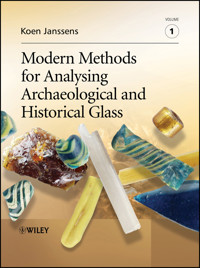
Modern Methods for Analysing Archaeological and Historical Glass E-Book
242,99 €
Mehr erfahren.
- Herausgeber: John Wiley & Sons
- Kategorie: Wissenschaft und neue Technologien
- Sprache: Englisch
The first scientific volume to compile the modern analytical techniques for glass analysis, Modern Methods for Analysing Archaeological and Historical Glass presents an up-to-date description of the physico-chemical methods suitable for determining the composition of glass and for speciation of specific components. This unique resource presents members of Association Internationale pour l'Histoire du Verre, as well as university scholars, with a number of case studies where the effective use of one or more of these methods for elucidating a particular culturo-historical or historo-technical aspect of glass manufacturing technology is documented.
Sie lesen das E-Book in den Legimi-Apps auf:
Seitenzahl: 1476
Veröffentlichungsjahr: 2013
Ähnliche




















Contents
Cover
Title Page
Copyright
About the Editor
List of Contributors
Preface
Chapter 1.1: What is Glass?
1.1.1 Introduction
1.1.2 Fundamentals of the Glassy State
1.1.3 Chemical Classification of Glasses
1.1.4 Properties of Glasses
References
Chapter 1.2: Raw Materials, Recipes and Procedures Used for Glass Making
1.2.1 Introduction
1.2.2 Other Sources of Information on Ancient Glass Production Technology
1.2.3 Raw Materials of the past
1.2.4 Composition Characteristics of Ancient Glass Varieties
1.2.5 Present-Day Raw Materials (from the Nineteenth Century Onwards)
1.2.6 The Melting Process of the past
1.2.7 Glass Furnaces of Today
References
Chapter 1.3: Colouring, Decolouring and Opacifying of Glass
1.3.1 Introduction
1.3.2 Conclusion
References
Chapter 1.4: Glass Compositions over Several Millennia in the Western World
1.4.1 Making Silica-Based Glass: Physico-Chemcial Constraints
1.4.2 Evolution of Glass Compositions
1.4.3 Summary
References
Chapter 2.1: X-Ray Based Methods of Analysis
2.1.1 Introduction
2.1.2 X-Ray Analysis Employing Table-Top Instrumentation
2.1.3 X-Ray Methods of Investigation Available at Synchrotron Facilities
References
Chapter 2.2: Electron Microscopy
2.2.1 Introduction
2.2.2 Electron–Matter Interactions
2.2.3 Analytical Investigations Using Scanning or Transmission Electron Microscopy
2.2.4 Additional Analytical Possibilities Using Transmission Electron Microscopy
References
Chapter 2.3: Ion-Beam Analysis Methods
2.3.1 Introduction
2.3.2 Principles of the Methods
2.3.3 Applications: Bulk Analysis
2.3.4 Surface Analysis
2.3.5 Conclusion
References
Chapter 2.4: Application of Neutron Activation Analysis to Archaeological Studies of Natural and Man-Made Glasses
2.4.1 Introduction
2.4.2 Theory of Activation Analysis
2.4.3 Application of NAA to Obsidian
2.4.4 Application of NAA to Man-Made Glass
2.4.5 Conclusions
Acknowledgements
References
Chapter 3.1: Glass Characterisation Using Laser Ablation Inductively Coupled Plasma Mass Spectrometry Methods
3.1.1 Introduction
3.1.2 Instrumentation
3.1.3 Analytical Procedure and Parameters
3.1.4 The Mass Spectrometer
3.1.5 The Laser Ablation
3.1.6 Calculation of Concentrations
3.1.7 Interferences, Detection Limits, Reproducibility and Accuracy
3.1.8 Examples of Results Obtained by Using Different Analytical Procedures
3.1.9 Conclusion
Acknowledgements
References
Chapter 3.2: Isotope-Ratio Techniques in Glass Studies
3.2.1 Introduction
3.2.2 Principles
3.2.3 Methodology
3.2.4 Isotope Systems in Glass Studies
3.2.5 Perspectives
Acknowledgements
References
Chapter 4.1: Surface Analysis
4.1.1 Atomic Force Microscopy (AFM)
4.1.2 Infrared Reflection Absorption Spectroscopy (IRRAS)
4.1.3 Secondary Ion Mass Spectrometry (SIMS)
Acknowledgements
References
Chapter 4.2: Non-Destructive Raman Analysis of Ancient Glasses and Glazes
4.2.1 Introduction
4.2.2 Fundamentals of Vibrational Spectroscopy
4.2.3 The SiO4 Vibrational Unit and an Understanding of its IR and Raman Signatures
4.2.4 Polymerisation Degree, Qn Model and Raman Identification of Glass Types
4.2.5 Raman Resonance and Pigment Identification
4.2.6 Glass Weathering
4.2.7 Raman Technique
4.2.8 Case Studies
Acknowledgments
References
Chapter 4.3: The Use of X-Ray Absorption Spectroscopy in Historical Glass Research
4.3.1 Introduction
4.3.2 Iron and Manganese
4.3.3 Copper
4.3.4 Calcium, Antimony and Lead
References
Chapter 5.1: Provenance Analysis of Glass Artefacts
5.1.1 Introduction
5.1.2 Obsidian, a Natural Glass Used since the Paleolithic
5.1.3 The First Neolithic Artificial Glassy Materials, and the Discovery of Glass during the Bronze Age
5.1.4 When Trade Beads Reached Europe
5.1.5 Middle Bronze Age Plant-Ash Soda–Lime Glasses
5.1.6 Late Bronze Age Mixed Soda–Potash Glasses
5.1.7 Iron Age and Antiquity Natron–Soda–Lime Glasses
5.1.8 Protohistoric Glass Trade Routes
5.1.9 Glass Chrono-Typo-Chemical Models: a Dating Tool?
5.1.10 Glass Trade to and from Central Asia and the Indian World during Antiquity
5.1.11 Carolingian Glass Production: Some Unusual Lead Glass Composition Smoothers
5.1.12 Late Middle Age Recycled Glass
5.1.13 Trade Beads: the Glass Trade Internationalisation, during the Post Medieval Period
5.1.14 Conclusion
Acknowledgements
References
Chapter 5.2: Glass at el-Amarna
5.2.1 Introduction
5.2.2 The Evidence from Amarna
5.2.3 Scientific Investigation
5.2.4 Conclusions
References
Chapter 5.3: Evolution of Vitreous Materials in Bronze Age Italy
5.3.1 Introduction
5.3.2 Materials: Definitions
5.3.3 Faiences
5.3.4 Glassy Faiences
5.3.5 Glass
5.3.6 Conclusive Notes and Open Problems
Acknowledgements
References
Chapter 5.4: Black-Appearing Roman Glass
5.4.1 Introduction
5.4.2 Background
5.4.3 Origin and Typology of the Analyzed Material
5.4.4 Methods of Analysis
5.4.5 Results
5.4.6 Chronological Evolution of the Recipes Used for Producing Black-Appearing Glass
5.4.7 Conclusions and Implications on the General Models for Roman Glassmaking and Distribution
Acknowledgements
References
Chapter 5.5: Glass Compositions of the Merovingian Period in Western Europe
5.5.1 Introduction
5.5.2 Data Sets Considered
5.5.3 Comments
5.5.4 A Special Case
5.5.5 Summary
References
Chapter 5.6: Glass in South Asia
5.6.1 Introduction
5.6.2 The Origin of Glass in South Asia
5.6.3 Mineral-Soda-Alumina or m-Na-Al Glass
5.6.4 Arikamedu: The Best-Studied Glass-Bead-Making Site in South Asia
5.6.5 Discussion
5.6.6 Conclusion
Acknowledgements
References
Chapter 5.7: Early Glass in Southeast Asia
5.7.1 Introduction
5.7.2 Evaluating the Evidence
5.7.3 The First Glass Bead in Southeast Asia?
5.7.4 Khao Sam Kaeo and Early Southeast Asian Glass
5.7.5 Ban Don Ta Phet
5.7.6 The Turn of the New Millennium, Khlong Thom and the Southern Silk Road
5.7.7 Glass Evidence from Khlong Thom
5.7.8 Khlong Thom and the Southern Silk Road
5.7.9 Conclusion
Acknowledgements
References
Chapter 5.8: Glass Trade between the Middle East and Asia
5.8.1 Introduction
5.8.2 Portable XRF Suitable for Glass Analysis
5.8.3 Asian Glass Beads Excavated from Ancient Tombs in Japan
5.8.4 Glass at Shosoin Temple
5.8.5 Islamic Glass Excavated from the Raya Site, Egypt
5.8.6 The Flow of Islamic Glass to Asia, a Glass Vessel at Toshodaiji Temple
5.8.7 The Glass Road to East Asia via the Sea Silk Road
5.8.8 Conclusion
References
Chapter 5.9: European Glass Trade Beads in Northeastern North America
5.9.1 Blue Beads
5.9.2 White Beads
5.9.3 Opaque Red Glass
5.9.4 Black Beads from Amsterdam
5.9.5 Gold-Coloured Beads from Amsterdam
5.9.6 Conclusions
Acknowledgements
References
Chapter 6.1: Medieval Glass-Making and -Working in Tuscany and Liguria (Italy). Towards a Standard Methodology for the Classification of Glass-Making and Glass-Working Indicators
6.1.1 Introduction
6.1.2 Medieval Glass-Making and -Working in Tuscany and Liguria (Italy)
6.1.3 Towards a Standard Methodology for the Classification of Glass Making and Glass Working Indicators
6.1.4 Conclusions
Acknowledgements
References
Chapter 6.2: Venetian Soda Glass
6.2.1 Introduction
6.2.2 Analysed Samples
6.2.3 The Origins (Early Medieval Glass) and the Levantine Influence
6.2.4 Middle Ages and Renaissance
6.2.5 Eighteenth Century: the Decline
6.2.6 Façon de Venise Glass
6.2.7 Other Glasses
6.2.8 Conclusion
References
Chapter 6.3: Transfer of Glass Manufacturing Technology in the Sixteenth and Seventeenth Centuries from Southern to Northern Europe
6.3.1 Introduction
6.3.2 Background Information
6.3.3 Materials and Methods
6.3.4 Results and Discussion
6.3.5 Conclusions
Acknowledgements
References
Chapter 6.4: Seventeenth-Century Varec Glass from the Great Hall of Mirrors at Versailles
6.4.1 Introduction
6.4.2 Experimental Determinations
6.4.3 Experimental Results
6.4.4 Analysis of the Results: What Came from Where?
6.4.5 Discussion
6.4.6 Conclusions
Acknowledgements
References
Chapter 6.5: Seventeenth- and Eighteenth-Century English Lead Glass
6.5.1 Introduction
6.5.2 Historical Background
6.5.3 Previous Research
6.5.4 Objectives
6.5.5 Analytical Method
6.5.6 Study Results and Discussion
6.5.7 Manufacture and Weathering of Replica Glasses
6.5.8 Conclusions
Acknowledgements
References
Chapter 7.1: Metal Nanoparticles in Glass: Lustre
7.1.1 Introduction
7.1.2 Historical Notes
7.1.3 Lustre Composition and Morphology
7.1.4 Lustre Formation Process
7.1.5 Optical Properties of Lustre
7.1.6 Conclusion
References
Chapter 7.2: Glass Degradation by Liquids and Atmospheric Agents
7.2.1 Introduction
7.2.2 The Corrosion of Glass
7.2.3 The Weathering of Glass
7.2.4 Summary and Conclusion
7.2.5 Acknowledgements
References
Chapter 7.3: Corrosion of Stained Glass Windows: Applied Study of Spanish Monuments of Different Periods
7.3.1 Introduction
7.3.2 Mechanisms of Chemical Attack
7.3.3 Environmental Degradation Effects
7.3.4 Conclusions and Outlook
Acknowledgements
References
Chapter 7.4: Novel Methods of Evaluation for the Conservation of Browned Historical Stained Glass
7.4.1 Introduction
7.4.2 Background
7.4.3 Corroded Glass Material
7.4.4 Methods of Analysis
7.4.5 Results Provided by the μ-XANES Measurements
7.4.6 Computed Tomography Monitoring of the Conservation Treatment
7.4.7 Conclusions
Acknowledgements
References
Index
This edition first published 2013 © 2013 John Wiley & Sons, Ltd
Registered officeJohn Wiley & Sons Ltd, The Atrium, Southern Gate, Chichester, West Sussex, PO19 8SQ, United Kingdom
For details of our global editorial offices, for customer services and for information about how to apply for permission to reuse the copyright material in this book please see our website at www.wiley.com.
The right of the author to be identified as the author of this work has been asserted in accordance with the Copyright, Designs and Patents Act 1988.
All rights reserved. No part of this publication may be reproduced, stored in a retrieval system, or transmitted, in any form or by any means, electronic, mechanical, photocopying, recording or otherwise, except as permitted by the UK Copyright, Designs and Patents Act 1988, without the prior permission of the publisher.
Wiley also publishes its books in a variety of electronic formats. Some content that appears in print may not be available in electronic books.
Designations used by companies to distinguish their products are often claimed as trademarks. All brand names and product names used in this book are trade names, service marks, trademarks or registered trademarks of their respective owners. The publisher is not associated with any product or vendor mentioned in this book. This publication is designed to provide accurate and authoritative information in regard to the subject matter covered. It is sold on the understanding that the publisher is not engaged in rendering professional services. If professional advice or other expert assistance is required, the services of a competent professional should be sought.
The publisher and the author make no representations or warranties with respect to the accuracy or completeness of the contents of this work and specifically disclaim all warranties, including without limitation any implied warranties of fitness for a particular purpose. This work is sold with the understanding that the publisher is not engaged in rendering professional services. The advice and strategies contained herein may not be suitable for every situation. In view of ongoing research, equipment modifications, changes in governmental regulations, and the constant flow of information relating to the use of experimental reagents, equipment, and devices, the reader is urged to review and evaluate the information provided in the package insert or instructions for each chemical, piece of equipment, reagent, or device for, among other things, any changes in the instructions or indication of usage and for added warnings and precautions. The fact that an organization or Website is referred to in this work as a citation and/or a potential source of further information does not mean that the author or the publisher endorses the information the organization or Website may provide or recommendations it may make. Further, readers should be aware that Internet Websites listed in this work may have changed or disappeared between when this work was written and when it is read. No warranty may be created or extended by any promotional statements for this work. Neither the publisher nor the author shall be liable for any damages arising herefrom.
Library of Congress Cataloging-in-Publication Data
Janssens, Koen H. A. Modern methods for analysing archaeological and historical glass / Koen Janssens, University of Antwerp, Belgium. pages cm Includes bibliographical references and index. ISBN 978-0-470-51614-0 (cloth) 1. Glass--Analysis. 2. Glass manufacture--Chemistry--History. 3. Excavations (Archaeology) 4. Antiquities. I. Title. QD139.G5J36 2011 666′.135–dc23 2012030740
A catalogue record for this book is available from the British Library.
ISBN: 9780470516140
About the Editor
Koen Janssens is full professor of general and analytical chemistry at the University of Antwerp in Belgium. He obtained his PhD in 1989 on a thesis dealing with the use of artificial intelligence techniques for automated treatment of X-ray analysis data. Since then, he has been actively making use of X-ray micro beams, produced in laboratory sources such as X-ray tubes or generated in large accelerator complexes called synchrotron storage rings, for non-destructive materials analysis. He is momentarily (co)author of ca 160 scientific papers and was (co)editor of books on Microscopic X-ray fluorescence analysis and on Non-destructive Micro Analysis of Cultural Heritage Materials. Next to devoting attention to the development of methods for X-ray based materials micro analysis, he also employs synchrotron micro- and nanobeams for studying questions of environmental nature, mainly dealing with heavy metal pollution of natural materials such as soils and sediments. In the area of cultural heritage, he employs X-ray based methods to better understand alteration and degradation processes of different materials such as glass, inks and paintings. Microscopic X-ray fluorescence analysis, X-ray absorption spectroscopy, X-ray diffraction and X-ray microtomography are valuable methods in this context. To record trace element finger prints of historical artefacts with the aim of elucidating their provenance, laser ablation ICP-MS is a frequently employed complementary method. More recently he developed a new method for visualisation of subsurface layers in painted works of art, based on X-ray fluorescence analysis.
List of Contributors
Ivana Angelini Dipartimento di Geoscienze, Università di Padova, Padova, Italy Rossella Arletti Dipartimento di Scienze della Terra, Università di Torino, Italy Gilberto Artioli Dipartimento di Geoscienze, Università di Padova, Padova, Italy Isabelle Biron Laboratory of the Centre de Recherche et de Restauration des Musées de France (C2RMF), Paris, France Colin Brain English Heritage B.G. Brunetti Department of Chemistry/Centre SMAART, University of Perugia, Perugia, Italy Simone Bugani Department of Industrial Chemistry and Materials, University of Bologna, Bologna, Italy Joost Caen Conservation Studies, Royal Academy of Fine Arts, Artesis University College of Antwerp, Antwerp, Belgium Simone Cagno Department of Chemistry, University of Antwerp, Antwerp, Belgium Noemí Carmona Dpto. Física de Materiales, Universidad Complutense de Madrid, Madrid, Spain L. Cartechini CNR-Institute of Molecular Science and Technologies, Perugia, Italy Marie-Hélène Chopinet Saint-Gobain Recherche, Aubervilliers Cedex, France Ph. Colomban Laboratoire Dynamique, Interactions et Réactivité (LADIR), CNRS, Université Pierre et Marie Curie, Paris, Thiais, France Peter Cosyns Mediterranean Archaeology Research Institute, Vrije Universiteit Brussel, Brussels, Belgium Marine Cotte ESRF, Grenoble, France I. De Raedt Chemistry Department, University of Antwerp, Antwerp, Belgium Kristel De Vis Conservation Studies, Royal Academy of Fine Arts, Artesis University College of Antwerp, Antwerp, Belgium Patrick Degryse Geology, Centre for Archaeological Sciences, Earth and Environmental Sciences, K.U. Leuven, Leuven, Belgium David Dungworth English Heritage Laure Dussubieux Department of Anthropology, The Field Museum, Chicago, Illinois, USA Federica Fenzi CNR Istituto di Chimica Inorganica e delle Superficie, Padova, Italy José-María Fernández-Navarro Instituto de Óptica Daza de Valdés, CFMAC, CSIC, Madrid, Spain Michael D. Glascock Research Reactor Center, University of Missouri – Columbia Bernard Gratuze Centre Ernest Babelon, Institut de Recherches sur les Archéomatériaux, Université d’Orléans - CNRS, Orléans, France R.G.V. Hancock Department of Medical Physics and Applied Radiation Sciences and Department of Anthropology, McMaster University, Hamilton, Ontario, Canada Lukas Helfen Karlsruhe Institute of Technology, Karlsruhe, Germany Sandro Hreglich Statione Sperimentale del Vetro, Venice, Italy Caroline Jackson University of Sheffield, Department of Archaeology, Northgate House, U.K. Koen Janssens Department of Chemistry, University of Antwerp, Antwerp, Belgium Christoph Kleber Institute of Science and Technology, Academy of Fine Arts, Vienna, Austria; Institute of Chemical Technologies and Analytics, Vienna University of Technology, Vienna, Austria and CEST Centre of Electrochemical Surface Technology, Wiener Neustadt Austria James W. Lankton UCL Institute of Archaeology, London, UK Simone Lerma Università di Siena, Dipartimento di Archeologia e Storia delle Arti, Siena, Italy Michael Melcher Institute of Science and Technology in Art, Academy of Fine Arts, Vienna, Austria Marja Mendera Università di Pavia, Dipartimento di Scienze della Terra, Pavia, Italy Bruno Messiga Università di Siena, Dipartimento di Archeologia e Storia delle Arti, Siena, Italy Cesare Moretti Deceased C. Miliani CNR-Institute of Molecular Science and Technologies, Perugia, Italy J. Motteau Laboratoire Archéologie et Territoires, Tours, France Izumi Nakai Tokyo University of Science, Japan Paul Nicholson Cardiff University, School of History, Archaeology & Religion, U.K. Gert Nuyts Department of Chemistry, University of Antwerp, Antwerp, Belgium Karin Nys Mediterranean Archaeology Research Institute, Vrije Universiteit Brussel, Brussels, Belgium Simona Quartieri Dipartimento di Fisica e Scienze della Terra, Università di Messina, Messina S. Agata, Italy Peter Reischig Karlsruhe Institute of Technology, Karlsruhe, Germany Maria Pia Riccardi Università di Siena, Dipartimento di Archeologia e Storia delle Arti, Siena, Italy Olivier Schalm Conservation Studies, Royal Academy of Fine Arts, Artesis University College of Antwerp, Antwerp, Belgium Manfred Schreiner Institute of Science and Technology, Academy of Fine Arts, Vienna, Austria and Institute of Chemical Technologies and Analytics, Vienna University of Technology, Vienna, Austria A. Sgamellotti Department of Chemistry/Centre SMAART, University of Perugia, Perugia, Italy Yoko Shindo The Research Institute for Islamic Archaeology and Culture, Japan Ž. Šmit Faculty of Mathematics and Physics, University of Ljubljana, and Jožef Stefan Institute, Slovenia B. Velde Laboratoire de Géologie, Ecole Normale Supérieure, Paris, France Marco Verità LAMA Laboratory, IUAV University, Venice, Italy Alessandro Pietro Vigato CNR Istituto di Chimica Inorganica e delle Superficie, Padova, Italy María-Ángeles Villegas Instituto de Historia, CCHS, CSIC, Madrid, Spain
Preface
Glass can be considered to be the first manmade polymeric material. Although relatively hard to make (since it requires a specific mixture of several ingredients and a sufficiently high working temperature to fuse them into an amorphous, homogeneous and transparent material), the earliest glass was already in use several thousands of years before Christ, e.g. in Egypt and other near-Eastern localities of advanced cultural development.
During its long and complex history, the technology and (resulting from that) the composition, and thus also the physico-chemical properties of glass and (resulting from that) the possible uses of glass in various societies (such as the Ancient Egyptians, the Iron age cultures, the Greeks, the Romans, the Byzantine and Ottoman civilizations, the European medieval and post-medieval states and also the Indian and Chinese cultures) have been subject to considerable evolution. The key to reading the rich history of the technology of glass making, glass colouring and glass shaping throughout the ages is the determination of the chemical composition of (sometimes minute) historic glass fragments, which in all the above-mentioned cultures are encountered in archaeological excavations.
Increasingly, next to the elemental composition, it is relevant to also extract information on the chemical speciation or the isotopic distribution of some major, minor or trace constituent(s) of historical glass fragments. Corrosion of glass, on the other hand, is a wide-spread phenomenon, for which a number of surface-specific methods are very useful.
This book attempts to bring together into one volume: (i) an up-to-date description of the physico-chemical methods suitable for determining the composition of glass and for speciation of specific components and (ii) a number of case studies where the effective use of one or more of these methods for elucidating a particular culturo-historical or historo-technical aspect of glass manufacturing technology is documented.
The book has been divided into several sections, each section being composed of 4–10 chapters. In the first section, the attention is devoted to describing glass as a material, including a discussion of its physico-chemical properties (Chapter 1.1). This chapter is followed by one (Chapter 1.2) that focuses on which raw materials have been used throughout the ages for glass making: with respect to both the silica and the ash/flux, a number of alternative sources have been used in different periods. Depending on the purity of these materials, glass can acquire different colours and tints. In Chapter 1.3, methods and materials employed in various periods for giving glass a particular colour, for obtaining colourless glass and/or for making opacified glass are treated. Also the various physical processes (such as absorption, scattering or interference of light) that can lead to a sensation of colour are discussed. The first section closes with Chapter 1.4 on how the composition of (European) glass has evolved throughout the centuries.
In the second section, several methods for determining the elemental composition and other properties of glass samples are described that employ energetic electromagnetic radiation. Chapter 2.1 treats the use of X-rays for elemental glass analysis at the major to the trace level, for speciation purposes and for 3D imaging of heterogeneous glass samples. Also methods that make use of synchrotron radiation are covered. This is followed by Chapter 2.2 on various forms of electron microscopy; in this chapter the exploration of the seemingly homogeneous glass material at the microscopic to the nanoscopic level by means of highly focused electron beams and related methods is discussed. In Chapter 2.3, the possibilities of analyzing minute glass fragments or entire glass vessels by means of ion beam methods are presented. As in the preceding chapters, next to elemental analysis per se, based on X-ray (or gamma) emission, via related methods such as Rutherford backscattering and elastic recoil detection analysis, certain forms of depth profiling are also possible. The fourth chapter in Section 2 deals with instrumental neutron activation analysis, a panoramic method of (trace) element analysis that has been frequently employed in glass provenancing studies.
To complement the methods described in the previous section, in Section 3 we find two chapters that deal with mass spectrometric methods that are now being increasingly used in glass provenancing studies; they are specifically oriented towards using patterns of (trace) elements or isotopic ratios of some geological tracers with the aim of making a more optimal distinction between the various sources of raw materials encountered in glass of different chronological and geographical origins.
In the fourth section of this book, methods are treated that go beyond elemental analysis: first, the use of different surface analysis methods for the characterization of (reactive) glass surfaces is treated in Chapter 4.1; this chapter describes methods such as secondary ion microscopy, atomic force microscopy and infrared reflection absorption spectroscopy. In Chapter 4.2, infrared and raman spectroscopy and microscopy as means of obtaining information on the different classes of Si−O bonds that are present in a silicate glass network, and how these are influenced by the composition and the state of corrosion of the glass are discussed. To conclude Section 4, Chapter 4.3 treats the use of X-ray absorption spectroscopy for the characterization of the chemical environment of metals present in silicate glass materials.
The remaining sections of the book comprise a series of studies in which one or a combination of the above-mentioned analytical methods are employed to characterize archaeological glass fragments, historic museum pieces in glass or other related materials. Studies of this kind can be performed having different objectives in mind.
A first and important objective is to reveal information on the provenance of (a series of mainly) archaeological glass fragments and/or to disclose information on the technology used to make and influence the colour of glass. Section 5 contains a number of chapters devoted to this endeavor. The first chapter of this section deals with provenance studies of glass that originates from various periods, ranging from obsidian, a natural glass used since Paleolithic times, through the first artificial glassy materials of the Neolithic period and the discovery of glass during the Bronze Age, to glass of the Iron Age, Antique, Medieval and Post-medieval periods. After this extensive chapter, a concise description of the glass found in the short-lived capital city of the Egyptian Pharao Akhenaten, Tell El-Amarna, in the delta of the Nile, is provided in Chapter 5.2. Since Amarna is the earliest scientifically excavated potential glass manufactory site known in either Egypt or the Near East, the finds from this location are crucial to understanding the earliest production of glass in the Antique period. In Chapter 5.3 the systematic characterization of Bronze Age Italian vitreous materials are reviewed in terms of their compositional, mineralogical, and textural variations in time. Chapter 5.4 is devoted to the analysis of black (appearing) glass from the Roman era, while Chapter 5.5 addresses Merovigian glass finds. In Chapters 5.6 to 5.8, Asian glass is given the focus of attention: in Chapter 5.6 an overview of the glass circulating through the Indian world is provided, while Chapter 5.7 discusses glass is South-East Asia. A description is provided of how the glass manufacturing industry was organized in ancient times in South Asia and what routes were used to exchange glass as a raw material or as finished objects. Chapter 5.8 deals with the trade in glass between the Near and the Far East, perhaps along the silk road or via the sea, and how portable X-ray-based analysis methods may be profitably used in this context. Finally Chapter 5.8 discusses the unravelling of sixteenth century trade patterns in Northern America between the aboriginal peoples of north-eastern North America and the increasing numbers of Europeans, via trace element analysis of glass beads.
Section 6 is composed of four chapters dealing with various types of (post) medieval glass. Chapter 6.1 focuses on medieval glass making and working in Tuscany and Liguria, while Chapter 6.2 addresses the evolution of the Venetian glass compositions. As a result of technology transfer, the practice of making clear, colourless glass gradually spread from Italy to Northern Europe in the sixteenth and seventeenth centuries. Chapter 6.3 discusses the compositional similarities and differences between genuine Venetian glass pieces and vessels made à-la-façon-de-Venise in north European urban centres such as Antwerp, Amsterdam and London. Glass produced on the basis of kelp ash for the Galerie des Glaçes of the Châteaux de Versailles is discussed in Chapter 6.4. Another clear type of glass that was invented in the last quarter of the seventeenth century is lead glass, the topic of Chapter 6.5.
The final section of the book (Section 7) includes a Chapter 7.1 on the characterization of nanoparticles that, when present in a glassy matrix, can give rise to glazes of different colours with surprising metallic reflections and dichroic effects. It was a frequently employed decoration technique for medieval and Renaissance pottery of the Mediterranean basin. The other chapters in this section deal with various aspects of glass weathering, a phenomenon frequently encountered in stained glass windows. In Chapter 7.2, the degradation of glass by liquids and atmospheric agents is discussed, while Chapter 7.3 focuses on the corrosion of stained windows in Spanish monuments of different periods. Finally in Chapter 7.4, the use of state-of-the-art speciation and imaging methods to monitor the chemical changes that take place when reducing agents are employed to remove Mn-staining from archaeological glass finds, is described.
Summarizing, in this volume, a combination of, on the one hand, a series of chapters that introduce methods with which silicate glass materials may be characterized in various manners, and on the other a series of case studies on how such methods may be employed to address several research questions regarding archaeological glass, is presented. I hope this combination will be a useful one for natural scientists, archaeologists and for archaeological and conservation scientists alike and that it will stimulate further research in this area.
This edition first published 2013 © 2013 John Wiley & Sons, Ltd
Registered officeJohn Wiley & Sons Ltd, The Atrium, Southern Gate, Chichester, West Sussex, PO19 8SQ, United Kingdom
For details of our global editorial offices, for customer services and for information about how to apply for permission to reuse the copyright material in this book please see our website at www.wiley.com.
The right of the author to be identified as the author of this work has been asserted in accordance with the Copyright, Designs and Patents Act 1988.
All rights reserved. No part of this publication may be reproduced, stored in a retrieval system, or transmitted, in any form or by any means, electronic, mechanical, photocopying, recording or otherwise, except as permitted by the UK Copyright, Designs and Patents Act 1988, without the prior permission of the publisher.
Wiley also publishes its books in a variety of electronic formats. Some content that appears in print may not be available in electronic books.
Designations used by companies to distinguish their products are often claimed as trademarks. All brand names and product names used in this book are trade names, service marks, trademarks or registered trademarks of their respective owners. The publisher is not associated with any product or vendor mentioned in this book. This publication is designed to provide accurate and authoritative information in regard to the subject matter covered. It is sold on the understanding that the publisher is not engaged in rendering professional services. If professional advice or other expert assistance is required, the services of a competent professional should be sought.
The publisher and the author make no representations or warranties with respect to the accuracy or completeness of the contents of this work and specifically disclaim all warranties, including without limitation any implied warranties of fitness for a particular purpose. This work is sold with the understanding that the publisher is not engaged in rendering professional services. The advice and strategies contained herein may not be suitable for every situation. In view of ongoing research, equipment modifications, changes in governmental regulations, and the constant flow of information relating to the use of experimental reagents, equipment, and devices, the reader is urged to review and evaluate the information provided in the package insert or instructions for each chemical, piece of equipment, reagent, or device for, among other things, any changes in the instructions or indication of usage and for added warnings and precautions. The fact that an organization or Website is referred to in this work as a citation and/or a potential source of further information does not mean that the author or the publisher endorses the information the organization or Website may provide or recommendations it may make. Further, readers should be aware that Internet Websites listed in this work may have changed or disappeared between when this work was written and when it is read. No warranty may be created or extended by any promotional statements for this work. Neither the publisher nor the author shall be liable for any damages arising herefrom.
Library of Congress Cataloging-in-Publication Data
Janssens, Koen H. A. Modern methods for analysing archaeological and historical glass / Koen Janssens, University of Antwerp, Belgium. pages cm Includes bibliographical references and index. ISBN 978-0-470-51614-0 (cloth) 1. Glass--Analysis. 2. Glass manufacture--Chemistry--History. 3. Excavations (Archaeology) 4. Antiquities. I. Title. QD139.G5J36 2011 666′.135–dc23 2012030740
A catalogue record for this book is available from the British Library.
ISBN: 9780470516140
About the Editor
Koen Janssens is full professor of general and analytical chemistry at the University of Antwerp in Belgium. He obtained his PhD in 1989 on a thesis dealing with the use of artificial intelligence techniques for automated treatment of X-ray analysis data. Since then, he has been actively making use of X-ray micro beams, produced in laboratory sources such as X-ray tubes or generated in large accelerator complexes called synchrotron storage rings, for non-destructive materials analysis. He is momentarily (co)author of ca 160 scientific papers and was (co)editor of books on Microscopic X-ray fluorescence analysis and on Non-destructive Micro Analysis of Cultural Heritage Materials. Next to devoting attention to the development of methods for X-ray based materials micro analysis, he also employs synchrotron micro- and nanobeams for studying questions of environmental nature, mainly dealing with heavy metal pollution of natural materials such as soils and sediments. In the area of cultural heritage, he employs X-ray based methods to better understand alteration and degradation processes of different materials such as glass, inks and paintings. Microscopic X-ray fluorescence analysis, X-ray absorption spectroscopy, X-ray diffraction and X-ray microtomography are valuable methods in this context. To record trace element finger prints of historical artefacts with the aim of elucidating their provenance, laser ablation ICP-MS is a frequently employed complementary method. More recently he developed a new method for visualisation of subsurface layers in painted works of art, based on X-ray fluorescence analysis.
List of Contributors
Ivana Angelini Dipartimento di Geoscienze, Università di Padova, Padova, Italy Rossella Arletti Dipartimento di Scienze della Terra, Università di Torino, Italy Gilberto Artioli Dipartimento di Geoscienze, Università di Padova, Padova, Italy Isabelle Biron Laboratory of the Centre de Recherche et de Restauration des Musées de France (C2RMF), Paris, France Colin Brain English Heritage B.G. Brunetti Department of Chemistry/Centre SMAART, University of Perugia, Perugia, Italy Simone Bugani Department of Industrial Chemistry and Materials, University of Bologna, Bologna, Italy Joost Caen Conservation Studies, Royal Academy of Fine Arts, Artesis University College of Antwerp, Antwerp, Belgium Simone Cagno Department of Chemistry, University of Antwerp, Antwerp, Belgium Noemí Carmona Dpto. Física de Materiales, Universidad Complutense de Madrid, Madrid, Spain L. Cartechini CNR-Institute of Molecular Science and Technologies, Perugia, Italy Marie-Hélène Chopinet Saint-Gobain Recherche, Aubervilliers Cedex, France Ph. Colomban Laboratoire Dynamique, Interactions et Réactivité (LADIR), CNRS, Université Pierre et Marie Curie, Paris, Thiais, France Peter Cosyns Mediterranean Archaeology Research Institute, Vrije Universiteit Brussel, Brussels, Belgium Marine Cotte ESRF, Grenoble, France I. De Raedt Chemistry Department, University of Antwerp, Antwerp, Belgium Kristel De Vis Conservation Studies, Royal Academy of Fine Arts, Artesis University College of Antwerp, Antwerp, Belgium Patrick Degryse Geology, Centre for Archaeological Sciences, Earth and Environmental Sciences, K.U. Leuven, Leuven, Belgium David Dungworth English Heritage Laure Dussubieux Department of Anthropology, The Field Museum, Chicago, Illinois, USA Federica Fenzi CNR Istituto di Chimica Inorganica e delle Superficie, Padova, Italy José-María Fernández-Navarro Instituto de Óptica Daza de Valdés, CFMAC, CSIC, Madrid, Spain Michael D. Glascock Research Reactor Center, University of Missouri – Columbia Bernard Gratuze Centre Ernest Babelon, Institut de Recherches sur les Archéomatériaux, Université d’Orléans - CNRS, Orléans, France R.G.V. Hancock Department of Medical Physics and Applied Radiation Sciences and Department of Anthropology, McMaster University, Hamilton, Ontario, Canada Lukas Helfen Karlsruhe Institute of Technology, Karlsruhe, Germany Sandro Hreglich Statione Sperimentale del Vetro, Venice, Italy Caroline Jackson University of Sheffield, Department of Archaeology, Northgate House, U.K. Koen Janssens Department of Chemistry, University of Antwerp, Antwerp, Belgium Christoph Kleber Institute of Science and Technology, Academy of Fine Arts, Vienna, Austria; Institute of Chemical Technologies and Analytics, Vienna University of Technology, Vienna, Austria and CEST Centre of Electrochemical Surface Technology, Wiener Neustadt Austria James W. Lankton UCL Institute of Archaeology, London, UK Simone Lerma Università di Siena, Dipartimento di Archeologia e Storia delle Arti, Siena, Italy Michael Melcher Institute of Science and Technology in Art, Academy of Fine Arts, Vienna, Austria Marja Mendera Università di Pavia, Dipartimento di Scienze della Terra, Pavia, Italy Bruno Messiga Università di Siena, Dipartimento di Archeologia e Storia delle Arti, Siena, Italy Cesare Moretti Deceased C. Miliani CNR-Institute of Molecular Science and Technologies, Perugia, Italy J. Motteau Laboratoire Archéologie et Territoires, Tours, France Izumi Nakai Tokyo University of Science, Japan Paul Nicholson Cardiff University, School of History, Archaeology & Religion, U.K. Gert Nuyts Department of Chemistry, University of Antwerp, Antwerp, Belgium Karin Nys Mediterranean Archaeology Research Institute, Vrije Universiteit Brussel, Brussels, Belgium Simona Quartieri Dipartimento di Fisica e Scienze della Terra, Università di Messina, Messina S. Agata, Italy Peter Reischig Karlsruhe Institute of Technology, Karlsruhe, Germany Maria Pia Riccardi Università di Siena, Dipartimento di Archeologia e Storia delle Arti, Siena, Italy Olivier Schalm Conservation Studies, Royal Academy of Fine Arts, Artesis University College of Antwerp, Antwerp, Belgium Manfred Schreiner Institute of Science and Technology, Academy of Fine Arts, Vienna, Austria and Institute of Chemical Technologies and Analytics, Vienna University of Technology, Vienna, Austria A. Sgamellotti Department of Chemistry/Centre SMAART, University of Perugia, Perugia, Italy Yoko Shindo The Research Institute for Islamic Archaeology and Culture, Japan Ž. Šmit Faculty of Mathematics and Physics, University of Ljubljana, and Jožef Stefan Institute, Slovenia B. Velde Laboratoire de Géologie, Ecole Normale Supérieure, Paris, France Marco Verità LAMA Laboratory, IUAV University, Venice, Italy Alessandro Pietro Vigato CNR Istituto di Chimica Inorganica e delle Superficie, Padova, Italy María-Ángeles Villegas Instituto de Historia, CCHS, CSIC, Madrid, Spain
Preface
Glass can be considered to be the first manmade polymeric material. Although relatively hard to make (since it requires a specific mixture of several ingredients and a sufficiently high working temperature to fuse them into an amorphous, homogeneous and transparent material), the earliest glass was already in use several thousands of years before Christ, e.g. in Egypt and other near-Eastern localities of advanced cultural development.
During its long and complex history, the technology and (resulting from that) the composition, and thus also the physico-chemical properties of glass and (resulting from that) the possible uses of glass in various societies (such as the Ancient Egyptians, the Iron age cultures, the Greeks, the Romans, the Byzantine and Ottoman civilizations, the European medieval and post-medieval states and also the Indian and Chinese cultures) have been subject to considerable evolution. The key to reading the rich history of the technology of glass making, glass colouring and glass shaping throughout the ages is the determination of the chemical composition of (sometimes minute) historic glass fragments, which in all the above-mentioned cultures are encountered in archaeological excavations.
Increasingly, next to the elemental composition, it is relevant to also extract information on the chemical speciation or the isotopic distribution of some major, minor or trace constituent(s) of historical glass fragments. Corrosion of glass, on the other hand, is a wide-spread phenomenon, for which a number of surface-specific methods are very useful.
This book attempts to bring together into one volume: (i) an up-to-date description of the physico-chemical methods suitable for determining the composition of glass and for speciation of specific components and (ii) a number of case studies where the effective use of one or more of these methods for elucidating a particular culturo-historical or historo-technical aspect of glass manufacturing technology is documented.
The book has been divided into several sections, each section being composed of 4–10 chapters. In the first section, the attention is devoted to describing glass as a material, including a discussion of its physico-chemical properties (Chapter 1.1). This chapter is followed by one (Chapter 1.2) that focuses on which raw materials have been used throughout the ages for glass making: with respect to both the silica and the ash/flux, a number of alternative sources have been used in different periods. Depending on the purity of these materials, glass can acquire different colours and tints. In Chapter 1.3, methods and materials employed in various periods for giving glass a particular colour, for obtaining colourless glass and/or for making opacified glass are treated. Also the various physical processes (such as absorption, scattering or interference of light) that can lead to a sensation of colour are discussed. The first section closes with Chapter 1.4 on how the composition of (European) glass has evolved throughout the centuries.
In the second section, several methods for determining the elemental composition and other properties of glass samples are described that employ energetic electromagnetic radiation. Chapter 2.1 treats the use of X-rays for elemental glass analysis at the major to the trace level, for speciation purposes and for 3D imaging of heterogeneous glass samples. Also methods that make use of synchrotron radiation are covered. This is followed by Chapter 2.2 on various forms of electron microscopy; in this chapter the exploration of the seemingly homogeneous glass material at the microscopic to the nanoscopic level by means of highly focused electron beams and related methods is discussed. In Chapter 2.3, the possibilities of analyzing minute glass fragments or entire glass vessels by means of ion beam methods are presented. As in the preceding chapters, next to elemental analysis per se, based on X-ray (or gamma) emission, via related methods such as Rutherford backscattering and elastic recoil detection analysis, certain forms of depth profiling are also possible. The fourth chapter in Section 2 deals with instrumental neutron activation analysis, a panoramic method of (trace) element analysis that has been frequently employed in glass provenancing studies.
To complement the methods described in the previous section, in Section 3 we find two chapters that deal with mass spectrometric methods that are now being increasingly used in glass provenancing studies; they are specifically oriented towards using patterns of (trace) elements or isotopic ratios of some geological tracers with the aim of making a more optimal distinction between the various sources of raw materials encountered in glass of different chronological and geographical origins.
In the fourth section of this book, methods are treated that go beyond elemental analysis: first, the use of different surface analysis methods for the characterization of (reactive) glass surfaces is treated in Chapter 4.1; this chapter describes methods such as secondary ion microscopy, atomic force microscopy and infrared reflection absorption spectroscopy. In Chapter 4.2, infrared and raman spectroscopy and microscopy as means of obtaining information on the different classes of Si−O bonds that are present in a silicate glass network, and how these are influenced by the composition and the state of corrosion of the glass are discussed. To conclude Section 4, Chapter 4.3 treats the use of X-ray absorption spectroscopy for the characterization of the chemical environment of metals present in silicate glass materials.
The remaining sections of the book comprise a series of studies in which one or a combination of the above-mentioned analytical methods are employed to characterize archaeological glass fragments, historic museum pieces in glass or other related materials. Studies of this kind can be performed having different objectives in mind.
A first and important objective is to reveal information on the provenance of (a series of mainly) archaeological glass fragments and/or to disclose information on the technology used to make and influence the colour of glass. Section 5 contains a number of chapters devoted to this endeavor. The first chapter of this section deals with provenance studies of glass that originates from various periods, ranging from obsidian, a natural glass used since Paleolithic times, through the first artificial glassy materials of the Neolithic period and the discovery of glass during the Bronze Age, to glass of the Iron Age, Antique, Medieval and Post-medieval periods. After this extensive chapter, a concise description of the glass found in the short-lived capital city of the Egyptian Pharao Akhenaten, Tell El-Amarna, in the delta of the Nile, is provided in Chapter 5.2. Since Amarna is the earliest scientifically excavated potential glass manufactory site known in either Egypt or the Near East, the finds from this location are crucial to understanding the earliest production of glass in the Antique period. In Chapter 5.3 the systematic characterization of Bronze Age Italian vitreous materials are reviewed in terms of their compositional, mineralogical, and textural variations in time. Chapter 5.4 is devoted to the analysis of black (appearing) glass from the Roman era, while Chapter 5.5 addresses Merovigian glass finds. In Chapters 5.6 to 5.8, Asian glass is given the focus of attention: in Chapter 5.6 an overview of the glass circulating through the Indian world is provided, while Chapter 5.7 discusses glass is South-East Asia. A description is provided of how the glass manufacturing industry was organized in ancient times in South Asia and what routes were used to exchange glass as a raw material or as finished objects. Chapter 5.8 deals with the trade in glass between the Near and the Far East, perhaps along the silk road or via the sea, and how portable X-ray-based analysis methods may be profitably used in this context. Finally Chapter 5.8 discusses the unravelling of sixteenth century trade patterns in Northern America between the aboriginal peoples of north-eastern North America and the increasing numbers of Europeans, via trace element analysis of glass beads.
Section 6 is composed of four chapters dealing with various types of (post) medieval glass. Chapter 6.1 focuses on medieval glass making and working in Tuscany and Liguria, while Chapter 6.2 addresses the evolution of the Venetian glass compositions. As a result of technology transfer, the practice of making clear, colourless glass gradually spread from Italy to Northern Europe in the sixteenth and seventeenth centuries. Chapter 6.3 discusses the compositional similarities and differences between genuine Venetian glass pieces and vessels made à-la-façon-de-Venise in north European urban centres such as Antwerp, Amsterdam and London. Glass produced on the basis of kelp ash for the Galerie des Glaçes of the Châteaux de Versailles is discussed in Chapter 6.4. Another clear type of glass that was invented in the last quarter of the seventeenth century is lead glass, the topic of Chapter 6.5.
The final section of the book (Section 7) includes a Chapter 7.1 on the characterization of nanoparticles that, when present in a glassy matrix, can give rise to glazes of different colours with surprising metallic reflections and dichroic effects. It was a frequently employed decoration technique for medieval and Renaissance pottery of the Mediterranean basin. The other chapters in this section deal with various aspects of glass weathering, a phenomenon frequently encountered in stained glass windows. In Chapter 7.2, the degradation of glass by liquids and atmospheric agents is discussed, while Chapter 7.3 focuses on the corrosion of stained windows in Spanish monuments of different periods. Finally in Chapter 7.4, the use of state-of-the-art speciation and imaging methods to monitor the chemical changes that take place when reducing agents are employed to remove Mn-staining from archaeological glass finds, is described.
Summarizing, in this volume, a combination of, on the one hand, a series of chapters that introduce methods with which silicate glass materials may be characterized in various manners, and on the other a series of case studies on how such methods may be employed to address several research questions regarding archaeological glass, is presented. I hope this combination will be a useful one for natural scientists, archaeologists and for archaeological and conservation scientists alike and that it will stimulate further research in this area.




