


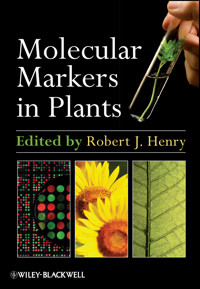
Molecular Markers in Plants E-Book
193,99 €
Mehr erfahren.
- Herausgeber: John Wiley & Sons
- Kategorie: Wissenschaft und neue Technologien
- Sprache: Englisch
Molecular Markers in Plants surveys an array of technologies used in the molecular analysis of plants. The role molecular markers play in plant improvement has grown significantly as DNA sequencing and high-throughput technologies have matured. This timely review of technologies and techniques will provide readers with a useful resource on the latest molecular technologies. Molecular Markers in Plants not only reviews past achievements, but also catalogs recent advances and looks forward towards the future application of molecular technologies in plant improvement. Opening chapters look at the development of molecular technologies. Subsequent chapters look at a wide range of applications for the use of these advances in fields as diverse as plant breeding, production, biosecurity, and conservation. The final chapters look forward toward future developments in the field. Looking broadly at the field of molecular technologies, Molecular Markers in Plants will be an essential addition to the library of every researcher, institution, and company working in the field of plant improvement.
Sie lesen das E-Book in den Legimi-Apps auf:
Seitenzahl: 356
Veröffentlichungsjahr: 2012
Ähnliche




















Contents
Cover
Title Page
Copyright
Contributors
Preface
Chapter 1: Evolution of DNA Marker Technology in Plants
Introduction
Early Marker Technologies
Evolving Range of Applications of DNA Markers in Plants
Applications
Future Developments
References
Chapter 2: Whole-Genome Sequencing for Marker Discovery
Sequencing Strategies
Sequencing Technologies
Epigenetic Markers
Genome-Wide Selection
Data Analysis Resources
References
Chapter 3: Amplicon Sequencing for Marker Discovery
Introduction
Background
Maximizing Efficiency Through Sample Pooling
Limitations of Amplicon-Based MPS
Bioinformatics
Concluding Remarks
Acknowledgments
References
Chapter 4: Transcriptome Sequencing for Marker Discovery
Introduction
Basic Approach
Conclusions
References
Chapter 5: Molecular Markers in Plant Improvement
Introduction
Plant Domestication and Traditional Breeding
Application of Molecular Markers to Breeding
Next-Generation Approaches to QTL Discovery
Conclusion
References
Chapter 6: Applications of Molecular Markers in Plant Conservation
Introduction
Traditional Approaches
The Way Forward
Conclusion
References
Chapter 7: Molecular Markers for Plant Biosecurity
Introduction
The Present—PCR for Specific Diagnosis and for DNA Barcoding
The Future—Next-Generation Sequencing Methods to Revolutionize Plant Quarantine Diagnostics
Conclusions
Acknowledgments
References
Chapter 8: Molecular Markers for Harnessing Heterosis
Introduction
Molecular Markers for Understanding the Genetic Basis of Heterosis
Molecular Diversity and Heterosis—Molecular Markers for Predicting Heterosis
Conclusion
References
Chapter 9: Genetic Variant Discovery and Its Use in Genome Characterization of Agronomically Important Crop Species
Introduction
Sanger Resequencing
Single Feature Polymorphisms
Next-Generation Sequencing
High-Density Genotyping using the Illumina Golden Gate Platform
Genotyping by Sequencing
Genome Characterization and Haplotypes
Conclusions and Perspectives
References
Chapter 10: Future Prospects of Molecular Markers in Plants
Introduction
Molecular Markers: The Past
Molecular Markers: The Present
Molecular Markers: The Future
Novel Approaches or Platforms for Plant Breeding
Conclusions
Acknowledgments
References
Index
Advertisements
This edition first published 2013 © 2013 by John Wiley & Sons, Inc.
Wiley-Blackwell is an imprint of John Wiley & Sons, formed by the merger of Wiley's global Scientific, Technical and Medical business with Blackwell Publishing.
Editorial offices: 2121 State Avenue, Ames, Iowa 50014-8300, USA The Atrium, Southern Gate, Chichester, West Sussex, PO19 8SQ, UK 9600 Garsington Road, Oxford, OX4 2DQ, UK
For details of our global editorial offices, for customer services and for information about how to apply for permission to reuse the copyright material in this book please see our website at www.wiley.com/wiley-blackwell.
Authorization to photocopy items for internal or personal use, or the internal or personal use of specific clients, is granted by Blackwell Publishing, provided that the base fee is paid directly to the Copyright Clearance Center, 222 Rosewood Drive, Danvers, MA 01923. For those organizations that have been granted a photocopy license by CCC, a separate system of payments has been arranged. The fee codes for users of the Transactional Reporting Service are ISBN-13: 978-0-4709-5951-0/2013.
Designations used by companies to distinguish their products are often claimed as trademarks. All brand names and product names used in this book are trade names, service marks, trademarks or registered trademarks of their respective owners. The publisher is not associated with any product or vendor mentioned in this book. This publication is designed to provide accurate and authoritative information in regard to the subject matter covered. It is sold on the understanding that the publisher is not engaged in rendering professional services. If professional advice or other expert assistance is required, the services of a competent professional should be sought.
Library of Congress Cataloging-in-Publication Data
Molecular markers in plants / editor, Robert J. Henry. p. cm. Includes bibliographical references and index. ISBN 978-0-470-95951-0 (hardback : alk. paper) 1. Plant breeding. 2. Genetic markers. 3. Plant genetics. 4. Crop improvement. I. Henry, Robert J. SB123.M58 2013 634.9′56--dc232012019771
A catalogue record for this book is available from the British Library.
Wiley also publishes its books in a variety of electronic formats. Some content that appears in print may not be available in electronic books.
Contributors
Matthew A. Campbell DuPont Pioneer Johnston, Iowa, United States
Stéphane Deschamps DuPont Agricultural Biotechnology Experimental Station – P.O. Box 80353 200 Powder Mill Road Wilmington, DE 19880-0353
Mark Edwards Southern Cross Plant Sciences Southern Cross University Lismore, Australia
Celine H. Frere School of Agricultural and Food Sciences University of Queensland Brisbane, Australia
Andrew D.W. Geering Cooperative Research Centre for National Plant Biosecurity and the Queensland Alliance for Agriculture and Food Innovation The University of Queensland Ecosciences Precinct Brisbane, Queensland, Australia
Edward K. Gilding School of Agricultural and Food Sciences University of Queensland Brisbane, Australia
Susan Gillies Southern Cross Plant Sciences Southern Cross University Lismore, Australia
Ian D. Godwin School of Agricultural and Food Sciences University of Queensland Brisbane, Australia
Robert J. Henry Queensland Alliance for Agriculture and Food Innovation University of Queensland Brisbane, Queensland, Australia
Pavana J. Hiremath International Crops Research Institute for the Semi-Arid Tropics Hyderabad, India
Gopala S. Krishnan Division of Genetics Indian Agricultural Research Institute New Delhi, India
Ana Pavasovic School of Biomedical Science Queensland University of Technology Brisbane, Australia
Peter J. Prentis School of Earth, Environmental and Biological Sciences Queensland University of Technology Brisbane, Australia
Oscar Riera-Lizarazu International Crops Research Institute for the Semi-Arid Tropics Hyderabad, India
Maurizio Rossetto National Herbarium of NSW Royal Botanic Gardens and Domain Trust Sydney, Australia
Reyazul R. Mir International Crops Research Institute for the Semi-Arid Tropics Hyderabad, India
Paul D. Rymer Hawkesbury Institute for the Environment University of Western Sydney Richmond, Australia
Timothy R. Sexton Department of Forest Sciences The University of British Columbia Vancouver, British Columbia, Canada
Frances M. Shapter Southern Cross Plant Sciences Southern Cross University Lismore, Australia
A.K. Singh Division of Genetics Indian Agricultural Research Institute New Delhi, India
Rajeev K. Varshney International Crops Research Institute for the Semi-Arid Tropics Hyderabad, India; CGIAR-Generation Challenge Programme Mexico; School of Plant Biology Faculty of Natural and Agricultural Sciences The University of Western Australia Crawley, Australia
Daniel L.E. Waters Southern Cross Plant Science Southern Cross University Lismore, Australia
Preface
Plants are fundamental to life, being the basis of our food production and an essential part of the global ecosystem on which life on earth depends. Plants have been used as a source of a wide range of materials, but the threat of exhaustion of fossil oil supplies has resulted in a renewed evaluation of plants as a source of energy and biomaterials. Molecular analysis of plants has found many applications in plant improvement, in the management of plant production, and the conservation of plant resources. Molecular markers are routinely used to identify plants for forensic or intellectual property applications. Molecular tools have become key contributors to the management of wild plant populations helping to conserve biodiversity. The relentless need for the continuous development of genetically improved crops to satisfy the demands of a global human population growing in number and affluence is now strongly supported by molecular marker technology.
Recent dramatic advances in DNA sequencing are now providing cost-effective options for the discovery of very large numbers of markers for any plant species. These developments significantly change the approach to marker discovery and analysis in plants and greatly expand the potential range of applications. This book outlines the technologies for molecular analysis of plants in support of plant breeding, production, and conservation. The techniques that have been used in the past are reviewed in relation to recent developments and future potential. This book updates earlier volumes on this topic featuring significant advances in both the technology and application of markers.
Robert Henry University of Queensland
1
Evolution of DNA Marker Technology in Plants
Robert J. Henry
Contents
Introduction
Early Marker Technologies
Evolving Range of Applications of DNA Markers in Plants
Applications
Future Developments
References
Introduction
Genetic markers are key tools for plant identification and plant improvement (Henry, 2001). Genetic marker technology has evolved rapidly with early methods based on phenotyping or isozymes being replaced by DNA-based methods of increasing sophistication. Early markers were few in number and difficult to assay. The ultimate development of the technology will provide simple methods to assess all genetic variation in the genome. This chapter provides a brief account of the development of genetic marker technology and its application to plants over the last 30 years. This perspective is provided as background and context for the accounts of the latest technologies (Henry et al., 2012) to follow in subsequent chapters.
Molecular marker technology has evolved though several phases. Early methods employing non-DNA-based methods were replaced by DNA-based methods as the technologies for DNA analysis improved. Early hybridization-based methods were displaced rapidly following the development of polymerase chain reaction (PCR). PCR-based methods greatly increased the feasibility of high-throughput marker screening. Early PCR-based methods relied upon arbitrary primers because of a lack of sequence information for many species. These in turn were overtaken by the widespread adoption of more robust microsatellite or simple sequence repeat (SSR) markers. Single nucleotide polymorphisms (SNPs) have more recently replaced SSR markers as larger volumes of sequence data became available (Henry, 2008). Second-generation sequencing technologies have greatly accelerated the move to sequence-based markers. Ongoing improvements in DNA sequencing promise a continued convergence of sequencing and genotyping technologies. Third-generation sequencing promises delivery of technology for routine sequencing of even complex plant genomes enabling ready marker discovery and analysis.
Molecular markers have a wide range of applications in biological systems including plants. Molecular makers are very useful in identification of plants and in determining the relationships between plants. Plant identification may be important in plant breeding, plant production and processing, policing of intellectual property rights, and forensic applications. Determination of genetic relationships is required in evolutionary and conservation genetic analyses and in selection of germplasm in plant breeding. Plant breeding is often directly supported by marker-assisted selection.
Lesen Sie weiter in der vollständigen Ausgabe!
Lesen Sie weiter in der vollständigen Ausgabe!
Lesen Sie weiter in der vollständigen Ausgabe!
Lesen Sie weiter in der vollständigen Ausgabe!
Lesen Sie weiter in der vollständigen Ausgabe!
Lesen Sie weiter in der vollständigen Ausgabe!
Lesen Sie weiter in der vollständigen Ausgabe!
Lesen Sie weiter in der vollständigen Ausgabe!
Lesen Sie weiter in der vollständigen Ausgabe!
Lesen Sie weiter in der vollständigen Ausgabe!
Lesen Sie weiter in der vollständigen Ausgabe!




