


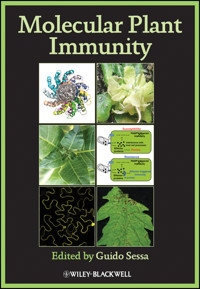
Molecular Plant Immunity E-Book
144,99 €
Mehr erfahren.
- Herausgeber: John Wiley & Sons
- Kategorie: Wissenschaft und neue Technologien
- Sprache: Englisch
Molecular Plant Immunity provides an integrated look at both well-established and emerging concepts in plant disease resistance providing the most current information on this important vitally important topic within plant biology. Understanding the molecular basis of the plant immune system has implications on the development of new varieties of sustainable crops, understanding the challenges plant life will face in changing environments, as well as providing a window into immune function that could have translational appeal to human medicine.
Molecular Plant Immunity opens with chapters reviewing how the first line of plant immune response is activated followed by chapters looking at the molecular mechanisms that allow fungi, bacteria, and oomycetes to circumvent those defenses. Plant resistance proteins, which provide the second line of plant immune defense, are then covered followed by chapters on the role of hormones in immunity and the mechanisms that modulate specific interaction between plants and viruses. The final chapters look at model plant-pathogen systems to review interaction between plants and fungal, bacterial, and viral pathogens.
Written by a leading team of international experts, Molecular Plant Immunity will provide a needed resource to diverse research community investigated plant immunity.
Sie lesen das E-Book in den Legimi-Apps auf:
Seitenzahl: 801
Veröffentlichungsjahr: 2012
Ähnliche




















Contents
Cover
Title Page
Copyright
Contributors
Preface
Chapter 1: The Rice Xa21 Immune Receptor Recognizes a Novel Bacterial Quorum Sensing Factor
Introduction
Plants and Animal Immune Systems
A Plethora of Immune Receptors Recognize Conserved Microbial Signatures
Ax21 Conserved Molecular Signature
Non-RD Receptor Kinase Xa21
XA21-Mediated Signaling Components
Cleavage and Nuclear Localization of the Rice XA21 Immune Receptor
Regulation in the Endoplasmic Reticulum: Quality Control of XA21
Systems Biology of the Innate Immune Response
Acknowledgments
References
Chapter 2: Molecular Basis of Effector Recognition by Plant NB-LRR Proteins
Introduction
Building Blocks of NB-LRRs; Classification and Structural Features of Subdomains
Putting the Parts Together: Combining the Domains to Build a Signaling Competent NB-LRR Protein
Stabilization and Accumulation of NB-LRR Proteins: Their Maturation and Stabilization
When the Pathogen Attacks: Perception and Signaling by NB-LRR Proteins
Conclusion
Acknowledgments
References
Chapter 3: Signal Transduction Pathways Activated by R Proteins
Introduction
R Protein Stability
Genetic Separation of CC and TIR-NB-LRR Signaling
NB-LRRs Exhibit Modular Structure and Function
Subcellular Localization of NB-LRRs
NB-LRRs Can Function in Pairs
Common Immune Signaling Events Downstream of R Protein Activation
Conclusion
Acknowledgments
References
Chapter 4: The Roles of Salicylic Acid and Jasmonic Acid in Plant Immunity
Introduction
Biosynthesis of SA
Derivatives of SA
SA and Systemic Acquired Resistance
SA Signaling Pathway
Jasmonates Mediate Plant Immunity
JA Biosynthetic Mutants Are Altered in Microbial Defense
Receptor Protein Complex Perceives JA
Transcription Factors Regulate JA-Derived Signaling
JA Regulates Defense Gene Expression
Conclusion
Acknowledgments
References
Chapter 5: Effectors of Bacterial Pathogens: Modes of Action and Plant Targets
Introduction
Overview of Plant Innate Immunity
Overview of Type III Effectors
Host Targets and Biochemical Functions
Conclusion
Acknowledgments
References
Chapter 6: The Roles of Transcription Activator–Like (TAL) Effectors in Virulence and Avirulence of Xanthomonas
Introduction
TAL Effectors Are Delivered into and May Dimerize in the Host Cell
TAL Effectors Function in the Plant Cell Nucleus
AvrBs4 Is Recognized in the Plant Cell Cytoplasm
TAL Effectors Activate Host Gene Expression
Central Repeat Region of TAL Effectors Determines DNA Binding Specificity
TAL Effectors Wrap Around DNA in a Right-Handed Superhelix
TAL Effector Targets Include Different Susceptibility and Candidate Susceptibility Genes
MtN3 Gene Family Is Targeted by Multiple TAL Effectors
Promoter Polymorphisms Prevent S Gene Activation to Provide Disease Resistance
Nature of the Rice Bacterial Blight Resistance Gene xa5 Suggests TAL Effector Interaction With Plant Transcriptional Machinery
Executor R Genes Exploit TAL Effector Activity for Resistance
Diversity of TAL Effectors in Xanthomonas Populations Is Largely Unexplored
TAL Effectors Are Useful Tools for DNA Targeting
Conclusion
References
Chapter 7: Effectors of Fungi and Oomycetes: Their Virulence and Avirulence Functions and Translocation From Pathogen to Host Cells
Introduction
Plant-Associated Fungi and Oomycetes
Identification of Fungal and Oomycete Effectors
Defensive Effectors: Effectors That Interfere With Plant Immunity
Offensive Effectors: Effectors That Debilitate Plant Tissue
Effectors That Contribute to Fitness via Unknown Mechanisms
Entry of Intracellular Effectors
Genome Location and Consequences for Adaptation/Dispensability
Conclusion
Acknowledgments
References
Chapter 8: Plant-Virus Interaction: Defense and Counter-Defense
Introduction
RNA Silencing as an Antiviral Defense Pathway – the Beginning of the Story
Small Regulatory RNA Biogenesis and Function
The Silencing Mafia – the Protein Families
Defense: Antiviral RNA Silencing Pathways
Counter-Defense: Viral Suppressors of Silencing and Their Targets
Viral Suppressors of Silencing and Endogenous Small Regulatory RNA Pathways
References
Chapter 9: Molecular Mechanisms Involved in the Interaction Between Tomato and Pseudomonas syringae pv. tomato
Introduction
PAMP-Triggered Immunity in Solanaceae
Pseudomonas syringae pv. tomato Virulence Mechanisms
Effector-Triggered Immunity in Solanaceae
Races of Pseudomonas syringae pv. tomato
ETI Is Involved in Nonhost Resistance to Pseudomonas syringae Pathovars
ETI Signaling Pathways in Solanaceae
Conclusion
Acknowledgments
References
Chapter 10: Cladosporium fulvum–Tomato Pathosystem: Fungal Infection Strategy and Plant Responses
Introduction
History of the Interaction Between C. fulvum and Tomato
Compatible and Incompatible Interactions
Cf-Mediated Downstream Signaling
Effectors in Other Fungi with Similar Infection Strategies
Conclusion
References
Chapter 11: Cucumber Mosaic Virus–Arabidopsis Interaction: Interplay of Virulence Strategies and Plant Responses
Introduction
Biology of CMV
Host Resistance Responses to Virus Infection
Targeting of Host Factors by the Virus
Phenomenon of Cross-Protection
Functions of SA in Antiviral Defense
Metabolic Responses to CMV Infection
Vector-Mediated Transmission
Conclusion
Acknowledgments
References
Chapter 12: Future Prospects for Genetically Engineering Disease-Resistant Plants
Introduction
Targets for Second-Generation Transgenic Strategies for Resistance
Hormones
Defense Modulation
Transcription Factors
Promoters for Transgenic Disease Resistance
Implementation of Transgenic Resistance in the Field
Why Choose a Transgenic Approach?
Conclusion
Acknowledgments
References
Index
Advertisements
This edition first published 2013 © 2013 by John Wiley & Sons, Inc.
Wiley-Blackwell is an imprint of John Wiley & Sons, formed by the merger of Wiley's global Scientific, Technical and Medical business with Blackwell Publishing.
Editorial offices: 2121 State Avenue, Ames, Iowa 50014-8300, USA The Atrium, Southern Gate, Chichester, West Sussex, PO19 8SQ, UK 9600 Garsington Road, Oxford, OX4 2DQ, UK
For details of our global editorial offices, for customer services and for information about how to apply for permission to reuse the copyright material in this book please see our website at www.wiley.com/wiley-blackwell.
Authorization to photocopy items for internal or personal use, or the internal or personal use of specific clients, is granted by Blackwell Publishing, provided that the base fee is paid directly to the Copyright Clearance Center, 222 Rosewood Drive, Danvers, MA 01923. For those organizations that have been granted a photocopy license by CCC, a separate system of payments has been arranged. The fee codes for users of the Transactional Reporting Service are ISBN-13: 978-0-4709-5950-3/2013.
Designations used by companies to distinguish their products are often claimed as trademarks. All brand names and product names used in this book are trade names, service marks, trademarks or registered trademarks of their respective owners. The publisher is not associated with any product or vendor mentioned in this book. This publication is designed to provide accurate and authoritative information in regard to the subject matter covered. It is sold on the understanding that the publisher is not engaged in rendering professional services. If professional advice or other expert assistance is required, the services of a competent professional should be sought.
Library of Congress Cataloging-in-Publication Data
Molecular plant immunity / editor, Guido Sessa. p. cm. Includes bibliographical references and index. ISBN 978-0-470-95950-3 (hardback) 1. Plant immunology. 2. Molecular immunology. I. Sessa, Guido. SB750.M665 2013 581.3′5–dc23
2012028578
A catalogue record for this book is available from the British Library.
Wiley also publishes its books in a variety of electronic formats. Some content that appears in print may not be available in electronic books.
Contributors
Douglas BakerDepartment of Plant Pathology University of California at Davis Davis, California, USAAdam J. BogdanoveDepartment of Plant Pathology and Microbiology Iowa State University Ames, Iowa, USAJohn P. CarrDepartment of Plant Sciences University of Cambridge Cambridge, United KingdomYan-Jun ChenDepartment of Plant Biology and Biotechnology University of Copenhagen Copenhagen, DenmarkGitta CoakerDepartment of Plant Pathology University of California at Davis Davis, California, USADavid B. CollingeDepartment of Plant Biology and Biotechnology University of Copenhagen Copenhagen, DenmarkBen J. C. CornelissenUniversity of Amsterdam Faculty of Science, SILS Molecular Plant Pathology Amsterdam, The NetherlandsPierre J. G. M. de WitLaboratory of Phytopathology Wageningen University The NetherlandsFeng FengState Key Laboratory of Plant Genomics and National Center for Plant Gene Research Institute of Genetics and Developmental Biology Chinese Academy of Sciences Beijing, ChinaAmy Wahba ForemanDepartment of Biological Sciences University of South Carolina Columbia, South Carolina, USAAaron W. HummelDepartment of Plant Pathology and Microbiology Iowa State University Ames, Iowa, USAAardra KachrooDepartment of Plant Pathology University of Kentucky Lexington, Kentucky, USAPradeep KachrooDepartment of Plant Pathology University of Kentucky Lexington, Kentucky, USAMichael F. LyngkjærDepartment of Plant Biology and Biotechnology University of Copenhagen Copenhagen, DenmarkLisong MaUniversity of Amsterdam Faculty of Science, SILS Molecular Plant Pathology Amsterdam, The NetherlandsGregory B. MartinBoyce Thompson Institute for Plant Research Ithaca, New York, USABilal ÖkmenLaboratory of Phytopathology Wageningen University The NetherlandsChang Jin ParkDepartment of Plant Pathology and the Genome Center University of California at Davis Davis, California, USAGail J. PrussDepartment of Biological Sciences University of South Carolina Columbia, South Carolina, USAPamela C. RonaldDepartment of Plant Pathology and the Genome Center University of California at Davis Davis, California, USAThierry RouxelINRA-Bioger Thiverval-Grignon, FranceFrank L. W. TakkenUniversity of Amsterdam Faculty of Science, SILS Molecular Plant Pathology Amsterdam, The NetherlandsBrett M. TylerCenter for Genome Research and Biocomputing Department of Botany and Plant Pathology Oregon State University Corvallis, Oregon, USAVicki VanceDepartment of Biological Sciences University of South Carolina Columbia, South Carolina, USAHarrold A. van den BurgUniversity of Amsterdam Faculty of Science, SILS Molecular Plant Pathology Amsterdam, The NetherlandsAndré C. VelásquezDepartment of Plant Pathology and Plant-Microbe Biology Cornell University Ithaca, New York, USAJack H. WestwoodDepartment of Plant Sciences University of Cambridge Cambridge, United KingdomJian-Min ZhouState Key Laboratory of Plant Genomics and National Center for Plant Gene Research Institute of Genetics and Developmental Biology Chinese Academy of Sciences Beijing, ChinaPreface
Plants and pathogens are constantly engaged in an “arms race,” each party competing to develop molecular weapons for the defeat of its enemy. As a result, plants are equipped with a sophisticated immune system for the recognition of invading pathogens, transmission of alarm signals, and rapid activation of efficient defense responses that limit infection. Concurrently, pathogens have developed strategies to cause disease through sabotaging the plant immune system. In an era of growing food demand for the sustainment of the world's population, understanding the molecular mechanisms of plant immunity and microbial pathogenicity is of cardinal importance for devising strategies that limit the large yield losses owing to plant diseases.
This book provides comprehensive coverage of the molecular basis of plant disease resistance by reviewing fundamental features of the plant immune system as well as the most recent insights into this important field of plant biology. Chapter 1 describes recognition of a novel bacterial quorum sensing factor by the rice Xa21 receptor, representing a paradigm for how a first line of immune responses is activated on recognition of conserved molecular signatures of microbial pathogens by plant transmembrane receptors. Chapters 2 and 3 review molecular mechanisms involving resistance (R) proteins, an additional class of immune receptors responsible for the activation of a second line of immune responses. Topics covered in these chapters include structure, control, and activation of R proteins; molecular mechanisms mediating effector recognition by R proteins; and signaling pathways acting downstream of R proteins and leading to the activation of effective immune responses. Chapter 4 describes the role of the plant hormones salicylic acid and jasmonic acid in signaling pathways downstream of immune receptors. Chapters 5, 6, and 7 discuss molecular features of pathogen effector proteins of bacteria, fungi, and oomycetes that interfere with plant immunity and contribute to bacterial and fungal pathogenicity. Chapter 8 presents molecular mechanisms that modulate the interaction between plants and viruses. Chapters 9, 10, and 11 focus on plant-pathogen interactions representing model systems for the interplay between host plants and bacterial, fungal, or viral pathogens. Chapter 12 describes future prospects for genetically engineering disease-resistant plants.
I would like to thank all the authors for their excellent contributions that integrate well-established and emerging concepts to provide an up-to-date review of the state of the art in the challenging field of molecular plant immunity.
Guido Sessa
1
The Rice Xa21 Immune Receptor Recognizes a Novel Bacterial Quorum Sensing Factor
Chang Jin Park and Pamela C. Ronald
Introduction
During the course of evolution, plants and animals have acquired the capability to perceive microbes and respond with robust defense responses. Plant diseases were mentioned in 750 BCE in the Hebrew Bible and again in the writings of Democritus, around 470 BCE (Agrios 1997). Theophrastus made plants and plant disease a subject of systematic studies in 300 BCE. He and his contemporaries believed that plant diseases were a manifestation of the wrath of God (Agrios 1997). Very little useful knowledge about plant diseases was gained for another 2000 years.
The devastating late blight of potatoes, an epidemic that began in 1845 and destroyed the principal food source for millions of people in Ireland, launched the first serious investigations into the basis of plant disease. Although some scientists believed that the causal agent was a microbe (Kelman and Peterson 2002), this hypothesis flew in the face of the prevailing scientific view that microbes commonly found in diseased plant tissues were the products rather than the cause of disease. In 1853, through studies of rusts and smut fungi infection of cereal crops, De Bary conclusively demonstrated that microbes are the causal agents of infectious disease (Agrios 1997).
A quarter century later, the causal role of microorganisms in animal diseases was demonstrated by Koch (1876), who studied anthrax in cattle, using the mouse as a model host. Koch's postulates, developed in the course of these studies, applied equally thereafter to work with plant and animal pathogens. Biffen (1894–1949), a British geneticist and plant breeder, speculated that resistance to disease would be inherited in Mendelian ratios, and in 1905 he demonstrated that this was true for resistance to yellow rust, a fungal disease of wheat (http://www.answers.com/topic/rowland-biffen).
In 1946, Flor (1942, 1971) working with the rust disease of flax proposed the gene-for-gene hypothesis based on genetic analyses of the variation within host and pathogen populations. He used the terms “host resistance genes” and “pathogen avirulence (avr) genes.” The presence of corresponding avr-R genes in each organism leads to recognition and the activation of defense responses, limiting infection. Flor's hypothesis suggested that specific sensors for microbial molecules were present in their hosts. Although some resistance genes conferred broad-spectrum resistance, others did not, specifying resistance to only some races of a particular pathogen species.
Plants and Animal Immune Systems
Since the discoveries of Biffen >100 years ago, plant breeders have introduced resistance genes into virtually all crops that we eat today. However, for many years, the molecular basis of this resistance remained elusive.
In the 1990s, an avalanche of genetic experiments in numerous laboratories led to the isolation of the first resistance genes from multiple plant species. These discoveries established that diverse molecules and mechanisms govern the resistance phenotypes described in 1946 by Flor. Two of these resistance genes encode cytoplasmic NLRs (nucleotide-binding site domain [NBS], leucine-rich repeat [LRR]–containing intracellular proteins). These include Arabidopsis RPS2 (resistance to Pseudomonas syringae 2) (Kunkel et al. 1993; Yu et al. 1993), the tobacco mosaic virus resistance gene N (Whitham et al. 1994), and the flax L6 gene. These NLR proteins later were shown to perceive directly or indirectly highly conserved effector proteins that target the host immune system.
Other resistance genes isolated at this time encoded the tomato Pto kinase (Martin et al. 1993), the rice XA21 receptor kinase (Song et al. 1995), and the tomato receptor–like protein Cf9 that lacked a kinase domain (Jones et al. 1994). In contrast to the narrow-spectrum resistance conferred by RPS2, N, L6, Pto, and Cf9, XA21 conferred broad-spectrum resistance to the bacterial pathogen Xanthomonas oryzae pv. oryzae (Xoo) and was predicted to recognize a conserved microbial signature (Ronald et al. 1992). The XA21 kinase belongs to a subclass of kinases that carry the non–arginine-aspartate (non-RD) motif (Dardick and Ronald, 2006).
Shortly after the discovery of the first plant resistance genes, work in Drosophila established that Toll, originally known for its function in development and its ability to elicit an nuclear factor κB (NF-κB) response, is a key transducer of responses to fungal and gram-positive bacterial infection (Ronald and Beutler 2010). Similar to XA21, Toll carried LRRs in the predicted extracellular domain and signaled through a non-RD kinase called Pelle (which associates with Toll through an adapter protein). Toll also shared the Toll/IL-1 Receptor (TIR) domain with the tobacco N and flax L6 proteins.
Toll does not serve as a receptor for any known molecule of fungal origin. Instead, Toll responds to Spaetzle, which is cleaved from an endogenous protein as a result of infection. This recognition leads to activation of Pelle and to signals that culminate in the production of antimicrobial peptides and hundreds of other proteins, most of unknown function.
Lesen Sie weiter in der vollständigen Ausgabe!
Lesen Sie weiter in der vollständigen Ausgabe!
Lesen Sie weiter in der vollständigen Ausgabe!
Lesen Sie weiter in der vollständigen Ausgabe!
Lesen Sie weiter in der vollständigen Ausgabe!
Lesen Sie weiter in der vollständigen Ausgabe!
Lesen Sie weiter in der vollständigen Ausgabe!
Lesen Sie weiter in der vollständigen Ausgabe!
Lesen Sie weiter in der vollständigen Ausgabe!
Lesen Sie weiter in der vollständigen Ausgabe!
Lesen Sie weiter in der vollständigen Ausgabe!
Lesen Sie weiter in der vollständigen Ausgabe!
Lesen Sie weiter in der vollständigen Ausgabe!




