


Erhalten Sie Zugang zu diesem und mehr als 300000 Büchern ab EUR 5,99 monatlich.
- Herausgeber: Pushkin Press
- Kategorie: Gesellschafts- und Liebesromane
- Sprache: Englisch
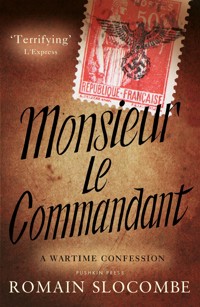
French Academician and Nazi sympathiser, Paul-Jean Husson, writes a letter to his local SS officer in the autumn of 1942.Tormented by an illicit passion for Ilse, his German daughter-in-law, Husson has taken a decision that will devastate several lives, including his own.The letter explains why. It is a dramatic and sometimes harrowing story that begins in the years leading up to the war, when the Academician's gilded existence starts to unravel. Husson's confession is a startling picture of one man's journey: from pillar of the French Establishment and First World War hero, to outspoken supporter of Nazism and the Vichy government.
Sie lesen das E-Book in den Legimi-Apps auf:
Seitenzahl: 268
Veröffentlichungsjahr: 2025
Das E-Book (TTS) können Sie hören im Abo „Legimi Premium” in Legimi-Apps auf:
Ähnliche



















MONSIEUR LE COMMANDANT ROMAIN SLOCOMBE
Translated from the French by Jesse Browner
To Pascal Garnier
Betrayal can be the fruit of a superior intelligence, unbound by civic ideologies.
Paul Léautaud,Passe-temps
FRIENDS OF THE MARÉCHAL
Pledge of Allegiance
I hereby declare that:
I am French, born of a French father and mother;
I am neither a Jew nor a Freemason;
I shall follow Maréchal Pétain in all faith;
I endorse his national and European policy
And am prepared to disseminate and defend that policy,
In the same spirit as Maréchal Pétain, in order to achieve
The active union of all Frenchmen under his leadership.
Surname: Husson
Christian name: Paul-Jean
Profession: Writer, member of the Académie Française
Address: 20 Quai de Verdun, Andigny, Département de l’Eure
I authorise the publication of my pledge for propaganda purposes.
PUBLISHER’S NOTE
The following letter, which comprises the main part of this work, was discovered in May 2006 by the German documentary film-maker Peter Klemm among family papers abandoned in a Leipzig rubbish dump not far from a group of buildings under demolition.
For reasons that will be readily understood, we have deemed it prudent to change the names of the letter-writer, some of the protagonists and a sub-prefecture in Haute-Normandie, as well as that of a literary award and the titles of several books. On the other hand, the occasionally excessive use of capital letters has been retained.
We have also taken the liberty of dividing the manuscript into chapters to make it easier to read.
Contents
1.
Herr Sturmbannführer H. Schöllenhammer
Kreiskommandantur
Hôtel de Paris
10 Avenue du Maréchal Pétain
Sous-préfecture d’Andigny, Eure
Villa Némésis
4 September 1942
Monsieur le Commandant,
I should have found it easy, even in a provincial town where everything, or almost everything, becomes common knowledge, to write this letter, which you will receive this evening, anonymously. Yes, forgive me for reiterating this, it should have been easy to remain anonymous.
But anonymity, like mendacity and error – or more particularly, what I consider to be mendacity and error – inspires the most violent revulsion in me. On the threshold of old age, I shall alter neither my opinion on that nor my temperament.
This in no way explains why I permit myself to bore you with a composition that will undoubtedly degenerate gradually into a painful confession; but ever since your arrival in Andigny and the first words exchanged between reserve officer and active duty officer, I have held you in high regard. Despite the differences in our culture and age – I believe I have some twenty years on you – I have sensed that the great distance between us and other people, you by dint of your presence in an occupied land, and I by my remoteness, pure and simple, has somehow created an understanding between us.
I have never indulged in the romantic delusion that writers ought to be saints or heroes to be worshipped at the altar; on the contrary, I believe that the cultivation of such subversive faculties as the imagination and sensibility carries a clear moral risk. That is why so few writers have led exemplary lives.
I was in Paris yesterday, where I called upon Sonderführer1 Gerhard Heller of the Propagandastaffel.2 I had requested an urgent meeting with him. When our interview was at an end, I restrained myself with some difficulty – although I had merely to cross the Seine and drive a scant kilometre along half-empty streets – from visiting the one who is always in my thoughts, and who at that hour was most likely still at work in her office at the Opéra.
The Gospel tells us: ‘Woe unto him who looks back.’
Holy scripture is clearly speaking here of our devotion to God, which, as I understand it, is absolute and admits of neither reticence nor rejection. One must therefore wipe the slate clean, all or nothing! And having chosen all, having been compelled to choose all, I must relinquish all attachment to everything I once desired. When one gives oneself to God, one must give oneself entirely. So it is with all human enterprise. Yet again, I found myself with a choice to make.
I chose.
On the way home, I was alone in the Imperia as it made its swift way along the banks of the Seine. The slope of Rolleboise rose in the distance. Dozing in the drowsy summer warmth, the countryside shone in all its splendour beside the serene river, which was dotted with fishing skiffs and little white wooden houses on stilts, their shutters closed. To my left loomed dark, heavily wooded hills, throwing a shadow across the road that cast my mind back to the terrible events of recent days. Gazing in that direction, I thought of my daughter-in-law. Turning the other way, towards the calm, light-flooded countryside, I recalled the words of Claudel:
Neither the felicitous plain, nor the harmony of these words, nor the pleasant hue of greenery atop the crimson harvest can satisfy the gaze, which demands light itself. Over there, in that square ditch enclosed by wild mountain walls, the air and the water burn with a mysterious flame. I see gold so beautiful that all of nature seems but a dead mass, and the brightness shed by light itself but the deepest night. Delightful elixir, by what mystic path will it be given me to bathe in your scant waters?
One does not reach the light in a single journey.
One reaches it via a darkling road.
That truth has been amply borne out by three years of war – ever since that 3 September 1939, when the French, having thrown caution to the wind, set off with little enthusiasm in the name of a cause that appeared dubious at best.
All of Europe, a few countries excepted, is now engaged in the hostilities. United by conquest and the spirit of a new world, it is a common bulwark against the enemy in the East. Fourteen months have gone by since your nation, anticipating the imminent onslaught of the Soviets, boldly launched its attack on the boundless Slavic plain. In just a few weeks, you overthrew the enemy’s defences, advanced inexorably to the very gates of Moscow and, along a front stretching thousands of kilometres, were able to consolidate your positions before a winter the like of which had not been seen in years. Your offensive resumed this spring: Kerch fell on 15 May, and Sevastopol, the strongest fortress in the world, vainly resisted a hellish siege until 1 July. The Crimea has been conquered. The brave Wehrmacht took Kharkov on 24 May, reached the Don at Voronezh, swept Voroshilovgrad and, having captured Rostov-on-Don on 24 July, occupied the lands either side of the Don before marching off to Stalingrad and the Caucasus!
Never has Stalin been in such peril, and his appeals for an Anglo-American distraction, the so-called ‘second front’, are growing shriller by the minute. But as you so rightly pointed out to Dr Hild last Sunday, following our game of chess in the gardens of the Bellevue, the British are already mired in a second front in North Africa, where Rommel’s armoured divisions have forced Ritchie’s Eighth Army into retreat and crossed the Egyptian border.
But let us set all this aside, for you know as well as I do how impossible it is to foretell the end of the gargantuan struggle that is now pitting one half of the world against the other.
That, in short, was what was on my mind on that Normandy road, whose every turn, copse, forest, dale, combe, spire and village I know so well … My ears picked up the monotonous drone of the engine, the wind whistling through the car window; I breathed in petrol fumes mingled with the musky scent of fields recently harvested, drenched in heat and light, and bathed in smouldering, dreamy languor, like a woman who has just made love. I passed a line of barges slowly pushing upstream, the river sparkling with reflected sunlight, air and water mysteriously aflame. As the road straightened out ahead, I put my foot down. The blood beat savagely in my temples, coursed through my tired veins. I thought of Ilse. Again!
The truth of what had to be done – cruel and blinding like the summer light – struck me.
I had to put an end to it.
Woe unto him who looks back.
Such was our woe, our crime, our downfall.
2.
I set my pen aside for a moment and tried to order my thoughts. So that you might understand the reason for my long account – and for certain conversations that I shall later have to transcribe in detail, as well as for certain acts of abject violence – I must go back in time to 1932, the year when Ilse Wolffsohn entered our lives. When I say our lives, I mean mine and those of my wife and two children.
You have met Ilse, Monsieur le Commandant, having once exchanged a few words with her in French – which she speaks perfectly, as she does English and Italian. I introduced her to you that day as ‘my daughter-in-law, Madame Olivier Husson’, careful to avoid using her German Christian name. That was last year, after Mass one Sunday in autumn, I’m sure you recall. But you have never met my son Olivier. I have never spoken of him to you. You will know why.
My son always had a gift for music. Which is far from the case with me, I’m sorry to say. But God has offered me certain compensations: instead of concertos and symphonies I have my novels and my plays. Olivier first took up the piano at a very tender age, and then switched to the violin. My daughter Jeanne, two years his elder, had a rather pretty voice, and we soon began to be treated to family concerts at which Olivier accompanied her as she sang Debussy or Fauré … Jeanne had a bad influence on Olivier, turning him against religion. She came across a copy of Renan’s Life of Jesus and that was that; she became deeply anti-religious, to my, and especially to my wife’s, despair. Jeanne’s ideas destroyed Olivier’s devotion and gave rise to furious arguments within the family. But I digress. The fact is that Olivier embarked on a career as a violinist and, having graduated with distinction from the Conservatoire, at the age of twenty-five joined the Paris Symphony Orchestra under the direction of Pierre Monteux.
In the spring of 1932, the orchestra went to perform in Berlin and other German cities. Olivier came home to spend a few days in Andigny that summer. He was accompanied by a beautiful young girl, blonde with languid, laughing eyes. My son introduced her as a German actress, Elsie Berger, whom he had met at a reception thrown by the French embassy in Berlin. Olivier surprised us by announcing that they were engaged, but that Elsie – her stage name, for her real name was Ilse Wolffsohn – would soon have to return to her country, where, despite her extreme youth, she had already starred in many films. My son’s ravishing conquest was only nineteen years old!
During their stay, my wife Marguerite, who was immovable on the matter (and I might add – please excuse my indiscretion – that while we still shared a room, we had had no physical relations for about a year), insisted that Ilse sleep alone in one of the guest rooms. Knowing his mother’s principles, Olivier made no objection, but it became clear to me that when they went off on their long walks through the countryside, boating excursions on the Seine, or to visit our local castle, their relations were no longer chaste. The way they smiled at each other, touched or exchanged tender, intimate glances at the least opportunity told the whole story. On several occasions at night, I heard furtive footsteps in the hallway, stifled laughter, doors discreetly opened and closed. Marguerite pretended to notice none of it. And Jeanne, who joined us at weekends, immediately adopted the young German as her little sister. As for me …
I am trying to recollect the confusion of my feelings in those early days. Like Olivier, and then Jeanne, I was undoubtedly smitten. The German girl had – and still has, though to a lesser extent than then – a very particular way of putting one instantly at ease, a warm eloquence, a disarming enthusiasm, and a candour that was tempered by her remarkable delicacy and sensitivity. On her very first night with us, our guest sat at the piano and played us Schubert’s lieder and a few Bach partitas. My gaze was constantly drawn to her shoulders, visible beneath her diaphanous dress, and the golden hair gathered at the nape of her neck.
The young actress had received the very best education in Berlin. She spoke several languages and had even read – in translation, sadly – my best collection of poems, Ode to Nemesis, and, in the original, two of my best-known ‘war’ novels, The Skirmish and The Ordeal (if memory serves; and I won’t pretend that I wasn’t flattered). The latter is the book in which I recount, through the epic battlefield experience of Captain Dandigny, how I lost my left forearm on 16 October 1918 while liberating Acy, near Rethel, when Gouraud’s army foiled the German counterattack (but we’ve discussed all this already at our chess games). I hastened to offer Ilse the French edition, dedicated to her, of Ode to Nemesis, and we had several opportunities for intimate discussions of poetry, philosophy, literature or History – meandering conversations in which I was impressed by such extensive learning in one so young and apparently so innocent, who soon abandoned the respectful, conventional ‘Monsieur’ for the more casual ‘Paul-Jean’ – and that, too, was a source of pleasure to me. Despite our vast difference in age, I soon felt us becoming the best friends in the world. When Jeanne and I (for Marguerite, I recall, had all of a sudden decided to stay at home and had violently slammed the garden gate behind us) accompanied the couple to Andigny station, I expressed the hope that the actress’s return to the capital, and then on to Germany where a new production awaited her, would not be a lasting one, and that my son’s choice – one of the first of which, to my surprise, I entirely approved – would soon be cemented in a union that would offer my later years the delicious presence and ever-fresh vision of that most charming and intelligent of nymphs.
That she was German bothered me not in the least, even if I had once fought against her people – your own, Monsieur le Commandant. But remember those early years of the 1930s; Europe had been transformed. Between 1918 and 1930 three empires – the Russian, the German and the Austrian – had been wiped off the map, and eight young States had been born, new hues among the expanded, shrunken or reshaped splashes of colour representing the various powers. Alongside ancient wounds, some only partially healed, the treaties had opened fresh ones. How long could it all hold together? Would the disintegration of that fragile edifice cost Europe another four years of war, hundreds of thousands of homes destroyed, billions upon billions spent, more than ten million killed and thirty million maimed, widowed and orphaned?
The policies of England and France to monopolise trade with their colonies represented a serious threat to Germany and Italy. As for the peace treaties, they had in no way enriched Italy, which was poor, and had seriously impoverished Germany, which was rich. If things continued this way, it seemed to me that a new war was inevitable, and sooner rather than later.
England, not Germany, is the age-old enemy of France, as Dunkirk and Mers-el-Kébir have proved yet again. I saw a Franco-German rapprochement as the only chance for a lasting European peace. The journalist Gustave Hervé, an ardent admirer of Hitler even before he became Reich Chancellor, suggested to the leaders of the Nazi Party that the Treaty of Versailles ought to be revised, to which your paper the Völkischer Beobachter responded favourably. In the introduction to his book Une Voix de France, translated and published in your country, Hervé wrote: ‘The National Socialist moment cannot come too soon to France, and when it does it will ring in the hour of Franco-German reconciliation.’
Finding such ideas convincing, I signed up as an active member of the Parti Socialiste National founded by Gustave Hervé in 1929 around his newspaper La Victoire.
In July 1932, the military coup that set the stage for the rise of your Führer took place in Berlin.
That autumn, preceded by its steamy reputation, a film featuring Elsie Berger came to our screens. It was the notorious Mädchen in Uniform, the work of film-maker Leontine Sagan; shot a year earlier, it had enjoyed great success in your country and then had the honour of being chosen to represent Germany abroad. It was banned a few years later by the government of Chancellor Hitler – more for its critique of authority, perhaps, than for its sapphic content.
Under some pretext or other, I drove myself to Paris to attend a screening at a picture house on the Champs-Élysées. If you have seen these ‘young girls in uniform’, Monsieur le Commandant, you will no doubt remember the storyline. I myself remember it as if it were only yesterday that I had seen the all-female production. Orphaned at fourteen, Manuela, played by Hertha Thiele, is enrolled at a boarding school run with an iron fist by the sour Fraülein von Nordeck. Although she is welcomed by her classmates, the newcomer keeps herself to herself at first, until she projects her need for affection onto her literature teacher, Fraülein von Bernburg (played by Dorothea Wieck), the only adult who is sensitive to the feelings of the young boarders. The ardent friendship that the orphan feels for her elder becomes deeper, restoring her joie de vivre. Following her triumph in a staging of Don Carlos, in which she plays the lead role dressed as a man, she gets drunk and confesses her love for her literature teacher to her dumbfounded classmates.
While I appreciated the originality of the story and the talent of the actors, I had eyes only for Elsie Berger, in her all-too-brief appearances as the heroine’s best friend. My son’s fiancée glowed on screen with a charm comparable to that of her peers Miriam Hopkins, Nancy Carroll or Leila Hyams – three pretty blondes appearing in the pictures of that time, and whom the German resembled. But Ilse’s voice and mannerisms were all her own. And to this very day, her almost silent expression of jealous admiration for her best friend’s bold confession seems to me to epitomise the eternal temptation of adventure and flight, perdition even, that spirit of adolescence and rebellion that society requires us to set aside, or to extirpate. Yet it seems to me that this spirit of adventure – which is in fact a thirst for creation, for God’s work – is not a bad thing in itself.
And it occurred to me that Ilse, too, barely out of adolescence herself when I had met her that summer, had yet to find a way to harness the ambition, the impetuous drive, the desire to experiment, to learn and to embrace things, that was bubbling inside her – that noble, grandiose self-belief whose rightful use it is our task to discover. And, truth be told, I doubted that Olivier was man enough to respond to such yearning.
3.
For several long months we heard no more about Ilse Wolffsohn. All through the autumn, and then the winter, I was taken up with calling upon members of the Académie Française, and inviting some of their number to dine at la Tour d’Argent, Prunier or Lapérouse. This was the third time I had set my sights on a seat in the Institute. I won’t go into the old grudges and jealousies that had scuttled my two previous attempts, the latter of which had been particularly painful to me. The elections in the spring represented my last chance. I beat my rival by a single vote in the second ballot and was enrolled in the immortal assembly, taking a seat that had once been occupied by the Dreyfusard Sully Prudhomme. As you might imagine, I would have preferred to take Racine’s seat! François Mauriac, who was younger than I, was elected a few months later; I would have found it humiliating had it happened the other way round.
The year 1933 was equally important to your country, Monsieur le Commandant, as Adolf Hitler rose to the chancellorship in January and Germany withdrew from the League of Nations just a few months later, the first step in a plan to liberate herself from all encumbrances in order to achieve her great destiny.
In November, Le Matin and L’Information, our most influential financial newspaper, printed interviews with Chancellor Hitler, conducted by Monsieur de Brinon, in which the great man guaranteed French security and expressed the finest regard for our country.
Ilse Wolffsohn returned to France at Christmas that year, spending the holidays with us in Andigny. I went to meet the young actress and my son at the station, accompanied by Marguerite. To me, Ilse’s complexion seemed waxen, her face thinner. Olivier mentioned that she was still recovering from a nasty bout of flu, and that she had family worries. I must admit that my wife and I knew next to nothing about the Wolffsohns. Ilse, whose parents Olivier had met but once in Berlin, rarely mentioned them, and neither did my son. All we were able to gather was that her father was a chemist working in heavy industry, and that she had a younger brother, a student.
When the children married in March 1934, it was that young man, Franz, who travelled from Germany for the ceremony, which was held in l’Église de la Madeleine. No other member of the family was present. It was a beautiful, big wedding; many members of the Academy did me the honour of attending. Ilse, delicate and radiant in her white veil, looked like a young goddess descended from the Nordic pantheon, and all without exception were love-struck. The student brother, a pleasant-looking but serious young man, shook me firmly by the hand and murmured solemnly in impeccable French: ‘Monsieur Husson, I am entrusting Dorte to you. So that through you – a war hero, a member of the Academy, and a great poet – and through all you represent, the spirit of Eternal France may watch over her!’ He called his sister ‘Dorte’, no doubt an affectionate nickname she had had since childhood. I did not have the opportunity to talk to him again. Early the next day, Franz Wolffsohn boarded a train at the Gare de l’Est and we never saw him again.
I feel I should mention here that last year, on the occasion of the French writers’ visit to Berlin, I was saddened to learn that the young man, a member of a subversive organisation hostile to the government of the Third Reich, had been arrested, condemned to death and executed in 1940 at Hamburg prison. It will be easy for you to verify that information. Naturally, I did not tell Ilse this; better for her to imagine him still alive and hiding somewhere in Germany.
*
The year 1934 was, dare I say, the most wonderful year of my life. At the age of fifty-eight, in full possession of my intellectual and physical powers, I felt my literary efforts reaching their zenith. My work had been translated into any number of languages and performed in the best theatres; each of my novels had been hailed as a masterpiece by the critics. In the autumn, I was awarded the Prix Renaudot. My poetry collections were studied in schools and academies. I was offered very well-remunerated lectures. Unlike that of so many others, my wealth had barely been touched by the economic chaos, thanks to some wise investments and to two buildings in Paris that had come with Marguerite’s dowry. My son, a gifted musician, had recently wed a splendid young actress – I hoped that my daughter Jeanne would soon find her way to the altar – and shortly thereafter, proud and abashed, Olivier announced that his wife was expecting a happy event in November.
Ilse seemed to have renounced her film career for good, which amazed me, since I had been so impressed by her performance in Mädchen in Uniform. But like Olivier I had no desire to see her head east again, and I hastened to suggest that my daughter-in-law move into Villa Némésis, far from the miasmas of the big city, at least for the duration of her pregnancy, which she could bring to term in conditions optimal for both mother and child. The idea of practising, like Victor Hugo, the ‘art of being a grandfather’ – which I would once have found repugnant – now enchanted me. Even Marguerite seemed to have overcome her early reservations about the German.
We gave the couple our best guest room on the third floor, with a magnificent view of the bend in the Seine, with the island and the plain beyond, all the way to the cliffs of La Roquette. My son divided his time between the Eure and the capital, where he rehearsed with the orchestra while his wife settled in as our permanent guest in Andigny.
*
My God, what memories of that fine summer!
Towards the end of June, we rented the Chalet Haset in Trouville – a little gem of art nouveau architecture – for ten days. The races and the Grand Prix de Paris were over and the season was just beginning; crowds invaded the boardwalk and pier, and all who were considered, in Paris and abroad, to be major figures in the arts, the nobility, finance and politics seemed to have come together to mount a common, elegant assault on the Normandy coast, jostling and mingling and swept up in the same whirlwind of activity. The recent troubles – the night of 6 February, ‘the magnificent, instinctive revolt, the night of sacrifice’, as it was welcomed by Robert Brasillach, that had rattled the Whore Republic, and the Bolshevik protests six days later – seemed to have been forgotten, at least for the duration of the summer season. Lounging serenely on the soft sand of the beach at the end of the day, I fell victim to a fantasy as I watched Ilse in the orange light of sunset, my eyes following her as she strolled along the water’s edge on my wife’s arm, the waves arriving and dying at their feet, their dresses blowing as one in the breeze. I fancied that I had suddenly been restored to my youth in the Belle Époque …
I noticed, too, that the young woman was filling out at the waist. That face whose charming profile I so admired, now aglow in the failing light, radiated the promise of the new life growing within her. The only sorrow I felt, for a brief instant – the confession pains me, but you will read others far more terrible by the end of this letter – was the bitter, jealous regret of not being myself the source of that tiny seed now germinating in those tender depths.
In November of that year 1934, the Franco-German Committee was established under the auspices of your current Ambassador to Paris, His Excellency Monsieur Otto Abetz. The members of the French Guidance Committee were:
Monsieur Fernand de Brinon, now Ambassador of the Vichy Government to Paris;
Monsieur Georges Scapini, Deputy, now Envoy for prisoners of war;
Monsieur Gaston Henry-Haye, Senator, now Ambassador of France to Washington, DC;
Monsieur Gaston Bergery, Deputy, now Ambassador to Ankara;
Monsieur François Piétri, Deputy, now Ambassador to Madrid;
Monsieur Jean Montigny, Deputy, former colleague of Monsieur Laval;
Monsieur Jean Goy, Deputy, President of the Union Nationale des Combattants and ardent follower of the Maréchal since 1935;
Professor Fourneau of the Academy of Medicine;
My friend and colleague Abel Bonnard of the Académie Française, now Minister of National Education;
Professor Bernard Faÿ, current Director of the Bibliothèque Nationale;
and me, Paul-Jean Husson.
My granddaughter Hermione was born on 2 October 1934, six weeks before her due date. The newborn being healthy and of normal weight, I concluded that she had actually been conceived several weeks before the wedding. Such things are of little importance to me. My wife, on the other hand, sought to keep up appearances by referring to Hermione for months as our ‘adorable little premature baby’.
What did bother me, however, was that I had been expecting to welcome a miniature Ilse into the bosom of my family – a darling little blonde with her mother’s laughing blue eyes – whereas our Hermione had an olive complexion, brown eyes and dark hair. Just like my son Olivier, that is.
Is that why I almost never behaved like the doting and protective grandfather that I should so have loved to be? The baby and later the toddler would laugh as she held out her little arms to me, but I could only ever respond with reticence to her touching invitations. I was wary when I picked Hermione up, hugged her reluctantly and hastened to find someone to relieve me of her. I now ask myself: Was it because she looked too much like Olivier, the son who was so different from me and over whom I continued to prefer my darling Jeanne?
Or was it because I was already beginning to suspect something else?
4.
The years passed.
Beyond the Rhine, your Reich created its first three Panzer divisions. In 1935, Marshal Göring – who had met Maréchal Pétain and Pierre Laval (then Minister of Foreign Affairs and soon to become President of the Council) in Warsaw on the occasion of the funeral of Marshal Pilsudski, and found them to be congenial – announced that his country was in the process of creating a powerful air force to include, in addition to numerous fighters, a significant number of bombers and a strong assault command.
The League of Nations could offer nothing more than token protests to these treaty violations. The French Nation, gangrenous with the corrupting individualism born of that absurd republican theory of human rights, seemed to be mired in staggering apathy. Democratic anarchy, so lucidly denounced by Charles Maurras, had unleashed the four scourges upon us: Jewish, Protestant, Foreigner and Freemason. Disorder was paving the way for the downfall of the Motherland, and I could not fail to register the irreversible debasement of France that had long cost us our rightful place in the world – first place.
All this time, our little Hermione was growing. Tawny, joyful, intelligent. The only faults I found in her were suggestions of frivolity and pridefulness, which are readily forgivable in a child.
Ilse, barely touched by maternity, was as young, radiant and beautiful as ever, the light that, on each of her visits to Normandy, illuminated my existence.
Olivier became First Violin of the Paris Symphony Orchestra.




