


0,49 €
Niedrigster Preis in 30 Tagen: 1,99 €
Niedrigster Preis in 30 Tagen: 1,99 €
Mehr erfahren.
- Herausgeber: Booksell-Verlag
- Kategorie: Geisteswissenschaft
- Sprache: Englisch
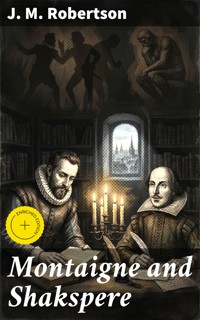
In "Montaigne and Shakspere," J. M. Robertson embarks on a scholarly examination of the profound connections between the philosophical musings of Michel de Montaigne and the dramatic genius of William Shakespeare. Through a detailed analysis of Montaigne's essays and their thematic parallels in Shakespeare's plays, Robertson employs a comparative literary style, drawing intricate lines of influence that illuminate the Renaissance's humanistic ideals. The text is steeped in the historical context of the late 16th century, showcasing how Montaigne's introspective and often skeptical exploration of the human condition resonates within the tapestry of Shakespearean drama. J. M. Robertson was a noted literary critic and scholar, whose extensive study of both Montaigne and Shakespeare positioned him uniquely to explore the intersections of their works. His background in classical literature and philosophy, along with a deep appreciation for the English Renaissance, fueled his endeavor to clarify their intertwined intellectual legacies, further enriching the discourse around these two towering figures of literary history. This book is ideal for scholars, students, and literature enthusiasts alike, as it not only offers profound insights into the minds of Montaigne and Shakespeare but also invites readers to explore the broader implications of their works on contemporary thought. Robertson's meticulous research paves the way for a deeper understanding of how personal reflection and expressive art converge to challenge and deepen our understanding of humanity. In this enriched edition, we have carefully created added value for your reading experience: - A succinct Introduction situates the work's timeless appeal and themes. - The Synopsis outlines the central plot, highlighting key developments without spoiling critical twists. - A detailed Historical Context immerses you in the era's events and influences that shaped the writing. - A thorough Analysis dissects symbols, motifs, and character arcs to unearth underlying meanings. - Reflection questions prompt you to engage personally with the work's messages, connecting them to modern life. - Hand‐picked Memorable Quotes shine a spotlight on moments of literary brilliance. - Interactive footnotes clarify unusual references, historical allusions, and archaic phrases for an effortless, more informed read.
Das E-Book können Sie in Legimi-Apps oder einer beliebigen App lesen, die das folgende Format unterstützen:
Veröffentlichungsjahr: 2019
Ähnliche














Montaigne and Shakspere
Table of Contents
LONDON THE UNIVERSITY PRESS, LIMITED 16, JOHN STREET, BEDFORD ROW, W.C. 1897
THE UNIVERSITY PRESS
MONTAIGNE AND SHAKSPERE
For a good many years past the anatomic study of Shakspere, of which a revival seems now on foot, has been somewhat out of fashion, as compared with its vogue in the palmy days of the New Shakspere Society in England, and the years of the battle between the iconoclasts and the worshippers in Germany. When Mr. Fleay and Mr. Spedding were hard at work on the metrical tests; when Mr. Spedding was subtly undoing the chronological psychology of Dr. Furnivall; when the latter student was on his part undoing in quite another style some of the judgments of Mr. Swinburne; and when Mr. Halliwell-Phillipps was with natural wrath calling on Mr. Browning, as President of the Society, to keep Dr. Furnivall in order, we (then) younger onlookers felt that literary history was verily being made. Our sensations, it seemed, might be as those of our elders had been over Mr. Collier's emendated folio, and the tragical end thereof. Then came a period of lull in things Shaksperean, partly to be accounted for by the protrusion of the Browning Society and kindred undertakings. It seemed as if once more men had come to the attitude of 1850, when Mr. Phillipps had written: "An opinion has been gaining ground, and has been encouraged by writers whose judgment is entitled to respectful consideration, that almost if not all the commentary on the works of Shakspere of a necessary and desirable kind has already been given to the world."1 And, indeed, so much need was there for time to digest the new criticism that it may be doubted whether among the general cultured public the process is even now accomplished.
To this literary phase in particular, and to our occupation with other studies in general, may be attributed the opportunity which still exists for the discussion of one of the most interesting of all problems concerning Shakspere. Mr. Browning, Mr. Meredith, Ibsen, Tolstoi—a host of peculiarly modern problem-makers have been exorcising our not inexhaustible taste for the problematic, so that there was no very violent excitement over even the series of new "Keys" to the sonnets which came forth in the lull of the analysis of the plays; and yet, even with all the problems of modernity in view, it seems as if it must be rather by accident of oversight than for lack of interest in new developments of Shakspere-study that so little attention has been given among us to a question which, once raised, has a very peculiar literary and psychological attraction of its own—the subject, namely, of the influence which the plays show their author to have undergone from the Essays of Montaigne.
As to the bare fact of the influence, there can be little question. That Shakspere in one scene in the Tempest versifies a passage from the prose of Florio's translation of Montaigne's chapter Of the Cannibals has been recognised by all the commentators since Capell (1767), who detected the transcript from a reading of the French only, not having compared the translation. The first thought of students was to connect the passage with Ben Johnson's allusion in Volpone2 to frequent "stealings from Montaigne" by contemporary writers; and though Volpone dates from 1605, and the Tempest from 1610-1613, there has been no systematic attempt to apply the clue chronologically. Still, it has been recognised or surmised by a series of writers that the influence of the essayist on the dramatist went further than the passage in question. John Sterling, writing on Montaigne in 1838 (when Sir Frederick Madden's pamphlet on the autograph of Shakspere in a copy of Florio had called special attention to the Essays), remarked that "on the whole, the celebrated soliloquy in Hamlet presents a more characteristic and expressive resemblance to much of Montaigne's writings than any other portion of the plays of the great dramatist which we at present remember"; and further threw out the germ of a thesis which has since been disastrously developed, to the effect that "the Prince of Denmark is very nearly a Montaigne, lifted to a higher eminence, and agitated by more striking circumstances and a severer destiny, and altogether a somewhat more passionate structure of man."3 In 1846, again, Philarète Chasles, an acute and original critic, citing the passage in the Tempest, went on to declare that "once on the track of the studies and tastes of Shakspere, we find Montaigne at every corner, in Hamlet, in Othello, in Coriolanus. Even the composite style of Shakspere, so animated, so vivid, so new, so incisive, so coloured, so hardy, offers a multitude of striking analogies to the admirable and free manner of Montaigne."4 The suggestion as to the "To be or not to be" soliloquy has been taken up by some critics, but rejected by others; and the propositions of M. Chasles, so far as I am aware, have never been supported by evidence. Nevertheless, the general fact of a frequent reproduction or manipulation of Montaigne's ideas in some of Shakspere's later plays has, I think, since been established.
Twelve years ago I incidentally cited, in an essay on the composition of Hamlet, some dozen of the Essays of Montaigne from which Shakspere had apparently received suggestions, and instanced one or two cases in which actual peculiarities of phrase in Florio's translation of the Essays are adopted by him, in addition to a peculiar coincidence which has been pointed out by Mr. Jacob Feis in his work entitled Shakspere and Montaigne; and since then the late Mr. Henry Morley, in his edition of the Florio translation, has pointed to a still more remarkable coincidence of phrase, in a passage of Hamlet which I had traced to Montaigne without noticing the decisive verbal agreement in question. Yet so far as I have seen, the matter has passed for little more than a literary curiosity, arousing no new ideas as to Shakspere's mental development. The notable suggestion of Chasles on that head has been ignored more completely than the theory of Mr. Feis, which in comparison is merely fantastic. Either, then, there is an unwillingness in England to conceive of Shakspere as owing much to foreign influences, or as a case of intelligible mental growth, or else the whole critical problem which Shakspere represents—and he may be regarded as the greatest of critical problems—comes within the general disregard for serious criticism, noticeable among us of late years. And the work of Mr. Feis, unfortunately, is as a whole so extravagant that it could hardly fail to bring a special suspicion on every form of the theory of an intellectual tie between Shakspere and Montaigne. Not only does he undertake to show in dead earnest what Sterling had vaguely suggested as conceivable, that Shakspere meant Hamlet to represent Montaigne, but he strenuously argues that the poet framed the play in order to discredit Montaigne's opinions—a thesis which almost makes the Bacon theory specious by comparison. Naturally it has made no converts, even in Germany, where, as it happens, it had been anticipated.
In France, however, the neglect of the special problem of Montaigne's influence on Shakspere is less easily to be explained, seeing how much intelligent study has been given of late by French critics to both Shakspere and Montaigne. The influence is recognised; but here again it is only cursorily traced. The latest study of Montaigne is that of M. Paul Stapfer, a vigilant critic, whose services to Shakspere-study have been recognised in both countries. But all that M. Stapfer claims for the influence of the French essayist on the English dramatist is thus put:—
"Montaigne is perhaps too purely French to have exercised much influence abroad. Nevertheless his influence on England is not to be disdained. Shakspere appreciated him (le goûtait); he has inserted in the Tempest a passage of the chapter Des Cannibales; and the strong expressions of the Essays on man, the inconstant, irresolute being, contrary to himself, marvellously vain, various and changeful, were perhaps not unconnected with (peut être pas étrangères à) the conception of Hamlet. The author of the scene of the grave-diggers must have felt the savour and retained the impression of this thought, humid and cold as the grave: 'The heart and the life of a great and triumphant emperor are but the repast of a little worm.' The translation of Plutarch, or rather of Amyot, by Thomas North, and that of Montaigne by Florio, had together a great and long vogue in the English society of the seventeenth century."5
So modest a claim, coming from the French side, can hardly be blamed on the score of that very modesty. It is the fact, however, that, though M. Stapfer has in another work6 compared Shakspere with a French classic critically enough, he has here understated his case. He was led to such an attitude in his earlier study of Shakspere by the slightness of the evidence offered for the claim of M. Chasles, of which he wrote that it is "a gratuitous supposition, quite unjustified by the few traces in his writings of his having read the Essays."7 But that verdict was passed without due scrutiny. The influence of Montaigne on Shakspere was both wider and deeper than M. Stapfer has suggested; and it is perhaps more fitting, after all, that the proof should be undertaken by some of us who, speaking Shakspere's tongue, cannot well be suspected of seeking to belittle him when we trace the sources for his thought, whether in his life or in his culture. There is still, indeed, a tendency among the more primitively patriotic to look jealously at such inquiries, as tending to diminish the glory of the worshipped name; but for anyone who is capable of appreciating Shakspere's greatness, there can be no question of iconoclasm in the matter. Shakspere ignorantly adored is a mere dubious mystery; Shakspere followed up and comprehended, step by step, albeit never wholly revealed, becomes more remarkable, more profoundly interesting, as he becomes more intelligible. We are embarked, not on a quest for plagiarisms, but on a study of the growth of a wonderful mind. And in the idea that much of the growth is traceable to the fertilising contact of a foreign intelligence there can be nothing but interest and attraction for those who have mastered the primary sociological truth that such contacts of cultures are the very life of civilisation.
II.
The first requirement in the study, obviously, is an exact statement of the coincidences of phrase and thought in Shakspere and Montaigne. Not that such coincidences are the main or the only results to be looked for; rather we may reasonably expect to find Shakspere's thought often diverging at a tangent from that of the writer he is reading, or even directly gainsaying it. But there can be no solid argument as to such indirect influence until we have fully established the direct influence, and this can only be done by exhibiting a considerable number of coincidences. M. Chasles, while avowing that "the comparison of texts is indispensable—we must undergo this fatigue in order to know to what extent Shakspere, between 1603 and 1615, became familiar with Montaigne"—strangely enough made no comparison of texts whatever beyond reproducing the familiar paraphrase in the Tempest, from the essay Of Cannibals; and left absolutely unsupported his assertion as to Hamlet, Othello, and Coriolanus. It is necessary to produce proofs, and to look narrowly to dates. Florio's translation, though licensed in 1601, was not published till 1603, the year of the piratical publication of the First Quarto of Hamlet, in which the play lacks much of its present matter, and shows in many parts so little trace of Shakspere's spirit and versification that, even if we hold the text to have been imperfectly taken down in shorthand, as it no doubt was, we cannot suppose him to have at this stage completed his refashioning of the older play, which is undoubtedly the substratum of his.8 We must therefore keep closely in view the divergencies between this text and that of the Second Quarto, printed in 1604, in which the transmuting touch of Shakspere is broadly evident. It is quite possible that Shakspere may have seen parts of Florio's translation before 1603, or heard passages from it read; or even that he might have read Montaigne in the original. But as his possession of the translation is made certain by the preservation of the copy bearing his autograph, and as it is from Florio that he is seen to have copied in the passages where his copying is beyond dispute, it is on Florio's translation that we must proceed.
I. In order to keep all the evidence in view, we may first of all collate once more the passage in the Tempest with that in the Essays which it unquestionably follows. In Florio's translation, Montaigne's words run:
"They [Lycurgus and Plato] could not imagine a genuity so pure and simple, as we see it by experience, nor ever believe our society might be maintained with so little art and human combination. It is a nation (would I answer Plato) that hath no kind of traffic, no knowledge of letters, no intelligence of numbers, no name of magistrate, nor of politic superiority; no use of service, of riches, or of poverty; no contracts, no successions, no dividences, no occupations, but idle; no respect of kindred, but common; no apparel, but natural; no manuring of lands, no use of wine, corn, or metal. The very words that import lying, falsehood, treason, dissimulation, covetousness, envy, detraction, and passion, were never heard of amongst them. How dissonant would he find his imaginary commonwealth from this perfection?"
Compare the speech in which the kind old Gonzalo seeks to divert the troubled mind of the shipwrecked King Alonso:
There can be no dispute as to the direct transcription here, where the dramatist is but incidentally playing with Montaigne's idea, proceeding to put some gibes at it in the mouths of Gonzalo's rascally comrades; and it follows that Gonzalo's further phrase, "to excel the golden age," proceeds from Montaigne's previous words: "exceed all the pictures wherewith licentious poesy hath proudly embellished the golden age." The play was in all probability written in or before 1610. It remains to show that on his first reading of Florio's Montaigne, in 1603-4, Shakspere was more deeply and widely influenced, though the specific proofs are in the nature of the case less palpable.
II. Let us take first the more decisive coincidences of phrase. Correspondences of thought which in themselves do not establish their direct connection, have a new significance when it is seen that other coincidences amount to manifest reproduction. And such a coincidence we have, to begin with, in the familiar lines:




