


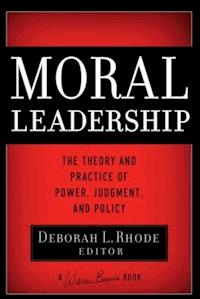
Moral Leadership E-Book
48,99 €
Mehr erfahren.
- Herausgeber: John Wiley & Sons
- Kategorie: Fachliteratur
- Serie: J-B Warren Bennis Series
- Sprache: Englisch
Moral Leadership brings together in one comprehensive volumeessays from leading scholars in law, leadership, psychology,political science, and ethics to provide practical, theoreticalpolicy guidance. The authors explore key questions about moralleadership such as: * How do leaders form, sustain, and transmit moralcommitments? * Under what conditions are those processes most effective? * What is the impact of ethics officers, codes, trainingprograms, and similar initiatives? * How do standards and practices vary across context andculture? * What can we do at the individual, organizational, and societallevel to foster moral leadership? Throughout the book, the contributors identify what people know,and only think they know, about the role of ethics in keydecision-making positions. The essays focus on issues such as thedefinition and importance of moral leadership and the factors thatinfluence its exercise, along with practical strategies forpromoting ethical behavior. Moral Leadership addresses thedynamics of moral leadership, with particular emphasis on majorobstacles that stand in its way: impaired judgment, self-interest,and power. Finally, the book explores moral leadership in a varietyof contexts?business and the professions, nonprofit organizations,and the international arena.
Sie lesen das E-Book in den Legimi-Apps auf:
Seitenzahl: 621
Veröffentlichungsjahr: 2015
Ähnliche




















Table of Contents
Cover
Title
Copyright
Dedication
Foreword
INTRODUCTION: WHERE IS THE LEADERSHIP IN MORAL LEADERSHIP?
Moral Leadership Defined
The Historical Backdrop and Current Need for Moral Leadership
Doing Good and Doing Well: When Does Ethics Pay?
Individual and Contextual Dimensions of Moral Conduct
Strategies of Moral Leadership
Promoting Moral Leadership
Part One: ETHICAL JUDGMENT
1: MAKING SENSE OF MORAL MELTDOWNS
The Ethical Dimension: Adversarial Ethics
The Cultural Dimension: America’s Love Affair with Winners
The Economic Dimension: The Feudal and Socialist Character of American Capitalism
The Psychological Dimension: Cognitive Dissonance and Moral Compass
Lessons for Leaders?
2: THREE PRACTICAL CHALLENGES OF MORAL LEADERSHIP
Time
Ambivalence
Sense of Self
Conclusion
3: ETHICAL JUDGMENT AND MORAL LEADERSHIP
Ethical Fading
Contextualizing Ethics
The Need for Moral Courage
Conclusion
4: MORALS FOR PUBLIC OFFICIALS
A Priori Versus Conventional Ethics
Individual-Level Morality Versus Institutional Arrangements
Political Versus Legal and Regulatory Agency Control
Division of Labor in Official Ethics
Conflicts of Interest
Three Potential Distortions
Conclusion
Part Two: THE PSYCHOLOGY OF POWER
5: THE PSYCHOLOGY OF POWER
Locating Evil Within Particular People: The Rush to Judgment
Blind Obedience to Authority: The Milgram Investigations
Ten Steps to Creating Evil Traps for Good People
On Being Anonymous: Deindividuation and Destructiveness
Cultural Wisdom: How to Make Warriors Kill in Battle But Not at Home
Moral Disengagement and Dehumanization
Suspension of the Usual Cognitive Controls Guiding Moral Action
The Hostile Imagination Created by Faces of the Enemy
Can Ordinary Old Men Become Murderers Overnight?
Educating Hatred and Destructive Imaginations
The Stanford Prison Experiment: Institutional and Systemic Power to Corrupt
The Evil of Inaction
Torturers and Executioners: Pathological Types or Situational Imperatives?
Suicide Bombers: Mindless Fanatics or Mindful Martyrs?
Summing Up Before Moving On
Understanding What Went Wrong in Abu Ghraib Prison
Promoting Civic Virtue, Moral Engagement, and Human Goodness
6: TAMING POWER
Candidate Variables for Taming Power
Social-Structural Candidate Variables
Taming Power: An Analogy and a Vision
7: POWER AND MORAL LEADERSHIP
Status Endowed: The Rise of the Impulsive
Power and the Pursuit of Self-Interest
Power and the Ideology of Self-Interest
Power and Solipsistic Social Environments
Leveling Mechanisms
Conclusions and Future Directions
Part Three: SELF-SACRIFICE AND SELF-INTEREST
8: ORCHESTRATING PROSOCIAL MOTIVES
Motives as Goal-Directed Forces
Four Types of Prosocial Motivation
Conflict
Orchestration
Conclusion
9: SELF-SACRIFICE AND SELF-INTEREST
Adherence to Rules
Models of Human Motivation
Alternative Models
Evidence for the Value-Based Approach
Procedural Justice
Implications for Moral Leadership
Defining Procedural Justice
Conclusion
Part Four: SERVING THE PUBLIC THROUGH THE PUBLIC SECTOR
10: STRATEGIC PHILANTHROPY AND ITS MALCONTENTS
The Idea of Strategic Philanthropy
Two Qualifications
In Defense of Strategic Philanthropy
The Critique of Venture Philanthropy and the Value of General Operating Support
11: ETHICS AND PHILANTHROPY
Funding Ethics
Foundation Accountability
Philanthropy and Public Goods
Part Five: MORAL LEADERSHIP
12: EXERCISING MORAL COURAGE
Who Are the Management Students?
Unlearning the Myths of the Inexperienced
Doing the Right Thing: Powerlessness Corrupts
The Role of Business as a Societal Force
Moral Leadership: Expanding the Zone of Acceptability
13: PERSPECTIVES ON GLOBAL MORAL LEADERSHIP
What Is Global Moral Leadership?
Who Is a Global Moral Leader?
Characteristics of a Global Moral Leader
What Are Global Moral Values?
Conclusion
Notes
Acknowledgments
About the Authors
Index
End User License Agreement
Guide
Cover
Table of Contents
Begin Reading
List of Illustrations
12: EXERCISING MORAL COURAGE
Figure 12.1. Zone of Acceptability
Figure 12.2. Expanding the Zone of Acceptability
List of Tables
8: ORCHESTRATING PROSOCIAL MOTIVES
Table 8.1. Four Prosocial Motives
12: EXERCISING MORAL COURAGE
Table 12.1. The Reality of Managing and Leading
Pages
Cover
contents
i
ii
iii
iv
v
vi
vii
viii
xi
xii
1
2
3
4
5
6
7
8
9
10
11
12
13
14
15
16
17
18
19
20
21
22
23
24
25
26
27
28
29
30
31
32
33
34
35
36
37
38
39
40
41
42
43
44
45
46
47
48
49
50
51
52
53
54
55
56
57
58
59
60
61
62
63
64
65
66
67
68
69
70
71
72
73
74
75
76
77
78
79
80
81
82
83
84
85
86
87
88
89
90
91
92
93
94
95
96
97
98
99
100
101
102
103
104
105
106
107
108
109
110
111
112
113
114
115
116
117
118
119
120
121
122
123
124
125
126
127
128
129
130
131
132
133
134
135
136
137
138
139
140
141
142
143
144
145
146
147
148
149
150
151
152
153
154
155
156
157
158
159
160
161
162
163
164
165
166
167
168
169
170
171
172
173
174
175
176
177
178
179
180
181
182
183
184
185
186
187
188
189
190
191
192
193
194
195
196
197
198
199
200
201
202
203
204
205
206
207
208
209
210
211
212
213
214
215
216
217
218
219
220
221
222
223
224
225
226
227
228
229
230
231
232
233
234
235
236
237
238
239
240
241
242
243
244
245
246
247
248
249
250
251
252
253
254
255
256
257
258
259
260
261
262
263
264
265
266
267
268
269
270
271
272
273
274
275
276
277
278
279
280
281
282
283
284
285
286
287
288
289
290
291
292
293
294
295
296
297
298
299
300
301
302
303
304
305
306
307
308
309
310
311
312
313
314
315
316
317
318
319
320
321
322
323
324
325
326
327
328
329
330
331
332
333
334
335
336
337
338
339
340
341
342
343
344
345
346
347
348
349
350
351
352
353
354
355
356
357
358
359
360
361
362
363
364
365
366
367
368
369
370
371
372
373
374
375
376
377
378
379
380
381
382
383
384
385
386
Praise for Moral Leadership
“This collection of essays takes a fresh look at one of today’s most urgent concerns: moral leadership in the public domain. The book is important reading for anyone who believes that moral leadership may still be possible, even during a time of ethical degradation in many key social institutions.”
—William Damon, professor of education, Stanford University
“A stellar group of well-known thinkers. A topic of commanding importance. Articles that make hard ideas fascinating and readable. What’s not to like in this striking new collection of essays? It is hands-down the best anthology on practical ethics to appear in many years.”
—Thomas Donaldson, Mark O. Winkelman Professor, the Wharton School of the University of Pennsylvania
“The heavy hitters in business ethics are well represented in this timely volume. Their message is of compelling interest to scholars and business leaders alike.”
—Robert H. Frank, Henrietta Johnson Louis Professor of Management and professor of economics, Cornell University
A WARREN BENNIS BOOK
This collection of books is devoted exclusively to new and exemplary contributions to management thought and practice. The books in this series are addressed to thoughtful leaders, executives, and managers of all organizations who are struggling with and committed to responsible change. My hope and goal is to spark new intellectual capital by sharing ideas positioned at an angle to conventional thought—in short, to publish books that disturb the present in the service of a better future.
Books in the Warren Bennis Signature Series
Branden
Self-Esteem at Work
Mitroff, Denton
A Spiritual Audit of Corporate America
Schein
The Corporate Culture Survival Guide
Sample
The Contrarian’s Guide to Leadership
Lawrence, Nohria
Driven
Cloke, Goldsmith
The End of Management and the Rise ofOrganizational Democracy
Glen
Leading Geeks
Cloke, Goldsmith
The Art of Waking People Up
George
Authentic Leadership
Kohlrieser
Hostage at the Table
Rhode
Moral Leadership
Moral Leadership
The Theory and Practice of Power, Judgment, and Policy
Deborah L. Rhode
Warren Bennis
Copyright © 2006 by John Wiley & Sons, Inc. All rights reserved.
Published by Jossey-BassA Wiley Imprint989 Market Street, San Francisco, CA 94103-1741 www.josseybass.com
No part of this publication may be reproduced, stored in a retrieval system, or transmitted in any form or by any means, electronic, mechanical, photocopying, recording, scanning, or otherwise, except as permitted under Section 107 or 108 of the 1976 United States Copyright Act, without either the prior written permission of the publisher, or authorization through payment of the appropriate per-copy fee to the Copyright Clearance Center, Inc., 222 Rosewood Drive, Danvers, MA 01923, 978-750-8400, fax 978-646-8600, or on the Web at www.copyright.com. Requests to the publisher for permission should be addressed to the Permissions Department, John Wiley & Sons, Inc., 111 River Street, Hoboken, NJ 07030, 201-748-6011, fax 201-748-6008, or online at http://www.wiley.com/go/permissions.
Limit of Liability/Disclaimer of Warranty: While the publisher and author have used their best efforts in preparing this book, they make no representations or warranties with respect to the accuracy or completeness of the contents of this book and specifically disclaim any implied warranties of merchantability or fitness for a particular purpose. No warranty may be created or extended by sales representatives or written sales materials. The advice and strategies contained herein may not be suitable for your situation. You should consult with a professional where appropriate. Neither the publisher nor author shall be liable for any loss of profit or any other commercial damages, including but not limited to special, incidental, consequential, or other damages.
Readers should be aware that Internet Web sites offered as citations and/or sources for further information may have changed or disappeared between the time this was written and when it is read.
Jossey-Bass books and products are available through most bookstores. To contact Jossey-Bass directly call our Customer Care Department within the U.S. at 800-956-7739, outside the U.S. at 317-572-3986, or fax 317-572-4002.
Jossey-Bass also publishes its books in a variety of electronic formats. Some content that appears in print may not be available in electronic books.
Library of Congress Cataloging-in-Publication Data
Moral leadership : the theory and practice of power, judgment, and policy / by Deborah L. Rhode, editor ; foreword by Warren Bennis.
p. cm. Includes bibliographical references and index. ISBN-13: 978-0-7879-8282-9 (cloth : alk. paper) ISBN-10: 0-7879-8282-2 (cloth : alk. paper) 1. Business ethics. 2. Management—Moral and ethical aspects. 3. Leadership—Moral and ethical aspects. 4. Social responsibility of business. I. Rhode, Deborah L. HF5387.M649 2006 174'.4—dc22
2006008774
For Lawrence Quill
Foreword
“The trouble with the world is that everyone has his reasons.”
—Jean Renoir
Books of readings—compendia, collections, and anthologies, that sort of undertaking—are notoriously difficult to pull off. Especially those with original essays. To begin with, publishers don’t like them because they, er, don’t sell. And mostly for good reasons: the typical anthology includes a dizzying assortment of unrelated papers fastened uneasily together by typographic artifices. We’re all too familiar with the usual pitfalls: papers of uneven quality; first drafts that were never quite in shape and were gathering dust in some desk drawer; and assemblages of articles that fit uneasily, like unmatched socks. Most important, many such “readers” lack a clear and coherent conceptual armature.
Deborah Rhode’s choices of authors and their seminal contributions is a relief, a startlingly fresh exception to all of the usual mishaps that beleaguer those intrepid souls who agree to undertake such a thankless task. Rhode’s challenge is unusually daunting: to create a framework that is useful, balanced, objective, and with a carapace generous enough to address the key aspects of a topic as forebodingly complex as “moral leadership.” This book—it’s not bold or hyperbolic to say—will soon become required reading for anyone who wants to understand the vexing issues that inhere in this complicated topic.
As a veteran “foreword writer” who’s come in from the cold, I long ago vowed that I would never write another one. The importance of this book made it an obligation. First of all, Rhode’s introductory essay is a masterpiece. With super lucidity she confronts the issues and conundrums facing this nascent field of inquiry. If some of the other essays didn’t measure up to her standard, I would stop here and simply say as they do on menus, “that one alone is worth the price of admission.” Well, Rhode’s is, but there are many others and to mention one would imply that others weren’t of the same quality; that’s not the case.
There are two reasons for my enthusiasm. First, all of the authors know what they’re talking about. They do not avoid complexity or try to avoid the dangerous shoals of this regularly contested terrain. Whether they dwell on the dispositional factors, as some do, or situational factors, which others do, or the systemic factors, as still others do, their eyes are wide open and make legitimate their own dubiety. Second, the values they express, indirectly or directly, comport with what our democratic institutions should be about: transparency, freedom, parity, and moral awareness of its leaders. Not only did I feel uplifted reading this book, I felt that it helped to disperse the shadows where moral leadership restlessly resides. This book should make it more difficult for leaders to hold on to the “reasons” that trouble the world.
March 2006
Warren Bennis
WB Series Editor
Santa Monica, California
INTRODUCTION: WHERE IS THE LEADERSHIP IN MORAL LEADERSHIP?
Deborah L. Rhode
Moral leadership has always been with us, but only recently has the concept attracted systematic attention. Political philosophers dating from the early Greeks and theologians dating from the Middle Ages occasionally discussed virtue in the context of leadership.1 However, not until the later half of the twentieth century did leadership or business ethics emerge as distinct fields of study, and attention to their overlap has been intermittent and incomplete. In the United States, it took a succession of scandals to launch moral leadership as an area of research in its own right. Price fixing in the 1950s, defense contracting in the 1960s, Watergate and securities fraud in the 1970s, savings and loans and political abuses in the 1980s, and massive moral meltdowns in the corporate sector in the late 1990s and early 2000s underscored the need for greater attention to ethics.
Moral leadership is now in a boom cycle. At last count, a Web search revealed some forty-seven thousand sites. National leaders have clamoured that “Something Must Be Done.”2 Dutiful platitudes have been uttered, and a thriving cottage industry has been churning out courses, commissions, conferences, and consultants.
Parodies of all of the above also have been in ample supply. In the post-Watergate era, cartoonist Gary Trudeau satirized hastily assembled professional ethics courses as “trendy lip service to our better selves.” The 1980s and 1990s debacles prompted publications like Wall Street Ethics, which opened to nothing but blank pages. And Enron and its disciples have generated comparable comic relief. The New York Times Magazine ran a mock job application for a corporate ethics officer that included multiple-choice questions such as the following:
Experience (check all that apply)
MFA in fiction writing
Accounting Department, Enron
Congressman
Analogies
Please choose the best word or phrase to complete the analogy.
Shoplifting is to accident as accounting fraud is to
a. misunderstanding
b. rounding error
c. friendly disagreement
d. subject to interpretation
e. impossible
I believe that the truth is
objective
subjective
for sale
3
The New Yorker featured a similar spoof under the caption, “Bush, Cheney Blister Shady Business Ethics.” In this account, the president displayed his customary “can-do attitude” in solving the “real problems facing American business,” such as theft of hotel shampoo, soap, and sewing kits by corporate executives traveling at company expense. To combat such abuses, the president reportedly announced plans to form a “cabinet level department of Homeland Personal Toiletries.”
Lesen Sie weiter in der vollständigen Ausgabe!
Lesen Sie weiter in der vollständigen Ausgabe!
Lesen Sie weiter in der vollständigen Ausgabe!
Lesen Sie weiter in der vollständigen Ausgabe!
Lesen Sie weiter in der vollständigen Ausgabe!
Lesen Sie weiter in der vollständigen Ausgabe!
Lesen Sie weiter in der vollständigen Ausgabe!
Lesen Sie weiter in der vollständigen Ausgabe!
Lesen Sie weiter in der vollständigen Ausgabe!
Lesen Sie weiter in der vollständigen Ausgabe!
Lesen Sie weiter in der vollständigen Ausgabe!
Lesen Sie weiter in der vollständigen Ausgabe!
Lesen Sie weiter in der vollständigen Ausgabe!
Lesen Sie weiter in der vollständigen Ausgabe!
Lesen Sie weiter in der vollständigen Ausgabe!
Lesen Sie weiter in der vollständigen Ausgabe!
Lesen Sie weiter in der vollständigen Ausgabe!
Lesen Sie weiter in der vollständigen Ausgabe!
Lesen Sie weiter in der vollständigen Ausgabe!
Lesen Sie weiter in der vollständigen Ausgabe!
Lesen Sie weiter in der vollständigen Ausgabe!
Lesen Sie weiter in der vollständigen Ausgabe!
Lesen Sie weiter in der vollständigen Ausgabe!




