


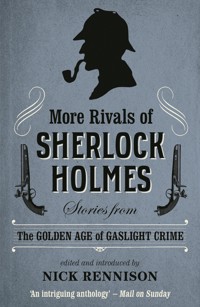
More Rivals of Sherlock Holmes E-Book
6,99 €
Mehr erfahren.
- Herausgeber: No Exit Press
- Kategorie: Krimi
- Sprache: Englisch
Sherlock Holmes remains the most famous of all fictional detectives. But he was not the only solver of crimes to patrol the gaslit streets of late Victorian and Edwardian London. The years between 1890 and 1914 were the heyday of the English (and American) story magazines and their pages were filled with platoons of private detectives, police officers and eccentric criminologists. These were the 'Rivals of Sherlock Holmes' and this second anthology of stories edited by Nick Rennison, author of Sherlock Holmes: An Unauthorised Biography, highlights fifteen of them: Mr Booth created by Herbert Keen Max Carrados created by Ernest Bramah Florence Cusack created by LT Meade and Robert Eustace John Dollar, 'The Crime Doctor' created by EW Hornung Dick Donovan created by JE Preston Muddock Horace Dorrington created by Arthur Morrison Martin Hewitt created by Arthur Morrison Judith Lee created by Richard Marsh Madelyn Mack created by Hugh Cosgro Weir Lady Molly of Scotland Yard created by Baroness Orczy Addington Peace created by Fletcher Robinson Mark Poignand and Kala Persad created by Headon Hill John Pym created by David Christie Murray Christopher Quarles created by Percy Brebner John Thorndyke created by R Austin Freeman
Das E-Book können Sie in Legimi-Apps oder einer beliebigen App lesen, die das folgende Format unterstützen:
Veröffentlichungsjahr: 2019
Ähnliche




















Join the No Exit Press eBook Club
The publishing industry has changed dramatically over the last thirty years and now, more than ever, we value our relationship with you, our readers. That’s why we launched the No Exit Press eBook club in which we aim to give you the best value for money across our entire catalogue.
Subscribe to the No Exit eBook club and get 30% off our entire catalogue. Click here to find out more
CRITICAL ACCLAIM FOR NICK RENNISON
THE RIVALS OF SHERLOCK HOLMES
‘An intriguing anthology’ – Mail on Sunday
‘A book which will delight fans of crime fiction’ – Verbal Magazine
‘It’s good to see that Mr Rennison has also selected some rarer pieces – and rarer detectives, such as November Joe, Sebastian Zambra, Cecil Thorold and Lois Cayley’ – Roger Johnson, The District Messenger (Newsletter of the Sherlock Holmes Society of London)
THE RIVALS OF DRACULA
‘These 15 sanguinary spine-tinglers… deliver delicious chills’ – Christopher Hirst, Independent
‘A gloriously Gothic collection of heroes fighting against maidens with bone-white skin, glittering eyes and blood-thirsty intentions’ – Lizzie Hayes, Promoting Crime Fiction
‘Nick Rennison’s The Rivals of Dracula shows that many Victorian and Edwardian novelists tried their hand at this staple of Gothic horror’ – Andrew Taylor, Spectator
‘The Rivals of Dracula is a fantastic collection of classic tales to chill the blood and tingle the spine. Grab a copy and curl up somewhere cosy for a night in’ – Citizen Homme Magazine
To Eve with love and thanks
INTRODUCTION
‘After Holmes, the deluge!’ the author and Sherlockian critic Vincent Starrett once wrote. He was referring, of course, to the vast number of private detectives and other crime-solvers who peopled the pages of the English and American popular magazines in the wake of the astonishing success of Sir Arthur Conan Doyle’s character.
The magazine press of the day had very nearly as voracious an appetite for content and stories as TV does today. The most significant of these magazines was The Strand. Founded by the publisher George Newnes, it first appeared in January 1891. Its editor was Herbert Greenhough Smith who was to continue in that role for the next thirty-nine years. It was Smith who had the perspicacity to spot immediately the potential in Conan Doyle’s Sherlock Holmes short stories. Forty years later, perhaps with a little benefit of hindsight, he recalled the moment in 1891 when he received the manuscripts of two of the stories. ‘I at once realised that here was the greatest short story writer since Edgar Allan Poe… there was no mistaking the ingenuity of the plot, the limpid clearness of the style, the perfect art of telling a story.’ The first of the Holmes short stories, ‘A Scandal in Bohemia’, was published in the July 1891 edition of The Strand Magazine. A literary phenomenon was born. The connection between Holmes and The Strand was to last until 1927 and the publication of ‘The Adventure of Shoscombe Old Place’, the final tale of the great consulting detective. Apart from the first two novels, every Holmes story made its first British appearance in the pages of The Strand.
However, The Strand did not just provide a home for Holmes and Dr Watson. Stories of other fictional detectives of the period, several of them represented in this collection, were published in its pages. These included Dick Donovan, created by Greenhough Smith’s father-in-law JE Preston Muddock, EW Hornung’s gentleman thief AJ Raffles, Lois Cayley, a feisty ‘New Woman’ who appeared in stories by Grant Allen, and Richard Marsh’s Judith Lee. Arthur Morrison’s Martin Hewitt made his debut in The Strand in 1894, at least in part to fill the gap left by Conan Doyle’s decision to kill off Holmes in ‘The Final Problem’ which had been published the previous December.
Nor, of course, was The Strand the only such periodical on the newsstands. There were dozens and dozens of similar magazines in the 1890s and 1900s and nearly all of them featured crime stories. Arthur Morrison’s Horace Dorrington stories made their first appearance in The Windsor Magazine as did Guy Boothby’s tales of the occultist and criminal mastermind Dr Nikola and Arnold Bennett’s Cecil Thorold stories. The Idler, edited for several years by Jerome K Jerome, author of Three Men in a Boat, published some of William Hope Hodgson’s ‘Carnacki’ stories, about an investigator of the supernatural. (In 1892, The Idler also published the very first parody of Sherlock Holmes – ‘The Adventures of Sherlaw Kombs’ by Jerome’s co-editor Robert Barr.) GK Chesterton’s Father Brown stories featured in The Pall Mall Magazine. (There seemed to be a fondness at the time for naming periodicals after famous London streets.) Other, smaller magazines also had their detectives. Loveday Brooke, one of a number of female detectives in the fiction of the period, appeared in The Ludgate Monthly; Headon Hill’s Sebastian Zambra was to be found in The Million and Victor Whitechurch’s railway detective Thorpe Hazell, appropriately enough, graced the pages of The Railway Magazine as well as The Royal Magazine and Pearson’s Magazine.
It is from this vast pool of periodical fiction that I have drawn the majority of the stories in this book. As with the first volume in this series (The Rivals of Sherlock Holmes) what I wanted to do more than anything was to demonstrate the sheer variety of crime stories published between 1890 and 1914. People often assume that there is little worth reading from that era other than the Holmes stories and that the fictional detectives of the time are all Sherlock clones. Neither of these assumptions is true. Conan Doyle was inarguably the best writer in the genre in the decades immediately before the First World War but that does not mean he was the only one with great talents. Arthur Morrison, R Austin Freeman and Baroness Orczy – to name just three – were all highly skilled writers of popular fiction who can be read with great pleasure today. And while there were undoubtedly characters who were cheap copies of Doyle’s detective (I have included David Christie Murray’s John Pym as an example of one of these) they were vastly outnumbered by those who were very different. It was almost a matter of pride among self-respecting authors to come up with a character that did not echo Sherlock Holmes. From the blind detective Max Carrados to Arthur Morrison’s utterly ruthless, almost monstrous creation, Horace Dorrington, from Baroness Orczy’s pioneering Scotland Yard detective Lady Molly to John Dollar, EW Hornung’s ‘Crime Doctor’, there are plenty of characters who are memorable in their own right.
In this new volume of stories, I have avoided including any of the ‘Rivals of Sherlock Holmes’ who appeared in my first collection. It would have been easy enough to pick another Father Brown story by GK Chesterton or another tale about Jacques Futrelle’s ‘Thinking Machine’, Professor Augustus SFX Van Dusen. There are plenty of very readable stories featuring those two characters from which to choose. However, in pursuit of my wish to demonstrate the variety and range of late Victorian and Edwardian crime fiction, I have picked fifteen entirely different ‘Rivals’ for this volume. And only one writer from the first book – Headon Hill - also makes an appearance in this one.
When fans of crime fiction refer to its ‘Golden Age’ they usually mean the era of Agatha Christie, Dorothy L Sayers and Margery Allingham but there was an earlier period in the history of the genre that was just as rich and fascinating. The years between 1890 and the outbreak of the First World War saw the emergence and establishment of Sherlock Holmes as the greatest of all fictional detectives. No one disputes his pre-eminence but he had plenty of rivals. As Vincent Starrett pointed out, there was a ‘deluge’ of them. As I hope this second volume of stories proves, many of them deserve to be remembered and read today.
MR BOOTH
Created by Herbert Keen (fl. 1896)
Mr Booth (we never learn his Christian name) appears in a series of stories collectively entitled ‘Chronicles of Elvira House’ which were published in The Idler magazine in 1896. They are narrated by Mr Perkins, an unworldly, middle-aged clerk in an insurance office who lodges at the boarding house of the title and persuades his friend Booth to take rooms there as well. Booth is a former detective and a much shrewder individual than his friend. In most of the stories Perkins or somebody he knows blunders into a tricky, possibly criminal situation and Mr Booth, through his knowledge of human nature, comes to the rescue. The ‘Chronicles of Elvira House’ are slight stories in themselves but they have a great deal of charm and are richly redolent of the era in which they were written. I have been unable to find any information whatsoever about the author Herbert Keen. Possibly it was a pseudonym; possibly he wrote nothing other than the stories of Mr Booth and Mr Perkins.
THE MISSING HEIR
My friendship for Mr Booth was cemented by his rendering me a great personal service, for which I shall ever be grateful to him. I regret to say that he obstinately refused to admit that he had done anything to make me his debtor, when I in vain endeavoured to persuade him to accept some substantial recognition of my obligation. I did, indeed, succeed in forcing upon him a cat’s-eye scarf-pin of his own selection, which I thought, not only hideous in itself, but ridiculously inadequate, even as a mere memento. If he survives me, however, the contents of my will may convince him that he cannot baulk my fixed determination; meanwhile, I can, at least, enjoy the satisfaction of relating the episode.
I have already said that I was a clerk in the Monarchy Assurance Office, and until a certain eventful evening, about a year after Mr Booth came to reside at Elvira House, I never imagined, in my wildest dreams, that any improvement in my position or prospects was likely to occur. I was already on the wrong side of fifty, and had reached the limit of salary allotted to the subordinate staff. Younger men had been promoted over my head to more responsible posts; and I had long since realised, without bitterness, that my services were not regarded as entitling me to especial consideration. I had no friends among the Directorate, no influential connections, and no outside expectations from any source whatever. Fortunately, I had always contrived to make my modest salary suffice for my requirements, and had even saved a little money: so that, being totally devoid of ambition, I was leading a perfectly contented existence, undismayed by the certainty of being forced to retire into private life at the end of another ten years or so on a pension of infinitesimal proportions.
I never had a spirit to contract a debt which I could not pay, and therefore I was quite calm when, on being summoned from the drawing-room one evening, I was informed by the faithful footman George, in an awe-stricken whisper on the landing outside, that a mysterious ‘party’, who refused his name and business, was waiting to see me. George, though young in years, was not without experience in the class of callers who are objects of distrust and perturbation to impecunious boarders. The Major, for instance, was never at home to anyone on any consideration whatever; and George understood that he was entitled to claim a shilling from his master for every obnoxious visitor whom he succeeded in turning away from the premises. Constant practice in this respect had sharpened the lad’s wits, and his warning glance plainly told me that, in his opinion, the person below was a dun.
I descended, however, without the least apprehension on this score, and was confronted in the entrance-hall by a young man, who obsequiously addressed me by name. He handed to me a cheap card, on which was inscribed with many flourishes the distinguished appellation, ‘Mr Farquhar Barrington’. He was a tall, slim, respectable-looking youth, neatly, though somewhat shabbily dressed, with rather prominent features, sandy hair, and a clean-shaven face. Before I could say a word he whispered hastily behind his hand.
‘I have some valuable information of immense importance to you, sir, and must beg for a private interview.’
The man’s manner, rather than his words, vaguely impressed me, and I invited him into the dining-room, which was then unoccupied. All traces of our recent meal had been cleared away, and the long table, denuded of its cloth, was ignominiously displayed in the guise of a series of wide boards, supported by trestles, and sparsely covered with green baize. While I turned up the one dim gas-jet which remained alight, my visitor carefully closed the door behind him, and threaded his way among the scattered chairs to the seat which I indicated by the fireplace.
‘Mr Perkins,’ he said solemnly, ‘permit me to congratulate you.’
‘Why?’ I enquired, staring at him.
‘Because you have only to say a single word to find yourself in possession of a handsome sum of money.’
‘Indeed, how?’ I enquired curiously, but not particularly moved.
‘Never mind how, Mr Perkins. You shall know in one minute. At present nobody in the world knows or suspects but myself.’
This sounded rather startling, and I gazed at him with renewed interest while he sat facing me. He had a thin, curved, hawk-like nose, high cheek-bones, small light blue eyes, deep-set and close together, very thin lips, and a strong lower jaw. His complexion was yellow and freckled, and I now judged him to be considerably older than I had at first supposed. His dress consisted of a long frock-coat, much frayed and worn at the wrists and elbows, a tall hat bronzed with age, trousers with a threadbare pattern, and enormous boots, all bulged and cracked. His linen, what there was of it, was decidedly dingy; round his neck he wore a greasy old silk tie, and his large bony hands were gloveless. Yet, in spite of his unprepossessing exterior, his resolute manner, and the absolute calmness with which he submitted to my scrutiny, impelled a vague respect.
‘You think I’m a beggar or a lunatic, of course,’ he said quietly.
‘I do not recognise your name,’ I said, glancing in perplexity at his card.
‘No, and what is more, you do not even know it,’ he replied; and then, in answer to my look of surprise, he added, ‘That is an assumed name. My real name will be forthcoming if we do business; otherwise I prefer to remain, so far as you are concerned, Mr Farquhar Barrington.’
‘You might just as well have called yourself plain John Smith,’ I said, inclined to laugh at the fellow’s cool impudence.
‘First impressions go for something. My appearance, I know, is not in my favour. I assumed a name that might attract,’ he replied, in a matter-of-fact way.
‘How can you expect me to do business, as you call it, if you don’t tell me who and what you are?’ I exclaimed, irritably.
‘What does it matter to you, Mr Perkins, who and what I am?’ he answered, imperturbably. ‘It is much more to the point that I know who and what you are. I don’t want anything from you; on the contrary, I come as a benefactor. If you will sign this, you will never regret it.’
He produced a folded paper as he spoke, and handed it to me. It was a short document, very neatly and formally written in legal phraseology, on a sheet of blue foolscap, with a red seal at the end. I opened it carelessly at first, and then read it through with attention. It was in the form of a bond, by which I undertook, in consideration of certain information, to pay to someone – a blank space was left for the name – one half of any money I might recover by means of such information.
‘Your name is not filled in,’ I remarked, when I had mastered this remarkable production.
‘It shall be filled in when you sign,’ he said, with a laugh.
I read the document again, but with the aid of all the intelligence I could muster, I failed to see anything in it that was not fair and straightforward. It pledged me to nothing except to pay this man half of any money I might receive through his information. It did not bind me to employ him about the business, and it left me entirely free to make use or not of his information, as I pleased.
‘One half seems a considerable proportion,’ I said.
‘It is better than nothing,’ replied Barrington, for so I suppose I had better call him. ‘Take time, if you please, for reflection. Do you know of any money due to you from anyone?’
‘No,’ I answered, truthfully.
‘Any expectations? Any rich relatives? Think, Mr Perkins!’
He spoke half mockingly, yet with sufficient earnestness to put me on my guard. I deliberately reflected, but without result, while he sat watching me with admirable self-control.
‘I think you ought to tell me a little more,’ I said at length, rather feebly.
‘Not a word, unless you choose to sign,’ he replied, with quiet determination.
‘Very well,’ I said abruptly, after a further pause, ‘I’ll sign.’
I now know that my decision was very hasty and unwise, but at the time I believed either that Barrington’s boasted information would turn out delusive, or else that it referred to some small unclaimed dividend in a long-forgotten bankruptcy due to a remote ancestor of mine. I had heard of such cases, and of consequent disappointment, but so far as I was concerned, as I expected nothing, I was not uneasy.
‘There seems to be no ink here, and we shall want a witness,’ he remarked coolly, as he spread the document on the table, and screwed together a portable pen which he took from his pocket.
‘What sort of witness?’ I enquired, ringing the bell.
‘Anyone who is intelligent enough to write his name and to prove, if necessary, that you signed the document of your own free will, Mr Perkins,’ said Barrington, testing the nib of the pen on his thumb-nail.
I thought of the lad, George, but, alas it was before the days of School Boards, and I doubted whether he could write; therefore, when he appeared in answer to the bell, I requested him to bring the ink, and to ask Mr Booth, who was in the smoking-room, if he would be good enough to step this way.
‘What is Mr Booth?’ enquired Mr Barrington, as George departed on his errand.
‘What is he?’ I repeated, not seeing the drift of the question.
‘He isn’t a lawyer, I suppose. I won’t have anything to do with lawyers,’ said Barrington, for the first time showing a slight symptom of uneasiness.
‘No, he isn’t a lawyer. He is a private gentleman; a boarder here,’ I answered.
I suppose there was a little hesitation in my tone, though I was not conscious of any intention to deceive, for it did not enter my mind that my friend’s occupation was the least material. Barrington, however, looked at me sharply and seemed a trifle disturbed, until Mr Booth made his appearance, following on the heels of the lad who brought the ink. I noticed that my visitor seemed relieved at the aspect of the mild, benevolent-looking gentleman who entered, with his half-consumed cigar in his hand, bowing politely as he beheld the stranger. The latter, when the footman had left, dipped his pen into the ink with a reassured air, and was evidently proceeding to fill his real name into the blank space when I said, with assumed carelessness, which doubtless did not conceal my suppressed excitement:
‘I want you to witness my signature to a document, Mr Booth.’
‘I should like to see it first,’ said he, glancing at Barrington over his spectacles.
Barrington immediately withdrew his pen, and looked annoyed, while I handed the paper silently across the table to my friend, who read it through between the whiffs of his cigar. Then he said quietly but decidedly:
‘I shouldn’t sign this, if I were you, Perkins; it wants considering.’
‘Mr Perkins has considered,’ said Barrington, quickly.
‘What is it all about?’ enquired Booth, strolling round the table, and dropping carelessly into a chair by my side.
I explained, and it is unnecessary to repeat the conversation that ensued, because it was practically a repetition of my previous questions put in more ingenious forms by Mr Booth, and of Barrington’s guarded answers. But I soon perceived that the latter realised he had a very different person to deal with in my friend, and if he did not actually suspect Mr Booth’s late occupation, he at least manifested considerable distrust of him. But he maintained his resolute bearing and would not budge an inch from his terms, though my friend tried to tempt him with alternative proposals, such as various percentages on the amount recovered, and finally, to my dismay, he commenced making deliberate offers to purchase the information for money down. He started with £100, and got as far as £200, then £300. Finally, he said:
‘Come, Mr Barrington. £350! It is the last time!’
‘No,’ said Barrington, resolutely, to my secret relief. ‘It is sign or nothing.’
‘Well, well, there’s no hurry, I suppose?’ said Mr Booth, who seemed amused. ‘The property won’t run away.’
‘It is in the hands of somebody who won’t keep it long. What’s more,’ added Barrington, with an angry gleam in his eyes, ‘if Mr Perkins won’t decide tonight I’ll sell my information to the other side.’
At this I nudged my friend warningly under the table, for I had worked myself into a foolish state of nervous excitement. It had become quite evident to me, from Barrington’s refusal to be tempted by the large sums offered to him, that the money at stake was considerable, and I was fairly carried away by his resolute attitude.
But Mr Booth took not the slightest notice of my hint, and merely said:
‘We will turn the matter over in our minds. Perhaps tomorrow I may be disposed to advise Mr Perkins to sign the document.’
He was proceeding to take it up, when Barrington pounced upon it, tore it across with an emphatic gesture, and threw the pieces on the fire. They were caught in a lingering blaze and instantly consumed, while Barrington stood by buttoning up his coat.
‘Will you leave your address in case we wish to communicate with you?’ asked Mr Booth, innocently.
At this Barrington laughed scoffingly, and made no answer.
‘Perhaps you would prefer a message in the first column of the Times,’ suggested Mr Booth, quite unmoved.
‘As you please,’ said Barrington indifferently.
‘Will you write a form of advertisement?’ said Mr Booth.
‘You can write, I’ll dictate,’ replied Barrington, with a glance of contempt.
‘Have you a slip of paper?’ enquired Mr Booth, a little sharply, as he felt in his own pocket.
I hastened to feel in mine, but my friend kicked me under the table. Barrington, meanwhile, had instinctively commenced to unbutton his coat, but, desisting suddenly, he said with a sneer:
‘I have none.’
Considering that the bulging of his coat plainly showed that his inner breast-pocket was full of letters, &c., it was obvious that his reply was untrue. However, Mr Booth only smiled, and said good-humouredly:
‘I’ll fetch some.’
He walked quickly from the room, and when he had gone, Barrington immediately turned upon me.
‘Your friend isn’t so clever as he thinks. He is causing you to make a fool of yourself, Mr Perkins.’
‘I am satisfied to leave myself in his hands,’ I replied angrily.
‘Very well. Fortunately, you’ll never know what it has cost you,’ said Barrington, with a shrug.
I did not respond, for I was not best pleased at the turn of events, and was afraid of showing it. During Mr Booth’s brief absence Barrington sat on the end of the table, frowning at the fire; he rose when my friend returned, and, strolling to the hearthrug, said sarcastically:
‘Shall I dictate the advertisement?’
‘Yes,’ said Mr Booth, placing a sheet of notepaper before him on the table and taking up a pen.
‘If you will put this in the first column of the Times any morning this week, I will call here at 9 o’clock on the evening of the same day, understanding that Mr Perkins will sign the document.’
‘Well?’ said Mr Booth, pen in hand.
‘Mr B admits that he is beaten,’ dictated Barrington, sneeringly.
My friend grinned as he wrote this down, and then carefully blotted it.
‘The initial might mean either of us,’ he observed slyly.
‘You forget that Barrington isn’t my name,’ said the stranger, moving round the table to the door.
‘No, I shan’t forget,’ laughed Mr Booth.
Our visitor, I could see, did not feel at all at his ease with my friend in spite of his pretended assurance, and without another word, except a muttered ‘Goodnight’, he strode from the room, and presently we heard the hall-door bang behind him.
Mr Booth and I sat looking at one another for a few moments across the table, and, no doubt, my expression conveyed my sentiments of mingled disappointment and anxiety, for Mr Booth suddenly burst out laughing,
‘My dear fellow, don’t look so glum,’ he cried. ‘I wonder you can resist laughing. That is one of the cleverest young fellows I’ve ever met. I’ve been at him for half an hour, and yet I don’t know his name, his address, his handwriting, his occupation, his nationality – I haven’t succeeded in eliciting a solitary shred of a clue. I’m a much older hand than he is, too.’
‘I must confess I don’t think it is a laughing matter,’ I said ruefully. ‘What about the money?’
‘I’m firmly convinced, Perkins, that you are entitled to a fortune,’ he replied, evidently quite in earnest.
‘Good heavens! But where is it?’ I exclaimed, my natural feeling of elation struggling with misgivings.
‘I think it perfectly possible that, at present, he alone knows,’ replied Mr Booth, lighting another cigar.
‘And he has disappeared?’ I murmured.
‘Yes,’ he nodded.
‘I expect we shall have to insert the advertisement, after all,’ I said tentatively.
‘What, this?’ he exclaimed, crushing up the slip of paper in his hand rather viciously, and jerking it into the fireplace. ‘I would almost sooner you lost your fortune, Perkins, than give that fellow such a triumph. No, no! It was only a little dodge of mine to get a scrap of his handwriting, if possible. I hoped, too, he might have given me an old envelope with an address upon it, to write upon.’
‘But he didn’t,’ I said shortly.
‘No, he was pretty cute – yet he is not so clever as he thinks,’ replied Mr Booth, unconsciously repeating Barrington’s words about him. ‘I set George to follow him.’
‘When you went out of the room?’
‘Yes; George is an intelligent lad. He may bring us some information; and now, old fellow, let us seriously consider your side of the question. Come up to my room and talk it over.’
Mr Booth occupied one of the largest of the private apartments in the house, which, by the way, consisted, strictly speaking, of two houses communicating with one another. He had partly furnished it himself, and, by an ingenious contrivance of curtains, had practically divided it into a sitting-room and bedroom. The fireplace was in the former, and seated on a couple of comfortable armchairs in front of it, with a genial blaze leaping up the chimney, and the table spread with glasses and decanters from his private store, my friend and I settled down to a private confabulation.
This consisted, mainly, of researches into my family history. I ransacked my memory to recall to mind all the relatives I had ever known or heard of, while Mr Booth laboriously constructed my pedigree on a slip of paper. Unfortunately, our occupation was not very encouraging in its results, for I was almost the only survivor of my own generation, and of my ancestors I could give but little information. I thought Mr Booth looked rather blue at the conclusion of our labours, though he said cheerfully:
‘One never can tell. Of course, that fellow may be on a false scent, but somehow I fancy he has found out something which we can’t at present. Come in!’
The last words were uttered in response to a knock at the door, and the next moment the lad George presented himself, looking flushed and excited.
‘Well?’ queried Mr Booth.
‘Please, sir, I did as you told me. I slipped out and hired a hansom, and waited a few doors off till the party left this house,’ said George breathlessly. ‘He jumped on a passing ’bus and rode up to the end of Orchard Street.’
‘Did he notice you following in the hansom?’
‘No, sir… not then. He walked up Oxford Street to the Marble Arch. I got out of the cab, as you suggested, and hung on the step by the driver, who walked his horse as if he were plying for a fare.’
‘Good lad! Yes?’
‘The party took another ’bus at the Marble Arch, to the end of Hamilton Place.’
‘Yes?’
‘Then he strolled eastward along Piccadilly. I am afraid he twigged me then.’
‘Ah!’
‘Yes, sir, for he made a start into the roadway and jumped on a ’bus as quick as lightning, while I, as the traffic was blocked, followed on foot. It was lucky I did, for he suddenly slipped off the ’bus he was on and jumped upon the one in front.’
‘Lucky you saw him.’
‘Yes, sir, and being rather blown I got inside the same ’bus while he was mounting on the roof.’
‘Five shillings for that, George!’
‘Thank you, sir. Well, I kept a sharp look-out, and all of a sudden, just after we had passed the Egyptian ’All, I see’d him jump off.’
‘On which side of the road?’
‘Side he was agoing, sir; the left-hand side. I don’t think he knew I was in the ’bus, but he was precious quick. He turned up a turning and disappeared before you could say “knife”!’
‘You followed?’
‘Yes, sir, but only just in time. The turning wasn’t a street. There was a house at the end, with a flight of steps leading to it. I think they call it the Albany, sir?’
‘Quite right,’ said Mr Booth, with increased interest.
‘Well, sir, he said a word to the porter, and passed into the building along a sort of corridor. I followed, but the porter stopped me and asked my business. Well, of course I hadn’t got no business, nothing that I could tell. The porter wouldn’t let me go in; couldn’t persuade him anyhow, sir. I waited about for more than an hour, sir, but he never came out, so I returned.’
‘There is an entrance at the other end,’ observed Mr Booth, thoughtfully.
‘So I remembered afterwards, sir, and I didn’t think it worthwhile waiting any longer,’ said George, apologetically.
‘You did very well, George, and here is half-a-sovereign,’ said Mr Booth, producing the money.
‘Much obliged, sir, I’m sure, sir,’ said George, pocketing the coin with intense gratification at my friend’s commendation.
‘Sharp lad that,’ said Mr Booth, approvingly, when he had disappeared.
‘But nothing has come of it all,’ I exclaimed.
‘H’m. I’m not so sure it isn’t a clue. How did Barrington manage to get past the porter? He must have mentioned the name of someone in the building. It doesn’t follow, of course, that he called on anyone. Still, there is no knowing. Well, goodnight, Perkins,’ he added, suddenly rousing himself, after some minutes’ reflection, ‘I’m more hopeful than I was five minutes ago.’
I took the hint and returned to my own room, somewhat cheered by my friend’s last words, but feeling, upon the whole, rather depressed than otherwise. My head was a little turned by the vague expectations which had been aroused by the mysterious Barrington; and I was possessed by a sort of feverish impatience which made me inclined to blame Mr Booth for his interference. I passed an almost sleepless night in building castles in the air on the very unsubstantial foundation of Barrington’s visit. But by slow degrees I became calmer; my common sense reasserted itself; the extreme improbability of an unexpected inheritance appealed to my sober judgment; and though I did not close my eyes till dawn, I awoke at the usual hour without a trace of my recent excitement. Nay, more, I can honestly assert that those short hours of mental disturbance had completely discounted the effect of any future development, however startling, and from that time forward I watched the progress of events with philosophical calmness, almost amounting to indifference.
‘Well, Perkins, what do you think about it all this morning?’ was my friend’s greeting when we met at breakfast.
‘I think it is all nonsense,’ I replied quietly. ‘And you?’
‘I agree. Nevertheless, as a mere matter of curiosity, I propose to make an enquiry of the porter at the Albany. Will you come?’
So far from feeling disappointed at Mr Booth’s reply, I was disposed to regard the suggestion as a waste of time and energy. However, I did not wish to appear ungracious, and curiosity, if nothing stronger, caused me to acquiesce in his proposal. I was rather surprised to find that my friend seemed to regard the affair more seriously than he pretended, but even this discovery failed to render me the least enthusiastic.
The porter at the Albany, a pompous individual in a red waistcoat, displayed a very defective memory at first, but the magical effect of five shillings was that he recalled the circumstance of the incident which George had recounted, and recognised Barrington by our description.
‘Why did you let him pass?’ enquired Mr Booth, when relations between us had been established on this friendly footing.
‘He said he had a message for Mr Halstead from his lawyers.’
‘Mr Halstead resides here then?’
‘Yes, last house but one.’
‘Did you notice whether he called there?’ enquired Mr Booth.
‘No, sir, I didn’t. The fact is that other impudent chap comes up at the moment and gives me a lot of his cheek. It was all I could do to turn him away.’
‘Is Mr Halstead at home now?’
‘I suppose so. He ain’t often out so early as this,’ said the porter, glancing at his watch.
‘I think my friend and I will call upon him,’ observed Mr Booth.
The porter politely made way for us, and we strolled up the corridor while Mr Booth said:
‘I expect it was only a blind. Still, we will call, and enquire if Mr Halstead knows him. It is worthwhile.’
On arriving at the house indicated, however, we learnt from Mr Halstead’s servant that his master was out of town; and further enquiry elicited the fact that no one answering to the description of Barrington had called the preceding evening. The valet, who seemed to be well informed about Mr Halstead’s affairs, and was evidently in his confidence, had never seen or heard of such a person.
‘Is he a wrong ’un, this Mr – what is his name – Barrington?’ enquired the valet.
‘That is just what I want to find out,’ replied Mr Booth cautiously. ‘He knows your master’s name, at all events. By the way, who are Mr Halstead’s lawyers?’
‘Messrs Talbot & Black, of Lincoln’s Inn Fields,’ said the man promptly.
‘Thanks,’ said Mr Booth, as we turned away. ‘Possibly he may be one of their clerks.’
The valet, who, no doubt, imagined that we were a couple of detectives on the track of a malefactor, manifested his discretion by refraining from asking any further questions, and we walked away to the Vigo Street entrance of the Arcade.
‘It is quite clear he isn’t known there,’ said Mr Booth, thoughtfully. ‘I should like to find out how he got hold of Mr Halstead’s name, though I expect he only used it as a means of escaping through the Albany corridor. No doubt he was sharper than George imagined, and saw that he was being shadowed.’
‘Why did you ask the name of Mr Halstead’s solicitors?’ I enquired.
‘Because, although I don’t think that anything will come of it, we may as well call upon them,’ replied Mr Booth, hailing a passing hansom.
A short drive, during which my companion sat silent and thoughtful, brought us to our destination, and, as neither of the principals had arrived, we had an interview with the managing clerk of the firm. I envied and admired the easy self-possession which my friend displayed in obtaining the information he required. Instead of appearing to ask a favour, he contrived, by his tact and pleasant manners, to convey an impression of conferring an obligation, and caused the cautious old head clerk to produce his snuff-box with a deferential air, and to become quite friendly and confidential.
‘No, sir, we have never heard of Mr Farquhar Barrington, as he calls himself,’ said the old gentleman. ‘We have never had a clerk of that name or answering his description during the fifty-two years I have been here.’
‘That is quite conclusive,’ said Mr Booth, smiling.
‘And you say that this individual is passing himself off as a member of our staff? Really, sir, I am indebted to you – my principals will be indebted to you – for your friendly warning. We will be on our guard, sir, we will be on our guard.’
Mr Booth accepted these expressions of thanks with becoming modesty, and by degrees drifted into an amicable conversation on general subjects until, to my surprise, the name of Mr Halstead was introduced. How it came about I really cannot exactly remember; I think my friend made a casual reference to somebody he knew, who had once lived in the Albany; and so, insensibly as it were, the old clerk was led to speak of the firm’s client.
Without manifesting any curiosity, and in the most natural way in the world, my friend became possessed of all the information he required about Mr Halstead. We learnt that he was an old bachelor, who had formerly been a clerk in one of the government offices; that he was eminently respectable, and fairly well off; that his family came from Leicestershire, and that there was no kind of mystery about him or his affairs.
‘Well, Perkins,’ said my friend quietly, as we parted on the pavement in front of Messrs Talbot & Black’s office, at the conclusion of our visit, ‘I think we need not pursue the matter any further; it is a false scent.’
‘Then what is to be done?’ I asked.
‘We must consider. Barrington must be unearthed. Anyhow, we’ve got a week,’ said Mr Booth, hopefully, in allusion to the period of grace so contemptuously accorded.
But during this interval, which quickly slipped by, I began to observe in my friend signs of gloomy irritation. He said very little to me about what he was doing, and, as I felt convinced that he was making unremitting efforts on my behalf, I forbore to question him. Curiously enough, as time went on, I felt much more concerned on his account than on my own. It would be affectation to pretend that I did not experience some disappointment as I instinctively realised the failure of his attempts to discover my mysterious visitor, but it grieved me to see how he took the matter to heart, and I dreaded to think of his bitter humiliation at having to confess himself baffled.
However, the apparently inevitable moment arrived, and one morning he came up to me after breakfast, and silently handed me a slip of paper.
‘What is this?’ I enquired nervously, knowing full well.
‘Tomorrow is the last day. That young fellow is too clever for me,’ he replied quietly.
‘You advise me to insert the advertisement and to sign the bond?’ I said.
‘I dare not advise the contrary. Mind you, I think, in course of time, I might find everything out. But it is a hard nut to crack. At present I have been able to do nothing.’
He turned aside as he spoke, with such an air of dejection and annoyance that I made, on the spot, a reckless resolve. Of course, I was influenced in some measure by his suggestion that he only needed time; but at the moment I felt in a mood to hazard everything rather than cause my friend pain.
My first impulse was simply not to insert the advertisement; but, on second thoughts, a better plan occurred to me. I took up a pen, and on a fresh slip of paper I wrote the words:
‘Mr Barrington is informed that he is beaten.’
It was a mere piece of harmless bravado, designed to gratify my friend rather than to cause annoyance to his adversary. Still, I could not help chuckling at Mr Barrington’s mystification when he beheld it, and I experienced quite a thrill of gleeful satisfaction when I handed the message across the desk at the Times office.
I kept my secret from Mr Booth, and next morning I watched with considerable amusement to see the effect upon him of my little manoeuvre. He was very late down – I think purposely – and when he arrived he distinctly avoided opening his private copy of the Times, which lay by the side of his plate. But at length, catching my eye, he unfolded the sheet with a studied air of indifference. I saw him glance at the ‘agony’ column, and then give a start of surprise, while his bald forehead grew rosy over the top of the page. The next moment he jumped up from his seat with a beaming countenance, and came round to the back of my chair.
‘You old ass,’ he murmured in my ear, giving me at the same time a friendly dig in the ribs.
After which little ebullition of feeling, he resumed his place at the table, and went on with his breakfast as though nothing had happened. For my part, between satisfaction at the evident gratification which I had caused him and an Englishman’s nervous dread of being thanked, I made haste to despatch my meal, and hurried off to the office without giving him an opportunity of speaking to me.
I was in unaccountably good spirits all that day and felt rather relieved that my duties kept me mostly out of doors. I sometimes had a good deal of running about to do, and it happened that it was my turn to go the round of the various branches, so that I had little leisure to reflect upon the possible consequences of the step I had taken. I did not get back to my desk till after the doors of the establishment had been closed to the general public; and I then learnt that a lad had called during the afternoon with a note for me, but that, just before closing time, he had returned and asked to have the note handed back to him on the ground that, owing to my continued absence, it was now useless. I was annoyed to find that this request had been complied with, so that I had absolutely no idea who my correspondent was.
I naturally associated this rather mysterious incident with my advertisement in the day’s Times, and hastened back to Elvira House as soon as I could to tell my friend about it.
George opened the door to me in a state of suppressed excitement, and after briefly saying, in answer to my enquiry, that Mr Booth had not yet returned, he blurted out:
‘That there party is here, sir! I showed him in the smoking-room, as he said he would wait for you.’
‘Did he ask for me?’ I enquired, considerably startled.
‘No, sir, he asked for Mr Booth first, and it’s my belief he wouldn’t have come in if I hadn’t told him Mr Booth wasn’t coming back tonight,’ said George with a wink.
I felt exceedingly uncomfortable, for without my friend at my elbow I did not know what on earth I should say to my visitor. From Mr Booth’s opinion of the fellow, I knew that I was no match for him in cunning, and, with regard to the bond, I should have considered it an act of disloyalty to have signed it behind my friend’s back.
However, there was nothing to be done but to face the man, so, bidding George to warn Mr Booth if he returned before my visitor left, I hung up my greatcoat and hat in the hall, and walked into the smoking-room.
Barrington was standing on the hearth-rug with his back to the fire, looking much more prosperous than at our first interview. He was neatly dressed in a stout suit of blue serge, and on the table lay a brand new cloth-cap of the same material. He looked as though he were on the eve of a journey, and carried a railway rug across his arm.
‘Ah! Mr Perkins,’ he exclaimed, impatiently, as I entered. ‘I sent a note to your office, but you were out.’
‘You saw the advertisement, I suppose,’ I said, taking the bull by the horns.
‘Yes. I’m glad to find that you can do without me,’ he replied, looking at me keenly.
‘Thanks to my friend, Mr Booth,’ I observed, as calmly as I could.
‘He has found out everything, has he?’ enquired Barrington, rather nervously.
‘May I enquire,’ I said, stiffly, feeling unpleasantly conscious that the tell-tale blush was mounting to my cheeks, ‘the object of your visit?’
‘I am going abroad, and my train starts for Southampton in an hour,’ he said, still looking hard at me. ‘I am afraid I must admit that I called simply out of curiosity.’
‘You don’t want me to sign that precious document then?’ I said, hastily, to conceal my dismay at the news of his departure from England.
‘Oh, no! It is too late. I made you a fair offer, Mr Perkins. I have sold my secret to somebody else,’ he replied, gravely.
‘You scoundrel!’ I exclaimed, exasperated by his coolness.
‘Strong language, Mr Perkins, won’t disguise the fact that, as I expected, your advertisement was bounce,’ he replied, in a tone of such evident satisfaction that I felt doubly annoyed with myself.
‘How about Mr Halstead?’ I exclaimed in desperation.
‘Mr Halstead!’ he repeated, pausing with an air of bewilderment in the act of taking up his hat from the table. ‘Oh! You mean the old gentleman who lives in the Albany,’ he added, after a few moments of puzzled reflection.
‘Yes,’ I said sullenly, perceiving that my chance shot had missed its mark.
‘Ha! ha! ha!’ he laughed boisterously. ‘So that is the extent of Mr Booth’s wonderful discoveries! Will you present my compliments to your friend and say that I knew that I was being followed that night. If I could spare the time I should like to see him to congratulate him upon his triumph.’
He took a step towards the door as he spoke, but before he could reach it I rushed forward and, with a desperate movement, turned the key. My action was so totally unexpected that Barrington at first looked simply amazed, while for my part, I was so carried away by excitement and anger at the thought of his quitting the country with his undisclosed secret that I had yielded to a desperate and unreasoning impulse.
‘Mr Perkins! What does this mean?’ exclaimed Barrington, quickly and sternly, when he realised the situation.
‘You must wait to see Mr Booth,’ I gasped, as I slipped the key into my pocket.
‘I understood Mr Booth was out of town,’ he said, in a startled tone.
‘He will be back in time for dinner,’ I answered.
‘Open that door immediately,’ cried Barrington, in a peremptory tone.
‘Not until –’
‘Mr Perkins, open that door, or –’
He did not conclude his sentence, but, with a determined air, produced suddenly a formidable revolver and levelled it straight at my head. I wish I could record that I displayed courage and firmness in this startling emergency. I am afraid I must admit that, on the contrary, I behaved with absolute pusillanimity. I endeavoured to convince myself that my assailant would not dare to carry out his threat, but it is not easy to reason calmly with the gleaming barrel of a revolver dazzling one’s eyes and understanding, and Barrington’s aspect was that of a desperate man. After a brief moment of hesitation, I sulkily threw the key on the table, and stepped out of range, while my visitor picked it up and, transferring the offensive weapon to his left hand, proceeded to unlock the door, keeping his eyes fixed, half sternly and half jeeringly, upon me.
We were both of us too much preoccupied, I suppose, in watching one another, to notice the sound of an approaching footstep in the hall outside; at all events it would be difficult to say which was the more startled – though with widely different emotions – when, the instant Barrington had turned the key, the door was quietly opened from the outside and Mr Booth, still wearing his hat and overcoat, quietly entered the room.
He appeared to take in the situation at a glance, and, before Barrington could recover from his surprise, closed the door behind him and stood with his back against it.
‘You had better put that thing away,’ he said, addressing my companion, referring contemptuously to the revolver.
‘I’m in a hurry,’ said Barrington, taking a step forward.
‘You were thinking of starting on a journey?’ enquired Mr Booth, blandly.
‘Abroad,’ I interposed, significantly.
‘Will you be good enough to ring the bell, Perkins?’ said Mr Booth.
‘Stop!’ exclaimed Barrington, as I was proceeding mechanically to obey. ‘What for?’ he added, turning fiercely upon my friend.
‘I propose to give you in charge for threatening Mr Perkins – and also myself – with a revolver,’ said Mr Booth, smiling at the fellow’s manifest discomfiture. ‘What the ultimate result may be I can’t say, but you will pass this night, at all events, in a police cell.’
‘What is the object of this tomfoolery?’ cried Barrington, angrily.
‘That’s my affair, but I can guarantee this much – that in twelve hours from now, you being safe under lock and key, I shall, with the assistance of the police, have discovered everything I wish to know – your name, your recent address, your present destination, the persons you have been in communication with, the nature of your business with them – in a word, everything.’
‘You know nothing at present, at all events,’ said Barrington, with an attempted sneer, though he could not disguise his consternation at my friend’s words.
‘You are going to tell me a good deal,’ said Mr Booth, grinning with satisfaction, ‘unless the prospect of having to put off your journey will not inconvenience you.’
‘I was a d----d fool to come here,’ exclaimed Barrington, half involuntarily.
‘Oh, no. You needn’t blame yourself too much,’ said Mr Booth, condescendingly, ‘you naturally wished to find out what the advertisement meant. You feared the money which is to be paid to you by certain parties might have been withheld at the last moment if everything had been discovered.’
‘That is right enough,’ replied Barrington, who seemed somewhat relieved by my friend’s altered manner.
‘Now the question is,’ said Mr Booth, strolling from the door to the fireplace, a circumstance of which our visitor showed no disposition to take advantage in his evident perplexity, ‘will it suit you better to be detained in a police cell for a night, and run the risk of getting nothing after all, or to be allowed to proceed on your journey with – say – twenty-four hours’ grace?’
‘Confound you! You’ve won after all!’ exclaimed Mr Barrington, after an agitated silence, smiling in spite of his vexation.
‘You see, you are in a cleft stick!’ laughed Mr Booth, gleefully.
‘Well, I suppose I must accept your terms,’ said Barrington, hastily producing a well-filled pocket-book and extracting an advertisement cut from a newspaper, ‘you must have discovered this for yourself, you know. I’ve told you nothing.’
‘Not a word,’ said Mr Booth gravely. ‘Is this right, Perkins?’ he enquired, passing on the newspaper cutting to me, after glancing at it.
‘Yes!’ I exclaimed excitedly, a moment later. ‘Henry Eustace Barker was my father’s first cousin. He went to Australia many years ago, and – well, to tell the truth, I had forgotten all about him.’
‘Then we need not detain Mr Barrington,’ said Mr Booth, bowing ironically.
* * * * * *
I have terminated the story at this point because I have no desire to weary my readers by detailing the legal formalities which resulted in my successfully establishing my claim as heir-at-law of my father’s cousin. Mr Booth acted throughout as a zealous and shrewd adviser, and it was chiefly owing to his assistance that I recovered the greater part of the property. It turned out that Barrington – whose real name I charitably refrain from mentioning – had been a clerk in the office of the firm of solicitors who had some years previously inserted the advertisement which had escaped my notice at the time. How he discovered me was never clearly ascertained, for I am pleased to say that my existence was never suspected either by the solicitors referred to or by the distant relative who wrongfully inherited the fortune. It was this circumstance which caused me to overlook my relative’s weakness in having yielded to temptation by purchasing Barrington’s silence for a very large sum after the latter had revealed to him that I – the real heir – was still living. It is an episode in my family history which I prefer not to dwell upon. Suffice it to say, that I recouped him this outlay, and agreed to a compromise which did not leave him penniless; while, on the other hand, I became possessed of a handsome competence, which enabled me to retire from the office, and to present the capital sum I became entitled to in lieu of a pension, to the Monarchy Clerks’ Benevolent Fund.
MAX CARRADOS
Created by Ernest Bramah (1868-1942)
Ernest Brammah Smith, whose writings all appeared under the name Ernest Bramah, began his working life as a farmer. Indeed, his first published book was about farming but he soon realised that a life on the land was not for him. He took a job as secretary to the humourist Jerome K Jerome and worked as an editor on several magazines before his own writing career took off. Bramah wrote in a variety of styles and genres. During his lifetime, his best-known creation was probably Kai Lung, an itinerant storyteller in Ancient China whose tales, sometimes fantastical in nature, were collected in volumes published over a forty-year period. (The Kai Lung stories are rarely read today and they are undoubtedly dated, although they have had some unlikely admirers, including Jorge Luis Borges.) Bramah’s one science fiction novel, What Might Have Been, a work of alternate history, was published in 1907. A later edition was reviewed by George Orwell and some critics have claimed it as an influence on Nineteen Eighty-Four. Bramah’s blind detective Max Carrados first appeared in a volume of short stories published in 1914. Carrados is not the only blind detective from that era – the American writer Clinton Stagg created Thornley Colton at about the same date – but he is much the most interesting. Some of Carrados’s abilities (he can read fine print by touch alone and shoot accurately at targets he cannot see) verge on the supernatural but, in other ways, he is a sympathetic and down-to-earth character. Like his creator, he was a numismatist and coins have a part to play in several of his adventures. All of them are well written and remain worth reading.
THE TRAGEDY AT BROOKBEND COTTAGE
‘Max,’ said Mr Carlyle, when Parkinson had closed the door behind him, ‘this is Lieutenant Hollyer, whom you consented to see.’
‘To hear,’ corrected Carrados, smiling straight into the healthy and rather embarrassed face of the stranger before him. ‘Mr Hollyer knows of my disability?’
‘Mr Carlyle told me,’ said the young man, ‘but, as a matter of fact, I had heard of you before, Mr Carrados, from one of our men. It was in connection with the foundering of the Ivan Saratov.’
Carrados wagged his head in good-humoured resignation.
‘And the owners were sworn to inviolable secrecy!’ he exclaimed. ‘Well, it is inevitable, I suppose. Not another scuttling case, Mr Hollyer?’
‘No, mine is quite a private matter,’ replied the lieutenant. ‘My sister, Mrs Creake – but Mr Carlyle would tell you better than I can. He knows all about it.’
‘No, no; Carlyle is a professional. Let me have it in the rough, Mr Hollyer. My ears are my eyes, you know.’
‘Very well, sir. I can tell you what there is to tell, right enough, but I feel that when all’s said and done it must sound very little to another, although it seems important enough to me.’
‘We have occasionally found trifles of significance ourselves,’ said Carrados encouragingly. ‘Don’t let that deter you.’
This was the essence of Lieutenant Hollyer’s narrative:
‘I have a sister, Millicent, who is married to a man called Creake. She is about twenty-eight now and he is at least fifteen years older. Neither my mother (who has since died), nor I, cared very much about Creake. We had nothing particular against him, except, perhaps, the moderate disparity of age, but none of us appeared to have anything in common. He was a dark, taciturn man, and his moody silence froze up conversation. As a result, of course, we didn’t see much of each other.’
‘This, you must understand, was four or five years ago, Max,’ interposed Mr Carlyle officiously.
Carrados maintained an uncompromising silence. Mr Carlyle blew his nose and contrived to impart a hurt significance into the operation. Then Lieutenant Hollyer continued:
‘Millicent married Creake after a very short engagement. It was a frightfully subdued wedding – more like a funeral to me. The man professed to have no relations and apparently he had scarcely any friends or business acquaintances. He was an agent for something or other and had an office off Holborn. I suppose he made a living out of it then, although we knew practically nothing of his private affairs, but I gather that it has been going down since, and I suspect that for the past few years they have been getting along almost entirely on Millicent’s little income. You would like the particulars of that?’
‘Please,’ assented Carrados.




