


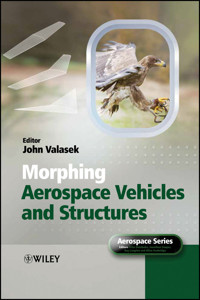
Morphing Aerospace Vehicles and Structures E-Book
125,99 €
Mehr erfahren.
- Herausgeber: John Wiley & Sons
- Kategorie: Fachliteratur
- Serie: Aerospace Series (PEP)
- Sprache: Englisch
Morphing Aerospace Vehicles and Structures provides a highly timely presentation of the state-of-the-art, future directions and technical requirements of morphing aircraft. Divided into three sections it addresses morphing aircraft, bio-inspiration, and smart structures with specific focus on the flight control, aerodynamics, bio-mechanics, materials, and structures of these vehicles as well as power requirements and the use of advanced piezo materials and smart actuators. The tutorial approach adopted by the contributors, including underlying concepts and mathematical formulations, unifies the methodologies and tools required to provide practicing engineers and applied researchers with the insight to synthesize morphing air vehicles and morphing structures, as well as offering direction for future research.
Sie lesen das E-Book in den Legimi-Apps auf:
Seitenzahl: 498
Veröffentlichungsjahr: 2012
Ähnliche




















Contents
Cover
Series
Title Page
Copyright
List of Contributors
Foreword
Series Preface
Acknowledgments
1: Introduction
1.1 Introduction
1.2 The Early Years: Bio-Inspiration
1.3 The Middle Years: Variable Geometry
1.4 The Later Years: A Return to Bio-Inspiration
1.5 Conclusion
Part I: Bio-Inspiration
2: Wing Morphing in Insects, Birds and Bats: Mechanism and Function
2.1 Introduction
2.2 Insects
2.3 Birds
2.4 Bats
2.5 Conclusion
Acknowledgements
3: Bio-Inspiration of Morphing for Micro Air Vehicles
3.1 Micro Air Vehicles
3.2 MAV Design Concepts
3.3 Technical Challenges for MAVs
3.4 Flight Characteristics of MAVs and NAVs
3.5 Bio-Inspired Morphing Concepts for MAVs
3.6 Outlook for Morphing at the MAV/NAV scale
3.7 Future Challenges
3.8 Conclusion
Part II: Control and Dynamics
4: Morphing Unmanned Air Vehicle Intelligent Shape and Flight Control
4.1 Introduction
4.2 A-RLC Architecture Functionality
4.3 Learning Air Vehicle Shape Changes
4.4 Mathematical Modeling of Morphing Air Vehicle
4.5 Morphing Control Law
4.6 Numerical Examples
4.7 Conclusions
Acknowledgments
5: Modeling and Simulation of Morphing Wing Aircraft
5.1 Introduction
5.2 Modeling of Aerodynamics with Morphing
5.3 Modeling of Flight Dynamics with Morphing
5.4 Actuator Moments and Power
5.5 Open-Loop Maneuvers and Effects of Morphing
5.6 Control of Gull-Wing Aircraft using Morphing
5.7 Conclusion
Appendix
6: Flight Dynamics Modeling of Avian-Inspired Aircraft
6.1 Introduction
6.2 Unique Characteristics of Flapping Flight
6.3 Vehicle Equations of Motion
6.4 System Identification
6.5 Simulation and Feedback Control
6.6 Conclusion
7: Flight Dynamics of Morphing Aircraft with Time-Varying Inertias
7.1 Introduction
7.2 Aircraft
7.3 Equations of Motion
7.4 Time-Varying Poles
7.5 Flight Dynamics with Time-Varying Morphing
8: Optimal Trajectory Control of Morphing Aircraft in Perching Maneuvers
8.1 Introduction
8.2 Aircraft Description
8.3 Vehicle Equations of Motion
8.4 Aerodynamics
8.5 Trajectory Optimization for Perching
8.6 Optimization Results
8.7 Conclusions
Part III: Smart Materials and Structures
9: Morphing Smart Material Actuator Control Using Reinforcement Learning
9.1 Introduction to Smart Materials
9.2 Introduction to Reinforcement Learning
9.3 Smart Material Control as a Reinforcement Learning Problem
9.4 Example
9.5 Conclusion
10: Incorporation of Shape Memory Alloy Actuators into Morphing Aerostructures
10.1 Introduction to Shape Memory Alloys
10.2 Aerospace Applications of SMAs
10.3 Characterization of SMA Actuators and Analysis of Actuator Systems
10.4 Conclusion
11: Hierarchical Control and Planning for Advanced Morphing Systems
11.1 Introduction
11.2 Morphing Dynamics and Performance Maps
11.3 Application to Advanced Morphing Structures
11.4 Conclusion
12: A Collective Assessment
12.1 Looking Around: State-of-the-Art
12.2 Looking Ahead: The Way Forward
12.3 Conclusion
Index
Aerospace Series List
Sense and Avoid in UAS: Research and Applications Angelov April 2012
Morphing Aerospace Vehicles and Structures Valasek March 2012
Gas Turbine Propulsion Systems MacIsaac and Langton July 2011
Basic Helicopter Aerodynamics, Third Edition Seddon and Newman June 2011
Advanced Control of Aircraft, Rockets and Spacecraft Tewari July 2011
Cooperative Path Planning of Unmanned Aerial Vehicles Tsourdos et al. November 2010
Principles of Flight for Pilots Swatton October 2010
Air Travel and Health: A Systems Perspective Seabridge et al. September 2010
Design and Analysis of Composite Structures: With applications to Aerospace Structures Kassapoglou September 2010
Unmanned Aircraft Systems: UAVS Design, Development and Deployment Austin April 2010
Introduction to Antenna Placement and Installations Macnamara April 2010
Principles of Flight Simulation Allerton October 2009
Aircraft Fuel Systems Langton et al. May 2009
The Global Airline Industry Belobaba April 2009
Computational Modelling and Simulation of Aircraft and the Environment: Volume 1 – Platform Kinematics and Synthetic Environment Diston April 2009
Handbook of Space Technology Ley, Wittmann and Hallmann April 2009
Aircraft Performance Theory and Practice for Pilots Swatton August 2008
Surrogate Modelling in Engineering Design: A Practical Guide Forrester, Sobester and Keane August 2008
Aircraft Systems, Third Edition Moir and Seabridge March 2008
Introduction to Aircraft Aeroelasticity And Loads Wright and Cooper December 2007
Stability and Control of Aircraft Systems Langton September 2006
Military Avionics Systems Moir and Seabridge February 2006
Design and Development of Aircraft Systems Moir and Seabridge June 2004
Aircraft Loading and Structural Layout Howe May 2004
Aircraft Display Systems Jukes December 2003
Civil Avionics Systems Moir and Seabridge December 2002
This edition first published 2012 © 2012, John Wiley & Sons, Ltd
Registered office John Wiley & Sons Ltd, The Atrium, Southern Gate, Chichester, West Sussex, PO19 8SQ, United Kingdom
For details of our global editorial offices, for customer services and for information about how to apply for permission to reuse the copyright material in this book please see our website at www.wiley.com.
The right of the author to be identified as the author of this work has been asserted in accordance with the Copyright, Designs and Patents Act 1988.
All rights reserved. No part of this publication may be reproduced, stored in a retrieval system, or transmitted, in any form or by any means, electronic, mechanical, photocopying, recording or otherwise, except as permitted by the UK Copyright, Designs and Patents Act 1988, without the prior permission of the publisher.
Wiley also publishes its books in a variety of electronic formats. Some content that appears in print may not be available in electronic books.
Designations used by companies to distinguish their products are often claimed as trademarks. All brand names and product names used in this book are trade names, service marks, trademarks or registered trademarks of their respective owners. The publisher is not associated with any product or vendor mentioned in this book. This publication is designed to provide accurate and authoritative information in regard to the subject matter covered. It is sold on the understanding that the publisher is not engaged in rendering professional services. If professional advice or other expert assistance is required, the services of a competent professional should be sought.
Library of Congress Cataloging-in-Publication Data
Morphing aerospace vehicles and structures / edited by John Valasek. p. cm. – (AIAA progress series) Includes bibliographical references and index. ISBN 978-0-470-97286-1 (cloth) – ISBN 978-1-60086-903-7 1. Aerospace engineering. 2. Wing-warping (Aerodynamics) 3. Airplanes–Design and construction. 4. Airplanes–Wings–Design and construction. I. Valasek, John. II. American Institute of Aeronautics and Astronautics. TL565.M67 2012 629.1′2–dc23 2011045495
A catalogue record for this book is available from the British Library.
ISBN: 978-0-470-97286-1
List of Contributors
Gregg Abate, Air Force Research Laboratory, Eglin AFB, Florida, USA
Anna C. Carruthers, Department of Zoology, Oxford University, UK
Animesh Chakravarthy, Department of Mechanical and Aerospace Engineering, University of Florida, Gainesville, Florida, USA
Suman Chakravorty, Aerospace Engineering Department, Texas A&M University, College Station, Texas, USA
Ephrahim Garcia, Sibley School of Mechanical and Aerospace Engineering, Cornell University, Ithaca, New York, USA
Daniel T. Grant, Department of Mechanical and Aerospace Engineering, University of Florida, Gainesville, Florida, USA
Jared Grauer, Aerospace Engineering Department, University of Maryland and National Institute of Aerospace, USA
Darren J. Hartl, Aerospace Engineering Department, Texas A&M University, College Station, Texas, USA
James Hubbard Jr, Aerospace Engineering Department, University of Maryland and National Institute of Aerospace, USA
Tatjana Y. Hubel, Royal Veterinary College, UK
Kenton Kirkpatrick, Aerospace Engineering Department, Texas A&M University, College Station, Texas, USA
Mrinal Kumar, Department of Mechanical and Aerospace Engineering, University of Florida, Gainesville, Florida, USA
Dimitris C. Lagoudas, Aerospace Engineering Department, Texas A&M University, College Station, Texas, USA
Amanda Lampton, Systems Technology Inc., Hawthorne, California, USA
Rick Lind, Department of Mechanical and Aerospace Engineering, University of Florida, Gainesville, Florida, USA
Borna Obradovic, Aerospace Engineering Department, University of Texas – Arlington, Arlington, Texas, USA
Justin R. Schick, Aerospace Engineering Department, Texas A&M University, College Station, Texas, USA
Wei Shyy, Department of Mechanical Engineering, The Hong Kong University of Science and Technology, PRC
Stephen Sorley, Department of Mechanical and Aerospace Engineering, University of Florida, Gainesville, Florida, USA
Kamesh Subbarao, Aerospace Engineering Department, University of Texas – Arlington, Arlington, Texas, USA
Graham K. Taylor, Department of Zoology, Oxford University, UK
John Valasek, Aerospace Engineering Department, Texas A&M University, College Station, Texas, USA
Simon M. Walker, Department of Zoology, Oxford University, UK
Adam M. Wickenheiser, Department of Mechanical and Aerospace Engineering, George Washington University, Washington, DC
Foreword
Morphing systems are reconfigurable systems whose features include geometric shape change, but also can include color, aural or electromagnetic changes. Morphing aircraft with retractable landing gear, flaps and slats and variable sweep wings are not unusual today, but they were futuristic 70 or 80 years ago. Who has not marveled to see the morphing wing of a commercial jet robotically change shape as it deploys spoilers and flaps when landing? On the other hand, the missions for these aircraft are conventional. This book looks at morphing systems with an eye to the future in which missions will be challenging and today's solutions simply will not work.
I first came across the term “morphology” in 1971 while reading the final draft of Professor Holt Ashley's textbook Engineering Analysis of Flight Vehicles. His first chapter is entitled “Morphology of the Airplane.” Holt was my research adviser at Stanford in the late 1960s and, more importantly a distinguished educator, researcher, engineer and master of the written English language. When I suggested that he change “morphology” to something like “shape,” he replied: “But morphology is such a wonderful word! So descriptive!” And so it is.
My four-year stint as a DARPA program manager included development of game-changing morphing aircraft for a specific military mission. The DARPA program was very successful and we showed that: (1) morphing shape change is not expensive, compared to the system benefits it provides; and (2) morphing concepts succeed when the airplane mission involves design conflicts requiring the choice of either building a large wing/engine combination or a smaller mechanized wing with smaller engines and fuel requirements. Sometimes, no other approach other than morphing worked.
Future aircraft missions will require aircraft shape and feature changes that, in turn, require new component technologies, from engines to wing mechanisms to smart materials, as well as expanded analysis techniques. This book provides valuable information to begin this journey into the future. It begins with bio-inspiration. The Russian engineer Genrich Altshuller observed that “In nature there are lots of hidden patents.” Chapter on perching aircraft suggests a unique use for integrated morphing technologies, while Chapter on smart materials and control of morphing devices provides a window on the challenging problems of system integration.
Oliver Wendell Holmes once wrote: “A man's mind stretched by a new idea can never go back to its original dimensions.” This book provides an opportunity for mind expansion. I encourage you to read it, absorb the ideas and contribute to the morphing aircraft future.
Terry A. WeisshaarProfessor EmeritusPurdue UniversityWest Lafayette, IndianaUSA
Series Preface
The field of aerospace is wide ranging and multi-disciplinary, covering a large variety of products, disciplines and domains, not merely in engineering but in many related supporting activities. These combine to enable the aerospace industry to produce exciting and technologically advanced vehicles. The wealth of knowledge and experience that has been gained by expert practitioners in the various aerospace fields needs to be passed onto others working in the industry, including those just entering from University.
The Aerospace Series aims to be a practical and topical series of books aimed at engineering professionals, operators, users and allied professions such as commercial and legal executives in the aerospace industry. The range of topics is intended to be wide ranging, covering design and development, manufacture, operation and support of aircraft as well as topics such as infrastructure operations and developments in research and technology. The intention is to provide a source of relevant information that will be of interest and benefit to all those people working in aerospace.
There has been much interest world-wide in the development of morphing air-vehicles to improve performance, and possibly change mission requirements in-flight, by enabling the air-vehicle to adjust its external shape and structural/aerodynamic/control characteristics to adapt to the changing flight environment. Many different concepts have been proposed, with a few being demonstrated on a range of different prototype flying vehicles.
This book, Morphing Aerospace Vehicles and Structures, is the first textbook to provide an overview of the current status of morphing air-vehicles, and to provide guidance as to likely future directions in this exciting technology. Starting with the bio-inspired geometric changes of insects, birds and bats that are the motivation for many morphing concepts, the book then describes issues relating to the flight control and dynamics of morphing air-vehicles, and also the application of smart materials and hierarchical control for morphing. It is a welcome addition to the Wiley Aerospace Series.
Peter Belobaba, Jonathan Cooper, Roy Langton and Allan Seabridge
Acknowledgments
Several individuals and organizations have made special and significant contributions to this book, and I wish to recognize their efforts. My wife Stephanie has encouraged me to write a book for many years. This book would not have been realized without her tireless support and steadfast encouragement, all while she pursued her graduate studies. My graduate and undergraduate research students who contributed to this book have been a joy to work with, and a constant source of inspiration. Teachers can learn from their students, and indeed I have and continue to do so. I am grateful to many of my faculty colleagues in various departments at Texas A&M University who have shared their valuable insights and provided suggestions on the research. Special thanks are bestowed upon Dr. Sharon M. Swartz of Brown University, for graciously providing a specialized review and critique of Chapter 2.
This book was begun during my Faculty Development Leave, and I am indebted to my Department Heads in the Aerospace Engineering Department at Texas A&M University during and since that time: Dr. Helen L. Reed, Dr. Walter E. Haisler, and Dr. Dimitris C. Lagoudas. They not only encouraged me to pursue it, but also provided me with the full opportunity and means to do so.
While all of the authors in this book have obtained funding for their portion of the work from various sponsors, two sponsors in particular have provided exceptional support overall. The U.S. Air Force Office of Scientific Research provided support under contract FA9550-08-1-0038, with technical monitors Dr. Scott Wells, Dr. William M. McEneaney, and Dr. Fariba Fahroo. The National Aeronautics and Space Administration was instrumental in providing early support through the Texas Institute of Intelligent Bio-Nano Materials and Structures for Aerospace Vehicles (TiiMS). The technical monitor was Dr. Tom Gates. This generous support is gratefully acknowledged.
The wonderful staff at John Wiley & Sons Ltd., Chichester, have been instrumental and contributed a great deal to this endeavor. They have also been only a pleasure to work with. Commissioning Editors David Palmer and Debbie Cox conceived the original idea for the book, approached me with it and patiently encouraged me to pursue it, and then championed it to the publisher. Project Editors Claire Bailey and Liz Wingett skillfully managed both the author and the manuscript to completion. Project Editor of Engineering Technology Nicky Skinner was a warm and generous colleague whom I enjoyed getting to know and work with, who tragically passed on during the final stages. She is greatly missed by me and all who knew her, and her memory is embossed in the final product.
Finally, I would like to thank all of the authors who contributed chapters and their expertise. I am blessed to have you as colleagues and collaborators, and pleased to call you friends.
John ValasekCollege Station, Texas, USAJuly 2011
1
Introduction
John Valasek
Texas A&M University, USA
A flying machine is impossible, in spite of the testimony of the birds
—John Le Conte, well-known naturalist, ”The Problem of the Flying Machine,” Popular Science Monthly, November 1888, p. 69.
1.1 Introduction
Current interest in morphing vehicles has been fueled by advances in smart technologies such as materials, sensors, actuators, their associated support hardware and microelectronics. These advances have led to a series of breakthroughs in a wide variety of disciplines that, when fully realized for aircraft applications, have the potential to produce large improvements in aircraft safety, affordability, and environmental compatibility. The road to these advances and applications is paved with the efforts of pioneers going back several centuries. This chapter seeks to succinctly map out this road by highlighting the contributions of these pioneers and showing the historical connections between bio-inspiration and aeronautical engineering. A second objective is to demonstrate that the field of morphing has now come nearly full circle over the past 100 plus years. Birds inspired the pioneer aviators, who sought solutions to aerodynamic and control problems of flight. But a smooth and continuous shape-changing capability like that of birds was beyond the technologies of the day, so the concept of variable geometry using conventional hinges and pivots evolved and was used for many years. With new results in bio-inspiration and recent advances in aerodynamics, controls, structures, and materials, researchers are finally converging upon the set of tools and technologies needed to realize the original dream of aircraft which are capable of smooth and continuous shape-changing. The focus and scope of this chapter are intentionally limited to concepts and aircraft that are accessible through the unclassified, open literature.
Figure 1.1 Lilienthal Glider circa 1880s showing bird influence. Reproduced by permission of Archives Otto-Lilienthal Museum
1.2 The Early Years: Bio-Inspiration
Otto Lilienthal was a nineteenth-century Prussian aviator who had a lifelong fascination with bird flight which led him into a professional career as a designer. He appeared on the aviation scene in 1891 by designing, building, and flying a series of gliders. Between 1891 and 1896 he completed nearly 2,000 flights in 16 different types of gliders, an example of which is shown in Figure 1.1. The wings of these gliders were described as resembling “the outstretched pinions of a soaring bird.” The bird species which captivated him most were storks, and the extent to which birds influenced Lilienthal is evidenced by two of the many books which he wrote on aviation: Our Teachers in Soaring Flight in 1897, and Birdflight as the Basis for Aviation: A Contribution toward a System of Aviation in 1889 (Lilienthal 1889). His observations on bird twist and camber distributions were influential in the development of his air-pressure tables and airfoil data. Interestingly, Lilienthal also made attempts at powered flight but chose to only study wings with orntithopteric wingtips. His insistence on the use of flapping wing tips in preference to a conventional propeller is an indication of the extent to which he was captivated by bird flight (Crouch 1989). Several early pioneers recognized the value in morphing as a control effect. Edson Fessenden Gallaudet, Professor of Physics at Yale, applied the concept of wing warping to a kite in 1898. While not entirely successful, this kite nonetheless embodied the basic structural concepts which would appear in aircraft designs much later (Crouch 1989). Independently, Orville and Wilbur Wright, correctly deduced that wing warping could provide lateral control. Wilbur remarked to Octave Chanute in 1900 that “My observation of the flight of buzzards leads me to believe that they regain their lateral balance, when partly overturned by a gust of wind, by a torsion of the tips of the wings. If the rear edge of the right wing tip is twisted upward and the left downward, the bird becomes an animated windmill and instantly begins to turn, a line from its head to its tail being the axis” (Wright 1900). This observation led to the design of the 1902 Wright Glider, which incorporated wing warping for lateral (roll) control (Figure 1.2). The warping was accomplished by wires attached to the pilot's belt, which were controlled by his shifting body position. Although this craft was flown by the Wrights as both a kite and a glider, it was during flights of the latter type that the need for a directional (yaw) control was first realized, and then solved with the creation of the rudder. Correctly recognizing that achieving harmony of control would greatly improve the control and usefulness of an aircraft, in October 1902 the Wrights developed an interconnection between warping of the wing and warping of the vertical tail. Thus the concept of what would later become the aileron-to-rudder interconnect or ARI was born. With the problems of longitudinal control, lateral control, directional control, and control harmony solved, the 1902 Wright Glider became essentially the world's first successful airplane (Crouch 1989). These developments paved the way for the success of the powered 1903 Wright Flyer a year later.
Figure 1.2 1902 Wright Glider featuring lateral and directional control by warping. Reproduced by permission of United States Air Force Historical Research Agency
Figure 1.3 Etrich Luft-Limousine / VII four-seater passenger airplane of 1912
Figure 1.4 Rumpler Taube on the front page of the New York Times Mid-Week Pictorial, January 1st, 1917
The Etrich Taube (“dove” in German) series of designs have probably been the ultimate expression of bio-inspiration to aircraft design. In fact, except for the omission of flapping wings, the Taube designs are essentially bio-mimetic, i.e. directly mimicking a biological system (Figure 1.3). The Etrich Luft-Limousine / VII was somewhat unique for an airplane of its time since it employed multi-material construction. This consisted of an aluminum sheet covering from the nose to just behind the wings, with wood used everywhere else. The fuselage structure used wooden rings and channel-section longitudinal members and the windows were celluloid and wire gauze. The initial Taube designs were created by Igo Etrich in Austria in 1909. The original inspiration for the unique wing planform on Taube designs was not a bird wing, but the Zanonia macrocarpa seed, which falls from trees in a slow spin induced by a single wing. This was not successful, yet the influence of birds on later adaptations of this wing design can clearly be seen (Figure 1.4). Like the Wright designs, the Taube designs employed wing and horizontal tail warping via wires and external posts, although the vertical tail surfaces were hinged. Despite contemporary aircraft designs which featured vertical tails of a size and proportion that would be recognizable in modern designs, the Taube designs mimicked birds so much that the dorsal and ventral fins comprising the vertical tail surfaces were very small. Ultimately, the very small vertical tail surfaces became a distinguishing characteristic of the Taube designs.
The Wright and Taube designs demonstrated that warping controls can be effective on aircraft with thin and flexible wings. But the invention of the now conventional hinged controls, such as ailerons and rudders, was essential for later aircraft with more rigid structures and metallic materials. Thus the problem of materials and structures has been a central consideration to morphing aircraft from the outset. By the onset of the First World War in 1914 and in the years afterward, virtually all high performance aircraft used conventional hinged control surfaces instead of warping. With the advent of aircraft with relatively rigid metallic structures in the 1930s, the path to morphing clearly lay in changing the geometry of the aircraft via complex arrangements of conventional hinges, pivots, and rails rather than warping.
Figure 1.5 The Makhonine MAK-101 telescoping wing airplane of 1933: wing tip extended (top) and retracted (bottom)
1.3 The Middle Years: Variable Geometry
During the inter-war years in France, Ivan Makhonine conceived the idea of a telescoping wing aircraft. The aim was to improve cruise performance by reducing the induced drag, or the drag due to the creation of lift. This was to be accomplished by reducing span loading which is the ratio of aircraft weight to wing span. As shown in Figure 1.5, the mechanism works like a stiletto knife, except that the wing can also be retracted automatically since it was pneumatically powered with a standby manual system. The fixed landing gear MAK-10 was first flown in 1931, followed by the retractable landing gear MAK-101 in 1933. The MAK-101 was flown many times over the next several years until it was destroyed in its hangar during a USAAF bombing raid late in the Second World War. Makhonine continued his research into the telescoping wing concept post-war, culminating in the last aircraft in the series, the MAK-123 which first flew in 1947. The MAK-123 was a four-seat passenger aircraft that flew well and was reported to have adequate handling qualities, but was damaged in a forced landing and never flew again.
Figure 1.6 Sir Barnes Neville Wallis with a model of the Swallow, wings at low sweep
Figure 1.7 An illustration of the Swallow by Barnes Wallis
Figure 1.8 Bell X-5 showing variable sweep wing positions. Reproduced by permission of National Aeronautics and Space Administration
Figure 1.9 Boeing 2707 Supersonic Transport notional configuration with variable sweep wing
Figure 1.10 NASA AFTI F-111 Mission Adaptive Wing. Reproduced by permission of National Aeronautics and Space Administration
British aircraft designer Sir Barnes Neville Wallis, well known as the inventor of the geodesic structural design concept used in the Vickers Wellington medium bomber, also investigated novel variable geometry configurations. Although he did not invent the swing-wing concept, Wallis devoted much effort to making what he called the “wing-controlled aerodyne” practical as a means of achieving supersonic flight. His two main goals were to use variable geometry as a solution to handling the center of gravity changes during flight, and to achieve laminar flow over the wing body. His Wild Goose design of the 1940s was a military mission supersonic concept with a slender laminar flow body and swing-wings. Several sub-scale models of the Wild Goose were successfully flown in the late 1940s and early 1950s. A full-scale piloted version of the Wild Goose was planned but later cancelled in 1952. The Swallow was a longer-range derivative of the Wild Goose, designed in the 1950s. Many sub-scale models were produced (Figure 1.6) and flown, and the results were so promising that full-scale versions were planned. However, these were not to be implemented due to the British defense funding climate of the late 1950s. Nevertheless, the Swallow was influential as a military concept aircraft (Figure 1.7) and inspired various design features which later appeared in U.S. aircraft such as the General Dynamics F-111 Aardvark. During this same period in the USA, variable geometry research sponsored by NASA paved the way for experimental transonic designs such as the Bell X-5 (Figure 1.8). The X-5 was the first full-scale aircraft to be flown which was capable of sweeping its wings in flight. The wing sweep angles could be set in flight to 20, 45, and 60 degrees and were tested at subsonic and transonic speeds. With the wings fully extended, the low-speed performance was improved for take-off and landing, and with the wings swept back, the high speed performance was improved and drag was reduced. Results of this research directly influenced the design of the General Dynamics F-111 Aardvark and the Grumman F-14 Tomcat, both of which went into large-scale production. It is interesting to note that the variable geometry concept eventually found its way into the commercial air transport sector as well. It was seriously considered for various conceptual designs, including the Boeing 2707 Supersonic Transport of the 1960s (Figure 1.9). Even though the B2707 never progressed beyond the full-scale mock-up stage, a large variable geometry supersonic aircraft appeared a decade later in the form of the Rockwell International B-1A bomber. NASA later conducted a research program with an aircraft that combined both variable geometry and shape changing similar to the traditional wing warping of the early pioneers. The AFTI F-111 Mission Adaptive Wing (MAW), shown in Figure 1.10, was intended to minimize penalties for off-design flight conditions through a combination of smooth-skin variable camber and variable wing sweep angle. As opposed to the hinged flaps with discontinuous surfaces and exposed mechanisms of conventional aircraft, the variable camber surfaces of the MAW feature smooth flexible upper surfaces and fully enclosed lower surfaces that can be actuated in flight to provide the desired wing camber. This flight research program was highly successful and served as a vital stepping stone toward the realization of a fully morphing aircraft.
With all of the successes of the variable geometry approach, it is not surprising that bio-inspiration was largely overlooked or simply not considered promising enough during this period. John Harris opined in 1989 the feelings of some that “(Yet) birds are terrible models for human flight, and a too slavish attention to their example – often unconscious – has often impeded the development of aircraft. An airplane is not a bird, and designers throughout the history of aircraft development have had a hard time fully realizing this (Harris 1989).” In spite of this, a dramatic change in the way morphing aircraft were viewed was about to take place.
1.4 The Later Years: A Return to Bio-Inspiration
Recent discoveries in bird flight mechanics and new insights for bio-inspiration led many researchers to reconsider birds as models for morphing aircraft. Two significant and ambitious research programs that were to have far-reaching and productive effects on morphing aircraft appeared nearly simultaneously around 2000. The NASA Morphing Aircraft Project was a large and highly coordinated program conducted from 1994–2004 (Wlezien et al. 1998). It was a wide-ranging, large scope program that was specifically targeted at high pay-off applications that would enable efficient, multi-point adaptability aircraft and spacecraft. In the context of the project, the word “morphing” was defined as “efficient, multi-point adaptability” and could include macro, micro, structural and/or fluidic approaches. This program enabled and sponsored research across a broad range of technologies that included biotechnology, nanotechnology, biomaterials, adaptive structures, micro-flow control, biomimetic concepts, optimization, and controls. At its height this program supported between 80 to 100 researchers. The focal point for all technologies in this program was the notional NASA morphing unmanned air vehicle shown in Figure 1.11. This aircraft brought together most of the earlier morphing concepts, including bio-inspiration, warping, shape-changing, variable geometry, structures, materials, controls, and aerodynamics. Most importantly, it sought to address the contribution of propulsion in a fully integrated fashion. This notional aircraft continues to serve as useful concept and model for morphing research.
Figure 1.11 NASA morphing unmanned air vehicle concept. Reproduced by permission of National Aeronautics and Space Administration
The DARPA Morphing Aircraft Structures (MAS) Program dates back to 2002 and continued until 2007. The Defense Technology Directive stated that:
Morphing is a capability to provide superior and/or new vehicle system performance while in flight by tailoring the vehicle's state to adapt to the external operational environment and multi-variable mission roles. In the context of this DTO, morphing aircraft are multi-role aircraft that change their external shape substantially to adapt to a changing mission environment during flight
—(Anonymous 2006)
The DARPA Morphing Aircraft Structures Program responded to this DTO with objectives defined as the design and fabrication of effective combinations of integrated wing skins, actuators and mechanisms, structures, and flight controls to achieve the anticipated diverse, conflicting aircraft mission capabilities via wing shape change. For a notional aircraft, the DARPA/MAS program used a so-called Hunter-Killer unmanned aircraft concept that combined reconnaissance aircraft features of aircraft like the General Atomics Predator or Northrop Grumman Global Hawk, with the attack features of a fast attack aircraft such as the General Dynamics F-16. Studies indicated that morphing wings would enable multi-functional Hunter-Killer mission features such as: (1) responsiveness – time-critical ability to respond to unpredictable crisis situations; (2) agility – the ability to change system roles on demand; and (3) persistence – the ability to dominate large operational areas for long time periods. The DARPA/MAS program generated many useful results and insights, and culminated in the flight test of a small demonstrator.
1.5 Conclusion
This chapter has related the main historical research and development path of the morphing air vehicle, along the way highlighting key ideas and connections between bio-inspiration and aeronautical engineering. Over the course of these developments, it is clear that ideas which were once old are new again. The following chapters in this book tell the contemporary story of the morphing air vehicle in three parts: Part I Bio-inspiration, Part II Control and Dynamics, and Part III Smart Materials and Structures. The volume concludes with a discussion of current and future challenges, and a look at the way forward.
References
Anonymous (2006) Defense Technology Objectives, DTO 71, DDR&E. Washington, DC: U.S. Department of Defense.
Crouch, TD (1989) A Dream of Wings, Americans and the Airplane, 1875–1905. Washington, DC: Smithsonian Institution Press.
Harris, JS (1989) An airplane is not a bird. American Heritage of Invention and Technology, Fall: 18–22.
Lilienthal, O (1889) Der Vogelflug als Grundlage der Fliegekunst. Berlin: R. Gärtners Verlagsbuchhandlung.
Wlezien, RW, Horner, GC, McGowan, AR, Padula, A, Scott, MA, Silcox, RJ and Simpson, JO (1998) The aircraft morphing program. In AIAA/ASME/ASCE/AHS/ASC Structures, Structural Dynamics & Materials Conference, number AIAA-98-1927, Long Beach, CA, 20–23 April 1998, pp. 176–187.
Wright, W (1900) Wilbur Wright to Octave Chanute. Papers, 13 May.
Part I
Bio-Inspiration
2
Wing Morphing in Insects, Birds and Bats: Mechanism and Function
Graham K. Taylor1, Anna C. Carruthers1, Tatjana Y. Hubel2, and Simon M. Walker1
1Department of Zoology, Oxford University, UK
2Royal Veterinary College, UK
2.1 Introduction
The great majority of wings are morphing designs with continuously variable planform, camber, or twist: such are the wings of insects, birds, and bats. Indeed, morphing wings may be said to be the norm at the length scales associated with flying animals, while the rigid wing designs that have been favored by engineers are typical only at the largest length scales. It is worth noting in this context that the membranous wings of the largest extinct pterosaurs are currently estimated to have had spans of approximately 10m (Witton and Naish 2008)—comparable to a light aircraft—so it is clear that Nature’s morphing wing designs are workable across a wide range of length scales of current interest to engineers. Just as birds helped inspire the warping wing design of the Wright Flyer, Nature now offers a rich seam of inspiration for a new generation of morphing wing designs across a range of scales of interest to engineers.
Lesen Sie weiter in der vollständigen Ausgabe!
Lesen Sie weiter in der vollständigen Ausgabe!
Lesen Sie weiter in der vollständigen Ausgabe!
Lesen Sie weiter in der vollständigen Ausgabe!
Lesen Sie weiter in der vollständigen Ausgabe!
Lesen Sie weiter in der vollständigen Ausgabe!
Lesen Sie weiter in der vollständigen Ausgabe!
Lesen Sie weiter in der vollständigen Ausgabe!
Lesen Sie weiter in der vollständigen Ausgabe!
Lesen Sie weiter in der vollständigen Ausgabe!
Lesen Sie weiter in der vollständigen Ausgabe!
Lesen Sie weiter in der vollständigen Ausgabe!
Lesen Sie weiter in der vollständigen Ausgabe!




