


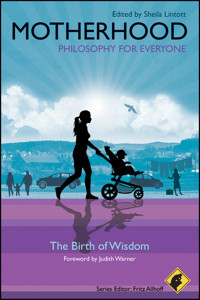
Motherhood - Philosophy for Everyone E-Book
14,99 €
Mehr erfahren.
- Herausgeber: John Wiley & Sons
- Kategorie: Geisteswissenschaft
- Serie: Philosophy for Everyone
- Sprache: Englisch
MOTHERHOOD
PHILOSOPHY FOR EVERYONE
If you have ever wondered what makes a “good” or a “bad” mother, or if mothers are always right in thinking their babies are beautiful, or indeed, whether mother always knows best, look no further. Without a single nag, Motherhood – Philosophy for Everyone covers these salient philosophical issues, and more, including:
- The anticipation of impending parenthood compared with the reality
- Should we tell the occasional lie to our children?
- What does the Bible actually say about the virgin birth?
- If we were able to turn our children off, would and should we be tempted by this option?
- The experience of lesbian mothering
- The unexpected challenges and complications of being a mother
“As in any group of thinkers, some mothers are more ambitiously reflective than others, either out of temperamental thoughtfulness, moral and political concerns, or, most often, because they have serious problems with their children. However, maternal thinking is no rarity. Maternal work itself demands that mothers think…”
From Maternal Thinking: Toward A Politics of Peace, Sara Ruddick
Sie lesen das E-Book in den Legimi-Apps auf:
Seitenzahl: 443
Veröffentlichungsjahr: 2011
Ähnliche




















CONTENTS
FOREWORD
ACKNOWLEDGMENTS
NAVEL-GAZING AT ITS FINEST
PART I: MOMMY BRAIN
CHAPTER 1 HOW MANY EXPERTS DOES IT TAKE TO RAISE A CHILD?
Finding Answers to Mothering Questions
Both/And Not Either/Or
Toward a Pragmatic Approach to Mothering
CHAPTER 2 CREATIVE MOTHERING
Bedtime Stories
It’s For Your Own Good; Or Is It?
Truth, Lies, and Parental Whoppers
Lies, Rights, and Rationality
Conclusion: It Isn’t Easy Being Honest
CHAPTER 3 PRO-CHOICE PHILOSOPHER HAS BABY
Pregnancy: Before and After
McFall, Shimp, and Thomson’s Ailing Violinist
Pro-Choice Does Not Mean Pro-Abortion
CHAPTER 4 KIM, ELLEN, AND ZACK’S BIG ADVENTURE
Zack’s Sensitivity
Zack’s Race
Zack’s Desire
Zack’s Violence
Music
Conclusion
PART II: LABOR PAINS
CHAPTER 5 DAYS AND NIGHTS OF A NEW MOTHER
The Maternal Condition: Freedom in Situation
Beyond the “Ideal Mother”: Creating Our Own Identities
Mommy and Me
CHAPTER 6 MINDFUL MOTHERING
Pregnancy and the First Noble Truth: Pain is Inevitable
The Second Noble Truth: Pain Arises from Cravings and Attachment
The Third Noble Truth: The End of Suffering is Possible, or How to Be a Feminist Buddhist Mommy
Mommy Meditations
CHAPTER 7 A FACE ONLY A MOTHER COULD LOVE?
Mothers on Baby Beauty
Good Mom, Bad Critic?
Beauty, Love, and Prejudice
CHAPTER 8 KEVIN, COMING INTO FOCUS
Conception
Gestation
Labor and Delivery
Home
PART III MOM’S MORALITY
CHAPTER 9 MAKING CHOICES
A Riff on Infant Feeding
Ethical Questions about Infant Feeding
Closing Thoughts on Classification and Responsibility
CHAPTER 10 LACTATIONAL BURKAS AND MILKMEN
Lactational Burkas, Lactational Burdens
Breastfeeding as Obscene
The Intimacy of Breastfeeding
“Breast is Best”
Milkmen
Conclusion
CHAPTER 11 ON “CRYING-IT-OUT” AND CO-SLEEPING
What’s A Parent to Do?
Crying-It-Out
Co-Sleeping
Conclusion
CHAPTER 12 NATURAL CHILDBIRTH IS FOR THE BIRDS
Maybe It’s Simple Sexism
Do Not Go Gentle
Universal Praise for the Natural? What About Natural Disasters?
Focus on the Pain
Recommending Pain
Humble Mamas
Praise Mama
PART IV IS MOTHERHOOD EVERYTHING YOU THOUGHT IT WOULD BE? FANTASY MEETS REALITY
CHAPTER 13 THE OFF BUTTON
A Shared Fantasy
Thinking About This Shared Fantasy
Thinking About Our Thinking About This Fantasy
CHAPTER 14 THE VIRTUES OF MOTHERHOOD
The Complex Unity
Endurance Helps
Knowing When to Let Go
Following Your Example
Imitation is the Highest Form of . . .
CHAPTER 15 THE MEDIA PROUDLY PRESENT
Meet the Celebrity Moms
How to be a Good Mother
Working Mothers
How to be a Bad Mother
Conclusion: Mothering as Boring
CHAPTER 16 GOD, MOM!
“God is a woman”
From Mother Goddesses to Classical Theism
It’s Like This
“Defective and misbegotten”
“The true mother of life and all things”
Mothers Made in the Image of God
A BRIEF AFTERWORD
What Does Your Mom Do?
What Do Philosophers Do?
What Do You Think About Philosophy?
What Do You Want To Be When You Grow Up?
Some Other Deep Thoughts
READ ALL ABOUT IT
NOTES ON CONTRIBUTORS
VOLUME EDITOR
SHEILA LINTOTT is an Assistant Professor of Philosophy at Bucknell University, and the mother of two children. She is co-editor (with Allen Carlson) of Nature, Aesthetics, and Environmentalism: From Beauty to Duty (2008) and was co-editor of the American Society for Aesthetics Newsletter (2005–2008).
SERIES EDITOR
FRITZ ALLHOFF is an Assistant Professor in the Philosophy Department at Western Michigan University, as well as a Senior Research Fellow at the Australian National University’s Centre for Applied Philosophy and Public Ethics. In addition to editing the Philosophy for Everyone series, Allhoff is the volume editor or co-editor for several titles, including Wine & Philosophy (Wiley-Blackwell, 2007), Whiskey & Philosophy (with Marcus P. Adams, Wiley, 2009), and Food & Philosophy (with Dave Monroe, Wiley-Blackwell, 2007).
PHILOSOPHY FOR EVERYONE
Series editor: Fritz Allhoff
Not so much a subject matter, philosophy is a way of thinking. Thinking not just about the Big Questions, but about little ones too. This series invites everyone to ponder things they care about, big or small, significant, serious … or just curious.
Running & Philosophy: A Marathon for the MindEdited by Michael W. Austin
Wine & Philosophy: A Symposium on Thinking and DrinkingEdited by Fritz Allhoff
Food & Philosophy: Eat, Think and Be MerryEdited by Fritz Allhoff and Dave Monroe
Beer & Philosophy: The Unexamined Beer Isn’t Worth DrinkingEdited by Steven D. Hales
Whiskey & Philosophy: A Small Batch of Spirited IdeasEdited by Fritz Allhoff and Marcus P. Adams
College Sex – Philosophy for Everyone: Philosophers With BenefitsEdited by Michael Bruceand Robert M. Stewart
Cycling – Philosophy for Everyone: A Philosophical Tour de ForceEdited by Jesús Ilundáin-Agurruza and Michael W. Austin
Climbing – Philosophy for Everyone: Because It’s ThereEdited by Stephen E. Schmid
Hunting – Philosophy for Everyone: In Search of the Wild LifeEdited by Nathan Kowalsky
Christmas – Philosophy for Everyone: Better Than a Lump of CoalEdited by Scott C. Lowe
Cannabis – Philosophy for Everyone: What Were We Just Talking About?Edited by Dale Jacquette
Porn – Philosophy for Everyone: How to Think With KinkEdited by Dave Monroe
Serial Killers – Philosophy for Everyone: Being and KillingEdited by S. Waller
Dating – Philosophy for Everyone: Flirting With Big IdeasEdited by Kristie Miller and Marlene Clark
Gardening – Philosophy for Everyone: Cultivating WisdomEdited by Dan O’Brien
Motherhood – Philosophy for Everyone: The Birth of WisdomEdited by Sheila Lintott
Fatherhood – Philosophy for Everyone: The Dao of DaddyEdited by Lon S. Nease and Michael W. Austin
Forthcoming books in the series:
Fashion – Philosophy for EveryoneEdited by Jessica Wolfendale and Jeanette Kennett
Coffee – Philosophy for EveryoneEdited by Scott Parker and Michael W. Austin
Blues – Philosophy for EveryoneEdited by Abrol Fairweather and Jesse Steinberg
This edition first published 2010© 2010 Blackwell Publishing Ltd except for editorial material and organization© 2010 Sheila Lintott
Blackwell Publishing was acquired by John Wiley & Sons in February 2007. Blackwell’s publishing program has been merged with Wiley’s global Scientific, Technical, and Medical business to form Wiley-Blackwell.
Registered OfficeJohn Wiley & Sons Ltd, The Atrium, Southern Gate, Chichester, West Sussex, PO19 8SQ, United Kingdom
Editorial Offices350 Main Street, Malden, MA 02148-5020, USA9600 Garsington Road, Oxford, OX4 2DQ, UKThe Atrium, Southern Gate, Chichester, West Sussex, PO19 8SQ, UK
For details of our global editorial offices, for customer services, and for information about how to apply for permission to reuse the copyright material in this book please see our website at www.wiley.com/wiley-blackwell.
The right of Sheila Lintott to be identified as the author of the editorial material in this work has been asserted in accordance with the UK Copyright, Designs and Patents Act 1988.
All rights reserved. No part of this publication may be reproduced, stored in a retrieval system, or transmitted, in any form or by any means, electronic, mechanical, photocopying, recording or otherwise, except as permitted by the UK Copyright, Designs and Patents Act 1988, without the prior permission of the publisher.
Wiley also publishes its books in a variety of electronic formats. Some content that appears in print may not be available in electronic books.
Designations used by companies to distinguish their products are often claimed as trademarks. All brand names and product names used in this book are trade names, service marks, trademarks or registered trademarks of their respective owners. The publisher is not associated with any product or vendor mentioned in this book. This publication is designed to provide accurate and authoritative information in regard to the subject matter covered. It is sold on the understanding that the publisher is not engaged in rendering professional services. If professional advice or other expert assistance is required, the services of a competent professional should be sought.
Library of Congress Cataloging-in-Publication Data
Motherhood – Philosophy for Everyone : the birth of wisdom / edited by Sheila Lintott; foreword by Judith Warner.
p. cm. — (Philosophy for everyone)
Includes bibliographical references.
ISBN 978-1-4443-3028-1 (pbk. : alk. paper) 1. Motherhood—Philosophy. 2. Mother and child. I. Lintott, Sheila. II. Title: Motherhood – Philosophy for Everyone
HQ759.M873819 2010
173—dc22
2010010365
A catalogue record for this book is available from the British Library.
To my mother,Dorothy June Lintott
JUDITH WARNER
FOREWORD
How fitting it is to have a book of essays dedicated to the subject of motherhood and philosophy. For ours is an age where philosophies of motherhood abound. They clash. They compete. They battle for preeminence. They are not, for many of their adherents, mere matters of personal preference or individual parenting style. Breast or bottle, co-sleep or cry it out, home school or preschool, 2 percent or skim, opt-in (to our competitive, performance driven society) or opt out – all of these things are discussed and debated, argued over, made obsessions, with a sense of urgency that is all but universal among mothers in our time. They provide fodder for endless moralizing – a not-too-moral activity very different from the serious considerations of the moral issues surrounding motherhood you’ll find here in the section devoted to “Mom’s Morality.” They are the material of elaborate self-justifications, the basis of too-easy judgments. They are, for many women now it seems, the building blocks of identity.
One would think that motherhood, of all categories of activity or states of being, could, in the abstract, at least, be something that one could just do. That a mother might be someone you could just be. That’s an impossible dream in our culture, of course; in any culture, most likely. But still: Does motherhood really have to be as complicated as we – the current generation – have made it seem? Does every gesture, every decision, every plan of action, every choice, really have to be so freighted with meaning?
We have seen, over the past ten years or so in America, a number of trends regarding the emotional experience of motherhood. There was, first, the unquestioning embrace of a kind of child-centeredness that led mothers to sell their souls for a shot at maternal saintedness – the trend I’ve long come to think of as Total Reality Motherhood or called the motherhood religion. And then there was a backlash: the I’m-too-cool-for-that, slacker mom, three-martini-playdate moment of correction. These days, I often hear mothers, and a new wave of younger mothers in particular, striving to achieve a kind of balance in their emotional approach to motherhood. They want to bond without fusing, to be present for their children without disconnecting from themselves. They love their children and care deeply about mothering them, of course. But they don’t necessarily want to make a fetish of motherhood. They have looked hard at those of us who have been defining motherhood for the past decade or two. And they don’t want to be like us at all. They raise the possibility that there is perhaps room for thinking seriously and carefully about motherhood without making it into a religion or an all-consuming obsession; that perhaps a “Mommy Brain” can think and be, as the authors in the first section of this collection aim to do.
Despite all this, in the media, and in particular, in the blogosphere and the hellish domain of mommy chat rooms like UrbanBaby, Mommy War battles continue. They’re not really about that old saw, working vs. non-working motherhood. (In this recession, or jobless recovery, just about everyone is working or wants to be.) But they’re about everything and anything else and generally boil down, as Ayelet Waldman made so clear in her book Bad Mother: A Chronicle of Maternal Crimes, Minor Calamities, and Occasional Moments of Grace,1 to turn around the theme of who’s in and who’s out, who’s good and, in particular, most deliciously, who’s bad. (For a discussion of some purportedly good/bad celebrity examples, see chapter 15 in this collection.)
Of those mothers deemed bad, Waldman writes, “By defining for us the kinds of mothers we’re not, they make it easier for us to stomach what we are.” She asks: “Is there really no other way to be a mother in contemporary American society than to be locked into the cultural zero-sum game of ‘I’m okay, you suck’?”
There could be another way.
“Pain is inevitable: Suffering is optional,” contributor Sheryl Tuttle Ross reminds us at the beginning of her splendid essay, “Mindful Mothering.” Confusion, exhaustion, frustration, sadness, but also joy, pleasure, inspiration, and hope are all inevitable parts of motherhood. So much more – the anguish over breastfeeding, over sleeping arrangements, over how to live, how to teach, how to be a role model; in short, how to perform motherhood are optional. The degree to which we turn ourselves inside-out about motherhood, the degree to which we torture ourselves in striving to master it, the investment we make in our decisions, the degree to which we confound our identities with our mothering decisions – all these things can be taken or left. The practice of motherhood does not have to be elaborated into an identity-decreeing philosophy. The practice should be able to be enjoyed and fully, deeply experienced, as the authors in the section here called “Labor Pains” explore.
Yet, how we talk about motherhood influences what we think of mothers and what mothers think of themselves. So, the ideology of motherhood is not just of theoretical importance, it has an impact on how mothers live and how mothers feel. The divide between the fantasy world of contemporary motherhood and the real life experience is canvassed from various perspectives in the final section of this volume, “Is It Everything You Thought It Would Be? Fantasy Meets Reality.”
Certain dilemmas of motherhood – or, more accurately put, of motherhood in our society – are inevitable. It is inevitable that mothers living in a society that has refused to march forward into modernity with them will experience great difficulties. I believe it’s the material conditions of mothers’ lives in America that has led to the base levels of unhappiness, overwhelmedness, self-doubt, anxiety, and guilt (feeling “crappy,” as Waldman once put it to me) that plague so many mothers and cause them – as crappy-feeling people will – to lash out at other mothers who differ from them. It’s the outer-directed symptom of what Elizabeth Butterfield so convincingly describes here, in her essay “Days and Nights of a New Mother.” Mothers’ anxiety about their lives causes them to cloak themselves in the inauthentic identities she describes, the false selves which serve as a form of self-protection. Buttressing these false selves are the reified philosophies that set mothers apart, lock them into attack mode, and, maybe most tragically, guarantee that they won’t face squarely the objective contradictions of their lives.
One might argue that perhaps it’s the choices that mothers have in this generation – the greater spectrum of possibilities for self-definition, with the greater anxiety such freedom necessarily entails – that lead them now to so insistently and assiduously take refuge in such highly elaborated forms of self-armor as the “serious mother” stance that Butterfield explores. But I don’t think that’s truly the case.
I think it’s the limits that are placed on mothers’ freedoms, the impediments that stand in the way of their making truly free choices that, in fact, cause them so much pain. Mothers today have been led to believe that they are free to choose. They’ve been told that – if they are at all well-off or well-educated – they have no right to yearn for more. It’s been made clear to them that demanding more – like structures to promote work-family balance – is just a sign of being spoiled; mere “whining.” And they’ve been sold a bill of goods that teaches that their problems are theirs alone, and if they can’t work their lives out, in ways that are satisfying and on a most basic level just make sense, it is their fault alone.
Yet, the truth is, most of the time, mothers who want to balance work and family simply face a wall of impossibility. Full-time work in most professions demands extremely long hours and around the clock availability. Part-time work – which poll after poll shows mothers would prefer – is only in the rarest cases economically feasible and virtually never comes with benefits. Childcare is so expensive that it often forces lower-paid mothers out of the workplace. Afterschool programs are too few and often too mediocre to give most families meaningful and guilt-free coverage in the afternoons.
The list of lacks facing mothers, and families, in all demographics, goes on and on. But the bottom line is: in response to an unchanging landscape of roadblocks and impossibilities, mothers, feeling powerless, resort to magical thinking. They spin stories that will protect themselves and their children from the callous indifference of the outside world. As self-justifying philosophers of motherhood, they find ways for the ambiguities of existence to resolve themselves into solid certainties. And reality just gets blurrier and blurrier. We need books like this one to deconstruct such magical thinking and ground us in solid thought.
Does long-term breastfeeding inoculate children against stress and strain, rejection and failure, cruelty and despair? Probably not. But it does offer mothers and babies an oasis of calm and connection in an otherwise dislocated and harshly demanding world. Does co-sleeping produce children who will venture forth in life forever swaddled in warmth and surrounded by love? Probably not. But it does compensate parents and children cozily for the stressful lives they must live out in the world. These are valuable things. But the truth is: except for behavior that flies to extremes, most of what we do as mothers is pretty much good enough. Mostly not perfect and mostly not so bad.
Does attacking mothers’ choices produce anything of value for children? Surely not – but perhaps in a world in which most mothers feel they don’t have the power to really change things for their families, the attacks feel like social activism.
It would be so much more constructive to be honest with ourselves. To “stay with” the anxiety and anger and frustration and despair that result from mothering in a political culture that refuses to join the rest of the developed world in making family life livable and workable and, even, pleasurable.
Being fully present for our children – the goal, I believe, we all aspire to – also means being willing to be fully aware of all the unacceptable contradictions in our lives. And it means trying to do something about them. This multifaceted, inclusive, inviting essay collection provides a space in which we can start to think critically and honestly.
NOTES
1 Ayelet Waldman (2009) Bad Mother: A Chronicle of Maternal Crimes, Minor Calamities, and Occasional Moments of Grace (New York: Doubleday).
ACKNOWLEDGMENTS
This project has been a labor of love for me, pun intended, and at this point in my life it has seemed equally impossible (I am, after all, a philosopher with two little kids) and inevitable (I am after all, a philosopher with two little kids). My reflections on motherhood are rooted in the ancient history of my childhood, in the time I spent with my mom – most memorably, our many long days together at the beach – and in my thinking about my mom – something I have done and will in all likelihood do every day of my life. So, my largest debt of gratitude for helping to make this book, and much else, possible is owed to my mother, Dorothy June Lintott. I thank too the mothers and allomothers who have helped me understand, through their lived examples, the philosophical significance of motherhood and mothering. Through their modeling and talking with me about mothering, I have learned much of practical and theoretical value. These people include, although not exclusively, my husband Eric Johnson, sisters Kathy Bice and Monica Lintott, sisters-in-law Christine and Greta Lintott, aunts, cousins, nieces, grandmothers, in-laws, and, lucky for me, many friends, notably Martha McCaughey and Maureen Sander-Staudt, who provided prompt and critical review when I most needed it, and all of the “Bucknell Mamas,” who provide support, laughter, and wine when I most need them. My children, Sonja and Jack, teach me more about mothering and about myself than anyone or anything, sometimes, in fact, more than I care to know. Singly and jointly they have helped me become a mother and have opened my world to emotional and intellectual expanses I never dreamed possible before them. Eric has my deep gratitude for being a real partner with me and a patient editor for me during this project and every other one I’ve been involved with since we met, including our favorite “projects,” those we lovingly call “Sonja” and “Jack.”
Amy Ramírez was my research assistant at Bucknell University during the final stages of this project and she was a tremendous help in stylistic, technical, and substantive matters. She has been not only a thoroughly competent and intelligent assistant, but great fun to work with besides. Darren Hick assisted me in thinking through various organizational patterns I might impose on the book and cheerfully helped me format the pictures that help make this volume in part a family album.
I am grateful for Judith Warner’s interest in this project and willingness to contribute a foreword to it. In her weekly New York Times column, “Domestic Disturbances,” Warner confronts a broad range of issues, from the (mis)representation of mothers in media and popular culture to children’s mental health issues and treatment, mother’s mortality, competition between mothers, breastfeeding rights and controversies, and domestic violence – always speaking with brave honesty and humble self-reflection. Warner is also the author of the best-selling Perfect Madness: Motherhood in the Age of Anxiety (2005), a motherhood book among motherhood books! Although she declares clearly on the first page of Perfect Anxiety that it is not a self-help book, her analysis of the anxiety surrounding motherhood today and its root causes helped me, for one, to put my own motherhood anxiety in perspective. Warner writes to and for mothers as friends; indeed, when I read her work, I am reminded of David Hume’s observation that one chooses a favorite author as one chooses a friend. Warner is definitely one of my favorite authors and I believe she is a friend to all mothers. Hers is an important voice of our time and I am delighted to have it as part of our maternal chorus.
An impressive number of scholars submitted their work for consideration for publication in this volume. Those selected worked very hard, many taking time away from their own families to do so, and I am extremely appreciative for the time and energy they devoted to this project. Much credit is due to Agnus, Aeden, Aiden, Alice, Arden, Ariadne, Benjamin, Eleanor, Ella, Emilie, Gary, Gavin, Graham, Jack, Jacob, Jayden, Jayden, Joie, Joseph, Julia, Kevin, Leah, Liam, Maddy, Matilda, Michelle, Molly, Ruby, Sam, Sonja, Stephen, Toby, Tula, William, Wilkes, Zack, and Zoe for letting their mommies and/or daddies do a little work from time to time.
I thank Wiley-Blackwell Publishing for taking this project on and for seeing the philosophical significance and wide appeal this inquiry has. In particular, I acknowledge Fritz Allhoff, Jeff Dean, and Tiffany Mok. I am sure each of these individuals will be happy to put this project to bed (although not without dinner) and to thereby regain some space in their email inboxes.
This book was originally conceived during a research leave funded by Bucknell University and I am grateful to the university and my department, the Department of Philosophy, for their support.
I also thank you, the reader, for your curiosity and open minded interest in motherhood. I hope you enjoy the volume, that it encourages you to think more about mothers, mothering, and motherhood, and that it reminds you of the many relationships that mothering fosters – including the unique mother-child relationship, but also bonds between women, between women and men, between generations, and more. May reading this volume also prompt you to call your mother if you are lucky enough to be able to do so. Finally, I extend a sincere “thank you” to moms everywhere. This is as much a celebration of you as it is an inquiry into your realities.
Sheila LintottLewisburg, Pennsylvania
SHEILA LINTOTT
NAVEL-GAZING AT ITS FINEST
An Introduction to Motherhood – Philosophy for Everyone
navel (nā-vəl) n. 1. the depression in the center of the surface of the abdomen indicating the point of attachment of the umbilical cord to the embryo. 2. The central point or middle of any thing or place. Navel-gaz·ing (nā-vəl-gā-ziŋ) n.1. useless or excessive self-contemplation.
Lesen Sie weiter in der vollständigen Ausgabe!
Lesen Sie weiter in der vollständigen Ausgabe!
Lesen Sie weiter in der vollständigen Ausgabe!
Lesen Sie weiter in der vollständigen Ausgabe!
Lesen Sie weiter in der vollständigen Ausgabe!
Lesen Sie weiter in der vollständigen Ausgabe!
Lesen Sie weiter in der vollständigen Ausgabe!
Lesen Sie weiter in der vollständigen Ausgabe!
Lesen Sie weiter in der vollständigen Ausgabe!
Lesen Sie weiter in der vollständigen Ausgabe!
Lesen Sie weiter in der vollständigen Ausgabe!
Lesen Sie weiter in der vollständigen Ausgabe!
Lesen Sie weiter in der vollständigen Ausgabe!
Lesen Sie weiter in der vollständigen Ausgabe!
Lesen Sie weiter in der vollständigen Ausgabe!
Lesen Sie weiter in der vollständigen Ausgabe!
Lesen Sie weiter in der vollständigen Ausgabe!
Lesen Sie weiter in der vollständigen Ausgabe!
Lesen Sie weiter in der vollständigen Ausgabe!
Lesen Sie weiter in der vollständigen Ausgabe!
Lesen Sie weiter in der vollständigen Ausgabe!
Lesen Sie weiter in der vollständigen Ausgabe!
Lesen Sie weiter in der vollständigen Ausgabe!




