


99,99 €
Mehr erfahren.
- Herausgeber: John Wiley & Sons
- Kategorie: Wissenschaft und neue Technologien
- Sprache: Englisch
This book provides a comprehensive introduction to multiple-point geostatistics, where spatial continuity is described using training images. Multiple-point geostatistics aims at bridging the gap between physical modelling/realism and spatio-temporal stochastic modelling. The book provides an overview of this new field in three parts. Part I presents a conceptual comparison between traditional random function theory and stochastic modelling based on training images, where random function theory is not always used. Part II covers in detail various algorithms and methodologies starting from basic building blocks in statistical science and computer science. Concepts such as non-stationary and multi-variate modeling, consistency between data and model, the construction of training images and inverse modelling are treated. Part III covers three example application areas, namely, reservoir modelling, mineral resources modelling and climate model downscaling. This book will be an invaluable reference for students, researchers and practitioners of all areas of the Earth Sciences where forecasting based on spatio-temporal data is performed.
Sie lesen das E-Book in den Legimi-Apps auf:
Seitenzahl: 599
Veröffentlichungsjahr: 2014
Ähnliche



















Multiple-point geostatistics
Stochastic modeling with training images
Gregoire Mariethoz
Faculty of Geosciences and Environment University of Lausanne, Switzerland
Jef Caers
Energy Resources Engineering Department Stanford University, USA
This edition first published 2015 © 2015 by John Wiley & Sons, Ltd
Registered office:John Wiley & Sons, Ltd, The Atrium, Southern Gate, Chichester, West Sussex, PO19 8SQ, UK
Editorial offices:9600 Garsington Road, Oxford, OX4 2DQ, UK The Atrium, Southern Gate, Chichester, West Sussex, PO19 8SQ, UK 111 River Street, Hoboken, NJ 07030-5774, USA
For details of our global editorial offices, for customer services and for information about how to apply for permission to reuse the copyright material in this book please see our website at www.wiley.com/wiley-blackwell
The right of the author to be identified as the author of this work has been asserted in accordance with the UK Copyright, Designs and Patents Act 1988.
All rights reserved. No part of this publication may be reproduced, stored in a retrieval system, or transmitted, in any form or by any means, electronic, mechanical, photocopying, recording or otherwise, except as permitted by the UK Copyright, Designs and Patents Act 1988, without the prior permission of the publisher.
Designations used by companies to distinguish their products are often claimed as trademarks. All brand names and product names used in this book are trade names, service marks, trademarks or registered trademarks of their respective owners. The publisher is not associated with any product or vendor mentioned in this book. It is sold on the understanding that the publisher is not engaged in rendering professional services. If professional advice or other expert assistance is required, the services of a competent professional should be sought.
The contents of this work are intended to further general scientific research, understanding, and discussion only and are not intended and should not be relied upon as recommending or promoting a specific method, diagnosis, or treatment by health science practitioners for any particular patient. The publisher and the author make no representations or warranties with respect to the accuracy or completeness of the contents of this work and specifically disclaim all warranties, including without limitation any implied warranties of fitness for a particular purpose. In view of ongoing research, equipment modifications, changes in governmental regulations, and the constant flow of information relating to the use of medicines, equipment, and devices, the reader is urged to review and evaluate the information provided in the package insert or instructions for each medicine, equipment, or device for, among other things, any changes in the instructions or indication of usage and for added warnings and precautions. Readers should consult with a specialist where appropriate. The fact that an organization or Website is referred to in this work as a citation and/or a potential source of further information does not mean that the author or the publisher endorses the information the organization or Website may provide or recommendations it may make. Further, readers should be aware that Internet Websites listed in this work may have changed or disappeared between when this work was written and when it is read. No warranty may be created or extended by any promotional statements for this work. Neither the publisher nor the author shall be liable for any damages arising herefrom.
Library of Congress Cataloging-in-Publication Data
Mariethoz, Gregoire, author. Multiple-point geostatistics : stochastic modeling with training images / Gregoire Mariethoz and Jef Caers. pages cm Includes index.
Summary: “The topic of this book concerns an area of geostatistics that has commonly been known as multiple-point geostatistics because it uses more than two-point statistics (correlation), traditionally represented by the variogram, to model spatial phenomena”–Provided by publisher.
ISBN 978-1-118-66275-5 (hardback) 1. Geology–Statistical methods. 2. Geological modeling. I. Caers, Jef, author. II. Title. QE33.2.S82M37 2015 551.01′5195–dc23
2014035660
A catalogue record for this book is available from the British Library.
Wiley also publishes its books in a variety of electronic formats. Some content that appears in print may not be available in electronic books.
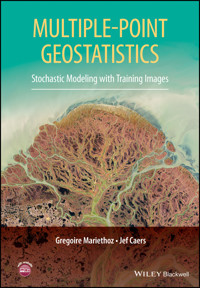
Cover image: Courtesy of NASA Earth Observatory.
CONTENTS
Preface
Acknowledgments
Part I: Concepts
Chapter 1: Hiking in the Sierra Nevada
1.1 An imaginary outdoor adventure company: Buena Sierra
1.2 What lies ahead
Chapter 2: Spatial estimation based on random function theory
2.1 Assumptions of stationarity
2.2 Assumption of stationarity in spatial problems
2.3 The kriging solution
2.4 Estimating covariances
2.5 Semivariogram modeling
2.6 Using a limited neighborhood
2.7 Universal kriging
2.8 Semivariogram modeling for universal kriging
2.9 Simple trend example case
2.10 Nonstationary covariances
2.11 Assessment
References
Chapter 3: Universal kriging with training images
3.1 Choosing for random function theory or not?
3.2 Formulation of universal kriging with training images
3.3 Positive definiteness of the sop matrix
3.4 Simple kriging with training images
3.5 Creating a map of estimates
3.6 Effect of the size of the training image
3.7 Effect of the nature of the training image
3.8 Training images for nonstationary modeling
3.9 Spatial estimation with nonstationary training images
3.10 Summary of methodological differences
References
Chapter 4: Stochastic simulations based on random function theory
4.1 The goal of stochastic simulations
4.2 Stochastic simulation: Gaussian theory
4.3 The sequential Gaussian simulation algorithm
4.4 Properties of multi-Gaussian realizations
4.5 Beyond Gaussian or beyond covariance?
References
Chapter 5: Stochastic simulation without random function theory
5.1 Direct sampling
5.2 The extended normal equation
5.3 Simulation by texture synthesis
References
Chapter 6: Returning to the Sierra Nevada
Reference
Part II: Methods
Chapter 7: Introduction
Chapter 8: The algorithmic building blocks
2.1 Grid and pointset representations
2.2 Multivariate grids
2.3 Neighborhoods
2.4 Storage and restitution of data events
2.5 Computing distances
2.6 Sequential simulation
2.7 Multiple grids
2.8 Conditioning
References
Chapter 9: Multiple-point geostatistics algorithms
3.1 Archetypal MPS algorithm
3.2 Pixel-based algorithms
3.3 Patch-based algorithms
3.4 Qualitative comparison of MPS algorithms
3.5 Postprocessing
References
Chapter 10: Markov random fields
4.1 Markov random field model
4.2 Markov mesh models
4.3 Multigrid formulations
References
Chapter 11: Nonstationary modeling with training images
5.1 Modeling nonstationary domains with stationary training images
5.2 Modeling nonstationary domains with nonstationary training images
References
Chapter 12: Multivariate modeling with training images
6.1 Multivariate and multiple-point relationships
6.2 Multivariate conditional simulation: Implementation issues
6.3 An example
6.4 Multivariate simulation as a filtering problem
References
Chapter 13: Training image construction
7.1 Choosing for training images
7.2 Object-based methods
7.3 Process-based models
7.4 Process-mimicking models
7.5 Elementary training images
7.6 From 2D to 3D
7.7 Training data
7.8 Construction of multivariate training images
7.9 Training image databases
References
Chapter 14: Validation and quality control
8.1 Introduction
8.2 Training image – data validation
8.3 Posterior quality control
References
Chapter 15: Inverse modeling with training images
9.1 Introduction
9.2 Inverse modeling: theory and practice
9.3 Sampling-based methods
9.4 Stochastic search
9.5 Parameterization of MPS realizations
References
Chapter 16: Parallelization
10.1 The need for parallel implementations
10.2 The challenges of parallel computing
10.3 Assessing a parallel implementation
10.4 Parallelization strategies
10.5 Graphical Processing Units
References
Part III: Applications
Chapter 17: Reservoir forecasting – the West Coast of Africa (WCA) reservoir
1.1 Introducing the context around WCA
1.2 Application of MPS to the WCA case
1.3 Alternative modeling workflows
References
Chapter 18: Geological resources modeling in mining
2.1 Context: sustaining the mining value chain
2.2 Stochastic updating of a block model
2.3 An alternative workflow: updating geological contacts
Notes
References
Chapter 19: Climate modeling application – the case of the Murray–Darling Basin
3.1 Introduction
3.2 Presentation of the data set
3.3 Climate model downscaling using multivariate MPS
3.4 Results and validation
References
Index
End User License Agreement
List of Tables
Chapter 1
Table I.1.1
Chapter 3
Table I.3.1
Chapter 4
Table I.4.1
Chapter 8
Table II.8.1
Table II.8.2
Table II.8.3
Chapter 9
Table II.9.1
Chapter 18
Table III.2.1
Table III.2.2
Table III.2.3
Table III.2.4
Table III.2.5
Table III.2.6
Table III.2.7
Table III.2.8
List of Illustrations
Chapter 1
Figure I.1.1 (left) Walker Lake exhaustive digital elevation map (size: 260×300 pixels) grid; and (right) 100 extracted sample data. The colorbar represents elevation in units of ft.
Figure I.1.2 Visualization of the 80 paths taken by hikers of two types: (left) minimal effort; and (right) maximal effort. The color indicates how frequently that portion of the path is taken, with redder color denoting higher frequency.
Figure I.1.3 Histograms of the cumulative elevation gain and path length for the minimal- and maximal-effort hiker. Cumulative elevation gain in units of ft, path length in units of grid cells.
Chapter 2
Figure I.2.1 Example loss functions; the most common choice is the parabola (least squares).
Figure I.2.2 (a) A single unique truth; (b) some sample data taken from it; and (c) its histogram. The goal is to estimate the value at the unsampled location marked with
X
.
Figure I.2.3 (a) Rock density in a homogeneous layer of a carbonate reservoir; and (b) rock density in a heterogeneous deltaic reservoir.
Figure I.2.4 Omnidirectional semivariogram of
Z
.
Figure I.2.5 Semivariogram of the exhaustive Walker Lake data set versus the sample variogram.
Figure I.2.6 (a) Global kriging using all 50 sample data at all estimated locations; (b) a local moving neighborhood; (c) using a minimum of 12 samples; and (d) using penalty. Parts (a–c) are calculated using SGEMS (Remy et al., 2008), and (d) is calculated using the R-package RGeostats.
Figure I.2.7 Simple trend case study: (left) the unknown truth (one realization, see Equation (I.2.38)); and (right) the sample data.
Figure I.2.8 (left) OLS estimate of trend; (middle) a universal kriging estimate based on the OLS estimate of trend; and (right) a universal kriging estimate based on the two-step procedure (using R-package RGeostats).
Chapter 3
Figure I.3.1 An analog data set considered relevant for the domain being modeled. The size of this image (250 × 250) need not be the same as the model grid size.
Figure I.3.2 (a) Artifacts induced by using a moving neighborhood; and (b) corrected by using finite domain kriging and by requiring a minimum of 12 neighboring points.
Figure I.3.3 Comparing the estimates obtained by (a) using a 150 × 150 size training image and (b) using a 250 × 250 size training image.
Figure I.3.4 Minimum error maps (kriging variances) compared to the kriging variance obtained using global ordinary kriging.
Figure I.3.5 (a) Reference case and (b) 100-sample data.
Figure I.3.6 (a–b) Two visually dissimilar training images each with their estimated map from 100 sample data (c–d).
Figure I.3.7 Omnidirectional empirical semivariograms for the two training images (a) Figure I.3.6(a) and (b) Figure I.3.6(b) along with fitted semivariograms using package RGeoS. Both have nugget 0, a range of approximately 35, and sill of 0.985.
Figure I.3.8 (a) An exhaustive DEM deemed representative for the Walker Lake area. The size of the training image is 400 × 400. (b) the result of a simple smoother applied to (a).
Figure I.3.9 (a) A training image for the simple trend case; and (b) its auxiliary variable.
Lesen Sie weiter in der vollständigen Ausgabe!
Lesen Sie weiter in der vollständigen Ausgabe!
Lesen Sie weiter in der vollständigen Ausgabe!
Lesen Sie weiter in der vollständigen Ausgabe!
Lesen Sie weiter in der vollständigen Ausgabe!
Lesen Sie weiter in der vollständigen Ausgabe!
Lesen Sie weiter in der vollständigen Ausgabe!
Lesen Sie weiter in der vollständigen Ausgabe!
Lesen Sie weiter in der vollständigen Ausgabe!
Lesen Sie weiter in der vollständigen Ausgabe!
Lesen Sie weiter in der vollständigen Ausgabe!
Lesen Sie weiter in der vollständigen Ausgabe!
Lesen Sie weiter in der vollständigen Ausgabe!
Lesen Sie weiter in der vollständigen Ausgabe!
Lesen Sie weiter in der vollständigen Ausgabe!
Lesen Sie weiter in der vollständigen Ausgabe!
Lesen Sie weiter in der vollständigen Ausgabe!
Lesen Sie weiter in der vollständigen Ausgabe!
Lesen Sie weiter in der vollständigen Ausgabe!
Lesen Sie weiter in der vollständigen Ausgabe!
Lesen Sie weiter in der vollständigen Ausgabe!
Lesen Sie weiter in der vollständigen Ausgabe!
Lesen Sie weiter in der vollständigen Ausgabe!
Lesen Sie weiter in der vollständigen Ausgabe!
Lesen Sie weiter in der vollständigen Ausgabe!
Lesen Sie weiter in der vollständigen Ausgabe!




