


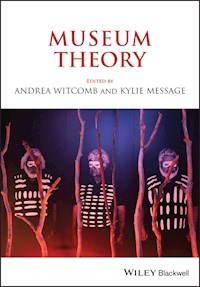
Museum Theory E-Book
55,99 €
Mehr erfahren.
- Herausgeber: John Wiley & Sons
- Kategorie: Geisteswissenschaft
- Sprache: Englisch
MUSEUM THEORY EDITED BY ANDREA WITCOMB AND KYLIE MESSAGE
Museum Theory offers critical perspectives drawn from a broad range of disciplinary and intellectual traditions. This volume describes and challenges previous ways of understanding museums and their relationship to society. Essays written by scholars from museology and other disciplines address theoretical reflexivity in the museum, exploring the contextual, theoretical, and pragmatic ways museums work, are understood, and are experienced.
Organized around three themes—Thinking about Museums, Disciplines and Politics, and Theory from Practice/Practicing Theory—the text includes discussion and analysis of different kinds of museums from various, primarily contemporary, national and local contexts. Essays consider subjects including the nature of museums as institutions and their role in the public sphere, cutting-edge museum practice and their connections with current global concerns, and the links between museum studies and disciplines such as cultural studies, anthropology, and history.
Sie lesen das E-Book in den Legimi-Apps auf:
Seitenzahl: 1370
Veröffentlichungsjahr: 2020
Ähnliche




















Table of Contents
Cover
Title page
Copyright
LIST OF ILLUSTRATIONS
EDITORS
GENERAL EDITORS
CONTRIBUTORS
ACKNOWLEDGMENTS
EDITORS’ PREFACE TO
MUSEUM THEORY AND THE INTERNATIONAL HANDBOOKS OF MUSEUM STUDIES
INTRODUCTION: – MUSEUM THEORY: An Expanded Field
PART I: Thinking about Museums
1. THINKING (WITH) MUSEUMS: From Exhibitionary Complex to Governmental Assemblage
The perspective of the exhibitionary complex
Limitations of the exhibitionary complex
Museums as governmental assemblages
Conclusion
Notes
References
2. FOUCAULT AND THE MUSEUM
The discourse of the museum
Seeing and the power of the museum
Museum fragments and the space between saying and seeing
Conclusion: Seeing in the space of the already said
References
3. WHAT, OR WHERE, IS THE (MUSEUM) OBJECT?: Colonial Encounters in Displayed Worlds of Things
Colonial encounters
The thing returns the gaze
Prosopopoeia: The object’s point of view
Notes
References
4. ANARCHICAL ARTIFACTS: Museums as Sites for Radical Otherness
The times are a-changing
Affect, not emotion
The museum as screen
Beyond the horizon
Theory behaving badly
References
5. (POST?) CARTOGRAPHIC URGES: The Intersection of Museums and Tourism
Introduction: Being in Venice
Mobilities and performance
Embodiment
Materiality and mobility
Concluding remarks
Note
References
6. MUSEUMS, HUMAN RIGHTS, AND UNIVERSALISM RECONSIDERED
Universal museums
Declaration of Universal Museums (2002), human rights, and universalism
Human rights and museums
New human rights museums
The International Slavery Museum
Federation of International Human Rights Museums
Canadian Museum for Human Rights
Museums and human rights discourses in conflict
Conclusion: The particular and the universal – the international public sphere
Note
References
Further Reading
7. THE DEMOCRATIC HORIZONS OF THE MUSEUM: Citizenship and Culture
Horizons: Democracy, citizenship, participation
Museums and civic cultures
Museums and cultural citizenship
Civic museums
Note
References
8. MUSEUMS, ECOLOGY, CITIZENSHIP
Greener museums?
Back at the Design Museum
Philosophical dimensions/dementia
Political-economic issues
Environmental ripostes
Notes
References
PART II: Disciplines and Politics
9. REFLEXIVE MUSEOLOGY: Lost and Found
In theory
Into the Heart of Africa:
A reflexive experiment
Canonization
Irony, postmodernism, and reflexivity
Exposing colonial museology and ideology
The artist as ironic trickster
Postcolonial reflexivity
Concluding remarks: Integrating reflexivity and practice
Notes
References
10. THE ART OF ANTHROPOLOGY: Questioning Contemporary Art in Ethnographic Display
The parallel epistemologies of contemporary art andethnographic artifacts
The aesthetics of new cultural museums
Institutional critique within the ethnographic museum
The freedom of the artist in the ethnographic museum?
Pasifika Styles
The Weltkulturen Museum
Art and assemblage in ethnographic museums
Conclusion
Acknowledgments
Notes
References
11. CHANGE AND CONTINUITY: Art Museums and the Reproduction of Art-Museumness
Transcending elitism: A contradictory desire
Merging art and culture: A bridge too far
Art museum without walls?
Conclusion
Note
References
12. COOL ART ON DISPLAY: The Saatchi Phenomenon
“The Saatchi phenomenon” and neoliberalism
Newspeak: British Art Now
The cool capitalist shark
Coda: The capitalist pyramid
Notes
References
13. CONTENTIOUS POLITICS AND MUSEUMS AS CONTACT ZONES
Contentious politics and museums as contact zones
The Poor People’s Campaign: What kind of theory do we need?
What is a good theory?
Museums as contact zones: Toward a movement-relevant theory?
Contentious politics: The National Museum of African American History and Culture
Conclusion
Notes
References
14. EMOTIONS IN THE HISTORY MUSEUM
Emotions
Emotions in the museum
Museums, history, communities, collective identities, and emotions
Design as an emotional instrument
The use of media
Museums using objects for emotional effect
Narrative stories
Ethical considerations
Conclusion
Acknowledgments
Note
References
15. THE PRESENCE OF THE PAST: Imagination and Affect in the Museu do Oriente, Portugal
Museums and affect
Portuguese national identity and the empire
The Museu do Oriente
The Portuguese Presence in Asia
Captivating artifices
Utopian geographies
Elusive temporalities
Note
References
16. TOWARD A PEDAGOGY OF FEELING: Understanding How Museums Create a Space for Cross-Cultural Encounters
Genealogy
The significance of narrative structure
Conclusions
Note
References
17. THE LIQUID MUSEUM: New Institutional Ontologies for a Complex, Uncertain World
Dynamical forces and the liquid museum
Temporal reframing
Uncertainty
Complexity and nonlinearity
The transnationalizing effects of climate change andglobalization
Reworking the human and the social: Nature cultures
Becoming liquid
Museums as complex adaptive systems
The liquid museum: A strategic simplification
Museums as assemblage convertors
Conclusion
Note
References
PART III: Theory from Practice/Practicing Theory
18. THE DISPLACED LOCAL: Multiple Agency in the Building of Museums’ Ethnographic Collections
A brief revisionist perspective on the building of ethnographic collections
Reflecting back from Australia
Making Yolngu collections
Collections as distributed memory
A favorable conjunction of interests
Reflecting back
Baldwin Spencer
Alfred Haddon
The producers’ perspective
Conclusion
Acknowledgments
Notes
References
19. THE WORLD AS COLLECTED; OR, MUSEUM COLLECTIONS AS SITUATED MATERIALITIES
Zombies of anatomy
The other way around
Collections as situated materialities
Strategic omissions, hidden associations
The nation collected
Bodies of us and them as collected
Old and new worlds collected, or strategic resituatings
Acknowledgments
References
20. AMBIENT AESTHETICS: Altered Subjectivities in the New Museum
Cultures of distraction
The new museum
The Australian Centre for the Moving Image as “new”
The Screen Gallery
Ambient space
Play and pedagogy
Conclusion
References
21. MUSEUM ENCOUNTERS AND NARRATIVE ENGAGEMENTS
Background: Museums, visitors, and meanings
Theoretical framework: Interpretive engagements as narrative meanings
Translating theory into methodology: Narrative interviews at Te Papa
Narrative engagements and cross–cultural meanings
Conclusion
Notes
References
22. THEORIZING MUSEUM AND HERITAGE VISITING
Heritage as a performance
Museums and the three Ls: Learning and lifelong learning
Methodology
Commemorating and learning a forgotten history: The 1807 bicentenary of the British abolition of the slave trade
Reinforcing and confirming: Museums and the performance of self
Conclusion
Acknowledgments
Notes
References
23. THE MUSEUM IN HIDING: Framing Conflict
Lyndell Brown and Charles Green
Amelia Barikin
References
24. PRESERVING/SHAPING/CREATING: Museums and Public Memory in a Time of Loss
Museums in contemporary life
Preserving/shaping/creating the public memory of September 11
Note
References
25. SITES OF TRAUMA: Contemporary Collecting and Natural Disaster
The Victorian Bushfires Collection
Oral history, but more so
Forging change
Conclusion
Note
References
Index
End User License Agreement
List of Illustrations
Chapter 8
FIGURE 8.1 Design Museum exhibit.
FIGURE 8.2 Design Museum poster.
Chapter 9
FIGURE 9.1 M. NourbeSe Philip, excerpts from Looking for Livingstone: An Odyssey...
Chapter 10
FIGURE 10.1 Interior shot of the Musée du Quai Branly, showing Visite du Plateau...
FIGURE 10.2 Exterior shot of the National Museum of the American Indian, Washing...
FIGURE 10.3 Wall of gold objects in the exhibition Our Peoples: Giving Voice to ...
FIGURE 10.4 Lisa Reihana,
He Tautoko
, 2006, Museum of Archaeology and Anthropolo...
FIGURE 10.5 Installation view of Otobong Nkanga,
Facing the Opponent
, a speciall...
Chapter 12
FIGURE 12.1 The Saatchi Gallery mark 3.
FIGURE 12.2 Scott King,
Pink Cher
, in situ at the Saatchi Gallery mark 3.
FIGURE 12.3 Scott King,
Pink Cher
. Installation view: Scott King and Steven Clay...
FIGURE 12.4
Guerrillero Heroico
, 1960: Alberto Korda’s famous photograph of CheG...
FIGURE 12.5 Damien Hirst, The Physical Impossibility of Death in the Mind of Som...
FIGURE 12.6 Damien Hirst,
For the Love of God,
2007. Platinum, diamonds and huma...
FIGURE 12.7
Pyramid of the Capitalist System
, IWW poster, 1911.
Chapter 16
FIGURE 16.1 Bunjil’s wings kinetic sculpture in the
First Peoples
exhibition, Bu...
FIGURE 16.2 Language map showing the message sticks and the relationship to Coun...
FIGURE 16.3 Maree Clarke,
Meen Warrann
(smallpox) in the
First Peoples
exhibitio...
FIGURE 16.4 Treaty and Tanderrum section of “Our Story” in the
First Peoples
exhi...
Chapter 19
FIGURE 19.1 A zombie of anatomy: female pelvis and fetus skull mounted and exhib...
FIGURE 19.2 Object landscape of the Swedish History Museum in Stockholm photogra...
FIGURE 19.3 The evolutionary walk on the ground floor of the Swedish History Mus...
FIGURE 19.4 Remains of the old anatomical collection of Uppsala University, curr...
Chapter 23
FIGURE 23.1 Lyndell Brown and Charles Green,
The Vale of Kashmir
, 1995, 155 × 15...
FIGURE 23.2 Lyndell Brown and Charles Green, Afghan Traders, Tarin Kowt, Uruzgan...
FIGURE 23.3 Lyndell Brown and Charles Green, History Painting: Market, Tarin Kow...
FIGURE 23.4 Lyndell Brown and Charles Green, Helicopter Landing, View from Roof ...
FIGURE 23.5 Lyndell Brown and Charles Green,
Styx
, 2005, 155 × 155 cm, oil on li...
FIGURE 23.6 Lyndell Brown and Charles Green,
Hare Rama Hare Krishna
, 2008–2009, ...
Chapter 24
FIGURE 24.1 Poster distributed by Jeffrey Wiener’s family members in their searc...
FIGURE 24.2 Firefighter’s pry bar, known as an officer’s tool, carried by New Yo...
FIGURE 24.3 Michelle Guyton, an artist and poet from Mobile, Alabama, created th...
FIGURE 24.4 Over one million visitors saw the exhibition September 11: Bearing W...
Chapter 25
FIGURE 25.1 Sign, Devon North, Gippsland, February 8, 2009. Source: Liza Dale-Ha...
FIGURE 25.2 The Poetry Tree, Strathewen, 2010.
FIGURE 25.3 Leadbeater’s possum nest box, Lake Mountain, 2010.
List of Illustrations
Chapter 19
TABLE 19.1 The world as collected: common themes and omissions
Chapter 22
TABLE 22.1 Visitor interviews per museum
TABLE 22.2 Ethnicity
TABLE 22.3 Messages people took from the museums or the bicentenary
Guide
Cover
Table of Contents
Begin Reading
Pages
v
iii
iv
ix
x
xi
xiii
xiv
xv
xvi
xvii
xix
xx
xxi
xxii
xxiii
xxiv
xxv
xxvi
xxvii
xxviii
xxix
xxx
xxxi
xxxii
xxxiii
xxxiv
xxxv
xxxvi
xxxvii
xxxviii
xxxix
xl
xli
xlii
xliii
xliv
xlv
xlvi
xlvii
xlviii
xlix
l
li
lii
liii
liv
lv
1
2
3
4
5
6
7
8
9
10
11
12
13
14
15
16
17
18
19
20
21
22
23
24
25
26
27
28
29
30
31
32
33
34
35
36
37
38
39
40
41
42
43
44
45
46
47
48
49
50
51
52
53
54
55
56
57
58
59
60
61
62
63
64
65
66
67
68
69
70
71
72
73
74
75
76
77
78
79
80
81
82
83
84
85
86
87
88
89
90
91
92
93
94
95
96
97
98
99
100
101
102
103
104
105
106
107
108
109
110
111
112
113
114
115
117
118
119
120
121
122
123
124
125
126
127
128
129
130
131
132
133
134
135
136
137
138
139
140
141
142
143
144
145
146
147
148
149
150
151
152
153
154
155
156
157
158
159
160
161
162
163
164
165
166
167
168
169
170
171
172
173
174
175
176
177
178
179
180
181
182
183
184
185
186
187
188
189
190
191
192
193
194
195
196
197
198
199
200
201
202
203
204
205
206
207
208
209
210
211
212
213
214
215
216
217
218
219
220
221
222
223
224
225
226
227
228
229
230
231
232
233
234
235
236
237
238
239
240
241
242
243
244
245
246
247
248
249
250
251
252
253
254
255
256
257
258
259
260
261
262
263
264
265
266
267
268
269
270
271
272
273
274
275
276
277
278
279
280
281
282
283
284
285
286
287
288
289
290
291
292
293
294
295
296
297
298
299
300
301
302
303
304
305
306
307
308
309
310
311
312
313
314
315
316
317
318
319
320
321
322
323
324
325
326
327
328
329
330
331
332
333
334
335
336
337
338
339
340
341
342
343
344
345
346
347
348
349
350
351
352
353
354
355
356
357
358
359
360
361
363
364
365
366
367
368
369
370
371
372
373
374
375
376
377
378
379
380
381
382
383
384
385
386
387
389
390
391
392
393
394
395
396
397
398
399
400
401
402
403
404
405
406
407
408
409
410
411
412
413
414
415
417
418
419
420
421
422
423
424
425
426
427
428
429
430
431
432
433
434
435
436
437
438
439
440
441
442
443
444
445
446
447
448
449
450
451
452
453
454
455
456
457
458
459
460
461
462
463
464
465
466
467
468
469
470
471
472
473
474
475
476
477
478
479
480
481
482
483
484
485
486
487
488
489
490
491
492
493
494
495
496
497
498
499
500
501
502
503
504
505
506
507
508
509
510
511
512
513
514
515
516
517
518
519
520
521
522
523
524
525
526
527
528
529
530
531
532
533
534
535
536
537
538
539
540
541
542
543
544
545
546
547
548
549
550
551
552
553
554
555
556
557
558
559
560
561
562
563
564
565
566
567
568
569
570
571
572
573
Museum Theory
Edited by
Andrea Witcomb and Kylie Message
General Editors
Sharon Macdonald and Helen Rees Leahy
WILEY Blackwell
This paperback edition first published 2020
© 2015 John Wiley & Sons Ltd
Edition history: John Wiley and Sons Ltd (hardback, 2015)
All rights reserved. No part of this publication may be reproduced, stored in a retrieval system, or transmitted, in any form or by any means, electronic, mechanical, photocopying, recording or otherwise, except as permitted by law. Advice on how to obtain permission to reuse material from this title is available at http://www.wiley.com/go/permissions.
The right of Andrea Witcomb, Kylie Message, Sharon Macdonald, and Helen Rees Leahy to be identified as the authors of the editorial material in this work has been asserted in accordance with law.
Registered Office(s)
John Wiley & Sons, Inc., 111 River Street, Hoboken, NJ 07030, USA John Wiley & Sons Ltd, The Atrium, Southern Gate, Chichester, West Sussex, PO19 8SQ, UK
Editorial Office
The Atrium, Southern Gate, Chichester, West Sussex, PO19 8SQ, UK
For details of our global editorial offices, customer services, and more information about Wiley products visit us at www.wiley.com.
Wiley also publishes its books in a variety of electronic formats and by print-on-demand. Some content that appears in standard print versions of this book may not be available in other formats.
Limit of Liability/Disclaimer of Warranty
While the publisher and authors have used their best efforts in preparing this work, they make no representations or warranties with respect to the accuracy or completeness of the contents of this work and specifically disclaim all warranties, including without limitation any implied warranties of merchantability or fitness for a particular purpose. No warranty may be created or extended by sales representatives, written sales materials or promotional statements for this work. The fact that an organization, website, or product is referred to in this work as a citation and/or potential source of further information does not mean that the publisher and authors endorse the information or services the organization, website, or product may provide or recommendations it may make. This work is sold with the understanding that the publisher is not engaged in rendering professional services. The advice and strategies contained herein may not be suitable for your situation. You should consult with a specialist where appropriate. Further, readers should be aware that websites listed in this work may have changed or disappeared between when this work was written and when it is read. Neither the publisher nor authors shall be liable for any loss of profit or any other commercial damages, including but not limited to special, incidental, consequential, or other damages.
Library of Congress Cataloging-in-Publication Data
Museum Theory – The international handbooks of museum studies / edited by Andrea Witcomb,Kylie Message / general editors: Sharon Macdonald, Helen Rees Leahy. – First edition.
pages cm Includes bibliographical references and index. ISBN 978-1-4051-9850-9 (cloth) | ISBN 978-1-119-64208-4 (pbk.)
1. Museums. 2. Museum exhibits. I. Macdonald, Sharon. II. Leahy, Helen Rees. AM5.I565 2015 069–dc23
2015003407
Cover Design: Wiley Cover Image: Meen Warrann (smallpox) by Maree Clarke. Photo: Dianna Snape, courtesy Museum of Victoria.
Set in 11/13 pt Dante by SPi Global, Pondicherry, India
Printed and bound by CPI Group (UK) Ltd, Croydon, CR0 4YY
10 9 8 7 6 5 4 3 2 1
LIST OF ILLUSTRATIONS
Color plate section
8.1 Design Museum exhibit
10.1 Interior shot of the Musée du Quai Branly, 2013
10.2 Exterior shot of the National Museum of the American Indian, 2012
10.3
Our Peoples: Giving Voice to Our Histories
at the Smithsonian’s National Museum of the American Indian
10.4 Lisa Reihana,
He Tautoko
, 2006, Museum of Archaeology and Anthropology, Cambridge
10.5 Installation view of Otobong Nkanga,
Facing the Opponent
, Weltkulturen Museum
12.1 Saatchi Gallery mark 3
12.2 Scott King,
Pink Cher
, Saatchi Gallery mark 3
12.3 Installation view: Scott King and Steven Claydon,
Newspeak Part One
, 2010
12.5 Damien Hirst,
The Physical Impossibility of Death in the Mind of Someone Living,
1991
12.6 Damien Hirst,
For the Love of God
, 2007
12.7
Pyramid of the Capitalist System
, IWW poster, 1911
16.1 Bunjil’s wing kinetic sculpture,
First Peoples
exhibition, Melbourne Museum
16.3 Maree Clarke,
Meen Warrann
(smallpox),
First Peoples
exhibition, Melbourne Museum
19.1 A zombie of anatomy, Biomedical Center, Uppsala University
23.1 Lyndell Brown and Charles Green,
The Vale of Kashmir
, 1995
23.2 Lyndell Brown and Charles Green,
Afghan Traders, Tarin Kowt, Uruzgan Province, Afghanistan
, 2007–2009
23.3 Lyndell Brown and Charles Green,
History Painting: Market, Tarin Kowt, Uruzgan Province, Afghanistan
, 2008
23.4 Lyndell Brown and Charles Green,
Helicopter Landing, View from Roof of Morgue, Southern Iraq
, 2007–2009
23.5 Lyndell Brown and Charles Green,
Styx
, 2005
23.6 Lyndell Brown and Charles Green,
Hare Rama Hare Krishna
, 2008 – 2009
24.3 Michelle Guyton, interpretive scrapbook on September 11, 2001
25.2 Poetry Tree, Strathewen, 2010, Museum Victoria x
Chapter illustrations
8.1 Design Museum exhibit
8.2 Design Museum poster
9.1 M. NourbeSe Philip, excerpts from
Looking for Livingstone: An Odyssey of Silence
, 1991 and Royal Ontario Museum invitation
10.1 Interior shot of the Musée du Quai Branly, 2013
10.2 Exterior shot of the National Museum of the American Indian, 2012
10.3
Our Peoples: Giving Voice to Our Histories
at the Smithsonian’s National Museum of the American Indian
10.4 Lisa Reihana,
He Tautoko
, 2006, Museum of Archaeology and Anthropology, Cambridge
10.5 Installation view of Otobong Nkanga,
Facing the Opponent
, Weltkulturen Museum
12.1 Saatchi Gallery mark 3
12.2 Scott King,
Pink Cher
, Saatchi Gallery mark 3
12.3 Installation view: Scott King and Steven Claydon,
Newspeak Part One
, 2010
12.4 Alberto Korda,
Guerrillero Heroico
, 1960
12.5 Damien Hirst,
The Physical Impossibility of Death in the Mind of Someone Living
, 1991
12.6 Damien Hirst,
For the Love of God
, 2007
12.7
Pyramid of the Capitalist System
, IWW poster, 1911
16.1 Bunjil’s wing kinetic sculpture,
First Peoples
exhibition, Melbourne Museum
16.2 Language map showing message sticks and the relationship to Country,
First Peoples
exhibition, Melbourne Museum
16.3 Maree Clarke,
Meen Warrann
(smallpox),
First Peoples
exhibition, Melbourne Museum
16.4 Treaty and Tanderrum section of “ Our Story,”
First Peoples
exhibition, Melbourne Museum
19.1 A zombie of anatomy, Biomedical Center, Uppsala University
19.2 Object landscape of the Swedish National Heritage Board, Stockholm, 1926
19.3 Evolutionary walk, Swedish History Museum, shortly after opening in 1866
19.4 Remains of the old anatomical collection of Uppsala University
23.1 Lyndell Brown and Charles Green,
The Vale of Kashmir
, 1995
23.2 Lyndell Brown and Charles Green,
Afghan Traders, Tarin Kowt, Uruzgan Province, Afghanistan
, 2007 – 2009
23.3 Lyndell Brown and Charles Green,
History Painting: Market, Tarin Kowt, Uruzgan Province, Afghanistan
, 2008
23.4 Lyndell Brown and Charles Green,
Helicopter Landing, View from Roof of Morgue, Southern Iraq
, 2007 – 2009
23.5 Lyndell Brown and Charles Green,
Styx
, 2005
23.6 Lyndell Brown and Charles Green,
Hare Rama Hare Krishna
, 2008 – 2009
24.1 Poster distributed by Jeffrey Wiener’s family members in their search after 9/11
24.2 Firefighter’s pry bar carried by Lt. Kevin Pfeifer, FDNY
24.3 Michelle Guyton, interpretive scrapbook on September 11, 2001
24.4 Comment card from
September 11: Bearing Witness to History
exhibition
25.1 Sign, Devon North, Gippsland, February 8, 2009
25.2 Poetry Tree, Strathewen, 2010, Museum Victoria
25.3 Leadbeater’s possum nest box, Lake Mountain, 2010, Museum Victoria
EDITORS
Andrea Witcomb is a Professor of Cultural Heritage and Museum Studies at Deakin University and a Deputy Director (Research) of the Alfred Deakin Institute for Citizenship and Globalisation. Her research interests range across the museum and heritage fields and are informed by theoretical, historical, and professional practice concerns. She brings an interdisciplinary approach to her research, locating her work at the intersection of history, museology, and cultural studies. Her work is driven by a desire to understand the ways in which a range of heritage practices can be used to foster cross?cultural understandings and dialogue as well as the history of collecting as part of colonialism. Her work explores the uses of immersive interpretation strategies in museums and heritage sites, the role of memory and affect in people’s encounters with objects and displays, and, more recently, the place of collecting practices as an embodiment of colonial relations. Andrea is the author of Re-imagining the Museum: Beyond the Mausoleum (Routledge, 2003) and, with Chris Healy, the co-editor of South Pacific Museums: An Experiment in Culture (Monash University ePress, 2006). Her latest book, co?written with Kate Gregory, is From the Barracks to the Burrup: The National Trust in Western Australia (UNSW Press, 2010).
Professor Andrea WitcombDeputy Director (Research)Alfred Deakin Research Institute for Citizenship and GlobalisationDeakin University Victoria, Australia
Kylie Message is Professor of Public Humanities in the Humanities Research Centre at the Australian National University. Her research examines the relationships between cultural organisations, citizenship, government, and political reform movements. She has written extensively about the ways that museums across the world have been involved in and identified as sites of activism and controversy, and her research has made a significant contribution to the way various participants and stakeholders understand the political history and impact of culture. She is the author of Museums and Social Activism: Engaged Protest (Routledge, 2013); New Museums and the Making of Culture (Bloomsbury, 2006); and most recently, The Disobedient Museum: Writing at the Edge (Routledge, 2018); Museums and Racism (Routledge, 2018); and Archiving Activism: The Occupy Wall Street Collection (Routledge, 2019). She is the Founding Editor of Routledge’s ‘Museums in Focus’ book series.
Professor Kylie MessageANU College of Arts and Social SciencesThe Australian National UniversityCanberra ACT, Australia
GENERAL EDITORS
Sharon Macdonald is Alexander van Humboldt Professor in Social Anthropology at the Humboldt University Berlin where she directs the Centre for Anthropological Research on Museums and Heritage–CARMAH. The centre works closely with a wide range of museums. Sharon has edited and coedited volumes include the Companion to Museum Studies (Blackwell, 2006); Exhibition Experiments (with Paul Basu; Blackwell, 2007); and Theorizing Museums (with Gordon Fyfe; Blackwell, 1996). Her authored books include Behind the Scenes at the Science Museum (Berg, 2002); Difficult Heritage: Negotiating the Nazi Past in Nuremberg and Beyond (Routledge, 2009); and Memorylands: Heritage and Identity in Europe Today (Routledge, 2013). Her current projects include Making Differences: Transforming Museums and Heritage in the 21stCentury.
Professor Sharon MacdonaldAlexander van Humboldt Professor in Social AnthropologyInstitute for European EthnologyHumboldt University of BerlinBerlin, Germany
Helen Rees Leahy is Professor Emerita of Museology at the University of Manchester, where, between 2002 and 2017 she directed the Centre for Museology. Previously, Helen held a variety of senior posts in UK museums, including the Design Museum, Eureka! The Museum for Children, and the National Art Collections Fund. She has also worked as an independent consultant and curator, and has organized numerous exhibitions of art and design. She has published widely on practices of individual and institutional collecting, in both historical and contemporary contexts, including issues of patronage, display and interpretation. Her Museum Bodies: The Politics and Practices of Visiting and Viewing was published by Ashgate in 2012.
Professor Emerita Helen Rees LeahyCentre for MuseologySchool of Arts, Languages and CulturesUniversity of ManchesterManchester, UK
CONTRIBUTORS
Ien Ang, University of Western Sydney, Australa
Janice Baker, Curtin University, Australia
Amelia Barikin, University of Queensland, Australia
Jennifer Barrett, University of Sydney, Australia
Tony Bennett, University of Western Sydney, Australia
Lyndell Brown, University of Melbourne, Australia
Shelley Ruth Butler, McGill University, Canada
Fiona Cameron, University of Western Sydney, Australia
Rebecca Carland, Museum Victoria, Australia
Peter Dahlgren, Lund University, Sweden
Liza Dale?Hallett, Museum Victoria, Australia
Sandra H. Dudley, University of Leicester, UK
Peg Fraser, Museum Victoria, Australia
James B. Gardner, US National Archives, USA
Haidy Geismar, University College London, UK
Charles Green, University of Melbourne, Australia
Joke Hermes, Inholland University, The Netherlands
Kevin Hetherington, Open University, UK
Jim McGuigan, Loughborough University, UK
Scott McQuire, University of Melbourne, Australia
Kylie Message, Australian National University, Australia
Toby Miller, Cardiff University, UK, and Murdoch University, Australia
Howard Morphy, Australian National University, Australia
Nikos Papastergiadis, University of Melbourne, Australia
Elsa Peralta, University of Lisbon, Portugal
Natalia Radywyl, Fjord, New York
Philipp Schorch, Deakin University, Australia, and Ludwig-Maximilians-University Munich, Germany
Laurajane Smith, Australian National University, Australia
Russell Staiff, University of Western Sydney, Australia
Fredrik Svanberg, National Historical Museums, Sweden
Sheila Watson, University of Leicester, UK
Andrea Witcomb, Deakin University, Australia
ACKNOWLEDGMENTS
Editing this volume has been an enormously rewarding experience. We wish to thank all those who made it possible, particularly our friend Chris Healy, who first brought us into this project. We would also like to thank Sharon Macdonald and Helen Rees Leahy, who conceptualized the series and have overseen its develop? ment. As our guiding editor, Sharon was exacting but enormously supportive, and we thank her for it. We also warmly acknowledge our contributors–colleagues inside and outside museums without whom this volume would not have taken shape. Thank you for staying the course of the project–all those emails backward and forward, the drafting and redrafting that went into the editing process, and your faith that the publication would eventually emerge. Finally but not least, we wish to thank Gill Whitley, the project manager working with Wiley, who went above and beyond her duty of care in supporting us as editors, running around chasing copyright, and keeping us to deadlines or managing requests for exten? sions when we needed them. We are also no less grateful for the patience, careful reading, and extraordinary care taken by our copy?editor, Jacqueline Harvey
EDITORS’ PREFACE TO MUSEUM THEORY AND THE INTERNATIONAL HANDBOOKS IN MUSEUM STUDIES
Museum Theory
As general editors of The International Handbooks in Museum Studies, we–Sharon Macdonald and Helen Rees Leahy–are delighted that Museum Theory is now appearing in paperback, as a self-standing volume. So too are the other volumes, which is testament to the strength of these volumes individually, as well as collectively, and to the importance of the issues that they each address. Museum Theory clearly concerns a fundamental area of museum studies. Although fundamental, however, there is not an established consensus on precisely what might be covered under the label ‘museum theory’. One reason for this is the relative recency of museum studies as a field. A second reason is that museum studies draws on a wide range of disciplines, each themselves renewing their toolkits in various ways, resulting in new impulses for museum theorising too. In addition, and perhaps of most significance, is the fact of change–and calls for more change–within museums themselves as they seek to address wider social and cultural transformations. This inspires a search for fresh theorising to understand and shape new developments. At the same time, as museums can be seen as themselves ‘theorisers’, it helps to propel new theorizing.
As such, the editors of Museum Theory, Andrea Witcomb and Kylie Message, in consultation with us as general editors, faced a task of how to achieve a volume that would cover approaches that have become central to the theorising of museums, while also being sure to include as much as possible of the new directions and ideas that have been emerging in recent years. That this was achieved so well is evident from the resulting volume. The range of topics included and the ways in which they are tackled, provide a sound and also cutting-edge coverage of museum theory.
The International Handbooks in Museum Studies
Collectively, The International Handbooks in Museum Studies include over a hundred original, state-of-the-art chapters on museums and museum studies. As such, they are the most comprehensive review to date of the lively and expanding field of museum studies. Written by a wide range of scholars and practitioners–newer voices as well as those already widely esteemed–The International Handbooks provide not only extensive coverage of key topics and debates in the museum field, but also make a productive contribution to emerging debates and areas, as well as to suggest how museum studies–and museums–might develop in the future.
The number of excellent contributors able and willing to write on museum topics is itself testimony to the state of the field, as was recognition by the publishers that the field warranted such a substantial work. Bringing together such a range and quantity of new writing about museums was accomplished through the deep knowledge, extensive networks, and sheer labour of the volume editors–Andrea Witcomb and Kylie Message, Museum Theory; Conal McCarthy, Museum Practice; Michelle Henning, Museum Media; and Annie E. Coombes and Ruth B. Phillips, Museum Transformations. All enthusiastically took up the mandate to go out and recruit those they thought would be best able to write useful and timely essays on what they defined as the most important topics within their area of remit. Their brief was to look widely for potential contributors, including unfamiliar, as well as familiar, names. We–and they–were especially interested in perspectives from people whose voices have not always been heard within the international museum studies conversation thus far. This breadth is also a feature of the expanded and expanding field itself, as we explain further below.
Diversification anddemocratization
The editors of the four volumes that constitute The International Handbooks are based in four different countries–Australia, New Zealand, the United Kingdom, and Canada; and contributors have their institutional homes in over a dozen more. Yet these numbers alone do not fully convey the trend to diversification that we see in these volumes, and in museum studies more widely. “Internationalization” is a term that might be used but does not, we think, adequately characterize what is involved. Certainly, there is more traffic between nations of ideas about museums and about how to study them. Debates travel from one part of the globe to another, with museums and exhibitions in one location being used as models for emulation or avoidance in another. The massive expansion of professional training in museum studies that has taken place over the past three decades helps establish a shared discourse, not least as many students study away from their home countries or those in which they will later work. So too do texts in and about the field, certain key ones often being found on reading lists in numerous countries and also republished in successive readers. Such developments establish the basis for a conversation capable of transcending borders.
It is evident from the contents of The International Handbooks of Museum Studies, however, that the democratization runs deeper than the traffic of discourse and practice across national borders, and, in particular, that the traffic is more multi-directional than it was previously. Not only do contributors have their primary work bases in a range of different countries, and not only do many have experience of training or working in others, they also often give attention–sometimes through the direct engagement of collaborative work or study–to a wide range of groups and populations in a variety of countries, including their own. In doing so, they strive not merely to incorporate but also to learn from and be challenged by people and perspectives that have not been part of mainstream museological debate. The attention to the (not unproblematic) category of the indigenous is especially marked in these International Handbooks, most notably in the Transformations volume, although it also finds its way into the others. Like attention to other forms of absence from the existing mainstream museum conversation, this is symptomatic of a broader move toward finding alternative ways of seeing and doing, ways that both add to the range of existing possibilities and also, sometimes, unsettle these by showing how, say, particular theorizing or practice relies on unspoken or previously unrecognized assumptions.
Diversification takes other forms too. These volumes are not organized by type of museum–a format that we think restrictive in its lack of recognition of so many shared features and concerns of museums–and do not use this as a classification of content. Nevertheless, it is easy to see that the volumes include a great range of museum kinds, and even of forms that might not always be considered museums, or that challenge the idea of the museum as a physical space. Museums of art, history, and ethnography–and also those more general and eclectic museums that have sometimes been described as encyclopedic–have powered a good deal of museum theorizing and debate, and they are amply represented here. But they are accompanied also by examples from museums of natural history, science, technology, and medicine, as well as heritage sites and out-of- gallery installations. Alongside national museums, which were the backbone of much important theorizing of the role of museums in the making of national identity and citizenship, are numerous examples of smaller museums, some of which are devoted to a specific topic and others of which have a regional or local foundation and focus. These museums may be less well endowed with staff, buildings, or funds, but are nevertheless doing important, even pioneering, work that deserves attention from museum studies. That attention contributes not only to extending the range of types and cases but also helps to illuminate the variety of specific features of museums that need to be taken into account in formulating more comprehensive approaches. As many chapters across the volumes show, one size does not fit all–or, to put it better perhaps, one theoretical perspective or set of guidelines for practice, one apt choice of media or transformative activity, does not fit all types and sizes of museums. Adding more to the mix does not just provide greater coverage or choice but also helps to identify better what is at stake and what might be possible in different kinds of situations, constellations, or conjunctures (to use a word favored in Museum Theory). As such, it helps those of us engaged in and with museums to get a better grasp on what is and what might be shared, as well as on what is distinctive and needs to be understood in more fine-grained ways.
Another feature of diversification that deserves comment here is the temporal. There has been a considerable amount of outstanding historical research undertaken in museum studies and the International Handbooks both review some of this and contribute further to it. Such work is important in its own terms, helping us to understand better the contexts in which museums emerged and have operated, and the concerns, constraints, personalities, and opportunities in evidence in particular times and places. It also contributes in vital ways to contemporary understandings, both by adding to the range of cases available for analysis and by showing the longer historical trajectories out of which various current approaches and practices emerged. Sometimes–and there are examples in all of the volumes here–their message is salutary, showing that what seemed like an innovation has been tried before, and perhaps with the distance of time allowing a more critical perspective than might feel comfortable today. The past shows change but also continuities and the re-emergence, or even repackaging, of what has gone before.
Disciplinarity andmethodology
Research on past museum innovation and practice shows the importance of historical method, and of history as a discipline, within museum studies. This brings us to the wider issue of disciplinarity and methodology. To talk of museum studies as interdisciplinary has become a truism. The volumes here are a clear illustration that those involved in museum studies have been trained in and may have primary institutional locations in a wide range of disciplines and areas of study, including anthropology, archaeology, architecture, area studies, cultural studies, economics, education, geography, literature, management, media studies, political science, and sociology, as well as history and art history. Beyond that, however, they are also carving out new niches, sometimes institutionally recognized, sometimes not, in areas such as digital curation and creative technologies, as well as in art gallery, museum, and heritage studies, in various combinations or alone. Moreover, in addition to disciplines and a multitude of academic specialisms, practitioner contributors bring diverse professional expertise in areas including exhibition design, community engagement, conservation, interpretation, and management.
Alongside the diversity of concepts and methodologies offered by various disciplines and diverse forms of practical expertise, is also the distinctive feature of museum studies–its engagement with the past, present, and future world of museums. Such work, to varying extents, confronts researchers and academics with the actual concerns, predicaments, objects, spaces, media, and people all, in various ways, involved in museum collections and exhibitions. Increasingly, this means actual collaboration, and the development of methodological approaches to enable this. Examples in these volumes include those who consider themselves to be primarily academics, artists, or activists being directly involved in the production of collections, media (e.g., new media apps or forms of display), and exhibitions. The nature of museum work is, inevitably, collaborative, but in some cases it also involves more explicit attempts to work with those who have had little previous engagement in museum worlds and draws on methodology and ethical insight from disciplines such as social and cultural anthropology to do so. Such actual engagement–coupled with what we see as more fluid traffic between academia and museums also powers new forms of theorizing and practice. This productive mobility affords museum studies its characteristic–and, in our view, especially exciting–dynamic.
Organization of the International Handbooks
As we originally planned these International Handbooks, dividing their coverage into the four volumes of Theory, Practice, Media, and Transformations made good sense as a way of grouping key areas of work within the field. Our idea was that Theory would bring together work that showed central areas of theorizing that have shaped museum studies so far, together with those that might do so in the future. We envisaged Practice as attending especially to areas of actual museum work, especially those that have tended to be ignored in past theorizing, not in order to try to reinstate a theory/practice division but, rather, to take the opportunity to transcend it through theorizing these too. We saw Media as the appropriate label to cover the crucially important area for museums of their architecture, spaces, and uses of diverse media primarily, though not exclusively, for display. Transformations was intended to direct its attention especially to some of the most important social, cultural, political, and economic developments that are shaping and look likely to reshape museums in the future.
In many ways, what has resulted fits this original remit. We always knew that there would inevitably be areas of convergence: in particular, that theory can derive from practice, and vice versa; that the development and expansion of social media is propelling some of the most significant transformations in museums, and so forth. Yet it is probably true to say that there are more synergies than we had imagined, perhaps because museum work has itself become more open to change, new ideas and practice, and unconventional practitioners and participants, from what would previously have been considered outside. To make distinctions between practitioners and theorists continues to make sense in some contexts. What we see, however, is an increasing band of critical practitioners and practice- based researchers–those who operate in both worlds, drawing inspiration for new practice from areas of theorizing as well as from adaptations of cases from elsewhere. Equally they use practice to think through issues such as the nature of objects, the role of media, or sensory potentials.
It is interesting to note that at an analytical level, the volumes all contain chapters that give emphasis to specific cases and argue for the importance of paying close attention to grounded process–what actually happens, where, who, and what is involved. Although not all are informed by theoretical perspectives of actor network theory or assemblage theory, there is much here that recognizes the significance of material forms not just as objects of analysis but as agents in processes themselves. There is also much work across the volumes that gives explicit attention to the affective dimensions of museums, exploring, for example, how different media or spaces might afford certain emotional engagements. The sensory is also given new levels of consideration in what we see as, collectively, a more extensive attempt to really get to grips with the distinctiveness of museums as a medium, as well as with their sheer variety.
Various forms of collaborative engagement with specific groups–sometimes called communities–as well as with individual visitors, is also a notable theme cutting across the various volumes. Certainly, the idea of a generic “audience” or “public” seems to be less present as a central but abstract focus than in the past. Divisions along lines of gender or class are made less frequently than they might have been in earlier critical perspectives–though when they are, this is often done especially well and powerfully, as, for example, in some contributions to the discussion of museum media. Interestingly, and this is a comment on our times as well as on social and political developments in which museums are embroiled, the work with “communities” is framed less in terms of identity politics than would probably have been the case previously. No longer, perhaps, is the issue so much about making presence seen in a museum, increasingly it is more about mutually enriching ways of working together, and about pursuing particular areas or issues of concern, such as those of the environment or future generations. Yet politics is certainly not absent. Not only is the fundamental question about whose voice is represented in the museum a thoroughly political one, the chapters also show political concerns over relatively subtle matters such as methodology and reformulations of intimacy, as well as over questions of sponsorship, money-flow in the art world, the development of mega-museums in Gulf states, environmental destruction, and so forth. Indeed, there is a strong current of work that positions the museum as an activist institution and that shows its potential as such–something perhaps indicative of at least one future direction that more museums might take.
One thing that is clear from these volumes, however, is that there is no single trajectory that museums have taken in the past. Neither is there a single track along which they are all heading, nor one that those of us who have contributed would agree that they should necessarily all take. The diversity of museums themselves, as well as of those who work in, on, and with them, and of the perspectives that these volumes show can be brought to bear upon them–as well as their very various histories, collections, contexts, personnel, publics, and ambitions–has inspired the diversified museum studies represented in these InternationalHandbooks. Our hope is that this more diversified museum studies can contribute not only to new ways of understanding museums but also to new, and more varied, forms of practice within them–and to exciting, challenging futures, whatever these might be.
Acknowledgments
Producing these International Handbooks of Museum Studies has probably been a bigger and more demanding project than any of us had anticipated at the outset. Assembling together so many authors across four different volumes, and accommodating so many different timetables, work dynamics, styles, and sensitivities has been a major task over more years than we like to recall for both us as general editors, and even more especially for the editors of our four volumes: Andrea Witcomb, Kylie Message, Conal McCarthy, Michelle Henning, Annie E. Coombes, and Ruth B. Phillips. As general editors, our first thanks must be to the volume editors, who have done a remarkable task of identifying and eliciting so many insightful and illuminating contributions from such a wide field, and of working with authors–not all of whom were experienced in academic writing and many of whom were already grappling with hectic schedules–to coax the best possible chapters from them. We thank our volume editors too for working with us and what may sometimes have seemed overly interventionist assistance on our part in our push to make the volumes work together, as well as individually, and for all contributions, as well as the International Handbooks as a whole, to be a substantial contribution to the field. We also thank our volume editors for sharing so much good humor and so many cheering messages along the way, turning what sometimes felt like relentless chasing and head-aching over deadlines into something much more human and enjoyable. All of the contributors also deserve immense thanks too, of course, for joining the convoy and staying the journey. We hope that it feels well worth it for all concerned. Without you–editors and contributors–it couldn’t have happened.
There is also somebody else without whom it couldn’t have happened. This is Gill Whitley. Gill joined the project in 2012 as Project Editor. In short, she transformed our lives through her impeccable organization and skillful diplomacy, directly contacting contributors to extract chapters from them, setting up systems to keep us all on track with where things were up to, and securing many of the picture permissions. She has been a pleasure to work with and we are immensely grateful to her.
The idea for a series of International Handbooks of Museum Studies came from Jayne Fargnoli at Wiley Blackwell and we are grateful to her for this and being such a great cheerleader for the project. She read a good deal of the work as it came in and knowing that this only increased her enthusiasm for the project boosted everyone’s energy as we chased deadlines. We also thank other staff at Wiley Blackwell for their role in the production processes, including, most recently, Jake Opie, for helping to at last allow us to bring out the individual volumes in paperback format.
Because of its extended nature and because things don’t always happen according to initial timetables, editorial work like this often has to be fitted into what might otherwise be leisure time or time allocated for other things. Luckily, both of our Mikes (Mike Beaney and Mike Leahy) were sympathetic, not least as both have deeply occupying work of their own; and we thank them for being there for us when we needed them.
Lastly, we would like to thank each other. We have each benefited from the other’s complementary expertise and networks, from the confidence of having that insightful second opinion, and from the sharing of the load. Having some-body else with whom to experience the frustrations and joys, the tribulations and amusements, has made it so much more fun. Not only has this helped to keep us relatively sane, but it has also made The International Handbooks of Museum Studies so much better than they would otherwise have been.
Sharon Macdonald and Helen Rees Leahy, August 2014 and July 2019
INTRODUCTION: MUSEUM THEORY An Expanded Field
Kylie Message and Andrea Witcomb
At a public lecture delivered in September 2013 in Canberra, Nicholas Thomas, director of the University of Cambridge Museum of Archaeology and Anthropology, remarked that the–now not so “new”–new museology has been preoccupied with the politics of museums at the expense of remembering and theorizing what museums are and do (Thomas 2013). The journal of the American Anthropological Association, Museum Anthropology, had previously published a “commentary” piece by Thomas in which he had presented his preliminary sug-gestions for exploring what he called the “museum as method.” Thomas had pro-posed the museum as method as a conceptual approach for reflection that may lead to innovation in the ways we think about museums as complex assemblages of meaning. He used this idea to challenge the generally accepted understanding that theory is primarily aligned with academic disciplines and discourse–a pre-sumption that overlooks the reality, which is that museums have been and con-tinue to be key sites for the creation of theory. He explained:
If it has been taken for granted for several generations that the locus of innovation in disciplines such as anthropology has been “theory,” there is now scope to think differently and to revalue practices that appeared to be, but were actually never, sub-theoretical … [I have] not tried to map out in any rigorous way what an understand-ing of “the museum as method” might entail. My general point is simply that one can work with contingencies, with the specific qualities and histories of artifacts and works of art, in ways that challenge many everyday or scholarly understandings of what things are and what they represent. (Thomas 2010, 8)
Thomas argued that understanding the museum as method means coming to terms with the role played by contingency –that is, the specificities of chance and unpredictability–in day-to-day museum work. From our perspective as the editors of this volume on museum theory, his ideas intersect with and affirm broader dis-ciplinary discussions occurring in other sectors about the opportunities for renewal and innovation that can arise from debates over disciplinary crisis. The broad church of the humanities, for example, is often discussed as being caught in a per-petual cycle of crisis, dissonance, and renewal, a process that is often explained as being productive and as generating opportunities for the future. Focused on the specific discipline of anthropology and its relationship to the museum, which is the main vehicle through which the public have come to know the discipline, Thomas’s main concern is that “mainstream anthropology arguably continues to drift away from the museum as a research resource or site of analysis,” even despite the revival of debate around art and material culture that occurred in the 1980s and 1990s (Thomas 2010, 6).
The unpredictability that Thomas identifies as being potentially valuable for attempts to develop museum theory (Thomas 2010, 7) can be understood as having similarities with theories first raised by John Tunbridge and Gregory Ashworth in 1996 in relation to ideas about dissonance.1 In the context of the interdisciplinary field of heritage studies, for example, Tunbridge and Ashworth (1996, 21) argued that heritage is, at its core, dissonant because the messages, values, and meanings that different people create about heritage and the pasts it represents are always going to be interpreted and understood differently by individuals and groups with different backgrounds, experiences, interests, and agendas. While discord, conflict, contest, and lack of agreement in the way that the past is represented can perhaps be most readily perceived in relation to places and instances of “difficult” heritage (representing historical brutality, genocide, wars, and so on), dissonance is, in their view, inherently and inevitably created when something takes on the status of “heritage.”
Thomas’s ideas, and those of Tunbridge and Ashworth (1996) and others, pro-vide a useful and timely series of links and contextual relationships with the con-cerns motivating this book, including: first, the analysis of the disciplinary affiliations of museum work; second, our attention to demonstrating the museum as a locus of theory, where theory is generated within the museum; and, third, the discussion about disciplinary crisis that can extend from this analysis. Unlike Thomas, however, our intention in building this collation of contributions has been to explore the issues of disciplinary control (through affiliation) and crisis through a discourse about conjunctural politics. While we take his point about the tendency for the new museology to be preoccupied with the contemporary poli-tics of museums, perhaps at the expense of broader projects of theorizing muse-ums on their own terms, our aim in this book has been to investigate the hypothesis that every aspect of museum work is–and has always been–political. Hence, the case studies and discussions included herein have been invited for the contribution that they can make to understanding and challenging ideas about the interrelationships between culture and politics.
Background
Museums have long been understood by museum studies researchers as sites of politics and culture, where themes of power, citizenship, and democracy have played out in or been ignored by officially sanctioned spaces of representation.The first phase of museum studies, affiliated with history, art history, sociology, cultural studies, and Foucauldian cultural theory, addressed the process of nation building that had motivated the development of mid-nineteenth-century public museums. Scholars situated museums as agencies of liberal governance which, through their capacity to represent and construct imagined communities, are involved in molding citizens who are informed and able to take part in modern democratic life (Sherman 1994; Bennett 1995; 1998a). The new museology was influenced by postcolonial theory, cultural theory (identity politics), and the “history wars” of the era (Luke 2002). Boosted by a post-1989 surge in scholarship concerned with the public sphere, the new museology became popular in the 1990s because of its contention that the political work of museums extended to the capacity of these institutions to represent the interests and concerns of disadvantaged and minority groups to the broader national community (Karp, Lavine, and Kreamer 1992; Macdonald and Fyfe 1996; Simpson 1996; Sandell 2002; Kreps 2003; Peers and Brown 2003; Witcomb 2003).




