


Museum Transformations E-Book
55,99 €
Mehr erfahren.
- Herausgeber: John Wiley & Sons
- Kategorie: Geisteswissenschaft
- Sprache: Englisch
MUSEUM TRANSFORMATIONS DECOLONIZATION AND DEMOCRATIZATION
Edited By ANNIE E. COOMBES AND RUTH B. PHILLIPS
Museum Transformations: Decolonization and Democratization addresses contemporary approaches to decolonization, greater democratization, and revisionist narratives in museum exhibition and program development around the world. The text explores how museums of art, history, and ethnography responded to deconstructive critiques from activists and poststructuralist and postcolonial theorists, and provided models for change to other types of museums and heritage sites.
The volume's first set of essays discuss the role of the museum in the narration of difficult histories, and how altering the social attitudes and political structures that enable oppression requires the recognition of past histories of political and racial oppression and colonization in museums. Subsequent essays consider the museum's new roles in social action and discuss experimental projects that work to change power dynamics within institutions and leverage digital technology and new media.
Sie lesen das E-Book in den Legimi-Apps auf:
Seitenzahl: 1383
Veröffentlichungsjahr: 2020
Ähnliche




















Table of Contents
Cover
Title page
Copyright
LIST OF ILLUSTRATIONS
EDITORS
GENERAL EDITORS
CONTRIBUTORS
EDITORS’ PREFACE TO MUSEUM TRANSFORMATIONS AND THE INTERNATIONAL HANDBOOKS OF MUSEUM STUDIES
INTRODUCTION: MUSEUMS IN TRANSFORMATION: Dynamics of Democratization and Decolonization
PART I: Difficult Histories
1 THE HOLOCAUST MEMORIAL IN BERLIN AND ITS INFORMATION CENTER: Concepts, Controversies, Reactions
After the Holocaust
Becoming aware of the fate of individuals
Dealing with the past in the former GDR
Memory discourse after unification
A decision of the German Bundestag
The Degussa debate
Politics behind Memory: Underlying tensions
An underground location
Historians at work
The basic concept
Designing the information center: Continuity or counterpoint?
Contemplation versus information
Religious reading or historical remembrance? The Room of Names
The outcome
Reactions
A moving experience
References
Further Reading
2 GHOSTS OF FUTURE NATIONS, OR THE USES OF THE HOLOCAUST MUSEUM PARADIGM IN INDIA
Punjab
Exile Tibet
Conclusion: Ghosts of future nations
Acknowledgments
Notes
References
3 THE INTERNATIONAL DIFFICULT HISTORIES BOOM, THE DEMOCRATIZATION OF HISTORY, AND THE NATIONAL MUSEUM OF AUSTRALIA
Refounding settler nations
A national museum for Australia
History wars
The democratization of history
Bells Falls Gorge and the Wiradjuri War exhibit
Review and renewal
Conclusion
Acknowledgments
References
Further Reading
4 WHERE ARE THE CHILDREN? AND “WE WERE SO FAR AWAY …”: Exhibiting the Legacies of Residential Schools, Healing, and Reconciliation
The truth, healing, and legacy landscape
“We Were So Far Away …”: The Inuit experience of residential schools
Conclusion
Notes
References
5 RECIRCULATING IMAGES OF THE “TERRORIST” IN POSTCOLONIAL MUSEUMS: The Case of the National Museum of Struggle in Nicosia, Cyprus
Historical context
Terrorists
Torture and heroism
Bringing pain into vision
Death by hanging
Notes
References
6 REACTIVATING THE COLONIAL COLLECTION: Exhibition-Making as Creative Process at the Tropenmuseum, Amsterdam
A history of transformation
The creative process
Communicating colonialism
The Colonial Theater visited and revisited
Conclusion
Notes
References
Further Reading
7 “CONGO AS IT IS?”: Curatorial Reflections on Using Spatial Urban History in the Memory of Congo: The Colonial Era Exhibition
“Belgium exhumes its colonial demons”?
(Re)presenting Congo’s colonial past
Visualizing the “color bar”
Living apart together
Blurring the image of the dual city
Spatializing cosmopolitanism
Visualizing violence
Whose Congo?
Acknowledgments
Notes
References
8 BETWEEN THE ARCHIVE AND THE MONUMENT: Memory Museums in Postdictatorship Argentina and Chile
Reasserting truth: Santiago de Chile’s Museum of Memory and Human Rights
Arts of memory: Rosario’s Museum of Memory
Conclusion
Notes
References
9 THE GENDER OF MEMORY IN POSTAPARTHEID SOUTH AFRICA: The Women’s Jail as Heritage Site
Cinema and the media
Monuments
The Women’s Jail
Conclusion
Acknowledgments
Notes
References
PART II: Social Agency and the Museum
10 AN ETHNOGRAPHY OF REPATRIATION: Engagements with Erromango, Vanuatu
Repatriation
The Vanuatu Kaljoral Senta
Erromango
Barkcloth
Knowledge
Forms of repatriation
Repatriation and return
Notes
References
11 OF HERITAGE AND HESITATION: Reflections on the Melanesian Art Project at the British Museum
References
12 THE BLACKFOOT SHIRTS PROJECT: “Our Ancestors Have Come to Visit”
Planning the Blackfoot Shirts Project
The Blackfoot shirts in Canada
The responses of high school and college students
Knowledge repatriation: Museum and community expectations
Concluding thoughts
Notes
References
13 “GET TO KNOW YOUR WORLD”: An Interview with Jim Enote, Director of the A:shiwi A:wan Museum and Heritage Center in Zuni, New Mexico
The origins of a museum for the Zuni people
Thinking about collective knowledge: An interview with Jim Enote
Conclusions and future conversations
Notes
References
14 THE PARO MANENE PROJECT: Exhibiting and Researching Photographic Histories in Western Kenya
Luo photographs
“Looking past”: Interpretive frameworks and local expectations
The exhibitions
Photographic homecomings
Conclusion
Notes
References
15 REANIMATING CULTURAL HERITAGE: Digital Curatorship, Knowledge Networks, and Social Transformation in Sierra Leone
The Sierra Leonean object diaspora and its remittances
Reanimating museum objects in digital space
From source communities to knowledge networks
Working across the digital divide
Strengthening relationships, building capacity
Reanimating cultural heritage, reanimating civil society?
Notes
References
16 ON NOT LOOKING: Economies of Visuality in Digital Museums
To look or not to look?
Not looking
Access and authority: Visuality and textuality
“It’s time to repaint that picture”
Acknowledgments
Notes
References
17 PRESERVING THE PHYSICAL OBJECT IN CHANGING CULTURAL CONTEXTS
The physical use of objects from museum collections
More challenges to core conservation values
The authority for conservation decisions
Challenges to conservation from within Western values
Conclusion
Acknowledgments
Notes
References
Further Reading
PART III: Museum Experiments
18 THE LAST FRONTIER: Migratory Culture, Video, and Exhibiting without Voyeurism
Landscapes of Madness
Towards the Other
Parties and encounters
Migratory aesthetics
Reunion, resilience, resistance
Failed encounters: The problems of identification
At home?
Metaphors museums live by
Notes
References
19 PUBLIC ART/PRIVATE LIVES: The Making of Hotel Yeoville Tegan Bristow, Terry Kurgan and Alexander Opper
Introduction
On Rockey Street
Exploring the ground
Culture as infrastructure
Going live
Who wants what
Photography, Facebook, and human rights
Tegan Bristow
Research and insights
Nets are for catching
Interactive encounters in flow
Anonymity
Alexander Opper
New exhibition models
Conclusion
Acknowledgments
Notes
References
20 MUSEUMS, WOMEN, AND THE WEB
The web advantage
A brief history of feminist exhibitions on the web
WACK!
Global Feminisms
elles@centrepompidou
Shifting the Gaze
References
Websites
Further Reading
21 MÖBIUS MUSEOLOGY: Curating and Critiquing the Multiversity Galleries at the Museum of Anthropology at the University of British Columbia
Transforming aboriginal–museum relationships in the multiversity galleries
Working with Dzawada’enuxw community members in the Multiversity Galleries
Working with Nuxalk community members in the Multiversity Galleries
Conclusions
Postscript
Notes
References
Further Reading
22 WHEN YOU WERE MINE: (Re)Telling History at the National Museum of the American Indian
References
23 AGAINST THE EDIFICE COMPLEX: Vivan Sundaram’s History Project and the Colonial Museum in India
Notes
References
24 CAN NATIONAL MUSEUMS BE POSTCOLONIAL?: The Canadian Museum for Human Rights and the Obligation of Redress to First Nations
Initiating redress, countering the vanishing Indian, 1967–2011
Minding the gaps: The CMHR and the problem of redress
Acknowledgments
Notes
References
INDEX
End User License Agreement
List of Illustrations
INTRODUCTION
FIGURE 0.1 (a) Display of masks made by the Kalabari peoples from the Niger Delt...
FIGURE 0.2 The Sainsbury Africa Gallery at the British Museum, showing the Tree ...
FIGURE 0.3 Recreated Mohawk Family diorama, 2012, The Daphne Cockwell Gallery of...
FIGURE 0.4 Visual Sovereignty Dance performed by Git Hayetsk at Masq’alors! Inte...
Chapter 1
FIGURE 1.1 The Memorial to the Murdered Jews of Europe in Berlin, facing the Tie...
FIGURE 1.2 Room of Dimensions, Memorial to the Murdered Jews of Europe. Eyewitne...
FIGURE 1.3 Room of Names, Memorial to the Murdered Jews of Europe. The room is e...
FIGURE 1.4 Room of Families, Memorial to the Murdered Jews of Europe. Different ...
Chapter 2
FIGURE 2.1 Khalsa Heritage Complex, Anandpur Sahib. Architect Moshe Safdie. View...
FIGURE 2.2 Interior of Khalsa Heritage Complex, showing galleries dedicated to t...
FIGURE 2.3 Central Sikh Museum, Amritsar. Visitors view paintings showing eighte...
FIGURE 2.4 The Tibet Museum, McLeodganj, upper Dharamsala. Gallery view with pan...
FIGURE 2.5 The Tibet Museum, McLeodganj (upper Dharamsala). Gallery case showing...
FIGURE 2.6 Street leading to the Tibet Museum and Dalai Lama’s Monastery, McLeod...
Chapter 3
FIGURE 3.1 The “Contested Frontiers” exhibit, National Museum of Australia, Canb...
FIGURE 3.2 The 1823–1825 Wiradjuri War display, National Museum of Australia. Ph...
FIGURE 3.3 Theresa Napurrula Ross, in front of a photo of her father, tells the ...
Chapter 4
FIGURE 4.1 Where Are the Children? Healing the Legacy of the Residential Schools...
FIGURE 4.2 The entrance to the installation of Where Are the Children? Healing t...
FIGURE 4.3 Entering Where Are the Children? Healing the Legacy of the Residentia...
FIGURE 4.4 “We Were So Far Away …”: The Inuit Experience of Residential Schools ...
FIGURE 4.5 An Elder in Arviat, Nunavut, encounters the exhibition “We Were So Fa...
Chapter 5
FIGURE 5.1 (a) National Museum of Struggle, Nicosia, Cyprus (b) Archbishop’s Pal...
FIGURE 5.2 Photographs of the dead fighters line the wall.
FIGURE 5.3 Photographs of British interrogators/torturers are displayed together...
FIGURE 5.4 The prison space has been transformed into a shrine and the preserved...
Chapter 6
FIGURE 6.1 The Tropenmuseum souterrain entrance, created in 1978, replaced the m...
FIGURE 6.2 The round wall introductory panel to the “Oceania” section of Eastwar...
FIGURE 6.3 The Colonial Theater as seen on arrival by lift. The last governor ge...
FIGURE 6.4 Yinka Shonibare, Planets in My Head, Literature (2011), installed at ...
Chapter 7
FIGURE 7.1 Display on the color bar as reflected in urban form and architecture,...
FIGURE 7.2 Main interface of the interactive display on the city of Boma, Royal ...
FIGURE 7.3 Title page of the interactive display on the city of Boma, showing th...
FIGURE 7.4 “Society” menu of the interactive display on the city of Boma. Highli...
FIGURE 7.5 “Violence” menu of the interactive display on the city of Boma. Highl...
Chapter 8
FIGURE 8.1 The Museum of Memory and Human Rights, Santiago de Chile, seen from A...
FIGURE 8.2 Detail of Jorge Tacla, Al mismo tiempo, en el mismo lugar (Same time,...
FIGURE 8.3 The Museum of Memory, Rosario, Argentina. In the foreground an instal...
FIGURE 8.4 Former clandestine concentration camp at Police Headquarters, Plaza C...
Chapter 9
FIGURE 9.1 Detail from the Monument to the Women of South Africa, Pretoria, by W...
FIGURE 9.2 Ground plan of a cell at the Women’s Jail, Johannesburg. Metal, 2005.
FIGURE 9.3 Installations across the atrium at the Women’s Jail, Johannesburg, 20...
FIGURE 9.4 Nikiwe Deborah Matshoba’s wedding dress in one of the isolation cells...
Chapter 10
FIGURE 10.1 Erromangan women dressed in barkcloth and other ornaments ready to p...
FIGURE 10.2 Women in south Erromango studying photographs of barkcloth held by t...
Chapter 11
FIGURE 11.1 Shield, Trobriand Islands. Late 19th century. Paint, wood, ochre, ca...
FIGURE 11.2 Sam Luguna and Liz Bonshek in the workroom at the British Museum eth...
FIGURE 11.3 Ralph Regenvanu, The Melanesia Project, 2006. Oil on canvas, 50 × 10...
Chapter 12
FIGURE 12.1 The Blackfoot shirts on display at the Glenbow Museum.
FIGURE 12.2 Andy Blackwater (left), Frank Weasel Head (right), and Alison Brown ...
FIGURE 12.3 (Left to right) Carl Singer, Michael Delaney, and Joey Blood, studen...
FIGURE 12.4 Marvin Smith and Jeannie Davis at a teacher training session at the ...
Chapter 13
FIGURE 13.1 Yucca workshop, A:shiwi A:wan Museum and Heritage Center.
FIGURE 13.2 Zuni waffle gardens. Photo: Curtis Quam.
Chapter 14
FIGURE 14.1 Jacob Odawo and Archdeacon W. E. Owen, who is holding the tong (spea...
FIGURE 14.2 Pupils at Rakombe Primary School view the exhibition in one of their...
FIGURE 14.3 Two of Chief Owuor’s surviving wives, Dorina Owuor (left) and Turfos...
FIGURE 14.4 Two framed portraits in the home of a surviving wife of Chief Owuor....
Chapter 15
FIGURE 15.1 Screenshot of the sierraleoneheritage.org digital resource, showing ...
FIGURE 15.2 Frames from the sowei video documentation, produced by Ballanta Acad...
FIGURE 15.3 A mural promoting the sierraleoneheritage.org resource painted on a ...
FIGURE 15.4 The visual repatriation of history at Rotata. Elders reminisce and s...
FIGURE 15.5 An important part of the Reanimating Cultural Heritage project was t...
Chapter 16
FIGURE 16.1 Three generations of Warumungu women watching and editing videos for...
FIGURE 16.2 Home page of the DDAC website shows users crossing tracks as they na...
FIGURE 16.3 In physical museum spaces Aboriginal community members often use mas...
FIGURE 16.4 Members of the Inuvialuit Living History Project team examine engrav...
FIGURE 16.5 Homepage of the Inuvialuit Pitqusit Inuuniarutait/Inuvialuit Living ...
Chapter 18
FIGURE 18.1 Towards the Other: watching films on the lecterns/little houses. Pho...
FIGURE 18.2 Towards the Other: watching Nothing Is Missing.
Chapter 19
FIGURE 19.1 A Hotel Yeoville visitor prepping for his photo in the Photo Booth.
FIGURE 19.2 Hotel Yeoville visitors who used the Photo Booth would print two set...
FIGURE 19.3 A Hotel Yeoville participant adds his story to the Google Maps API i...
FIGURE 19.4 A Hotel Yeoville visitor making a short YouTube video in the Video B...
FIGURE 19.5 The exhibition as street: The exhibition layout results in a number ...
FIGURE 19.6 Hotel Yeoville main thoroughfare installation view.
Chapter 20
FIGURE 20.1 WACK! Art and the Feminist Revolution, homepage, 2007 (accessed July...
FIGURE 20.2 elles@centrepompidou, homepage, 2009 (accessed November 20, 2011).
FIGURE 20.3 Shifting the Gaze: Painting and Feminism, homepage, 2010 (accessed J...
Chapter 21
FIGURE 21.1 (a) Kwakwaka’wakw area, bay 1, Museum of Anthropology Multiversity G...
FIGURE 21.2 Nuxalk raven rattles on display in the Museum of Anthropology: (a) f...
Chapter 22
FIGURE 22.1 National Museum of the American Indian, Washington DC, with opening ...
FIGURE 22.2 Mr. and Mrs. Ike, Confederated Tribes of the Warm Springs Reservatio...
FIGURE 22.3 Installation of guns and Bibles from the “Our Peoples” section of th...
Chapter 23
FIGURE 23.1 The Victoria Memorial Museum, Kolkata.
FIGURE 23.2 Exhibition view: Vivan Sundaram, The History Project, 1998, site-spe...
FIGURE 23.3 Vivan Sundaram, “Traces of the Queen,” The History Project, 1998, si...
FIGURE 23.4 View of railway car: Vivan Sundaram, The History Project, 1998, site...
Chapter 24
FIGURE 24.1 The Canadian Museum for Human Rights in Winnipeg, Manitoba, designed...
FIGURE 24.2 The “Canadian Residential Schools” module in the First Peoples Hall ...
FIGURE 24.3 “Canadian Residential Schools” module (detail), First Peoples Hall, ...
FIGURE 24.4 Artist’s rendering of the “Aboriginal Peoples of Canada” section of ...
Guide
Cover
Table of Contents
Begin Reading
Pages
iii
iv
ix
x
xi
xii
xiii
xiv
xv
xvi
xvii
xviii
xix
xx
xxi
xxii
xxiii
xxiv
xxv
xxvi
xxvii
xxviii
xxix
xxx
xxxi
xxxii
xxxiii
xxxiv
xxxv
xxxvi
xxxvii
xxxviii
xxxix
xl
xli
xlii
xliii
xliv
xlv
xlvi
xlvii
xlviii
xlix
l
li
lii
liii
liv
lv
1
3
4
5
6
7
8
9
10
11
12
13
14
15
16
17
18
19
20
21
22
23
24
25
26
27
28
29
30
31
32
33
34
35
36
37
38
39
40
41
42
43
44
45
46
47
48
49
50
51
52
53
54
55
56
57
58
59
60
61
62
63
64
65
66
67
68
69
70
71
72
73
74
75
76
77
78
79
80
81
82
83
85
86
87
88
89
90
91
92
93
94
95
96
97
98
99
100
101
102
103
104
105
106
107
108
109
110
111
113
114
115
116
117
118
119
120
121
122
123
124
125
126
127
128
129
130
131
132
133
134
135
136
137
138
139
140
141
142
143
144
145
146
147
148
149
150
151
152
153
154
155
157
158
159
160
161
162
163
164
165
166
167
168
169
170
171
172
173
174
175
176
177
178
179
180
181
182
183
184
185
186
187
188
189
190
191
192
193
194
195
196
197
198
199
200
201
202
203
204
205
206
207
208
209
210
211
212
213
214
215
216
217
218
219
220
221
222
223
224
225
226
227
229
230
231
232
233
234
235
236
237
238
239
240
241
242
243
244
245
246
247
248
249
250
251
252
253
254
255
256
257
258
259
260
261
263
264
265
266
267
268
269
270
271
272
273
274
275
276
277
278
279
280
281
282
283
284
285
286
287
289
290
291
292
293
294
295
296
297
298
299
300
301
302
303
304
305
306
307
308
309
311
312
313
314
315
316
317
318
319
320
321
322
323
324
325
326
327
328
329
330
331
332
333
334
335
337
338
339
340
341
342
343
344
345
346
347
348
349
350
351
352
353
354
355
356
357
358
359
360
361
362
363
364
365
366
367
368
369
370
371
372
373
374
375
376
377
378
379
380
381
382
383
384
385
386
387
388
389
390
391
392
393
394
395
396
397
398
399
400
401
402
403
404
405
406
407
408
409
410
411
412
413
415
416
417
418
419
420
421
422
423
424
425
426
427
428
429
430
431
432
433
434
435
436
437
438
439
440
441
442
443
444
445
446
447
448
449
450
451
452
453
454
455
456
457
458
459
460
461
462
463
464
465
466
467
468
469
471
472
473
474
475
476
477
478
479
480
481
482
483
484
485
486
487
488
489
490
491
492
493
494
495
496
497
498
499
500
501
502
503
504
505
506
507
508
509
510
511
512
513
514
515
516
517
518
519
520
521
522
523
524
525
527
528
529
530
531
532
533
534
535
536
537
538
539
540
541
542
543
545
546
547
548
549
550
551
552
553
554
555
556
557
558
559
560
561
562
563
564
565
566
567
568
569
570
571
572
573
575
576
577
578
579
580
581
582
583
584
585
586
587
588
589
590
591
592
593
594
601
Museum Transformations
DECOLONIZATION AND DEMOCRATIZATION
Edited by
Annie E. Coombes and Ruth B. Phillips
General EditorsSharon Macdonald and Helen Rees Leahy
This paperback edition first published 2020
© 2015 John Wiley & Sons Ltd
Edition history: John Wiley and Sons Ltd (hardback, 2015)
Chapter 9 © Annie E. Coombes and Chapter 24 © Ruth B. Phillips
All rights reserved. No part of this publication may be reproduced, stored in a retrieval system, or transmitted, in any form or by any means, electronic, mechanical, photocopying, recording or otherwise, except as permitted by law. Advice on how to obtain permission to reuse material from this title is available at http://www.wiley.com/go/permissions.
The right of Annie E. Coombes, Ruth B. Phillips, Sharon Macdonald & Helen Rees Leahy to be identified as the authors of the editorial material in this work has been asserted in accordance with law.
Registered Office(s)
John Wiley & Sons, Inc., 111 River Street, Hoboken, NJ 07030, USA
John Wiley & Sons Ltd, The Atrium, Southern Gate, Chichester, West Sussex, PO19 8SQ, UK
Editorial Office
The Atrium, Southern Gate, Chichester, West Sussex, PO19 8SQ, UK
For details of our global editorial offices, customer services, and more information about Wiley products visit us at www.wiley.com.
Wiley also publishes its books in a variety of electronic formats and by print‐on‐demand. Some content that appears in standard print versions of this book may not be available in other formats.
Limit of Liability/Disclaimer of Warranty
While the publisher and authors have used their best efforts in preparing this work, they make no representations or warranties with respect to the accuracy or completeness of the contents of this work and specifically disclaim all warranties, including without limitation any implied warranties of merchantability or fitness for a particular purpose. No warranty may be created or extended by sales representatives, written sales materials or promotional statements for this work. The fact that an organization, website, or product is referred to in this work as a citation and/or potential source of further information does not mean that the publisher and authors endorse the information or services the organization, website, or product may provide or recommendations it may make. This work is sold with the understanding that the publisher is not engaged in rendering professional services. The advice and strategies contained herein may not be suitable for your situation. You should consult with a specialist where appropriate. Further, readers should be aware that websites listed in this work may have changed or disappeared between when this work was written and when it is read. Neither the publisher nor authors shall be liable for any loss of profit or any other commercial damages, including but not limited to special, incidental, consequential, or other damages.
Library of Congress Cataloging‐in‐Publication Data
Museum Transformations: Decolonization and Democratization – The international handbooks of museum studies / edited by Annie E. Coombes and Ruth B. Phillips / general editors: Sharon Macdonald, Helen Rees Leahy. – First edition.
pages cm
Includes bibliographical references and index.
ISBN 978-1-4051-9850-9 (cloth) | ISBN 978-1-119-64204-6 (pbk.)
1. Museums. 2. Museum exhibits. I. Macdonald, Sharon. II. Leahy, Helen Rees.
AM5.I565 2015 069–dc23
2015003407
A catalogue record for this book is available from the British Library
Cover Design: Wiley
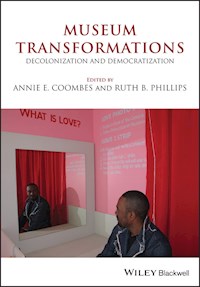
Cover Image: A Hotel Yeoville visitor prepping for his photo in the Photo Booth. © Terry Kurgan and the Hotel Yeoville project. The participant has given permission for the use of his image but has asked that his name be withheld.
Set in 11/13 pt Dante by SPi Global, Pondicherry, India
Printed and bound by CPI Group (UK) Ltd, Croydon, CR0 4YY
10 9 8 7 6 5 4 3 2 1
LIST OF ILLUSTRATIONS
Color plate section
0.1 Display of masks made by the Kalabari peoples from the Niger Delta in Southern Nigeria, the Sainsbury Africa Gallery at the British Museum
1.2 Room of Dimensions, Foundation Memorial to the Murdered Jews of Europe, 2008
2.6 Street leading to Demton Khang and Tsuglugkhang Complex, McLeodganj (upper Dharamsala). The black obelisk is the Tibetan National Martyrs’ Memorial.
3.3 Theresa Napurrula Ross, National Museum of Australia
6.4 Yinka Shonibare, Planets in My Head, Literature, 2011, Colonial Theater at the Tropenmuseum, Amsterdam, 2012
7.4 “Society” menu of the interactive display on the city of Boma
8.1 The Museum of Memory and Human Rights, Santiago de Chile
9.2 Ground plan of a cell at the Women’s Jail, Johannesburg, 2005
9.4 Nikiwe Deborah Matshoba’s wedding dress at the Women’s Jail, Johannesburg, 2005
10.2 Women in south Erromango studying photographs of barkcloth held by the British Museum, 2007
11.3 Ralph Regenvanu, The Melanesia Project, 2006, British Museum
12.3 Students from Red Crow Community College, Kainai Nation, during a visit to the Glenbow Museum
13.1 Yucca workshop, A:shiwi A:wan Museum and Heritage Center
14.3 Two of Chief Owuor’s surviving wives, Dorina Owuor and Turfosa Omari, with Gilbert Oteyo, holding the framed portraits of Owuor
15.3 Mural promoting the sierraleoneheritage.org resource painted on a wall of the Sierra Leone National Museum by the Freetown‐based artist Julius Parker
15.4 Visual repatriation of history at Rotata 16.1 Three generations of Warumungu women watching and editing videos for inclusion on the DDAC website in Tennant Creek, NT, Australia, 2005
19.3 A Hotel Yeoville participant adds his story to the Google Maps API in the Journey Booth
19.6 Installation view of the Hotel Yeoville main thoroughfare
20.2 elles@centrepompidou homepage, 2009
21.1 Kwakwaka’wakw area, UBC Museum of Anthropology Multiversity Galleries
22.2 Mr. and Mrs. Ike, Confederated Tribes of the Warm Springs Reservation, Oregon, in front of the National Museum of the American Indian
23.2 Exhibition view: Vivan Sundaram, The History Project, 1998
24.2 “Canadian Residential Schools” module, First Peoples Hall, Canadian Museum of Civilization (now the Canadian Museum of History)
Chapter illustrations
0.1 Masks made by Kalabari peoples from the Niger Delta, Sainsbury Africa Gallery, British Museum
0.2 Tree of Life, 2004, Sainsbury Africa Gallery
0.3 Recreated Mohawk Family diorama, Daphne Cockwell Gallery of Canada: First Peoples, Royal Ontario Museum
0.4 Visual Sovereignty Dance at Masq’alors! International Mask Festival, St. Camille
1.1 Memorial to the Murdered Jews of Europe, Berlin
1.2 Room of Dimensions, Memorial to the Murdered Jews of Europe
1.3 Room of Names, Memorial to the Murdered Jews of Europe
1.4 Room of Families, Memorial to the Murdered Jews of Europe
2.1 Khalsa Heritage Complex, Anandpur Sahib
2.2 Galleries dedicated to Guru Nanak, Khalsa Heritage Complex
2.3 Paintings of eighteenth‐century martyrs, Central Sikh Museum
2.4 Gallery view, Tibet Museum, McLeodganj
2.5 Bloodstained shirt of escapee from China, Tibet Museum
2.6 Street leading to Demton Khang and Tsuglugkhang Complex, McLeodganj
3.1 “Contested Frontiers” exhibit, National Museum of Australia
3.2 1823–1825 Wiradjuri War display, National Museum of Australia
3.3 Theresa Napurrula Ross tells of the Coniston Massacre, National Museum of Australia
4.1 Where Are the Children? at the Tom Thomson Gallery, 2009
4.2 Entrance to Where Are the Children?, Glooscap Heritage Centre, Millbrook, Nova Scotia, 2011
4.3 Entrance to Where Are the Children?, Tom Thomson Gallery, 2009
4.4 “We Were So Far Away …,” Ottawa Catholic School Board, 2010
4.5 An Elder in Arviat, Nunavut, encounters “We Were So Far Away …” at the Mikilaaq Centre, 2009
5.1 National Museum of Struggle and Archbishop’s Palace, Nicosia
5.2 Photographs of dead fighters, National Museum of Struggle
5.3 Photographs of British interrogators/torturers and of their victims, National Museum of Struggle
5.4 Execution room and memorial plaque at the Central Jail of Nicosia 6.1 Souterrain entrance, Tropenmuseum
6.2 Introductory panel to “Oceania” section of “Eastward Bound!” at the Tropenmuseum
6.3 Colonial Theater, Tropenmuseum
6.4 Yinka Shonibare, Planets in My Head, Literature, 2011
7.1 The color bar as reflected in urban form and architecture, Royal Museum for Central Africa
7.2 Main interface of interactive display on the city of Boma, Royal Museum for Central Africa
7.3 Title page of interactive display on Boma
7.4 “Society” menu of the interactive display on Boma
7.5 “Violence” menu of the interactive display on Boma
8.1 Museum of Memory and Human Rights, Santiago de Chile
8.2 Jorge Tacla, Al mismo tiempo, en el mismo lugar, Museum of Memory and Human Rights
8.3 Museum of Memory, Rosario
8.4 Former concentration camp at Police Headquarters, Plaza Cívica, Rosario
9.1 Monument to the Women of South Africa, by Wilma Cruise and Marcus Holme, 2000
9.2 Ground plan of a cell, Women’s Jail, Johannesburg
9.3 Installations across the atrium, Women’s Jail
9.4 Nikiwe Deborah Matshoba’s wedding dress, Women’s Jail
10.1 Erromangan women ready to perform at Vanuatu’s Third National Arts Festival, Port Vila
10.2 Women in south Erromango studying photographs of barkcloth held by the British Museum
11.1 Shield, Trobriand Islands, British Museum
11.2 Workroom at British Museum ethnograph store
11.3 Ralph Regenvanu, The Melanesia Project, 2006
12.1 Blackfoot shirts on display at the Glenbow Museum
12.2 Discussing leggings and shirts at the Pitt Rivers Museum
12.3 Students from Red Crow Community College, Kainai Nation, during a visit to the Glenbow Museum
12.4 Teacher training session at the Glenbow Museum
13.1 Yucca workshop, A:shiwi A:wan Museum and Heritage Center
13.2 Zuni waffle gardens
14.1 Photo of Jacob Odawo and Archdeacon W. E. Owen by E. E. Evans‐Pritchard, 1936, Pitt Rivers Museum
14.2 Pupils at Rakombe Primary School view the Paro Manene exhibition
14.3 Two of Chief Owuor’s surviving wives, Dorina Owuor and Turfosa Omari, holding his framed portraits
14.4 Framed portraits in the home of a surviving wife of Chief Owuor
15.1 The sierraleoneheritage.org digital resource
15.2 Frames from the sowei video documentation
15.3 Mural promoting sierraleoneheritage.org on a wall of the Sierra Leone National Museum
15.4 Visual repatriation of history at Rotata
15.5 The Reanimating Cultural Heritage project
16.1 Warumungu women watching and editing videos for the DDAC website
16.2 Home page of the DDAC website
16.3 Recreation on DDAC website of Aboriginal community’s covering over of images of the deceased in museum spaces
16.4 Inuvialuit Living History Project team examine engraved wooden plaques
16.5 Inuvialuit Pitqusit Inuuniarutait/Inuvialuit Living History homepage
18.1 Watching films on the lecterns/little houses in Towards the Other
18.2 Watching Nothing Is Missing in Towards the Other
19.1 Hotel Yeoville visitor in the Photo Booth
19.2 Comments left in the Photo Booth by Hotel Yeoville visitors
19.3 Hotel Yeoville participant adds his story to the Journey Booth
19.4 Hotel Yeoville visitor making a YouTube video in the Video Booth
19.5 Hotel Yeoville exhibition layout
19.6 Installation view of Hotel Yeoville main thoroughfare
20.1 WACK! Art and the Feminist Revolution homepage
20.2 elles@centrepompidou homepage
20.3 Shifting the Gaze: Painting and Feminism homepage
21.1 Kwakwaka’wakw area, Multiversity Galleries, UBC Museum of Anthropology
21.2 Nuxalk raven rattles, UBC Museum of Anthropology
22.1 National Museum of the American Indian, Washington, DC
22.2 Mr. and Mrs. Ike, Confederated Tribes of the Warm Springs Reservation, Oregon, at the National Museum of the American Indian
22.3 Installation of guns and Bibles, National Museum of the American Indian
23.1 Victoria Memorial Museum, Kolkata
23.2 Vivan Sundaram, The History Project, 1998
23.3 Vivan Sundaram, “Traces of the Queen,” The History Project, 1998
23.4 Railway car, The History Project, 1998
24.1 Canadian Museum for Human Rights, Winnipeg
24.2 “Canadian Residential Schools” module, Canadian Museum of Civilization
24.3 “Canadian Residential Schools” module (detail)
24.4 “Aboriginal Peoples of Canada” section (artist’s rendering), Canadian Museum for Human Rights
EDITORS
Annie E. Coombes teaches museum studies and art and cultural history at Birkbeck, University of London. She is Director of the Peltz Gallery and author of award‐winning books on museums, memorialization, and the legacy of colonialism including Reinventing Africa: Museums, Material Culture and Popular Imagination in Late Victorian and Edwardian England (Yale University Press, 1994); History After Apartheid: Visual Culture and Public Memory in a Democratic South Africa (Duke University Press, 2003); and Managing Heritage, Making Peace: History, Identity and Memory in Contemporary Kenya (with L. Hughes and Karega‐Munene; I. B. Tauris, 2013). She has also edited the collection Rethinking Settler Colonialism: History and Memory in Australia, Canada, Aotearoa New Zealand and South Africa (Manchester University Press, 2006).
Professor Annie E. Coombes Professor of Material and Visual Culture
Department of History of Art Birkbeck, University of London
London, UK
Ruth B. Phillips teaches in the graduate program in Cultural Mediations at Carleton University and is a former director of the University of British Columbia Museum of Anthropology. Her research and publications span African art, indigenous North American art and critical museology, and include Representing Woman: Sande Society Masquerades of the Mende of Sierra Leone (Fowler Museum of Cultural History, 1995); Trading Identities: The Souvenir in Native North American Art from the Northeast, 1700‐1900 (University of Washington Press, 1998); Museum Pieces: Toward the Indigenization of Canadian Museums (McGill Queen’s University Press, 2011); and, with Janet Catherine Berlo, Native North American Art (Oxford University Press, revised edition, 2014). She is a fellow of the Royal Society of Canada.
Professor Ruth B. Phillips Canada Research Professor and
Professor of Art History Institute for Comparative Studies in Literature, Art, and Culture
Carleton University Ottawa, ON, Canada
GENERAL EDITORS
Sharon Macdonald is Alexander van Humboldt Professor in Social Anthropology at the Humboldt University Berlin where she directs the Centre for Anthropological Research on Museums and Heritage – CARMAH. The centre works closely with a wide range of museums. Sharon has edited and coedited volumes include The Companion to Museum Studies (Blackwell, 2006); Exhibition Experiments (with Paul Basu; Blackwell, 2007); and Theorizing Museums (with Gordon Fyfe; Blackwell, 1996). Her authored books include Behind the Scenes at the Science Museum (Berg, 2002); Difficult Heritage: Negotiating the Nazi Past in Nuremberg and Beyond (Routledge, 2009); and Memorylands: Heritage and Identity in Europe Today (Routledge, 2013). Her current projects include Making Differences. Transforming Museums and Heritage in the 21st Century.
Professor Sharon Macdonald Alexander van Humboldt Professor in Social Anthropology
Institute for European Ethnology Humboldt University of Berlin
Berlin, Germany
Helen Rees Leahy is Professor Emerita of Museology at the University of Manchester, where, between 2002 and 2017 she directed the Centre for Museology. Previously, Helen held a variety of senior posts in UK museums, including the Design Museum, Eureka! The Museum for Children, and the National Art Collections Fund. She has also worked as an independent consultant and curator, and has organized numerous exhibitions of art and design. She has published widely on practices of individual and institutional collecting, in both historical and contemporary contexts, including issues of patronage, display and interpretation. Her Museum Bodies: The Politics and Practices of Visiting and Viewing was published by Ashgate in 2012.
Professor Emerita Helen Rees Leahy
Centre for Museology School of Arts, Languages and Cultures
University of Manchester
Manchester, UK
CONTRIBUTORS
Jens Andermann, University of Zurich, Switzerland
Bain Attwood, Monash University, Australia
Mieke Bal, University of Amsterdam, The Netherlands
Paul Basu, University College London, UK
Lissant Bolton, British Museum, London, UK
Mary Bouquet, University College Utrecht, The Netherlands
Tegan Bristow, University of the Witwatersrand, South Africa
Alison K. Brown, University of Aberdeen, UK
Miriam Clavir, Museum of Anthropology at the University of British Columbia, Canada
Annie E. Coombes, Birkbeck, University of London, UK
Jonathan Dewar, Director of the Shingwauk Residential Schools Centre and Special Advisor to the President at Algoma University in Sault Ste. Marie, Ontario
Reesa Greenberg, Carleton University and York University, Canada
Gwyneira Isaac, National Museum of Natural History, Smithsonian Institution, USA
Gabriel Koureas, Birkbeck, University of London, UK
Jennifer Kramer, University of British Columbia and Museum of Anthropology at the University of British Columbia, Canada
Terry Kurgan, University of the Witwatersrand, South Africa
Johan Lagae, Ghent University, Belgium
Saloni Mathur, University of California, Los Angeles, USA
Christopher Morton, Pitt Rivers Museum, University of Oxford, UK
Alexander Opper, University of Johannesburg, South Africa
Gilbert Oteyo, independent researcher, Kenya
Laura Peers, Pitt Rivers Museum, University of Oxford, UK
Ruth B. Phillips, Carleton University, Canada
Sibylle Quack, Leibniz Universität, Hannover, Germany
Kavita Singh, Jawaharlal Nehru University, India
Paul Chaat Smith, National Museum of the American Indian, Smithsonian Institution, USA
Nicholas Thomas, Museum of Archaeology and Anthropology, University of Cambridge, UK
Kimberly Christen, Washington State University, USA
EDITORS’ PREFACE TO MUSEUM TRANSFORMATIONS AND THE INTERNATIONAL HANDBOOKS IN MUSEUM STUDIES
Museum Transformations
As general editors of The International Handbooks in Museum Studies, we – Sharon Macdonald and Helen Rees Leahy – are delighted that Museum Transformations is now appearing in paperback, as a self‐standing volume. So too are the other volumes, which is testament to the strength of these volumes individually, as well as collectively, and to the importance of the issues that they each address. Museum Transformations explores a wide range of ways in which museums seem to be changing, and examines how far the ‘tranformational energies’ that can be witnessed in many parts of the globe, represent ramifying reconfiguration of museums. This is a major focus of interest for museum studies, identifying as it does not only what has been happening but also what the future might bring. Deciding which are the key transformations – especially when retrospect is only sometimes and then usually only partly available – is inevitably a major challenge.
That challenge is, however, one that the editors of Museum Transformations, Annie E.Coombes and Ruth B.Phillips tackled with great insight and deep knowledge of the field. Writing now from the vantage point of 2019, it is clear to us as general editors that they absolutely had their fingers on the pulse, as is thoroughly evident from the resulting volume. The range of topics included and the ways in which they are tackled clearly highlight not only what is already in transformation but also potential future trajectories – and, in some cases, dreams that are already on their way to becoming realities.
The International Handbooks in Museum Studies
Collectively, The International Handbooks in Museum Studies include over a hundred original, state‐of‐the‐art chapters on museums and museum studies. As such, they are the most comprehensive review to date of the lively and expanding field of museum studies. Written by a wide range of scholars and practitioners – newer voices as well as those already widely esteemed – The International Handbooks provide not only extensive coverage of key topics and debates in the museum field, but also make a productive contribution to emerging debates and areas, as well as to suggest how museum studies – and museums – might develop in the future.
The number of excellent contributors able and willing to write on museum topics is itself testimony to the state of the field, as was recognition by the publishers that the field warranted such a substantial work. Bringing together such a range and quantity of new writing about museums was accomplished through the deep knowledge, extensive networks, and sheer labour of the volume editors – Andrea Witcomb and Kylie Message, Museum Theory; Conal McCarthy, Museum Practice; Michelle Henning, Museum Media; and Annie E. Coombes and Ruth B. Phillips, Museum Transformations. All enthusiastically took up the mandate to go out and recruit those they thought would be best able to write useful and timely essays on what they defined as the most important topics within their area of remit. Their brief was to look widely for potential contributors, including unfamiliar, as well as familiar, names. We – and they – were especially interested in perspectives from people whose voices have not always been heard within the international museum studies conversation thus far. This breadth is also a feature of the expanded and expanding field itself, as we explain further below.
Diversification and democratization
The editors of the four volumes that constitute The International Handbooks are based in four different countries – Australia, New Zealand, the United Kingdom, and Canada; and contributors have their institutional homes in over a dozen more. Yet these numbers alone do not fully convey the trend to diversification that we see in these volumes, and in museum studies more widely. “Internationalization” is a term that might be used but does not, we think, adequately characterize what is involved. Certainly, there is more traffic between nations of ideas about museums and about how to study them. Debates travel from one part of the globe to another, with museums and exhibitions in one location being used as models for emulation or avoidance in another. The massive expansion of professional training in museum studies that has taken place over the past three decades helps establish a shared discourse, not least as many students study away from their home countries or those in which they will later work. So too do texts in and about the field, certain key ones often being found on reading lists in numerous countries and also republished in successive readers. Such developments establish the basis for a conversation capable of transcending borders.
It is evident from the contents of The International Handbooks of Museum Studies, however, that the democratization runs deeper than the traffic of discourse and practice across national borders, and, in particular, that the traffic is more multi‐directional than it was previously. Not only do contributors have their primary work bases in a range of different countries, and not only do many have experience of training or working in others, they also often give attention – sometimes through the direct engagement of collaborative work or study – to a wide range of groups and populations in a variety of countries, including their own. In doing so, they strive not merely to incorporate but also to learn from and be challenged by people and perspectives that have not been part of mainstream museological debate. The attention to the (not unproblematic) category of the indigenous is especially marked in these International Handbooks, most notably in the Transformations volume, although it also finds its way into the others. Like attention to other forms of absence from the existing mainstream museum conversation, this is symptomatic of a broader move toward finding alternative ways of seeing and doing, ways that both add to the range of existing possibilities and also, sometimes, unsettle these by showing how, say, particular theorizing or practice relies on unspoken or previously unrecognized assumptions.
Diversification takes other forms too. These volumes are not organized by type of museum – a format that we think restrictive in its lack of recognition of so many shared features and concerns of museums – and do not use this as a classification of content. Nevertheless, it is easy to see that the volumes include a great range of museum kinds, and even of forms that might not always be considered museums, or that challenge the idea of the museum as a physical space. Museums of art, history, and ethnography – and also those more general and eclectic museums that have sometimes been described as encyclopedic – have powered a good deal of museum theorizing and debate, and they are amply represented here. But they are accompanied also by examples from museums of natural history, science, technology, and medicine, as well as heritage sites and out‐of‐ gallery installations. Alongside national museums, which were the backbone of much important theorizing of the role of museums in the making of national identity and citizenship, are numerous examples of smaller museums, some of which are devoted to a specific topic and others of which have a regional or local foundation and focus. These museums may be less well endowed with staff, buildings, or funds, but are nevertheless doing important, even pioneering, work that deserves attention from museum studies. That attention contributes not only to extending the range of types and cases but also helps to illuminate the variety of specific features of museums that need to be taken into account in formulating more comprehensive approaches. As many chapters across the volumes show, one size does not fit all – or, to put it better perhaps, one theoretical perspective or set of guidelines for practice, one apt choice of media or transformative activity, does not fit all types and sizes of museums. Adding more to the mix does not just provide greater coverage or choice but also helps to identify better what is at stake and what might be possible in different kinds of situations, constellations, or conjunctures (to use a word favored in Museum Theory). As such, it helps those of us engaged in and with museums to get a better grasp on what is and what might be shared, as well as on what is distinctive and needs to be understood in more fine‐grained ways.
Another feature of diversification that deserves comment here is the temporal. There has been a considerable amount of outstanding historical research undertaken in museum studies and the International Handbooks both review some of this and contribute further to it. Such work is important in its own terms, helping us to understand better the contexts in which museums emerged and have operated, and the concerns, constraints, personalities, and opportunities in evidence in particular times and places. It also contributes in vital ways to contemporary understandings, both by adding to the range of cases available for analysis and by showing the longer historical trajectories out of which various current approaches and practices emerged. Sometimes – and there are examples in all of the volumes here – their message is salutary, showing that what seemed like an innovation has been tried before, and perhaps with the distance of time allowing a more critical perspective than might feel comfortable today. The past shows change but also continuities and the re‐emergence, or even repackaging, of what has gone before.
Disciplinarity and methodology
Research on past museum innovation and practice shows the importance of historical method, and of history as a discipline, within museum studies. This brings us to the wider issue of disciplinarity and methodology. To talk of museum studies as interdisciplinary has become a truism. The volumes here are a clear illustration that those involved in museum studies have been trained in and may have primary institutional locations in a wide range of disciplines and areas of study, including anthropology, archaeology, architecture, area studies, cultural studies, economics, education, geography, literature, management, media studies, political science, and sociology, as well as history and art history. Beyond that, however, they are also carving out new niches, sometimes institutionally recognized, sometimes not, in areas such as digital curation and creative technologies, as well as in art gallery, museum, and heritage studies, in various combinations or alone. Moreover, in addition to disciplines and a multitude of academic specialisms, practitioner contributors bring diverse professional expertise in areas including exhibition design, community engagement, conservation, interpretation, and management.
Alongside the diversity of concepts and methodologies offered by various disciplines and diverse forms of practical expertise, is also the distinctive feature of museum studies – its engagement with the past, present, and future world of museums. Such work, to varying extents, confronts researchers and academics with the actual concerns, predicaments, objects, spaces, media, and people all, in various ways, involved in museum collections and exhibitions. Increasingly, this means actual collaboration, and the development of methodological approaches to enable this. Examples in these volumes include those who consider themselves to be primarily academics, artists, or activists being directly involved in the production of collections, media (e.g., new media apps or forms of display), and exhibitions. The nature of museum work is, inevitably, collaborative, but in some cases it also involves more explicit attempts to work with those who have had little previous engagement in museum worlds and draws on methodology and ethical insight from disciplines such as social and cultural anthropology to do so. Such actual engagement – coupled with what we see as more fluid traffic between academia and museums also powers new forms of theorizing and practice. This productive mobility affords museum studies its characteristic – and, in our view, especially exciting – dynamic.
Organization of the International Handbooks
As we originally planned these International Handbooks, dividing their coverage into the four volumes of Theory, Practice, Media, and Transformations made good sense as a way of grouping key areas of work within the field. Our idea was that Theory would bring together work that showed central areas of theorizing that have shaped museum studies so far, together with those that might do so in the future. We envisaged Practice as attending especially to areas of actual museum work, especially those that have tended to be ignored in past theorizing, not in order to try to reinstate a theory/practice division but, rather, to take the opportunity to transcend it through theorizing these too. We saw Media as the appropriate label to cover the crucially important area for museums of their architecture, spaces, and uses of diverse media primarily, though not exclusively, for display. Transformations was intended to direct its attention especially to some of the most important social, cultural, political, and economic developments that are shaping and look likely to reshape museums in the future.
In many ways, what has resulted fits this original remit. We always knew that there would inevitably be areas of convergence: in particular, that theory can derive from practice, and vice versa; that the development and expansion of social media is propelling some of the most significant transformations in museums, and so forth. Yet it is probably true to say that there are more synergies than we had imagined, perhaps because museum work has itself become more open to change, new ideas and practice, and unconventional practitioners and participants, from what would previously have been considered outside. To make distinctions between practitioners and theorists continues to make sense in some contexts. What we see, however, is an increasing band of critical practitioners and practice‐ based researchers – those who operate in both worlds, drawing inspiration for new practice from areas of theorizing as well as from adaptations of cases from elsewhere. Equally they use practice to think through issues such as the nature of objects, the role of media, or sensory potentials.
It is interesting to note that at an analytical level, the volumes all contain chapters that give emphasis to specific cases and argue for the importance of paying close attention to grounded process – what actually happens, where, who, and what is involved. Although not all are informed by theoretical perspectives of actor network theory or assemblage theory, there is much here that recognizes the significance of material forms not just as objects of analysis but as agents in processes themselves. There is also much work across the volumes that gives explicit attention to the affective dimensions of museums, exploring, for example, how different media or spaces might afford certain emotional engagements. The sensory is also given new levels of consideration in what we see as, collectively, a more extensive attempt to really get to grips with the distinctiveness of museums as a medium, as well as with their sheer variety.
Various forms of collaborative engagement with specific groups – sometimes called communities – as well as with individual visitors, is also a notable theme cutting across the various volumes. Certainly, the idea of a generic “audience” or “public” seems to be less present as a central but abstract focus than in the past. Divisions along lines of gender or class are made less frequently than they might have been in earlier critical perspectives – though when they are, this is often done especially well and powerfully, as, for example, in some contributions to the discussion of museum media. Interestingly, and this is a comment on our times as well as on social and political developments in which museums are embroiled, the work with “communities” is framed less in terms of identity politics than would probably have been the case previously. No longer, perhaps, is the issue so much about making presence seen in a museum, increasingly it is more about mutually enriching ways of working together, and about pursuing particular areas or issues of concern, such as those of the environment or future generations. Yet politics is certainly not absent. Not only is the fundamental question about whose voice is represented in the museum a thoroughly political one, the chapters also show political concerns over relatively subtle matters such as methodology and reformulations of intimacy, as well as over questions of sponsorship, money‐flow in the art world, the development of mega‐ museums in Gulf states, environmental destruction, and so forth. Indeed, there is a strong current of work that positions the museum as an activist institution and that shows its potential as such – something perhaps indicative of at least one future direction that more museums might take.
One thing that is clear from these volumes, however, is that there is no single trajectory that museums have taken in the past. Neither is there a single track along which they are all heading, nor one that those of us who have contributed would agree that they should necessarily all take. The diversity of museums themselves, as well as of those who work in, on, and with them, and of the perspectives that these volumes show can be brought to bear upon them – as well as their very various histories, collections, contexts, personnel, publics, and ambitions – has inspired the diversified museum studies represented in these International Handbooks. Our hope is that this more diversified museum studies can contribute not only to new ways of understanding museums but also to new, and more varied, forms of practice within them – and to exciting, challenging futures, whatever these might be.
Acknowledgments
Producing these International Handbooks of Museum Studies has probably been a bigger and more demanding project than any of us had anticipated at the outset. Assembling together so many authors across four different volumes, and accommodating so many different timetables, work dynamics, styles, and sensitivities has been a major task over more years than we like to recall for both us as general editors, and even more especially for the editors of our four volumes: Andrea Witcomb, Kylie Message, Conal McCarthy, Michelle Henning, Annie E. Coombes, and Ruth B. Phillips. As general editors, our first thanks must be to the volume editors, who have done a remarkable task of identifying and eliciting so many insightful and illuminating contributions from such a wide field, and of working with authors – not all of whom were experienced in academic writing and many of whom were already grappling with hectic schedules – to coax the best possible chapters from them. We thank our volume editors too for working with us and what may sometimes have seemed overly interventionist assistance on our part in our push to make the volumes work together, as well as individually, and for all contributions, as well as the International Handbooks as a whole, to be a substantial contribution to the field. We also thank our volume editors for sharing so much good humor and so many cheering messages along the way, turning what sometimes felt like relentless chasing and head‐aching over deadlines into something much more human and enjoyable. All of the contributors also deserve immense thanks too, of course, for joining the convoy and staying the journey. We hope that it feels well worth it for all concerned. Without you – editors and contributors – it couldn’t have happened.
There is also somebody else without whom it couldn’t have happened. This is Gill Whitley. Gill joined the project in 2012 as Project Editor. In short, she transformed our lives through her impeccable organization and skillful diplomacy, directly contacting contributors to extract chapters from them, setting up systems to keep us all on track with where things were up to, and securing many of the picture permissions. She has been a pleasure to work with and we are immensely grateful to her.
The idea for a series of International Handbooks of Museum Studies came from Jayne Fargnoli at Wiley Blackwell and we are grateful to her for this and being such a great cheerleader for the project. She read a good deal of the work as it came in and knowing that this only increased her enthusiasm for the project boosted everyone’s energy as we chased deadlines. We also thank other staff at Wiley Blackwell for their role in the production processes, including, most recently, Jake Opie, for helping to at last allow us to bring out the individual volumes in paperback format.
Because of its extended nature and because things don’t always happen according to initial timetables, editorial work like this often has to be fitted into what might otherwise be leisure time or time allocated for other things. Luckily, both of our Mikes (Mike Beaney and Mike Leahy) were sympathetic, not least as both have deeply occupying work of their own; and we thank them for being there for us when we needed them.
Lastly, we would like to thank each other. We have each benefited from the other’s complementary expertise and networks, from the confidence of having that insightful second opinion, and from the sharing of the load. Having somebody else with whom to experience the frustrations and joys, the tribulations and amusements, has made it so much more fun. Not only has this helped to keep us relatively sane, but it has also made The International Handbooks of Museum Studies so much better than they would otherwise have been.
Sharon Macdonald and Helen Rees Leahy, August 2014 and July 2019




