


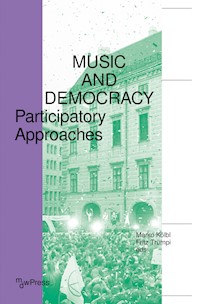
Music and Democracy E-Book
0,00 €
Mehr erfahren.
- Herausgeber: transcript Verlag
- Kategorie: Geisteswissenschaft
- Serie: mdwPress
- Sprache: Englisch
Music and Democracy explores music as a resource for societal transformation processes. This book provides recent insights into how individuals and groups used and still use music to achieve social, cultural, and political participation and bring about social change. The contributors present outstanding perspectives on the topic: From the promise and myth of democratization through music technology to the use of music in imposing authoritarian, neoliberal or even fascist political ideas in the past and present up to music's impact on political systems, governmental representation, and socio-political realities. The volume further features approaches in the fields of gender, migration, disability, and digitalization.
Das E-Book können Sie in Legimi-Apps oder einer beliebigen App lesen, die das folgende Format unterstützen:
Seitenzahl: 502
Veröffentlichungsjahr: 2021
Ähnliche




















The editors invited this volume’s authors to contribute their chapters. Each chapter underwent a double-blind peer review process. In total, eighteen independent invited reviewers were involved. The mdwPress coordination and the editors supervised the review process.
Marko Kölbl, Fritz Trümpi (eds.)
Music and Democracy
Participatory Approaches
This book was generously funded by
Bibliographic information published by the Deutsche Nationalbibliothek
The Deutsche Nationalbibliothek lists this publication in the Deutsche Nationalbibliografie; detailed bibliographic data are available in the Internet at http://dnb.d-nb.de
This work is licensed under the Creative Commons Attribution-Non Commercial 4.0 (BY-NC) license, which means that the text may be may be remixed, build upon and be distributed, provided credit is given to the author, but may not be used for commercial purposes.
For details go to: http://creativecommons.org/licenses/by-nc/4.0/
Permission to use the text for commercial purposes can be obtained by contacting [email protected]
Pictures which are used in this publication thanks to the courtesy of a third party may not be re-used independently from (parts of) the text of this publication despite the Creative Commons license. Permission from the rights holder is required in this case. The obligation to research and clear permission lies solely with the party re-using the material.
© 2021 The authors
Editorial assistant: Karoline Feyertag
Cover layout: Bueronardin
Cover illustration: Dutch pop group Vengaboys perform their song “We’re Going to Ibiza” on a stage during a protest against the government in Vienna, Austria, May 30, 2019. Credit: Lisi, Nieser/Reuters/picturedesk.com
Proofread: Jason S. Heilman
Typeset: Nora Schmidt
Printed by Majuskel Medienproduktion GmbH, Wetzlar
Print-ISBN 978-3-8376-5657-2
PDF-ISBN 978-3-8394-5657-6
EPUB-ISBN 978-3-7328-5657-2
https://doi.org/10.14361/9783839456576
Contents
Ambivalences in Music and Democracy:Introductory Remarks
Marko Kölbl and Fritz Trümpi
Part 1: From Recorded Democracy to Digital Participation?
Entrepreneurial Tapists
Underground Music Reproduction and Distribution in the US and USSR, 1960s and 1970s
Marsha Siefert
New Model, Same Old Stories?
Reproducing Narratives of Democratization in Music Streaming Debates
Raphaël Nowak and Benjamin A. Morgan
Part 2: Political Impacts of Bourgeois Music Culture
The National Society of Music (1915–1922) and the Ambivalent Democratization of Music in Spain
David Ferreiro Carballo
Verdi at the Heart of the Dictatorship
A celebrazione verdiana Among Fascists
Gabrielle Prud’homme
Part 3: (Non‐)Democratic Participation in Popular Music and Performance Cultures
The Intervision Song Contest
Popular Music and Political Liberalization in the Eastern Bloc
Dean Vuletic
“Vodka, Beer, Papirosy”
Eastern European Working‐class Cultures Mimicry in Contemporary Hardbass
Ondřej Daniel
Disembodiment and South Asian Performance Cultures
Rumya S. Putcha
Part 4: Sonic Implications of Political Changes
Music Activism in Serbia at the Turn of the Millennium
Counterpublics, Citizenship, and Participatory Art
Milena Dragićević Šešić and Julija Matejić
Expanding Musical Inclusivity
Representing and Re‐presenting Musicking in Deaf Culture through Hip Hop
Katelyn E. Best
About mdwPress
Ambivalences in Music and Democracy: Introductory Remarks
Marko Kölbl and Fritz Trümpi
Marko Kölbl is an ethnomusicologist and senior scientist at the Department of Folk Music Research and Ethnomusicology at mdw – University of Music and Performing Arts Vienna. He is specialized in music and dance of minorities and migrant communities with an interest in intersectional, queer-feminist, and postcolonial perspectives.
Fritz Trümpi is a musicologist and associate professor at the Department of Musicology and Performance Studies at mdw – University of Music and Performing Arts Vienna. His research focuses on the history of music industries and musicians’ organisations, music & politics, and music culture(s) of the late Habsburg Empire and its successor states.
After Donald Trump’s failed re-election as President of the United States of America in fall 2020, the Republicans’ out-of-the-blue claims of “electoral fraud” is just one of countless warning signs: to varying extents and degrees, democracy is in great danger all over the world. Already in the early 2000s, Colin Croach noted a subtle but increasing demolition of—but also an increased disinterest in—political participation of the people, which he considered as main characteristics of “post-democracy.”1 However, despite the doubtlessly growing interventions (of growing severity) of political as well as economic elites against liberal and democratic values and structures, it cannot be overlooked that also resistance against limitations on the people’s active participation in political life is growing and spreading. Some of these protest movements are globally connected, operating in many parts of the world (such as “Fridays for Future” or “Black Lives Matter”), while others are acting primarily on a country-by-country basis, within specific regions, or even communally.
An illustrative example of regional protests that address the broader political climate is the “Ibiza affaire,” to which this book’s cover refers. After the infamous Ibiza tapes leaked,2 the governmental crisis in Austria resulted in public protests that were profoundly shaped by music and dancing. Various musical actors provided the soundscape for political protest, spanning from postmigrant rap to activist choirs. This volume’s cover photo captures a historic moment in the course of this governmental crisis. The fact that the eponymous tapes were secretly recorded at a rented finca on Ibiza, Spain, resulted in a sudden revival of the 1999 song “We’re Going to Ibiza” by the ’90s Euro Dance band Venga Boys. The song became the soundtrack of the protest, was used in TV coverage and ranked number one on the Austrian Spotify charts. It achieved definite political significance when Venga Boys performed it from their tour bus in front of the main government’s building at Vienna’s Ballhausplatz, where an enormous dancing and singing crowd celebrated the expected fall of the government. The song’s musical qualities and its topical apoliticality—’90s synthetic club sounds dealing with partying in Ibiza—are not exactly what one would call a prime example of democratic content in music. Precisely the song’s trashy aura, however, helped to point out the political critique of cheap corruption and simultaneously showcased contemporary protest culture’s entanglement with club culture and party making.
While a rich body of literature has explored in recent years how individuals and groups use music as a resource to achieve social, cultural, and political participation and to bring about social change in society,3 the present volume specifically focuses on the addressed tensional dichotomy. Its various contributions investigate the manifold ways of music’s use by activists, but also by political groups and even governments, exploring emancipative processes and mirroring them with the implementation of nationalist, authoritarian, fascist, or neoliberal political ideas. Furthermore, the volume is also concerned with the promise and myth of democratization through technology in regard to music production, distribution, and reception/appropriation.
However, the addressed dichotomy—the existence of a causal link between governmental repression and the formation of protest movements—is anything but new. A short look back to the long nineteenth century in Europe, for example, shows this, for instance with regard to the revolutionary acts around 1848 across the continent (and in other parts of the world), when (the not only but predominantly bourgeois) parts of the population revolted against the repressive ancien régime (which came back to power after the French Revolution had lost its claims and influence). And these revolutionaries did so not least by using music as an important tool of their political struggle: be it by singing revolutionary songs (as done, among others, by protesting students) or by performing noise (“Charivari”) during protest marches, or by composing for the revolution (e.g. the Revolutions-Marsch by Johann Strauss Sohn, but also operas like Gustav Albert Lortzing’s Regina, representing the genre of “opera of freedom”). The revolts of 1848 can therefore, admittedly among many other aspects, also be considered as a musical empowerment of the people, or more precisely, in predominant cases, of the bourgeois protagonists (if not of the bourgeoisie as such), as recently shown in a voluminous anthology edited by Barbara Boisits.4
However, the revolutionary frequently threatens to become reactionary: the claims of freedom for the people raised by the revolts’ protagonists of 1848 turned soon into severe claims of nationalism, identifying people more and more as national subjects. And again, music served as an important means of communication when nationalist groups tried to press their case, for instance by the men’s choral societies that had been flourishing since the midnineteenth century.5 With the rise of nationalist aspirations, the inclusion and exclusion of certain groups among the population also increased, not at least with regard to the production, performance, and consumption of music (of any kind), as (for instance) Philip Bohlman showed in a long-term perspective ranging from the end of the nineteenth century up to the early twenty-first.6
After a first peak of devastating violence in the name of nationalism in World War I and the dissolution of imperial Europe, the establishment of more or less democratic-structured republics across the continent happened only hesitantly and was in many cases short lived. This, by reflecting the role of music within the fragile and ambivalent democratization, marks the starting point of the present volume. The contribution of David Ferreiro Carballo deals with the question of how political impacts on bourgeois music culture became implemented within this phase of governmental transition in Spain. He does so with regard to the creation of the National Society of Music, by investigating the repertoire policies of this institution.
What followed, resulting not at least from the republics’ weaknesses, which were caused by fragile democratic structures, was the rise and consolidation of fascism. Implemented first in Italy by Mussolini and his henchmen, it soon covered large parts of Europe. Studying fascism shows—until today without comparison—the devastating instrumentalization of governments acting in the name of “the people” while simultaneously excluding any political participation in a democratic sense. Without a doubt, the sphere of music was highly affected by this fascization of politics and society, as numerous scholars were able to show in the recent past, mainly with regard to Nazi Germany (and Austria).7 In this volume, Gabrielle Prud’homme examines the political appropriation of Giuseppe Verdi in Fascist Italy by studying the celebrations surrounding the fortieth anniversary of Verdi’s death in 1941. Thereby, the author sheds light on how Mussolini’s regime maintained its grip on the commemorations and disseminated a discourse entirely consistent with the fascist political and ideological agenda.
But even under fascist regimes, music did not exclusively fulfil the purposes of the official political agenda. It was, on the contrary, not uncommon to also use music for political protests (albeit for the most part in rather subliminal forms, for fear of repression and persecution); the documented performative acts of the “Swing-Jugend” (Germany) or the “Schlurfs” (Austria) under the Nazi regime may be exemplary here.8 The same applies to political opposition movements in other totalitarian systems of rule. In her essay on the history of “bootleg” sound recordings of the twentieth century, Marsha Siefert explores the world of magnitizdat (as underground music recordings in the Soviet Union were called). She does so by comparing them with “bootleg” opera recordings in the United States, considering both as a way of “democratizing” accesses to music provided by bards (USSR) and music fans (USA).
As implemented in this essay, highlighting the sphere of consumption and distribution of music as a participatory act, and thus as a specific form of artistic practice, adds important perspectives on music and democracy, complementing the more commonly used foci on composing and performing. This understanding obviously meets Christopher Small’s concept of “musicking,” where both the act of performing and the act of listening are equally considered to be predominant musicological research parameters.9 In this context, we would like to point not least to the growing field of research that has been dedicated to the manifold aspects of digitalization in/of music.10 Research on various forms of such “mediamorphosis” include, among others, investigations on the effects for democratization, including possibilities of self-representation, modes of participation for consumers, or business models in music and media. In their contribution, Raphaël Nowak and Ben Morgan investigate interactive commercial services within the “digital ecosystem” by placing a critical perspective on “democratization” in its ambivalence, but at the same time by understanding it as a key indicator for evaluating the distribution of music content on streaming platforms.
A few decades before online streaming platforms shaped music consumption, television shows that featured music were central to popular music distribution as well as the public discourses on popular music. These programs were inherently political, as illustrated by Dean Vuletic in his text. Vuletic discusses Europe’s political split, defined through presumed levels of democracy building on “a longer history of West European cultural prejudice against Central and East Europe” (p. 142). The Intervision Song Contest offered a separate “Eastern” realm for presenting popular music in a competitive format while constituting an arena for the complex dynamics within the chosen regional frame of the singing competition.
Music itself often carries notions of professionalism and elitism that foster a fairly undemocratic image. Specifically, Western classical music’s harsh education system and its high standards of excellence and virtuosity presume a wide range of preconditions seemingly necessary for active musical expression. Similarly, the global pop music scene departs from an understanding of music that is highly professionalized and focuses on idealized individual star figures rather than the collective and social dimensions of music making. However, as a collective and inherently social expression by people notwithstanding their musical educations, instrumental or vocal capabilities, and stylistic preferences, music shows its profoundly democratic qualities. Social movements often rely on democratic ways of musicking that foreground grassroots, “bottom-up” and Do-It-Yourself approaches that help to articulate demands for social justice and challenge political hegemonies.11 In their contribution, Milena Dragičević Šešić and Julija Matejić trace various scenarios of musical activism—“artivism”— in Serbia during the 1990s. The specific contemporary history of the region, the democratic upheavals, and the discussed musical and expressive styles and genres exemplarily showcase music’s and art’s usage in creating counterpublics, defining citizenship, and enabling participation.
As Dragičević Šešić and Matejić show, instances of musical activism often align their aesthetic preferences and content with their political message. The examples are manifold: Activist choirs that appropriate specific political histories of music for contemporary political struggle,12 feminist and queer performance groups that contest heteronormative exclusion through musical and bodily aesthetics and/or anti-racist expressions that foreground the identitypolitical meanings of music and dance. India’s anti-caste movement, for example, draws on musical traditions that emphasize a Dalit self-empowerment, contesting racist and classist social orders.13
A contrasting example of music’s impact is provided by Ondřej Daniel in his essay. Daniel’s class-sensitive discussion of hardbass, “a predominantly Eastern European electronic dance music style” (p. 158) that spread from Russia in the 2000s, shows how music relates to fast-changing political meanings. Through the example of this unique dance and fashion phenomenon—a “working class mimicry”—Daniel traces the genre’s satirical beginnings, its connection to farright politics, and its subsequent de-politicization.
Here, music’s (anti-)democratic capacities become apparent off the beaten tracks of established musical canons and the global music industry. Regional popular music forms, community-based music traditions, orally transmitted musics, and the like make up the central expressive formats of communities (however they are defined), allowing for democratic meaning within music and dance. Specifically, the music and performance practices of minorities and marginalized groups often aim to challenge and subvert dominant norms and classifications. Since power hegemonies frequently inhibit an appropriate representation of minorities and marginalized groups, the communities in question apply their own expressive agency in contesting subordination. This expressive agency of course encompasses various styles and genres of music and performing arts.
One such particular musical style—Deaf hip hop—is the topic of Katelyn Best’s chapter. In it, Best shows how musical agency functions within a community that is commonly perceived as voiceless. Her detailed ethnographic account on musical inclusivity through this specific form of hip hop highlights music’s efficacy in negotiating social exclusion and structural discrimination. As “sound in Deaf culture is signified across sensory modalities” (p. 239), Deaf hip hop expands the common understanding of music and sound and displays a powerful example of musical participation and the relationship between democracy and music.
Migration and border regimes poignantly illustrate the relationship between democracy and the aforementioned variety of musical and performing practices. Music, here, serves as a tool of diasporic relocation that contests both ethnicization and racialization as well as assimilation and the reduction of cultural rights. In migratory settings, musicking enables translation, defines dynamics of Othering processes, and simultaneously gains meaning in sociopolitical change in various settings, from diaspora to exile.14 At the same time, music, and specifically dance, can be useful in propagating ethno-nationalist and gender-stereotypical ideas of ethnicity, as Rumya Putcha shows in her text. Drawing on her own positionality and own experience with the transnational South Indian dance education system, she offers meaningful insight into how this ethnically marked performance culture is bound to maintain the classist imaginaries of caste, gender, and ethnicity.
The present volume gathers various and diverse perspectives on the relationships between music and democracy that are based on contributions to the international conference “Participatory Approaches to Music & Democracy,” the 2018 edition of isaScience (mdw—University of Music and Performing Arts Vienna). In addition to selected conference participants and keynote speakers, this volume also includes other invited authors that we chose to adequately represent the thematic breadth of political participation, democracy, and music.
References
Adlington, Robert and Esteban Buch. Finding Democracy in Music. London:
Routledge, 2021.
Ajotikar, Rasika. “Reflections on the Epistemic Foundations of Music in Modern India through the Lens of Caste: A Case from Maharashtra, India.” In Ethnomusicology Matters: Influencing Social and Political Realities, edited by Ursula Hemetek, Marko Kölbl, and Hande Sağlam, 135–62. Vienna: Böhlau, 2019.
Beyer, Wolfgang and Monica Ladurner. Im Swing gegen den Gleichschritt. Die Jugend, der Jazz und die Nazis. Salzburg: Residenz Verlag, 2011.
Bohlman, Philip. Focus: Music, Nationalism, and the Making of the New Europe. New York: Routledge, 2011.
Boisits, Barbara, ed. Musik und Revolution. Die Produktion von Identität und Raum durch Musik in Zentraleuropa 1848/49. Vienna: Hollitzer, 2013.
Crouch, Colin. Coping with Post-Democracy. Cambridge: Fabian Society, 2000. Hemetek, Ursula, Marko Kölbl, and Hande Sağlam, eds. Ethnomusicology
Matters: Influencing Social and Political Realities. Vienna: Böhlau, 2019.
Hesmondhalgh, David. “Have Digital Communication Technologies Democratized the Media Industries?” In Media and Society, edited by James Curran and David Hesmondhalgh, 6th ed., 101–20. London: Bloomsbury, 2019.
Hofman, Ana. “Disobedient: Activist Choirs, Radical Amateurism, and the Politics of the Past after Yugoslavia.” Ethnomusicology 64, no. 1 (2020): 89– 109.
Kasinitz, Philipp and Marco Martiniello, eds. Ethnic and Racial Studies 42, Special Issue: “Music, Migration and the City” (2019).
Levi, Erik. Music in the Third Reich. Basingstoke: Macmillan, 1994.
Love, Nancy. Musical Democracy. Albany, NY: State University of New York Press, 2006.
______. Trendy Fascism: White Power Music and the Future of Democracy. Albany, NY: State University of New York Press, 2016.
Mecking, Sabine. “Gelebte Empathie und donnerndes Pathos. Gesang und Nation im 19. Jahrhundert.” In Musik—Macht—Staat. Kulturelle, soziale und politische Wandlungsprozesse in der Moderne, edited by Sabine Mecking and Yvonne Wasserloos, 99–126. Göttingen: V&R Unipress, 2012.
Potter, Pamela. Most German of the Arts: Musicology and Society from the Weimar Republic to the End of Hitler’s Reich. New Haven: Yale University Press, 1998.
Ramnarine, Tina, ed. “Musical Performance in the Diaspora.” Special Issue, Ethnomusicology Forum 16, no. 1 (June 2007).
Rathkolb, Oliver. Führertreu und gottbegnadet. Künstlereliten im Dritten Reich. Vienna: Österreichischer Bundesverlag, 1991.
Redepenning, Dorothea. “‘... unter Blumen eingesenkte Kanonen ...’. Substanz und Funktion nationaler Musik im 19. Jahrhundert.” Das Andere. Eine Spurensuche in der Musikgeschichte des 19. und 20. Jahrhunderts, edited by Annette Kreutziger-Herr, 225–45. Frankfurt/Main: Lang, 1998.
Small, Christopher. Musicking: The Meanings of Performing and Listening. Middletown, CT: Wesleyan University Press, 1998.
Toynbee, Jason and Byron Dueck. Migrating Music. London: Routledge, 2012.
Trümpi, Fritz. The Political Orchestra: The Vienna and Berlin Philharmonics during the Third Reich. Chicago: University of Chicago Press, 2016.
1Colin Crouch, ed., Coping with Post-Democracy (Cambridge: Fabian Society, 2000).
2Former Austrian vice chancellor H.C. Strache and his fellow party member Johann Gudenus from the far-right party FPÖ were caught on tape initiating corrupt deals with the supposed niece of a Russian oligarch. The release of the video evoked public civil protests and resulted in the resignation of the two politicians, the dissolution of the government, and subsequent early parliament elections.
3Above all, we would like to point on the only recently published anthology edited by Robert Adlington and Esteban Buch, Finding Democracy in Music (London: Routledge, 2021). Representative of many others, we furthermore point to the important and influential writings of Nancy Love, including Musical Democracy (Albany, NY: State University of New York Press, 2006) and Trendy Fascism: White Power Music and the Future of Democracy (Albany, NY: State University of New York Press, 2016).
4Barbara Boisits, ed., Musik und Revolution. Die Produktion von Identität und Raum durch Musik in Zentraleuropa 1848/49 (Vienna: Hollitzer, 2013).
5See, e.g., Sabine Mecking, “Gelebte Empathie und donnerndes Pathos. Gesang und Nation im 19. Jahrhundert,” in Musik—Macht—Staat. Kulturelle, soziale und politische Wandlungsprozesse in der Moderne, ed. Sabine Mecking and Yvonne Wasserloos (Göttingen: V&R Unipress, 2012), 99–126; Dorothea Redepenning, “‘... unter Blumen eingesenkte Kanonen ...’. Substanz und Funktion nationaler Musik im 19. Jahrhundert,” in Das Andere. Eine Spurensuche in der Musikgeschichte des 19. und 20. Jahrhunderts, ed. Annette Kreutziger-Herr (Frankfurt/Main: Lang, 1998), 225–45.
6See, e.g., Philip Bohlman, Focus: Music, Nationalism, and the Making of the New Europe (New York: Routledge, 2011).
7To name only a few of the most influential: Oliver Rathkolb, Führertreu und gottbegnadet. Künstlereliten im Dritten Reich (Vienna: Österreichischer Bundesverlag, 1991); Erik Levi, Music in the Third Reich (Basingstoke: Macmillan, 1994); Pamela Potter, Most German of the Arts: Musicology and Society from the Weimar Republic to the End of Hitler’s Reich (New Haven: Yale University Press, 1998); Fritz Trümpi, The Political Orchestra: The Vienna and Berlin Philharmonics during the Third Reich (Chicago: University of Chicago Press, 2016).
8See e.g. Wolfgang Beyer and Monica Ladurner, Im Swing gegen den Gleichschritt. Die Jugend, der Jazz und die Nazis (Salzburg: Residenz Verlag, 2011).
9Christopher Small, Musicking: The Meanings of Performing and Listening (Middletown, CT: Wesleyan University Press, 1998).
10In the context of music and democracy, cf. especially David Hesmondhalgh, “Have Digital Communication Technologies Democratized the Media Industries?,” in Media and Society, ed. James Curran and David Hesmondhalgh, 6th ed. (London: Bloomsbury, 2019), 101–20.
11See Ursula Hemetek, Marko Kölbl, and Hande Sağlam, Ethnomusicology Matters: Influencing Social and Political Realities (Vienna: Böhlau, 2019).
12See also Ana Hofman, “Disobedient: Activist Choirs, Radical Amateurism, and the Politics of the Past after Yugoslavia,” Ethnomusicology 64, no. 1 (2020): 89–109.
13See Rasika Ajotikar, “Reflections on the Epistemic Foundations of Music in Modern India through the Lens of Caste: A Case from Maharashtra, India,” in Ethnomusicology Matters: Influencing Social and Political Realities, ed. Ursula Hemetek, Marko Kölbl, and Hande Sağlam (Vienna: Böhlau, 2019), 135–62.
14To name only a few central publications: Philipp Kasinitz and Marco Martiniello, eds., Ethnic and Racial Studies 42, Special Issue: “Music, Migration and the City” (2019); Jason Toynbee and Byron Dueck, Migrating Music (London: Routledge, 2012); Tina Ramnarine, ed., Ethnomusicology Forum 16, no. 1, Special Issue: “Musical Performance in the Diaspora” (2007).
Part 1:From Recorded Democracy to Digital Participation?
Entrepreneurial Tapists
Underground Music Reproduction and Distribution in the US and USSR, 1960s and 1970s
Marsha Siefert
Abstract: This chapter takes a participatory approach to the reproduction of live music performance by looking at the history of “bootleg” sound recordings in two formations during the 1960s and 1970s. The first builds on the history of how opera lovers, mostly in concert and sometimes in conflict with formal opera institutions and commercial recording companies, created their own community for reproduced live opera performances through surreptitious live recording, record producing, distributing, cataloging, trading, and collecting. I will relate these activities to the world of magnitizdat, the live music recordings in the USSR that were also reproduced and circulated through trusted networks. The aim of looking at both of these twentieth-century forms of music reproduction is to ask questions about how music listeners responded to perceived limitations of formal music industries by creating participatory networks that identified, reproduced, and circulated recorded music that corresponded to their preferences and ideas about authenticity, aesthetics, and direct experience before the internet age.
Marsha Siefert1 is Associate Professor of History at Central European University, Vienna. Her research and teaching focuses on cultural and communications history, particularly media industries and public diplomacy, from the nineteenth century to the present. Recent published work on Cold War culture appears in Socialist Internationalism in the Cold War and Cold War Crossings; her most recent edited book is Labor in State-Socialist Europe, 1945–1989: Contributions to a History of Work.
As a historian, reading about contemporary discussions of the digital revolution in music, especially the new modes of reproduction and distribution, I could not help but reflect upon these issues in the pre-internet world. Like the stimulating scholarly “rewinding of the phonographic regime,”2 I, too, fastened onto the role of magnetic tape in revolutionizing post-World War II music and musicking. In music school, I learned about the role of tape technology in music composition and later studied how tape aided song dubbing and soundtrack production in Hollywood film.3 In life, I encountered innovative uses of magnetic tape for music reproduction and distribution in two otherwise seemingly unrelated practices—American “private” opera recordings and the circulation of Soviet bard song on tape.
One might argue that these two forms from two contrasting, in fact oppositional, political systems of those years are not comparable, or that comparing them must begin from the high politics of capitalism and communism. But I propose to view the phenomena from the point of view of participatory music culture, as was the invitation for the first iteration of this text. Both practices engage people who do not find the established music industry that selects, produces, and distributes sound recordings to be sufficient or inclusive regarding music genre, performers, styles, or aesthetics. Those whom I have called “entrepreneurial tapists” adopted practices from the state or commercial recording industries to create their own sometimes parallel—and even complementary—versions of reproduced musical performances they deemed worthy.
The title of this chapter is emblematic of terms used in the discussion of both of these musical phenomena and practices. Talking about “tapists” builds on the nominative forms in English like artist and vocalist and helps to identify the link between technology and its human agency; paraphrasing Walter Benjamin, the mechanical reproduction of music requires someone to produce the “master” copy.4 Further, as Katz has rightly identified, Benjamin was “wrong” about how recording emancipated music from ritual. As explored here, “reproductions, no longer bound to the circumstances of their creation, generate new experiences, traditions, and indeed rituals, wherever they happen to be.”5
Recording a music performance for personal use is an allowed form of participation in both societies, but reproducing it for trade is a “gray” area and selling it to consumers accounts for its “entrepreneurial” nature. The appellation of “bootleg” to this genre of reproduced LPs or tapes is also common, although strictly speaking, they are not “bootlegs,” since they are not reproducing music that has been “legitimately” issued by official recording entities; quite the contrary. The term “bootleg” came to be used in the commercial recording industry outside of the USSR with reference to unreleased studio recordings, rehearsals, outtakes, alternate versions, and amateur live recordings that are reproduced and sold “illegally”; now in contemporary music it can even be used to sell these versions of a popular artist.6 Nonetheless, “bootleg” has come to be applied to the reproduction of these recordings for sale or, in the Soviet case, especially in the reproduction of smuggled rock music.7 Arguably, the term bootleg can be extended to the world of state-sponsored sound recording if private/amateur sound recordings are reproduced and distributed outside the state music recording industry.8
And how is it best to refer to and compare the circumstances of their circulation and perhaps even the “ritual” of their communal exchange and listening experience? In the Soviet case, even during Stalinism, the networks among musicians and performers were discussed in terms of official—meaning belonging to the musicians union—and unofficial, for music practices, from composition to performance to reproduction, that took place outside the union’s imprimatur.9 For the commercial recording industry, colorful catchphrases like “piracy on the high Cs” appear regularly along with “the musical underground.”10 Given the culturally overlapping play on words from Dostoevsky’s “Notes from Underground,” I have chosen to use that term in describing the cultural milieu for both.
The comparison might at first seem spurious—should we not compare forms of popular music, or similar genres at least? In this case, while seemingly far apart, both forms of recorded singing shared values in live performance, relied on an amenity to a taped version, and featured sung performances that, for reasons of content or performance style, would not be appropriate for or appropriated by the official music industry.
Choosing these two forms of underground circulated live vocal performances also helps to give agency, whether in a “democratic” society or “late Soviet socialism,” to those who expressed dissatisfaction with the prevailing music industry choices. Their activities in taping live performances and developing appropriate modes for duplication, distribution, listening, and curating illuminate the formation of “trusted” networks of listeners. Admittedly, opera bootleggers and Soviet guitar poets are located in very different formal musical communities, much less political entities. However, by looking for the gray areas and paying attention to practices by these entrepreneurial tapists, we can ask whether there is a similarity in the fluidity and complexity of social relations. By looking at participation in these communities, the goal is to show some “complicity” or at least toleration/cooperation in the formal and informal systems of musical reproduction.
Another reason for choosing these two phenomena—bootleg opera and guitar poetry—is that the choice excludes rock music, which has dominated the analysis of underground music in this period. Not surprisingly, the Soviet and state-socialist rock scene attracted a great deal of attention from the late 1980s and early 1990s until today, as perestroika opened the USSR to on-site research.11 The scholarly focus on rock, especially smuggled recordings of the Beatles and the Rolling Stones, has played into the post-Cold War narrative about “how the Beatles rocked the Kremlin,” the name of a widely circulated documentary film,12 and emphasized music imported from the West. Perhaps the juxtaposition of pirated opera recordings with Soviet-produced “guitar poetry” can reveal participants’ motivations and musical desires beyond the Cold War political frame.13
This comparison has some other advantages. It allows us to look at the way in which recording technology was used in creative ways to mirror the formal system of record production, distribution, and critique. The materiality of the recordings, whether they are LPs reproduced from tape or reel-to-reel copies, demonstrates how enterprising tapists establish their tapes or LPs as “authentic,” documenting the performance, the tapist/producer, and later curated collections.
Of course, the response of the formal recording industry to these informal endeavors varies in each country but, as I will try to show, a certain leniency in both recorded music cultures operated within limits, depending upon who produced and who shared what with whom. In both cases the perceived audience was sufficiently niche that it was not deemed worth pursuing by the authorities except under certain circumstances that will be noted below. Often these same audiences also bought sound recordings marketed through record shops and formal organizations, so the authorities tacitly at least recognized a potential synergy for consumers, buyers, and collectors.
Nonetheless, before proceeding, the stark differences between the music industries—indeed, the political systems and social conditions—of the two Cold War superpowers must be acknowledged. The USSR was a one-party state and cultural industries were state controlled; in the postwar world, the Soviet efforts to improve social conditions and provide desired consumer goods were put to the test in various exchanges. These conditions help to make the “West”— even “imagined”—as desirable to many in Soviet society.14 Decades of research on the cultural Cold War, embracing metaphors like a “cultural contest” and a “nylon curtain,”15 have emphasized relations conditioned by political systems. Here, focusing on bottom-up, participatory practices does not dismiss these very real differences. However, this essay attempts to look at everyday life as experienced within very real constraints and how active music listeners found ways to create their own cultural practices using the available technologies and creative energies. The perceived power of high politics can sometimes overshadow the vitality and even similarity of bottom-up practices.
The impulse to compare or contextualize the practices is not mine alone. In the introduction to a project on French, Italian, and Soviet “cultures of dissent,” the organizers name it a “difficult comparison.”16 In one of the most stimulating analyses of the circulation of magnitizdat, literally tape publishing, in the USSR, the phenomenon is described in terms of its Soviet and post-Soviet existence, as well as in comparison to its paper counterpart: samizdat.17 Of the manifestation that I will discuss in this article—“guitar poetry”—another scrupulous commentator recognizes the transnational limits of the genre. By comparing Soviet “guitar poetry” to other examples as a progressive or socialist transnational form, he finds complementary genres in milieus on both sides of the Iron Curtain during the Cold War; however, the songs themselves did not travel due to the linguistic embeddedness of the lyrics.18 Still, the similarity of the phenomena warrants notice.19 Live opera recordings, on the other hand, derived from one of the earliest transnational music phenomena when the language issue had already been debated and resolved in a variety of ways over the 400 years of opera performance. What will emerge as significant in both cases, as will be discussed, is the authenticity of the performance, whether marred by the risk-taking of live performance or the lack of a conventionally “beautiful voice.”
The desire to compare is embodied in the question asked by the editors of the two-volume Encyclopedia of Informality: Is Russia a special case? This essay in the encyclopedia, which includes entries on magnitizdat as well as other forms of “underground” text and music circulation worldwide, including guerilla radio and bootleg recording, examines the embeddedness of informality and the way in which informality is associated with formal rules. It concludes that bending the rules may be more about social circle and context than about geography or one particular country and that seeking the area between “no but yes” is a way to examine both ambivalence and complexity.20
In the discussion that follows, I will describe each genre of bootleg recording in terms of its history and technology, its starred practitioners, its producers and distributors, and its relation to the authorities. The goal will be to see how viewing both practices as participatory can elaborate the concept in music cultures from below—and before digitization.
Bootleg Opera Recordings
History and Technology
Record piracy is coexistent with the development of the recording industry in the opening years of the twentieth century.21 Fledgling sound recording companies dubbed records for distribution under another label and at least one opera fan bootlegged opera performances on cylinders from his prompter’s box at the Metropolitan Opera between 1901 and 1904.22 Edison’s cylinder machine was capable of both recording and playback, but lost to the Victor Company’s convenience and marketing of playback-only vinyl records.23 Vocal records dominated due to their acoustic superiority and opera arias, while a small portion of the production, lent legitimacy to the recording industry.
The coming of radio and electric sound recording in the mid-1920s created a new situation for the recording industries and hence for recorded opera as well. “Electric recordings” relied on a microphone for amplifying the vibrations of the singer’s voice but were still recorded “live.” Radio had an immediate impact in presenting to the public the singing voice “amplified” by the microphone, thereby bringing new-style singers like crooners into the recording limelight. Opera gained its regular, though limited, place on the radio primarily through the “live broadcasts from the Met,” which began in 1931. Importantly for pirate records, broadcasts of most radio programs through the 1940s, including the Met Opera broadcasts, were recorded on discs as “soundchecks” and often stored in the corner of a station or network. These soundchecks became a foundation of the opera live recording industry.
Enter magnetic tape in the late 1940s. Originally used for recording film soundtracks, magnetic recording made possible the mixing of tracks from several sound sources.24 The arrival of magnetic recording meant several things for those who were to become the opera pirates. First, and most obviously, the availability of consumer reel-to-reel tape recorders meant that for the first time since cylinders, recording live performances in situ was practical, even if awkward. Stories of how a reel-to-reel tape recorder could be smuggled into the theater in a briefcase, with the microphone up the raincoat sleeve began in this era.
Ironically, the arrival of magnetic tape in the recording studio gave the new opera pirates a reason for being. Magnetic tape allowed for the manipulation of recording through editing techniques. Rather than “dubbing” an original performance, now a single track could be dubbed, or several performances could be “edited together” to achieve a perfection not always available in nature. One of the most famous studio tinkerings was when Elizabeth Schwarzkopf supplied Kirsten Flagstad’s high Cs in her recording of Isolde in the Wagner opera.25 Opera afficionados felt they could no longer trust what appeared on disc as a “record” of a performance.26
The possibility of “over-engineering” also meant that some values, like spontaneity, risk, “presence” (a sound engineering term similar to Benjamin’s term “aura”), and operatic vocal excess were devalued in favor of accuracy, consistency, and blend achieved, according to opera pirates, through technological tricks. In contrast, the bootleg recordings were valued for being “live.” Live performance is “authentic, with all its flaws, where a studio recording is noteperfect but sterile.”27 In live performance, the stakes are higher than if mistakes can be corrected by tape. The flaws, the tempo, the high note held longer, the difficult passage taken faster—these “feats” of live performance become part of the thrill of listening.
Live recordings also circumvented the “legal” limitations of the recording industry: singers often had exclusive contracts with individual record companies—RCA, Columbia, etc.—and could not record together even if they sang together onstage. Ideal casts and occasional pairings onstage offered the potential for something new, something extraordinary to emerge on a “hot night,” a performance known to opera fans for having superseded the ordinary to a peak experience.28 Even around 1980, when the record companies began to notice the market for live performances, they patched together various rehearsals and performances, sound-engineered into a whole.29
Finally, the pirate tapes of live performance allow for literally “collected memory.” Being there—“I heard Callas in Dallas in ’56”—is a memory that can be collected and re-collected in its retelling. The recording represents an equally important artifactual memory. It becomes part of the collection, and its very specific musical content is incorporated into the knowledge base that opera lovers share and debate. The act of collecting and the comparison of performances are considered an active, participatory way to be part of opera performance.
Therefore, not only did the bootleg tapes of live performances come to stand, for many of the operagoers of the time, as “real opera,” but also the radio broadcasts, both contemporary and the airchecks of the past, took on added value as an “authentic” operatic experience. For a few enterprising men, these tapes became the foundation of a small distribution network that bound together singers, record producers, vocal record collectors, and listeners.
The Singers and their Songs
Tapes of complete live performances of operas were the norm. Some operas were rarely performed, others were obscure. Some were performed with famous conductors, performed with a distinctive cast, featured star singers, or were performed at a major opera house. Some were taped broadcast recordings, so common on the radio from the 1930s.30 Wagner’s “Ring Cycle” was a particular favorite, especially since it was less frequently recorded than Verdi or Mozart.31 With all this in mind, however, the pirates became known particularly for their multiple recordings of the divas—the star sopranos—especially those who were less available on commercial recordings and who had voices that emphasized their performances as singing actresses.
The one singer who crossed the boundary between the formal opera world of stardom and the pirate kingdom was Maria Callas.32 At last count, there are at least sixty-five live performances with Callas. While now available on YouTube and remastered CDs, her high E-flat in the triumphal scene of Verdi’s Aida is one of the frequently shared moments.33 Other “must-haves” are her bel canto performances in Donizetti’s operas.34 While Callas also formally recorded many operas in the studio, the discussion of her weight and her interpretations backed the large sales of these live pirated recordings. Her voice in particular attracted comment: it was heard as “tortured,” or “shrill,” or “just plain ugly.”35 The scholarship on Maria Callas and pirate tapes is extensive,36 but one example may illustrate. The recording company EMIhad planned to record Verdi’s La Traviata in the 1950s; however, they could not include their star, Maria Callas, in one of her most famous roles because she had already recorded it with the Italian label Cetra and was prohibited from recording it with another company for five years. Amidst complicated dealings among companies and agents, it still had not materialized as late as 1968. Into the gap came several pirated recordings that were hunted “with a vengeance,” with three pirate labels issuing a live 1955 performance from La Scala, another of a 1952 Mexico City performance, and yet another of a 1958 Covent Garden performance; by the end of 1974 at least four different complete performances had been issued on “private labels.”37
Magda Olivero, popular in Italy, was a second favorite, her singing available in at least seventy live performances. After dissatisfaction with professional life and the coming of World War II, she retired, but then returned to sing onstage ten years later in 1951. In the United States, she was known by the mid-1960s through her pirate recordings. According to one description, Olivero was willing to “mold, shove, and mangle” her voice “into countless colors and emotions in order to serve the music.” She had to find ways to “make her voice beautiful,” as her art was often extreme and brutal.38 Due to these qualities and her rarified repertoire, commercial companies were not willing to make the investment.39 However, in 1975, at the age of sixty-five, she was invited to sing three performances of Tosca at the Met: “Her prodigious technique and breath control spoke of a bygone era.”40
During the 1950s and 1960s, the Turkish soprano Leyla Gencer came to be known as “Queen of the Pirates.” She was recorded in pirated live performances in over twenty different operas—some in “two salable versions by two rival pirates!”41 She sang nineteen roles at La Scala between 1957 and 1983 but was often compared unfavorably as “the poor man’s Callas” and so was “shamefully neglected by the recording companies.”42 When asked, Gencer was delighted that the pirate recordings exist and “keeps quite a collection [herself], supplied by [her] friends,” even though she realizes that the “risk of a bad performance might end up on records.”43 According to the pirates, Gencer was perfect because her “uninhibited dramaticism was, aurally, extremely satisfying.”44 They loved her as “one who prowls a stage like a wild thing confined behind bars.” Hurling “imprecations like no one in the business,” she was perfect to wear the crown for those who valued singing over the top.45
As illustrated by the record catalogs created by the “live opera” record companies, however, the range of taste and popularity extended beyond these soprano divas. To take an example from one undated 1950s newsletter:
The September release will feature two complete operas and a solo record.First of the operas is Rossini’s Zelmira, initially produced in 1822 […]. The singers, headed by Virginia Zeani,46 are excellent […]. Second opera is the most famous production by the Brazilian composer, Antonio Carlos Gomes, Il Guarany, first produced at Milano in 1870 […] this can also be recommended without qualm. […] Had Kirsten Flagstad lived she would have been 70 in July. To commemorate her birthday […].47
Or, to take a later example:
“An Event of Unparalleled Importance!!” For the first time on records, absolutely complete and in very good sound, the famous 1954 La Scala production of Spontini’s La Vestale [….] Maria Callas was at the height of her musical powers, while her dramatic talents burned more ferociously with each new performance [….] La Callas smolders with dramatic conviction.”48
Whatever the performance, whomever the singer, one unwritten rule is that a tapist cannot use a tape “to ridicule an artist or to harm a reputation.”49
Recording, Production, and Distribution Networks
Contextualizing operatic bootleg records in the 1960s and 1970s, especially for the United States, requires a market reality check. In 1974 figures, the proportion of the market allotted to classical music was four percent, with opera a very small subset of these sales.50 The American center of this bootlegging and dubbing activity was the environs of New York City, with its Metropolitan Opera among its premiere recording sites. But the network of tapists was worldwide. Enterprising producers of “private” opera recordings received tapes of live performances at major opera houses throughout Europe and beyond. Performances were taped in house or from radio broadcasts, and then acquired by the pirates for their special, limited issues. Many tapists who tape for private listening come from the professions, from teachers and doctors to other professions.51
Among the first to capitalize this venture was Edward J. (“Eddie”) Smith (1931–1984). EJS records copied the practices of a commercial company, including a catalog complete with numbers, different labels, and a newsletter with reviews of new releases. He created several labels, such as “The Golden Age of Opera,” (1956–71; 566 releases!),52 Unique Opera Records Corporation (1972– 77), A.N.N.A. Record Company (1978–82) and the Special Label issues (1954–81). Each of his labels were printed with a catalog number, e.g., EJS-122D, along with a notice at the bottom: “Private Record Not for Sale.” He reissued historic recordings, including Toscanini’s earliest Wagner recording with the New York Philharmonic in 1932 (EJS-444A, “The Golden Age of Wagner”) and on the other side of the LP included selected opera house recordings from Covent Garden, the Vienna Staatsoper, and the Chicago Opera Company in 1930 (EJS-444B).
His sources were sometimes studio performances or rare broadcast tapes from the interwar period. Many of the singers loaned their own private unissued and broadcast recordings and some set up private concerts in apartments that were recorded in the singers’ homes.53 Smith sold his records in brown paper sleeves with the center cut out to reveal the label. Just as the major record companies like RCA Victor and Columbia, the pirates were able to request small-run custom pressings at various record producing plants, which further muddled relations between the labels and record companies.54
At the production site of Ralph Ferrandina, nicknamed “Mr. Tape,” a popular New York City producer, the process of copying tapes was impressive. Twentysix reel-to-reel tape recorders and later twelve double cassette recorders were operating at the same time. Limansky states that all copies were made doubletime and of multiple operas. He got used to hearing Aida in one ear and Tosca in the other, while hustling to fulfill the customers’ orders. He was also in charge of mounting the masters, checking the quality, and keeping the tape machines in working order.55
Other labels soon joined in the 1970s. Ed Rosen’s label (ERR) belonged to a new generation of pirates. Some were hopeful singers who also befriended opera stars; Rosen’s collection, for example, began in friendship with the tenor Richard Tucker. Rosen also used mailings, but added more professional packaging, libretti, and photographs.56 New distributors arose carrying many “private labels” and other collectors, like Charles Handelman, advertised “on demand taping” from their private collections.57
The private record producers created an informal distribution system with different notions of quantity/profit, different stars, and a different aesthetic for a community that not only purchased but also shared their knowledge and recordings. Information about pirate recordings sometimes surfaced in the press but during the 1960s and 1970s, it was often encoded in otherwise regular catalogs of record and tape sales, ephemeral newsletters, or classified ads. As in other “underground networks,” members learned from each other how to recognize traces of this underground distribution system and, indeed, to use the Soviet expression, “read between the lines” in stories about opera stars to find evidence of desirable and available material.
For example, in the late 1970s during the opera season, a one-page weekly newsletter called “Diva” circulated gossip about the Metropolitan Opera and predicted the performances to see (and eventually to tape). An occasional magazine, Opera Fanatic, was born from the conjunction of an opera radio show on the Columbia University station, a circulating catalog, and an enterprising disc jockey.
Many members of the musical community made use of these pirate tapes. One tapist recounted that he “tapes on demand,” often for performers who are studying roles.58 But the largest audience—and customers—for the bootleg opera recordings are opera fans and collectors of vocal art, many of whom intersect the official music community as performers, critics, music journalists, radio show hosts, university lecturers, and sound engineers.59 They are often collectors of tapes and through their detailed description of individual performances—from the interpretation of a given phrase by a given singer to anecdotes of performance disaster—may “leak” information that suggests the existence of a tape, which then adds to its value. Through their program notes and curation, the opera pirates saw themselves as patrons of the arts and as catering to collectors’ legitimate demands.60
Important communities of listeners61 are represented by vocal record collectors. Early in the 1960s, several clubs were formed in New York City that brought together collectors and experts of vocal art, with opera and art song recordings as their primary object. Some focused on the singing itself, such as the Vocal Record Collectors Society,62 which publishes an annual recording of selections from members’ collections. Other collecting communities focus on sound engineering, especially remastering older recordings, with reports published in the ARSC (Association for Recording Sound Collectors) journal. These groups overlap, with recording engineers participating in collectors’ meetings and remastering/reissuing collections for institutions like the Lincoln Center Library for the Performing Arts or the Sound Archive at the British Library. These groups also represent the curators of the recordings, especially from the collectors’ communities.63 While the role of collectors is beyond the scope of this chapter, it is worth noting here that the goals of collecting—such as the accumulation of knowledge, systematic classification, as well as “records” of experience—may duplicate the functions that Benjamin feared would be extinguished by mechanical reproduction.64
Bootleg Opera and the Authorities
Of course, such taping is illegal. “Bootlegging” (taping a live performance) and “copying” (dubbing tapes for distribution) were explicitly prohibited in the US 1976 copyright law revision and were highly suspect before then.65 For the most part, however, theater ushers and opera singers regarded the tapists as harmless collectors of private memorabilia. But it is not coincidental that, in the cult French film Diva (dir. Jean-Jacques Beneix, 1981), in which a young Parisian opera fan is taping the live stage performance of an opera singer who refuses to record, the two persons sitting behind him are record company executives.66 Seeking the potential star, enforcing copyright, contracts, and artist royalties all affected into how bootleg opera recordings were tolerated or persecuted at any given time.
The extended network of institutions involved in the production of opera and its recordings have vested interests in the performances recorded, their distribution, and their interpretation. What the pirates record, how they distribute, and how the fans interpret sometimes challenges the hegemony of the opera institutions in controlling these aspects. Everyone from ushers to record executives knew that taping was going on, but the story goes that most in the opera world turned a blind eye toward the practice as long as the trade was in audio tapes and LPs.67 A couple of circumstances brought about a showdown. First, the arrival of opera videos raised the financial stakes of circulating illegal tapes. Second, in the early 1980s, the Metropolitan Opera Guild, the Metropolitan Opera’s official organization of large donors, began to offer selected live broadcasts from their own vault of recordings as premiums for contributions and also began to sell videos of Met performances. They sued to prevent the sale of these recordings in pirated versions. Although the case settled out of court,68 it scared many underground distributors from advertising their Met Opera recordings.69 The Met also addressed the problem in an oblique fashion by establishing an archive for taped performances at the New York Public Library for the Performing Arts at Lincoln Center. Citing union contracts and royalties as reasons for the institutional costs of circulating these tapes, they made the tapes available for study but not for collection. The Metropolitan Opera now has an official “collective memory” but not one capable of being collected. The FBI closed down “Mr. Tape” in 1986, ostensibly because he was marketing “Live from the Met,” “Dance in America,” and American Ballet Theater performance videos,70 another of the Lincoln Center performing arts groups.
But a crack in the legal scaffolding appeared abroad. In mid-1970s Italy, copyright bans were lifted from any performances over twenty years old.71 This ruling is thought to have been tailored to release the live performances of Maria Callas, which could then be marketed in the US without restriction.72 However, some Italian companies included among their CD collections Metropolitan Opera performances as well, marked in catalogues “not available in the US”73
According to one tape owner, there is some degree of guilt at the illegality of the pirate tapes, which encourages them to also purchase commercial recordings. And there is evidence from record store owners and even critics that opera fans are in fact the most knowledgeable buyers of these commercial recordings.74 Other fans stress that they are performing a service by preserving important performances that would otherwise be lost, an important “collective” and “collected” memory of live performance and, importantly, of the star and less performed repertoire.75 According to a curator of the EJS collection after enumerating the numerous taped performances still in the vaults of radio stations and opera companies, he affirmed that “there is an unchallengeable right of afficionados to have access to the great performances of the past.”76 The tapists, producers, and purchasers of live opera recordings in effect were in dialogue with the official, commercial field of opera performance and recording, active participants in creating a community that respected and preserved the performances they valued.
Bootleg Music under Communism
History and Technology
Sound recording began in imperial Russia with record producers from the Victor Company arriving to record Russian singers in the first decade of the twentieth century. Before the October Revolution, Russian bass Feodor Chaliapin had joined Caruso as a “bestseller” for the international Victor Company77 and three record pressing plants were established in and near Moscow.78 Concurrently, gramophone records, especially from the international Gramophone Company, were illegally duplicated and distributed, inaugurating a history of musical piracy in Russia.79 Despite (or perhaps because of) an emphasis on agitational recordings, the Soviet recording industry failed to thrive until the mid-1930s, when the state began production in earnest and increased record production exponentially in the areas of classical music, opera, folksongs, and mass song.80 Imports from the west, notably jazz, were smuggled to aficionados, some even in the Soviet nomenklatura, through routes later amenable to rock music.81
In the late 1940s, intrepid record producers distributed popular music etched on used x-ray films. Hospitals were willing to give them away, because due to their flammability—and several hospital fires—x-ray films had to be destroyed at the end of each year. These record producers built their own recording machines by rigging a gramophone to a second one with a recording stylus. They worked in secret, making records one at a time. These “bone records” or Roentgenizdat, could then be played back on a gramophone.
From the late 1940s, “distributors” of bone records stood outside of the department store GUM or under the Kuznetsky Bridge in Leningrad. Due to the flexibility of the x-ray plates, they could fit twenty-five in each sleeve of their coat! While colloquially called the “ribs of rock,” most of the songs recorded featured tangos and popular songs, with a couple of jazz standards.82 The few Elvis Presley tunes (like “Heartbreak Hotel”) represented his vocal balladry not the rhythmic thrust.83
X-ray records were linked to “hooliganism” and made illegal in 1958, while some record producers were sent to prison.84 The ruling may have also been a fallout from the World Festival of Youth and Students, held in Moscow during late summer of 1957, when for the first time live and recorded music of all sorts from all over the world was played and replayed in Moscow. The world’s youth was perhaps less impressed with Soviet musical achievements than had been hoped by the authorities and the Soviet youth were perhaps less resistant to the charms of popular western music than decades of Soviet education would have preferred.85
The early 1960s saw changes, both organizational and technological, to the Soviet music recording industry. In 1964, the state enterprise Melodiya replaced the All-Union Firm and Studio of Gramophone Recording, uniting under its auspices the sound recording studios located in Moscow, Leningrad, Tallinn, Riga, Tashkent, Vilnius, and Tbilisi, and the manufacturing plants located in the first four cities. Melodiya also controlled the 30,000 retail outlets, wholesaling branches, and arrangements with external recording companies from the west, such as EMI/Angel and Le Chante du Monde.86 According to one estimate for the late 1960s, fifty-five percent of all record releases (about 1,200) were from the classical repertoire, although they accounted for only fifteen percent of sales. The rest were about evenly divided between estrada and folk music.87 According to various estimates, by the late 1960s, between 170.5 and 200 million discs were produced per year.88
What changed—and challenged this state monopoly on recorded sound— was the affordability and ubiquity of tape recorders in the USSR The first viable home tape recorders became available—and legal!—in the early 1960s. By 1965, almost half a million tape recorders were produced per year and by 1970, they numbered more than a million annually.89 Reel-to-reel tape recorders remained the norm, long after tape cassettes became the standard in North America, Europe, and Asia. The reason for this absence is that Melodiya feared that consumers might purchase classical recordings on cassette and then erase them to record what they wished. Even as late as 1984, blank cassette tapes were rare and very expensive.90
Magnitizdat, from a combination of the Russian words for “tape recorder” (magnitofon) and “publish (izda(va)t),” describes a form of copying and selfdistributing of tape recordings. The term covers a wide range of music-related practices in the USSR, from copies of rock albums from the west, music that was considered illegal in the Soviet Union, to home-grown music by Soviet musicians and sanctioned for distribution by the performers but not produced by Melodiya. In fact, according to Troitsky, who wrote about Soviet rock in the late 1980s, some magnitizdat recordings were sold right outside the Melodiya offices, as well as at train stations and other locations.91 While ribs of rock were distributed in the tens of thousands, magnitizdat tapes numbered in the millions.92
The Singers and their Songs
Here I focus on one form of magnitizdat that epitomized the intimate connection between the vocalist, the performance, and its reproduction: “guitar poetry.” In Russian it is called avtorskaya pesnya




