


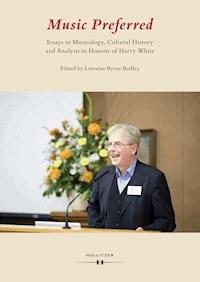
Music Preferred E-Book
Erhalten Sie Zugang zu diesem und mehr als 300000 Büchern ab EUR 5,99 monatlich.
- Herausgeber: Hollitzer Wissenschaftsverlag
- Kategorie: Geisteswissenschaft
- Sprache: Englisch
The contributions to this Festschrift, honouring the distinguished Irish musicologist Harry White on his sixtieth birthday, have wide repercussions and span a broad timeframe. But for all its variety, this volume is built around two axes: on the one hand, attention is focussed on the history of music and literature in Ireland and the British Isles, and on the other, topics of the German and Austrian musical past. In both cases it reflects the particular interest of a scholar, whose playful, sometimes unconventional way of approaching his subject is so refreshing and time and again leads to innovative, surprising insights. It also reflects a scholar, who – for all the broadening of his perspectives that has taken place over the years – has always adhered to the strands of his scholarly preoccupations that have become dear to him: the music of the 'Austro-Italian Baroque', and Irish musical culture first and foremost. An international cast of authors announces the sustaining influence of Harry White's wide-ranging research. Professor Dr Thomas Hochradner Chair of the Department of Musicology University of Music and Dramatic Arts Mozarteum Salzburg
Sie lesen das E-Book in den Legimi-Apps auf:
Seitenzahl: 1521
Veröffentlichungsjahr: 2018
Das E-Book (TTS) können Sie hören im Abo „Legimi Premium” in Legimi-Apps auf:
Ähnliche




















Music Preferred:Essays in Musicology, Cultural History and Analysis in Honour of Harry White
Professional Photo: Professor Harry White, DMus (NUI) PhD (Dubl) FRIAM MRIA MAE, UCD School of Music
Music Preferred:
Essays in Musicology, Cultural History and Analysis in Honour of Harry White
Edited by Lorraine Byrne Bodley
Layout and Cover: Nikola Stevanović
Printed and bound in the EU
Cover image:
Harry White at the International Conference, Schubert and Concepts of Late Style, Maynooth University, 22 October 2011
This publication was funded by:
Lorraine Byrne Bodley (ed.): Music Preferred:
Essays in Musicology, Cultural History and Analysis in Honour of Harry White
Vienna: HOLLITZER Verlag, 2018
© HOLLITZER Verlag, Wien 2018
Hollitzer Verlag
a division of Hollitzer Baustoffwerke Graz GmbH, Wien
www.hollitzer.at
All rights reserved.
Except for the quotation of short passages for the purposes of criticism and review, no part of this publication may be reproduced, stored in a retrieval system, or transmitted, in any form by any means, digital, electronic or mechanical, or by photocopying, recording, or otherwise, or conveyed via the Internet or a Web site without prior written permission of the publisher.
Responsibility for the contents of the various articles and for questions of copyright lies with the authors. In the case of outstanding, justified claims, we request to be notified by the rights owner.
ISBN pdf: 978-3-99012-402-4
ISBN epub: 978-3-99012-403-1
ACKNOWLEDGEMENTS
I should like to express my sincere gratitude to all contributors to this volume for their invariably instant, universally generous and heartfelt responses to the invitation to contribute. All of us have had the privilege of Harry White’s friendship and these essays bear testimony to the extraordinary depth and warmth of his personality. My deepest thanks to Professor Lorenz Welker (Ludwig-Maximilians-Universität Munich) who was a true friend when needed; to Professor Stanislav Tuksar (Croatian Academy of Sciences and Arts, Zagreb), Professor Philip V. Bohlman (Ludwig Rosenberger Distinguished Service Professor in Jewish History, The University of Chicago) and Robert Gerwarth (University College Dublin), whose generosity helped me to secure seed funding in the early stages of this book’s preparation. Professor Jen-yen Chen (Graduate Institute of Musicology, National Taiwan University) read three essays in section one with sympathy and searching insight and I am profoundly indebted to him for that. I owe a debt of gratitude to Dr Shane McMahon who graciously gave too much of his time fine-tuning many nuances of translation and to Dr Adrian Scahill (Maynooth University) I owe more than I can say for his meticulous reading of three ‘Music in Ireland’ chapters. Dr Michael Hüttler, Director of Hollitzer Verlag, offered unwavering enthusiasm from our earliest email. For this I shall be ever grateful, as well as for his keen, steady judgement and compromising support during the long haul of the book. I should like to thank in particular my desk editor, Sigrun Müller, whose sterling work made a real difference to the book’s progress and who guided the manuscript through the final editorial stages with characteristic efficiency and good cheer. The good-humoured assistance of all at Hollitzer Verlag, Vienna, has been outstanding.
The editor and publisher wish to thank the following for permission to use copyrighted material: the Sächsische Landesbibliothek for reproduction of Fux, Sonata à 4, MS mus 1–B–98, Figure 1, chapter 2; the International Museum and Library of Music of Bologna for Agostini, title page from the first volume of Spartitvra Delle Messe del Primo Libro di Paolo Agostini and Agostini’s Libro quarto delle messe in spartitura Figures 1 and 2, chapter 5; the Governors and Guardians of Marsh’s Library for reproduction of a page from John Mathew Score Books, Figure 1, chapter 6; the Photographic Archive Museo Nacional del Prado, Madrid for the reproduction of Figure 1, chapter 25.
For financial assistance I owe a debt of gratitude: Dr Attracta Halpin (Registrar, the National University of Ireland); Professor Orla Feely (Vice President for Research, University College Dublin); Professor Sarah Prescott (Principal, UCD College of Arts and Humanities); Professor Anne Fuchs (Director, UCD Humanities Institute); Professor Wolfgang Marx and Dr Jaime Jones (School of Music, University College Dublin); Professor Philip Nolan (President, Maynooth University); Deborah Kelleher (Director of the Royal Irish Academy of Music) and Dr Denise Neary (Director of Academic Studies, Royal Irish Academy of Music); Dr Kerry Houston (Director of Academic Studies, DIT Conservatory of Music and Drama); John Holland and Henry Gillanders (Pianos Plus); Evonne Ferguson and Linda O’Shay Farren (Contemporary Music Centre); Fr Paul Connell (St Finian’s College, Mullingar); the Society for Musicology in Ireland and der Verein der Freunde der Musikwissenschaft München e. V.
Lorraine Byrne Bodley
Dublin, April 2018
CONTENTS
NOTES ON CONTRIBUTORS
FOREWORD by Gerard Gillen (Maynooth University and Titular Organist, St. Mary’s Pro-Cathedral)
INTRODUCTION by Lorraine Byrne Bodley (Maynooth University) and Robin Elliot (University of Toronto)
PART ONE: THE MUSICAL BAROQUE
Julian HORTON (Durham University): J. S. Bach’s Fugue in C sharp minor, Well-Tempered Clavier, Book I and the Autonomy of the Musical Work
Lorenz WELKER (Ludwig-Maximilians-Universität, Munich): Johann Joseph Fux’s Sonata à 4 in G (K. 347): Further Considerations on its Source, Style, Context and Authorship
Tassilo ERHARDT (Liverpool Hope University): Johann Joseph Fux’ Church Music in its Spiritual and Liturgical Contexts
Jen-yen CHEN (National Taiwan University): The Musical Baroque in China: Interactions and Conflicts
Denis COLLINS (The University of Queensland, Australia): Canon in Baroque Italy: Paolo Agostini’s Collections of Masses, Motets and Counterpoints from 1627
PART TWO: MUSIC IN IRELAND
Kerry HOUSTON (DIT Conservatory of Music and Drama): John Mathews: A specimen of Georgian ignorance?
Ita BEAUSANG (DIT Conservatory of Music and Drama): There is a calm for those who weep: William Shore’s New Edition of a Chorale by John [sic] Sebastian Bach
Axel KLEIN (Frankfurt): “No, Sir, the Irish are not musical”: Some Historic (?) Debates on Irish Musicality
Adrian SCAHILL (Maynooth University): “That vulgar strummer”: The Piano and Traditional Music in the Gaelic Revival
Maria MCHALE (DIT Conservatory of Music and Drama): “Hopes for regeneration”: Opera in Revivalist Dublin, 1900–1916
Karol MULLANEY-DIGNAM (University of Limerick): “What do we mean by Irish music?” The Politics of State-Sponsored Music Publication in Independent Ireland
Ruth STANLEY (Cork Institute of Technology): “Jazzing the soul of the Nation away”: The Hidden History of Jazz in Ireland and Northern Ireland During the Interwar Years
Gearóid Ó HALLMHURÁIN (Concordia University Montreal): Sonic Icon, Music Pilgrimage: Creating an Irish World Music Capital
Méabh NÍ FHUARTHÁIN (NUI Galway): “In the mood for dancing”: Emigrant, Pop and Female
Gareth COX (Mary Immaculate College,University of Limerick): Aloys Fleischmann’s Games (1990)
Denise NEARY (Royal Irish Academy of Music): The Development of Music Performance as Artistic Research in Ireland
Michael MURPHY (Mary Immaculate College, University of Limerick): “Irish” Musicology and Musicology in Ireland: Grattan Flood, Bewerunge, Harrison, White
PART THREE: MUSIC AND LITERATURE
Declan KIBERD (University of Notre Dame): The New Policeman
Gerry SMYTH (Liverpool John Moores University): Moore, Wagner, Joyce: Evelyn Innes and the Irish Wagnerian Novel
John O’FLYNN (Dublin City University): Alex North, James Joyce, and John Huston’s The Dead (1987)
Patrick ZUK (Durham University): L’ami inconnu: Nataliya Esposito and Ivan Bunin
PART FOUR: AUSTRO-GERMANIC TRADITIONS
Michael HÜTTLER (Don Juan Archiv, Vienna): Hof- and Domkapellmeister Johann Joseph Friebert (1724–1799) and his Singspiele
Anne HYLAND (University of Manchester): Tautology or Teleology? Reconsidering Repetition and Difference in Two Schubertian Symphonic First Movements
Susan YOUENS (University of Notre Dame): Of Anthropophagy, the Abolitionist Movement, and Brahms: An unlikely Conjunction
Shane MCMAHON (UCD Humanities Institute): The Moth-Eaten Musical Brocade: Narrative and the Limits of the Musical Imagination
David COOPER (University of Leeds): Die zweite Heimat: Musical Personae in a Second Home
Glenn STANLEY (University of Connecticut): Brechtian Fidelio Performances in West Germany: 1968 to the New Millennium
Nicole GRIMES (University of California, Irvine): Brahms as a Vanishing Point in the music of Wolfgang Rihm: Reflections on Klavierstück Nr. 6
PART FIVE: MUSIC IN BRITAIN
Pauline GRAHAM (Griffith College): Intimations of Eternity in the Creeds from William Byrd’s Five-Voice Mass and Great Service
John CUNNINGHAM (Bangor University): “An Irishman in an opera!”: Music and Nationalism on the London Stage in the Mid–1770s
Jeremy DIBBLE (Durham University): Canon Thomas Hudson, Clergyman Musician, Cambridge Don and the Hovingham ‘Experiment’
William A. EVERETT (University of Missouri – Kansas City): The Great War, Propaganda, and Orientalist Musical Theatre: The Twin Histories of Katinka and Chu Chin Chow
Richard ALDOUS (Bard College): “Flash Harry”: Sir Malcolm Sargent and the Progress of Music in England
PART SIX: MUSIC HISTORIES WORLDWIDE
Philip V. BOHLMAN (University of Chicago): Worlds Apart: Resounding Selves and Others on Islands of Music History
Ivano CAVALLINI (University of Palermo): A Counter-Reformation Reaction to Slovenian and Croatian Protestantism: The Symbol of St. Athanasius in a Creed of 1624
Stanislav TUKSAR (University of Zagreb): Musical Prints from c.1750–1815 in the Dubrovnik Franciscan Music Collection (HR-Dsmb)
Vjera KATALINIC (Croatian Academy of Sciences and Arts, Zagreb): Routes of Travels and Points of Encounters Observed Through Musical Borrowings: The Case of Giovanni Giornovichi/Ivan Jarnović, an 18th-Century Itinerant Violin Virtuoso
Jan SMACZNY (Queen’s University Belfast): Antonín Dvořák in the Salon: A Composer Emerges from the Shadows
Jaime JONES (University College Dublin): Singing the Way: Music as Pilgrimage in Maharashtra
PART SEVEN: MUSIC AND POETRY
John BUCKLEY (Dublin City University): A Setting of Harry White’s Sonnet Bardolino from Polite Forms (2012) for Baritone and Piano
AFTERWORD by Iain FENLON (King’s College Cambridge)
HARRY WHITE: LIST OF PUBLICATIONS
NOTES ON CONTRIBUTORS
Richard Aldous the Eugene Meyer Chair and Professor of History at Bard College, New York, is the author and editor of eleven books, including a life of the conductor Malcolm Sargent and, most recently, Schlesinger: The Imperial Historian. His writing appears regularly in the Wall Street Journal, the New York TimesBook Review, and The American Interest, where he is a contributing editor. He previously taught at UCD for fifteen years.
Ita Beausang is a music graduate of University College Cork and Emeritus lecturer at DIT Conservatory of Music and Drama. Her main research interests centre on music education and contextual studies of music in Ireland in the eighteenth and nineteenth centuries. Her book Anglo-Irish Music 1780–1830 is the standard work of the period. She acted as research assistant to Professor Aloys Fleischmann for his chapter in the New History of Ireland vol. 6 and has contributed articles to Irish Musical Studies vols. 5 and 9. In 2010 she was awarded honorary life membership of the Society for Musicology in Ireland. She was an Advisory Editor for the Encyclopaedia of Music in Ireland and her book Ina Boyle (1889–1967): A Composer’s Life will be published by Cork University Press in 2018.
Philip V. Bohlman is Ludwig Rosenberger Distinguished Service Professor in Jewish History in the Department of Music at the University of Chicago, where he is also artistic director of the New Budapest Orpheum Society. His research ranges widely across religious, racial, and cultural encounter in Europe, North America, the Middle East, and South Asia. He is Honorarprofessor at the Hochschule für Musik, Theater und Medien Hannover, a Fellow of the American Academy of Arts and Sciences, and a Corresponding Fellow of the British Academy. Among his recent books are Jewish Music and Modernity (Oxford University Press), Hanns Eisler – In der Musik ist es anders (with Andrea F. Bohlman; Hentrich & Hentrich), and Song Loves the Masses: Herder on Music and Nationalism (with Johann Gottfried Herder; University of California Press), and the CDs, Jewish Cabaret in Exile and As Dreams Fall Apart (Cedille Records).
John Buckley was born in Templeglantine, Co. Limerick in 1951. He studied flute with Doris Keogh and composition with James Wilson, Alun Hoddinott and John Cage. Buckley’s output now exceeds 100 works, which have been performed in over fifty countries worldwide and have been issued on over twenty CDs. He has been awarded both a PhD and a DMus by the National University of Ireland. A monograph on his life and work, Constellations: The Life and Music of John Buckley by Benjamin Dwyer, was published in May 2011 by Carysfort Press. He is a member of Aosdána, Ireland’s state sponsored academy of creative artists and was senior lecturer at St Patrick’s College, Dublin City University from 2001 to 2017.
Lorraine Byrne Bodley is Senior Lecturer in Musicology at Maynooth University. She is the author and editor of 14 books including: Goethe and Zelter: Musical Dialogues (2009); The Unknown Schubert (2007) and Schubert’s Goethe Settings (2003). Recent publications include Music in Goethe’s Faust: Goethe’s Faust in Music (Boydell and Brewer, 2017); Schubert’s Late Music: History, Theory, Style (Cambridge University Press, 2016) and Rethinking Schubert (Oxford University Press, 2016), co-edited with Julian Horton, and a special Schubert edition of Nineteenth Century Music Review co-edited with James Sobaskie. She is currently writing a new biography of Schubert commissioned by Yale University Press. Recent awards include a DMUS in Musicology, a higher doctorate on published work (NUI, 2012); two DAAD Senior Academic Awards (2010 and 2014) and a Gerda-Henkel Foundation Scholarship (2014). In 2015 she was elected President of the Society for Musicology in Ireland and Member of The Royal Irish Academy.
Ivano Cavallini is associate professor of musicology and past co-ordinator of the PhD in European Cultural Studies/Europäische Kulturstudien at the University of Palermo. After the graduation at the university of Padua and the postgraduate studies at the university of Bologna, he received his PhD at the university of Zagreb. He is a member of the advisory boards of the periodicals Recercare (Rome), Arti Musices (Zagreb), De Musica Disserenda (Ljubljana). His research is focused on the connection between Italian music and Slavic cultures of Central and Southern Europe. Other areas of study are music historiography and incidental music of sixteenth-century Italian theatre. He has written four books: Musica, cultura e spettacolo in Istria tra il Cinquecento e il Seicento, Florence: L. S. Olschki, 1990; I due volti di Nettuno: teatro e musica a Venezia e in Dalmazia dal Cinquecento al Settecento, Lucca: Libreria Musicale Italiana, 1994, selected for the award “Viareggio”; Il direttore d’orchestra: genesi e storia di un’arte”, Venice: Marsilio 1998, awarded the prize “Città di Iglesias”; Istarske glazbene teme i portreti od 16. do 19.stoljeća [Themes and Portraits of Music in Istria from the Sixteenth to Nineteenth Centuries] (Pula: Čakavski sabor, 2007). Between 2002 and 2007 he was a member of the Levi Foundation in Venice. In 2012 he was appointed honorary member of the Croatian Musicological Society.
Jen-yen Chen received his PhD from Harvard University in historical musicology and is currently Associate Professor of the Graduate Institute of Musicology at National Taiwan University. His research interests include music in eighteenth-century Austria and the history of musical interactions between Europe and East Asia. He has published articles in Eighteenth-Century Music, The Journal of Musicological Research, Musiktheorie, and Ad Parnassum, chapters for The Cambridge History of Eighteenth-Century Music and About Bach (essays for Christoph Wolff), and volumes of music for the complete works edition of Johann Joseph Fux and A-R Editions.
Denis Collins studied Music at University College Dublin where he had the privilege in his final year to take lectures with Harry White who had just started as a Junior Lecturer in the Department (as it was then) of Music. Harry’s warmth and brilliance as an educator and his unstinting support and mentorship were invaluable to an aspiring scholar, while Harry’s research trajectory inspired vigorous and inquisitive musicological enquiry amongst all who came into contact with him. Denis Collins completed a PhD in Musicology at Stanford University and is currently a Senior Lecturer at the University of Queensland, Australia. His research interests are in canon and related contrapuntal procedures in Western music before 1800. He has been an Associate Investigator with the Australian Research Council’s Centre of Excellence for the History of Emotions in Europe, 1100–1800, and he is a Chief Investigator in an Australian Research Council Discovery Grant that is examining canonic techniques and musical change, c.1330–c.1530. Recent and forthcoming articles are in Music Analysis, Musicology Australia, BACH, and Musica Disciplina. He is the author of the article on Counterpoint in Oxford Bibliographies Online, and he has contributed to the chapter on music and dance in the Bloomsbury Cultural History of Emotions, volume 3, 1300–1600.
David Cooper is Professor of Music at the University of Leeds. His research is underpinned by an interest in music’s communicative power, whether considered in relation to film scores by composers such as Bernard Herrmann, Seán Ó Riada, Trevor Jones, Michael Nyman, and Nikos Mamangakis, to the music of Béla Bartók or to the repertoire of traditional Irish music. He is also interested in approaches to music that are influenced by science and technology, whether as analytical tools or critical models, in particular through mathematics and computing. Among the nine books he has authored or edited are volumes on scores by Herrmann and Bartok, and the musical traditions of Northern Ireland. His recent monograph on Béla Bartók for Yale University Press has received critical acclaim. He has recently completed a large-scale project funded by the UK Arts and Humanities Research Council on the music of film composer Trevor Jones.
Gareth Cox is Senior Lecturer in Music and Head of the Department of Music at Mary Immaculate College, University of Limerick. He is co-editor of volumes 7 and 11 of the Irish Musical Studies series (with Axel Klein and Julian Horton respectively), The Life and Music of Brian Boydell (with Axel Klein and Michael Taylor), and author of Seóirse Bodley (Field Day Publications, 2010). He was a subject editor for The Encyclopaedia of Music in Ireland and is currently Executive Editor of the Journal of the Society for Musicology in Ireland.
John Cunningham is a Senior Lecturer in Music at the School of Music, Bangor University. He completed his BMus and MA at UCD, and PhD at the University of Leeds. His research centres on secular music in Britain and Ireland, c.1600–1800. He is the author of The Consort Music of William Lawes, 1602–1645 (Boydell and Brewer, 2010), and has written over a dozen book chapters and journal articles. He was the contributing music editor to: TheNew Oxford Shakespeare Edition, ed. G. Taylor, J. Jowett etal. (Oxford: OUP, 2016, 2017); TheCambridge Edition of the Works of Ben Jonson (Cambridge: CUP, 2014). Among his forthcoming publications is a volume of Restoration Music for Three Violins, Bass Viol and Continuo, co-edited with Peter Holman (Musica Britannica, volume 103). He is a member of the Purcell Society Committee.
Jeremy Dibble is Professor of Music at Durham University and Vice-President of the Stanford Society. His specialist interests in the Victorian, Edwardian and Georgian eras are reflected in the major studies of C. Hubert H. Parry: His Life and Music (1992; rev. 1998) and Charles Villiers Stanford: Man and Musician (2002), both OUP, his volume of Parry’s violin sonatas for the Musica Britannica Trust (2003) and his editions for the RSCM Press. His work on musical criticism, historiography, opera and church music in Britain and Ireland have instigated studies such as John Stainer: A Life in Music (Boydell & Brewer, 2007) Michele Esposito (Field Day Press, 2010), Hamilton Harty: Musical Polymath (Boydell & Brewer, 2013) and British Musical Criticism and Intellectual Thought, 1850-1950 (with Julian Horton, Boydell & Brewer, 2018). Musical editor for the Canterbury Dictionary of Hymnology (2013), and a contributor to the Cambridge History of Christianityand Oxford History of Anglicanism, he is an Honorary Fellow of the Royal School of Church Music and the Guild of Church Musicians. He is presently working on an analytical study of the music of Frederick Delius.
Tassilo Erhardt joined Liverpool Hope University in September 2012 as Professor of Music and Head of the Music Department. As a baroque violinist he has performed around the globe in some of the world’s leading ensembles including The Academy of Ancient Music and The King’s Consort as well as with his own chamber group, Apollo & Pan, winner of the 2001 International Early Music Competition in York. Erhardt’s academic interests focus on period performance practice as well as the overlap between music, theology, and liturgy. His study on the theological contexts of Handel’s Messiah received several international awards, including the prestigious Erasmus Research Prize. His current research focuses on sacred music at the imperial court chapel in Vienna, in particular the work of chapel master Antonio Bertali (c.1605–1669), research which was initially funded by a major research grant from the Dutch Research Council. Erhardt came to Liverpool from Utrecht University’s Roosevelt Academy and the Royal Conservatoire in The Hague, where he taught for eight years. Previously, he studied baroque violin in The Hague and London, Theology at Oxford University’s St Benet’s Hall, and musicology at the University of Utrecht where he gained his PhD with the highest distinction.
William A. Everett is Curators’ Distinguished Professor of Musicology at the University of Missouri-Kansas City Conservatory of Music and Dance, where he teaches courses ranging from medieval music to American musical theater. His books include Sigmund Romberg (2007), Rudolf Friml (2008), and Music for the People: A History of the Kansas City Philharmonic Orchestra, 1933–82 (2015). He is contributing co-editor of The Cambridge Companion to the Musical (2002; 2nd ed., 2008; 3rd ed., 2017) and The Palgrave Handbook of Musical Theatre Producers (2017).
Iain Fenlon has now retired from teaching at the Faculty of Music, but until September 2017 was Professor of Historical Musicology. He is a Fellow of King’s College. He is also a Fellow of the Royal Historical Society, and a Visiting Professor in Heidelberg, 2016–17. Most of his writing has been concerned with the social and cultural history of music in Renaissance Italy. His books include a two-volume study, Music and Patronage in Sixteenth-Century Mantua (Cambridge University Press, 1980, 1982), a monograph on the early Italian madrigal (with James Haar), and Music, Print and Culture in Early Sixteenth-Century Italy (The Panizzi Lectures, British Library, 1994). In the course of his career he has been affiliated to a number of other academic institutions including Harvard University, All Souls College, Oxford, New College Oxford, the École Normale Supérieure, Paris, and the University of Bologna. His most recent books are The Ceremonial City: History, Memory and Myth in Renaissance Venice (Yale University Press, 2007); Piazza San Marco: Theatre of the Senses, Market Place of the World (Harvard, 2012) and Heinrich Glarean’s Books: The Intellectual World of a Sixteenth-Century Musical Humanist (Cambridge, 2013).
Gerard Gillen is Professor Emeritus in Music at Maynooth University, having retired from the position of Professor and Head of the Music Department of that university at the end of September 2007. He came to NUI Maynooth in 1985, previously having been a lecturer in music for sixteen years at University College Dublin Professor Gillen has overseen the expansion of the Music Department in undergraduate and postgraduate programmes, for example, new diplomas in Musicology Technology and Church Music. He also directed the University Choral Society from October 1985 until April 2007. Gillen is a first-class honours graduate of University College Dublin and Oxford. Professor Gillen’s interest lie in the areas of Catholic church music, organ building and performance practice. He was honoured as the John Betts Fellow in 1992 at the University of Oxford and since 1993 he has been chair of the Irish Episcopal Commission’s Advisory Committee on Church Music. He is also the general editor (with Harry White of UCD) of the bi-annual Irish Musical Studies.
Pauline Graham completed studies in vocal performance at the Royal Conservatoire of Scotland, Glasgow and the Royal Conservatoire, The Hague, followed by a doctorate in musicology at University College Dublin, under the supervision of Professor Harry White, assisted by an Irish Research Council scholarship. Her research juxtaposed and probed questions of meaning and religious identity in the Three Masses and Great Service of William Byrd. Pauline lectures in music education at Griffith College Dublin, and has been a guest lecturer at the University of Limerick. She contributed articles to The Encyclopaedia of Music in Ireland (edited by Harry White and Barra Boydell). Pauline is also active as a performer, with a particular interest in early vocal repertoire, and as a vocal tutor and consultant.
Nicole Grimes is Assistant Professor of Musicology at the University of California, Irvine. Her research is focused at the intersection between nineteenth- and twentieth-century German music criticism, music analysis and music aesthetics. She is particularly fascinated by the intertextual relationship between music and philosophy, and music and literature on which she has published widely. Her books include Mendelssohn Perspectives (2012 with Angela Mace), and Rethinking Hanslick: Music, Formalism, and Expression (2013, with Siobhán Donovan and Wolfgang Marx). She is in the final stages of writing a monograph called Brahms’s Elegies: The Poetics of Loss in German Culture and in the early stages of writing a monograph on Brahms’s final published opus, the Vier ernste Gesänge. She serves on the Editorial Board of the journal Music Analysis and is a member of the Board of Directors of the American Brahms Society.
Julian Horton is Professor of Music at Durham University and President of the Society for Music Analysis. He was educated at Trinity College, Cambridge, and taught in the School of Music at UCD from 2001–2013. His research concerns the analysis of nineteenth-century instrumental music, with particular interests including sonata form, theories of tonality, the piano concerto, the symphony and the music of Anton Bruckner. He was recipient of the Westrup Prize in 2012, and in 2016 was appointed Music Theorist in Residence to the Netherlands and Flanders.
Kerry Houston was a chorister at St Patrick’s Cathedral, Dublin where he studied organ with W. S. Greig. He took his music degrees at Trinity College Dublin and his degree in theology at Pontifical University of St Patrick’s College, Maynooth. He has held positions in the Royal Irish Academy of Music and the music departments of Trinity College Dublin and Maynooth University, where he was a colleague of Gerard Gillen’s. He is head of the department of academic studies at the DIT Conservatory of Music and Drama, where he is also director of the Research Foundation for Music in Ireland. His publications focus on aspects of sacred music in Ireland and on the history of music in Irish cathedrals. He served as joint subject editor for church music with Professor Gerard Gillen in the Encyclopedia of music in Ireland. He is director of chapel music at Trinity College Dublin.
Michael Hüttler has taught at Yeditepe University Istanbul (2001–2003) and Vienna University, Department for Theatre, Film and Media Studies (2003–2010). From 2007 to 2010 he was director of Don Juan Archiv Wien, and since 2011 he is General Manager of Hollitzer publishing. His current research focuses on theatre in the eighteenth century and the Turkish trope in European theatre. He has published on Mozart, theatre-ethnology, business-theatre, and experimental theatre in Austria. He is series editor (with Hans Ernst Weidinger) of the Ottomania book series (Vienna, Hollitzer, currently 6 volumes) and editor of TheMA – Open Access Journal for Theatre, Music, Arts.
Anne M. Hyland is Lecturer in Music Analysis at the University of Manchester. Her research involves the analysis and reception of early nineteenth-century music of the Austro-Germanic tradition, particularly the instrumental music of Schubert and his contemporaries. Her work has appeared in Music Analysis (2009 – awarded the 25th Anniversary Prize of the journal), Music Theory Spectrum (2016), Rethinking Schubert (OUP, 2016), Schubert’s Late Music: History, Theory Style (CUP, 2016), and The String Quartet: from the Private to the Public Sphere (Brepols, 2016). She is the recipient of a British Academy/Leverhulme Trust Research Grant. In 2017, she became Critical Forum Editor for Music Analysis.
Jaime Jones is Lecturer in Ethnomusicology at University College Dublin, where she teaches courses on ethnomusicology, Indian music, popular music, music and religion, and film music. The research that has grown out of her PhD (University of Chicago, 2009) examines affective publics and Hindu devotional music in Western India. Recent publications include a chapter in the Cambridge History of World Music, and a 2016 article on pilgrimage for the Yale Journal of Music and Religion. She is currently working on the monograph Music and Devotion in India for the Routledge Focus series. In addition to her work on Hinduism, Jaime also works with punk and underground rock communities in Dublin, investigating issues of place, network, and self-curation. She served as Chair of the International Council for Traditional Music, Ireland, and she is the co-founder of the National Concert Hall Gamelan Orchestra in Dublin.
Vjera Katalinić, is research advisor and director at the Department for the History of Croatian Music, Croatian Academy of Sciences and Arts in Zagreb, and full professor at the University of Zagreb, Music Academy. Her fields of interest embrace 18th- and 19th-century musical culture, musical collections and archives. She was leader of the HERA project “Music migrations in the early modern age: the meeting of the European East, West and South” (2013–2016) and leader of the national project “Networking through music” (2017–2021). She is author of four books, some 200 articles, editor of 10 proceedings and six music scores. Her most recent book is The Sorkočevićes: Aristocratic musicians from Dubrovnik (2014). She is Editor-in-chief of the journal Arti musices (2009–2017).
Declan Kiberd is Keough Professor of Irish Studies at University of Notre Dame. Among his books are Synge and the Irish Language (1979), Men and Feminism in Modern Literature(1985), Idir Dhá Chultúr (1991), Inventing Ireland (1995), Irish Classics (2000), The Irish Writer and the World (2005), Ulysses and Us (2009), and After Ireland (2017). He co-edited (with PJ Mathews) Handbook of the Irish Revival 1891–1922 (2015). He was Professor of Anglo-Irish literature for many years at University College Dublin.
Axel Klein is an independent scholar based in Frankfurt am Main, Germany, and a Research Associate of the Research Foundation for Music in Ireland (RFMI). He studied at Universität Hildesheim and Trinity College Dublin (1984–90) and received a PhD in musicology from Hildesheim in 1995. Specialising in Irish art music of the 19th and 20th centuries, he has published three monographs and co-edited two further publications, besides numerous contributions to symposia and academic journals. He was an advisor to the multi-volume German encyclopaedia Die Musik in Geschichte und Gegenwart (1996–2008) and an Advisory Editor of the Encylopaedia of Music in Ireland (Dublin, 2013) and has contributed to the New Grove Dictionary of Music and Musicians (London, 2001) and the Dictionary of Irish Biography (Cambridge, 2009). In 2015, he was elected Corresponding Member of the Society for Musicology in Ireland (SMI).
Maria McHale was an IRCHSS Postdoctoral Fellow in Music at University College Dublin between 2007 and 2009, before moving to the DIT Conservatory of Music and Drama, where she is now Lecturer in Musicology. Her research interests lie in late-nineteenth and early-twentieth-century Irish and British musical culture. She was joint executive editor of the Encyclopaedia of Music in Ireland (UCD Press, 2013) and has received funding from the Irish Research Council for the projects ‘Music at the Abbey Theatre’ and ‘Music in Ireland: 1916 and Beyond’. With Michael Murphy and Kerry Houston, she is co-editor of Irish Musical Studies 12 (Four Courts Press, 2018), an essay collection on documents of Irish music history in the long nineteenth century.
Shane McMahon is a musicologist and historian. His received his PhD from University College Dublin, with a dissertation titled ‘The Fabric of Time: Richard Wagner and the Antinomies of Modernity’, which was supervised by Harry White and funded by the Irish Research Council. He is a Research Associate of the UCD Humanities Institute, where his work, drawing on the perspectives and methodologies of the anthropology and sociology of religion, explores the sacred paradigms and religious narratives underpinning secular 19th-century music.
Michael Murphy has lectured in the Department of Music, Mary Immaculate College, Limerick since 2001. He co-edited Musical Constructions of Nationalism with Harry White (Cork University Press, 2001), Music in Nineteenth-Century Ireland (Irish Musical Studies vol. 9) with Jan Smaczny (Four Courts Press, 2007), and Documents of Irish Music History (Irish Musical Studies vol. 12) with Maria McHale and Kerry Houston (Four Courts Press, 2018). He was involved in editing and contributing to the Encyclopaedia of Music in Ireland (ed.) Harry White and Barra Boydell (UCD Press, 2013). Since its inception in 2003, he has been a member of the Council of the Society for Musicology in Ireland, and has acted as its Hon. Treasurer and Membership Secretary (2003–2006), and Hon Secretary (2006–2009). He is a member of the editorial board of the Journal of the Society for Musicology in Ireland, and has broadcast many music documentaries on RTÉ lyric fm.
Karol Mullaney-Dignam, PhD, is a cultural historian and Lecturer in History at the University of Limerick, Ireland. Her interdisciplinary research encompasses social, economic and political explorations of Irish music history across the long nineteenth century. She has been the recipient of an Irish Research Council Postdoctoral Fellowship (2010–12), a Royal Irish Academy Charlemont Award (2015) and an Irish Research Council New Foundations Award (2016). Her publications include Music and dancing at Castletown, Co. Kildare, 1759–1821 (2011), William Despard Hemphill, Irish Victorian Photographer (2014) and Aspects of Irish Aristocratic Life: essays on the FitzGeralds and Carton House (2014). Karol’s research on historic properties also includes public history and heritage interpretation projects, most notably with the Irish Office of Public Works.
Denise Neary is Director of Academic Studies for the Doctor in Music Performance programme at the Royal Irish Academy of Music. Denise has been a council member of the Society for Musicology in Ireland since 2009 and is currently Honorary Treasurer of the Society. She is also a member of the RILM National Committee of Ireland. Denise was a member of the organising committee for the joint SMI/RMA annual conference at the RIAM in July 2009 and chair of the organising committee for the 9th annual SMI conference at the RIAM in June 2011. Most recently she organised the “Doctors in Performance” festival conference of music performance and artistic research at the RIAM in September 2016. Denise’s research has concentrated on music in late seventeenth- and eighteenth-century Dublin churches and cathedral music in England in the eighteenth and early nineteenth centuries. She is also centrally involved in the development of artistic research in Ireland, collaborating with European partners.
Méabh Ní Fhuartháin is lecturer/researcher at the Centre for Irish Studies, NUI Galway, specializing in Irish Music and Dance Studies. Dr. Ní Fhuartháin has contributed articles and reviews to a variety of journals such as Ethnomusicology, Journal of Music in Ireland, Journal of the Society of Musicology in Ireland and New York Irish History Roundtable and was also Popular Music subject editor of the landmark two-volume Encyclopedia of Music in Ireland (UCD Press, 2013). Co-editor with Dr David Doyle of Ordinary Life and Popular Culture in Ireland (IAP, 2013), Méabh is particularly interested in the institutionalization of musical revival in Ireland during the twentieth century, and Irish popular music studies. Recent published articles include work on pop music and emigration; masculinities and Irish popular music; and the interface between organisational culture and traditional music scholarship.
Gearóid Ó hAllmhuráin, MA (UCC), HDE (Trinity College Dublin), MBA (IUA), PhD (QUB) is an anthropologist and ethnomusicologist who specializes in the study in Irish traditional music and folklife. Author of Flowing Tides: History and Memory in an Irish Soundscape (Oxford: Oxford University Press, 2016), A Short History of Irish Traditional Music (Dublin: O’Brien Press, 2017), A Pocket History of Irish Traditional Music (Dublin: O’Brien Press, 1998/2003), as well as chapters, articles and academic papers on Irish music and cultural history, his work has been featured on PBS, CBC, RTÉ, BBC and TF1. Formerly Jefferson Smurfit Professor of Irish Studies and Professor of Music at the University of Missouri-St. Louis, he is the inaugural holder of the bilingual Johnson Chair in Quebec and Canadian Irish Studies at Concordia University, Montreal. Funded by the Quebec government, his research focuses on Irish cultural memory and soundscape studies. An award winning professional musician, his recordings include: Traditional Music from Clare and Beyond (1996), Tracin’: Traditional Music from the West of Ireland (1999) and The Independence Suite: Traditional Music from Ireland, Scotland and Cape Breton (2004).
John O’Flynn is Associate Professor of Music at Dublin City University. He previously lectured at Mary Immaculate College, University of Limerick and at St Patrick’s College, Drumcondra where he was Head of Music, 2008–2016. He is recipient of research fellowships from The Irish Research Council (2008), An Foras Feasa (2011) and St Patrick’s College (2015). A Council Member of the Society for Musicology in Ireland, he is also founding chair of the Society for Music Education in Ireland. Publications include The Irishness of Irish Music (Ashgate, 2009), Music and Identity in Ireland and Beyond (Ashgate, 2014, co-edited with Dr. Mark Fitzgerald) and numerous journal articles, book chapters and encyclopaedia entries. In 2015–16 he was principal investigator for Mapping Popular Music in Dublin, an applied research project externally funded by Fáilte Ireland (Irish Tourism). He is currently completing the monograph Music, the moving image, and Ireland for publication by Routledge.
Adrian Scahill is a lecturer in Irish traditional music and ethnomusicology in the Department of Music, Maynooth University. A graduate of Maynooth, he undertook doctoral research with Professor Harry White at University College Dublin, and after receiving his doctorate returned to Maynooth as a lecturer. He was subject editor for traditional music for The Encyclopaedia of Music in Ireland (2013), and has published on a broad range of topics within traditional music.
Jan Smaczny recently retired as the Sir Hamilton Harty Professor of Music at Queen’s University, Belfast, and is now Emeritus Professor of Music. He has published widely on many aspects of Czech music and his books include studies of the repertoire of the Prague Provisional Theatre and Dvořák’s B-minor Cello Concerto; jointly edited volumes comprise Music in Nineteenth-Century Ireland and Exploring the B-minor Mass. He was a founding member of the committee that established the Society for Musicology in Ireland of which he was also a two-term president. More recently he has served as a vice-president of the Royal Musical Association.
Gerry Smyth is Professor of Irish Cultural History at Liverpool John Moores University. Several of his books focus on aspects of Irish musical history, including Noisy Island (2005), Music and Irish Cultural History (2009), and Celtic Tiger Blues (2015). At the time of writing Professor Smyth is researching a study of music in the life and literature of James Joyce, and recording an album of settings of the lyrics of W. B. Yeats.
Glenn Stanley, Professor of Music at the University of Connecticut, has published extensively on German music, musical life, and thought from the eighteenth through the twentieth century with special emphasis on Beethoven. He has also written extensively on Mozart, Mendelssohn, and Wagner. He contributed articles on historiography and German music criticism to the New Grove Dictionary and edited the Cambridge Companion to Beethoven. Recent publications include essays on the performance and reception history of Fidelio, Schubert’s “Unfinished” Symphony, and Wagner’s Faust Overture and Wagner’s engagement with Goethe’s literary work. He is a co-editor of Beethoven in Context for Cambridge University Press (forthcoming 2019). Stanley has written program notes and lectured for Carnegie Hall and Lincoln Center. Stanley organized international conferences on Beethoven at UConn (1993) and at Carnegie Hall (1996). In 1997 he was Fulbright Senior Scholar at the Humboldt University in Berlin and in 2010–2011 he was a guest professor at the Free University, Berlin.
Ruth Stanley is a BMus graduate of CIT Cork School of Music (2000). She was awarded an MA from Mary Immaculate College, Limerick (2003) and a PhD from Queen’s University Belfast (2011). Ruth’s research is concerned with musical culture in twentieth-century Ireland and Northern Ireland, especially pertaining to broadcasting and issues of identity. Her publications include contributions to TheEncyclopedia of Music in Ireland, edited by Harry White and Barra Boydell, and Music and Identity in Ireland and Beyond, edited by Mark Fitzgerald and John O’Flynn. She was a recipient of funding from the Irish Research Council’s New Foundations Scheme (2016). A member of the Society for Musicology in Ireland, she currently serves as Honorary Membership Secretary on the SMI Council. Ruth lectures in piano at CIT Cork School of Music and is a Grade Examiner with the Associated Board of the Royal Schools of Music.
Stanislav Tuksar is a Professor Emeritus of the University of Zagreb. He was awarded a BA in philosophy, English and violoncello, MA and PhD in musicology, all at the University of Zagreb where he taught musicology since 1993. He also made advanced studies at the Université de Paris IV-Sorbonne (1974–76) and was research fellow at Staatliches Institut für Musikforschung in West Berlin (1986–88). He has participated in c. 130 scholarly symposia in Croatia and abroad, and lectured at 24 universities worldwide. As author, editor and translator, he has published 26 books and authored c. 230 articles. Since 2000 he has been Editor-in-Chief of the International Review of the Aesthetics and Sociology of Music; he is member (past and present) of the editorial boards of the journals: Acta musicologica (Basle), Current Musicology (New York), South African Journal of Musicology (Durban); Arti musices (Zagreb); De musica disserenda (Ljubljana); Kroatologija (Zagreb). He was co-founder (1992), Secretary (1992–1997) and President (2001–2006, 2013–2018) of the Croatian Musicological Society in Zagreb, and he is full member of the Croatian Academy of Sciences and Arts (since 2012). His main research areas are musico-cultural aspects and aesthetics of music in the 16th–19th century period. His main works are Hrvatski renesansni teoretičari glazbe (1978; English translation: Croatian Renaissance Music Theorists, 1980); Hrvatska glazbena terminologija u razdoblju baroka (Croatian Music Terminology of the Baroque Era, 1992) and Kratka povijest hrvatske glazbe (Short History of Croatian Music, 2000).
Lorenz Welker was born 1953 in Munich. After completing a degree in medicine in Munich he studied musicology at the universities of Basle and Zürich. After working for two years at the MPI of Psychiatry, he was an assistant teacher at the Schola Cantorum of Basle and at Basle University while completing his M.D. at Zürich (1988). In 1990 he joined the department of musicology at Heidelberg and took the doctorate in musicology at Basle in 1992, with a dissertation on Renaissance performing practice, and the Habilitation in 1993 with a study on late medieval music. He was appointed professor at the University of Erlangen in 1994 and became professor at Munich University in 1996. His main areas of expertise are the late Middle Ages; performing practice and instrumental music of the Renaissance and Baroque periods. He was awarded the Henry E. Sigerist prize in 1988 and the Dent Medal in 1994.
Susan Youens, who received her PhD from Harvard University in 1976, is the J. W. Van Gorkom Professor of Music at the University of Notre Dame. She is the author of eight books on German song, including Schubert, Müller, and Die schöne Müllerin; Hugo Wolf and his Mörike Songs; Schubert’s Late Lieder; and Heinrich Heine and the Lied (all from Cambridge University Press), as well as over-60 scholarly articles and chapters. She is the recipient of four fellowships from the National Endowment for the Humanities, as well as additional fellowships from the Guggenheim Foundation, the Institute for Advanced Study at Princeton, and the National Humanities Center, and has lectured widely on the music of Schubert, Hugo Wolf, and other songcomposers.
Patrick Zuk is Associate Professor of Music at the University of Durham and a specialist in Russian music and cultural history. He is co-editor (with Marina Frolova-Walker) of a volume of essays Russian Music Since 1917: Reappraisal and Rediscovery, published in 2017 by Oxford University Press in conjunction with the British Academy. He is currently working on a study of the Soviet composer Nikolay Myaskovsky, and has recently been awarded funding by the Wellcome Trust for a research project examining the role played by personal and collective traumatic experience in shaping the styles and aesthetic outlooks of musical modernism.
FOREWORD
GERARD GILLEN
My connections with Harry White go back to his pre-birth, as it were, as in my early teenage years I was organist for the boy’s choir directed by his late father, Frank, at the Oblate Church in Inchicore in south-west Dublin. I remember well his father announcing to me that their firstborn were soon to arrive in the form of twins, thus heralding the birth of Harry and his brother John in July, 1958. About a dozen years later I noted with pleasure that the twins had been awarded music scholarships to the newly founded Schola Cantorum of St Finian’s College, Mullingar, where they came under the benign and sensitive tutelage of Father Frank MacNamara, whom Harry generously acknowledges as a prime influence on his future development, musically and intellectually.
While it is hardly necessary to do so, it is worth reciting Harry White’s formidable litany of academic honours and achievements, and concomitant list of publications. Suffice to say that in the subjects he covers with magisterial authority, ranging from music in Imperial Austria, through a history of Anglo-American musicology since 1945, to authoritative monographs on the cultural history of music in Ireland, he has richly earned the description of him in the New Grove Dictionary of Music and Musicians (2001) as “the leading Irish musicologist of his generation”. But Harry White is not just a most distinguished musicologist, he is in the fullest sense of the term, the “compleat” man of letters, as he is also a dramatist, a novelist and a poet of no mean accomplishment. While a graduate student at the University of Toronto in 1984 he won the University’s gold medal for poetry, and in 2012 he published his first collection of poetry, entitled Polite Forms. Thus in Harry White we have a formidable combination of first-rate, widely-encompassing musical scholarship mediated to us through the prism of a highly creative imagination, which gives to Harry’s scholarly writings a literary patina which makes him a delight to read and to experience in “live performance”.
However (to return to musicology), there are three very important achievements of Harry White which I would like to draw attention to at this seminal moment in his stellar career: (i) his founding of the musicological journal series Irish Musical Studies; (ii) his establishment of the Society for Musicology in Ireland (of which he was the founding president); and (iii) his crucial input into the gestation, birth, and delivery of the Encyclopaedia of Music in Ireland, which was published in October 2013; thus was born the largest research project in music to be undertaken in Ireland to date. Readers can be assured that without Harry’s drive, persistence and initiative, and the input of his own considerable intellectual and critical vigour and rigour, none of these three enormously important developments for Irish musical scholarship and its reputation both at home and abroad, would have happened.
In a curious way Harry White brings to mind one of his predecessors as Professor of Music at UCD over a century ago, and one of my predecessors as Professor at Maynooth, the German priest and scholar, Heinrich Bewerunge (1862–1923), who in his day was a mover and shaker of formidable influence and achievement, just as Harry is today. White is a gifted pedagogue, a forceful, illuminating and prolific writer on many of the musical educational issues of the day, and an internationally acknowledged authoritative scholar. And so I think it is no accident, as it were, that Harry White has had a long-term fascination with Bewerunge and his work, and gave expression to this in a very thoughtful essay on the writings of Bewerunge written in collaboration with Frank Lawrence some 25 years ago in the second volume of Irish Musical Studies (Music and the Church, 1993).
Harry White, like Bewerunge 100 years ago, is passionately concerned with music education in Ireland. In Bewerunge’s case he was particularly exercised by the lack of opportunities for the training of church musicians in Ireland which resulted in the importation of a number of German and Belgian organists to fill the various new cathedral Kantor positions as they became vacant. He felt that the only remedy, if Irish musicians were to fill these positions with professional competence, was for the church to set up a special school in Ireland dedicated to their training. However, it was not to be until 1970, some 47 years after the death of Bewerunge, that that proposal received partial implementation with the establishment of the Schola Cantorum at St Finian’s College, Mullingar. And among the first cohort of students admitted to the new Schola was a young 13-year-old Harry White. So this 1970 establishment, founded in a sense at the historical instigation of Bewerunge, was to give Harry White his crucially important early musical education.
It’s a great personal and professional pleasure and honour to pay tribute to my distinguished colleague, close friend, and former student, Professor Harry White, on the presentation to him of this Festschrift volume to mark his 60th birthday. Ad multos annos!
INTRODUCTION:LIBER AMICORUM
Robin Elliott and Harry White, Dublin, May 2016
LIBER AMICORUM ESSAYS DEDICATED TO HARRY WHITE ON THE OCCASION OF HIS 60th BIRTHDAY
LORRAINE BYRNE BODLEY (MAYNOOTH UNIVERSITY) AND ROBIN ELLIOT (UNIVERSITY OF TORONTO)
A birthday, and reaching the age of sixty, make an appropriate time to celebrate one of Ireland’s most distinguished musicologits. The title of this book, “Music Preferred”, is from White’s very first publication, a poem written to announce his intention to privilege music as a preoccupation rather than take a purely literary path.1 Since then White has actively built a stellar reputation as an eminent scholar of international stature. His establishment of Irish Musical Studies, The society for musicology in Ireland and general editorship of TheEncyclopedia of Music in Ireland not only bear testimony to the kind of goals that he has set himself, but his ability to bring others with him. It is a measure of his gifts and of his energy that in the past three decades he has remained an exceptionally productive scholar, whose work has been transformative. His monographs and edited volumes have been reviewed as being major works of scholarship. The original quality of these publications has led to White’s widespread international acceptance as a leading musicologist specializing in the cultural history of music in Ireland, the music of Johann Joseph Fux and the history of Anglo-American musicology since 1945. The vitality and creativity of his scholarly career is indicated by the fact that he continues to work in all of his fields of interest, cross-fertilizing each of them with questions and insights drawn from the others. As a scholar he represents the tradition of musicology in Ireland at its very best: original, insightful, expansive and yet responsive to public interest, a superb communicator and industrious to a remarkable degree. Aside from honouring to his lifelong commitment to musicology, this book celebrates his extensive European connections and his distinguished record as an inspirational teacher.
Born in Dublin in 1958, Harry White was at the earliest age exposed to music at home and at St Finian’s College, Mullingar where he was a Member of the Schola Cantorum from 1971–76. Educated at University College Dublin (1976–81), the University of Toronto (1981–84) and Trinity College Dublin (1984–86), White took degrees in English (BA), Music (BMUS) and Modern English and American Literature (MA) at University College Dublin, after which he took an MA in Musicology at Toronto. As a graduate student in Toronto he was elected to a Junior Fellowship of Massey College in 1983 and was awarded the university’s gold medal for poetry in 1984. He wrote his doctoral dissertation on the oratorios of Johann Joseph Fux (PhD) at Trinity, graduating in November 1986.
To work as a musicologist is more than to publish criticism, give public lectures or contribute to panel discussions; it is also to bring the routine labour of these things into a meaningful alignment with the society in which they take place. For White that work began (as now it so commonly does) in the obligations of university teaching and research, in his first teaching appointment as a part-time lecturer in St Patrick’s College, Maynooth (1984–1985). He was subsequently appointed to an assistant lectureship and college lectureship in music at University College Dublin (1985–1993), incrementally establishing himself as a far-carrying voice in musicology. From this auspicious start, he was appointed to the Chair of Music at University College Dublin in January 1993, where he soon became regarded as the foremost Irish musicologist of our generation. His visiting professorships at universities in a number of countries – the University of Western Ontario (1996), Ludwig-Maximilians-Universität, Munich (1999), King’s College, Cambridge (2005) and the University of Zagreb (2006) – testify to his reputation as an international musicologist of singular versatilty. His most recent short-term teaching appointment abroad (of which he has undertaken several in the course of his career) was in November 2017, when he gave the inaugural seminars in the newly-established doctoral programme in musicology at the University of Zagreb, where he has been a regular and welcome guest.
White has been a defining presence at the School of Music, University College Dublin, where he has spent his entire academic career. His teaching has in the main been devoted to European art music, music in Ireland, the relationship between music and literature and the history of Anglo-American musicology. He has contributed importantly not just to academia but also to the wider community through his fifteen-year directorship of the UCD Baroque Orchestra and Chamber Choir in public performances of Bach, Fux and Mozart. Even more seminal has been his establishment of the first taught MA programme in musicology (subsequently designated as the degree of Master of Musicology) at an Irish university, through which he has attracted generations of younger scholars to University College Dublin to pursue recondite fields of music history. For George Steiner, there is no craft more privileged than the calling of the teacher. ‘To awaken in another human being powers, dreams beyond one’s own; to induce in others a love for that which one loves; to make of one’s inward present their future: this is a threefold adventure like no other’.2 Harry White’s teaching career bears testimony to this belief. Just as his presence fills the room, his musicology has filled the minds of generations of scholars and students and his reputational excellence as a teacher has grown with each succeeding decade.
No Irish scholar has worked harder than Harry White to promote musicology in Ireland in all its variety. His career has spanned over thirty years to date and his services to Irish musicology have been outstanding. This is illustrated by White’s 30-year co-editorship of the book series Irish Musical Studies which he founded in 1990 with Professor Gerard Gillen (published initially by Irish Academic Press and subsequently by Four Courts Press), the first five volumes of which he edited with Professor Gillen and Dr Patrick F. Devine. It is also illustrated in his pioneering and jointly organizing (with Patrick Devine) in 1995 the first international musicological conference to take place in Ireland. In 2003 he founded the Society for Musicology in Ireland (SMI), served as its Inaugural President and has continued to serve as a council member of the Society to the present day. During his tenure as President of the SMI (2003–2006) the Journal of the Society for Musicology in Ireland (2005–) was established online. He also chaired the first RILM and RISM Irish committees (1994–2005) and actively promoted the presence of musicology as an Irish discipline through the agency of his own research. While his benign influence on, and generosity and encouragement of younger musicologists is widely acknowledged, his nurturing of generations of readers has been less remarked. In both respects his achievements in the writing and re-writing of Irish musical history have merited affirmation through his work as joint general editor (with Professor Barra Boydell) of The Encyclopaedia of Music in Ireland (EMIR), begun in 2003 and published in 2013, which gathers together 240 contributors and is the single largest research project on music in Ireland to have been undertaken to date.
As editor as well as author, White’s work has had an international impact which has been recognised in numerous editorial appointments, notably as a member of the executive board of the Irish University Review (1987–1997), consultant editor in music to The Oxford Companion to Irish History, edited by Seán Connolly (1998), The Blackwell Companion to Modern Irish Culture, edited by W.J. McCormack (1999) and The Encyclopaedia of Ireland, edited by Brian Lalor (2003). It was Professor White’s editorial ability which led to his position as national advisory editor for the revised edition of The New Grove Dictionary of Music and Musicians, edited by Stanley Sadie (2001), which increased the presence of Irish music and music in Ireland in an international context. He has also served as foreign corresponding editor for Current Musicology (New York), and as advisory editor for The International Review of the Aesthetics and Sociology of Music (Zagreb), the Journal of the Royal Musical Association (London), the Canadian Journal of Irish Studies (Montreal) and the Dictionary of Irish Biography (Dublin).
Another hallmark of White’s work (and character) is his pietas. White, who has built so much himself, has reminded us how much we owe to our musical forefathers and that the way forward in the humanities requires the humility to acknowledge this truth. The effects of this virtue are extended to the long dead, examples of which are his Royal Irish Academy Discourse in 2010: “Aloys Fleischmann and the Development of Musicology in Ireland” and his keynote address “The Enchantment of Authority: Heinrich Bewerunge and the Cultural Discourse of Music in Ireland” at the International Conference on Heinrich Bewerunge in Maynooth University (2012) both of which limn the achievements of scholars who laid the foundations of musicology in Ireland.3 Further acts of commemoration are White’s establishment of the UCD memorial lectures in honour of John F. Larchet (1884–1967) and the Harrison Medal of the Society for Musicology in Ireland in honour of the ethnomusicologist Frank Llewellyn Harrison (1905–1987).4
In remembering others, White has inadverently brought honour onto himself and his extraordinarly imaginative scholarship has led to a proliferation of national and international awards to date. On home ground these include: a Government of Ireland Senior Research Fellowship awarded by the Irish Research Council in 2005; election to the Royal Irish Academy in 2006 – he was the first historical musicologist to receive this honour – an honorary Fellowship of the Royal Irish Academy of Music the following year and a DMUS degree for published work from the National University of Ireland also in 2007 – again he was the first person to receive this distinction. In recognition of his outstanding contribution to musicology, the Society for Musicology in Ireland awarded him the Harrison medal in 2014 and life membership in 2015. Further afield he has received the Michael J. Durkan Prize of the American Conference of Irish Studies in 2009; honorary membership of the Croatian Musicological Society in 2012; election to the Academia Europaea in 2015 and to the Croatian Academy of Sciences and Arts in 2018.




