



Erhalten Sie Zugang zu diesem und mehr als 300000 Büchern ab EUR 5,99 monatlich.
- Herausgeber: ESMOD
- Kategorie: Lebensstil
- Sprache: Englisch
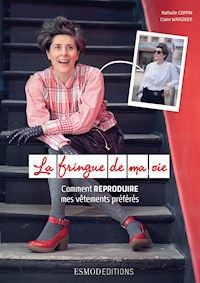
How to easily reproduce the pattern of your clothes without undoing it.
We all have a garment carefully foldedaway or hung protectively in our closet that recalls a key moment or memory inour lives: it's a piece of clothing we certainly don't want to take apart! Though we may regretfully have abandoned it, wedream of wearing it again but often it's worn out or doesn't fit us anymore. It may be a souvenir from a trip or a timelesspiece that's frayed and threadbare. Maybe it reminds us of a person who wasdear to us, maybe it's too classic or strict but fits us perfectly, maybe wefound it in a vintage store... in any case, we keep it and take it with uswhenever we move! The SEVEN WORKSHOPS in this book explain how toremake patterns for garments without taking them apart. You’ll discover a sweater, jeans, pants, a shirt and a blouse plus a dress and jacket. By using a variety of simple techniques, you'll beable to make a pattern you can transform at whim to give your new garment alook that's yours alone!
ABOUT THE AUTHOR
A patternmaker in the clothing industry and then a trainer for the LECTRA company,
Nathalie Coppin currently gives all CAD classes in patternmaking at ESMOD Paris. She was thus the best person to write this book on methods for grading.
Claire Wargnier is a graduate of ESMOD, the world's oldest and most renowned fashion design school, where she was a pattern-drafting professor during thirty years. Her experience in the different sectors of the fashion industry have allowed her to adapt her teaching methods to the students' needs. She is also a consultant in the fashion industry, works and lives in Paris.
Sie lesen das E-Book in den Legimi-Apps auf:
Seitenzahl: 103
Veröffentlichungsjahr: 2021
Das E-Book (TTS) können Sie hören im Abo „Legimi Premium” in Legimi-Apps auf:
Ähnliche












Nathalie Coppin
Claire Wargnier
How to reproduce my favorite clothes
My favorite duds
2 / 144
Equipment..........................................................6
Principles for copying...................................7
Principles for adjusting................................9
Principles for making the pattern............9
Vocabulary.......................................................11
Foldable or 2-D garments
Workshop1 my Norwegian sweater......................21
step 1 The tracing................................23
step 2Adjusting the tracing.............29
step 3 Pattern.........................................31
Workshop2 Jeans I can’t live without!................35
step 1The tracing................................37
step 2Adjusting the tracing.............47
step 3 Pattern........................................49
Workshop3 my grandfather’s shirt....................53
step 1 The tracing................................55
Step 2Adjusting the tracing ...........62
step 3 Pattern........................................65
Unfoldable or 3-D garments
Workshop4 my tailored pants..............................71
step 1 The tracing................................73
step 2Adjusting the tracing ...........79
step 3 Pattern........................................82
Workshop5 The blouse I discovered in a vintage store..............................85
step 1 The tracing................................87
step 2Adjusting the tracing.............98
step 3 Pattern........................................99
Workshop6 My little black dress in red on Satur-day night and in white on Sunday..105
step 1 The tracing..............................107
step 2Adjusting the tracing ...........116
step 3 Pattern.................................................................118
Workshop6 My updated military jacket............123
step 1 The tracing...............................125
step 2Adjusting the tracing............136
step 3 Pattern.......................................138
Table of contents
TABLE OF CONTENTS
3 / 144
Why reproduce a garment that already exists?
Our wardrobes are full of clothes that represent special moments in our lives. They might recall a particular event or be especially comfortable… but mostly we feel good about ourselves when we wear them. They’re the best! We wear them until they fall apart, forget them in the closet and when we move, we can’t leave them behind! They continue on with us to our new adventures!
Perhaps one item of clothing has a more unique role in your life. Maybe you can’t wear it because it’s frayed, has holes, is torn or too small (rarely too big). You look at it wistfully.
But if you do sew, there’s a way to bring this garment back to life by making a “little brother” that’s almost exactly the same – or similar.
Here’s how to “clone” your favorite garment without destroying it… and without taking it apart!
Let’s begin with an essential question: which piece is your all-time favorite?
Answer this question in less than a minute. Be spontaneous!
You’ll discover that your favorite piece of clothing bears an imprint of your taste and personality, that’s why you can’t part with it.
Another question: do you want to reproduce it in the same fabric or adapt it to next year’s style?
Now let’s get started! I’m sure you remember where you found this fetish garment. In the first part of this book, our workshops show the principle ways to work on examples of typical garments!
TABLE OF CONTENTS
4 / 144
TABLE OF CONTENTS
Instructions
6 / 144
1.French curve
2.L-square
3.Self-adhesive, thin ribbons
4.Japanese flexible ruler 50 cm
5.Pins
6.Measuring tape
7.Eraser
8.Embroidery scissors
9.Pattern weights
10.Awl
11.Red and blu pencil
12.Black pencil
13.Fabric scissors
14.Permanent marker
15.Pencil sharpener
16.Metal ruler 1 meter
3
2
4
8
15
13
11
10
7
16
14
5
6
9
12
And also:
Patternmaking supplies, gridded or ungridded paper, PVC or muslin.
1
Equipment
TABLE OF CONTENTS
7 / 144
If you want to remake your garment, it must be in a traditional fabric: either a woven or knit fabric bought by the meter, or a handknit...
But it is difficult to clone a tightly-fitted garment like a Batman jumpsuit or Lady Gaga’s steak dress.
First, observe the garment to define what family it belongs to.
To do this, spread it out on a table and note where it lies flat or where it is only partially flat.
The reproduction techniques to use for the garment will depend on this observation.
In garments that are totally flat, or 2-D, we find: knits (sweaters, T-shirts, dresses,…), traditional shirts and some sportswear pieces like pants,…
Reproducing a pattern for your favorite garment without taking it apart is fairly easy but you must choose the right technique!
Each garment, either 2-D or 3-D, is constructed on the same principles.
First, observe the shape and details, then:
Find the center front and center back. Layer them over each other. In general, these centers will most often serve as the axis for the garment’s symmetry. It’s important to determine them accurately to make a good copy. The best thing is to pin the center front over the center back. Searching for these two axes will be explained in each workshop. These centers define the Straight Grain, essential for determining each pattern piece (see “The Pattern” chapter).
Using these axes, define the construction axes that will serve as verification lines after copying the shape, we call these balance lines. They are often perpendicular to the Straight Grain. On a shirt or bodice, the shoulder line, under sleeve, waist or bottom edge of the garment are good reference points. For pants, using the hip or crotch depth and knee line (though the latter may be approximative) are useful.
The principles for reproducing a foldable or 2-D garment can be done with different materials. We give examples in our workshops: gridded or ungridded paper or PVC plastic are stable grounds perfectly adapted to flat garments.
Principles for copying
TABLE OF CONTENTS
The choice of the fabric or muslin will offer possibilities for copying 3-D garments by adapting the copying technique to a type of draping.
Among the 3-D garments that don’t lie flat are clothes you would hang in your closet since it’s hard to fold them on a shelf. These include skirts, tailored pants, dresses, suits, jackets, blousons,…
Attention:the clothes you want to clone have already lived! They’ve been distorted, worn or twisted… Before copying them, iron them to straighten them out and remove any twists or distortions.
!
TABLE OF CONTENTS
8 / 144
9 / 144
Principles for adjusting
The first step in tracing your garment is to adjust it; this is essential before drawing the final pattern. It helps verify the balance of each piece: the front with the back, the body armhole with the sleeve armhole, the front and back lengths… all elements that help construct a good pattern and its eventual evolution, size by size, without distorting the shape being traced.
An important step of adjusting is to verify the right angle junctions of two lines.
Principles for making the pattern
What is the pattern? What is it used for? How is it made? What information is needed?
Tracing the pattern is an important step in the process of finalizing the model. It is done before cutting the garment in fabric and assembling the model. The pattern is made up of pieces that correspond to each part of the garment (front, back, sleeve, collar…). The pieces will be placed precisely on the fabric (on the Straight Grain). From there, you will cut each piece in fabric following the pattern’s outline before moving on to the final step: assembling it.
When you see this symbol on a copy, you must be sure that the designated angle is perpendicular(90°). For this, place an L-square on one of the angle’s 2 lines and trace the other line.
!
TABLE OF CONTENTS
To trace a pattern, there are different methods:
By transparency: place a sheet of paper over the piece to be traced that is larger than it and draw its outline. Don’t forget to note button positions, pockets… and especially the Straight Grain (needed to correctly position the pattern on the fabric later).
By recopying the lines: in this case, place a sheet of paper under the piece to be traced and, using a sewing awl or tracing wheel, trace the piece’s outline, Straight Grain and different points to be marked. By exactly following your tracing, retrace the curves using a French curve and the straight lines with a L-square. Close the contour completely.
For both methods, it’s important to use the same lines and measurements of your tracing.
The pattern is now traced. But this is only the first phase. It’s now important to place indications on each piece: here are certain terms to identify the elements present on each piece of a model.
tip
First, write the names on a piece of paper (list all the model’s pieces). Look at the garment to help you identify the pieces (ex: 1.Back - 2.Front - 3.Sleeve, etc.). Then begin making your pattern by using these names.
TABLE OF CONTENTS
11 / 144
Vocabulary
TABLE OF CONTENTS
Angles are indicated on the pattern pieces once the seam allowance has been established.
Info
TABLE OF CONTENTS
12 / 144
13 / 144
Angles
they help avoid problems of shifting seam allowances when two pieces are sewn together or for finishings like hems.
Where do we find these angles?
1) Hem angles
To obtain this angle, fold the paper on the hem line. Trace it, either by transparency or using a tracing wheel on both lines of the piece’s side along the cutting line (seeFigure 1).
2) Angles on back seams (jacket, coat, dress,…))
These angles, also called high points, are traced perpendicularly to the seam allowance and used to indicate the ends of the seams being sewn when the garment is being assembled.
a) If flattening the two seam allowances towards the center (of the front, back), continue the finished line of the center piece seam to the edge of the armhole seam allowance.
Draw a line perpendicular to the amount of the seam (ex : 1 cm). Also draw a notch on the side line where the armhole line begins.
Do




