


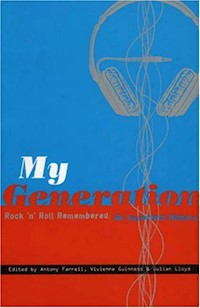
My Generation E-Book
4,99 €
Mehr erfahren.
- Herausgeber: The Lilliput Press
- Kategorie: Geisteswissenschaft
- Sprache: Englisch
Sex, drugs, rock'n'roll, love, discovery and death – this is the journey mapped through music taken by us all. Here, writers, artists, poets and players, makers of films and young guitar-players – all with Irish connections – flash back together to earlier days, favourite LPs and formative ways. Ah, we were so much younger then – This is the rhythm of our youth, the backbeat of our revelation, the rock music that changed a generation. My Generation. This extraordinary book makes it your generation too. Dare to turn the page and drop the needle. Contributors include: Paul Brady, Donovan, Ron Wood, Marianne Faithfull, Noel Redding, Shane MacGowan, Ronnie Drew, Mary Coughlan, Terry Woods, Niall Toner, Mick Hanley, Paddy Moloney, Paul McGuinness, Jim Sheridan, Sebastian Barry, Frank McGuinness, Carlo Gébler, Hugo Hamilton, Joe O'Connor, Dermot Healy, Elgie Gillespie, Patrick McGrath, Fintan O'Toole, Anne Enright, Paul Muldoon, Roddy Doyle, Philip Casey and Colm Tóibín. The editors are Dublin-based and work in publishing and the media.
Das E-Book können Sie in Legimi-Apps oder einer beliebigen App lesen, die das folgende Format unterstützen:
Veröffentlichungsjahr: 2015
Ähnliche




















MY GENERATION
ROCK ’N’ ROLL REMEMBERED AN IMPERFECT HISTORY
EDITORS
Antony Farrell, Vivienne Guinness and Julian Lloyd
ASSISTANT EDITORS
Brendan Barrington Faith O’Grady
FOR DENNY CORDELL AND BILL GRAHAM
‘Hearinghimforthefirsttimewaslikeburstingoutofjail.’
Bob Dylan on Elvis Presley
CONTENTS
EDITORS’ PREFACE
THIS BOOK HAD ITS ORIGINS in Loughcrew, County Meath, one late spring evening in 1994. My stepbrother Charlie Naper and I started naming our favourite albums and unravelled a past signposted by its music, leading to the garden of the late sixties and early seventies. An important point of departure was TheHeartofRockandSoul:The1001GreatestSinglesEverMade (1989) by Dave Marsh (rock bibliography is still in its infancy: Greil Marcus, Nick Kent and Hugo Williams are other reliable guides). I elaborated on the idea with the poet-publisher Peter Fallon, enlisted my co-editors Julian Lloyd and Vivienne Guinness, and the journey began.
MyGeneration is an act of aural repossession. We asked for ‘notes towards an autobiography through sound’, inviting contributors to select ten albums of classic, formative rock – a broad church that housed jazz, blues, soul, folk, country, reggae, punk. The memories elicited speak for a generation coming of age in a world in radical transition.
The responses, as they came, were generous and unqualified. First in was John Stephenson, by fax: ‘What a glorious idea! Thank you for the invitation, which so caught my fancy that I sat down immediately and churned it out. I haven’t enjoyed myself so much in ages.’ Ian Whitcomb, an early icon from Trinity College days, came next. (In May 1965 TrinityNews reported that Whitcomb’s ‘You Turn Me On’, recorded at the Eamonn Andrews Studios, had reached number 3 on the West Coast of America, topped by the Rolling Stones with ‘(I Can’t Get No) Satisfaction’ and the Byrds’ ‘Mr Tambourine Man’. The paper noted that he was scheduled to appear at the Trinity Ball, ‘where we hope to get a pre-view of this song, especially as it has been banned by Radio Eireann for being “erotic”’.) Aisling Foster, Elgy Gillespie and Frank Me Guinness followed, setting a seal on the enterprise, and through friendship and propinquity we gathered in a rich haul of over seventy contributors, all of them broadly Irish by birth, residence or association.
We had a few refusals. Among politicians, Mary Banotti ‘spent the 60s in the United States marching and not listening to a great deal of music’. One prominent novelist responded, ‘I’m afraid my days of Bob Dylan impersonations are no more now than a warm, pink smudge of embarrassment in my memory. Besides, I never think of it as my generation, but theirs …’. An eminent poet declined saying that he was ‘a case of total burn-out. I feelyou will understand’. A columnist stated she never ‘had money for albums.’ Ronan O’Rahilly, founder of Radio Caroline and grandson of The ‘1916’ O’Rahilly, nearly came on board. We courted Lynn Geldof assiduously but failed, despite a shared affection for Billy Fury.
As bodies swayed to music, editorial rules were bent. Aisling Foster wrote:
How serious is that ‘no more than one singer or group, no best-of compilations’? One of the first titles I thought of was TheRockMachineTurnsYouOn – surely everyone’s most-played mid-60s album? – and a compilation. What about the Motown compilations which came out at the same time as the (generally dire) individual albums – or most especially the Atlantic label SolidGoldSoul volume 1 and on, the absolute mother’s milk of Ireland’s long romance with black American soul music?
Jeananne Crowley, Mick Hanly, Kevin Myers, Colm Tóibín, Kathleen Williamson and others proceeded to fly the editorial net, magnificently.
The shards, narratives and vinyl dreams that go to form MyGeneration reveal an era in outline. Ireland’s intimate scale lends coherence to material dense with cross-reference and shared experience. While international rock music fed our elemental hungers and asserted itself as a lingua franca during the sixties, singles gave way to albums and the ‘rock industry’ became a part of corporate culture, smoothing away the individualism from which it developed. Irish rock itself came into its own during the seventies by using an idiom drawn from traditional sources and fired by the energy and excitement at large in the global village.
There was a world out there, stirring beneath our feet. At Haight-Ashbury an alternative society momentarily pitched its tents, Ken Kesey and Timothy Leary its avatars, ThePsychedelicExperience:AManualbasedontheTibetanBookoftheDead its guide to the underworld; from it some of us returned, bearing TheWholeEarthCatalog and new ways of seeing. In Carnaby Street and later at Bow Street Magistrates Court, wizard of Oz Richard Neville waved his magic wand, announced a sexual revolution and earned our gratitude. Radicalized Maoist students moved along the Boulevard Saint-Michel, overturning governments. More somberly, a movement begun at Burntollet culminated in Derry’s Bloody Sunday, the burning of the British Embassy in Dublin’s St Stephen’s Green and the end of Stormont. Those were the days – our pied pipers playing us through, these pages their memorial.
The precise nature of some contributions to MyGeneration contrasts with the baroque discursiveness of others. Space permitting, the players ‘speak for themselves’. The result is a wonderful landscape in which as readers and editors we are privileged to find ourselves. The last contribution in was from that quintessential rock correspondent, BP Fallon. Having begun with his brother Peter, the circle was complete.
[AF]
THIS IS A BOOK WITH A SOUNDTRACK. As an unashamed groupie, albeit rather a grown-up one now, I loved the singer as much as the song, so it was no hardship to gather many of the musicians’ contributions on tape (designated on the page). Marianne Faithfull quoted to me David Bowie’s maxim that ‘writing about music is like dancing about architecture’, but overcame her own reservations with some lucid and evocative recollections. Her remark, though, did make me wonder how the many gifted writers who have contributed to this work would fare if asked to make a record about their favourite books.
The going got delightfully tough in the case of Ronnie Wood: after a long and happy night I felt we had some resonant material on tape. The transcription was one of the most hilariously dadaistic documents imaginable (‘Got my mojo working’ came out as ‘Got my mother working’). Something had obviously gone wrong. I listened to the tape again. The truth was that snatches of conversation in euphoric late-night code, interspersed with pregnant pauses – some of considerable length – and cackles of laughter do not make good copy. We had another bash. It wasn’t quite such a riot, but we were able to make a proper record of Ronnie’s friendships and memories, going back to the dawn of British R&B, the crucial influence of which on 1960s music cannot be underestimated.
Both Denny Cordell and Bill Graham died while writing their entries. It is impossible to think of two people who loved music more or who more completely embodied the sense of adventure that is expressed in rock ’n’ roll and all its many roots and branches.
[JL]
And, for the record, here are the editors’ selections:
MY GENERATION
DERMOT BOLGER
MARTHA
I found the box of old albums,
Blew dust off a disused needle,
Tom Waits began to sing ‘Martha’.
Once again I was twenty-four,
The pull of hash and tobacco,
Cheap white wine at my elbow
At the window of your bedsit
In the dust-filled August light,
A needle bobbing over warped vinyl
One final time before we stroll
Down to bars where friends gather.
Decks to be shuffled, numbers rolled,
Blankets bagged on some dawnlit floor.
Our lives are just waiting to occur
As we linger in the infinity it takes
For the voice of Tom Waits to fade.
TIM BOOTH
THERE HAS ALWAYS BEEN MUSIC: my mother playing the piano while I beat my head in time against the bars of the play-pen; the wireless in the early fifties with programmes like ‘Music While You Work’. Daa, de daa, de daa, deee daa da … ‘brought to you today by Geraldo and his Orchestra’ – earworm signature tune followed by ‘How Much is that Doggie in the Window?’ and ‘The Deadwood Stage is a-Comin’ on over the Hill’ – all blown relentlessly from the old valve radio by a wind they called ‘Maria’. Terrible straight music.
In boarding-school, after lights-out, hit-parade fodder leaked furtively from Luxembourg 208, but that wasn’t the real thing either. You needed to hear the Everly Brothers, and Carl Perkins, boys like that, who could really doit. But what you got was the Kingston Trio, and Helen Shapiro, geeks, so the only thing to do was to go out and buy something for yourself. But what to buy? It had to be something to really impress your peers. After all, you had just mastered B7th on the six-quid guitar your mother gave you for your fourteenth birthday and you saw yourself as somehow akin to the young Beethoven, brimming with musical talent. So, maybe it should be jazz. That ought to knock ’em dead. But no. Too many notes, too hard to listen to, and there was no way any of you could actually play it. God alone knows what kind of chords were in there. Take five? Take a hike, Dave. Stick to the easy stuff – ‘Livin’ Doll’, ‘All Shook Up’. Tricky shit like that. Learn the chords, and get the Terylene slacks taken in.
Then, in 1962, your callow student ears heard something at a friend’s place – ‘What in the name of God is that?’ Lonesome high voices on a bed of guitars. No electricity, but somehow earthy. The white-trash roots of rock’n’roll. Music that you could take and fuse with black R&B. Stuff that people out there were already taking and fusing … as you would soon learn. Appalachian mountain music, with harmony singing so tight that, like the closely fitted stones of those fabled Andean temples, you couldn’t get a knife-blade between the elements.
TheNewLostCityRamblers. Mono, but sounding sweet on my mother’s new hi-fi – a state-of-the-art Pye Black Box, with little built-in speakers on each side of the unit – maybe not rock’n’roll, but the pure stuff all the same. They had these sounds: fiddles, mandolins, banjos, put the hair up on the back of my neck, just like the Everlys could, that vibrato in the vocals, a desperate yearning in the voices, like some kind of pre-electric poor-boy Buddy Holly singing harmonies with himself. But the girls didn’t like it, so it was back to the popular stuff: ‘Why mustah bee-eee a te-e-enaaaaggger in luuuve?’
That Ramblers album got a lot of play. I don’t have it anymore, but there were songs like ‘Mighty Mississippi’, ‘She Tickled Me’, and ‘All the Good Times’, as well as rags and breakdowns, that I learned, and subsequently attempted in places like The Pike, a late-night club in Herbert Lane, where in 1964 a young American, Andy Leader, with a big Martin guitar that he could finger-pick, had a song that I could not believe. Written by this newcomer called Bob Dylan. I’d never heard a song like that before. It sounded like the way things actually were. Andy taught me the picking style and the chords, and there I was. ‘Don’t think twice, it’s all right.’
I got the Dylan albums as they came out, grew my hair a bit and practised hard – both the guitar and the attitude. But I was also listening to other music: John Hammond Junior’s first album, entitled JohnHammond – produced by his father John Hammond Senior, the man who had first discovered Dylan – spoke to my condition. Black R&B, but a white boy singing it: numbers like ‘You Can’t Judge a Book by the Cover’ and ‘Who Do You Love?’, all played by an electric band that could make the music flow, stretching it out, hitting the bio-rhythm. I’ve still got that album.
Then the word went out: Dylan was coming to Dublin. So there I was, in the fifth row as his band took the stage, an all-electric outfit with a stereo-sound system. Jesus! A guitar each side on the speakers, and Garth Hudson’s Hammond, swirly and iridescent in the mix, like oil on water. The audience hated it, hated this movement forward, disgracing themselves yet again, but I had my innocent mind well and truly blown that night. When BlondeonBlonde came out, I was the first in the shop. An electric album, almost better than the concert. List-ening to it today I move back through time, to that flat on Waterloo Road, taste those tastes, smell those smells. ‘Nobody feels any pain …’
‘You heard this?’ somebody said, and this weirdness came out the radiogram speaker – in glorious monorama naturally – ‘Come a little closer to my breast and I’ll tell you that you really are the one I love the best, and you don’t have to worry about any of the rest, ’cause everything’s fine right now.’ Which it undoubtedly was: Incredible String Band’s first, eponymous album, hit with a huge impact, and like some vast extraterrestrial object whacking in from Tau Cetii, it blew our safe little musical world into a different orbit. Williamson, Heron and Palmer weren’t American, they were Scots, and their way of playing was completely new. The words and music came from their background, pioneered by them, out there on some strange frontier, each song exploring the parameters of their personal world, forging music that felt like it came from a tradition, from the source, even though it was fresh out of the mould. Music that made the mundane suddenly exotic, and allowed the everyday events of our lives take on a fantastical spin. Inspiring stuff. If they could do it, then maybe we could as well.
In Edinburgh, people followed a different drummer, so when I returned to Dublin I had a copy of DisraeliGears, Cream’s second album, with its tacky Martin Sharp cover that still managed to say it all, and thosesounds. Oh, the glorious pretension of the whole thing, a sort of quasi-yuppie rhetoric born ahead of its time: ‘Tales of Brave Ulysses’, my arse. Those voices quivering together, guitar cutting through a ground-zero onslaught of drums and bass. Clapton, Bruce, and some whangdoodle drummer called Ginger Baker doing stuff that shouldn’t be allowed. Sound waves whacking out from battered speakers like an F15 kicking in its afterburners – by now we had a crude stereo system in the house in Sandymount: ‘Do do do, do doo do. I feel free.’
Which I did, until in 1968, on the barricades somewhere, somebody put on an album called MusicfromBigPink by the Band. That put a halt to our tango! These guys were serious, and who’s that drummer? After the rococo bombast of Cream, this outfit was lean and dangerous, hard-edge. Nothing stated unless it was needed. Supposedly a début album, but you could tell from the music that these boys had been out there forever. Originally the Hawks, backing Ronnie Hawkins, and then Dylan’s first real band, these were veterans, seasoned campaigners, men who had paid their dues and could still smile about it. Their music had the lonely yearning of Appalachian music on the one hand and the power of rock’n’roll on the other – a fusion that went into your head and down your spine, little tantric fingers jacking in on-line, exactly there, at the heart of the matter. ‘I pulled in to Nazareth, I was feelin’ about half past dead …’ Getting that song down, trying out those long harmonies: ‘Annnnnnnnnnnnnd you put the load right on me …’
Then somebody, that same nameless somebody, did put the load right on me, with yet another album on the turntable. Side two, track one, something called ‘Ice’. Out-there stuff, warped stuff, full of seductive mind-enhancing sounds that not only spoke to my condition, but danced an off-centre hallucinogenic watusi with that condition. The album was Clear by Spirit, produced by Lou Adler in 1969, and its jazzy overtones breathed a sophistication that was very different from the Band, yet in its own way just as authentic. Ed Cassidy, their drummer, was the stepfather of guitarist Randy California. Ed sounded like he had been taught by Gene Krupa: he didn’t exactly swing, but somehow fit right in with the younger musicians. A good steadying influence. They produced a body of work, and maybe TheTwelveDreamsof DrSardonicus is a better album, but Clear was the first one I heard. There was also at that time a green VW beetle with Clear on the eight-track, and Johanna at the wheel, and these three facts enhance my recollection: ‘I said too much business is wrong for you baby.’ Track six, side two also offered the opinion that there was ‘New Dope in Town’, and there was, in not inconsiderable amounts.
The town was London in 1972, Van Morrison on the stereo. The album was SaintDominic’sPreview. Every track just right for the times and their interconnected leisure activities. In from Hampstead Heath of an autumn evening, pockets and cortex full of a certain mushroom, and Van the Man telling us that it was ‘Almost Independence Day’ while the Moogs of Bernie Krause and Mark Naftalin boomed and swooped behind the mix, as if the spiralling double helix of our own DNA had somehow escaped from our genes and replicated itself deep in the grooves of the vinyl. ‘As we gaze out on, as we gaze out on … St. Dominic’s Preview.’ Nobody knew what the words meant exactly, but it didn’t matter. They represented something that seemed profound, a way to go, a way to be, with the synapses firing on all four million cylinders, and John McFee’s steel guitar stringing silvery phrases across the melody like neural power-lines. We knew the precise location of St. Dominic’s Preview.
Back in Ireland, the real Bill Graham, for reasons that escape me, laid an album on me – InMyOwnTime, by an American singer called Karen Dalton. I had never heard of her before, nor have I since. Maybe something happened to her, but should you ever come across any of her work, buy it. Suffice to say that the record was produced by Harvey Brooks, and the backing musicians include such luminaries as Amos Garrett and Gregg Thomas.
Singing like Billie Holiday on meta-steroids, Dalton – who seems to come from a folk background – also plays twelve-string guitar and banjo. The album kicks off with Dino Valenti’s ‘Something on Your Mind’, then slips into ‘When a Man Loves a Woman’, followed by Paul Butterfield’s ‘In My Own Dream’. Dalton’s voice, phrasing like an alto sax, weaves through the superb ensemble players. Then comes the pearl. Something called ‘Katie Cruel’, the antithesis of everything that went before. Just banjo, voice, and the beautiful fiddle of Bobby Notkoff. Short and sweet. She resumes, back where she started, with Holland-Dozier-Holland’s standard ‘How Sweet It Is’. Side two kicks off with Richard Manuel’s epic ‘In a Station’, and like side one, a surprise lurks here as well, but you will have to discover this for yourself.
I’ve had the album for over twenty years. It’s worn and scratchy now, but I have never heard anything like it before or since. Eat your heart out Björk. ‘Here I am where I must be, where I would be I cannot.’
During those twenty years I had been listening to Frank Zappa, album after album, each one even better or even worse than the last, depending on your viewpoint. In 1979 he released Joe’sGarage,ActI, a wholesome piece of fun in the form of a morality play (according to the liner notes). Along with the usual superb musicianship, warped humour, blatant in-your-face sexuality and iconoclastic shadow-boxing, the album contains the classic ‘Joe’s Garage’. A rags-to-riches tale of your average beat combo in pursuit of fame, their playing ability slowly creeping up the quality scale – showband to four-chord naff to slick – while the lyrics unfold, Zappa displaying a bizarre yet comprehensive understanding of the music business. It should be compulsory listening at music schools everywhere, along with the wonderful ‘Why Does It Hurt When I Pee?’, a lampoon of the bombastic pomp-rock Meatloaf archetype.
Zappa is no longer with us, but everybody should give him a listen at least once. He’s the musical equivalent of reading Thomas Pynchon. ‘Oh those Catholic girls, with their tiny moustaches …’
It happened again last year – somebody, that famous somebody, put on a CD, and my attention was grabbed. Guitars, sparkling and slashing, Jesse Ed Davis-style, fluid bass and drums, swampy organ chords and some type of native chanting going down. What’s this? Somebody speaking the lyrics now … whatever happened to singing for chrissake? No, hold on. This is good … the business, the full shilling. A big resonant dramatic voice with a Yankee curl to the vowels: lyrics that are full of righteous anger, full of poetry, full of love. Songs with titles like ‘See the Woman’, ‘Raptor’, ‘Shadow over Sisterland’, hard-muscled committed ideas, taking no prisoners, the whole structure of the concept held in place by a hefty foundation of rock’n’roll, underpinned and reinforced by a layering of Native-American traditional vocals and drumming, from which the words soar up gracefully, implacably, to form music of great power and honesty, compelling you to listen:
Welcometograffitiland
Alltheridesareinyourhead
Theticketiswhatisthought
Andwhatissaid.
From ‘Rant and Roll’, the first track on JohnnyDamasandMe by John Trudell.
Says it all really.
PAUL BRADY
FAMILY STYLE
THE VAUGHAN BROTHERS
Among the last recordings by Stevie Ray Vaughan before his untimely death. Here, he and his brother Jimmy play the kind of music that must have been heard in bars throughout Texas from the late forties on. In a former incarnation I must have been a barfly in Texas because this music is a language I spoke fluently … before I even heard it. Essential listening.
MALAGASY GUITAR
D’GARY
Real name Ernest Randrianasolo, D’Gary is from the Bara tribal group of southern Madagascar. Hearing this record for the first time, I again felt this strange feeling of coming home. D’Gary’s guitar-playing is the most stunning thing I have ever heard. The music he plays and sings seems like the source of almost every type of music in existence. Here are Caribbean, Andalusian, Indian, European classical/church harmony, blues and Celtic rhythms all cascading riotously together, and not in a conscious New Age concoction. This music has been there forever. Not for the faint-hearted, but hugely rewarding and continuously so.
DIRTY MIND
PRINCE
From 1980, this is Prince in his classic early pop days before the funk-rock took over. Nothing wrong with his funk, but here he seemed more into straight-ahead songs and stripped-down dynamite. Incest, head, and doing it all night: what more could a body want? Nobody should have this much talent.
TRADITIONAL IRISH UNACCOMPANIED SINGING
DARACH Ó CATHÁIN
Originally released in Ireland on the Gael Linn label in the early sixties, these are some of the greatest-ever recordings of pure Gaelic ‘Sean Nós’ singing. Darach Ó Catháin was born in Leitir Mór in Connemara and became recognized as probably the best Connemara singer of his time. A hard life ‘working, drinking and making music’ in Leeds only served to make his voice all the richer. To hear him ‘open up’ a song still devastates me. Anyone who doubts the legend that Connemara people are descended from the Moors of North Africa and southern Spain should listen to this record. DiaLeataDhara, up there wherever you are!
PIRATES
RICKIE LEE JONES
From 1981, this record was Jones’s follow-up to her hit début album (featuring ‘Chuck E’s in Love’) and was already showing the dark side which came to dominate all her later albums. Rarely is darkness so sublime as this. All her street characters – Eddie, Zero, Bird, Cuntfinger Louie, Woody and Dutch – seem like the only people really alive as long as this record plays. Check out ‘Skeletons’, which is number one on my list of songs I wish I’d written.
ALL TIME GREATS
ELVIS PRESLEY
After all the attitude, hype, movies, excess, fantasy, myths and legends, what remains is that Elvis was simply an incredible singer. Instinct and talent shoot through every phrase of every line of every song, no matter what mood he was trying to convey. ‘Jailhouse Rock’ to ‘Wooden Heart’? Who else can show such balls alongside such tenderness and vulnerability?
THE BOTHY BAND
THE BOTHY BAND
Fasten your seat-belts! Dónal Lunny has been at the centre of energy in Irish music for so long now, it’s easy to forget the shock that greeted the unveiling of the Bothy Band, his inspired post-Planxty creation of the seventies. More so than the Chieftains, who were too orchestral and lacking in the engine-room department, the Bothy Band ran on high-octane all night. When Tommy Peoples, Matt Molloy and Paddy Keenan tore off with Tríona Ní Dhomhnaill and her brother, Mícheál, with Dónal stoking up the fire behind, people just started to giggle helplessly with excitement. Everything that happens in Irish music today owes something to this record.
GRACELAND
PAUL SIMON
This was a record struck by lightning. The inspiration to seek out the music of Soweto, as yet unheard on the world stage, and marry it with his own laconic poetry, gave Paul Simon one of the brightest moments in his career. To introduce a sound combination, ethnic and totally new, and make it appeal to the mainstream in a world of market research and playlist consultants, was a sweet triumph. A classic from day one, not least for the huge Roy Halley sound production.
BOP TILL YOU DROP
RY COODER
Was this the first-ever digitally recorded album? ‘Pop’ album certainly. That’s what we all thought in Dublin in 1979. We passed it around and listened to it as if it were something from another planet. Musically it hit us almost like Graceland did years later – a totally new sonic and attitudinal approach to sixties soul, sampled at fifty thousand times a second and recorded as numbers. Far out,
GIVE IT UP
BONNIE RAITT
I found this record when I was kipping on Chuck Neighbors’ floor in New York in 1972 or thereabouts. The Johnstons, an Irish folk group I was a member of, had just supported Bonnie Raitt at Tufts University, Boston, and this record was hot at the time. Little did I know that twenty years later she would record some of my songs and call her album LuckoftheDraw after one of them. This was the coolest record of that summer. It still is pretty cool. Any sound that comes out of that girl’s mouth is okay by me.
PHILIP CASEY
SGT. PEPPER’S LONELY HEARTS CLUB BAND
THE BEATLES
Rediscovering the date of this record, June 1967, is disconcerting, because the event I associate with it happened a year and a half before. This will be the case with a few more of my songs of experience, I have to confess.
I was in bed in Cappagh Hospital, beside the ward gramophone. It was a lovely mahogany set, with rich speakers, and it found its way into my novel TheFabulists, thirty years later, as belonging to Tess’s parents. One or two beds up from me was Paddy Doyle, since famous as author of TheGodSquad. Paddy later owned an almost identical machine. I had thought of the Beatles as a yeh yeh band, and so was startled to hear the rich, opening chords, a sound that remains vivid as a sensual shock. Perhaps this is why I associate it with the following.
In orthopaedic hospitals, apart from after operations, very few people are actually sick, and so teenage patients get up to ordinary teenage things, and in those days many patients spent years at a time in hospital. There were a few experimentation hotspots, the notorious one being behind the Congress Altar (I’m not sure if the nuns were aware how aptly it was named), which was the original Eucharistic Congress Altar on O’Connell Bridge in 1932, later rebuilt in Cappagh. Another hotspot was the linen room. One nurse took exception to my sojourns there, which were mostly with a beautiful colleague of hers, to whom I will be forever grateful, and never lost an opportunity to disapprove of my behaviour, which was innocent enough, if high-spirited. On Christmas Eve, those of us who could walk or go in wheelchairs were ordered to midnight Mass. The off-duty nurses were there too, in all their white-gloved splendour, and afterwards, when we were safely in bed, they returned to the ward with their mistletoe. One by one they kissed us, and I was beginning to feel very pleasant indeed, when I noticed the disapproving one was taking her turn. I expected a chaste peck, but for the first time in my life I got the length of a woman’s tongue down my throat. I remember you, and your name, very well, Nurse X, but our secret is safe.
It’swonderfultobehere,it’scertainlyathrill.You’resuchalovelyaudience,we’dliketotakeyouhomewithus,we’dlovetotakeyouhome.
AMERICAN PIE
DON MCLEAN
From about 1972 until he married Eileen Mulrooney in 1974, I shared a flat with Paddy Doyle in Ranelagh. Soon it became the norm to have a party every Saturday night. The evening might begin in Toner’s of Baggot Street, or the Chariot Inn, or T. Humphrey’s (Thumphrey’s as we called it) in Ranelagh. On a pay-packet of £8 a week, I paid tax, £5 as my share of my rent, bought food, clothing and transport, and had enough to get pie-eyed at the weekend. A pint was nineteen new pence. By 1974 I had a job as an ‘animal technician’ in the Medical Research Council labs in Trinity, which brought me up to £19 a week, though I wasn’t much better off. At one time there was a hard core of friends who made it to our parties most weekends: Jim Greeley, Maura Smith, Eucharia Morrissey, Eamonn Dawson, Carmel O’Rourke if she was off-duty, Dave Stokes, Mervyn Gilbert when he came to live next door, Siodhbhra Larkin when she wasn’t somewhere exotic, and Eileen Stokes, who always seemed to appear magically with a plastic basin when I’d had just too much. And Tony Corbett, who would have us in kinks with one of his Donald Duck routines, or describing two small breadcrumbs ganging up on a big breadcrumb. One night our landlord, an enormous Kerryman, arrived with twenty-four bags of fish and chips. On another, Eamonn Dawson arrived from work just before closing time, gasping for a pint. ‘You’ll get one if you take my wheelchair down to Thumphrey’s,’ Paddy told him. ‘But whatever you do, don’t get out of the chair.’ Dave Stokes wheeled him down, and sure enough, the closing-time crowd parted like the waters of the Red Sea, and Eamonn got his pint. Most of us had long hair, and I had thick ginger sideburns. Paddy lay on the floor, accompanying himself on guitar, and as we got mellower we all joined in, although Paddy was the only one who knew all the words: Buddy Holly, the Beatles, Cliff Richard’s ‘Travelling Light’, ‘The Butcher Boy’, ‘Scarlet Ribbon’, ‘The Banks of the Ohio’. But what really got us going, perhaps because it was so long that you had time to get into the mood, was ‘American Pie’, and around about the maudlin hour, ‘Vincent’.
Starry,starrynight …
ABRAXAS
SANTANA
I don’t remember much about this one except myriad parties, smoke haze and dawns in Ranelagh or Rathmines. I didn’t inhale, despite an hallucinatory memory of waking up in an enormous room beside a young woman I had never seen before, in the midst of what seemed like dozens of sleeping bodies (all of us fully dressed) – but I didn’t know about passive smoking then. As I remember it, Bob Marley was big, but so were Santana, and I preferred Santana.
You’reaBlackMagicWoman, you’reaBlackMagicWoman …
IRISH TOUR ’74
RORY GALLAGHER
One of my few claims to musical fame is that Rory Gallagher’s guitar once glanced off my head as he ran from the dressing-room to the stage in the National Stadium. The trouble is I have no idea when this was, despite enquiries – even on the Internet (by the way, for Gallagher admirers with Internet access cf. htpp://www.wmd.de/~grupe). My brother Peter and our old pal Mick Considine remember seeing him in the Carlton Cinema on his Irish Tour ’74, which is when I thought I had seen him in the Stadium. I first heard Rory Gallagher on the radio when he was with Taste and I was about nineteen, with greats like ‘Blister on the Moon’ and ‘Born on the Wrong Side of Time’, which are songs I still love. But the one I’ve always liked best is ‘Too Much Alcohol’.
91%.Bettermakeit92. 93%,94,that’lldo.95, 96, 97%, 98
– Bartenderthat’s99!Makeit100%. 100%. 100%.Wannatrysome?
Wannatrysome?100%.AndIwon’tfeelathingatall.
HAPPY TO MEET, SORRY TO PART
HORSLIPS
When we were in secondary school, Martin Armstrong was noted for two things: his brains, and his neatness. College put an end to the neatness. I didn’t see him for a number of years, until we worked together on an experiment in community radio organized by Paul Funge’s Gorey Arts Centre and Festival, the logo of which was the Dancing Man. Martin was brilliant at radio, a natural, and I remember working all night with him editing tapes and compiling material. I could only marvel.
Many bands, including U2 and, famously, the Virgin Prunes, came to the Gorey Arts Festival, but the night I cherish was the first Horslips concert. The Arts Centre was really a shed, used as a store for Funge’s drapery shop during the year, and it was unaccustomed to booming bass and pumped-up volume, which must have been heard all over Gorey. By the end we were dancing in the aisles, and Paul Funge’s father appeared in a vain attempt to stop the mayhem. Martin died a few years back, but he is forever etched on my memory as dancing with total abandon that summer’s evening, the apotheosis of the Dancing Man.
Thebestandstraightestarrowistheonethatwillrangeoutofthearcher’sview.
GOAT’S HEAD SOUP
THE ROLLING STONES
On leaving Ireland in 1974 to live in Spain, I was carrying the residue of an unrequited love, which is an ideal way to begin a voluntary exile. About twenty friends had all said they would come with me on my planned trip to a Gypsy Festival in Andalucia, but they were sceptical that Tony Corbett would be among them. In the event, Tony was the only one to venture forth.
We got a lift from Le Havre to Paris with Eileen Mulrooney’s brother and his friend. We found a café, and talked about what we would do, as we still hadn’t decided exactly where we were going. My unrequited love was at me, so I went over to the jukebox and picked out ‘Angie’ by the Rolling Stones. Outside, a pneumatic drill was hammering away in the heat.
On the platform Tony and I tossed a coin: Barcelona or Madrid, and Barcelona won. In our naiveté, we hadn’t booked a seat, and so we stood all the way to Port Bou, an overnight journey. Somewhere around four in the morning we met a Spaniard, a man of about twenty-seven, who spoke perfect English and told us a lot about Spain. I didn’t know anything about Catalonia, or the Basque country, or that Spain was anything other than one big homogeneous beach, with gypsies who lived mostly in the south and had a festival. As we were pulling into Port Bou, he took me aside and asked me if I would do him a favour. When I enquired as to what that might be, he said he wanted me to bring in a book for him. I coughed hard when I saw the title, TechniquesofGuerrillaWarfare, and said that as this would my first time in Spain, I wanted to get in – and more to the point, I would like to get out if I so desired. He shrugged, not in the least offended or perturbed. When I saw the Spanish customs, with the frontier police armed to the teeth, I feared the worst. He put his bag on the table, and the TechniquesofGuerrillaWarfare on top of his bag. The customs officer put the book on the table, and gave his bag an exhaustive search before putting the TechniquesofGuerrillaWarfare back on top of the bag and waving him on.
Angie, oh Angie,ain’titgoodtobealive.
TUBULAR BELLS
MIKE OLDFIELD
When Tony Corbett and I arrived in Barcelona, we lived for a number of months in a pension opposite what was then Estación de Francia, and discovered a great bar next door in the Hotel Park. This was full of wonderful characters, behind and in front of the bar, and within six weeks we had been to two weddings. We had very good friends among the staff, and as soon as they had finished work at 3 a.m. they brought us everywhere. This was how I discovered the Guardia Civil, or grises (greys), very nasty customers with whom we had several run-ins but survived unscratched because we were foreigners. One night we were returning from a bar with our Hotel Park friends at 5 a.m., on our way to get churros (pastry dipped in hot chocolate) at Parque Ciudadela, when I decided to raise a toast with my glass of rum to one of the grises, whose sub-machine gun was pointed somewhere between my heart and forehead. Salut,yforsaalganut! (Good health, and strength to your member!), I greeted him. Fortunately, he realized I was a stupid extranjero, as Franco was still very much alive and Catalan was most definitely banned, but my friends almost had a collective heart attack.
Adjacent to this government building was a very large restaurant, and one night in the small hours Tony and I found ourselves in there as guests of the owner’s son. He had arranged several speakers around the walls; it looked wonderful with the chairs stacked upside-down on the tables. We sat in the centre and he put TubularBells on the turntable. It is forty-eight minutes and fifty seconds I will never forget.
PEARL
JANIS JOPLIN
Janis Joplin is my favourite singer, and her ‘Mercedes-Benz’ is one of the few songs I ever learned. I sang it at my party the night before the Pope came to Ireland. Mad at my friends (who I had taken to be atheistic or at least agnostic) who were either coming to my party early to get up to see the Pope, or coming late to go directly from my party to the Phoenix Park, I got rather drunk, convinced I was the only one left with any integrity.
But fortune smiled. I like to think it was my passionate singing of ‘Mercedes-Benz’, but whatever it was, a beautiful Irish-Australian with the sexiest antipodean accent you ever heard took a fancy to me, and I fell deeply in love, a state I remained in for a number of years, and indeed, although Philomena is now happily married with two beautiful children in Sydney, we still keep in touch. We had the house to ourselves the next morning, and over a late fry breakfast we watched the Pope on TV.
To hell with integrity. I was so happy I’d have spent my holidays in Castelgondofo without blinking, and in the end we walked down to Christ Church to join the throng waving at John Paul II (although I drew the line at waving at the cardinals) as he sped past in the Papal bus. I owed him. It was the least I could do.
OLord,won’tyoubuymeaMercedes-Benz?
NASHVILLE SKYLINE
BOB DYLAN
When I was about fifteen, at the height of the ballad boom, I used to sing around the parish halls with my brother John. John had a prodigious memory for song lyrics but I could not remember a line. However, I used to stand at an angle to John, and read his lips, and in this way I muddled through until we were separated one night when all the performers got on stage to sing the National Anthem, and I was exposed as unpatriotic, not to mention a fraud.
Many years later I thought of this at parties thrown by my friends, Dave and Emer. These parties reminded me of our hooleys in Beech wood Avenue – except that Emer prepared wonderful food instead of chips – in that everyone talked to each other, and the night ended in song, usually led by Dave on the guitar, with his endless Beatles and Dylan repertoire. When I discovered that I could read Dave’s lips in much the same way that I had read John’s, we became something of a team, to the extent that we sang at a friend’s wedding, which shows I have nerves of steel or a hard neck, or both. Somehow I reckon our best duet was Dylan’s ‘Girl of the North Country’, especially as it stands out as the song I nearly learned.
I’ma-wonderin’ifsheremembersmeatall.ManytimesI’veoftenprayedInthedarknessofmynight.Inthebrightnessofmyday.
I’M YOUR MAN
LEONARD COHEN
For my fortieth birthday Ulrike gave me a holiday in Berlin. I had been there while the Wall was still up, and had been in the East. It was strange driving back and forth with Ulrike in 1990, not knowing whether we were in the East or West. We visited Brecht’s grave. The window of an old-fashioned tobacco shop that I remembered from before was now full of baubles from the Far East. There were posters for strip joints. An East Berlin speciality, a dessert, was no longer on the menu at a restaurant.
FirstwetakeManhattan,thenwetakeBerlin.
At that time, Ulrike was studying philosophy, and was part of a study group, all women. I was invited on a picnic with them, along with the boyfriend of one of the others. At first I was reluctant. ‘What would I have to say to Seven Female Philosophers?’ I asked Ulrike. We set off in two cars for a picnic on the banks of the Oder, passing through East Berlin which still boasted a giant redstone statue of Lenin, out past the already rusting factories and dilapidated apartment blocks (I’m still convinced that Communism fell for want of a tin of paint). The East German countryside was a revelation. We passed through beautiful old towns, preserved as they had been for hundreds of years – but what impressed me most, as a countryman, were the grasses and wild flowers.
The most significant thing about that trip, however, was the gossip. I have never heard, before or since, such red hot, XXXXX gossip and, for my benefit, it was all in English. We arrived at the Oder, which marks the border between Germany and Poland, in brilliant sunshine, and as we sat on the riverbank one of the women leaned over to me and said, ‘Well, Philip, a picnic with Seven Female Philosophers is not so bad, eh?’ I could only agree.
We went for a walk afterwards and had I not been told I would never have seen that the water was heavily polluted. We broke into small groups, and as the sun was setting, I looked back to see that as the light held them, the smog-filled air made our companions seem as if they were breaking into fuzzy pieces. Darkness fell as we drove home, and a wild boar leapt out in front of us. We drove along a tree-lined road, which I had seen in a dream fifteen years before, exactly like that, the headlights illuminating the row of white trunks.
I’mguidedbyasignalintheheavens.
I’mguidedbythebirthmarkonmyskin.
I’mguidedbythebeautyofourweapons.
FirstwetakeManhattan,thenwetakeBerlin.
LAR CASSIDY
MY LOVE OF SERIOUS MUSIC began when I was twelve years old, in 1962. Until then I had been listening to fifties rock’n’roll on the radio and on singles. Somehow, my friend John Cullen, who was two years older than me, obtained a copy of a budget record album of the great Chicago blues bands, for which I gave him a ten-shilling note. The album contained a selection of classics of fifties and early sixties Chicago blues, including a ‘live’ version of ‘Got My Mojo Workin’ by Muddy Waters, ‘First Time I Met the Blues’ by Buddy Guy, and other tracks by great musicians such as the harmonica player Little Walter. Its impact was profound and I started to listen to more blues music.
Shortly thereafter, the London blues movement got underway and had a significant following among pop audiences. These British bands – including John Mayall and the Bluesbreakers, early Rolling Stones, Eric Clapton with the Yardbirds, Alexis Korner and Long John Baldry – included many adherents of the Chicago blues style. Because they sold a lot of records, the popular music press in Britain gave them extensive coverage in which they stated how devoted to Chicago blues they were. Reading about how B.B. King influenced Eric Clapton, or how Big Bill Broonzy shaped the style of Alexis Korner, reinforced my own growing interest.
Following this grounding in blues, my interest in jazz grew through the rather simple, popular ‘soul’ jazz played by the Ramsey Lewis Trio in the sixties. In particular I remember buying two ‘live’ albums by this group, HangOn,Ramsey! and TheInCrowd, in the mid-sixties. They provided the bridge for me from blues into jazz. Because my first interest in jazz was piano/bass/drums trio, I was led on to buy an Oscar Peterson album, NightTrain, which Verve brought out in 1962. When I put this record on the turntable I found myself floundering between two river banks. On the left bank, which I comprehended somewhat, was the twelve-bar blues form I was learning to play on the piano. On the right was the much more sophisticated harmonic and rhythmic world of modern jazz. NightTrain has a number of classic jazz tunes in the blues form like ‘Bag’s Groove’, ‘C-Jam Blues’ and ‘Things Ain’t What They Used to Be’, which receive bracing and technically perfect performances from the Oscar Peterson Trio. The group boasted Oscar himself on piano, Ray Brown on bass and Ed Thigpen on drums, and over three months I struggled to come to terms with the more elastic, complex spaces of their approach to the blues.
I was encouraged in my explorations by a schoolfriend, Dave MacHale. We both attended junior school in Willow Park and senior school in Blackrock College. Dave became a professional rock and jazz musician on leaving school. He plays piano, electronic keyboards, alto saxophone and flute, and has been the musical director of the Boomtown Rats, among others, during his career. Dave’s mother was a fine pianist who could play much of the classical repertoire and was also a mistress of the traditional solo jazz piano style, in particular that of Fats Waller. As a result Dave was a precocious jazz musician with advanced tastes when he was fourteen years old.
Throughout our years in Blackrock, Dave kept stretching my taste, introducing me to Art Blakey after I had absorbed Oscar Peterson. After that, he let me hear what ‘Cannonball’ Adderley was doing, particularly with his hit single ‘Mercy, Mercy, Mercy’, written by Joe Zawinul and featuring very early jazz electric piano by the composer. I also listened with delight to the masters of bebop when I picked up a budget album on a visit to Derry with my father. This collection included ‘Perdido’ as performed by the Charlie Parker-Dizzy Gillespie Quintet from the LiveatMasseyHall album (1953), with a trumpet solo by Dizzy that is an artistic achievement to stand beside the greatest of twentieth-century Western classical music.
The broadcaster Gay Byrne was a good friend of my father’s and he suggested I should take jazz piano lessons from Tony Drennan. In the mid-sixties, Ireland possessed two masters of the traditional jazz piano, Tony Drennan and Professor Peter O’Brien, who remain great exponents today of this immensely demanding, difficult, joyful piano music. I had the great fortune to attend lessons with Tony Drennan from 1966 to 1970. He is a master of Harlem stride piano, of boogie, but perhaps above all, of the ‘swing’ piano style exemplified by Teddy Wilson and that great genius, Art Tatum. When we finished the lesson, Tony would play records. Among the riches he let me hear were the original 78s of the ‘boogie-woogie’ masters Albert Ammons, Meade ‘Lux’ Lewis and Pete Johnson, who recorded between 1930 and 1941.
Dave MacHale also introduced me to the free jazz of Ornette Coleman. The jump to atonality and a more lateral conception of music-making was encapsulated for me on TheEmptyFoxhole, on which Ornette’s son Denardo, then twelve years old, played drums. Dave also played me an album by Archie Shepp, through whose work one could hear the protests of African-Americans in the sixties. The raucous and uninhibited atonality of free jazz became an exciting musical parallel to the riots and rebellions taking place in American cities in this period.
In 1968, the international year of protest, I arrived in Trinity College, Dublin to study English, philosophy and history, and I quickly made a friend of the poet and publisher Peter Fallon of the Gallery Press. I was now a confirmed jazz and blues listener and I enjoyed playing piano. In secondary school, Dave MacHale and I had stayed apart from the general mass enthusiasm for rock music. We were conscious that rock musicians often earned money out of all proportion to their talent while dedicated jazz artists like Ornette Coleman and Louis Stewart had meagre returns. Stewart, a guitarist, then lived in Dublin and was an inspiration to musicians and listeners in Ireland. He spent most of his time between 1970 and 1972 touring Britain with the great British tenor saxophonist Tubby Hayes.
The serious and intense world of modern jazz was radically altered from 1967 onwards. It had been operating within two movements, namely bop, which has chromatic harmony, and free jazz, which is characterized by atonality. To these now were added jazz-rock or electric jazz, and neo-tonal jazz or worldbeat. These two new traditions became the new jazz of the period 1967 to 1975. As Frank Tirro states in Jazz:AHistory (1993), ‘The soul-wrenching cries of free jazz, the tortuous path of advanced bebop, and all those cerebral forms of music that seemed to have led jazz to artistic heights and financial bankruptcy were dispossessed, at least temporarily, in favour of fun and the search for a people’s music.’
The first harbinger of jazz-rock was contained in BitchesBrew (1969), a double album by Miles Davis. I recall experiencing it as a difficult music with which it took some months to come to terms. The electric and electronic instruments heretofore played by rock musicians were brought into jazz, including the electric piano, synthesizer, and bass guitar. Miles Davis amplified his trumpet. Two keyboards or more were used. The new sonorities involved an exploration of the rock vernacular. The tracks on BitchesBrew last for whole sides of a vinyl album and have a compendious, brooding, open-ended quality.
The next shock was the arrival of TheInnerMountingFlame (1971) by the Mahavishnu Orchestra, a quintet of virtuoso musicians led by Mahavishnu John McLaughlin, the British electric guitarist. The band used Indian music as a glue to conjoin jazz and rock. We were delighted that Rick Laird, from Dun Laoghaire, was their bass guitarist. Over a summer working in New York City my friend Brendan Frawley rang up McLaughlin and informed him that we knew Louis Stewart and were anxious to drive up to Massachussetts to see the band at the open-air Tanglewood Festival. To the delight of us all, including my then girlfriend, Clodagh O’Reilly, and Michael Moore, McLaughlin kindly set aside tickets for us and we saw the band perform in perfect stereo, in which the sound picture was visually matched to the position of the band on stage. The Mahavishnu Orchestra was a type of supersonic seventies version of the Django Reinhardt thirties group, the Quintet of the Hot Club of France.
Nineteen seventy-one also brought the welcome emergence of a band that was to be a fixture until its demise in 1986, the innovative Weather Report. Their 1972 album ISingtheBodyElectric represented a compendium of particularly startling developments. Most of this material was found documented at greater length in the double album LiveinTokyo. Weather Report, led by Joe Zawinul (keyboards) and Wayne Shorter (saxes) were pioneers in many areas. They were leaders in the field of synthesizer, with Joe Zawinul giving orchestral body to the band’s lines. They invented a new tapestry-like form of improvisation wherein different band members followed each other in a species of conversation. From 1971 until 1986, their yearly albums were awaited with eager anticipation all over the world, particularly by musicians.
The pianistic genius of Chick Corea was deployed in all its superb brilliance in his band, Return to Forever. He became the first great master of the electric piano on their first two albums, ReturntoForever (1971) and LightasaFeather (1972). These two albums of Latin-slanted pieces also introduced a second genius, double bassist Stanley Clarke, who became an inventive rival to Miroslav Vitous, Weather Report’s bassist. Return to Forever then mutated and became an aggressive jazz-rock band with Stanley Clarke proving to be a challenging virtuoso on the bass guitar. On the third album, HymnoftheSeventhGalaxy (1973), the quartet, which also included Bill Connors on guitar and Lenny White III on drums and percussion, played the first successful suite for a small jazz-rock band. Indeed, HymnoftheSeventhGalaxy is one of the first jazz concept albums.
Working in New York City as a cleaner during the summer of 1973, I saw Weather Report and Return to Forever at Philharmonic Hall in Lincoln Center during the Newport-New York Jazz Festival. Weather Report were disappointing because they did not get the right sound balance. Return to Forever were magnificent, however, playing the full suite ‘Hymn of the Seventh Galaxy’, with Corea’s electric piano glittering with crystalline clarity above the surging electric mix.
The seventies also provided a new avenue of development for the solo jazz piano, and this was the most important period on the instrument since the thirties. Chick Corea released PianoImprovisationsVols1 and 2 in 1971 on E.C.M., a label that set extremely high standards for jazz records. In 1993 E.C.M. issued its five hundredth album, appropriately from the great Norwegian saxophonist Jan Garbarek. E.C.M. also released FacingYou by Keith Jarrett, who became the most important solo jazz pianist since the death of Art Tatum in 1956. TheKölnConcert (1975), a double album, and SoloConcerts (1973), a triple album, became very influential.
Also in the early seventies, the tradition of modal jazz was carried forward by my favourite player of the period, McCoy Tyner and his Quartet. He had been John Coltrane’s pianist and reinvigorated the modal style of Coltrane with his intense, muscular and spiritual piano. On our second night in New York City in 1973 we went to the Village Vanguard, one of the shrines of jazz music. The McCoy Tyner Quartet was in full cry. Their sound is captured on Enlightenment, a soaring double album recorded at the Montreux Jazz Festival two weeks later.
The new jazz of the early seventies was also embodied in important extended works. Just as Duke Ellington’s work BlackBrownandBeige summed up many trends and ideas within traditional jazz, so EscalatorOvertheHill (1971), a jazz oratorio by Carla Bley, and Metropolis (1973) and Citadel/Room315 (1975) by Mike Westbrook, were among the period’s greatest works for big band. EscalatorovertheHill




