


11,99 €
Mehr erfahren.
- Herausgeber: Independent Thinking Press
- Kategorie: Bildung
- Sprache: Englisch
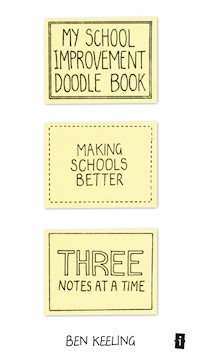
If a picture is worth a thousand words, imagine the power of three pictures at a time. Which is exactly what former graphic designer turned teacher and leadership team member Ben Keeling has done. As thought provoking as it is simple, this book combines an expert knowledge of schools and learning, an enviable talent for graphic design and a keen sense of irony. First spotted by Independent Thinking founder Ian Gilbert following a Twitter exchange that stretched between Chile, the UK and Indonesia, this ground-breaking book uses three simple 'doodles' per page, each on a separate sticky note, to highlight key issues. Simple yet contagious, this book re-writes the rules when it comes to the literature of school improvement and should be on the desk of every school leader and teacher.
Das E-Book können Sie in Legimi-Apps oder einer beliebigen App lesen, die das folgende Format unterstützen:
Veröffentlichungsjahr: 2012
Ähnliche


















For Beth Bones
Contents
Title Page
Dedication
Foreword
Introduction
The Notes
1 One size fits all …
2 Educational obesity
3 Spot the difference
4 Subjective knowledge
5 Positive correlation
6 Allsorts
7 Conversion of measure
8 Outstanding!
9 Potential
10 Gifted and talented
11 Laying (into) the foundations
12 The power of the brain
13 The absence of power
14 Education in bloom
15 Give or take
16 Targets
17 Home sweet home
18 Right on time?
19 Life lessons
20 Ebb and flow chart
21 E.Q.8
22 Question and answer
23 Packed up and ready to go
24 Spirit levels
25 Core purpose
26 Gardnering
27 Teacher?
28 Rubbing out, rubbing off
29 Try not to Confucious
30 Speed up
31 Creation
32 Sieve
33 Constellation triangulation
34 Valentines
35 Theory of constraints
36 Greater than
37 Teachers of …
38 Communican’t
39 Rev down
40 Raise
41 The road to success?
42 Mind the gap
43 The art of leadership
44 Objective, subjective
45 Transition
46 Ringmaster
47 The system
48 It’s Superman
49 We’re all going on a …
50 Change
Copyright
Foreword
When is a school improvement book not a school improvement book? Or, to put it another way, can a school improvement book that doesn’t tell you how to improve your school, that doesn’t give you any tips and ideas or fail-safe systems, that doesn’t offer quotes and insights from top school improvement gurus, that doesn’t even have any sentences in it, not really, can a book like that call itself a school improvement book at all?
Well, to be honest, that rather depends on you.
When Ben Keeling, working in a school in Indonesia, started putting together these ‘three Post-it™ notes in a row’ little works of art, he did it as his way of getting to grips with some of the keys issues in education that were vexing him. Issues like what is the purpose of school? Are grades enough? Is the world of education changing as fast as the world outside education? What will happen if it doesn’t?
Rather than doing what so many people would do, are positively encouraged to do, and reach for the latest school improvement best-seller or go on a course or a year-long programme, he sat down and used his not inconsiderable talent as an artist to kick start his own thinking about the issues. It was his way of reflecting on, thinking deeply about, coming to terms with, the very nature of education. And it helped him become a better teacher and a better colleague.
What it boils down to is that when things are changing fast, as they are in the world of education, today’s great answers are tomorrow’s passing fads. It’s not that the questions keep changing, far from it. ‘How do we design a school system that gets the best out of the children in it?’ is the same question for us today as it was for the Ancient Greeks. It’s that the answers to those questions are constantly evolving - evolving to reflect the nature of what we know about learning, what we know about leadership, what the world beyond school is like, what children are like, what classrooms are or could be or, better yet, should be like. But if you look for the answers from someone else you may never find the answer that your exact situation needs.
Independent Thinking, though, is about independent thinking. What we have tried to do over the years is (along with plenty of little tips and techniques that simply work when you use them in the classroom and that prove you can trust us) to encourage teachers and school leaders to think for themselves. To look for a system is to look for a way to not think for yourself. A system is fixed. Apart from the timetable and the calendar, nothing in school ever is. Applying a system in a school setting is like trying to do a jigsaw made of water. There is no system. There never will be. Not for the sort of education we believe in (which is more than just having children pass exams). What there is, is the professional application of possible answers to big questions that need constantly appraising as part of your journey. And that involves thinking long, hard, collaboratively and creatively about the questions.
Which is where this book comes in.




