


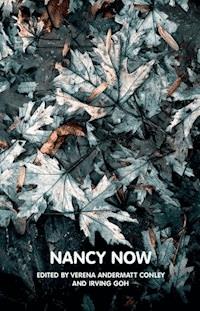
Nancy Now E-Book
17,99 €
Mehr erfahren.
- Herausgeber: John Wiley & Sons
- Kategorie: Geisteswissenschaft
- Serie: Polity Theory Now
- Sprache: Englisch
Jean-Luc Nancy stands as one of the great French theorists of "deconstruction." His writings on philosophy, politics, aesthetics, and religion have significantly contributed to the development of contemporary French thought and helped shape and transform the field of continental philosophy. Through Nancy's immense oeuvre, which covers a wide range of topics such as community, freedom, existence, sense/ touch, democracy, Christianity, the visual arts and music, and writing itself, we have learned to take stock of the world in a more nuanced fashion.
In this collection, contemporaries of Nancy and eminent scholars of continental philosophy, including Giorgio Agamben, Étienne Balibar, Ginette Michaud, Georges Van Den Abbeele, Gregg Lambert and Ian James, have been invited to reflect on the force of Nancy's "deconstruction" and how it has affected, or will affect, the ways we approach many of the most pertinent topics in contemporary philosophy. The collection also includes Jean-Luc Nancy's previously unpublished 'Dialogue Beneath the Ribs', where he reflects, twenty years after, on his heart transplant.
Nancy Now will be of critical interest not only to scholars working on or with Nancy's philosophy, but also to those interested in the development and future of French thought.
Sie lesen das E-Book in den Legimi-Apps auf:
Seitenzahl: 411
Veröffentlichungsjahr: 2014
Ähnliche




















Nancy Now
Theory Now Series
Series Editor: Ryan Bishop
Virilio Now, John Armitage
Baudrillard Now, Ryan Bishop
Rancière Now, Oliver Davis
Sloterdijk Now, Stuart Elden
Foucault Now, James Faubion
Žižek Now, Jamil Khader and Molly Anne Rothenberg
Kittler Now, Stephen Sale and Laura Salisbury
Nancy Now
EDITED BYVERENA ANDERMATT CONLEY AND IRVING GOH
polity
Copyright © Verena Andermatt Conley and Irving Goh 2014
The rights of Verena Andermatt Conley and Irving Goh to be identified as Authors of this Work have been asserted in accordance with the UK Copyright, Designs and Patents Act 1988.
First published in 2014 by Polity Press
Polity Press65 Bridge StreetCambridge CB2 1UR, UK
Polity Press350 Main StreetMalden, MA 02148, USA
All rights reserved. Except for the quotation of short passages for the purpose of criticism and review, no part of this publication may be reproduced, stored in a retrieval system, or transmitted, in any form or by any means, electronic, mechanical, photocopying, recording or otherwise, without the prior permission of the publisher.
ISBN-13: 978-0-7456-8248-8
A catalogue record for this book is available from the British Library.
The publisher has used its best endeavours to ensure that the URLs for external websites referred to in this book are correct and active at the time of going to press. However, the publisher has no responsibility for the websites and can make no guarantee that a site will remain live or that the content is or will remain appropriate.
Every effort has been made to trace all copyright holders, but if any have been inadvertently overlooked the publisher will be pleased to include any necessary credits in any subsequent reprint or edition.
For further information on Polity, visit our website: politybooks.com
Contents
Notes on Contributors
Prelude: The Silhouette of Jean-Luc Nancy
Giorgio Agamben
1 Introduction: Time in Nancy
Irving Goh and Verena Andermatt Conley
2 Nancy’s Inoperative Community
Etienne Balibar
3 “Literary Communism”
Gregg Lambert
4 Monograms: Then and “Now”
Georges Van Den Abbeele
5 Extended Drawing
Ginette Michaud
6 Differing on Difference
Ian James
7 (Mis)Reading in Dis-Enclosure
Isabelle Alfandary
8 Sovereignty Without Subject
Irving Goh
9 Dialogue Beneath the Ribs
Jean-Luc Nancy
Notes
Index
Notes on Contributors
Georges Van Den ABBEELE is Dean of Humanities at the University of California at Irvine, and previously served as Founding Dean of Social Sciences and Humanities at Northeastern University and as Dean of Humanities at UC Santa Cruz, after having taught at UC Berkeley, UC Davis, Miami (OH) and Harvard universities. A native of Belgium, he earned a bachelor’s degree from Reed College and the PhD from Cornell University. His books include Travel as Metaphor, Community at Loose Ends, A World of Fables, and French Civilization and its Discontents, as well as numerous articles on travel narrative, tourism and immigration, contemporary philosophy and critical theory, human geography, early modern science, cartography and Renaissance literature. He is a member of the European Academy of Sciences and 2008 recipient of its Blaise Pascal medal for outstanding contributions to the human and social sciences. A former NEH and Mellon Fellow, he has lectured extensively throughout North America, Europe, and Asia, and has served as a consultant and reviewer for a range of colleges and universities, publishers, professional organizations, and government agencies.
Giorgio AGAMBEN is an Italian philosopher who teaches at the University of Venice. He is the author of numerous key works in continental philosophy, many of which have been translated into English. They include The Coming Community, Homo Sacer: Sovereign Power and Bare Life, State of Exception, The Open: Man and Animal, and, more recently, The Highest Poverty and Opus Dei: An Archaeology of Duty.
Isabelle ALFANDARY is Professor of American Literature at the Université Sorbonne-Nouvelle (Paris-3) and Directrice de Programme at the Collège International de Philosophie (CIPH), where she teaches seminars at the intersection of philosophy and psychoanalysis. A specialist of American poetry and critical theory, she is the author of a book on e. e. Cummings (e. e. Cummings. La minuscule lyrique, 2002) and on American modernism (Le risque de la lettre, 2012). Her next book, on Jacques Derrida and Jacques Lacan, is forthcoming.
Etienne BALIBAR is Professor Emeritus of moral and political philosophy at Université de Paris X-Nanterre and Distinguished Professor of Humanities at the University of California, Irvine. He is also Visiting Professor (2012–2014) at Columbia University. His most recent publications include Violenceet civilité (2010), La proposition de l’égaliberté (2010) and Citoyen Sujet et autres essaisd’anthropologie philosophique (2011).
Verena Andermatt CONLEY is Long-Term Visiting Professor of Comparative Literature and Romance Languages and Literature at Harvard University. She works at the intersection of the humanities and the environment. A recent publication is Spatial Ecologies: Urban Sites, State and World-Spacein French Cultural Theory (2012).
Irving GOH is currently Visiting Scholar at the Society for the Humanities at Cornell University. He obtained his PhD in Comparative Literature from Cornell, having written his dissertation under the direction of Dominick LaCapra, Timothy Murray, Jonathan Culler, and Jean-Luc Nancy. His articles on contemporary continental philosophy have appeared in journals such as diacritics, MLN, differences: A Journal of Feminist Cultural Studies, and Cultural Critique. His first book, The Reject, is forthcoming.
Ian JAMES completed his doctoral research on the fictional and theoretical writings of Pierre Klossowski at the University of Warwick in 1996. He is a Fellow of Downing College and a Reader in Modern French Literature and Thought in the Department of French at the University of Cambridge. He is the author of Pierre Klossowski: The Persistence of a Name (2000), The Fragmentary Demand: An Introduction to the Philosophy of Jean-Luc Nancy (2006), Paul Virilio (2007) and The New French Philosophy (2012).
Gregg LAMBERT is Dean’s Professor of the Humanities at Syracuse University, and author of many works in contemporary philosophy and theory, including In Search of a New Image of Thought: Gilles Deleuze and Philosophical Expressionism (2012). The present chapter is part of a series of critical reflections on the question of “the return of religion” in continental philosophy.
Ginette MICHAUD is Professor in the Department of French Literature at the University of Montreal. She is a member of the Editorial Committee in charge of Jacques Derrida’s Seminars of which she has co-edited two volumes, La bête et le souverain (2008 and 2010 respectively) translated as The Beast and the Sovereign (2009–2011). She has also co-edited a volume of Derrida’s writings on the arts, Penser à ne pas voir (2013) and published numerous texts based on the work of Jean-Luc Nancy, among which the catalog of the exhibit Trop. Jean-Luc Nancy (2006) and Cosa volante. Le désir des arts dans lapensée de Jean-Luc Nancy (2013).
Jean-Luc NANCY is Professor Emeritus of Philosophy at the University of Strasbourg. His major works, The Inoperative Community, The Sense of the World, Being Singular Plural, and The Experience of Freedom, including the two volumes of The Deconstruction of Christianity, have been translated into English. Translations of Identity: Fragments, Frankness and Being Nude: The Skin of Images are forthcoming.
Prelude:The Silhouette of Jean-Luc Nancy
Giorgio Agamben
If there exists for each author a decisive experience – something like an incandescent core that he or she incessantly approaches and flees from at the same time, where must we situate this experience for Jean-Luc Nancy? Without a doubt, it involves an extreme experience. Nancy is not, as has been suggested, a tender thinker. The landscape of this Chthonian thinker is one of lava, as at the foot of Mount Etna. In pushing to the extreme one of the most aporetic points of Heidegger’s philosophy, he thinks of abandonment – the condition of existing entirely and irrevocably abandoned by Being. His ontology is one of abandonment and of the ban.1 Few pages in twentieth-century philosophical prose express this abandonment with as much rigor and harshness as those, under the heading of “Abandoned Being,” that seal The Categorical Imperative, through the invention of a new genre of the transcendental which dissolves all transcendentals:
Without us knowing, without us being able to really know it, abandoned Being has already begun to constitute an unavoidable condition for our thought, perhaps even its sole condition. The ontology that is demanded of us from then on is an ontology in which abandonment remains the unique predicament of Being, or else transcendental, in the scholastic sense of the term. […] [That is,] Being [thereby] considered to be abandoned of all categories, and of transcendentals. […] From what Being was abandoned, from what it is being abandoned, and from what it abandons itself, there is no memory. There is no history of this abandonment, neither knowledge nor account of how, where, when, and by whom it was abandoned. […] Being is not its abandonment, and it abandons itself only in not being the author or subject of abandonment. […] It is by an abandonment that Being comes to be: there is nothing more to say.2
It does not matter if, in the final pages of this text, something – a Law – seems, in contradictory fashion no doubt, to precede abandonment and survive it. What matters is that ontological difference, i.e. the apparatus [dispositif] that oversees [gouverne] occidental culture, attains its critical mass here.
There is an inclination to regard Nancy as the thinker of touch. But how must touch be understood, if it is not to remain an empty metaphor? Aristotle seems to accord to touch a particular prestige when he states that, without touch, the living would not exist. But what defines the very character of touch in relation to the other senses is that it lacks a medium or an exterior milieu. In touching, as Aristotle says, tangibles are sensed not by the action of a medium, but sensed at the same time (ama, 423b) as the very medium of touch,3 hence rendering touch hidden [caché] (lanthanei, 423b).4 The milieu of touch is not something with an exteriority, as air or the diaphanous are for sight; instead, it coincides with the flesh that perceives. The flesh is simultaneously the medium and the subject of touch.
If one wants to grasp the thought of Nancy, it is necessary to follow, and once again push to the extreme, the Aristotelian analysis, far beyond what recent readings have done. Giorgio Colli has given a very wonderful definition of contact when he writes that there is contact when two points are separated individually by the absence of a representation. While Aristotle has expressed the latter in saying that “we think that we in fact make contact with things directly and that there is no intermediary” (423b),5 this absence of representation, this ruin of the medium, is probably Nancy’s very own thought. This ferocious mystic stubbornly remains in contact, in the dark and blinding night where all medium and all representation are wrecked.
Translated from the French by Irving Goh
1
Introduction: Time in Nancy
Irving Goh and Verena Andermatt Conley
As with every great philosopher, there is something inexhaustible in Nancy’s writings. In that respect, one can immediately refer to his prolificacy: indeed, publishing his major philosophical writings since the 1970s, for example, La Remarque spéculative (1973), Le Discours de la syncope (1976), and Ego sum (1979), followed by what Derrida considers to be Nancy’s “most powerful works” – Corpus (1992), The Sense of the World (1993), The Muses (1994), and Being Singular Plural (1996)1 – Nancy shows no sign of stopping today, given the appearance of recent titles such as Tombe de sommeil (2007), Identité: fragments, franchises (2010), Dans quels mondes vivons-nous? (written with Aurélien Barreau, 2011), L’Équivalence des catastrophes (2012), and Ivresse (2013). This is not to mention the great breadth of his writings, which encompasses the history of philosophy (Hegel, Kant, Descartes), aesthetics, ontology, politics, literature, psychoanalysis, religion, and “deconstructive” engagements with philosophical topics such as subjectivity, community, sense, freedom, and the world. The inexhaustibility of Nancy’s writings also pertains to the fact that there always remains something to be explicated or elucidated further in his philosophy, which proves critical not only in making sense of contemporary issues, but also in suggesting political and ethical implications for the future of the contemporary world.
This present collection of essays testifies to that inexhaustible force. At the same time, we would also like to think that a certain preoccupation with time forms an implicit backdrop to this collection, thus setting it apart from other collections on the work of Nancy. That preoccupation can be said to exist on at least two counts. Firstly, it is almost inevitable to think of the time of mortality when we think of Nancy, who underwent a heart transplant operation more than twenty years ago. In light of that, we have a greater appreciation of Nancy’s prolificacy, reminding ourselves that the inexhaustibility of his writing is neither a given nor absolute: instead, it is always threatened by finitude and contingency. The second instance that gives us occasion to think about time is the collection’s title itself – Nancy Now. With the “now” of the title, one cannot help but expect this collection to touch in one way or another on the topic of time, especially that of the present. In effect, time is very much at the back of most of our contributors’ minds: most of them readily took the cue from the title, which they knew in advance, and evaluate the state of Nancy’s philosophy now, taking stock of how far-reaching his thoughts are, and assessing the stakes for philosophy and the world today. Or else, they foreground the philosophical motifs mobilized by Nancy in his recent publications and explore their future theoretical and empirical potentialities.
Lesen Sie weiter in der vollständigen Ausgabe!
Lesen Sie weiter in der vollständigen Ausgabe!
Lesen Sie weiter in der vollständigen Ausgabe!
Lesen Sie weiter in der vollständigen Ausgabe!
Lesen Sie weiter in der vollständigen Ausgabe!
Lesen Sie weiter in der vollständigen Ausgabe!
Lesen Sie weiter in der vollständigen Ausgabe!
Lesen Sie weiter in der vollständigen Ausgabe!
Lesen Sie weiter in der vollständigen Ausgabe!
Lesen Sie weiter in der vollständigen Ausgabe!




