


122,99 €
Mehr erfahren.
- Herausgeber: John Wiley & Sons
- Kategorie: Wissenschaft und neue Technologien
- Serie: IEEE Press Series on Microelectronic Systems
- Sprache: Englisch
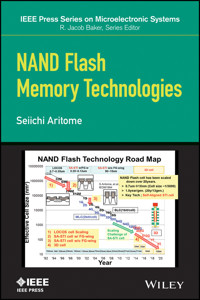
* Offers a comprehensive overview of NAND flash memories, with insights into NAND history, technology, challenges, evolutions, and perspectives * Describes new program disturb issues, data retention, power consumption, and possible solutions for the challenges of 3D NAND flash memory * Written by an authority in NAND flash memory technology, with over 25 years' experience
Sie lesen das E-Book in den Legimi-Apps auf:
Seitenzahl: 727
Veröffentlichungsjahr: 2015
Ähnliche




















IEEE Press445 Hoes LanePiscataway, NJ 08854
IEEE Press Editorial BoardTariq Samad, Editor in Chief
George W. Arnold Vladimir Lumelsky Linda ShaferDmitry Goldgof Pui-In Mak Zidong WangEkram Hossain Jeffrey Nanzer MengChu ZhouMary Lanzerotti Ray Perez George Zobrist
Kenneth Moore, Director of IEEE Book and Information Services (BIS)
Technical Reviewers
Joe E Brewer, PE, Electronic Engineering ConsultantChandra Mouli, Director, R&D Device Technology, Micron Technology Inc, Boise ID, USAGabriel Molas, CEA LETI Minatec, Grenoble, France
NAND FLASH MEMORY TECHNOLOGIES
SEIICHI ARITOME
Copyright © 2016 by The Institute of Electrical and Electronics Engineers, Inc.
Published by John Wiley & Sons, Inc., Hoboken, New Jersey. All rights reserved Published simultaneously in Canada
No part of this publication may be reproduced, stored in a retrieval system, or transmitted in any form or by any means, electronic, mechanical, photocopying, recording, scanning, or otherwise, except as permitted under Section 107 or 108 of the 1976 United States Copyright Act, without either the prior written permission of the Publisher, or authorization through payment of the appropriate per-copy fee to the Copyright Clearance Center, Inc., 222 Rosewood Drive, Danvers, MA 01923, (978) 750-8400, fax (978) 750-4470, or on the web at www.copyright.com. Requests to the Publisher for permission should be addressed to the Permissions Department, John Wiley & Sons, Inc., 111 River Street, Hoboken, NJ 07030, (201) 748-6011, fax (201) 748-6008, or online at http://www.wiley.com/go/permission.
Limit of Liability/Disclaimer of Warranty: While the publisher and author have used their best efforts in preparing this book, they make no representations or warranties with respect to the accuracy or completeness of the contents of this book and specifically disclaim any implied warranties of merchantability or fitness for a particular purpose. No warranty may be created or extended by sales representatives or written sales materials. The advice and strategies contained herein may not be suitable for your situation. You should consult with a professional where appropriate. Neither the publisher nor author shall be liable for any loss of profit or any other commercial damages, including but not limited to special, incidental, consequential, or other damages.
For general information on our other products and services or for technical support, please contact our Customer Care Department within the United States at (800) 762-2974, outside the United States at (317) 572-3993 or fax (317) 572-4002.
Wiley also publishes its books in a variety of electronic formats. Some content that appears in print may not be available in electronic formats. For more information about Wiley products, visit our web site at www.wiley.com.
Library of Congress Cataloging-in-Publication Data is available.
ISBN: 978-1-119-13260-8
CONTENTS
Foreword
Preface
Acknowledgments
About the Author
1 Introduction
1.1 Background
1.2 Overview
References
2 Principle of NAND Flash Memory
2.1 NAND Flash Device and Architecture
2.2 Cell Operation
2.3 Multilevel Cell (MLC)
References
3 NAND Flash Memory Devices
3.1 Introduction
3.2 LOCOS Cell
3.3 Self-Aligned STI Cell (SA-STI Cell) with FG Wing
3.4 Self-Aligned STI Cell (SA-STI Cell) without FG Wing
3.5 Planar FG Cell
3.6 SideWall Transfer Transistor Cell (SWATT Cell)
3.7 Advanced NAND Flash Device Technologies
References
4 Advanced Operation for Multilevel Cell
4.1 Introduction
4.2 Program Operation for Tight
V
t
Distribution Width
4.3 Page Program Sequence
4.4 TLC (3 Bits/Cell)
4.5 QLC (4 Bits/Cell)
4.6 Three-Level (1.5 bits/cell) NAND flash
4.7 Moving Read Algorithm
References
5 Scaling Challenge of NAND Flash Memory Cells
5.1 Introduction
5.2 Read Window Margin (RWM)
5.3 Floating-Gate Capacitive Coupling Interference
5.4 Program Electron Injection Spread
5.5 Random Telegraph Signal Noise (RTN)
5.6 Cell Structure Challenge
5.7 High-Field Limitation
5.8 A few electron phenomena
5.9 Patterning Limitation
5.10 Variation
5.11 Scaling impact on Data Retention
5.12 Summary
References
6 Reliability of NAND Flash Memory
6.1 Introduction
6.2 Program/Erase Cycling Endurance and Data Retention
6.3 Analysis of Program/Erase Cycling Endurance and Data Retention
6.4 Read Disturb
6.5 Program Disturb
6.6 Erratic Over-Program
6.7 Negative
V
t
shift phenomena
6.8 Summary
References
7 Three-Dimensional NAND Flash Cell
7.1 Background of Three-Dimensional NAND cells
7.2 BiCS (Bit Cost Scalable technology) / P-BiCS (Pipe-shape BiCS)
7.3 TCAT (Terabit Cell Array Transistor)/V-NAND (Vertical-NAND)
7.4 SMArT (Stacked Memory Array Transistor)
7.5 VG-NAND (Vertical Gate NAND Cell)
7.6 Dual Control gate—Surrounding Floating gate Cell (DC-SF cell)
7.7 Advanced DC-SF cell
References
8 Challenges of Three-Dimensional NAND Flash Memory
8.1 Introduction
8.2 Comparison of 3D NAND cells
8.3 Data Retention
8.4 Program Disturb
8.5 Word-Line RC delay
8.6 Cell Current Fluctuation
8.7 Number of Stacked Cells
8.8 Peripheral Circuit Under Cell Array
8.9 Power Consumption
8.10 Future Trend of 3D NAND Flash Memory
References
9 Conclusions
9.1 Discussions and conclusions
9.2 Perspective
References
Index
IEEE Press Series on Microelectronic Systems
EULA
List of Tables
Chapter 1
Table 1.1
Chapter 3
Table 3.1
Table 3.2
Table 3.3
Table 3.4
Table 3.5
Chapter 5
Table 5.1
Chapter 6
Table 6.1
Table 6.2
Chapter 7
Table 7.1
Table 7.2
Table 7.3
Lesen Sie weiter in der vollständigen Ausgabe!
Lesen Sie weiter in der vollständigen Ausgabe!
Lesen Sie weiter in der vollständigen Ausgabe!
Lesen Sie weiter in der vollständigen Ausgabe!
Lesen Sie weiter in der vollständigen Ausgabe!
Lesen Sie weiter in der vollständigen Ausgabe!
Lesen Sie weiter in der vollständigen Ausgabe!
Lesen Sie weiter in der vollständigen Ausgabe!
Lesen Sie weiter in der vollständigen Ausgabe!
Lesen Sie weiter in der vollständigen Ausgabe!
Lesen Sie weiter in der vollständigen Ausgabe!
Lesen Sie weiter in der vollständigen Ausgabe!
Lesen Sie weiter in der vollständigen Ausgabe!
Lesen Sie weiter in der vollständigen Ausgabe!
Lesen Sie weiter in der vollständigen Ausgabe!
Lesen Sie weiter in der vollständigen Ausgabe!




