


Nanomagnetic and Spintronic Devices for Energy-Efficient Memory and Computing E-Book
Jayasimha Atulasimha
94,99 €
Mehr erfahren.
- Herausgeber: John Wiley & Sons
- Kategorie: Wissenschaft und neue Technologien
- Sprache: Englisch
Nanomagnetic and spintronic computing devices are strong contenders for future replacements of CMOS. This is an important and rapidly evolving area with the semiconductor industry investing significantly in the study of nanomagnetic phenomena and in developing strategies to pinpoint and regulate nanomagnetic reliably with a high degree of energy efficiency. This timely book explores the recent and on-going research into nanomagnetic-based technology.
Key features:
- Detailed background material and comprehensive descriptions of the current state-of-the-art research on each topic.
- Focuses on direct applications to devices that have potential to replace CMOS devices for computing applications such as memory, logic and higher order information processing.
- Discusses spin-based devices where the spin degree of freedom of charge carriers are exploited for device operation and ultimately information processing.
- Describes magnet switching methodologies to minimize energy dissipation.
- Comprehensive bibliographies included for each chapter enabling readers to conduct further research in this field.
Written by internationally recognized experts, this book provides an overview of a rapidly burgeoning field for electronic device engineers, field-based applied physicists, material scientists and nanotechnologists. Furthermore, its clear and concise form equips readers with the basic understanding required to comprehend the present stage of development and to be able to contribute to future development. Nanomagnetic and Spintronic Devices for Energy-Efficient Memory and Computing is also an indispensable resource for students and researchers interested in computer hardware, device physics and circuits design.
Sie lesen das E-Book in den Legimi-Apps auf:
Seitenzahl: 784
Veröffentlichungsjahr: 2016
Ähnliche



















In memory of my late great-uncle, N. Seshagiri,who inspired my career in science and technology.Jayasimha AtulasimhaIn memory of my uncle.Supriyo Bandyopadhyay
NANOMAGNETIC AND SPINTRONIC DEVICES FOR ENERGY-EFFICIENT MEMORY AND COMPUTING
Edited by
Jayasimha Atulasimha and Supriyo BandyopadhyayVirginia Commonwealth University, US
This edition first published 2016 © 2016 John Wiley & Sons Ltd.
Registered officeJohn Wiley & Sons Ltd., The Atrium, Southern Gate, Chichester, West Sussex, PO19 8SQ, United Kingdom
For details of our global editorial offices, for customer services and for information about how to apply for permission to reuse the copyright material in this book please see our website at www.wiley.com.
The right of the author to be identified as the author of this work has been asserted in accordance with the Copyright, Designs and Patents Act 1988.
All rights reserved. No part of this publication may be reproduced, stored in a retrieval system, or transmitted, in any form or by any means, electronic, mechanical, photocopying, recording or otherwise, except as permitted by the UK Copyright, Designs and Patents Act 1988, without the prior permission of the publisher.
Wiley also publishes its books in a variety of electronic formats. Some content that appears in print may not be available in electronic books.
Designations used by companies to distinguish their products are often claimed as trademarks. All brand names and product names used in this book are trade names, service marks, trademarks or registered trademarks of their respective owners. The publisher is not associated with any product or vendor mentioned in this book.
Limit of Liability/Disclaimer of Warranty: While the publisher and author have used their best efforts in preparing this book, they make no representations or warranties with respect to the accuracy or completeness of the contents of this book and specifically disclaim any implied warranties of merchantability or fitness for a particular purpose. It is sold on the understanding that the publisher is not engaged in rendering professional services and neither the publisher nor the author shall be liable for damages arising herefrom. If professional advice or other expert assistance is required, the services of a competent professional should be sought.
The advice and strategies contained herein may not be suitable for every situation. In view of ongoing research, equipment modifications, changes in governmental regulations, and the constant flow of information relating to the use of experimental reagents, equipment, and devices, the reader is urged to review and evaluate the information provided in the package insert or instructions for each chemical, piece of equipment, reagent, or device for, among other things, any changes in the instructions or indication of usage and for added warnings and precautions. The fact that an organization or Website is referred to in this work as a citation and/or a potential source of further information does not mean that the author or the publisher endorses the information the organization or Website may provide or recommendations it may make. Further, readers should be aware that Internet Websites listed in this work may have changed or disappeared between when this work was written and when it is read. No warranty may be created or extended by any promotional statements for this work. Neither the publisher nor the author shall be liable for any damages arising herefrom.
Library of Congress Cataloging-in-Publication Data
Nanomagnetic and spintronic devices for energy-efficient memory and computing / edited by Jayasimha Atulasimha and Supriyo Bandyopadhyay. pages cm Includes bibliographical references and index. ISBN 978-1-118-86926-0 (cloth) 1. Magnetic memory (Computers) 2. Spintronics. 3. Nanoelectronics. I. Atulasimha, Jayasimha, editor. II. Bandyopadhyay, S., editor. TK7895.M3N27 2016 621.39′73--dc23
2015033564
A catalogue record for this book is available from the British Library.
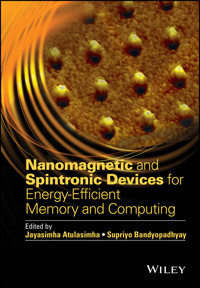
Cover image: The cover shows magnetic force micrographs of an array of 100-nm sized nanomagnets exhibiting single-domain behavior. Image courtesy of the Atulasimha group and Bandyopadhyay group.
Contents
About the Editors and Acknowledgments
List of Contributors
Foreword
Preface
CHAPTER 1 Introduction to Spintronic and Nanomagnetic Computing Devices
1.1 Spintronic Devices
1.2 Nanomagnetic Devices
1.3 Thinking beyond Traditional Boolean Logic
References
CHAPTER 2 Potential Applications of all Electric Spin Valves Made of Asymmetrically Biased Quantum Point Contacts
2.1 Introduction
2.2 Quantum Point Contacts
2.3 Spin Orbit Coupling
2.4 Importance of Spin Relaxation in 1D Channels
2.5 Observation of a 0.5 Conductance Plateau in Asymmetrically Biased QPCs in the Presence of LSOC
2.6 Intrinsic Bistability near Conductance Anomalies
2.7 QPC Structures with Four In-plane SGs: Toward an All Electrical Spin Valve
2.8 Future Work
2.9 Summary
2.10 Acknowledgments
References
CHAPTER 3 Spin-Transistor Technology for Spintronics/CMOS Hybrid Logic Circuits and Systems
3.1 Spin-Transistor and Pseudo-Spin-Transistor
3.2 Energy-Efficient Logic Applications of Spin-Transistors
3.3 Nonvolatile SRAM Technology
3.4 Application of Nonvolatile Bistable Circuits for Memory Systems
References
CHAPTER 4 Spin Transfer Torque: A Multiscale Picture
4.1 Introduction
4.2 The Physics of Spin Transfer Torque
4.3 First Principles Evaluation of TMR and STT
4.4 Magnetization Dynamics
4.5 Summary: Multiscaling from Atomic Structure to Error Rate
4.6 Acknowledgments
References
CHAPTER 5 Magnetic Tunnel Junction Based Integrated Logics and Computational Circuits
5.1 Introduction
5.2 GMR Based Field Programmable Devices
5.3 MTJ Based Field Programmable Devices
5.4 Information Transformation between Gates
5.5 MTJ Based Logic-in-Memory Devices
5.6 Magnetic Quantum Cellular Automata
5.7 All-Spin Based Magnetic Logic
5.8 Summary
5.9 Acknowledgment
References
CHAPTER 6 Magnetization Switching and Domain Wall Motion Due to Spin Orbit Torque
6.1 Introduction
6.2 Theory
6.3 Magnetic Switching Driven by Spin Orbit Torque
6.4 Domain Wall Motion Driven by Spin Orbit Torque
6.5 Applications of Spin Orbit Torque
6.6 Conclusion
References
CHAPTER 7 Magnonic Logic Devices
7.1 Introduction
7.2 Magnonic Logic Devices
7.3 Spin Wave-Based Logic Gates and Architectures
7.4 Discussion and Summary
References
CHAPTER 8 Strain Mediated Magnetoelectric Memory
8.1 Introduction
8.2 Concept of Unequivocal Strain- or Stress-Switched Nanomagnetic Memory
8.3 LLG Simulations – Macrospin Model
8.4 LLG Simulations – Eshelby Approach
8.5 Stochastic Error Analysis
8.6 Preliminary Experimental Results
8.7 Conclusions
8.8 Acknowledgments
References
CHAPTER 9 Hybrid Spintronics-Strainronics
9.1 Introduction
9.2 Nanomagnetic Memory Switched with Strain
9.3 Straintronic Clocking of Nanomagnetic Logic
9.4 Summary and Conclusions
References
CHAPTER 10 Unconventional Nanocomputing with Physical Wave Interference Functions*
10.1 Overview
10.2 Spin Waves Physical Layer for WIF Implementation
10.3 Elementary WIF Operators for Logic
10.4 Binary WIF Logic Design
10.5 Multivalued WIF Logic Design
10.6 Microprocessors with WIF: Opportunities and Challenges
10.7 Summary and Future Work
Note
References
Index
Supplemental Images
EULA
List of Tables
Chapter 3
Table 3.1
Table 3.2
Chapter 5
Table 5.1
Chapter 7
Table 7.1
Chapter 8
Table 8.1
Table 8.2
Table 8.3
Chapter 10
Table 10.1
Table 10.2
Table 10.3
Table 10.4
Table 10.5
Table 10.6
Table 10.7
Table 10.8
Table 10.9
Table 10.10
Table 10.11




