


144,99 €
Mehr erfahren.
- Herausgeber: John Wiley & Sons
- Kategorie: Wissenschaft und neue Technologien
- Sprache: Englisch
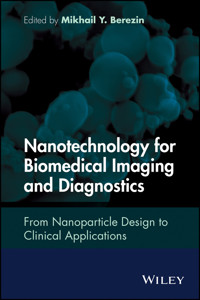
Nanotechnology for Biomedical Imaging and Diagnostics: From Nanoparticle Design to Clinical Applications reflects upon the increasing role of nanomaterials in biological and medical imaging, presenting a thorough description of current research as well as future directions. With contributions from experts in nanotechnology and imaging from academia, industry, and healthcare, this book provides a comprehensive coverage of the field, ranging from the architectural design of nanomaterials to their broad imaging applications in medicine. Grouped into three sections, the book: * Elucidates all major aspects of nanotechnology and bioimaging * Provides comprehensive coverage of the field, ranging from the architectural design of nanomaterials to their broad imaging applications in medicine * Written by well-recognized experts in academia, industry, and healthcare, will be an excellence source of reference * With a multidisciplinary approach and a balance of research and diagnostic topics, this book will appeal to students, scientiests, and healthcare professionals alike
Sie lesen das E-Book in den Legimi-Apps auf:
Seitenzahl: 1021
Veröffentlichungsjahr: 2015
Ähnliche



















CONTENTS
Cover
Title page
Copyright page
Dedication page
Contributors
Preface
Scope of the Book: Imaging and Nanoparticles
My Interest In This Field
Purpose of the Book and What the Reader Will Gain
Authors
Who Should Read This Book
Book Structure
Acknowledgments
1 Historical Perspective on Nanoparticles in Imaging from 1895 to 2000
1.1 Introduction
1.2 X-Ray and First Contrast Agents (1895–1930s)
1.3 Rise of the Nuclear Imaging Techniques (1940s–1950s)
1.4 Imaging with Liposomes (1960s–1970s)
1.5 Magnetic Imaging with Nanoparticles (1980s–2000)
1.6 Optical Imaging with Nanoparticles (1980s–2000)
1.7 Ultrasound Microbubble Contrast Agents (1970s–2000)
1.8 Maturity: Nanoparticles Surface Modifications (Late 1980s–early 2000s)
1.9 Concluding Remarks
References
Part I: Nanoparticle Design, Synthesis and Characterization
2 Iron Oxide-Based Magnetic Nanoparticles Synthesized from THE Organic Solution Phase for Advanced Biological Imaging
2.1 Introduction
2.2 Nanomagnetism and MRI
2.3 Organic Solution Phase Syntheses of IOMNPs
2.4 Designs and Fabrications of IOMNPs as MRI Contrast Agent
2.5 Designs and Fabrications of Multimodality Imaging Agents Based on IOMNPs
2.6 Conclusion and Perspective
References
3 Lipid-Based Pharmaceutical Nanocarriers for Imaging Applications
3.1 Introduction
3.2 General Approaches for Loading Liposomes and Micelles with Contrast Agents
3.3 Special Considerations for Target Visualization via Contrast-Loaded Lipid Nanocarriers
3.4 Diagnostic Applications of Liposomal Imaging Agents
3.5 Diagnostic Applications of Micellar Imaging Agents
3.6 Concluding Remarks
References
4 Hollow Nanocapsules in Biomedical Imaging Applications
4.1 Introduction
4.2 Synthesis and Characterization of Nanocapsules
4.3 Compartmentalization of Molecules in Hollow Nanocapsules
4.4 Biomedical Applications of Polymer Nanocapsules
4.5 Conclusions
Acknowledgments
References
5 Nanoparticles as Contrast Agents for Optoacoustic Imaging
5.1 Introduction
5.2 Optoacoustic Nanoparticles Based on Endogenous Chromophores
5.3 Exogenous Nonplasmonic Contrast Agents for Optoacoustic Imaging
5.4 Plasmonic Nanoparticles as Optoacoustic Contrast Agents
5.5 Conclusions
Acknowledgments
References
6 Nanoparticles for Bioimaging
6.1 Introduction
6.2 Elemental Analysis
6.3 Size Analysis
6.4 Surface Analysis Techniques
6.5 Radioactivity Measurement of Nanoparticles
6.6 Magnetic Properties of Nanoparticles
6.7 Optical Techniques
6.8 Miscellaneous Methods
References
Part II: Imaging Modalities: from Concepts to Applications
7 Radio-labeled Nanoparticles for Biomedical Imaging
7.1 Introduction
7.2 Radiolabeled Nanoparticles for Biomedical Imaging
7.3 Radiolabeled Nanoparticle for SPECT Imaging
7.4 Radiolabeled Nanoparticles for PET Imaging
7.5 Summary
References
8 MRI with Gadolinium-Based Nanoparticles
8.1 Introduction
8.2 Gadolinium as a Contrast Agent in MRI
8.3 Gadolinium-Based Nanoparticles
8.4 Alternatives to Gadolinium for MRI
8.5 Conclusion
References
9
In Vivo
Molecular Fluorescence Imaging
9.1 Introduction
9.2 Basics of Fluorescence
9.3 General Behavior of Light in Biological Tissue
9.4 Diffuse Fluorescence Optical Imaging Instruments
9.5 Modeling of Light Propagation in Tissue
9.6 Imaging Algorithms
9.7 Summary
Acknowledgments
References
10 Photoacoustic and Ultrasound Imaging with Nanosized Contrast Agents
10.1 Introduction
10.2 Principles of PAT
10.3 PAT Modalities
10.4 Intrinsic Contrasts for PAT
10.5 Exogenous Contrasts for PAT
10.6 Conclusions
References
11 Surface-Enhanced Raman Scattering-Based Bioimaging
11.1 Overview
11.2 Introduction
11.3 Raman Instrumentation for Bioimaging
11.4
In Vitro
and
In Vivo
Raman-Based Bioimaging
11.5 Raman Reporters
11.6 Summary and Future Perspective
References
Part III: Nanotechnology in Biomedical Imaging and Beyond
12 Pandia®: Gold Nanorods and Their Applications in Cancer Therapy and
In Vivo
Imaging in Companion Animals and Their Potential Application to Humans
12.1 Introduction
12.2 Background
12.3 Photothermal Imaging and Therapy
In Vivo
12.4 Potential Applications in Humans
12.5 Summary
Acknowledgement
References
13 Imaging Genetic Information
13.1 Introduction
13.2 Nucleic Acids as Biomarkers for Disease
13.3 Antisense RNA Imaging
13.4 Reporter Systems for RNA Imaging
13.5 Recent Examples of Nanoparticle Antisense Imaging Agents
13.6 Conclusions
References
14 The Application of Plant Viral Nanoparticles in Tissue-Specific Imaging
14.1 Introduction
14.2 VNPs Labeled with Fluorescent Dyes for Optical Imaging
14.3 Interaction of CPMV with Cells and its Application for Intravital Imaging
14.4 Passive Targeting of Tumors Using Fluorescent VNPs
14.5 Molecular Targeted Fluorescence Imaging
14.6 VNPs as MRI Contrast Agents
14.7 PET Imaging
14.8 Future Outlook
Acknowledgments
References
15 Design and Development of Theranostic Nanomedicines
15.1 Theranostics for Personalized Nanomedicine
15.2 Solid Nanoparticle Systems
15.3 Colloidal Systems
15.4 Selected Polymeric Nanosystems
15.5 Pharmaceutical Aspects of Theranostics
References
16 Animal Models for Preclinical Imaging
16.1 Introduction
16.2 Ethics in Animal Research
16.3 Considerations in Animal Care
16.4 Choice of Animal Model
16.5 Companion Animal Disease Models
References
Index
End User License Agreement
List of Tables
Chapter 03
Table 3.1 Concentration of a contrast agent required for diagnostically significant tissue attenuation in various imaging modalities
Chapter 06
Table 6.1 Imaging nanoparticles characteristics and most common analytical methods
Chapter 07
Table 7.1 Commonly used SPECT radionuclides for nanoparticles
Table 7.2 Nuclear characteristics of selected PET radionuclides for nanoparticles
Chapter 08
Table 8.1 Description of approved gadolinium-based contrast agents
Chapter 12
Table 12.1 Biodistribution Data from Mouse Injected Gold Nanorods
Table 12.2 Patients from Ohio State University Trial, Breed, Age, Sex, and Weight
Table 12.3 List of Histopath Posttreatment for Seven Canines Used in the Study
Chapter 15
Table 15.1 Representative liposomal hybrid nanoparticles for simultaneous imaging and Therapy of cancer
List of Illustrations
Chapter 01
Figure 1.1 Growth of the nanoparticle research in biomedical imaging. Solid arrows show the appearance of imaging techniques, and dotted arrows show the emergence of nanoparticles. A number of citations are given from PubMed database.
Figure 1.2 Timeline of the most important events in the development of nanoparticles for imaging and diagnostics covering the period from the twentieth century. The upper part corresponds to nanoparticles, and the lower part to the development of imaging modalities.
Figure 1.3 The
American X-Ray Journal
established in May 1897 was one of the first imaging journals. Launched by Dr. H. Robarts, a prominent radiologist from St. Louis, his biography is described in Ref. [2]. The journal existed until 1905.
Figure 1.4 First human PEN scanner PETT III (1974) located in the hall of the Department of Radiology Washington University School of Medicine in St. Louis, where this scanner had been invented. The inventors had given the name “positron emission transaxial tomography” (PETT). The name was reduced to PET because transaxial was no longer the only plane used for image reconstruction.
Figure 1.5 Structure of a multilamellar liposome and of a typical lecithin component phosphatidylcholine. The latter is composed from choline and phosphate group, glycerol, and long-chain fatty acid. Lecithin was first isolated in 1846 by the French chemist and pharmacist Theodore Gobley.
Figure 1.6 Design of
131
I-albumin liposomes. [
3
H]Amyloglucosidase and
131
I-labeled albumin were entrapped into liposomes composed of phosphatidyl choline, cholesterol, and dicetyl phosphate.
131
I-labeled albumin was also entrapped in [
3
H]cholesterol liposomes.
Figure 1.7 Formation of
99m
Tc liposomes via tin chloride method.
Figure 1.8 Amphipathic Gd complex with DTPA featuring hydrophobic tails. DTPA anhydride was reacted with stearyl amines and integrated into the lamellar phase of liposome particles. The in the liver increased by 180%.
Lesen Sie weiter in der vollständigen Ausgabe!
Lesen Sie weiter in der vollständigen Ausgabe!
Lesen Sie weiter in der vollständigen Ausgabe!
Lesen Sie weiter in der vollständigen Ausgabe!
Lesen Sie weiter in der vollständigen Ausgabe!
Lesen Sie weiter in der vollständigen Ausgabe!
Lesen Sie weiter in der vollständigen Ausgabe!
Lesen Sie weiter in der vollständigen Ausgabe!
Lesen Sie weiter in der vollständigen Ausgabe!
Lesen Sie weiter in der vollständigen Ausgabe!
Lesen Sie weiter in der vollständigen Ausgabe!
Lesen Sie weiter in der vollständigen Ausgabe!
Lesen Sie weiter in der vollständigen Ausgabe!
Lesen Sie weiter in der vollständigen Ausgabe!
Lesen Sie weiter in der vollständigen Ausgabe!
Lesen Sie weiter in der vollständigen Ausgabe!
Lesen Sie weiter in der vollständigen Ausgabe!
Lesen Sie weiter in der vollständigen Ausgabe!
Lesen Sie weiter in der vollständigen Ausgabe!
Lesen Sie weiter in der vollständigen Ausgabe!
Lesen Sie weiter in der vollständigen Ausgabe!
Lesen Sie weiter in der vollständigen Ausgabe!
Lesen Sie weiter in der vollständigen Ausgabe!
Lesen Sie weiter in der vollständigen Ausgabe!
Lesen Sie weiter in der vollständigen Ausgabe!
Lesen Sie weiter in der vollständigen Ausgabe!
Lesen Sie weiter in der vollständigen Ausgabe!




