


36,59 €
Mehr erfahren.
- Herausgeber: Packt Publishing
- Kategorie: Wissenschaft und neue Technologien
- Sprache: Englisch
A problem-solution guide to encounter various NLP tasks utilizing Java open source libraries and cloud-based solutions
Key Features
- Perform simple-to-complex NLP text processing tasks using modern Java libraries Extract relationships between different text complexities using a problem-solution approach
- Utilize cloud-based APIs to perform machine translation operations
Book Description
Natural Language Processing (NLP) has become one of the prime technologies for processing very large amounts of unstructured data from disparate information sources. This book includes a wide set of recipes and quick methods that solve challenges in text syntax, semantics, and speech tasks.
At the beginning of the book, you'll learn important NLP techniques, such as identifying parts of speech, tagging words, and analyzing word semantics. You will learn how to perform lexical analysis and use machine learning techniques to speed up NLP operations. With independent recipes, you will explore techniques for customizing your existing NLP engines/models using Java libraries such as OpenNLP and the Stanford NLP library. You will also learn how to use NLP processing features from cloud-based sources, including Google and Amazon's AWS. You will master core tasks, such as stemming, lemmatization, part-of-speech tagging, and named entity recognition. You will also learn about sentiment analysis, semantic text similarity, language identification, machine translation, and text summarization.
By the end of this book, you will be ready to become a professional NLP expert using a problem-solution approach to analyze any sort of text, sentences, or semantic words.
What you will learn
- Explore how to use tokenizers in NLP processing
- Implement NLP techniques in machine learning and deep learning applications
- Identify sentences within the text and learn how to train specialized NER models
- Learn how to classify documents and perform sentiment analysis
- Find semantic similarities between text elements and extract text from a variety of sources
- Preprocess text from a variety of data sources
- Learn how to identify and translate languages
Who this book is for
This book is for data scientists, NLP engineers, and machine learning developers who want to perform their work on linguistic applications faster with the use of popular libraries on JVM machines. This book will help you build real-world NLP applications using a recipe-based approach. Prior knowledge of Natural Language Processing basics and Java programming is expected.
Das E-Book können Sie in Legimi-Apps oder einer beliebigen App lesen, die das folgende Format unterstützen:
Seitenzahl: 323
Veröffentlichungsjahr: 2019
Ähnliche















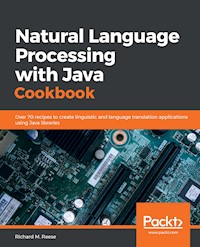
Natural Language Processing with Java Cookbook
Copyright © 2019 Packt Publishing
All rights reserved. No part of this book may be reproduced, stored in a retrieval system, or transmitted in any form or by any means, without the prior written permission of the publisher, except in the case of brief quotations embedded in critical articles or reviews.
Every effort has been made in the preparation of this book to ensure the accuracy of the information presented. However, the information contained in this book is sold without warranty, either express or implied. Neither the author, nor Packt Publishing or its dealers and distributors, will be held liable for any damages caused or alleged to have been caused directly or indirectly by this book.
Packt Publishing has endeavored to provide trademark information about all of the companies and products mentioned in this book by the appropriate use of capitals. However, Packt Publishing cannot guarantee the accuracy of this information.
Commissioning Editor: Pravin DhandreAcquisition Editor: Nelson MorrisContent Development Editor: Ronnel MathewTechnical Editor: Dinesh PawarCopy Editor: Safis EditingProject Coordinator: Namrata SwettaProofreader: Safis EditingIndexer:Pratik ShirodkarGraphics:Tom ScariaProduction Coordinator:Jayalaxmi Raja
First published: April 2019
Production reference: 1220419
Published by Packt Publishing Ltd. Livery Place 35 Livery Street Birmingham B3 2PB, UK.
ISBN 978-1-78980-115-6
www.packtpub.com
Mapt is an online digital library that gives you full access to over 5,000 books and videos, as well as industry leading tools to help you plan your personal development and advance your career. For more information, please visit our website.
Why subscribe?
Spend less time learning and more time coding with practical eBooks and Videos from over 4,000 industry professionals
Improve your learning with Skill Plans built especially for you
Get a free eBook or video every month
Mapt is fully searchable
Copy and paste, print, and bookmark content
Packt.com
Did you know that Packt offers eBook versions of every book published, with PDF and ePub files available? You can upgrade to the eBook version at www.packt.com and as a print book customer, you are entitled to a discount on the eBook copy. Get in touch with us at [email protected] for more details.
At www.packt.com, you can also read a collection of free technical articles, sign up for a range of free newsletters, and receive exclusive discounts and offers on Packt books and eBooks.
Contributors
About the author
Richard M. Reese has worked in both industry and academia. For 17 years, he worked in the telephone and aerospace industries, serving in several capacities, including research and development, software development, supervision, and training. He currently teaches at Tarleton State University, where he has the opportunity to apply his years of industry experience to enhance his teaching. Richard has written several Java books and a C pointer book. He uses a concise and easy-to-follow approach to the topics at hand. His Java books have addressed EJB 3.1, updates to Java 7 and 8, certification, jMonkeyEngine, natural language processing, functional programming, networks, and data science.
About the reviewer
Jennifer L. Reese studied computer science at Tarleton State University. She also earned her M.Ed. from Tarleton in December 2016. She currently teaches computer science to high-school students. Her interests include the integration of computer science concepts with other academic disciplines, increasing diversity in computer science courses, and the application of data science to the field of education. She has co-authored two books: Java for Data Science, and Java 7 New Features Cookbook. She previously worked as a software engineer. In her free time, she enjoys reading, cooking, and traveling—especially to any destination with a beach. She is a musician and appreciates a variety of musical genres.
Packt is searching for authors like you
If you're interested in becoming an author for Packt, please visit authors.packtpub.com and apply today. We have worked with thousands of developers and tech professionals, just like you, to help them share their insight with the global tech community. You can make a general application, apply for a specific hot topic that we are recruiting an author for, or submit your own idea.
Table of Contents
Title Page
Copyright and Credits
Natural Language Processing with Java Cookbook
About Packt
Why subscribe?
Packt.com
Contributors
About the author
About the reviewer
Packt is searching for authors like you
Preface
Who this book is for
What this book covers
To get the most out of this book
Download the example code files
Conventions used
Sections
Getting ready
How to do it…
How it works…
There's more…
See also
Get in touch
Reviews
Preparing Text for Analysis and Tokenization
Technical requirements
Tokenization using the Java SDK
Getting ready
How to do it...
How it works...
Tokenization using OpenNLP
Getting ready
How to do it...
How it works...
See also
Tokenization using maximum entropy
Getting ready
How to do it...
How it works...
See also
Training a neural network tokenizer for specialized text
Getting ready
How to do it...
How it works...
There's more...
See also
Identifying the stem of a word
Getting ready
How to do it...
How it works...
See also
Training an OpenNLP lemmatization model
Getting ready
How to do it...
How it works...
There's more...
See also
Determining the lexical meaning of a word using OpenNLP
Getting ready
How to do it...
How it works...
See also
Removing stop words using LingPipe
Getting ready
How to do it...
How it works...
See also
Isolating Sentences within a Document
Technical requirements
Finding sentences using the Java core API
Getting ready
How to do it...
How it works...
See also
Performing SBD using the BreakIterator class
Getting ready
How to do it...
How it works...
There's more...
See also
Using OpenNLP to perform SBD
Getting ready
How to do it...
How it works...
There's more...
See also
Using the Stanford NLP API to perform SBD
Getting ready
How to do it...
How it works...
There's more...
See also
Using the LingPipe and chunking to perform SBD
Getting ready
How to do it...
How it works...
There's more...
See also
Performing SBD on specialized text
Getting ready
How to do it...
How it works...
See also
Training a neural network to perform SBD with specialized text
Getting ready 
How to do it...
How it works...
See also
Performing Name Entity Recognition
Technical requirements
Using regular expressions to find entities
Getting ready
How to do it...
How it works...
There's more...
See also
Using chunks with regular expressions to identify entities
Getting ready
How to do it...
How it works...
There's more...
See also
Using OpenNLP to find entities in text
Getting ready
How to do it...
How it works...
There's more...
See also
Isolating multiple entities types
Getting ready
How to do it...
How it works...
See also
Using a CRF model to find entities in a document
Getting ready
How to do it...
How it works...
There's more...
See also
Using a chunker to find entities
Getting ready
How to do it...
How it works...
See also
Training a specialized NER model
Getting ready
How to do it...
How it works...
See also
Detecting POS Using Neural Networks
Technical requirements
Finding POS using tagging
Getting ready
How to do it...
How it works...
There's more...
See also
Using a chunker to find POS
Getting ready
How to do it...
How it works...
There's more...
See also
Using a tag dictionary
Getting ready
How to do it...
How it works...
There's more...
See also
Finding POS using the Penn Treebank
Getting ready
How to do it...
How it works...
There's more...
See also
Finding POS from textese
Getting ready
How to do it...
How it works...
There's more...
See also
Using a pipeline to perform tagging
Getting ready
How to do it...
How it works...
See also
Using a hidden Markov model to perform POS
Getting ready
How to do it...
How it works...
There's more...
See also
Training a specialized POS model
Getting ready
How to do it...
How it works...
See also
Performing Text Classification
Technical requirements
Training a maximum entropy model for text classification
Getting ready
How to do it...
How it works...
See also
Classifying documents using a maximum entropy model
Getting ready
How to do it...
How it works...
There's more...
See also
Classifying documents using the Stanford API
Getting ready
How to do it...
How it works...
There's more...
See also
Training a model to classify text using LingPipe
Getting ready
How to do it...
How it works...
See also
Using LingPipe to classify text
Getting ready
How to do it...
How it works...
There's more...
See also
Detecting spam
Getting ready
How to do it...
How it works...
There's more...
See also
Performing sentiment analysis on reviews
Getting ready
How to do it...
How it works...
There's more...
See also
Finding Relationships within Text
Technical requirements
Displaying parse trees graphically
Getting ready
How to do it...
How it works...
There's more...
See also
Using probabilistic context-free grammar to parse text
Getting ready
How to do it...
How it works...
There's more...
See also
Using OpenNLP to generate a parse tree
Getting ready
How to do it...
How it works...
There's more...
See also
Using the Google NLP API to parse text
Getting ready
How to do it...
How it works...
There's more...
See also
Identifying parent-child relationships in text
Getting ready
How to do it...
How it works...
There's more...
See also
Finding co-references in a sentence
Getting ready
How to do it...
How it works...
There's more...
See also
Language Identification and Translation
Technical requirements
Detecting the natural language in use using LingPipe
Getting ready
How to do it… 
How it works…
There's more…
See also
Discovering supported languages using the Google API
Getting ready
How to do it…
How it works…
See also
Detecting the natural language in use using the Google API
Getting ready
How to do it…
How it works…
There's more…
See also
Language translation using Google
Getting ready
How to do it…
How it works…
There's more…
See also
Language detection and translation using Amazon AWS
Getting ready
How to do it…
How it works…
There's more…
See also
Converting text to speech using the Google Cloud Text-to-Speech API
Getting ready
How to do it…
How it works…
See also
Converting speech to text using the Google Cloud Speech-to-Text API
Getting ready
How to do it…
How it works…
There's more…
See also
Identifying Semantic Similarities within Text
Technical requirements
Finding the cosine similarity of the text
Getting ready
How to do it...
How it works...
There's more...
See also
Finding the distance between text
Getting ready
How to do it...
How it works...
See also
Finding differences between plaintext instances
Getting ready
How to do it...
How it works...
There's more...
See also
Finding hyponyms and antonyms
Getting ready
How to do it...
How it works...
There's more...
See also
Common Text Processing and Generation Tasks
Technical requirements
Generating random numbers
Getting ready
How to do it…
How it works…
There's more…
See also
Spell-checking using the LanguageTool API
Getting ready
How to do it…
How it works…
See also
Checking grammar using the LanguageTool API
Getting ready
How to do it…
How it works…
See also
Summarizing text in a document
Getting ready
How to do it…
How it works…
There's more...
See also
Creating, inverting, and using dictionaries
Getting ready
How to do it…
How it works…
There's more…
See also
Extracting Data for Use in NLP Analysis
Technical requirements
Connecting to an HTML page
Getting ready
How to do it…
How it works…
There's more…
See also
Extracting text and metadata from an HTML page
Getting ready
How to do it…
How it works…
There's more…
See also
Extracting text from a PDF document
Getting ready
How to do it…
How it works…
There's more…
See also
Extracting metadata from a PDF document
Getting ready
How to do it…
How it works…
There's more…
See also
Extracting text from a Word document
Getting ready
How to do it…
How it works…
There's more…
See also
Extracting metadata from a Word document
Getting ready
How to do it…
How it works…
There's more…
See also
Extracting text from a spreadsheet
Getting ready
How to do it…
How it works…
There's more…
See also
Extracting metadata from a spreadsheet
Getting ready
How to do it…
How it works…
See also
Creating a Chatbot
Technical requirements
Creating a simple chatbot using AWS
Getting ready
How to do it…
How it works…
See also
Creating a bot using AWS Toolkit for Eclipse
Getting ready
How to do it…
How it works…
See also
Creating a Lambda function
Getting ready
How to do it…
How it works…
See also
Uploading the Lambda function
Getting ready
How to do it…
How it works…
See also
Executing a Lambda function from Eclipse
Getting ready
How to do it…
How it works…
See also
Installation and Configuration
Technical requirements
Getting ready to use the Google Cloud Platform
Getting ready
How to do it…
How it works…
See also
Configuring Eclipse to use the Google Cloud Platform
Getting ready
How to do it…
How it works…
See also
Getting ready to use Amazon Web Services
Getting ready
How to do it…
How it works…
See also
Configuring Eclipse to use Amazon Web Services
Getting ready
How to do it…
How it works…
See also
Other Books You May Enjoy
Leave a review - let other readers know what you think
Preface
NLP is a rapidly changing field with numerous supporting APIs. Keeping abreast of changes to these technologies and APIs can be challenging. In addition, there are numerous languages that provide access to NLP functionality.
This cookbook covers many of these techniques with a series of recipes using Java. Each recipe addresses one or more NLP technique and provides a template for using these techniques. Step-by-step instructions will guide the user through each recipe. This facilitates the reader's learning of these technologies and the development of their understanding of how to use them.
The book is organized around common NLP tasks. The chapters do not need to be followed sequentially and can be read in any order.
Who this book is for
This book is designed for Java developers who want to learn how to incorporate NLP techniques into their applications using Java. The reader is assumed to have a good working knowledge of Java 8. Ideally, they will have some experience with Eclipse and Maven as well, though this is not required.
What this book covers
Chapter 1, Preparing Text for Analysis and Tokenization, demonstrates numerous approaches for performing tokenization. This is the process of extracting the individual words and elements of a document, and forms the basis for most NLP tasks. This process can be difficult to perform correctly. There are many specialized tokenizers available to address a number of different specialized texts.
Chapter 2, Isolating Sentences within a Document, covers how the process of sentence isolation is also a key NLP task. The process involves more than finding a period, exclamation mark, or question mark and using them as sentence delimiters. The process often requires the use of trained neural network models to work correctly.
Chapter 3, Performing Name Entity Recognition, explains how to isolate the key elements of a text in terms of entities such as names, dates, and places. It is not feasible to create an exhaustive list of entities, so neural networks are frequently used to perform this task.
Chapter 4, Detecting POS Using Neural Networks, covers the topic of POS, which refers to parts of speech and corresponds to sentence elements such as nouns, verbs, and adjectives. Performing POS is critical to extract meaning from a text. This chapter will illustrate various POS techniques and show how these elements can be depicted.
Chapter 5, Performing Text Classification, outlines a common NLP activity: classifying text into one or more categories. This chapter will demonstrate how this is accomplished, including the process of performing sentiment analysis. This is often used to access a customer's opinion of a product or service.
Chapter 6, Finding Relationships within Text, explains how identifying the relationships between text elements can be used to extract meaning from a document. While this is not a simple task, it is becoming increasingly important to many applications. We will examine various approaches to accomplish this goal.
Chapter 7, Language Identification and Translation, covers how language translation is critical to many problem domains, and takes on increased importance as the world becomes more and more interconnected. In this chapter, we will demonstrate several cloud-based approaches to performing natural language translation.
Chapter 8, Identifying Semantic Similarities within Text, explains how texts can be similar to each other at various levels. Similar words may be used, or there may be similarities in text structure. This capability is useful for a variety of tasks ranging from spell checking to assisting in determining the meaning of a text. We will demonstrate various approaches in this chapter.
Chapter 9, Common Text Processing and Generation Tasks, outlines how the NLP techniques illustrated in this book are all based on a set of common text-processing activities. These include using data structures such as inverted dictionaries and generating random numbers for training sets. In this chapter, we will demonstrate many of these tasks.
Chapter 10, Extracting Data for Use in NLP Analysis, emphasizes how important it is to be able to obtain data from a variety of sources. As more and more data is created, we need mechanisms for extracting and then processing the data. We will illustrate some of these techniques, including extracting data from Word/PDF documents, websites, and spreadsheets.
Chapter 11, Creating a Chatbot, discusses an increasingly common and important NLP application: chatbots. In this chapter, we will demonstrate how to create a chatbot, and how a Java application interface can be used to enhance the functionality of the chatbot.
Appendix, Installation and Configuration, covers the different installations and configurations for Google Cloud Platform (GCP) and Amazon Web Services (AWS).
To get the most out of this book
The reader should be proficient with Java in order to understand and use many of the APIs covered in this book. The recipes used here are presented as Eclipse projects. Familiarity with Eclipse is not an absolute requirement, but will speed up the learning process. While it is possible to use another IDE, the recipes are written using Eclipse.
Most, but not all, of the recipes use Maven to import the necessary API libraries for the recipes. A basic understanding of how to use a POM file is useful. In some recipes, we will directly import JAR files into a project when they are not available in a Maven repository. In these situations, instructions for Eclipse will be provided.
In the last chapter, Chapter 11, Creating a Chatbot, we will be using the AWS Toolkit for Eclipse. This can easily be installed in most IDEs. For a few chapters, we will be using GCP and various Amazon AWS libraries. The reader will need to establish accounts on these platforms, which are free as long as certain usage quotas are not exceeded.
Download the example code files
You can download the example code files for this book from your account at www.packt.com. If you purchased this book elsewhere, you can visit www.packt.com/support and register to have the files emailed directly to you.
You can download the code files by following these steps:
Log in or register at
www.packt.com
.
Select the
SUPPORT
tab.
Click on
Code Downloads & Errata
.
Enter the name of the book in the
Search
box and follow the onscreen instructions.
Once the file is downloaded, please make sure that you unzip or extract the folder using the latest version of:
WinRAR/7-Zip for Windows
Zipeg/iZip/UnRarX for Mac
7-Zip/PeaZip for Linux
The code bundle for the book is also hosted on GitHub at https://github.com/PacktPublishing/Natural-Language-Processing-with-Java-Cookbook. In case there's an update to the code, it will be updated on the existing GitHub repository.
We also have other code bundles from our rich catalog of books and videos available at https://github.com/PacktPublishing/. Check them out!
Sections
In this book, you will find several headings that appear frequently (Getting ready, How to do it..., How it works..., There's more..., and See also).
To give clear instructions on how to complete a recipe, use these sections as follows:
Getting ready
This section tells you what to expect in the recipe and describes how to set up any software or any preliminary settings required for the recipe.
How to do it…
This section contains the steps required to follow the recipe.
How it works…
This section usually consists of a detailed explanation of what happened in the previous section.
There's more…
This section consists of additional information about the recipe in order to make you more knowledgeable about the recipe.
See also
This section provides helpful links to other useful information for the recipe.
Get in touch
Feedback from our readers is always welcome.
General feedback: If you have questions about any aspect of this book, mention the book title in the subject of your message and email us at [email protected].
Errata: Although we have taken every care to ensure the accuracy of our content, mistakes do happen. If you have found a mistake in this book, we would be grateful if you would report this to us. Please visit www.packt.com/submit-errata, selecting your book, clicking on the Errata Submission Form link, and entering the details.
Piracy: If you come across any illegal copies of our works in any form on the Internet, we would be grateful if you would provide us with the location address or website name. Please contact us at [email protected] with a link to the material.
If you are interested in becoming an author: If there is a topic that you have expertise in and you are interested in either writing or contributing to a book, please visit authors.packtpub.com.
Reviews
Please leave a review. Once you have read and used this book, why not leave a review on the site that you purchased it from? Potential readers can then see and use your unbiased opinion to make purchase decisions, we at Packt can understand what you think about our products, and our authors can see your feedback on their book. Thank you!
For more information about Packt, please visit packt.com.
Preparing Text for Analysis and Tokenization
One of the first steps required for Natural Language Processing (NLP) is the extraction of tokens in text. The process of tokenization splits text into tokens—that is, words. Normally, tokens are split based upon delimiters, such as white space. White space includes blanks, tabs, and carriage-return line feeds. However, specialized tokenizers can split tokens according to other delimiters. In this chapter, we will illustrate several tokenizers that you will find useful in your analysis.
Another important NLP task involves determining the stem and lexical meaning of a word. This is useful for deriving more meaning about the words beings processed, as illustrated in the fifth and sixth recipe. The stem of a word refers to the root of a word. For example, the stem of the word antiquated is antiqu. While this may not seem to be the correct stem, the stem of a word is the ultimate base of the word.
The lexical meaning of a word is not concerned with the context in which it is being used. We will be examining the process of performing lemmatization of a word. This is also concerned with finding the root of a word, but uses a more detailed dictionary to find the root. The stem of a word may vary depending on the form the word takes. However, with lemmatization, the root will always be the same. Stemming is often used when we will be satisfied with possibly a less than precise determination of the root of a word. A more thorough discussion of stemming versus lemmatization can be found at: https://blog.bitext.com/what-is-the-difference-between-stemming-and-lemmatization/.
The last task in this chapter deals with the process of text normalization. Here, we are concerned with converting the token that is extracted to a form that can be more easily processed during later analysis. Typical normalization activities include converting cases, expanding abbreviations, removing stop words along with stemming, and lemmatization. Stop words are those words that can often be ignored with certain types of analyses. For example, in some contexts, the word the does not always need to be included.
In this chapter, we will cover the following recipes:
Tokenization using the Java SDK
Tokenization using OpenNLP
Tokenization using maximum entropy
Training a neural network tokenizer for specialized text
Identifying the stem of a word
Training an OpenNLP lemmatization model
Determining the lexical meaning of a word using OpenNLP
Removing stop words using LingPipe
Technical requirements
In this chapter, you will need to install the following software, if they have not already been installed:
Eclipse Photon 4.8.0
Java JDK 8 or later
We will be using the following APIs, which you will be instructed to add for each recipe as appropriate:
OpenNLP 1.9.0
LingPipe 4.1.0
The code files for this chapter can be found at https://github.com/PacktPublishing/Natural-Language-Processing-with-Java-Cookbook/tree/master/Chapter01.
Tokenization using the Java SDK
Tokenization can be achieved using a number of Java classes, including the String, StringTokenizer, and StreamTokenizer classes. In this recipe, we will demonstrate the use of the Scanner class. While frequently used for console input, it can also be used to tokenize a string.
Getting ready
To prepare, we need to create a new Java project.
How it works...
The Scanner class's constructor took a string as an argument. This allowed us to apply the Scanner class's methods against the text we used in the next method, which returns a single token at a time, delimited by white spaces. While it was not necessary to store the tokens in a list, this permits us to use it later for different purposes.
Tokenization using OpenNLP
In this recipe, we will create an instance of the OpenNLPSimpleTokenizer class to illustrate tokenization. We will use its tokenize method against a sample text.
Getting ready
To prepare, we need to do the following:
Create a new Java project
Add the following POM dependency to your project:
<dependency> <groupId>org.apache.opennlp</groupId> <artifactId>opennlp-tools</artifactId> <version>1.9.0</version></dependency>
See also
The OpenNLP API documentation can be found at
https://opennlp.apache.org/docs/1.9.0/apidocs/opennlp-tools/index.html
Tokenization using maximum entropy
Maximum entropy is a statistical classification technique. It takes various characteristics of a subject, such as the use of specialized words or the presence of whiskers in a picture, and assigns a weight to each characteristic. These weights are eventually added up and normalized to a value between 0 and 1, indicating the probability that the subject is of a particular kind. With a high enough level of confidence, we can conclude that the text is all about high-energy physics or that we have a picture of a cat.
If you're interested, you can find a more complete explanation of this technique at https://nadesnotes.wordpress.com/2016/09/05/natural-language-processing-nlp-fundamentals-maximum-entropy-maxent/. In this recipe, we will demonstrate the use of maximum entropy with the OpenNLP TokenizerME class.
Getting ready
To prepare, we need to do the following:
Create a new Maven project.
Download the
en-token.bin
file from
http://opennlp.sourceforge.net/models-1.5/
. Save it at the root directory of the project.
Add the following POM dependency to your project:
<dependency> <groupId>org.apache.opennlp</groupId> <artifactId>opennlp-tools</artifactId> <version>1.9.0</version></dependency>
How it works...
The sampleText variable holds the test string. A try-with-resources block is used to automatically close the InputStream. The new File statement throws a FileNotFoundException, while the new TokenizerModel(modelInputStream) statement throws an IOException, both of which need to be handled.
An instance of the TokenizerModel class is created using the en-token.bin model. This model has been trained to recognize English text. An instance of the TokenizerME class represents the tokenizer where the tokenize method is executed against it using the sample text. This method returns an array of strings that are then displayed. Note that the comma and period are treated as separate tokens.
See also
The OpenNLP API documentation can be found at
https://opennlp.apache.org/docs/1.9.0/apidocs/opennlp-tools/index.html
Training a neural network tokenizer for specialized text
Sometimes, we need to work with specialized text, such as an uncommon language or text that is unique to a problem domain. In such cases, the standard tokenizers are not always sufficient. This necessitates the creation of a unique model that will work better with the specialized text. In this recipe, we will demonstrate how to train a model using OpenNLP.
Getting ready
To prepare, we need to do the following:
Create a new Maven project
Add the following dependency to the POM file:
<dependency> <groupId>org.apache.opennlp</groupId> <artifactId>opennlp-tools</artifactId> <version>1.9.0</version></dependency>




