


44,39 €
Mehr erfahren.
- Herausgeber: Packt Publishing
- Kategorie: Fachliteratur
- Sprache: Englisch
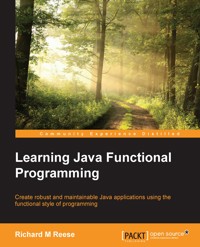
Functional programming is an increasingly popular technology that allows you to simplify many tasks that are often cumbersome and awkward using an object-oriented approach. It is important to understand this approach and know how and when to apply it. Functional programming requires a different mindset, but once mastered it can be very rewarding.
This book simplifies the learning process as a problem is described followed by its implementation using an object-oriented approach and then a solution is provided using appropriate functional programming techniques.
Writing succinct and maintainable code is facilitated by many functional programming techniques including lambda expressions and streams. In this book, you will see numerous examples of how these techniques can be applied starting with an introduction to lambda expressions. Next, you will see how they can replace older approaches and be combined to achieve surprisingly elegant solutions to problems.
This is followed by the investigation of related concepts such as the Optional class and monads, which offer an additional approach to handle problems. Design patterns have been instrumental in solving common problems. You will learn how these are enhanced with functional techniques.
To transition from an object-oriented approach to a functional one, it is useful to have IDE support. IDE tools to refactor, debug, and test functional programs are demonstrated through the chapters. The end of the book brings together many of these functional programming techniques to create a more comprehensive application. You will find this book a very useful resource to learn and apply functional programming techniques in Java.
Das E-Book können Sie in Legimi-Apps oder einer beliebigen App lesen, die das folgende Format unterstützen:
Seitenzahl: 316
Veröffentlichungsjahr: 2015
Ähnliche












Table of Contents
Learning Java Functional Programming
Learning Java Functional Programming
Copyright © 2015 Packt Publishing
All rights reserved. No part of this book may be reproduced, stored in a retrieval system, or transmitted in any form or by any means, without the prior written permission of the publisher, except in the case of brief quotations embedded in critical articles or reviews.
Every effort has been made in the preparation of this book to ensure the accuracy of the information presented. However, the information contained in this book is sold without warranty, either express or implied. Neither the author, nor Packt Publishing, and its dealers and distributors will be held liable for any damages caused or alleged to be caused directly or indirectly by this book.
Packt Publishing has endeavored to provide trademark information about all of the companies and products mentioned in this book by the appropriate use of capitals. However, Packt Publishing cannot guarantee the accuracy of this information.
First published: October 2015
Production reference: 1091015
Published by Packt Publishing Ltd.
Livery Place
35 Livery Street
Birmingham B3 2PB, UK.
ISBN 978-1-78355-848-3
www.packtpub.com
Credits
Author
Richard M Reese
Reviewers
Jose Luis Ordiales Coscia
David Greco
Hossein Kazemi
Amar Potghan
Commissioning Editor
Veena Pagare
Acquisition Editor
Vivek Anantharaman
Content Development Editor
Susmita Sabat
Technical Editor
Prajakta Mhatre
Copy Editor
Charlotte Carneiro
Project Coordinator
Judie Jose
Proofreader
Safis Editing
Indexer
Rekha Nair
Graphics
Jason Monteiro
Abhinash Sahu
Production Coordinator
Aparna Bhagat
Cover Work
Aparna Bhagat
About the Author
Richard M Reese has worked in both industry and academics. For 17 years, he worked in the telephone and aerospace industries, serving in several capacities, including research and development, software development, supervision, and training. He currently teaches at Tarleton State University, where he has the opportunity to draw on his years of industry experience to enhance his teaching.
Richard has written several Java books and a C pointer book. He uses a concise and easy-to-follow approach to the topics at hand. His Java books have addressed EJB 3.1, updates to Java 7 and 8, certification, jMonkeyEngine, and Natural Language Processing.
Richard would like to thank his daughter, Jennifer, for her numerous reviews and contributions; his wife, Karla, for her continued support; and the staff at Packt for their work in making this a better book.
About the Reviewers
Jose Luis Ordiales Coscia is a software engineer with much experience in both academia and the private industry. He has a master's degree in computer science, focusing his research on helping developers improve their service-oriented applications.
He has more than 7 years of experience working in backend development with Java and other JVM languages.
David Greco is a software architect with more than 27 years of working experience. He started his career as a researcher in the field of high-performance computing; thereafter, he moved to the business world, where he worked for different enterprise software vendors and helped to create two start-ups. He played different roles, those of a consultant and software architect and even a CTO. He's an enthusiastic explorer of new technologies, and likes to introduce new technologies into enterprises to improve their businesses. Over the past 5 years, he has fallen in love with big data technologies and typed functional programming—Scala and Haskell. When not working or hacking, he likes to practice karate and listen to jazz and classical music.
Hossein Kazemi is an entrepreneur and software engineer based in Amsterdam, the Netherlands. He holds a master's in artificial intelligence with a major in machine learning and minor in Natural Language Processing (NLP) from the University of Amsterdam. He has more than 5 years of hands-on experience in software development and has worked on projects for large-scale machine learning and NLP using Java and Scala.
Amar Potghan is a polyglot functional programming enthusiast. He has vast experience in building scalable distributed systems. Amar is currently working on Haskell and ClojureScript to build a next generation P2P lending platform for a fintech company in Singapore. Before that, he was working as a consultant at ThoughtWorks and as a senior software engineer for a couple of other global software consultancies where he worked on continuous delivery, microservices, big data, and analytics product development projects. Amar's current interests are functional programming, distributed systems, and machine learning.
www.PacktPub.com
Support files, eBooks, discount offers, and more
For support files and downloads related to your book, please visit www.PacktPub.com.
Did you know that Packt offers eBook versions of every book published, with PDF and ePub files available? You can upgrade to the eBook version at www.PacktPub.com and as a print book customer, you are entitled to a discount on the eBook copy. Get in touch with us at <[email protected]> for more details.
At www.PacktPub.com, you can also read a collection of free technical articles, sign up for a range of free newsletters and receive exclusive discounts and offers on Packt books and eBooks.
https://www2.packtpub.com/books/subscription/packtlib
Do you need instant solutions to your IT questions? PacktLib is Packt's online digital book library. Here, you can search, access, and read Packt's entire library of books.
Why subscribe?
Free access for Packt account holders
If you have an account with Packt at www.PacktPub.com, you can use this to access PacktLib today and view 9 entirely free books. Simply use your login credentials for immediate access.
Preface
With the introduction of Java 8, many functional programming techniques have been added to the language. However, functional programming may seem unfamiliar to developers who are used to using imperative and object-oriented techniques. The new additions to Java 8 offer the opportunity to develop more maintainable and robust applications than that offered by earlier versions of Java.
The goal of this book is to introduce functional programming techniques to developers who are not familiar with this technology. You will be guided through the use of functional programming techniques with the help of numerous examples. Older imperative and object-oriented approaches will be illustrated and contrasted with equivalent functional programming solutions.
What this book covers
Chapter 1, Getting Started with Functional Programming, introduces the essential elements of functional programming as supported by Java 8. This includes the introduction of functional terms complemented by Java 8 examples.
Chapter 2, Putting the Function in Functional Programming, covers the types of functions found in functional programming languages such as high-order functions, first-class functions, and pure functions. The use of lambda expressions in support of functions is explained.
Chapter 3, Function Composition and Fluent Interfaces, addresses how to use functional composition. Also covered are fluent interfaces and the use of default methods.
Chapter 4, Streams and the Evaluation of Expressions, covers the basics of their creation and use. Streams are an important addition to Java.
Chapter 5, Recursion Techniques in Java 8, demonstrates recursion, a very useful functional programming technique. While not new to Java, we explore the topic in depth and examine the use of recursive lambda expressions.
Chapter 6, Optional and Monads, covers the use and the nature of monads in creating fluent interfaces and producing resilient code. The Optional class provides a better way of working with missing data.
Chapter 7, Supporting Design Patterns Using Functional Programming, illustrates design patterns. They play an important role in Java programming. The impact of the functional style of programming and lambda expressions is illustrated.
Chapter 8, Refactoring, Debugging, and Testing, demonstrates how these tools have been affected by the new functional programming techniques and how IDEs support them. These are valuable tools in the development process.
Chapter 9, Bringing It All Together, summarizes many of the functional programming techniques presented earlier that are used in the creation of a demonstration application. Such an application provides a concise illustration of how these techniques support the development of robust and maintainable software.
What you need for this book
Java SDK 1.8 is needed for the functional programming examples encountered in the book. Some of the examples use NetBeans 8.02 and Eclipse IDE for Java developers, Mars Release Version 4.5.0.
Who this book is for
This book is for developers who are already proficient in Java and want to learn how to use the functional programming features of Java 8. Familiarity with basic Java object-oriented programming concepts is all that is needed. You will learn how to apply lambda expressions and other functional programming techniques to create a more elegant and maintainable code.
Conventions
In this book, you will find a number of text styles that distinguish between different kinds of information. Here are some examples of these styles and an explanation of their meaning.
Code words in text are shown are follows: "As you may remember, the forEach method accepts a lambda expression which matches the Consumer interface's accept method."
A block of code is shown as follows:
The output of code sequences is formatted as shown here:
New terms and important words are shown in bold. Words that you see on the screen, for example, in menus or dialog boxes, appear in the text like this: "There is the text form as entered by the user such as: drop Axe."
Note
Warnings or important notes appear in a box like this.
Tip
Tips and tricks appear like this.
Reader feedback
Feedback from our readers is always welcome. Let us know what you think about this book—what you liked or disliked. Reader feedback is important for us as it helps us develop titles that you will really get the most out of.
To send us general feedback, simply e-mail <[email protected]>, and mention the book's title in the subject of your message.
If there is a topic that you have expertise in and you are interested in either writing or contributing to a book, see our author guide at www.packtpub.com/authors.
Customer support
Now that you are the proud owner of a Packt book, we have a number of things to help you to get the most from your purchase.
Downloading the example code
You can download the example code files from your account at http://www.packtpub.com for all the Packt Publishing books you have purchased. If you purchased this book elsewhere, you can visit http://www.packtpub.com/support and register to have the files e-mailed directly to you.
Errata
Although we have taken every care to ensure the accuracy of our content, mistakes do happen. If you find a mistake in one of our books—maybe a mistake in the text or the code—we would be grateful if you could report this to us. By doing so, you can save other readers from frustration and help us improve subsequent versions of this book. If you find any errata, please report them by visiting http://www.packtpub.com/submit-errata, selecting your book, clicking on the Errata Submission Form link, and entering the details of your errata. Once your errata are verified, your submission will be accepted and the errata will be uploaded to our website or added to any list of existing errata under the Errata section of that title.
To view the previously submitted errata, go to https://www.packtpub.com/books/content/support and enter the name of the book in the search field. The required information will appear under the Errata section.
Piracy
Piracy of copyrighted material on the Internet is an ongoing problem across all media. At Packt, we take the protection of our copyright and licenses very seriously. If you come across any illegal copies of our works in any form on the Internet, please provide us with the location address or website name immediately so that we can pursue a remedy.
Please contact us at <[email protected]> with a link to the suspected pirated material.
We appreciate your help in protecting our authors and our ability to bring you valuable content.
Questions
If you have a problem with any aspect of this book, you can contact us at <[email protected]>, and we will do our best to address the problem.




