


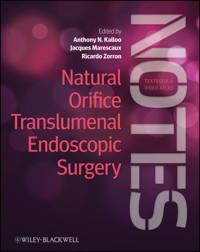
Natural Orifice Translumenal Endoscopic Surgery (NOTES) E-Book
192,99 €
Mehr erfahren.
- Herausgeber: John Wiley & Sons
- Kategorie: Fachliteratur
- Sprache: Englisch
Are you interested in using NOTES to treat your patients? Do you need a multimedia tool to guide you through all aspects of clinical management?
Just as laparoscopic surgery revolutionized surgical practice in the 1980’s and 90’s, offering genuine competition to traditional open surgery, Natural Orifice Translumenal Endoscopic Surgery (NOTES) presents a genuinely different alternative for surgeons and patients alike as we move forward in the 21st century. Advantages over laparoscopic surgery include lower anesthesia requirements, faster recovery and shorter hospital stays, avoidance of transabdominal wound infections, less immunosuppression, better postoperative pulmonary and diaphragmatic function and of course, the potential for "scarless" abdominal surgery.
Combining high-level text with a superb companion website, Natural Orifice Translumenal Endoscopic Surgery (NOTES): Textbook and Video-Atlas provides you with a hands-on, in-depth and practical multimedia tool on this exciting breakthrough, to consult either on the ward or in surgery. Highlights include:
- Full coverage of the fundamentals of NOTES, its current clinical applications and techniques, and future perspectives
- Over 50 outstanding videos illustrating NOTES being performed by the experts
- Full-color throughout and superbly illustrated with over 250 figures
- Edited by global leaders and pioneers in the field, who have recruited a world-class contributor team
As well being a valuable text for gastroenterologists, GI surgeons and general surgeons, Natural Orifice Translumenal Endoscopic Surgery (NOTES): Textbook and Video-Atlas will also appeal to urologists, urologic surgeons, gynecologists, gynecologic surgeons, thoracic and ENT surgeons.
Sie lesen das E-Book in den Legimi-Apps auf:
Seitenzahl: 863
Veröffentlichungsjahr: 2012
Ähnliche




















Table of Contents
Cover
Companion website
Title page
Copyright page
Contributors
Preface
Section 1: Development of the NOTES Concept
1 History of NOTES
Prehistory of NOTES (from ancient times to the late twentieth century)
On the verge of NOTES (1980–2000)
The birth of NOTES (2000)
NOTES launching (2000–2004)
NOTES booming (2005–2008)
NOTES in human medicine (2009–2011)
NOTES offspring
Conclusion
2 Endoscopic Platforms for NOTES
Introduction
Critical features of an ideal NOTES platform
Multifunctional instrumentation
Available endoscopic platforms for NOTES
Disruptive concepts of endoscopic platforms for NOTES
Conclusions
3 Physiology of NOTES
Why should NOTES be different than laparoscopy?
Central and peripheral nervous systems
Respiratory system and acid-base disturbance
Cardiovascular system
Peritoneum
Gastrointestinal tract
Immunology
Infection
Conclusion
4 Infection Control in NOTES
Introduction
Transvaginal
Transgastric
Transcolonic
Transurethral
Transmediastinal and transthoracic
Review
5 NOTES Access Techniques
Introduction
Technical considerations for NOTES access
Oral route: transoral/transesophageal/transgastric/transduodenal access
Vaginal route: transvaginal access
Anal route: transrectal/transcolonic access
Urethral route: Transvesical access
Conclusion
6 NOTES Closure Techniques
Introduction
No closure
Traditional closure techniques
Endoscopic clips
Full-thickness closure clips
T-fastener closures
Flexible endoscopic suturing devices and systems
Stapling devices
Other closure concepts
Conclusion
7 Mini-laparoscopy in the Endoscopy Unit
Introduction
Indications
Contraindications
Investigation technique
Complications
8 Single-port Surgery
Introduction
Philosophy of single-port access
Potential benefits and hazards
Available instruments for single-port surgery
Cholecystectomy
Appendectomy
Upper gastrointestinal and bariatric surgery
Splenectomy
Single-site adrenalectomy
Single-port laparoscopic colorectal surgery
9 Computer-assisted NOTES: From Augmented Reality to Automation
Introduction
From medical image to augmented reality for NOTES
Robotics for NOTES
Conclusion
Acknowledgment
Section 2: Current Clinical Applications and Techniques
10 NOTES for Peritoneal Exploration
Introduction
NOTES peritoneoscopy
Surgical technique
Future direction
Conclusion
11 NOTES Cholecystectomy
Introduction
Transgastric cholecystectomy
Transvaginal cholecystectomy
Discussion
Conclusions
12 NOTES Appendectomy
Introduction
Techniques of NOTES appendectomy
NOTES-related procedures
Single-incision appendectomy
Summary
13 NOTES Applications in Colorectal Surgery
Introduction
Conclusion
14 NOTES Applied for Rectal Surgery
Radical surgery for rectal cancer
Local excision of rectal cancer
Beyond laparoscopy: NOTES
Transanal colorectal surgery
NOTES transanal rectosigmoid resection: animal studies
NOTES transanal rectosigmoid resection: human cadaver experience
NOTES transanal rectosigmoid resection: clinical experience
The future of NOTES transanal rectosigmoid resection
15 Bariatric NOTES Procedures
Introduction
Bariatric challenges for NOTES
Laparo-endoscopic single-site surgery as a bridge to bariatric NOTES
Technical considerations for bariatric NOTES
Experimental results of NOTES for existing bariatric procedures
Intralumenal therapy
Conclusion
16 Urologic Applications of NOTES
Transvaginal NOTES
Hybrid NOTES
Transvesical NOTES
Transgastric NOTES
Transurethral NOTES
Summary
17 Gynecologic Applications of NOTES
Introduction
Definition and history
Surgical techniques for gynecologic NOTES
Which gynecologic operations may benefit from NOTES?
Which patients are good candidate for gynecologic NOTES?
Conclusion
18 NOTES Thyroidectomy
Background
Rationale and history of transoral surgery
Technique of totally transoral video-assisted thyroidectomy (TOVAT)
Conclusion
Section 3: Perspectives on NOTES
19 POEM and Emerging NOTES Applications
Introduction
Emerging NOTES applications
NOTES thyroid and parathyroid surgery
Transrectal NOTES using single-port devices
Retroperitoneal NOTES
Per-oral endoscopic myotomy for esophageal achalasia
Future of emerging applications
20 NOTES Applications in Veterinary Medicine
Introduction
Advantages and disadvantages of NOTES in animals
Instrumentation
Pre-operative preparation
Anesthesia and postoperative analgesia
Access
Insufflation
Exposure and navigation
Closure
Complications
Veterinary procedures
Acknowledgments
21 NOTES and Pregnancy: Where We Are and Where We Could Go
Introduction
Maternal surgery (for maternal pathology)
Access to the fetus and to the placenta: intra-amniotic surgery
Fetal NOTES
Conclusion
22 Thoracic Cavity Application of NOTES
Introduction
Access to the thoracic cavity
Transesophageal thoracic surgery
Applications of thoracic NOTES
Flexible endoscopic thoracic procedures
Barriers to practice
The future of thoracic NOTES
Conclusion
23 Designing the NOTES Procedure Room
Introduction
General principles
Lighting
Fluoroscopy
NOTES (operating room) table
Sterilization
NOTES room air pressure
Laparoscopic equipment
Conversion from NOTES to laparoscopic or open procedures
Ergonomics of a NOTES room
Future thoughts
Conclusion
Disclosures
24 Evolution and Future Developments of Instrument Technology for NOTES
Introduction
Evolution of the modern endoscope
Flexible instruments as peritoneoscopes
Evolution of NOTES
Overcoming technical barriers
Access to peritoneal cavity
Closure, hemostatic, anastomotic, and suturing devices
Multitasking platform
Robotics
Magnetic anchoring and guidance system
Spatial orientation
Lasers
Training
Conclusion
25 Training the Gastroenterologist for NOTES
Introduction
Technical challenges
Instruments
Training
Assessment
Procedures
Conclusion
26 Training the Surgeon for NOTES
“See one, do one, teach one”
See many, teach many, do a few . . .
27 Simulator-based Training of NOTES Procedures
Introduction
Clinical Interest in NOTES simulation
Skills sets of NOTES training
Assessment of competency using simulation models
Available NOTES simulation models
Team simulation of NOTES
Animal laboratory experience
VR-based NOTES simulation
28 NOTES: Possibilities for the Future
Introduction
The future
Index
Companion website
This book is accompanied by a website:
www.wiley.com/go/kalloo/notes
The website includes:
68 videos showing procedures described in the book
All videos are referenced in the text where you see this logo:
This edition first published 2012 © 2012 by John Wiley & Sons, Ltd
Wiley-Blackwell is an imprint of John Wiley & Sons, formed by the merger of Wiley’s global Scientific, Technical and Medical business with Blackwell Publishing.
Registered office: John Wiley & Sons, Ltd, The Atrium, Southern Gate, Chichester, West Sussex, PO19 8SQ, UK
Editorial offices: 9600 Garsington Road, Oxford, OX4 2DQ, UK
The Atrium, Southern Gate, Chichester, West Sussex, PO19 8SQ, UK
111 River Street, Hoboken, NJ 07030-5774, USA
For details of our global editorial offices, for customer services and for information about how to apply for permission to reuse the copyright material in this book please see our website at www.wiley.com/wiley-blackwell
The right of the author to be identified as the author of this work has been asserted in accordance with the UK Copyright, Designs and Patents Act 1988.
All rights reserved. No part of this publication may be reproduced, stored in a retrieval system, or transmitted, in any form or by any means, electronic, mechanical, photocopying, recording or otherwise, except as permitted by the UK Copyright, Designs and Patents Act 1988, without the prior permission of the publisher.
Designations used by companies to distinguish their products are often claimed as trademarks. All brand names and product names used in this book are trade names, service marks, trademarks or registered trademarks of their respective owners. The publisher is not associated with any product or vendor mentioned in this book. This publication is designed to provide accurate and authoritative information in regard to the subject matter covered. It is sold on the understanding that the publisher is not engaged in rendering professional services. If professional advice or other expert assistance is required, the services of a competent professional should be sought.
The contents of this work are intended to further general scientific research, understanding, and discussion only and are not intended and should not be relied upon as recommending or promoting a specific method, diagnosis, or treatment by physicians for any particular patient. The publisher and the author make no representations or warranties with respect to the accuracy or completeness of the contents of this work and specifically disclaim all warranties, including without limitation any implied warranties of fitness for a particular purpose. In view of ongoing research, equipment modifications, changes in governmental regulations, and the constant flow of information relating to the use of medicines, equipment, and devices, the reader is urged to review and evaluate the information provided in the package insert or instructions for each medicine, equipment, or device for, among other things, any changes in the instructions or indication of usage and for added warnings and precautions. Readers should consult with a specialist where appropriate. The fact that an organization or Website is referred to in this work as a citation and/or a potential source of further information does not mean that the author or the publisher endorses the information the organization or Website may provide or recommendations it may make. Further, readers should be aware that Internet Websites listed in this work may have changed or disappeared between when this work was written and when it is read. No warranty may be created or extended by any promotional statements for this work. Neither the publisher nor the author shall be liable for any damages arising herefrom.
Library of Congress Cataloging-in-Publication Data
Natural orifice translumenal endoscopic surgery (NOTES) : textbook and video atlas / edited by Anthony N. Kalloo, Jacques Marescaux, Ricardo Zorron.
p. ; cm.
NOTES
Includes bibliographical references and index.
ISBN 978-0-470-67103-0 (hardback : alk. paper)
I. Kalloo, Anthony, 1955– II. Marescaux, J. (Jacques) III. Zorron, Ricardo. IV. Title: NOTES.
[DNLM: 1. Natural Orifice Endoscopic Surgery–methods. 2. Natural Orifice Endoscopic Surgery–education. WO 505]
617'.057–dc23
2011048892
A catalogue record for this book is available from the British Library.
Wiley also publishes its books in a variety of electronic formats. Some content that appears in print may not be available in electronic books.
Contributors
Woojin Ahn, PhDPostdoctoral Research Associate, Center for Modeling, Simulation and Imaging in Medicine (CeMSIM)Department of Mechanical, Aerospace and Nuclear EngineeringJonsson Engineering Center 3205Rensselaer Polytechnic InstituteTroy, NY, USA
Janyne Althaus, MDAssistant ProfessorDivision of Maternal Fetal MedicineDepartment of Gynecology and ObstetricsJohns Hopkins UniversityBaltimore, MD, USA
Alexander Aurora, MDMIS General Surgery & BariatricsCase & Geauga Medical CentersUniversity HospitalsCleveland, OH, USA
Tahar Benhidjeb, MD, PhDChaiman, Department of SurgeryChief, Department of General SurgeryBurjeel Hospital, Abu Dhabi, UAE;Director, The New European Surgical Academy(NESA), Berlin, Germany
Jörn Bernhardt, MD, PhDHead, Department of Diagnostic and Interventional EndoscopyKlinikum SuedstadtRostock, Germany;Department of SurgeryKlinikum SuedstadtRostock, Germany
Juliane Bingener, MDAssociate ProfessorDepartment of SurgeryDivision of Gastroenterologic and General SurgeryDivision of Gastroenterology and HepatologyMayo ClinicRochester, MN, USA
Eduardo A. Bonin, MD, MScResearch FellowDevelopmental Endoscopy UnitMayo ClinicRochester, MN, USA
Nicolas Bourdel, MDDivision of Gastroenterology & HepatologyJohns Hopkins UniversityBaltimore, MD, USA
Géraldine Chauvin, MDCRES (Centre de Recherche et d’Etude de la Stérilité)Hôpital NATECIALyon, France
Bernard Dallemagne, MDDepartment of Digestive and Endocrine SurgeryUniversity Hospital of StrasbourgIRCAD (Research Institute Against Digestive Cancer)Strasbourg, France
Suvranu De, ScDDirector, Center for Modeling, Simulation and Imaging in Medicine (CeMSIM)Professor, Department of Mechanical, Aerospace and Nuclear Engineering (primary appointment)Department of Biomedical Engineering (joint appointment)Information Technology and Web Science (joint appointment)Jonsson Engineering Center 5002Rensselaer Polytechnic InstituteTroy, NY, USA
Michel de Mathelin, PhDProfessor, University of StrasbourgCNRS (National Center for Scientific Research)IRCAD (Research Institute Against Digestive Cancer)Strasbourg, France
Michele Diana, MDDepartment of Digestive and Endocrine SurgeryUniversity Hospital of StrasbourgIRCAD (Research Institute Against Digestive Cancer)Strasbourg, France
Anthony R. Dixon DM, FRCS, FRCSEdConsultant Laparoscopic Colorectal & Pelvic Floor SurgeonNorth Bristol (Frenchay) & SPIRE Bristol HospitalsBristol, UK
Xavier Dray, MD, PhDDépartement Médico-Chirurgical de Pathologie DigestiveAPHP Hôpital Lariboisière & Université Paris 7Paris, France;Division of Gastroenterology & HepatologyThe Johns Hopkins HospitalBaltimore, MD, USA
Alex Escalona, MDPontificia Universidad Católica de ChileFaculty of MedicineDepartment of Digestive SurgerySantiago, Chile
Lynetta J. Freeman, DVMAssociate Professor of Small Animal Surgery & Biomedical EngineeringPurdue UniversityWest Lafayette, IN, USA
Katherine Gash, MBChB, MRCSNorth Bristol NHS TrustFrenchay HospitalBristol, UK
Denise W. Gee, MDAttending SurgeonMinimally Invasive SurgeryMassachusetts General HospitalBoston, MA, USA
Matthew T. Gettman, MDProfessor of UrologyDepartment of UrologyMayo ClinicRochester, MN, USA
Christopher J. Gostout, MD, FASGE, FACGProfessor of MedicineDevelopmental Endoscopy UnitDivision of Gastroenterology & HepatologyDepartment of SurgeryMayo ClinicRochester, MN, USA
Candace F. Granberg, MDDepartment of UrologyMayo ClinicRochester, MN, USA
Jeffrey W. Hazey, MDAssociate ProfessorDepartment of SurgeryThe Ohio State University Medical CenterColumbus, OH, USA
Arthur Hoffman, MD, PhDFirst Department of Internal MedicineJohannes Gutenberg University of MainzMainz, Germany
Mitchell R. Humphreys, MDAssociate Professor of UrologyDepartment of UrologyMayo Clinic ArizonaPhoenix, AZ, USA
Haruhiro Inoue, MDProfessor, Faculty of MedicineDigestive Disease CenterShowa University Northern Yokohama HospitalYokohama, Japan
Angela M. Johnson, MDDepartment of SurgeryMayo ClinicRochester, MN, USA
Mouen A. Khashab, MDAssistant Professor of MedicineDirector of Therapeutic EndoscopyDivision of Gastroenterology and HepatologyJohns Hopkins HospitalBaltimore, MD, USA
Ralf Kiesslich, MD, PhDFirst Department of Internal MedicineJohannes Gutenberg University of MainzMainz, Germany
Seigo Kitano, MD, PhDDepartment of Gastroenterological SurgeryOita University Faculty of Medicine1-1 Idaigaoka, Yufu, Oita, Japan
Nitin Kumar, MDClinical GI Fellow, Gastroenterology DivisionBrigham and Women’s HospitalBoston, MA, USA
Joël Leroy, MD, Hon FRCSDepartment of Digestive and Endocrine SurgeryUniversity Hospital of StrasbourgIRCAD (Research Institute Against Digestive Cancer)Strasbourg, France
Kaja Ludwig, MD, PhDProfessor of SurgeryHead, Department of SurgeryKlinikum SuedstadtRostock, Germany
Magnus J. Mansard, MS, DNB(GI Surg)Consultant Surgical GastroenterologistAsian Institute of GastroenterologyHyderabad, India
Kai Matthes, MD, PhDDirector, Developmental EndoscopyBeth Israel Deaconess Medical CenterStaff AnesthesiologistChildren’s Hospital BostonClinical Assistant ProfessorHarvard Medical SchoolBoston, MA, USA
Peter N. Nau, MD, MSDepartment of SurgeryThe Ohio State University Medical CenterColumbus, OH, USA
Stéphane Nicolau, PhDIRCAD (Research Institute Against Digestive Cancer)University Hospital of StrasbourgStrasbourg, France
Karine Pader, DVMResident, Large Animal SurgeryPurdue UniversityWest Lafayette, IN, USA
Pankaj Jay Pasricha, MDProfessor of Medicine, and by courtesy,Surgery Chief,Division of Gastroenterology and Hepatology Stanford University School of MedicineStanford, CA, USA
Silvana Perretta, MDDepartment of Digestive and Endocrine SurgeryUniversity Hospital of StrasbourgIRCAD (Research Institute Against Digestive Cancer)Strasbourg, France
Jeffrey L. Ponsky, MDOliver H. Payne Professor and Chairman, Department of SurgeryCWRU School of MedicineSurgeon in ChiefUniversity Hospitals, Case Medical CenterCleveland, OH, USA
G.V. Rao, MS, MAMS, FRCSDirector and Chief of Surgical Gastroenterology & Minimally Invasive SurgeryAsian Institute of Gastroenterology,Hyderabad, India
D. Nageshwar Reddy, DM, DSc, FAMS, FRCPChairman and Chief of Gastroenterology & Therapeutic EndoscopyAsian Institute of Gastroenterology,Hyderabad, India
Erwin Rieder, MDMinimally Invasive Surgery ProgramLegacy Health SystemPortland, OR, USA
Homero Rivas, MD, MBAAssistant Professor of SurgeryDirector of Innovative SurgeryStanford University School of MedicineStanford, CA, USA
Ganesh Sankaranarayanan, PhDResearch Assistant ProfessorCenter for Modeling, Simulation and Imaging in Medicine (CeMSIM)Department of Mechanical, Aerospace and Nuclear EngineeringJonsson Engineering Center 5007Rensselaer Polytechnic InstituteTroy, NY, USA
Sylke Schneider-Koriath, MDDepartment of SurgeryKlinikum SuedstadtRostock, Germany
Luc Soler, PhDDepartment of Digestive and Endocrine SurgeryUniversity Hospital of StrasbourgIRCAD (Research Institute Against Digestive Cancer)Strasbourg, France
Michael Stark, MDPresident, The New European Surgical Academy (NESA)Berlin, Germany
Holger Steffen, MDDepartment of Diagnostic und Interventional EndoscopyKlinikum SuedstadtRostock, Germany;Department of SurgeryKlinikum SuedstadtRostock, Germany
Lee L. Swanstrom, MDDivision of GI and MIS SurgeryThe Oregon ClinicPortland, OR, USA
Patricia Sylla, MDAssistant Professor of Surgery, Harvard Medical School;Assistant in Surgery, Massachusetts General HospitalBoston, MA, USA
Christopher C. Thompson, MD, MSc, FACG, FASGEDirector of Therapeutic EndoscopyGastroenterology DivisionBrigham and Women’s HospitalAssistant Professor of MedicineHarvard Medical SchoolBoston, MA, USA
Brian G. Turner, MDWeil Cornell Medical CollegeDivision of Gastroenterology and HepatologyNew York, NY, USA
Michel Vix, MDDepartment of Digestive and Endocrine SurgeryUniversity Hospital of StrasbourgIRCAD (Research Institute Against Digestive Cancer)Strasbourg, France
James Wall, MD, MSEDepartment of Digestive and Endocrine SurgeryUniversity Hospital of StrasbourgIRCAD (Research Institute Against Digestive Cancer)Strasbourg, France
Antoine Watrelot, MDCRES (Centre de Recherche et d’Etude de la Stérilité)Hôpital NATECIALyon, France
Arnaud Wattiez, MD, PhDDepartment of Obstetrics and GynaecologyUniversity Hospital of StrasbourgIRCAD (Research Institute Against Digestive Cancer)Strasbourg, France
Kazuhiro Yasuda, MD, PhDDepartment of Gastroenterological SurgeryOita University Faculty of Medicine1-1 Idaigaoka, Yufu, Oita, Japan
Preface
The use of natural body orifices as the primary portal of entry for peritoneal or thoracic interventions challenges conventional surgical and endoscopic principles. NOTES is the evolutionary merger of endoscopy and surgery, using their basic principles while challenging the dogma of both fields. NOTES evolved because of the quest to seek less invasive surgical interventions and will have the added benefit of improved cosmesis. Both of these benefits will be attractive to patients much like laparoscopic surgery was at its beginning.
NOTES has already impacted our current endoscopic and surgical practices. Procedures such as per-oral endoscopic myotomy (POEM), submucosal endoscopy and single port laparoscopy arose because of NOTES and are addressed in detail in this book. Improved instrumentation, robotization of flexible instruments and new endoscopic platforms are some of the downstream benefits of NOTES research, are also all delineated here.
Since the first human application in 2004, there has been tremendous progress in the understanding of the physiologic mechanisms created by NOTES. As a result of the work of many of our authors and others, we now have a large body of information that is the basis for this textbook. Furthermore, there is an ever-growing arena of clinical applications extending beyond digestive diseases.
This book is intended to be an in-depth resource of information on NOTES. The early chapters focus on basic principles and techniques such as access and closure techniques as well as infection control issues. Later chapters review current clinical applications such as appendectomy and cholecystectomy. The final chapters are dedicated to more up-and-coming and perhaps controversial topics such as veterinarian medicine and spinal interventions. We hope that these later chapters will lay a foundation and stimulate further research into these burgeoning areas. The video library should significantly enhance the knowledge base of this book by augmenting the detailed written descriptions of the various procedures. Our hope is that you will be both excited and inspired by the videos.
We thank our publisher, Wiley-Blackwell, for taking a chance on pioneering a textbook about this emerging field. We would especially like to thank Elisabeth Dodds at Wiley-Blackwell for her gentle persistence, eye for detail and great sense of humor in dealing with three editors from three different continents and authors from all over the world. Most of all, we are grateful to each of our authors who are esteemed experts in their fields and were able to dedicate significant time to this textbook, including the creation of videos, in a short period of time.
Anthony N. KallooJacques MarescauxRicardo ZorronJanuary 2012
1 Development of the NOTES Concept
1
History of NOTES
Xavier Dray1,2 & Anthony N. Kalloo2
1APHP Hôpital Lariboisière & Université Paris 7, Paris, France
2The Johns Hopkins Hospital, Baltimore, MD, USA
Natural orifice translumenal endoscopic surgery (NOTES) is an endoscopic technique whereby surgical interventions can be performed with a flexible endoscope passed through a natural orifice (mouth, vulva, urethra, anus) then through a translumenal opening of the stomach, vagina, bladder, or colon [1]. NOTES has the potential to provide no scarring, reduced pain, and faster patient recovery compared to open and laparoscopic surgical procedures [1]. We present herein the landmarks in the history of NOTES, from the early stages of endoscopy and laparoscopy to its current development.
Prehistory of NOTES (from Ancient Times to the Late Twentieth Century)
It is difficult to date when people started to have a look into human bodies, and even harder to credit one individual with the invention of endoscopy. The earliest descriptions of endoscopy are by Hippocrates (460–375 BC), who described a rectal speculum. A three-bladed vaginal speculum was found in the ruins of Pompeii, demonstrating that Roman medicine also involved primitive endoscopic tools. At this time, nothing but ambient light was used, and only rigid instruments were available. Major technological developments leading to modern endoscopy and to modern laparoscopy were born in the nineteenth and twentieth centuries [2].
A Brief History of Endoscopy [3]
The first issue faced by the pioneers of endoscopy was the illumination problem. The first gastroscopy was reported by Kussmaul in 1868 [4]. Joseph Swan and Thomas Edison invented the incandescent electric light bulb in 1878, but this technology was incorporated into endoscopes only at the beginning of the twentieth century [3].
The second and more challenging problem was flexibility. Articulated lenses and prisms were proposed by Hoffmann in 1911 [5] and improved in 1932 by Wolf and Schindler, who developed a semi-flexible gastroscope [6]. However, the light source consisted of a distal light bulb that provided poor illumination and produced color distortion. In 1930, Lamm showed that bundles of glass fibers could be used as a conduit for a light source, and that this bundle could be bent with no effects on light transmission [7]. “Coherent” bundles, ordered in such a way that the position of a fiber at one end mirrors its position at the other end, provided a real image of internal organs [8]. An external light source transmitted through flexible and coherent fiber bundles could therefore illuminate internal organs.
Flexibility and illumination were combined by Harold Hopkins in 1954: the flexible fiber imaging device he invented was made of a tube of glass with thin lenses of air [9]. In 1958, Larry Curtiss and Basil Hirschowitz improved this system by using a highly transparent optical quality glass to give birth to a flexible fiberoptic endoscope [10].
In the late 1970s, the charge-coupled device (CCD) was incorporated into an endoscope [11]. This development heralded the modern era of endoscopy. The CCD allowed the display of endoscopic images on television screens and the connection of endoscopes and computers. From this major shift started a two-decade period described by Sivak as “the golden era of gastrointestinal endoscopy” [3]. Major achievements, which have since become routine procedures, were reported: endoscopic retrograde pancreatography (1968), colonoscopic polypectomy (1969), endoscopic retrograde cholangiography (1970), endoscopic sphincterotomy with bile duct stone removal (1974), percutaneous endoscopic gastrostomy (1980), endoscopic injection sclerotherapy (1980), endoscopic ultrasonography (1980), electronic CCD endoscope (1983), endoscopic control of upper gastrointestinal bleeding (1985), and endoscopic variceal ligation (1990) [3]. Modern endoscopy was born.
A Brief History of Minimally Invasive Surgery
Lesen Sie weiter in der vollständigen Ausgabe!
Lesen Sie weiter in der vollständigen Ausgabe!
Lesen Sie weiter in der vollständigen Ausgabe!
Lesen Sie weiter in der vollständigen Ausgabe!
Lesen Sie weiter in der vollständigen Ausgabe!
Lesen Sie weiter in der vollständigen Ausgabe!
Lesen Sie weiter in der vollständigen Ausgabe!
Lesen Sie weiter in der vollständigen Ausgabe!
Lesen Sie weiter in der vollständigen Ausgabe!
Lesen Sie weiter in der vollständigen Ausgabe!
Lesen Sie weiter in der vollständigen Ausgabe!
Lesen Sie weiter in der vollständigen Ausgabe!
Lesen Sie weiter in der vollständigen Ausgabe!
Lesen Sie weiter in der vollständigen Ausgabe!
Lesen Sie weiter in der vollständigen Ausgabe!
Lesen Sie weiter in der vollständigen Ausgabe!
Lesen Sie weiter in der vollständigen Ausgabe!
Lesen Sie weiter in der vollständigen Ausgabe!
Lesen Sie weiter in der vollständigen Ausgabe!
Lesen Sie weiter in der vollständigen Ausgabe!
Lesen Sie weiter in der vollständigen Ausgabe!
Lesen Sie weiter in der vollständigen Ausgabe!
Lesen Sie weiter in der vollständigen Ausgabe!
Lesen Sie weiter in der vollständigen Ausgabe!
Lesen Sie weiter in der vollständigen Ausgabe!
Lesen Sie weiter in der vollständigen Ausgabe!
Lesen Sie weiter in der vollständigen Ausgabe!
Lesen Sie weiter in der vollständigen Ausgabe!
Lesen Sie weiter in der vollständigen Ausgabe!
Lesen Sie weiter in der vollständigen Ausgabe!




