


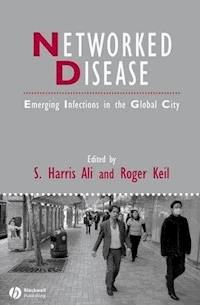
Networked Disease E-Book
20,99 €
Mehr erfahren.
- Herausgeber: John Wiley & Sons
- Kategorie: Wissenschaft und neue Technologien
- Serie: Studies in Urban and Social Change
- Sprache: Englisch
A collection of writings by leading experts and newer researchers on the SARS outbreak and its relation to infectious disease management in progressively global and urban societies. * Presents original contributions by scholars from seven countries on four continents * Connects newer thinking on global cities, networks, and governance in a post-national era of public health regulations and neo-liberalization of state services * Provides an important contribution to the global public debate on the challenges of emerging infectious disease in cities * Examines the impact of globalization on future infectious disease threats on international and local politics and culture * Focuses on the ways pathogens interact with economic, political and social factors, ultimately presenting a threat to human development and global cities * Employs an interdisciplinary approach to the SARS epidemic, clearly demonstrating the value of social scientific perspectives on the study of modern disease in a globalized world
Sie lesen das E-Book in den Legimi-Apps auf:
Seitenzahl: 709
Veröffentlichungsjahr: 2011
Ähnliche




















Contents
List of Figures
List of Tables
Notes on Contributors
Series Editors’ Preface
Preface
Introduction: Networked Disease
The SARS Outbreaks
Cities and Disease
Global Cities and Disease
The Organization of This Book
Part I Infectious Disease and Globalized Urbanization
Introduction
1 Toward a Dialectical Understanding of Networked Disease in the Global City: Vulnerability, Connectivity, Topologies
Contemporary Globalization and Urbanization: The Renewed Potential for Disease
Toronto and SARS: Global Citiness as Vulnerability
Re-Reading Global Cities: "The Dialectic of Mobility and Fixity"
"Global Cities," "World Cities": Situating the Urban in Globalization
The Global Cities Network: Articulating the Global Economy
Expanding the Global City Network: Which Cities Count, Which Flows Matter?
"Unexpected, Disproportionate, and Emergent Effects"
Infectious Disease and Global Cities: Building a Theoretical Framework
2 Health and Disease in Global Cities: A Neglected Dimension of National Health Policy
Health Risks and Contrasting Views of Urban Health
An Overview of Health and Health Systems in Four World Cities
Public Health Infrastructure across Four World Cities
Convergent Trends in Public Health Intervention
ACKNOWLEDGMENTS
Part II SARS and Health Governance in the Global City: Toronto, Hong Kong, and Singapore
Introduction
3 SARS and the Restructuring of Health Governance in Toronto
Introduction
SARS in Toronto
Global City Toronto
Conclusion
4 Globalization of SARS and Health Governance in Hong Kong under "One Country, Two Systems"
Introduction
Health Governance in Hong Kong: Compartmentalized with Minimal Regional Integration
SARS: Global, Regional, and Local Nexus
The SARS Outbreak in Hong Kong
Health Governance Issues Highlighted in the SARS Epidemic
Conclusion: Curbing the Global Epidemic at the Local Level
5 Surveillance in a Globalizing City: Singapore’s Battle against SARS
Introduction
The Epidemiological Outbreak and Measures to Fence in SARS
Global Linkages in a Time of Crisis
Social Responsibility, Surveillance, and Control
Safe and Unsafe Spaces
Discussion
Conclusion
ACKNOWLEDGMENTS
Part III The Cultural Construction of Disease in the Global City
Introduction
6 The Troubled Public Sphere and Media Coverage of the 2003 Toronto SARS Outbreak
Introduction
Framing the SARS Crisis
Methodology
The Competing Functions of the News Media
Stakeholders, Political Spin, and Blame
The American Coverage of SARS
Media Strategies in a Public Crisis
SARS, the Media, and Global Cultural Flows
By Way of a Conclusion
ACKNOWLEDGMENTS
7 SARS as a "Health Scare"
Introduction
Health Scares
Disease Scares: Pandemics
Network Amplifiers: The Social Amplification of Risk
SARS as a Health Scare
Conclusion and Implications
8 City under Siege: Authoritarian Toleration, Mask Culture, and the SARS Crisis in Hong Kong
Introduction
Life and Death in a Time of SARS
Paradoxes of Authoritarian Toleration
Mainland China and the Emergence of a Post-Westphalian System
The Masked City
Conclusions
9 "Racism is a Weapon of Mass Destruction": SARS and the Social Fabric of Urban Multiculturalism
Introduction
SARS and Racialization in Toronto1
Urbanization, Racism, and Disease
SARS, Biopolitics, and the Crisis of Multiculturalism
Making Chinatown: Histories of Racialization and Disease in Canada
Making Racism: The Complexity of Anti-Chinese Racialization in Toronto
Racism without Race
Conclusions
Part IV Re-Emerging Infectious Disease, Urban Public Health, and Global Biosecurity
Introduction
10 Deadly Alliances: Death, Disease, and the Global Politics of Public Health
Introduction
Gender, Poverty, and the Global Public Health Crisis
Urbanization and the Biopolitics of Modernity
The Politics of Death
Conclusions
ACKNOWLEDGMENTS
11 Tuberculosis and the Anxieties of Containment
Urbanization and the Boundaries of Infection
Globalization, Development, Containment
Susceptibility, Immunity, Race
Conclusion
12 Networks, Disease, and the Utopian Impulse
Introduction: Eden-Olympia
Networks of Emergence
Networks of Response
Networks as Metaphor and Reality, Problem and Solution
13 People, Animals, and Biosecurity in and through Cities
Introduction
Biosecurities
Ordering Avian Influenzas
Cairo and Avian Flu – Making Cairo Urban
Modernity and Biosecurity in Practice
Overlaps, Interferences, and Netwars
Conclusions
ACKNOWLEDGMENTS
Part V Networked Disease: Theoretical Approaches
Introduction
14 SARS as an Emergent Complex: Toward a Networked Approach to Urban Infectious Disease
Introduction
Emergence, Networks, and Complexity
Tracing the Spread of SARS
SARS and the Global Health Response
SARS and Complexity
SARS and the Network Society
SARS and Networked Inequality
Concluding Remarks
15 Thinking the City through SARS: Bodies, Topologies, Politics
SARS as Event
Political Physics: Urban Bodies and their Composition
The Biosocial City as an Unbounded or Polyrhythmic Space
SARS and the Biopolitical City
Conclusion
16 Vapors, Viruses, Resistance(s): The Trace of Infection in the Work of Michel Foucault
Fevers of Madness
Impurity as a Genealogical Principle
The Plague and the Disciplines
“Universally Destructive Viruses” and the Smallpox Model
Smallpox Liberalism
17 Fleshy Traffic, Feverish Borders: Blood, Birds, and Civet Cats in Cities Brimming with Intimate Commodities
The SARS Story: From Butcher to Barbeque
Wild/Meat
Meat/Commodity
Consumption/Body
All Pooled Together … Wet Markets
Dripping Commodities in the City
Concluding Remarks
Bibliography
Index
Studies in Urban and Social Change
Published
Networked Disease: Emerging Infections in the Global City
S. Harris Ali and Roger Keil (eds)
Eurostars and Eurocities: Free Movement and Mobility in an Integrating Europe
Adrian Favell
Urban China in Transition
John R. Logan (ed.)
Getting into Local Power: The Politics of Ethnic Minorities in British and French Cities
Romain Garbaye
Cities of Europe
Yuri Kazepov (ed.)
Cities, War, and Terrorism
Stephen Graham (ed.)
Cities and Visitors: Regulating Tourists, Markets, and City Space
Lily M. Hoffman, Susan S. Fainstein, and Dennis R. Judd (eds)
Understanding the City: Contemporary and Future Perspectives
John Eade and Christopher Mele (eds)
The New Chinese City: Globalization and Market Reform
John R. Logan (ed.)
Cinema and the City: Film and Urban Societies in a Global Context
Mark Shiel and Tony Fitzmaurice (eds)
The Social Control of Cities? A Comparative Perspective
Sophie Body-Gendrot
Globalizing Cities: A New Spatial Order?
Peter Marcuse and Ronald van Kempen (eds)
Contemporary Urban Japan: A Sociology of Consumption
John Clammer
Capital Culture: Gender at Work in the City
Linda McDowell
Cities after Socialism: Urban and Regional Change and Conflict in Post-Socialist Societies
Gregory Andrusz, Michael Harloe, and Ivan Szelenyi (eds)
The People’s Home? Social Rented Housing in Europe and America
Michael Harloe
Post-Fordism
Ash Amin (ed.)
Free Markets and Food Riots
John Walton and David Seddon
Fragmented Societies
Enzo Mingione
Urban Poverty and the Underclass: A Reader
Enzo Mingione
Forthcoming
Cities and Regions in a Global Era
Alan Harding (ed.)
Urban Social Movements and the State
Margit Mayer
Servicing Bodies: New Forms of Interactive Work
Linda McDowell
Locating Neoliberalism in East Africa: Neoliberalizing Spaces in Developmental States
Bae-Gyoon Park, Richard Child Hill and Asato Saito (eds)
Confronting Suburbanization: Urban Decentralization in Post-Socialist Central and Eastern Europe
Kiril Stanilov and Ludek Sykora (eds)
Social Capital Formation in Immigrant Neighborhoods
Min Zhou
This edition first published 2008
© 2008 Blackwell Publishing Ltd
Blackwell Publishing was acquired by John Wiley & Sons in February 2007. Blackwell’s publishing program has been merged with Wiley’s global Scientific, Technical, and Medical business to form Wiley-Blackwell.
Registered Office
John Wiley & Sons Ltd, The Atrium, Southern Gate, Chichester, West Sussex, PO19 8SQ, United Kingdom
Editorial Offices
350 Main Street, Malden, MA 02148–5020, USA
9600 Garsington Road, Oxford, OX4 2DQ, UK
The Atrium, Southern Gate, Chichester, West Sussex, PO19 8SQ, UK
For details of our global editorial offices, for customer services, and for information about how to apply for permission to reuse the copyright material in this book please see our website at www.wiley.com/wiley-blackwell.
The right of S. Harris Ali and Roger Keil to be identified as the authors of the editorial material in this work has been asserted in accordance with the Copyright, Designs and Patents Act 1988.
All rights reserved. No part of this publication may be reproduced, stored in a retrieval system, or transmitted, in any form or by any means, electronic, mechanical, photocopying, recording or otherwise, except as permitted by the UK Copyright, Designs and Patents Act 1988, without the prior permission of the publisher.
Wiley also publishes its books in a variety of electronic formats. Some content that appears in print may not be available in electronic books.
Designations used by companies to distinguish their products are often claimed as trademarks. All brand names and product names used in this book are trade names, service marks, trademarks or registered trademarks of their respective owners. The publisher is not associated with any product or vendor mentioned in this book. This publication is designed to provide accurate and authoritative information in regard to the subject matter covered. It is sold on the understanding that the publisher is not engaged in rendering professional services. If professional advice or other expert assistance is required, the services of a competent professional should be sought.
Library of Congress Cataloging-in-Publication Data
Networked disease: emerging infections in the global city/[edited by] S. Harris Ali and Roger Keil.
p.; cm.—(Studies in urban and social change)
Includes bibliographical references and index.
ISBN 978-1-4051-6133-6 (PLPC: alk. paper)—ISBN 978-1-4051-6134-3 (pbk.: alk. paper)
1. SARS (Disease)—Canada—Toronto. 2. SARS (Disease)—China—Hong Kong. 3. SARS (Disease) —Singapore. 4. Globalization—Health aspects. 5. Urban health. I. Ali, S. Harris. II. Keil, Roger, 1957- III. Series.
[DNLM: 1. Severe Acute Respiratory Syndrome-prevention & control. 2. Communicable Diseases, Emerging-prevention & control. 3. Internationality. 4. Public Health Practice. 5. Urban Health. WC 505 N476 2008]
RA644.S17N48 2008
362.196′2-dc22
2008008194
A catalogue record for this book is available from the British Library.
List of Figures
2.1Four world cities: urban core and first ring populations2.2Box plots of neighborhood infant mortality rate distributions: London, Manhattan, Paris, and Tokyo2.3Poor areas in four world cities4.1The organization structure of the healthcare delivery system in the public sector4.2The SARS epidemic: the global and local impacts of the index patient in the Metropole Hotel4.3The number of SARS infections: territory-wide and Amoy Gardens6.1Saturation periods: National Post, Globe and Mail, and Toronto Star6.2News content by type – Canadian: National Post, Globe and Mail, and Toronto Star6.3Stakeholder voices: National Post, Globe and Mail, and Toronto Star6.4Stakeholder voices – healthcare workers and politicians: National Post, Globe and Mail, and Toronto Star6.5Canadian references in American newspapersList of Tables
2.1Population health status in the largest US cities and in the United States as a whole (1997)2.2Infant mortality and life expectancy (LE) in world cities and their nations (2000–4)2.3Selected health characteristics (1988–9)2.4Healthcare resources: Manhattan, Inner London, Paris, and Inner Tokyo (1995–2000)2.5Infant mortality rates: Manhattan, Paris, and London (2001–4)2.6Life expectancy at birth and at age 65: New York, London, Paris, and Tokyo2.7Age-adjusted mortality rates from acute myocardial infarction for people aged 65 years and over: New York, London, Paris, and Tokyo (1998–2000)2.8Tuberculosis case incidence rates: New York, London, Paris, and Tokyo (1996–2000)2.9Avoidable mortality (AM) and hospital conditions (AHCs): four world cities (1998–2001)5.1Profiles of probable SARS cases5.2What was avoided during the SARS outbreak (%)6.1Analysis periods6.2The apportionment of blame6.3Coverage types6.4Health sub-topics7.1Fears/outcomes as described in articles13.1Bio-threats and characteristic responsesNotes on Contributors
S. Harris Ali is an Associate Professor in the Faculty of Environmental Studies at York University, Toronto. He holds a doctorate in Sociology and an undergraduate degree in Engineering, both from McMaster University. His research interests include the study of environmental health issues (including toxic contamination events and disease outbreaks) and the sociology of disasters and risk from an interdisciplinary perspective. He has published on this work in such journals as Social Problems, Social Science and Medicine, The Canadian Review of Sociology and Anthropology, Urban Studies, and the Journal ofCanadian Public Policy.
Peter Baehr is a Professor and Head of the Department of Politics and Sociology at Lingnan University, Tuen Mun, Hong Kong. His research straddles politics and sociology. While continuing to write on the history of political and social thought, Baehr is now more actively engaged in the study of social and state responses to mass emergency. He is an Honorary Fellow of the University of Edinburgh, and a member of the Scientific Board of the IMT Institute of Advanced Studies, Lucca (Italy). Locally, Peter Baehr is a co-investigator in the Hong Kong Transition Project, and a member of the Hong Kong Forum (an affiliate of the Council on Foreign Relations, New York).
Nick Bingham is a Lecturer in the Geography Discipline at the Open University in the UK. He has published widely on the challenging geographies that emerge once the social is not assumed to be a solely human construction. His current empirical research on the making of biosecurities and the cosmopolitics of coexistence both feeds into and feeds off an ongoing concern to articulate the kind of bodies-in-the-midst-of-things and objectoriented politics that might be adequate to our sociotechnical condition.
Bruce Braun is a Professor in the Earth and Environmental Sciences Program at the City University of New York. He is the author of TheIntemperate Rainforest: Nature, Culture and Power on Canada’s West Coast (Minnesota, 2002) and the co-editor of Remaking Reality: Nature at the Millennium (Routledge, 1998) and Social Nature: Theory, Practice, Politics (Blackwell, 2001). His current research on post-human urbanism examines the city as a "more-than-human" assemblage, and explores what this means for our understanding of the spatio-temporal rhythms of urban life, the composition of human and nonhuman bodies within urban networks, the political technologies devised to regulate the exchange of properties between humans and non-humans, and the relation between science, democracy, and urban politics.
David Clifton is a doctoral candidate in the Joint Program in Communication and Culture program at York University. He has worked as a graduate researcher at the Robarts Center since 2003, where he coauthored a major study on the role of the media in the SARS crisis in Toronto. David’s primary research area is the role of the media in democratic societies, with a focus on news production, public opinion polling and news broadcasting in Canada, the United Kingdom, and the United States. David has also done research on the interplay between technology and the public sphere, with a focus on the role of television and the Internet in shaping public discourse and public opinion.
Susan Craddock is an Associate Professor in the Institute for Global Studies and the Department of Gender, Women, and Sexuality Studies at the University of Minnesota. Her work focuses on the intersections of infectious disease, new biotechnologies, and globalizing medical practices that regulate access to medical therapies, reinvigorate debates over biosecurity and national borders, and introduce new modes of shaping and contesting meanings of biocitizenship. She is the author of City of Plagues: Disease, Poverty, and Deviance in San Francisco (Minnesota 2000), and co-editor of HIV and AIDSin Africa: Beyond Epidemiology (Blackwell 2004).
Daniel Drache is the Associate Director of the Robarts Centre for Canadian Studies and Professor of Political Economy at York University. He has written extensively on globalization, North American economic integration, new state forms and practices, as well as on global dissent and cultural flows. His latest book is entitled Borders Matter: Homeland Security and the Search for North America (Fernwood, 2005). His research on global cultural flows, the WTO, and Counterpublics is available at www.robarts.yorku.ca. The report on SARS is funded by a SSHRC grant on new information technologies, of which he is the Principal Investigator.
Matthew Gandy completed his PhD at the London School of Economics in 1992. He is currently an ESRC research fellow with the project "Cyborg Urbanization: Theorizing Water and Urban Infrastructure" at University College London. His research into urbanization and public health has also been developed through collaborative work on the global resurgence of tuberculosis and infectious disease, as well as informed through his research on the theme of "urban metabolism," involving the development of sanitation, water supply, and urban environmental politics in Britain, France, Germany, India, Nigeria, and the United States. His book Concrete and Clay:Reworking Nature in New York City (The MIT Press, 2002) was awarded the 2003 Spiro Kostof award for the book within the previous two years "that has made the greatest contribution to our understanding of urbanism and its relationship with architecture."
Steve Hinchliffe is Senior Lecturer in Geography at the Open University. He is author of Spaces for Nature (Sage) and co-editor of, among others, Understanding Environmental Issues (Wiley) and intellectual history of bacteriology and the (Wiley). He has authored work on urban natures, zoonotic diseases, and environmental risk. His research lies at the interstices of geographical interests in space, life politics, and materialities. Its overarching aim is to demonstrate, through empirically and theoretically informed work, how social worlds are enacted in and through a variety of spatial practices. From public health and risk policies to urban redevelopment in areas of high socio-economic and environmental deprivation, the aim is to demonstrate the purchase that social, spatial, and political theory can have on socio-environmental issues and in turn contribute to theoretical debates through an ethnographically informed understanding of social practices.
Claire Hooker is a Senior Lecturer in Medical Humanities at the Centre for Values, Ethics and Law in Medicine at the University of Sydney, Australia. She has conducted research on community responses to health scare situations as well as completing extensive research in contemporary and historical public health, with a focus on acute risk issues. Her work has covered the evolution of tobacco control policy and legislation, community responses to epidemics, and disease control throughout the twentieth century, as well as the intellectual history of bacteriology and the history of science. She is the author of Irresistible Forces: Women in Australian Science (Melbourne University Press, 2005) and the co-editor of Contagion: Cultural and HistoricalStudies (Routledge, 2001).
Paul Jackson is a PhD student in Geography at the University of Toronto, whose research combines urban political ecology, disease, and the commodification of nature. Previous research, at York University in the Faculty of Environmental Studies, investigated the city/countryside divide with regards to agricultural land and farmers, ex-urban landscapes, conservation planning projects, and critical urban geography. He has recently co-authored an article in City with Gerda R. Wekerle, entitled “Urbanizing the Security Agenda: Anti-Terrorism, Urban Sprawl and Social Movements."
Roger Keil is the Director of the City Institute and a Professor of Environmental Studies at York University in Toronto. He is a co-editor of the International Journal of Urban and Regional Research and a founding member of the International Network of Urban Research and Action (http://www.inura.org). Among his recent publications are Nature and the City (2004, with Gene Desfor) and The Global Cities Reader (2006, with Neil Brenner).
Nicholas B. King is an Assistant Professor in the Biomedical Ethics Unit at McGill University’s Faculty of Medicine in Montreal. He holds a PhD in the History of Science and an MA in Medical Anthropology from Harvard University; and from 2003 to 2005 he was a Robert Wood Johnson Health and Society Scholar in the Department of Epidemiology at the University of Michigan. At Case, he directs the Program in Genomics and Public Health, and co-directs the first block of the medical education curriculum. Dr King’s research focuses on public health ethics and policy, including health inequalities, biodefense, surveillance, and emerging infectious diseases. He has published essays in The American Journal of Public Health, The American Journal ofBioethics, Bioethics, Journal of the History of Medicine and the Allied Sciences, andSocial Studies of Science.
Mee Kam Ng is an Associate Professor at the Centre of Urban Planning and Environmental Management, the University of Hong Kong. She has published widely on urban planning and sustainability issues. She is a member of the Hong Kong Institute of Planners and the Royal Town Planning Institute. She was a founding vice-chairman of the Hong Kong People’s Council for Sustainable Development and one of the founders of Citizen Envisioning@Harbour, which is concerned with the future planning and development of Victoria Harbour, in the heart of the city. In 2004, she joined an international working group under the European Union sponsored Global Reporting Initiative to work on a public-sector supplement for sustainability reporting. Currently, she is working on two major research projects: sustainable world cities and sustainability impact assessments in Hong Kong within the regional context. To learn more, please visit http://www.hku.hk/cupem/home/Academic_staff_Mee.htm.
Shir Nee Ong is a Geography Lecturer at Hwa Chong Institution (College), Singapore. Her current research interests are geographies of health and illhealth, including AIDS and SARS. She has also co-authored a chapter on HIV/AIDS in Singapore in a forthcoming book from World Scientific, entitled Population Dynamics and Infectious Disease in Asia.
Victor G. Rodwin is a Professor of Health Policy and Management and teaches courses on community health and medical care, comparative analysis of healthcare systems, and international perspectives on healthcare reform. He is the recipient of a three-year Robert Wood Johnson Foundation Health Policy Investigator Award on "Megacities and Health: New York, London, Paris and Tokyo." He is the author of numerous articles and books, including The Health Planning Predicament: France, Quebec, England, and theUnited States (University of California, 1984); The End of an Illusion: The Futureof Health Policy in Western Industrialized Nations (with J. de Kervasdoué and J. Kimberly; University of California, 1984); Public Hospitals in New York andParis (with C. Brecher, D. Jolly, and R. Baxter; New York University Press, 1992); and Japan’s Universal and Affordable Health Care: Lessons for the U.S.? (Japan Society, 1994). His most recent book, Growing Older in Four WorldCities: New York, London, Paris and Tokyo (edited with Michael Gusmano), will be published by Vanderbilt University Press. Recent journal articles have appeared in the Journal of Urban Health, Indicators, and the American Journal ofPublic Health. Professor Rodwin directs the World Cities Project, a collaborative venture between the Wagner School and the International Longevity Center-USA, which examines the impact of population aging and longevity on New York, London, Paris, and Tokyo. He has consulted with the World Bank, the UN, the French National Health Insurance Fund, and other international organizations. Professor Rodwin earned his PhD in city and regional planning, and his MPH in public health, University of California at Berkeley.
Philipp Sarasin is Professor for Modern History at the History Department of the University of Zurich, Switzerland, and director of the centre "History of Knowledge" (Zurich University and the Federal Institute of Technology, Zurich). His recent books are Anthrax: Bioterror as Fact and Fantasy (Harvard University Press, 2006) and Michel Foucault zur Einführung (Junius, 2005). He has published on the history of the body and sexuality, on bourgeois culture in the late nineteenth century, and on the theory of historiography. His current research on the history of popular science in the late twentieth century focuses on the impact of biology and sociobiology on European culture during the Cold War.
Peggy Teo is with the Department of Geography, National University of Singapore. Her research interests are in social gerontological issues and in tourism. Her work on older persons has focused on identity issues, health issues, policy, and the gendered experience of aging. She is the co-author of Ageing in Singapore: Service Needs and the State (Routledge, 2006) and co-editor of Interconnected Worlds: Tourism in Southeast Asia (Pergamon, 2001), ChangingLandscapes of Singapore (McGraw Hill, 2004), and Gender Politics in the AsiaPacific Region (Routledge, 2002). She has worked with NGOs such as the Tan and Tsao Foundations toward better services for older people, and with government departments such as the Department of Statistics and Ministry of Community Development and Sports.
Estair Van Wagner lives in Toronto, where she graduated from York University’s joint Master of Environmental Studies and Bachelor of Laws program. She holds a BA from the University of Victoria in Political Science and Environmental Studies. Estair’s research interests include global cities, urban politics and governance, democratic theory and public participation, and legal theory.
Brenda S.A. Yeoh is Professor, Department of Geography, as well as the Head of the Southeast Asian Studies Programme, National University of Singapore. She is also the Research Leader of the Asian Migration Research Cluster and Principal Investigator of the Asian MetaCentre at the University’s Asia Research Institute. Her research interests include the politics of space in colonial and post-colonial cities; and gender, migration and transnational communities. Her first book was Contesting Space: Power Relations and the UrbanBuilt Environment in Colonial Singapore (Oxford University Press, 1996; reissued Singapore University Press, 2003). On the area of migration and health issues, she has recently published Migration and Health in Asia (Routledge, 2005, with Santosh Jatrana and Mika Toyota) and Population Dynamics and Infectious Diseases in Asia (World Scientific, 2006, with Adrian Sleigh, Chee Heng Leng, Phua Kai Hong, and Rachel Safman).
Series Editors’ Preface
The Blackwell Studies in Urban and Social Change series is published in associationwith the International Journal of Urban and Regional Research. It aims to advancetheoretical debates and empirical analyses stimulated by changes in the fortunesof cities and regions across the world. Among topics taken up in past volumesand welcomed for future submissions are:
Connections between economic restructuring and urban changeUrban divisions, difference, and diversityConvergence and divergence among regions of the east and west, north, and southUrban and environmental movementsInternational migration and capital flowsTrends in urban political economyPatterns of urban-based consumptionThe series is explicitly interdisciplinary; the editors judge books by their contributionto intellectual solutions rather than according to disciplinary origin. Proposals may be submitted to members of the series Editorial Committee:
Neil Brenner
Linda McDowell
Margit Mayer
Patrick Le Galès
Chris Pickvance
Jenny Robinson
Preface
Today public health challenges are no longer just local, national or regional. Theyare global.
Gro Harlem Brundtland, 2005
Infectious diseases are traveling around the world in humans, in insects, in animals,and in food and food products…so we live in a world where globalization has permitted this interchange of humans and insects, meat, food products around the world.
David Heymann, the World Health Organization, 2005
Who is the WHO? They don’t know what they’re talking about. I don’t know whothis group is, I never heard of them before. I’d never seen them before.
Mel Lastman, Toronto Mayor, 1998–2003, on CNN, 2003
This book is the result of a cooperation that began five years ago in Toronto. As the academic term was winding down in April 2003, Severe Acute Respiratory Syndrome (SARS) had hit several urban regions in East Asia and then also in Canada. Many at our university of 50,000 people were grappling with the issue of how to respond to SARS, a mysterious virus that was causing "atypical pneumonia" as it was starting to make its way across Toronto hospitals, having already done so in cities such as Beijing, Guangzhou, Hong Kong, Singapore, and Hanoi. Would it be a good idea to make hundreds of young people literally sweat it out in gymnasia and lecture halls for their final exams, especially if some may have been traveling to and from those places that were suspected origins of the new disease? What, if any, actions should be taken under the circumstances? These were some of the practical challenges that were at the root of the original idea behind this edited volume. The two editors of the present book compared notes of their previous separate research on emerging infectious disease and global cities, and came to the conclusion that there might be value in combining these interests in a joint research project. S. Harris Ali had just completed work on a waterborne outbreak of E. coli O157:H7 in a rural community close to Toronto – the largest infectious disease outbreak of its kind in Canada. This particular pathogen was just one example of a series of "new and (re)emerging diseases" – such as cryptosporidiosis, legionellossis, the Ebola virus, Lyme disease, hepatitis C, HIV/AIDS, Hantavirus pulmonary syndrome, West Nile virus, antibiotic resistant tuberculosis, and avian flu – with which societies around the world now have to increasingly contend. Roger Keil, on his part, had studied global cities, their networked connectivity and local governance, as well as their political ecologies. Could the mysterious disease that Toronto now faced be, in part at least, explained in terms of such linkages between cities? And if so, what was the nature of these linkages? It seemed that the case of SARS could serve as the ideal project for the synergistic combination of our two different fields of expertise.
Both of us were interested in what social science could bring to the study of cities and infectious disease. In this light, our research has been informed by our overall contention that there was a connection between global city formation in Toronto, Hong Kong, and Singapore and the way in which SARS has affected and connected these cities. From this starting point, three related areas of inquiry were identified as worthy of attention. The first involved the relationship between the global city network and microbial traffic, with particular reference to the "clique" that was constituted by the three cities under investigation. Issues arising in this inquiry domain included, for example, questions such as: How has the global city network altered the worldwide distribution of pathogens? What did this mean for the fight against diseases such as SARS in particular global cities? The second inquiry domain related to institutional governance and regulation. Here, we would address issues of urban vulnerability and public health security in the context of the global city, including questions such as the following: How does the global city provide the social and environmental interactions necessary for the spread of an emerging disease? How do global cities provide microbes with a range of opportunities unavailable in other settings (particularly important with reference to hospitals in different urban settings)? How was this different from the past? The third area of research concerned the culture of civil society of the global city: How, for example, did the "racialization" of the SARS outbreak affect citizenship rights in Toronto, Hong Kong, and Singapore in general, and the multicultural fabric in Toronto, the city-state in Singapore, and the national question in Hong Kong in particular? This book details our attempts to answer such questions.
It was clear from the outset that the types of questions that we raised, due to the inherent complexity and multidimensionality involved, would need to draw upon the expertise of other social scientists. This had two implications. First, our research focus naturally expanded to consider the more general question of infectious disease and global cities (although we have retained our original focus on SARS as the exemplary illustration of an infectious disease in the era of globalization). Accordingly, we have included work on other infectious diseases, in particular those with a well-known association with cities (most notably, for example, tuberculosis, but others as well), as well as work dealing with other global cities (for instance, London, New York, Tokyo, and Cairo). Second, we enlisted the assistance of a number of our students and collaborators from the international academic community, many of whose works are included in this volume.
In the end, of course, many people have helped bring this project to fruition and we gratefully acknowledge them and hope that we have not left anyone out. We first need to thank the research students who have participated during the past five years in making our project a success: Claire Major, Catherine Huang, Ahmed Allahwala, Matthew Binstock, Joanna Bull, Ashley Burke, Mimi Cheung, Paul Jackson, Sabiha Merali, Kirk Reid, Fernando Rouaux, Roxana Salehi, Sarah Sanford, and Estair Van Wagner. Heather McLean has edited the manuscript, Ahmed Allahwala translated a key chapter from German to English (Sarasin), and Krystina Faria helped with the bibliography.
Thanks also need to be extended to our international collaborators and participants in our SARS project workshop in 2004. Besides those who ended up as authors in this book – Bruce Braun, Mee Kam Ng, and Victor Rodwin – Ute Lehrer also contributed with her work to our project, as did Roxana Salehi, and Sarah Sanford.
We also wish to thank Drs Ortrud and Wolfgang Sonnabend in St Gallen, who have provided us with advice on the general medical questions related to infectious disease, and have generously left us their issues of the invaluable journal Emerging Infectious Diseases.
At York University, we would like to thank research officer Pat Laceby, who gave us more than reasonable amounts of time to support our project.
In the larger community, we would like to thank the public health officials, emergency management officials, nurses, civil society representatives, politicians, teachers, WHO officials, and others who we interviewed, and who gave us their time and insights.
We are also grateful to Harvey Molotch and Neil Brenner, as well as the editorial board of the SUSC series, our editor at Blackwell, Jacqueline Scott, and Geoffrey Palmer. We are extremely appreciative of the wisdom of John Hannigan and Neil Brenner, who commented extensively on a previous draft of our manuscript.
We have had the opportunity to present some of the work collected in this book at university seminars and in public lectures in Asia, Europe, and North America. Some of the ideas and some of the writing found in this book has appeared in journals such as TOPIA, Urban Studies, Antipode, CanadianPublic Policy, Social Theory and Health, and Area.
The book would have been impossible without a generous standard research grant from the Social Sciences and Humanities Research Council of Canada, through which this project has been funded.
Finally, the photographs used on the part and chapter titles were taken by Roger Keil, with the exception of Chapter 15 (Ute Lehrer) and Chapter 16 (S. Harris Ali).
Roger Keil and S. Harris Ali
Introduction: Networked Disease
S. Harris Ali and Roger Keil
Speculation about the coming pandemic, some form of infectious disease, most likely a respiratory illness that will reach epidemic proportions, has become part of the global vernacular. While there is much focus in this global public debate on the readiness of national healthcare systems to deal with the expected fallout of the new "plague," not much specific work has been published on the urban aspects of emerging infectious diseases, particularly in the increasingly significant context of globalizing cities and the global cities network. This book will begin to address this gap in the current literature by focusing on certain relevant and broad questions that will serve as springboards for discussion.
First, we use the empirical case of SARS to investigate in what ways processes of globalization have affected the transmission and response to this disease within and between global cities such as Toronto, Hong Kong, and Singapore. SARS represents one of the most recent examples of how a new and emerging disease can spread under contemporary conditions of globalization, and the consideration of this case, as we shall see, offers considerable insight into the practical issues related to global cities and disease. Second, we seek to situate the issues raised by the first question into a more appropriate theoretical context; that is, we wish to move toward the development of a conceptual framework that is better suited to study the myriad issues involving the very complex relationship between urban settings and infectious disease. It is our contention that such a framework would be negligent if it does not emphasize the dynamic role of the urban–global dialectic in the analysis of the spread and reaction to infectious disease in today’s world. Third, because we are dealing with infectious disease, whether in the form of viruses, bacteria, or parasites, we are by definition dealing with a biophysical phenomenon. However, the spread of infectious disease could only occur if certain social practices, conditions, and circumstances were in place, as HIV/AIDS most dramatically reveals, but so too does the contemporary spread of tuberculosis in inner-city areas. We will therefore be dealing with a second dialectic; namely, one involving nature and society (which, it should be noted, is sometimes expressed in terms of another dialectic – that is, between the rural and urban). Consequently, the inherent complexity involved in our project involves a consideration of various scales of action and impact, from the local/municipal all the way through to the regional, national, international, and global; noting that each of these scales themselves have various biophysical, social, political, cultural, and economic aspects associated with them. The resultant matrix of factors to consider in studying the relationship between cities and disease leads to an encompassing project. Accordingly, we have organized our presentation in specific parts, each related to different dimensions of the city–infectious disease problematic. We will elaborate upon these toward the end of our introductory remarks. At this point though, we begin by presenting some background information and description necessary for understanding the point of entry into our analysis.
Lesen Sie weiter in der vollständigen Ausgabe!
Lesen Sie weiter in der vollständigen Ausgabe!
Lesen Sie weiter in der vollständigen Ausgabe!
Lesen Sie weiter in der vollständigen Ausgabe!
Lesen Sie weiter in der vollständigen Ausgabe!
Lesen Sie weiter in der vollständigen Ausgabe!
Lesen Sie weiter in der vollständigen Ausgabe!
Lesen Sie weiter in der vollständigen Ausgabe!
Lesen Sie weiter in der vollständigen Ausgabe!
Lesen Sie weiter in der vollständigen Ausgabe!
Lesen Sie weiter in der vollständigen Ausgabe!
Lesen Sie weiter in der vollständigen Ausgabe!
Lesen Sie weiter in der vollständigen Ausgabe!
Lesen Sie weiter in der vollständigen Ausgabe!
Lesen Sie weiter in der vollständigen Ausgabe!
Lesen Sie weiter in der vollständigen Ausgabe!
Lesen Sie weiter in der vollständigen Ausgabe!
Lesen Sie weiter in der vollständigen Ausgabe!
Lesen Sie weiter in der vollständigen Ausgabe!
Lesen Sie weiter in der vollständigen Ausgabe!
Lesen Sie weiter in der vollständigen Ausgabe!
Lesen Sie weiter in der vollständigen Ausgabe!
Lesen Sie weiter in der vollständigen Ausgabe!
Lesen Sie weiter in der vollständigen Ausgabe!
Lesen Sie weiter in der vollständigen Ausgabe!




