


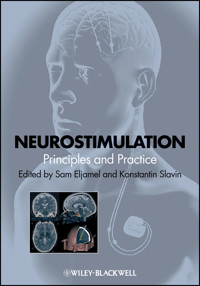
Neurostimulation E-Book
100,99 €
Mehr erfahren.
- Herausgeber: John Wiley & Sons
- Kategorie: Fachliteratur
- Sprache: Englisch
Could neurostimulation be a management option for your patients?
Neurostimulation techniques present real management options for patients with a range of neurologic and psychiatric disorders, such as movement disorders, pain, and depression. They should be actively considered when conventional medical approaches have failed or are inappropriate. But for many clinicians, these new methods pose many questions. What are the available modalities? How do they work? Which patients might benefit from them? How do I explain the processes to patients? How do I monitor my patient’s progress after implantation?
Neurostimulation: Principles and Practice provides a concise, easy-to-read fusion of the clinical applications of implanted neurostimulators. It demystifies selection and referral criteria, maximizing therapy, programming the implanted neuromodulators, monitoring progress, and troubleshooting problems associated with neurostimulation.
Neurostimulation: Principles and Practice covers the modalities available for your patients:
- Deep brain stimulation
- Motor cortex stimulation
- Vagus nerve stimulation
- Spinal cord stimulation
- Peripheral nerve stimulation
Written by an international cast of experts, Neurostimulation: Principles and Practice sets the stage for you to provide real clinical benefit to your patients who might receive, or are already using, neurostimulators.
Sie lesen das E-Book in den Legimi-Apps auf:
Seitenzahl: 411
Veröffentlichungsjahr: 2013
Ähnliche




















Table of Contents
Dedication
Title page
Copyright page
List of Contributors
Preface
Part 1: Deep Brain Stimulation
Chapter 1: Deep Brain Stimulation: Mechanisms of Action
Introduction
Importance of pathophysiological theories
The neuronal response to deep brain stimulation
Neural responses to deep brain stimulation
Higher order effects of deep brain stimulation
The hypothesis offered here
Chapter 2: Overview of Deep Brain Stimulation Components
Deep brain stimulation components
Chapter 3: Deep Brain Stimulation in Parkinson's Disease: Subthalamic Nucleus
Introduction
Rationale for neurostimulation of subthalamic nucleus
Referral criteria to select the ideal patient
Contraindications
Outcome
Stimulation parameters
Potential side effects and complications
Conclusions
Chapter 4: Deep Brain Stimulation in Parkinson's Disease: Pallidal (globus pallidus pars interna)
Introduction
Rationale of globus pallidus pars interna deep brain stimulation in Parkinson's disease
Patient selection and referral criteria
Targeting
Programming parameters
Complications of globus pallidus pars interna deep brain stimulation
Chapter 5: Deep Brain Stimulation of the Pedunculopontine Nucleus for Parkinson's Disease
Introduction and background
Characterization of the pedunculopontine nucleus
Rationale for targeting the pedunculopontine nucleus
Results from recent clinical studies of pedunculopontine nucleus stimulation
Limitations of current studies
Potential complications and adverse effects
Conclusions
Chapter 6: Deep Brain Stimulation in Tremor
Introduction
Patient selection
Rationale for targets
Device programming and patient assessment
Assessment and evidence
Complications
Conclusions
Chapter 7: Deep Brain Stimulation in Dystonia
Introduction
Target and rationale
Assessment scales
Referral criteria and patient selection
Surgical procedure
Programming parameters
Complications, side effects, monitoring, and troubleshooting
Conclusions
Chapter 8: Deep Brain Stimulation in Epilepsy
Introduction
Referral criteria
Rationale for deep brain stimulation in epilepsy
Assessment methods
Evidence level to date
Most common programming settings
Potential side effects and complications
Conclusions
Chapter 9: Deep Brain Stimulation in Obsessive Compulsive Disorders
Introduction
Rationale of deep brain stimulation in obsessive compulsive disorder
Deep brain stimulation targets in obsessive compulsive disorders
Patient selection and assessments
Evidence level to date
Most common programming settings
Potential side effects and complications
Conclusions
Chapter 10: Deep Brain Stimulation in Treatment of Refractory Major Depression
Introduction
Diagnostic criteria in major depression disorder
Deep brain stimulation
Surgical candidates
The rationale for deep brain stimulation in treatment of refractory major depression
Conclusions
Chapter 11: Deep Brain Stimulation in Pain Syndromes
Introduction
Referral criteria
Rationale of deep brain stimulation for pain
Assessment methods
Evidence of efficacy
Most common stimulator settings
Potential side effects and complications
Chapter 12: Deep Brain Stimulation in Cluster Headache
Introduction
Rationale of deep brain stimulation in chronic cluster headache
Referral criteria
Most common programming parameters
Evidence to date
Conclusions
Part 2: Vagus Nerve Stimulation
Chapter 13: Mechanism of Action and Overview of Vagus Nerve Stimulation Technology
Mechanism of action
Overview of vagus nerve stimulation indications
Vagal nerve stimulation components
Chapter 14: Vagus Nerve Stimulation in Epilepsy
Introduction
The rationale for vagus nerve stimulation in epilepsy
Patient selection and referral criteria
Evidence to date
Common programming parameters
Vagal nerve stimulation-related complications and side effects
Conclusions
Chapter 15: Vagal Nerve Stimulation in Treatment of Refractory Major Depression
Introduction
Referral criteria
Assessment scales
Rationale for vagal nerve stimulation in treatment of refractory major depression
Programming parameters
Monitoring, troubleshooting, complications, and side effects
Conclusion
Part 3: Motor Cortex Stimulation
Chapter 16: Mechanism of Action and Overview of Motor Cortex Stimulation Components
Mechanism of action
Motor cortex stimulation components
Chapter 17: Motor Cortex Stimulation in Refractory Pain
Introduction
Indications and referral criteria
Mechanisms of action
Surgical procedure
Evidence base and results of motor cortex stimulation for pain
Conclusions
Part 4: Spinal Cord Stimulation
Chapter 18: Mechanism of Action and Overview of Spinal Cord Stimulation Components
Mechanism of action
Spinal cord stimulation components
Chapter 19: Spinal Cord Stimulation in Failed Back Surgery Syndrome
Introduction
Rationale for spinal cord stimulation
Referral criteria for spinal cord stimulation
General principles
Contraindications for spinal cord stimulation
Evidence for use of spinal cord stimulation in patients with failed back surgery syndrome
Complications
Future developments
Conclusions
Chapter 20: Spinal Cord Stimulation in Complex Regional Pain Syndrome
Introduction
History and taxonomy
Diagnosis and classification
Criteria for referral to spinal cord stimulation
Rationale of spinal cord stimulation in complex regional pain syndrome
Assessment methods
Evidence for spinal cord stimulation in complex regional pain syndrome
Most common programming settings
Potential side effects and complications
Conclusions
Chapter 21: Spinal Cord Stimulation in Other Indications
Introduction
Motor control
Vasoactive applications of spinal cord stimulation
Genitourinary effects of spinal cord stimulation
Other areas of spinal cord stimulation application
Conclusions
Part 5: Peripheral Nerve Stimulation
Chapter 22: Peripheral Nerve Stimulation in Head and Face Pain
Introduction
Historical perspectives and rationale of peripheral nerve stimulation
Indications for peripheral nerve stimulation in the head and face
Patient selection criteria
Hardware for peripheral nerve stimulation in the craniofacial region
Complications of peripheral nerve stimulation and their avoidance
Common programming parameters
Outcomes and conclusions
Chapter 23: Peripheral Nerve Stimulation in Pain of the Body and Extremities
Introduction
Indications and patient selection
Device choice
Procedural details
Evidence base
Common programming parameters
Conclusions
Appendix I: Principles of Programming of Neurostimulators
Appendix II: Troubleshooting Malfunctioning Neurostimulators
Loss of response
Narrow therapeutic window
Skin erosions and infections
Index
We dedicate this book to:
All healthcare professionals who decided to be involved in the care of patients who underwent neurostimulation.
Our teachers and mentors in functional neurosurgery, who enabled, empowered, and taught us the skills to implant neurostimulators and to take care of patients with neurostimulators.
Our students and fellows who made the jump onto functional neurosurgery to continue the art of functional neurosurgery in years to come.
All our patients for entrusting us to help them over the years via neurostimulation.
Our families for their support over the years, providing us with the best start in life, and education, and for their support during this project.
Professor Sam Eljamel
Professor Konstantin V. Slavin
This edition first published 2013
© 2013 by John Wiley & Sons, Ltd
Registered office: John Wiley & Sons, Ltd, The Atrium, Southern Gate, Chichester, West Sussex, PO19 8SQ, UK
Editorial offices: 9600 Garsington Road, Oxford, OX4 2DQ, UK
The Atrium, Southern Gate, Chichester, West Sussex, PO19 8SQ, UK
111 River Street, Hoboken, NJ 07030-5774, USA
For details of our global editorial offices, for customer services and for information about how to apply for permission to reuse the copyright material in this book please see our website at www.wiley.com/wiley-blackwell
The right of the author to be identified as the author of this work has been asserted in accordance with the UK Copyright, Designs and Patents Act 1988.
All rights reserved. No part of this publication may be reproduced, stored in a retrieval system, or transmitted, in any form or by any means, electronic, mechanical, photocopying, recording or otherwise, except as permitted by the UK Copyright, Designs and Patents Act 1988, without the prior permission of the publisher.
Designations used by companies to distinguish their products are often claimed as trademarks. All brand names and product names used in this book are trade names, service marks, trademarks or registered trademarks of their respective owners. The publisher is not associated with any product or vendor mentioned in this book. It is sold on the understanding that the publisher is not engaged in rendering professional services. If professional advice or other expert assistance is required, the services of a competent professional should be sought.
The contents of this work are intended to further general scientific research, understanding, and discussion only and are not intended and should not be relied upon as recommending or promoting a specific method, diagnosis, or treatment by physicians for any particular patient. The publisher and the author make no representations or warranties with respect to the accuracy or completeness of the contents of this work and specifically disclaim all warranties, including without limitation any implied warranties of fitness for a particular purpose. In view of ongoing research, equipment modifications, changes in governmental regulations, and the constant flow of information relating to the use of medicines, equipment, and devices, the reader is urged to review and evaluate the information provided in the package insert or instructions for each medicine, equipment, or device for, among other things, any changes in the instructions or indication of usage and for added warnings and precautions. Readers should consult with a specialist where appropriate. The fact that an organization or Website is referred to in this work as a citation and/or a potential source of further information does not mean that the author or the publisher endorses the information the organization or Website may provide or recommendations it may make. Further, readers should be aware that Internet Websites listed in this work may have changed or disappeared between when this work was written and when it is read. No warranty may be created or extended by any promotional statements for this work. Neither the publisher nor the author shall be liable for any damages arising herefrom.
Library of Congress Cataloging-in-Publication Data
Neurostimulation : principles and practice / edited by Sam Eljamel and Konstantin V. Slavin.
p. ; cm.
Includes bibliographical references and index.
ISBN 978-1-118-34635-8 (hardback : alk. paper) – ISBN 978-1-118-34636-5 (ePub) – ISBN 978-1-118-34637-2 (ePDF) – ISBN 978-1-118-34638-9 (eMobi) – ISBN 978-1-118-34639-6 (ebook online product)
I. Eljamel, Sam. II. Slavin, Konstantin V.
[DNLM: 1. Central Nervous System Diseases–therapy. 2. Electric Stimulation Therapy. 3. Peripheral Nervous System Diseases–therapy. 4. Vagus Nerve Diseases–therapy. WL 300] RM871
615.8’45–dc23
2013003017
A catalogue record for this book is available from the British Library.
Wiley also publishes its books in a variety of electronic formats. Some content that appears in print may not be available in electronic books.
Cover images: © 2013 St. Jude Medical, Inc. (main) and courtesy of Dr Alexander Green (inset)
Cover design by Andy Meaden
List of Contributors
Editors
Sam Eljamel, MBBCh, MD, FRCS(Ed),(Ir),(SN)
Consultant Neurosurgeon, Centre for Neurosciences, University of Dundee, Ninewells Hospital and Medical School, Dundee, UK
Konstantin V. Slavin, MD, FAANS
Head of Section of Stereotactic and Functional Neurosurgery, University of Illinois at Chicago, Chicago, Illinois, USA
Contributors
Aviva Abosch, MD, PhD, FAANS
Neurosurgeon, Department of Neurosurgery, University of Minnesota, Minneapolis, Minnesota, USA
Sami Al-Nafi, MD
Fellow in Functional Neurosurgery, Department of Neurosurgery, University of Illinois at Chicago, Chicago, Illinois, USA
Giovanni Broggi, MD
Neurosurgeon, Fondazione Instituto Neurologico “Carlo Besta”, Milan, Italy;
Department of Applied Neurosciences, Ludes University, Lugano, Switzerland
Patrick Carena, BSC
Deputy Head of Instrumentation, Medical Physics, Ninewells Hospital and Medical School, Dundee, UK
David Christmas, PhD
Consultant Psychiatrist, Advanced Interventions Service, Ninewells Hospital and Medical School, Dundee, UK
Roberto Cordella, MD
Department of Neurosurgery, Fondazione Instituto Neurologico “Carlo Besta”, Milan, Italy
Pravin Dandegaonkar, MBBS, MD, FRCA, FCARCSI
Fellow in Pain Medicine and Specialty Registrar, Ninewells Hospital and Medical school, Dundee, UK
Sam Eljamel, MBBCh, MD, FRCS(Ed),(Ir),(SN)
Consultant Neurosurgeon, Director of Functional Neurosurgery, University of Dundee, Ninewells Hospital and Medical School, Dundee, UK
Angelo Franzini, MD
Department of Neurosurgery, Fondazione Instituto Neurologico “Carlo Besta”, Milan, Italy
Loes Gabriëls, PhD
Psychiatrist, KU Leuven, University Hospitals Leuven, Belgium
Gail Gillespie, MBChB, FRCA, FFPMRCA
Consultant in Anaesthesia and Pain Medicine, Regional Advisor in Pain Medicine for East of Scotland, Ninewells Hospital and Medical School, Dundee, UK
Eduardo Goellner, MD
Neurosurgeon, Hospital Mãe de Deus, Porto Alegre/RS, Brazil
Amit Goyal, MD
Fellow in Neurosurgery, University of Minnesota, Minneapolis, Minnesota, USA
Alexander Green, MD
Neurosurgeon, Department of Neurosurgery, John Radcliffe Hospital, Oxford, UK
Clement Hamani, MD
Neurosurgeon, Division of Neurosurgery, Toronto Western Hospital;
University Health Network and Behavioural Neurobiology Laboratory, Centre for Addiction and Mental Health, Toronto, Ontario, Canada
Yasuaki Harasaki, MD
Fellow, Department of Neurosurgery, University of Colorado, Denver, Colorado, USA
Paul E. Holtzheimer, III, MD
Psychiatrist, Departments of Psychiatry and Surgery, Geisel School of Medicine at Dartmouth, Dartmouth Hitchcock Medical Center, Lebanon, New Hampshire, USA
Christopher R. Honey, MD, DPhil, FRCS(C)
Neurosurgeon, Department of Neurosurgery, University of British Columbia, Vancouver, British Columbia, Canada
Michael G. Kaplitt, MD, PhD, FAANS
Vice-Chairman for Research and Residency Director, Department of Neurological Surgery, Weill Cornell Medical College, New York, New York, USA
Antonios Mammis, MD
Resident, Department of Neurosurgery, University of Medicine and Dentistry of New Jersey, New Jersey Medical School, Newark, New Jersey, USA
Christine Matthews
Research Technician, Department of Psychiatry, University of Dundee, Dundee, UK
Keith Matthews, PhD
Psychiatrist, Division of Neuroscience (Psychiatry), Medical Research Institute, University of Dundee, Ninewells Hospital and Medical School, Dundee, UK
Giuseppe Messina, MD
Department of Neurosurgery, Fondazione Instituto Neurologico “Carlo Besta”, Milan, Italy
Erwin B. Montgomery Jr., MD
Neurologist, University of Alabama, Birmingham, Alabama, USA
Ian Morrison, PhD, MRCP (UK)
Consultant Neurologist, Ninewells Hospital and Medical school, Dundee, UK
Steven Ojemann, MD, FAANS
Neurosurgeon, Department of Neurosurgery, University of Colorado, Denver, Colorado, USA
Manish Ranjan, MBBS, MCh
Fellow, Department of Neurosurgery, University of British Columbia, Vancouver, British Columbia, Canada
Serge Y. Rasskazoff, MD, FRCS(C)
Neurosurgeon, Flint, Michigan, USA
Michael Schulder, MD, FAANS
Professor and Vice Chairman, Department of Neurosurgery, Hofstra North Shore—LIJ School of Medicine, New York, New York, USA
Konstantin V. Slavin, MD, FAANS
Head of Section of Stereotactic and Functional Neurosurgery, University of Illinois at Chicago, Chicago, Illinois, USA
Serenella Tolomeo
Postgraduate Student, Department of Psychiatry, University of Dundee, Dundee, UK
Catherine Young, RCN
Specialist Movement Disorders Nurse, Ninewells Hospital and Medical School, Dundee, UK
Ludvic Zrinzo, MD, PhD, FRCSEd(NS)
Neurosurgeon, Sobell Department of Motor Neuroscience & Movement Disorders, UCL Institute of Neurology, University College London;
Victor Horsley Department of Neurosurgery, National Hospital for Neurology and Neurosurgery, London, UK
Preface
Neurostimulation: Principles and Practice is intended to give a concise but comprehensive picture of the methods and devices which are now of use in neurostimulation to ameliorate the symptoms of Parkinson's disease (PD), tremor, dystonia, refractory epilepsy, chronic pain, depression and obsessive compulsive disorders. It should appeal to anyone training or working in the healthcare arena – whatever their particular discipline – who wants either a concise introduction to the subject, or a gentle reminder of stuff they might have forgotten. We have aimed the book at:
Movement disorder neurologists, movement disorder specialist nurses, epileptologists, epilepsy specialist nurses, and residents in neurology.Pain specialists, pain specialist nurses and residents in pain management.Physicians of all grades who care for patients with PD, tremor, dystonia, chronic pain, or any patients who had a neurostimulator implanted.Psychiatrists and psychiatric specialist nurses with an interest in treatment refractory depression and OCD, and residents in psychiatry.Neurosurgeons interested in neurostimulation and neurosurgical residents.Any healthcare professional interested to learn more about neurostimulation.This book is divided into sections on deep brain, motor cortex, vagus nerve, spinal cord, and peripheral nerve stimulation. Each section covers approved and emerging applications with chapters on each diagnosis and target to make it easier for healthcare professionals to navigate the text quickly to the desired information.
Neurostimulation: Principles and Practice is a systematic approach to understanding the mechanism of action, rationale, indications, patients’ selection, targets, and programming of neurostimulators using common sense and the art of applying scientific knowledge to practice. No attempt is made to give detailed descriptions of surgical methods used to implant neurostimulators; these surgical methods have been adequately described in stereotactic books written specifically to neurosurgeons specializing in functional neurosurgery.
Contributors to this book were selected from around the globe because of their expertise and knowledge of each subject.
Professor Sam Eljamel
Centre for Neurosciences
Department of Neurosurgery
Ninewells Hospital & Medical School
Dundee, Scotland DD1 9SY, UK
Professor Konstantin V. Slavin
Department of Neurosurgery
University of Illinois at Chicago
912 S. Wood Street, M/C 799
Chicago, IL 60612, USA
Part 1
Deep Brain Stimulation
Chapter 1
Deep Brain Stimulation: Mechanisms of Action
Erwin B. Montgomery Jr.
University of Alabama, Birmingham, Alabama, USA
Introduction
Deep brain stimulation (DBS) is arguably the most effective treatment for movement disorders, such as Parkinson's disease (PD) and dystonia. DBS succeeds where all manner of pharmacological and biological therapies, such as neurotransplant, fail. Further, the range of disorders amenable to DBS is expanding rapidly, for example depression and epilepsy. At first, this may seem surprising, but that one would be surprised suggests a lack of appreciation that the brain is basically an electrochemical organ. The brain processes and transmits information electrically and, consequently, it should not be surprising that the brain's functions can be affected electrically. For example, while neurotransmitters, independently or affected by neuromodulators, result in changes in the electrical status in the post-synaptic neurons. The varying electrical changes induced by neurotransmitters are electrically integrated (processed) to produce new “information” that is subsequently encoded in the electric signal in the form of the axon potential train exiting the post-synaptic neuron. Further, changes in the neurotransmitter-induced post-synaptic electrical status produce further changes entirely independent of the neurotransmitter, such as post-excitatory depression of excitability due to deactivation of sodium (Na) conductance changes or post-inhibitory increases in excitability due to activation of Na conductance channels among other voltage-sensitive conductance changes. Thus, for example, inhibition of the ventrolateral (VL) thalamus by activity in the globus pallidus interna (GPi), for many neurons results in a net increased VL neuronal activity contrary to what would be expected based on the neurotransmitter released by GPi neurons onto VL neurons, that being gamma amino butyric acid (GABA) [1].
Lesen Sie weiter in der vollständigen Ausgabe!
Lesen Sie weiter in der vollständigen Ausgabe!
Lesen Sie weiter in der vollständigen Ausgabe!
Lesen Sie weiter in der vollständigen Ausgabe!
Lesen Sie weiter in der vollständigen Ausgabe!
Lesen Sie weiter in der vollständigen Ausgabe!
Lesen Sie weiter in der vollständigen Ausgabe!
Lesen Sie weiter in der vollständigen Ausgabe!
Lesen Sie weiter in der vollständigen Ausgabe!
Lesen Sie weiter in der vollständigen Ausgabe!
Lesen Sie weiter in der vollständigen Ausgabe!
Lesen Sie weiter in der vollständigen Ausgabe!
Lesen Sie weiter in der vollständigen Ausgabe!
Lesen Sie weiter in der vollständigen Ausgabe!
Lesen Sie weiter in der vollständigen Ausgabe!
Lesen Sie weiter in der vollständigen Ausgabe!
Lesen Sie weiter in der vollständigen Ausgabe!
Lesen Sie weiter in der vollständigen Ausgabe!
Lesen Sie weiter in der vollständigen Ausgabe!
Lesen Sie weiter in der vollständigen Ausgabe!
Lesen Sie weiter in der vollständigen Ausgabe!
Lesen Sie weiter in der vollständigen Ausgabe!
Lesen Sie weiter in der vollständigen Ausgabe!
Lesen Sie weiter in der vollständigen Ausgabe!
Lesen Sie weiter in der vollständigen Ausgabe!
Lesen Sie weiter in der vollständigen Ausgabe!
Lesen Sie weiter in der vollständigen Ausgabe!
Lesen Sie weiter in der vollständigen Ausgabe!
Lesen Sie weiter in der vollständigen Ausgabe!




