


15,59 €
Mehr erfahren.
- Herausgeber: Independent Thinking Press
- Kategorie: Bildung
- Sprache: Englisch
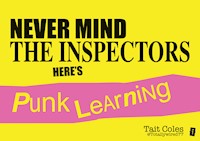
So what is Punk Learning? It details the importance of why all students should be allowed complete control of their learning. In Never Mind the Inspectors Tait justifies why we need Punk Learning, explains the philosophy behind the box ticking lessons that teachers are advised to deliver to appease Ofsted and how we should not be doing anything because the 'inspectors will like it', but because it's the right thing to do in a 21st century classroom to get the best out of all our students. Tait helps you discover how to create Punk Learning, offers ideas on how teachers can creatively inspire students to become self-regulating Punk Learners that take complete control of their learning, making it relative and memorable, so that it matters to them. For anybody with an interest in learning, teaching and doing things differently!
Das E-Book können Sie in Legimi-Apps oder einer beliebigen App lesen, die das folgende Format unterstützen:
Veröffentlichungsjahr: 2014
Ähnliche
















Punk is the freedom to create, freedom to be successful, freedom to not be successful, freedom to be who you are. It’s freedom.
Patti Smith
Contents
Foreword
It was the long hot summer of 1976. I didn’t have a Chopper bike or a Space Hopper but I was happy. Elton John and Kiki Dee were riding high in the charts, Demis Roussos was doing for big shirts what Nana Mouskouri had done for spectacles and Wurzelmania was rife.
And somewhere in London, The Clash and The Damned were playing their first ever live gigs as support to an outrageous group known as the Sex Pistols.
I was never a punk (except for doing a parody of the Sex Pistols’ single ‘No One Is Innocent’ about teachers in my school in a leaving assembly two years later) but I was into punk. I wasn’t anti-establishment. I wasn’t into swearing or spitting. I didn’t have to think about which drugs to take but rather whether to watch Tiswas or Swap Shop. All the same, I liked punk.
I think the fact that I would always choose Tiswas shows what an anarchist I really was. And the nearest Tiswas came to punk was when Sally James asked Kevin Rowland of Dexys Midnight Runners (who had been auditioned by Malcolm McLaren to front the Sex Pistols a few years earlier) where they got their name from, to which he replied, rather incredulously, ‘You do know what Dexy is?’ She moved on quickly. The fact that even now, over thirty years later, I have to turn to Wikipedia to finally find the answer to that question from my childhood shows what sort of childhood I had.
Fast forward a few decades and I’m sitting, appropriately for punk, in a London pub, although this one is more Docklands than Badlands. I’m with Phil Beadle, himself a consummate singer and musician with a couple of great CDs to his stage name, discussing the state of education in England. What was upsetting the two of us was the stultifying Ofsted obsession consuming schools, where teachers were unable to sneeze for fear of doing it in a way that the inspectors wouldn’t approve. It was then that the phrase ‘Never mind the inspectors …’ and the echo of my childhood dabbling with the Sex Pistols came into my head. It stayed there until I put it together with the remarkable work Tait Coles was doing under the banner ‘punk learning’ that I came across some time later. A match made in heaven, or Twitter at least.
Punk learning is the antidote to Ofsted-focused teaching in the way that punk rock was the antidote to keyboard solos that lasted longer than an edition of Top of the Pops. But punk rock was about more than just the rock, and punk learning is more than just what you do in the classroom. As this marvellous book will show you, it is about how you do what you do, who you are in the classroom, what level of authenticity you bring to the classroom, how arrogant you are in your defiance of what you don’t believe in. It is about tearing down walls and tearing up books, about looking the inspector in the eye and saying, ‘You know what? We ain’t perfect – and we don’t care!’
And, above all, it is about putting the learners in control – real, scary, honest, authentic control – of their learning.
Unlike many books on the market these days, this book is not a how-to guide with a checklist of top tips. Quite the opposite. Of course, you can have a go with some of Tait’s ideas. They are all tried and tested, and he is, please note, a practising teacher in a real live classroom somewhere up north. But to do what Tait does rather defeats the purpose of the book and the nature of the punk ethos, something best described by post-modern punk Billie Joe Armstrong of American group Green Day:
A guy walks up to me and asks ‘What’s punk?’ So I kick over a garbage can and say ‘That’s punk!’ So he kicks over a garbage can and says ‘That’s punk?’ and I say ‘No, that’s trendy!’
So, read this book and then go and kick your own bins over. Take your frustration over the way education is going and channel it into some devastatingly good teaching and learning, take fear and transform it into defiance, turn obedience into arrogance and put children centre stage in each and every viscerally unpredictable lesson.
Now, finally, you have a use for the anger you feel over not getting a Chopper bike or a Space Hopper when you were 11.
Ian Gilbert, Hong Kong
DON’T BE TOLD WHAT YOU WANT; DON’T BE TO LD WHAT YOU NEED
DON’T BE TOLD WHAT YOU WANT; DON’T BE TOLD WHAT YOU NEED*
The Clash are of ten referred to as ‘the only band that matters’. Punk learning should be described as ‘the only learning that matters’. Learning that is memorable, self-regulated, completely controlled by the students and real.
Punk learning is authentically defiant and wildly inventive. We should be planning learning with and for the students. And we shouldn’t settle for marginal impact in lessons – we should demand magnificence!
And while we’re at it, there isn’t an aesthetically pleasing proforma that will enable you to plan a punk learning lesson in five minutes. How can teachers even consider that something planned in five minutes is going to be worthwhile? What can you actually plan in five minutes? Making toast? When and where to have a dump?
It won’t fit into a nice little cycle for you to trawl out at a whole staff CPD event either. When Danny Baker, at the time a writer for the fanzine Sniffin’ Glue, was asked to define punk, he responded with this brilliant reply, which is recounted in his autobiography, Going to Sea in a Sieve:
We don’t know and we don’t care what pickling jar you want to identify us via. As far as I’m concerned, the less information we give, the more we can keep the establishment on the back foot. Has it ever occurred to you that this might be something you’ve not come across? That won’t be pinned down like some fucking butterfly in a museum of politics? This is something new. The old terms are handy, but we know what we really mean and confusion is all part of that. Fuck it. YOU figure it out.
* God Save the Queen, Sex Pistols.
AN’ EVERYBODY’S DOING JUST WHAT THEY’RE TOLD TO
AN’ EVERYBODY’S DOING JUST WHAT THEY’RE TOLD TO*
If you’ve just bought this book, or perhaps the book is the spoil of a successful shoplifting venture, then thanks, but please think carefully before you read any further. If you are under the deluded impression that this book will help you ‘pass’ an Ofsted inspection or will assist you in designing and planning lessons that will tick the boxes of an observation, then I’m afraid you will be sadly disappointed.
In fact, I’m not afraid at all. The philosophy of creating learning that enables a visitor to your classroom to deem it ‘good’, ‘outstanding’ or, heaven forbid, much worse, is fundamentally wrong. I’m deliberately being fairly tame at this point – I don’t want to scare you off … or perhaps I do? I’ll go into much more detail later about why the ‘informed’ judgement of a lesson based on the appearance of a stranger in your classroom is not only morally wrong but also pedagogically abhorrent. As Joe Strummer said:
‘Authority is supposedly grounded in wisdom, but I could see from a very early age that authority was only a system of control and it didn’t have any inherent wisdom. I quickly realised that you either became a power or you were crushed.’
If you want your lessons to be deemed ‘successful’, based solely on the opinion of someone who hasn’t taught in a very long while, who doesn’t understand your school and who hasn’t a clue about how your students act, behave, fail, succeed and learn, then this isn’t the book for you. There is a plethora of books purposely written on this subject which are available at all good booksellers. But this ain’t it, so find the receipt quickly or pass it on to a colleague who wants to truly understand about learning. Steve Jones the guitarist in the Sex Pistols famously said: ‘Actually we’re not into music. We’re into chaos.’ And that’s exactly what this book is about, causing chaos – and as much of it as possible.
And if you haven’t purchased the book, kindly remove it from where it was secreted and put it back on the shelf – or just keep walking.
Now, where were we?
* White Riot, The Clash.
I WANNA SEE SOME HISTORY
I WANNA SEE SOME HISTORY*
Pay attention, this is the only history lesson you will ever need.
There is a fair amount of argument about when and where punk music first originated. The US critic Dave Marsh first penned the term punk in CREEM magazine in 1971. Caroline Coon, writing in Melody Maker, appropriated the word punk about the emergence of bands led by the Sex Pistols and The Clash in the UK in 1976. She explained that the term punk was ‘coined to describe the American rock bands of 1965–68 who sprung up as a result of hearing The Yardbirds, The Who, Them and The Stones’.
Some would agree and say the creation of punk music began in New York in the late 1960s and early 1970s with bands such as The Stooges, MC5 and later the New York Dolls, the Ramones and Television. Others would argue that punk music first exploded in the UK in 1976 with the Svengali-style figure Malcolm McLaren, who created his manufactured band, the Sex Pistols, which inspired the likes of The Clash, the Buzzcocks, Siouxsie and the Banshees, The Damned and many others.
There is also a camp that will disagree with both of these opinions and actually say that punk can be traced back as far as you like, with every generation having its own youth subculture that shocked the established order. Some say even Elvis was a punk. Author John Robb suggests that punk has ‘always been with us, that wild spirit, that outsider cry. It’s only recently it’s been with electricity – and louder and wilder.’
Whichever theory you subscribe to, it’s important to remember that punk was, and still is, a frame of mind rather than a particular genre of music.
Arguably, punk has been the most important social culture in terms of its influence and legacy, encouraging kids in the suburbs, with little or no musical training, to take up instruments. In 1976, Tony Moon added a hand-drawn picture to the first issue of his punk fanzine, Sideburns. The now iconic image displays three chord structures. It reads: ‘This is a chord, this is another, this is a third, now form a band.’
This was at a time when the majority of music aficionados were listening to the likes of Yes, Genesis, Emerson Lake and Palmer and other ‘progressive’ rock acts. These predominantly male musical virtuosos performing twenty-minute long guitar solos were about as far removed from young people’s lives as was feasibly possible. And for many, the mere idea of becoming a musician was a near-impossible thought. Tony Wilson, the future head of Factory Records, sums up this period of time brilliantly in John Robb’s excellent Punk Rock: An Oral History: ‘Those years were unbelievably awful. First of all you watched heroes from the 1960s grow fat, limp and pointless. And the people who were happening were this pompous, sententious fucking crap. People forget how bad it all was. Two words: Rick Wakeman.’
But now young people had the opportunity to dance on the graves of the old guard.
The zeitgeist of punk made this possible for everyone and anyone. It represented a do-it-yourself ethos and a shake-up of the old-established order. It was a change. Mickey Foote, friend and roadie to The Clash, explained: ‘I don’t think the kids were doing anything; they were just hanging about slagging people off. But everyone was waiting for something, even though they had no idea what it was.’
The DIY culture of punk is something that still holds today – think fashion, art, design, film, journalism and music or, indeed, a way of life. If you want to do something, then what’s stopping you? Take risks, do things differently, think for yourself and succeed. As Michael Bracewell suggests in John Robb’s Punk Rock: ‘Punk’s role was to catalyse and accelerate – to turn things upside down, and, by doing so, enable new perspectives.’




