


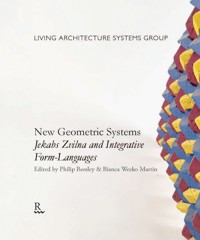
New Geometric Systems E-Book
7,99 €
Mehr erfahren.
- Herausgeber: Riverside Architectural Press
- Kategorie: Geisteswissenschaft
- Sprache: Englisch
New Geometric Systems: Jekabs Zvilna and Integrative Form-Languages surveys the graphic and three-dimensional work of Waterloo Architecture professor and mid-twentieth-century designer Jekabs Zvilna. Photography of original foam and wood models by Zvilna and new essays by Val Rynnimeri and Muhammad Tahir Pervaiz are followed by studies by undergraduate students working under the supervision of Philip Beesley at the University of Waterloo School of Architecture in 2019.
Jekabs Zvilna (1913-1997) was a designer, researcher, artist, and professor of architecture at the University of Waterloo. Zvilna studied architecture in Latvia at the University of Riga and immigrated to Canada in the mid-1950s.
Contributors: Muhammad Tahir Pervaiz, Val Rynnimeri, Saadman Ahmed, Yun Ru Amy Bao, Ien Boodan, Kelley Gu, Roni Haravon, Alice Jie Jie Huang, Winona Li, Bianca Weeko Martin, Vincent Min, Hagop Terzian, Winston Yew
Das E-Book können Sie in Legimi-Apps oder einer beliebigen App lesen, die das folgende Format unterstützen:
Seitenzahl: 45
Veröffentlichungsjahr: 2022
Ähnliche




















Publisher: Riverside Architectural Press, www.riversidearchitecturalpress.ca© Riverside Architectural Press and Living Architecture Systems Group 2021
Title: New Geometric Systems: Jekabs Zvilna and Integrative Form-LanguagesEditors: Philip Beesley and Bianca Weeko Martin
Contributors: Muhammad Tahir Pervaiz, Val Rynnimeri Saadman Ahmed, Yun Ru Amy Bao, Ien Boodan, Kelley Gu, Roni Haravon, Alice Jie Jie Huang, Winona Li, Bianca Weeko Martin, Vincent Min, Hagop Terzian, Winston Yew
Cover image: Archival Jekabs Zvilna painted foam geometric tesselation model, detail view, c. 1973-1986. Photograph: Val Rynnimeri and Muhammad Tahir Pervaiz, 2019. Zvilna Archive, Unversity of Waterloo School of Architecture.
Description: New Geometric Systems: Jekabs Zvilna and Integrative Form-Languages surveys the graphic and three-dimensional work of Waterloo Architecture professor and mid-twentieth-century designer Jekabs Zvilna. Photography of original foam and wood models by Zvilna and new essays by Val Rynnimeri and Muhammad Tahir Pervaiz are followed by studies by undergraduate students working under the supervision of Philip Beesley at the University of Waterloo School of Architecture in 2019.
Identifiers: ISBN 978-1-988366-28-9
Publication: December 2021Riverside Architectural Press7 Melville Street, Cambridge, ON
© Riverside Architectural Press and Living Architecture Systems Group 2021. All rights reserved.
The individual authors shown herein are solely responsible for their content appearing within this publication. No part of this book may be used or reproduced in any form or by any means—including but not limited to graphic, electronic, or mechanical, including photocopying, recording, taping or information storage and retrieval systems, without written permission from the copyright owner. Errors or omissions will be corrected in subsequent editions.
This book is set in Garamond and Zurich BT.
Contents
Form from Process
Val Rynnimeri
Jekabs Zvilna and Cultural Traditions of Geometry
Muhammad Tahir Pervaiz
Jekabs Zvilna Archive Models
New Zvilna Models
45 Degree Unit Block
Vincent Min and Winston Yew
Zvilna Forms
Saadman Ahmed and Kelley Gu
Various Experiments
Yun Ru Amy Bao
Abiogenesis of Basalt
Alice Jie Jie Huang
Clay: Imagining a Zvilna Brick
Bianca Weeko Martin
Honeycomb Experiments
Roni Haravon
Cloning Zvilna Blocks
Ien Boodan
Fractals
Winona Li
Bamboo Experiments
Hagop Terzian
Form from Process
Val Rynnimeri
Jekabs Zvilna was my first year professor at the University of Waterloo School of Architecture in 1974. Teaching and coordinating in the first year design studio with industrial designer Mike Elmitt, and a rotating cast of attached architect faculty, he was an enormous influence on the new students and their picture of what being an architect might be. In addition to his role as a teacher, Zvilna was a very early pioneer in in what we have begun to do as architects and designers today, but a very different kind of pioneer.
figure 1Montage mapping the three-dimensional forms created from “Zvilna blocks”
Along with that continuing role as a professor, Zvilna was also a researcher. Sixty years ago, beginning in 1960, that meant that he was not undertaking an expected role as an architect, a designer of buildings and cities, but instead was a solitary person sitting in a room working by hand on complex geometries and processes, and in 1974 when I joined his class as a first year student, with no computers. Over his life (I hesitate to say career in such a personal investigation as his work) Zvilna undertook two large bodies of research and work. One was graphic and two dimensional (Figure 2), the other three dimensional (Figure 3).1 Both were fundamentally linked in an exploration of the processes of form generation. Much of the material to follow I draw from one of Zvilna’s key retrospective articles, Ad Infinitum, which he wrote in 1989 and published in the journal “Computers & Mathematics with Applications”2. It summarizes most of his research. Also reviewed were other previous works and papers, which largely talk about geometry and about his methodology of “work through processes”.
figure 2Graphic study by Jekabs Zvilna
What you have in Zvilna in 1974, in my introduction to him and the middle of the arc of his research, is somebody who was not just a pioneer in a scientific framework of complex systems research. Today, one might find him at a place like the Harvard GSD or MIT (where he exhibited his work in the 1960s3). More importantly to him, however, was his place as a spiritual pioneer in the sense of trying to understand what all of this systemic complexity means at a level of personal revelation. In the forms self organized by complexity you will find his search for the opposite, the principle of the one4… unity.




