


0,99 €
Mehr erfahren.
- Herausgeber: Full Well Ventures
- Sprache: Englisch
This article, "New York Artists," written by Henry Theodore Tuckerman and published in the July 1856 issue of The Knickerbocker magazine, talks about the working conditions and lives of artists who were at mid-19th century well known in New York.
Das E-Book können Sie in Legimi-Apps oder einer beliebigen App lesen, die das folgende Format unterstützen:
Veröffentlichungsjahr: 2020
Ähnliche


















New York Artists
© 2020 Full Well Ventures
Originally published in July 1856 issue of “The Knickerbocker” magazine
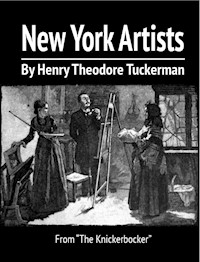
On the Cover: Illustration by S.G. McCutcheon from Scribner magazine, 1880
KNICKERBOCKER
New York Artists
By Henry Theodore Tuckerman
READER, DID YOU ever spring into an omnibus at the head of Wall Street, with a resolution to seek a more humanizing element of life than the hard struggle for pecuniary triumphs? Did you ever come out of a Fifth Avenue palace, your eyes wearied by a glare of bright and varied colors, your mind oppressed with a nightmare of upholstery, and your conscience reproachful on account of an hour’s idle gossip? Did you ever walk up Broadway, soon after meridian, and look into the stony, haggard, or frivolous countenances of the throng, listen to the shouts of omnibus drivers, mark the gaudy silks of bankrupt’s wives, and lose yourself the while in a retrospective dream of country life, or a sojourn in an old deserted city of Europe? A reaction such as this is certain, at times, to occur in the mood of the dweller in this kaleidoscope of New York; and as it is usually induced by an interval of leisure, we deem it a kindly hint to suggest where an antidote may be found for the bane, and how the imagination may be lured, at once, into a new sphere, and the heart refreshed by a less artificial and turbid phase of this mundane existence. Go and see the artists. They are scattered all over the metropolis: sometimes to be found in a lofty attic, at others in a hotel; here over a shop, there in a back parlor; now in the old Dispensary, and again in the new University: isolated or in small groups, they live in their own fashion, not a few practicing rigid and ingenious economies, others nightly in elite circles or at sumptuous dinners; some genially cradled in a domestic nest, and others philosophically forlorn in bacheloric solitude. But wherever found, there is a certain atmosphere of content, of independence, and of originality in their domiciles. I confess that the ease, the frankness, the sense of humor and of beauty I often discover in these artistic nooks, puts me quite out of conceit of the prescriptive formalities of Upper-Tendom. Our systematic and prosaic life ignores, indeed, scenes like these; but the true artist is essentially the same everywhere — a child of nature, to whom ‘a thing of beauty is a joy forever;’ and therefore a visit to the New York studios cannot fail to be suggestive and pleasing, if we only go thither, not in a critical, but in a sympathetic mood.
Many of our cherished artists — Allston, Greenough, and Cole, are no more: many, like Doughty, have in a great measure retired from public view, and not a few are abroad. Powers is at Florence, executing his unrivaled busts: Crawford is at Rome at work on the Virginia monument, the horse for which was cast not long ago at Munich, and won enthusiastic admiration: while the statues of Patrick Henry and of Jefferson, already at Richmond, are acknowledged masterpieces: the Beethoven, too, now in Boston, proved a complete triumph: Paige, called the modern Titian, is deemed there the greatest of portrait painters; Chapman, his neighbor, is etching Roman peasants in a manner no one can excel: Freeman, nearby, is studiously evolving a masterly work, and Thompson has made the most perfect copy of the Beatrice seen for years; while Ives models better than ever, and Miss Lander handles the clay and modeling stick with progressive aptitude and high promise.




