


13,99 €
Mehr erfahren.
- Herausgeber: John Wiley & Sons
- Kategorie: Wissenschaft und neue Technologien
- Serie: Digital Field Guide
- Sprache: Englisch
Detailed coverage of the three high-end speedlights builtexclusively for new Nikon SLRs Nikon speedlights put creative control of flash at thephotographer's command, and with Nikon's Creative Lighting System,flash control is practically intuitive and possibilities areseemingly endless. However, setting up, synchronizing theequipment, and determining lighting ratios can be a daunting task.This new edition of a bestseller puts your mind at ease in aflash. Award-winning photographer Benjamin Edwards begins with thebasics and demystifies the complexities of using multiplespeedlights, adjusting flash outputs, and setting up a wirelessstudio in an understandable, approachable way. * Teaches you how to fill in shadows, reveal detail, and add asense of motion or visual effects to your images, all withautomatic ease and total wireless control * Includes coverage of other Creative Lighting System componentssuch as Nikon's wireless commander and macro speedlights * Explores the basic functions of the SB-910, continues with theSB-700 and the similar, but less expensive, SB-600 * Boasts unique, detailed advice on lighting specific subjects:weddings, pets, product shots, corporate locations, portraits,large groups, sports, and much more While the Nikon Creative Lighting System speedlights are likehaving a low cost, wireless, studio lighting system that's portableenough to fit in a camera bag, this invaluable guide does fit inyour camera bag and goes where you go to help you take control ofthis amazing lighting system.
Sie lesen das E-Book in den Legimi-Apps auf:
Seitenzahl: 288
Veröffentlichungsjahr: 2012
Ähnliche




















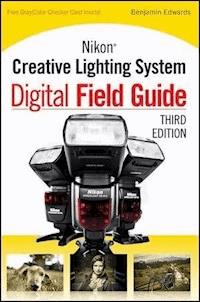
Nikon® Creative Lighting System Digital Field Guide, Third Edition
Table of Contents
Introduction
Quick Tour
Getting Started
Taking Your First Photos with a Speedlight
Chapter 1: Exploring the Nikon Creative Lighting System
Main Features and Functions
Anatomy of the Speedlight
SB-R200
SB-400
SB-700
SB-900
SB-910
Camera Compatibility
D3000, D3100, D5000, D5100
D90, D300s, D700, D800
D3s, D3x, D4, F6
Included Accessories
SB-700
SB-900
SB-910
Add-on Accessories
SU-800 Wireless Speedlight Commander
R1/R1C1 and SB-R200 kits
SG-31R
Chapter 2: Setting Up Your Nikon Speedlights
Power Requirements
Nonrechargeable batteries
Rechargeable batteries
Navigating the Speedlight Settings and Menus
Flash modes
The SB-900 Custom Functions menu and settings
The SB-910 Custom Functions menu and settings
The SB-700 Custom Functions menu and settings
Chapter 3: Flash Photography Fundamentals
Understanding Flash Exposure
Key Terms
Flash Basics
Achieving proper exposures
Flash sync modes
Flash Exposure Compensation
Understanding Color Temperature
The Kelvin scale
White balance settings
Mixed lighting
Using Repeating Flash
Using Bounce Flash
Using Fill Flash
Simple Light Modifiers
Diffusion domes
Bounce cards
Speedlights versus Studio Strobes
Chapter 4: Advanced Wireless Lighting
Flash Setup for Advanced Wireless Lighting
Setting Up a Master or Commander Flash
SB-700, SB-900, and SB-910
Built-in flash
Setting the Flash Mode
SB-910
SB-900
SB-700
SU-800
Setting Up Remotes and Remote Groups
SB-910
SB-900
SB-700
Making Adjustments on the Fly
SB-910
SB-900
SB-700
SU-800
Chapter 5: Setting Up a Portable Studio
Introduction to the Portable Studio
Equipment
Stands
Brackets and multiclamps
Umbrellas
Softboxes
Diffusers and reflectors
Backdrops
Filters
Transporting Your Portable Studio
Chapter 6: Advanced Flash Techniques
Action and Sports Photography
Setup
Tips and tricks
Macro Photography
Setup
Tips and tricks
Night Photography
Setup
Tips and tricks
Chapter 7: Flash Techniques for Portrait Photography
Indoor Portraits
Setup
Tips and tricks
Outdoor Portraits
Setup
Tips and tricks
Pet Portraits
Setup
Tips and tricks
Still Life and Product Photography
Setup
Tips and tricks
Wedding and Engagement Photography
Setup
Tips and tricks
Appendix A: Creative Lighting System Gallery
The Swan Sings the Blues
Boxing Ring Bride
Pink Shoes Amongst the Moss
The Castle’s Keep
LaChureca
Georgia On My Mind
Triple Take
All About the Shoes
Romulan Ale
Appendix B: Resources
Informational Websites
Workshops
Online Photography Magazines and Other Resources
Equipment
Appendix C: How to Use the Gray Card and Color Checker
The Gray Card
The Color Checker
Glossary
Nikon® Creative Lighting System
Digital Field Guide,
Third Edition
Benjamin Edwards
Nikon® Creative Lighting System Digital Field Guide, Third Edition
Published by
John Wiley & Sons, Inc.
10475 Crosspoint Boulevard
Indianapolis, IN 46256
www.wiley.com
Copyright © 2012 by John Wiley & Sons, Inc., Indianapolis, Indiana
Published simultaneously in Canada
ISBN: 978-1-118-02223-8
Manufactured in the United States of America
10 9 8 7 6 5 4 3 2 1
No part of this publication may be reproduced, stored in a retrieval system or transmitted in any form or by any means, electronic, mechanical, photocopying, recording, scanning or otherwise, except as permitted under Sections 107 or 108 of the 1976 United States Copyright Act, without either the prior written permission of the Publisher, or authorization through payment of the appropriate per-copy fee to the Copyright Clearance Center, 222 Rosewood Drive, Danvers, MA 01923, (978) 750-8400, fax (978) 646-8600. Requests to the Publisher for permission should be addressed to the Permissions Department, John Wiley & Sons, Inc., 111 River Street, Hoboken, NJ 07030, 201-748-6011, fax 201-748-6008, or online at http://www.wiley.com/go/permissions.
Limit of Liability/Disclaimer of Warranty: The publisher and the author make no representations or warranties with respect to the accuracy or completeness of the contents of this work and specifically disclaim all warranties, including without limitation warranties of fitness for a particular purpose. No warranty may be created or extended by sales or promotional materials. The advice and strategies contained herein may not be suitable for every situation. This work is sold with the understanding that the publisher is not engaged in rendering legal, accounting, or other professional services. If professional assistance is required, the services of a competent professional person should be sought. Neither the publisher nor the author shall be liable for damages arising herefrom. The fact that an organization or Web site is referred to in this work as a citation and/or a potential source of further information does not mean that the author or the publisher endorses the information the organization of Web site may provide or recommendations it may make. Further, readers should be aware that Internet Web sites listed in this work may have changed or disappeared between when this work was written and when it is read.
For general information on our other products and services or to obtain technical support, please contact our Customer Care Department within the U.S. at (877) 762-2974, outside the U.S. at (317) 572-3993 or fax (317) 572-4002.
Wiley publishes in a variety of print and electronic formats and by print-on-demand. Some material included with standard print versions of this book may not be included in e-books or in print-on-demand. If this book refers to media such as a CD or DVD that is not included in the version you purchased, you may download this material at http://booksupport.wiley.com. For more information about Wiley products, visit www.wiley.com.
Library of Congress Control Number: 2012932556
Trademarks: Wiley and the Wiley logo are trademarks or registered trademarks of John Wiley & Sons, Inc. and/or its affiliates. Nikon is a registered trademark of Nikon Corporation. All other trademarks are the property of their respective owners. John Wiley & Sons, Inc. is not associated with any product or vendor mentioned in this book.
About the Author
Benjamin Edwards is a wedding, portrait, and humanitarian photographer based out of Bend, Oregon, where he and his wife, Lauren, operate Benjamin Edwards Photography. Benjamin previously worked on Kevin Kubota’s Lighting Notebook: 101 Lighting Styles and Setups for Digital Photographers (also published by John Wiley & Sons, Inc.).
He has been featured in the September 2009 issue of Photo District News magazine and on Framed, a web-based series for photographers. Benjamin also won a Hollywood Film Festival award in 2009 for his short film, Cry Out for Congo, and has been recognized as a Photoflex Pro Showcase Member.
Credits
Senior Acquisitions Editor
Stephanie McComb
Project Editor
Amanda Gambill
Technical Editor
Jeff Wignall
Copy Editor
Marylouise Wiack
Editorial Director
Robyn Siesky
Business Manager
Amy Knies
Senior Marketing Manager
Sandy Smith
Vice President and Executive Group Publisher
Richard Swadley
Vice President and Executive Publisher
Barry Pruett
Senior Project Coordinator
Kristie Rees
Graphics and Production Specialists
Jennifer Mayberry
Mark Pinto
Quality Control Technicians
Jessica Kramer
Lauren Mandelbaum
Proofreading and Indexing
Laura Bowman Estalita Slivoskey
Dedication
For my Parker. I know you’ll change the world.
Acknowledgments
I’ve learned that the best things in my life and business have been the result of being surrounded by exceptional people. For their creativity, support, and love, I thank:
Lauren Edwards, you’re simply my better three-quarters and our partnership in life is truly divine. Without you, I couldn’t do what we do.
My boys, you’re shining lights in my life. Thanks for letting Daddy work a few weekends.
Kevin Kubota, you’re my creative, collaborative partner, a source of inspiration, and my best friend. Thank you for showing me all that you have, and for showing photographers and normal people everywhere that to give back isn’t to empty one’s self, but rather to fill oneself.
Tiffany Lausen, everyone needs a Tiffany in his or her life. Your creative support and energy have been a true blessing.
Stephanie and Amanda at Wiley, thank you for being here for me and answering the onslaught of questions.
Photoflex, thank you for your continued support and for making stellar gear.
Nikon, the best.
Introduction
From its origin in the Greek language, the word photography literally means painting (or writing) with light. It’s fairly safe to say that if you were to remove light altogether from the photography equation, you’d have a difficult time capturing the perfect picture. You could also say that the addition of light, or the ability to create it quickly and efficiently, could go a long way in helping you create your very own masterpiece.
When Nikon introduced the Creative Lighting System (CLS) in 2004, it was mostly overlooked. The industry was focused on the rapidly changing advancement of digital SLR (dSLR) cameras — more specifically, how many megapixels could be jammed into a new generation of image sensors. This was a shame because the Nikon CLS was the most amazing development in creative photography in decades. The ability to completely control the output of multiple lights, and do it wirelessly with full Through-the-Lens (TTL) metering was a true breakthrough.
The popularity of the Nikon CLS has grown exponentially in recent years as more people are becoming interested in off-camera, photographic lighting. With the SB-400, SB-700, SB-900, and SB-910, no other company comes close to offering such a multitude of tools for specific lighting needs.
The main features of the CLS are its ability to get the flashes off of the camera and control them wirelessly. Nikon refers to this as Advanced Wireless Lighting (AWL). Simply put, when the flash is on top of your camera (or even attached to a flash bracket) your freedom to place the light source exactly where you want it is limited. AWL eliminates these restrictions.
With the CLS, you can direct and modify all of the light from your camera. This gives you the ability to create images full of depth and dimension, with far greater ease than with traditional studio strobes, and at a much lower cost to both your wallet and your back.
The Evolution of the Nikon Creative Lighting System
Nikon introduced wireless Speedlight control in 1994 with the SB-26 Speedlight. This flash incorporated a built-in optical sensor that enabled you to trigger the flash with the firing of another flash. While this was handy, you still had to meter the scene and manually set the output level on the SB-26.
With the release of the SB-28 in 1997, Nikon omitted the built-in optical sensor. You could still do wireless flash, but you needed to buy the SU-4 wireless sensor. Wireless flash still had to be manually set because the pre-flashes used by the Through-the-Lens (TTL) metering system caused the SU-4 to fire the speedlight prematurely.
In 1999, Nikon released the SB-28DX. This flash was made to work with Nikon’s emerging line of dSLRs. The only difference from the SB-28 was the metering system — the film-based Through-the-Lens (TTL) metering was replaced by Digital Through-the-Lens (dTTL) metering. This metering system compensated for the lower reflectivity of a digital sensor as opposed to film’s highly reflective surface. (Don’t worry; there won’t be a test on this at the end of the book.)
In 2002, Nikon replaced the SB-28DX with the SB-80DX. The changes were minimal — more power, a wider zoom, and a modeling light. It also brought back the wireless optical sensor. Before, although you could use this speedlight wirelessly, you still had to set everything up on the flash.
When 2004 rolled in, Nikon revolutionized the world of photographic lighting with the SB-800, the first flash to be used with the new Creative Lighting System. The first camera to be compatible with the CLS was the D2H. Using the D2H with multiple SB-800s enabled you to control the speedlights individually by setting them to different groups — all of which were metered via pre-flashes and could be adjusted separately.
With the introduction of the D70 (and, later, the D70s and D200), users could now control any number of off-camera speedlights with the camera’s built-in flash. Of course, using this had some drawbacks. With the D70s, you could control only one group of speedlights. The D200 could control only two. Even so, it was remarkable. Prior to this, you could never use a speedlight off-camera while retaining the function of the intelligent Through-the-Lens (i-TTL) metering. Today, all Nikon dSLR cameras are CLS-compatible, but not all of them allow you to control the lighting with the built-in flash. However, any of them can be used with a speedlight acting as a Commander to control any number of off-camera speedlights.
Eventually, Nikon augmented the CLS line with a little brother for the SB-800: the SB-600. While lacking some of the features of the SB-800, such as the ability to control speedlights and no PC terminal, it’s still an amazing little flash.
Nikon also released a couple of kits for macro photography lighting: The R1 and the R1C1. The R1 Macro Lighting Kit includes two SBR-200s, which are small wireless speedlights. They can be mounted directly to the lens via an adapter. You can also purchase the SBR-200 separately, which enables you to use as many lights as you want. The R1C1 Kit is essentially the same, except that it includes an SU-800 Commander unit. The SU-800 is a wireless transmitter that allows you to control groups of flashes (just like the SB-800, but without a visible flash).
Nikon has rounded out the CLS with the bare-bones SB-400 (2006), the efficient SB-700 (2010), and the flagship models, the SB-900 (2008) and the SB-910 (2011). The newer models offer the photographer the ultimate Creative Lighting System. With great attention to detail and ergonomics, and enhanced user-interfaces, never before have so many features been so easy to access.
Released in late 2011, the SB-910 is the culmination of years of research and design. With a faster recycle time (2.5 to 3 seconds, depending on battery use), an improved Thermal cut-out feature, and a multipoint AF-assist Illuminator that now covers the field of view of a 17-135mm lens with 51 focus points (39 focus points for a 24-135mm lens), the SB-910 is the new CLS workhorse.
What’s in This Book?
While I certainly recommend that you read your camera and flash manual at least once, most of us find the best use for an owner’s manual is as a sleep aid. Technically written and devoid of user experiences, manuals leave out the parts like, “Oh yeah, this works sometimes, but when it doesn’t, try this.” That’s where this Field Guide becomes your best friend.
This book does include the nuts and bolts information usually included in a standard manual. However, it also covers tips and advice. It also includes sample images and setup diagrams that explain how a shot was created using the Nikon CLS.
Finally, some photographers may be so intimidated by off-camera lighting, that they shoot only in available light. That’s fine if it’s your passion, but what happens when there isn’t any light available? Creative, off-camera lighting takes a bit of time and practice to master, but it can be done — I’m proof of that.
This book will assist you throughout the learning process, but it won’t do the work for you. It’s important that you take the information contained in these pages and put it into practice. Find a willing model (anyone that will hold still for you will do) and experiment. Also, remember that mistakes are only little markers on the road to success.
With a newfound appreciation for the Nikon Creative Lighting System and an understanding of Advanced Wireless Lighting, you’ll be well on your way to a new season of creative photography.
Are you ready?
Quick Tour
Any photographer who uses a camera with a built-in flash usually realizes very quickly the limitations these little light sources present. While a built-in or pop-up flash may serve well in a pinch, adding one or more speedlights to your photographic arsenal enhances your capabilities well beyond those that a built-in flash can provide.
Lesen Sie weiter in der vollständigen Ausgabe!
Lesen Sie weiter in der vollständigen Ausgabe!
Lesen Sie weiter in der vollständigen Ausgabe!
Lesen Sie weiter in der vollständigen Ausgabe!
Lesen Sie weiter in der vollständigen Ausgabe!
Lesen Sie weiter in der vollständigen Ausgabe!
Lesen Sie weiter in der vollständigen Ausgabe!
Lesen Sie weiter in der vollständigen Ausgabe!
Lesen Sie weiter in der vollständigen Ausgabe!
Lesen Sie weiter in der vollständigen Ausgabe!
Lesen Sie weiter in der vollständigen Ausgabe!




