


60,99 €
Mehr erfahren.
- Herausgeber: John Wiley & Sons
- Kategorie: Wissenschaft und neue Technologien
- Sprache: Englisch
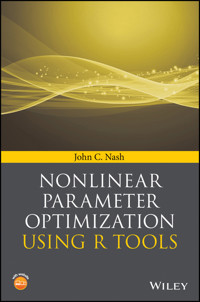
Nonlinear Parameter Optimization Using R
John C. Nash, Telfer School of Management, University of Ottawa, Canada
A systematic and comprehensive treatment of optimization software using R
In recent decades, optimization techniques have been streamlined by computational and artificial intelligence methods to analyze more variables, especially under non–linear, multivariable conditions, more quickly than ever before.
Optimization is an important tool for decision science and for the analysis of physical systems used in engineering. Nonlinear Parameter Optimization with R explores the principal tools available in R for function minimization, optimization, and nonlinear parameter determination and features numerous examples throughout.
Nonlinear Parameter Optimization with R:
- Provides a comprehensive treatment of optimization techniques
- Examines optimization problems that arise in statistics and how to solve them using R
- Enables researchers and practitioners to solve parameter determination problems
- Presents traditional methods as well as recent developments in R
- Is supported by an accompanying website featuring R code, examples and datasets
Researchers and practitioners who have to solve parameter determination problems who are users of R but are novices in the field optimization or function minimization will benefit from this book. It will also be useful for scientists building and estimating nonlinear models in various fields such as hydrology, sports forecasting, ecology, chemical engineering, pharmaco-kinetics, agriculture, economics and statistics.
Sie lesen das E-Book in den Legimi-Apps auf:
Seitenzahl: 494
Veröffentlichungsjahr: 2014
Ähnliche




















Table of Contents
Cover
Title Page
Copyright
Dedication
Preface
Chapter 1: Optimization problem tasks and how they arise
1.1 The general optimization problem
1.2 Why the general problem is generally uninteresting
1.3 (Non-)Linearity
1.4 Objective function properties
1.5 Constraint types
1.6 Solving sets of equations
1.7 Conditions for optimality
1.8 Other classifications
References
Chapter 2: Optimization algorithms—an overview
2.1 Methods that use the gradient
2.2 Newton-like methods
2.3 The promise of Newton's method
2.4 Caution: convergence versus termination
2.5 Difficulties with Newton's method
2.6 Least squares: Gauss–Newton methods
2.7 Quasi-Newton or variable metric method
2.8 Conjugate gradient and related methods
2.9 Other gradient methods
2.10 Derivative-free methods
2.11 Stochastic methods
2.12 Constraint-based methods—mathematical programming
References
Chapter 3: Software structure and interfaces
3.1 Perspective
3.2 Issues of choice
3.3 Software issues
3.4 Specifying the objective and constraints to the optimizer
3.5 Communicating exogenous data to problem definition functions
3.6 Masked (temporarily fixed) optimization parameters
3.7 Dealing with inadmissible results
3.8 Providing derivatives for functions
3.9 Derivative approximations when there are constraints
3.10 Scaling of parameters and function
3.11 Normal ending of computations
3.12 Termination tests—abnormal ending
3.13 Output to monitor progress of calculations
3.14 Output of the optimization results
3.15 Controls for the optimizer
3.16 Default control settings
3.17 Measuring performance
3.18 The optimization interface
References
Chapter 4: One-parameter root-finding problems
4.1 Roots
4.2 Equations in one variable
4.3 Some examples
4.4 Approaches to solving 1D root-finding problems
4.5 What can go wrong?
4.6 Being a smart user of root-finding programs
4.7 Conclusions and extensions
References
Chapter 5: One-parameter minimization problems
5.1 The
optimize()
function
5.2 Using a root-finder
5.3 But where is the minimum?
5.4 Ideas for 1D minimizers
5.5 The line-search subproblem
References
Chapter 6: Nonlinear least squares
6.1
nls()
from package
stats
6.2 A more difficult case
6.3 The structure of the
nls()
solution
6.4 Concerns with
nls()
6.5 Some ancillary tools for nonlinear least squares
6.6 Minimizing
R
functions that compute sums of squares
6.7 Choosing an approach
6.8 Separable sums of squares problems
6.9 Strategies for nonlinear least squares
References
Chapter 7: Nonlinear equations
7.1 Packages and methods for nonlinear equations
7.2 A simple example to compare approaches
7.3 A statistical example
References
Chapter 8: Function minimization tools in the base
R
system
8.1
optim()
8.2
nlm()
8.3
nlminb()
8.4 Using the base optimization tools
References
Chapter 9: Add-in function minimization packages for
R
9.1 Package
optimx
9.2 Some other function minimization packages
9.3 Should we replace
optim()
routines?
References
Chapter 10: Calculating and using derivatives
10.1 Why and how
10.2 Analytic derivatives—by hand
10.3 Analytic derivatives—tools
10.4 Examples of use of
R
tools for differentiation
10.5 Simple numerical derivatives
10.6 Improved numerical derivative approximations
10.7 Strategy and tactics for derivatives
References
Chapter 11: Bounds constraints
11.1 Single bound: use of a logarithmic transformation
11.2 Interval bounds: Use of a hyperbolic transformation
11.3 Setting the objective large when bounds are violated
11.4 An active set approach
11.5 Checking bounds
11.6 The importance of using bounds intelligently
11.7 Post-solution information for bounded problems
Appendix 11.A Function
transfinite
References
Chapter 12: Using masks
12.1 An example
12.2 Specifying the objective
12.3 Masks for nonlinear least squares
12.4 Other approaches to masks
References
Chapter 13: Handling general constraints
13.1 Equality constraints
13.2 Sumscale problems
13.3 Inequality constraints
13.4 A perspective on penalty function ideas
13.5 Assessment
References
Chapter 14: Applications of mathematical programming
14.1 Statistical applications of math programming
14.2
R
packages for math programming
14.3 Example problem: L1 regression
14.4 Example problem: minimax regression
14.5 Nonlinear quantile regression
14.6 Polynomial approximation
References
Chapter 15: Global optimization and stochastic methods
15.1 Panorama of methods
15.2
R
packages for global and stochastic optimization
15.3 An example problem
15.4 Multiple starting values
References
Chapter 16: Scaling and reparameterization
16.1 Why scale or reparameterize?
16.2 Formalities of scaling and reparameterization
16.3 Hobbs' weed infestation example
16.4 The KKT conditions and scaling
16.5 Reparameterization of the weeds problem
16.6 Scale change across the parameter space
16.7 Robustness of methods to starting points
16.8 Strategies for scaling
References
Chapter 17: Finding the right solution
17.1 Particular requirements
17.2 Starting values for iterative methods
17.3 KKT conditions
17.4 Search tests
References
Chapter 18: Tuning and terminating methods
18.1 Timing and profiling
18.2 Profiling
18.3 More speedups of
R
computations
18.4 External language compiled functions
18.5 Deciding when we are finished
References
Chapter 19: Linking
R
to external optimization tools
19.1 Mechanisms to link
R
to external software
19.2 Prepackaged links to external optimization tools
19.3 Strategy for using external tools
References
Chapter 20: Differential equation models
20.1 The model
20.2 Background
20.3 The likelihood function
20.4 A first try at minimization
20.5 Attempts with
optimx
20.6 Using nonlinear least squares
20.7 Commentary
Reference
Chapter 21: Miscellaneous nonlinear estimation tools for
R
21.1 Maximum likelihood
21.2 Generalized nonlinear models
21.3 Systems of equations
21.4 Additional nonlinear least squares tools
21.5 Nonnegative least squares
21.6 Noisy objective functions
21.7 Moving forward
References
Appendix A:
R
packages used in examples
Index
End User License Agreement
Pages
xv
xvi
17
18
19
20
21
22
23
24
25
26
27
28
29
30
31
32
33
34
35
36
37
38
39
40
41
42
43
44
45
46
47
48
49
50
51
52
53
54
55
56
57
58
59
60
61
62
63
64
65
66
67
68
69
70
71
72
73
74
75
76
77
78
79
80
81
82
83
84
85
86
87
88
89
90
91
92
93
94
95
96
97
98
99
100
101
102
103
104
105
106
107
108
109
110
111
112
113
114
115
116
117
118
119
120
121
122
123
124
125
126
127
128
129
130
131
132
133
134
135
136
137
138
139
140
141
142
143
144
145
146
147
148
149
150
151
152
153
154
155
156
157
158
159
160
161
162
163
164
165
166
167
168
169
171
172
173
174
175
176
177
178
179
180
181
182
183
184
185
186
187
188
189
190
191
192
193
194
195
196
197
198
199
200
201
202
203
204
205
206
207
208
209
210
211
212
213
214
215
216
217
218
219
220
221
222
223
224
225
226
227
228
229
230
231
232
233
234
235
236
237
238
239
240
241
242
243
244
245
246
247
248
249
250
251
252
253
254
255
256
257
258
259
260
261
262
263
264
265
266
267
268
269
270
271
272
273
274
275
276
277
278
279
280
281
282
283
284
285
286
287
Guide
Cover
Table of Contents
Preface
Chapter 1: Optimization problem tasks and how they arise
List of Illustrations
Figure 1.1
Figure 4.1
Figure 4.2
Figure 5.1
Figure 5.2
Figure 6.1
Figure 6.2
Figure 6.3
Figure 6.4
Figure 6.5
Figure 10.1
Figure 11.1
Figure 14.1
Figure 15.1
Figure 15.2
Figure 16.1
Figure 16.2
Figure 20.1
Figure 20.2
Nonlinear Parameter Optimization Using R Tools
John C. Nash
Telfer School of Management
University of Ottawa
This edition first published 2014
© 2014 John Wiley and Sons Ltd
Registered office
John Wiley & Sons Ltd, The Atrium, Southern Gate, Chichester, West Sussex, PO19 8SQ, United Kingdom
For details of our global editorial offices, for customer services and for information about how to apply for permission to reuse the copyright material in this book please see our website at www.wiley.com.
The right of the author to be identified as the author of this work has been asserted in accordance with the Copyright, Designs and Patents Act 1988.
All rights reserved. No part of this publication may be reproduced, stored in a retrieval system, or transmitted, in any form or by any means, electronic, mechanical, photocopying, recording or otherwise, except as permitted by the UK Copyright, Designs and Patents Act 1988, without the prior permission of the publisher.
Wiley also publishes its books in a variety of electronic formats. Some content that appears in print may not be available in electronic books.
Limit of Liability/Disclaimer of Warranty: While the publisher and author have used their best efforts in preparing this book, they make no representations or warranties with respect to the accuracy or completeness of the contents of this book and specifically disclaim any implied warranties of merchantability or fitness for a particular purpose. It is sold on the understanding that the publisher is not engaged in rendering professional services and neither the publisher nor the author shall be liable for damages arising herefrom. If professional advice or other expert assistance is required, the services of a competent professional should be sought.
MATLAB® is a trademark of The MathWorks, Inc. and is used with permission. The MathWorks does not warrant the accuracy of the text or exercises in this book. This book's use or discussion of MATLAB® software or related products does not constitute endorsement or sponsorship by The MathWorks of a particular pedagogical approach or particular use of the MATLAB® software.
Library of Congress Cataloging-in-Publication Data
Nash, John C., 1947-
Nonlinear parameter optimization using R tools / John C. Nash.
pages cm
Includes bibliographical references and index.
ISBN 978-1-118-56928-3 (cloth)
1. Mathematical optimization. 2. Nonlinear theories. 3. R (Computer program language) I. Title.
QA402.5.N34 2014
519.60285′5133–dc23
2013051141
A catalogue record for this book is available from the British Library.
ISBN: 9781118569283
This work is a part of and is dedicated to that effort by the many community-minded people who create, support, promote, and use free and open source software, and who generously share these ideas, without which R in particular would not exist.
Preface
This book is about tools for finding parameters of functions that describe phenomena or systems where these parameters are implicated in ways that do not allow their determination by solving sets of linear equations. Furthermore, it is about doing so with R.
R is a computer language and suite of libraries intended primarily to be used for statistical and mathematical computations. It has a strong but quite small base system that is rich in functions for scientific computations as well as a huge collection of add-in packages for particular extra problems and situations.
Among both the base and add-in tools are facilities for finding the “best” parameters of functions that describe systems or phenomena. Such tools are used to fit equations to data or improve the performance of devices or find the most efficient path from A to B, and so on. Some such problems have a structure where we only need solve one or two sets of linear equations. Others—the subject of this book—require iterative methods to approximate the solution we desire. Generally we refer to these as nonlinear parameters. A formal definition will be given later, but the tools we shall discuss can be applied anyway.
Sometimes the problems involve constraints as well as objective functions. Dealing with constraints is also a subject for this book. When there are many constraints, the problem is usually called mathematical programming, a field with many subspecialties depending on the nature of the objective and constraints. While some review of the R tools for mathematical programming is included, such problems have not been prominent in my work, so there is less depth of treatment here. This does not imply that the subject should be ignored, even though for me, and also to some extent for R, mathematical programming has been a lower priority than nonlinear function minimization with perhaps a few constraints. This reflects the origins of R in the primarily statistical community.
The topics in this book are most likely to be of interest to researchers and practitioners who have to solve parameter determination problems. In some cases, they will be developing specialized tools, such as packages for maximum likelihood estimation, so the tools discussed here are like the engines used by car designers to prepare their particular offering. In other cases, workers will want to use the tools directly. In either case, my aim is to provide advice and suggestions of what is likely to work well and what should generally be avoided.
The book should also interest the serious users of composite packages that use optimization internally. I have noticed that some such packages call the first or most obvious tool in sight. I believe the user really should be offered a choice or at least informed of what is used. Those who stand most to benefit from the book in this way are workers who have large computationally intensive problems or else awkward problems where standard methods may “fail”—or more likely simply terminate before finding a satisfactory solution.
Thus my goal in preparing this book is to provide an appreciation of the tools and where they are most useful. Most users of R are not specialists in computation, and the workings of the specialized tools are a black box. This can lead to mis application. A lumberjack's chain saw is a poor choice for a neurosurgeon's handiwork. But a system like R needs to have a range of choices for different occasions. Users also need to help in making appropriate choices.
I also hope to provide enough simplified examples to both help users and stimulate developers. While we have a lot of tools for nonlinear parameter determination in R, we do not have enough well-organized guidance on their use or ways to effectively retire methods that are not good enough.
As a developer of such tools, I have found myself confronted on a number of occasions by users telling me that a colleague said my program was very good, but “it didn't work.” This has almost always been because the mode of use or choice of tool was inappropriate. Ideally, I aim to have the software identify such misapplication but that is a very difficult challenge that I have spent a good deal of my career addressing.
That said, I must note that many many items that appear in this book were developed or adjusted during its writing. The legacy of a very large and widely used open source system leaves much detritus that is not useful and many inconvenient loose ends. Some have been addressed as the writing progressed.
A word about the structure of this book. Readers who read cover to cover will find a certain amount of duplication. I have tried to make each chapter somewhat self-contained. This does not mean that I will not refer the reader to other chapters, but it does mean that sometimes there is repetition of ideas that are also treated elsewhere. This is done to make it easier to read chapters independently.
Any book, of course, owes a lot to people other than the author. I cannot hope to do justice to every person who has helped with ideas or support, but the following, in no particular order, are the names of some people who I feel have contributed to the writing of this book: Mary Nash, Ravi Varadhan, Stephen Nash, Hans Werner Borchers, Claudia Beleites, Nathan Lemoine, Paul Gilbert, Dirk Eddelbeuttel, John Fox, Ben Bolker, Doug Bates, Kate Mullen, Richard Alexander and Gabor Grothendieck.
John C. Nash
Lesen Sie weiter in der vollständigen Ausgabe!
Lesen Sie weiter in der vollständigen Ausgabe!
Lesen Sie weiter in der vollständigen Ausgabe!
Lesen Sie weiter in der vollständigen Ausgabe!
Lesen Sie weiter in der vollständigen Ausgabe!
Lesen Sie weiter in der vollständigen Ausgabe!
Lesen Sie weiter in der vollständigen Ausgabe!
Lesen Sie weiter in der vollständigen Ausgabe!
Lesen Sie weiter in der vollständigen Ausgabe!
Lesen Sie weiter in der vollständigen Ausgabe!
Lesen Sie weiter in der vollständigen Ausgabe!
Lesen Sie weiter in der vollständigen Ausgabe!
Lesen Sie weiter in der vollständigen Ausgabe!
Lesen Sie weiter in der vollständigen Ausgabe!
Lesen Sie weiter in der vollständigen Ausgabe!
Lesen Sie weiter in der vollständigen Ausgabe!
Lesen Sie weiter in der vollständigen Ausgabe!
Lesen Sie weiter in der vollständigen Ausgabe!
Lesen Sie weiter in der vollständigen Ausgabe!
Lesen Sie weiter in der vollständigen Ausgabe!
Lesen Sie weiter in der vollständigen Ausgabe!
Lesen Sie weiter in der vollständigen Ausgabe!
Lesen Sie weiter in der vollständigen Ausgabe!




